 View PDF
The content displayed below is for educational and archival purposes only.
Unless stated otherwise, content is © 1919 International Bible Students Association

No. 16
gwSilSgWE
Scorning CMsw^and&jiig^aiwn^w:^
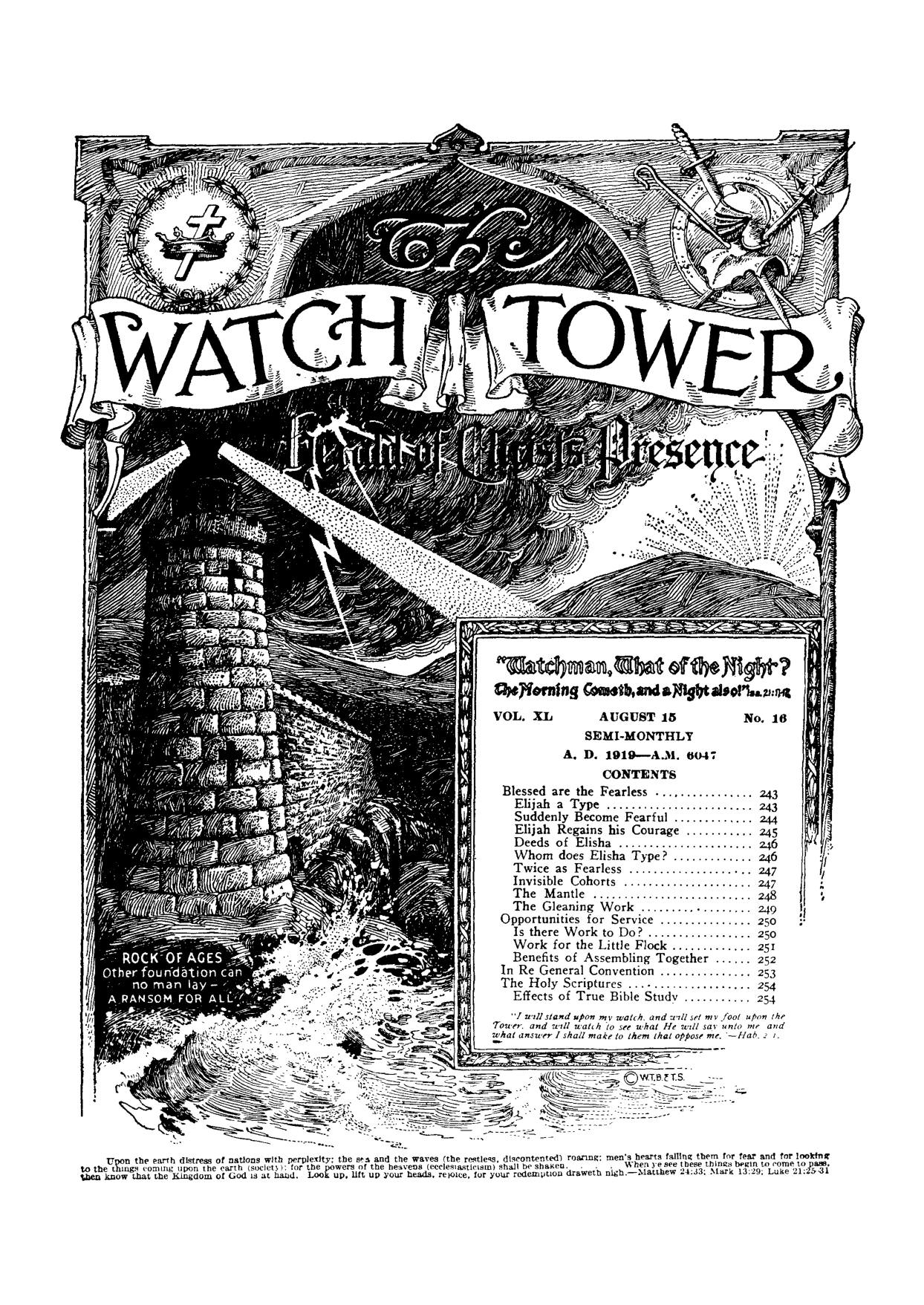
~ ROCK OF AGES^ Other foundation can ’ no man lay - < A RANSOM FOR ALL'/.
VOL. XL AUGUST 15
SEMI-MONTHLY
A. D. 1919—A..M. 6047
CONTENTS
Blessed are the Fearless ..........
Elijah a Type ...................
Suddenly Become Fearful .......
Elijah Regains his Courage .....
Deeds of Elisha ................
Whom does Elisha Type? ........
Twice as Fearless ...............
Invisible Cohorts ................
The Mantle .....................
The Gleaning Work .............
Opportunities for Service ..........
Is there Work to Do?............
Work for the Little Flock........
Benefits of Assembling Together .
In Re General Convention..........
The Holy Scriptures ...............
Effects of True Bible Study......
243
243
244
245
246
246
247
247
248
249
250
250
251
252
253
254
254
"/ will stand upon mv watch, and will set mv foot upon the Tower, and will watch to see what He will sav unto nte and what answer I shall make to them that oppose me. '—Hab. 2 1.
QW.T.B.t T.S.
upon the earth distress of nations with perplexity: the sea and the waves (the restless, discontented) roaring; men’s hearts falling them for fear and for looking forward to the things t-omuig upon the earth (society): for the powers nt the heavens (ecclesiastlcism) shall be shaken i ,h"’v'kthpw '4 rt- \Sk'rf%‘ Luke 21fsTi
Ye know that the Kingdom of God is at hand. Look up, Utt up your beads, rejoice. for your redemption drawerb nigh.—Matthew -4.33. Mark 13.29. Luke 21.2.V31
THIS JOURNAL AND ITS SACRED MISSION
THIS Journal Is one of the prime factors or Instruments in the system of Bible Instruction, or “Seminary Extension,” how beinfi presented In all parts of the civilized world by the Watch Tower Bible & Tract Society, chartered A. D. 1881, “For the Promotion of Christian Knowledge." It not only serves as a class room where Bible Students may meet In the study of the Divine Word, but also as a channel of communication through which they may be reached with announcements of the Society’s Conventions and o£ the coming of its traveling representatives styled “Pilgrims,” and refreshed with reports of Its Conventions.
Our “Berean Lessons" are topical rehearsals or reviews of our Society’s published Studies, most entertainingly arranged, and very helpful to ail who would merit the only honorary degree which the Society accords, viz.. Verbi Dei Minister (V.D.M.), which, translated into English, is Minister oj the Divine Word. Our treatment of the International S. S. Lessons Is specially for the older Bible Students and Teachers. By some this feature is considered Indispensable.
This Journal stands firmly for the defense of the only true foundation of the Christian's hope now being so generally repudiated— Redemption through the precious blood of “the Man Christ Jesus, who gave Himself a Ransom [a corresponding price, a substitute! for all.” (1 Pet. 1:19; 1 Tim. 2:6.) Building up on this sure foundation the gold, silver and precious stones (1 Cor. 3:11-15; 2 Pet 1:5-11) of the Word of God, its further mission is to—“Make all see what is the fellowship of the Mystery which . . . has been hid in God, ... to the intent that now might be made known by the Church the manifold wisdom of God”—“which in other Ages was not made known unto the sons of men as it is now revealed.”—Eph. 3 .5-9, 10.
It stands free from all parties, sects and creeds of men, while it seeks more and more to bring its every utterance into fullest •ubjection to the will of God In Christ, as expressed in the Holy Scriptures. It is thus free to declare boldly whatsoever the Lord bath spoken—according to the Divine wisdom granted unto us, to understand. Its attitude is not dogmatical, but confident; for we know whereof we affirm, treading with implicit faith upon the sure promises of God. It is held as a trust, to be used only in His service ; hence our decisions relative to what may and what may not appear In its columns must be according to our judgment of His good pleasure, the teaching of His Word, for the upbuilding of His people In grace and knowledge. And we not only invite but urge our readers to prove all its utterances by the Infallible Word to which reference is constantly made, to facilitate such testing.
TO US THE SCRIPTURES CLEARLY TEACH
That the Church is “the Temple of the Living God”—peculiarly “His workmanship ;” that its construction has been in progress throughout the Gospel Age—ever since Christ became the world’s Redeemer and the Chief Corner Stone of His Temple, through which, when finished, God's blessing shall come “to all people,” and they find access to Him.—1 Cor. 3 :16, 17 : Eph. 2 20-22: Gen. 28 :14 ; Gal. 3 :29.
That meantime the chiseling, shaping and polishing of consecrated believers in Christ's Atonement for sin, progresses; and when the last of these “living stones,” "Elect and precious," shall have been made ready, the great Master Workman will bring all together in the First Resurrection ; and the Temple shall be filled with His glory, and be the meeting place between God and men throughout the Millennium.—Rev. 15 -.5-8.
That the Basis of Hope, for the Church and the World, lies in the fact that “Jesus Christ, by the grace of God, tasted death for every man," “a Ransom for all,” and will be “the true Light which lighteth every man that cometh into the world," "in due time”— Heb. 2 :9 ; John 1 :9 ; 1 Tim. 2 :5, 6.
That the Hope of the Church Is that she may be like her Lord, “see Him as He Is,” be “partaker of the Divine nature,” and share HiS
glory as His joint-heir.—1 John 3 :2 ; John 17 :24 ; Rom. 8 :17; 2 Pet. 1 :4.
That the present mission of the Church is the perfecting of the saints for the future work of service; to develop in herself every grace;
to be God’s witness to the world; and to prepare to be kings and priests in the next Age.—Eph. 4 .12; Matt. 24 .14 ; Rev. 1:6; 20 :6.
That the hope for the World lies In the blessings of knowledge and opportunity to be brought to all by Christ’s Millennial Kingdom— the Restitution of al) that was lost in Adam, to all the willing and obedient, at the hands of their Redeemer and His glorified! Church—when all the wilfully wicked will be destroyed.—Acts 3 :19-23; Isa. 35.
PUBLISHED SY
WATCH TOWER BIBLE AND TRACT SOCIETY
_________118 FEDERAL ST., PITTSBURGH, PA., U, S. A,_________
The Watch Tower Editorial Committee:
This journal is published under the supervision of an Editorial Committee at least three of whom have read and approved as truth each and every article appearing in these columns, The names of the Editorial Committee are: J. F Rutherford, W. E. Van Amburgh, F. H. Robison, Geo. H. Fisher. W. E. Page.
annual subscription price $1.00 in advance.
SEND MONEY BY EXPRESS. BANK DRAFT, POSTAL ORDER, OR REGISTERED
Terms te the Lord's Poor as follows—All Bible Students who. by reason of old age or other infirmity or adversity, are unable to pay for this journal, will be supplied Free if they send a Postal' Card each May stating their case and requesting its continuance. We are not only willing, but anxious, that all such be on our list continually and in touch with the Studies, etc. _______
NOTICE TO ALL TOWER SUBSCRIBERS—Please remember that as a rule we no longer send a card of acknowledgment for a renewal or for a new subscription. Receipt and entry of renewal are indicated within a month by change in date of expiration of the -uh-scription on the TOWER wrapper.
When requesting change of address, please give old address as well as new. This is very important, saving us much t’me and unnecessary correspondence.
ENTERED AS SECOND-CLASS MATTER AT PITTSBURGH, PA , POSTOFFICE UNDER THE ACT OF MARCH 3RD, 1879.
YOUR COMMUNICATIONS TO THE SOCIETY
Several times in the past we have called attention to the fact that all communications should be addressed to the Society, and not to individuals; but new correspondents are constantly appearing on our lists, thus making necessary the reiteration of what has been often said.
In all matters of business relating to the Society, please address the SOCIETY and not individuals who may be occupying various positions in connection with the Society's work. This is not only the usual and preferable business way, but it works more nearly to the advantage of all concerned.
But in addition to using on your envelope the Society's general address (Watch Tower Bible & Tract Society, 119 Federal Street, Pittsburgh, Pa.) it will expedite the proper distribution of your mail to indicate on the envelope the department for which it is intended, if the subject matter is of a special nature, as Pilgrim Dept., Colporteur Dept., etc. Especially is this true with respect to the Pilgrim Department, and class secretaries can usually receive a much prompter reply if this suggestion is observed.
It is absolutely essential to have your name and full address on each communication you send. Even if there are people in the office who know you, there is no assurance whatever that any of those persons will be handling your mail; and even if they should it cannot be expected that they will remember the many thousands of addresses. No foreign address is complete without bearing the name of the country; and no domestic address is complete without the name of the state or (in the case of Canada) the province.
Furthermore, it is a great assistance to us if your name and address be not only somewhere on the letter, but if ,hey both be at the head of the letter. This simplifies our filing very much and tends to make possible better service in response to your correspondence, especially if it be of a business nature.
Married women should be careful to use the same name in all their letters. No small trouble and confusion can be avoided by using either the personal name or that of the husband, but not both alternately. We have no means whatever of knowing that it is the same person.
ADDED FEATURE TO TOWER REPRINTS
In addition to the subject matter already announced for the seven Tower reprint volumes, we are now able to inform the friends that seven full-page portraits of Brother Russell, one in each volume, will be reproduced in fine half-tone photo-engravings. These portraits show the likeness of the seventh messenger to the church as he appeared in the years 1879, 1888, 1896, 1900, 1906, 1910, and 1916. This is the first time a series of this kind has been presented and it adds very largely indeed to the historical interest and value of the work. No increase is made in the price: see price list for Reprint Towers in August 1 issue.
I. B. S. A. BEREAN BIBLE STUDIES
QUESTIONS FROM i
MANUAL ON SERIES SIXTH
“STUDIES IN THE SCRIPTURES” j
STUDY XI—“PASSOVER OF THE NEW CREATION” [ Week of Sept. 7 .... Q. 1- 5 Week of Sept. 21.... Q. 12-18 Week of Sept. 14 .... Q. 6-11 Week of Sept. 28.... Q. 17-22 [ Question Manual, a Vol. VI, Studies in the Scriptures, 10c aech, aaatpait. !

AND HERALD OF CHRISTS PRESENCE
Vol. xl Avgust 15, 1919 No. 16
BLESSED ARE THE FEARLESS
"Fear not, little flock, for it
is the Father's good pleasure to giz'e you the kingdom.”—Luke 12 :32.
PART II

HEN prophecy has been fulfilled or is in the course of fulfillment the consecrated child of God may understand it. The world has no faith in the Word of God, hence even though men of the world behold events transpire in fulfillment of prophecy, they do not believe the prophecy, and it means nothing to them. Knowing the inspired words of the prophets were written aforetime for the instruction and comfort of the church and particularly for the benefit of those upon whom the ends of the ages have come, the faithful Christian is enabled, by reason of the illumination of the holy Spirit, to see and have some appreciation of fulfilled prophecy. In this part of the subject under examination we will consider the life’s deeds and words of the prophets Elijah and Elisha from the viewpoint of type and antitype.
There has been much discussion among Bible students concerning these prophets and what class or classes of persons they represented. Since we are assured that the pathway of the just is as a shining light that shines more and more unto the day of perfection, the searcher after truth may with confidence expect to get further light as the end of the pathway is approached. The honest searcher for truth does not irrevocably commit himself to an interpretation of unfulfilled prophecy; for he realizes that the Lord may be pleased, from time to time, to grant a clearer vision of the subject, and as prophecy unfolds and the events transpire in fulfillment thereof the vision does become clearer. (2 Peter 1:19-21) What we state herein is not dogmatically given; but in the light of the great underlying principles or governing laws of conduct, as set forth in Part i of this subject, we submit the thoughts herein expressed for the careful consideration of the truly consecrated.
ELIJAH A TYPE
It seems to be definitely settled in the minds of practically all Bible students that Elijah was a type of the church in the flesh. (1 Kings 17; B-250-256) As to whether or not Elisha was a type of something, and if so of what, has not been definitely determined by students of divine prophecy. When we find that God uses a man to typify or picture events to happen in the future, it is of interest that we consider the words, deeds and character of that man. See Z T 5-285.
Ahab, King of Israel, the chosen people of the Lord, influenced by his unrighteous queen, Jezebel, had led the people into idolatry; and God sent to him the prophet Elijah, who boldly stood before the king and delivered his message, to the effect that for a period of three and one half years there would be no rain in the land, wherein dwelt the people of Israel. After delivering this message the prophet concealed himself for the period of the drouth. At the end of the three and a half years God sent him back to Israel, directing him to appear before Ahab, the king. On the way he met Obadiah, the king's most trusted servant, whom he requested to go to the king and tell him that Elijah had returned. Obadiah was exceedingly fearful of his life, fearing to report the presence of the prophet lest the prophet would fail to appear before the king; hence he begged to be relieved of the responsibility.
After being assured by Elijah that he would certainly appear that day before King Ahab Obadiah yielded to his request. A meeting of the prophet and the king resulted. King Ahab accused the prophet of being responsible for the drouth. Elijah with boldness responded by declaring that the king himself was responsible for the drouth of rain because he had forsaken the Lord and had led the people into idolatry. At the instance of Jezebel the prophets of Baal held sway in Israel, and the people followed them. Elijah now made a most startling and bold proposition to Ahab; namely, that King Ahab should summon the prophets of Baal who should build an altar and place upon it a slaughtered bullock and put no fire under it; that he himself (Elijah), would do the same thing and that then the prophets of Baal should call upon their God to consume the sacrifice by fire and Elijah would call upon Jehovah to consume his sacrifice by fire; and that whosoever’s God responded by consuming the sacrifice should be accepted by the people.
The king acquiesced and summoned 450 prophets of Baal. At an appointed time the meeting was held. The false prophets of Baal builded their altar and placed upon it a slaughtered bullock, and then called on their god Baal to consume the sacrifice. But they failed. Elijah then was not only careful to see there was no fire under his sacrifice, but he filled the trench with water. Then after he had offered up a prayer to Jehovah, fire descended from heaven and consumed not only the sacrifice, but the stones and the dust, and even licked up the water in the trench. The people then and there acknowledged Jehovah as God. Elijah, singlehanded and alone, boldly ordered that all the 450 false prophets of Baal should be taken and killed. They were taken, brought to the Brook Kishon and there were put to death. There then followed a great deluge of rain.
ANTITYPE
We have heretofore seen that these experiences of Elijah foreshadowed the experiences of the church in the flesh; that the lack of rain for three and a half years foreshadowed the lack of truth, living waters, during the period of 1260 years of Papal supremacy and wicked persecution of the saints, which ended in the year 1799. Then followed a great deluge of truth in the earth, the wide distribution of millions of Bibles and the proclamation of truth by word of mouth.
In his dealings with King Ahab and in his boldness in slaying the false prophets of Baal, Elijah exhibited a wonderful degree of courage and fearlessness. Herein he pictured the spirit and disposition of those composing the church who are pleasing to the heavenly Father. “Elijah seems to have been a most courageous servant of the Lord in executing whatever commands he received from the Great King * * * Elijah was courageous for the Lord and for the truth; Obadiah was less courageous and in some respects weak-kneed, lacking many of the qualities approved of the Lord ***** There are Christians of both of these types to-day, but Elijah stands for or represents the ‘little flock’ with whom the Lord is especially pleased and who, with the Redeemer, will constitute the kingdom class by and by.”—Z ’04-220,221.
“A general lesson may be drawn from these incidents by the Lord’s people of the new creation. The Elijah-like class have the lessons of courage and faithfulness and trust. Let us be strong in the Lord and in the power of his might; let us speak his Word plainly and show forth, on every possible occasion and by every proper means, the glories of him who hath called us from darkness to light. It is not for us to vanquish the enemies of the truth and put them to death as did Elijah, but it is for us to slay and utterly expose the errors and false teachings which are deceiving the people. The Lord’s ‘little ones’, as the Scriptures declare, may be mighty through his power to the pulling down of the strongholds of error and to the turning back of the tide of dissipation and sin from those who are in a reasonable attitude of mind to receive the Truth.”—Z ’04-234, 235.
FALSE PROPHETS SLAIN
The undaunted courage and fearlessness exhibited by Elijah in slaying the false prophets of Baal surely pictures something in the experiences of the church. Such an important event would not have been given prominence in the record unless it was intended to picture something or teach some lesson. We suggest the following: For many years the clergy, both Catholic and Protestant, operating under the name of Christ, have taught false doctrines and led the people into idolatry. They have taught the God-dishonoring doctrines of eternal torture, spiritism, the "doctrine of devils”, evolution, higher criticism, etc; and have so turned the minds of the people away from God and his pure Word of truth that even one of their own modern writers recently published this statement : “Christianity in its present form will have to go into the war scrapheap”. There are exceptions to the rule, of course, but, to quote the words of an earnest Bible student: “In the aggregate, the clergy are the greatest bunch of hypocrites that have ever afflicted the peoples of earth”. Surely there is nothing in all history that more clearly fulfills the picture of the false prophets than the majority of the clergy class of our own day. They have established a great stronghold of error and gnash their teeth and war against everyone who dares hold forth the truth.
Jehovah has armed the antitypical Elijah class; and their chief offensive and defensive weapon is the “sword of the Spirit”, the message of truth. The prophecies of Ezekiel and Revelation contain the most scathing arraignment of these false prophets that has ever been written. Volume VII of Studies in the Scriptures, “The Finished Mystery,” unfolds these prophecies so that even the unconsecrated may understand, and thus exposes these false prophets to the world as they have never before been exposed and deals a mortal blow to their false teachings and fraudulent deceptions. When this weapon was placed in the hands of the antitypical Elijah class, boldly and fearlessly they went forward and used it.
SUDDENLY BECOME FEARFUL
Ahab pictured the civil powers; Jezebel pictured the ecclesiastical elements. Ahab was not particularly interested in the false prophets of Baal. He cared for them only as they might serve his purpose, but he did not suffer much by reason of their loss. It was his unrighteous consort, Jezebel, who particularly desired to maintain these false prophets. The disloyal, unfaithful ecclesiastical systems of today are really the only ones that care particularly to maintain the false prophets; namely, the clergy.
In the type Jezebel sent word to Elijah that she would have him put to death in twenty-four hours because he had slain her prophets. This frightened him and he fled. This disposition of fear suddenly developed by Elijah seems strange in the light of the courage and fearlessness he had previously exhibited.
“Poor Elijah, so courageous previously, so ready to risk his life, now was panic-stricken and fled to Beersheba, the farther part of Judah. Even then he did not feel himself safe because Jehoshaphat, the king of Judah was a close friend of Ahab, King of Israel, so leaving there his servant he continued his flight southward to the wilderness of Mount Zion. It is useless for us to speculate as to how Elijah might have done otherwise than he did, or how he might have boldly stood up for the Lord, denounced the queen, rallied the heads of the tribes of Israel and carried forward to a general completion the reform movement which he began. We are to remember that Elijah was a type; and that hence his doings, as well as his words, in a particular sense and degree were ordered of the Lord, beyond any knowledge or motives of his own. It is only when we view this entire narrative of Elijah, Ahab and Jezebel from the standpoint of a type of more wonderful things coming afterward on a larger scale, only then can we grasp in any measure the force and meaning of the lessons taught through these types.”—Z ’04-236.
We emphasize the statement above made: “We must remember that Elijah was a type; hence his doings as well as his words were in a particular sense ordered of the Lord.” What experience has come to the church which seems to be pictured by this experience of fear and lack of courage that overtook Elijah? During the year 1917, and up to the spring of 1918, the church was unusually zealous in using the sword of the Spirit, particularly the point of the sword which had been prepared and “wrapped up for the slaughter” with which to assault Babylon’s strongholds of error and to expose her false prophets. Referring to that time it had been prophetically written: “Thou, therefore, son of man, prophesy, and smite thine hands together, and let the sword be doubled the third time, the sword of the slain; it is the sword of the great men that are slain, which entereth into their privy chambers”. (Ezekiel 21:14) The “sword of the Spirit” was to be wielded by Pastor Russell twice three times in six volumes of Studies in the Scriptures. The weapons of destruction will pursue all the great ones of earth, penetrating into all their most secret places. The sword of the Spirit will search out all of the lords over God’s heritage (1 Peter 5:3), the clergy, exposing their numerous ideas contrary to Jehovah and his plan. “I have set the point of the sword against all their gates, that their heart may faint, and their ruins be multiplied. Ah! it is made bright. It is wrapped up for the slaughter.” (Ezekiel 21:15) The point of the sword is Volume
VII, Studies in the Scriptures, “The Finished Mystery”, because it contains the essence of the weapons of all the writings of Pastor Russell and the explanation of the prophecies of Ezekiel and Revelation against the false systems that encumber the earth, particularly the false prophets, towit, the clergy.
JEZEBEL WAXED ANGBY
Immediately following the wide dissemination of this message of truth against the false prophets the antitypical Jezebel waxed exceedingly angry, and threatened and bullied and bluffed the Elijah class throughout all the country, and, by enlisting the aid of Ahab, so frightened the Elijah class that under the unrighteous persecution that followed upon them they laid down the sword and fled. Much persecution followed, instigated, pushed on by Jezebel, the mother harlot and her daughters associated with her, by the antitypical Ahab; and so great was the discouragement of some of the Elijah class that they said: 'Would that we might die and end this terrible ordeal’. For some time there was much despondency among the Elijah class. How like the experience of their prototype, Elijah!
“The antitype of Ahab, civil government, has to a considerable extent recognized the general truth of the matter (the refreshing that has come to the people from spreading the truth) but they are more or less closely affiliated with and under the influence of the Jezebel system; and, alas! as Revelation clearly points out, Jezebel today has daughters (systems termed Protestant), which nevertheless copy largely the mother's spirit. It is through the influence of the daughters that the antitypical Elijah may expect future persecution, instigated by the mother, accomplished through the daughters, as typically represented in the case of John the Baptist, beheaded by Herod at the instance of Salome and at the instigation of Herodias—Jezebel. This, however, is looking down to a period in the future.’’—Z ’04-237.
In view of the events above related, does it not seem that Brother Russell wrote the above paragraph prophetically? Again we quote from him:
“Elijah, under the juniper tree, praying God that he might die because he had been no more successful than his fathers had been in the mission of restoring Israel to the true worship of God, is almost amusing when we think of the fact that the prophet had fled panic-stricken a few days before to escape Jezebel’s threat against his life. Why thus flee from death and yet pray the Lord for death ? The prophet’s experiences and conduct are but an illustration of what frequently occurs. Amongst the Lord’s people some of strong faith at times become discouraged, panic-stricken, fearful. For a moment they seem to forget whose servants they are and the almighty power that is behind them, able and willing to make all things work together for good to his faithful ones. The fact of the matter is that all of the Lord’s consecrated servants devote their lives to sacrifice when they become followers of the Lamb; and if they could but realize their consecration continually they would be ready for the consummation at any moment at the Lord’s pleasure and by whatever means or channel his providences may permit. The Lord’s consecrated ones of the Elijah class are to remember that not a hair of their heads could fall without their Father’s knowledge and permission; and the attitude of their hearts should be that experienced by our dear Redeemer: ‘The cup which my Father hath poured for me, shall I not drink it?’”—Z ’04-237.
Of course the Lord foreknew the trying experiences that would come to his people in the spring of 1918— at the close of the forty year harvest period, and it seems that he purposed that the trying and fearful experiences of Elijah when he fled from the threats of Jezebel should represent and picture the church’s experiences at that time. Then be of good courage.
ELIJAH REGAINS HIS COURAGE
Subsequently Elijah regained his courage; and let the Lord’s people take courage from this. Afterwards King Ahaziah, who was injured, sent a messenger to Baal-zebub, the god of Ekron, to inquire whether he would recover. The angel of the Lord directed Elijah to go and meet the messenger and to tell the king that he would not recover. This Elijah did. Thereupon the king sent a captain with fifty men to Elijah, evidently for the purpose of apprehending him, and at Elijah’s instance fire came down from heaven and devoured them. A second fifty went up and presented themselves to Elijah, with the same result. Then the third fifty came and humbly bowed before Elijah; whereupon the Lord directed Elijah to go down to the king, saying, “Go down with him, be not afraid of him.” And Elijah rose and went down with him unto the king. (2 Kings, Chapter 1) Evidently he had lost his fear and regained his courage.
We must keep in mind that no human being could be so manipulated as to make one continuous picture showing every feature of the church’s experiences. As often stated by Brother Russell, there are pictures within pictures, and where one picture ends another begins. Therefore we must mark well the different pictures so as not to confuse them. The experience of Elijah while being taken up in the whirlwind must of necessity appear last in the picture; but whether or not that experience pictured the last experience of the antitypical Elijah class is entirely a different matter. Elijah typed a class of persons; and the fiery chariot and whirlwind might not be the last earthly experiences of the persons composing that class. He could not have exhibited the spirit of fear after the fiery chariot experience. Hence that fear must be pictured first, on the same principle that Jesus as a man could not institute the Memorial Supper after his death, and that hence it must precede his death. The taking away of Elijah in the whirlwind might represent a marked point in the church’s career, and yet many of the persons composing the church might remain in the flesh for a time after having that antitypical experience.
GREAT COMPANY CHARACTERISTICS
It has been suggested that Elisha was a type of the great company class. It is therefore important that we examine the characteristics of the great company class, and then see whether the events in the life and experiences of Elisha foreshadowed these characteristics. We here append some pertinent statements by Brother Russell:
“We have already pointed out that God does not make very particular mention of the great company in the Bible, and we have found out the reason for this, namely, that if the great company were treated on the same plane and with the same degree of interest and explicitness as the little flock it would imply that God had offered both and said, Here they are; take your choice. But that is not so. The Lord’s statement is: ‘Ye are all called in one hope of your calling’—to be members of the body of the Anointed. Thus the Scriptures merely give the hint that there are some who constitute the great company and who will get a great blessing, to which there never was an invitation. Everyone of that great company receives the grace of God in just the same way as the little flock, but they do not use it in the proper way, which was to lay down their lives with the Lord Jesus; for in carrying out the plan it must be laid down in death.”
“What are the chief things that will draw us from the little flock to the great company class?
“My answer would be ‘Lack of zeal, lack of love for God, lack of love for the brethren; that is to say, coolness on the part of your heart. The little flock will be the class without spot, etc., while the great company will be the class with robes that are spotted and wrinkled and not fit to be of the Bride class.”
“But though not voluntary overcomers, the Lord loves them and will deliver these who through fear of death (fear of contempt, fear of the reproach borne by the bullock and the goat beyond the camp in the wilderness, the separated or dead condition) were all their lifetime subject to bondage, bondage of fear of men and men's traditions and opinions, which always brings a snare and keeps back from full obedience to God, even unto death.’’—T-70.
Summing up, then, the chief characteristics of the great company are negligence or indifference in fulfilling their covenant of sacrifice, lack of zeal, fear and falling away from perfect love. Do we find any of these characteristics manifested by or in the experiences of the Prophet Elisha?
DEEDS OF ELISHA
After the anointing of Elisha to be a prophet we find him walking with Elijah, seemingly to indicate that they were in perfect harmony. They journeyed from Gilgal to Bethel, from Bethel to Jericho, then to the Jordan; and the two crossed the Jordan together. When Elijah was taken up by the whirlwind Elisha saw it, and then “he took up also the mantle of Elijah that fell from him and went back and stood by the bank of the Jordan. And then he took the mantle of Elijah that had fallen from him and smote the waters and said: Where is the Lord God of Elijah? And when he also had smitten the waters they parted hither and thither, and Elisha went over.” —2 Kings 2:13,14.
Other recorded deeds of Elisha are, the healing of the brackish waters (2 Kings 2:21,22); pronouncing of a curse upon some of his persecutors (2 Kings 2:24) ; causing a miraculous supply of water to flow into the ditches of the Israelites (2 Kings 3:13-20); increasing the widow’s cruse of oil (2 Kings 4:1-7); blessing the barren Shunamite woman with a son (2 Kings 4:17); raising from the dead the Shunamite’s son (2 Kings 4:37); healing the poisoned pottage (2 Kings 4:44) ; healing the leper and causing leprosy to come upon his own servant (2 Kings 5:14-27); causing the iron wedge to swim in water (2 Kings 6:6) ; and then came the experience at Dothan. In the examination of these acts and words of Elisha we find nothing of the characteristics of the great company.
It may be suggested then that these deeds do not seem to typify the great company class. Would it not indicate a restitution work on the part of Elisha and that Elisha would type the ancient worthies? The answer to this is that Elijah did a similar work in this, that he miraculously increased the widow woman’s barrel of meal and cruse of oil so that “the barrel of meal wasted not, neither did the cruse of oil, according to the word of the Lord which he spoke by Elijah”. (1 Kings 17:11-16) Later the son of the same woman fell sick and died, and Elijah awakened him out of death “and the soul of the child came into him again and he revived”. (1 Kings 17:18-23) In this connection we are reminded that during the three and a half years of Jesus’ ministry he opened the eyes of the blind, unstopped the ears of the deaf, loosed the tongue of the dumb, healed the sick and afflicted, and awakened some out of death.
In speaking to his disciples on one occasion he said: “Verily, verily I say unto you, he that believeth on me, the works that I do shall he do also, and greater works than these shall ye do, because I go to my Father”. (1 John 14:12) Instead of these works of temporary blessings done by Elijah, and subsequently by Elisha, representing restitution work to be done by the ancient worthies, may it not be that it typified or represented the privileges that the Elijah class have had during the Gospel age of bringing blessings to those to whom they brought the message of truth through the opening of their eyes of understanding, etc? Commenting upon the words of Jesus that his disciples should do greater works than he had done, his “faithful and wise servant” wrote:
“It may perhaps be proper to think that some of these greater works will occur after the kingdom has been established, the greater work of awakening the world of mankind from the sleep of death; but in our opinion this is not the only sense in which the Lord's followers are to understand that their works are to be greater than those of the- Master. When the holy Spirit was given after Pentecost, the Lord’s people, in his name and as his representatives, began to do greater and more wonderful works than those which he himself had performed. Did the Lord open the eyes of the blind? His followers were privileged to open the eyes of men’s understandings. Did the Lord heal the physically sick? His disciples were permitted to heal the spiritually sick. Did the Lord cure physical leprosy? It was the privilege of his followers to heal spiritual leprosy, sin. Did our Lord revive the dead? It was the privilege of his followers to preach the Gospel, by which many passed ‘from death unto life' in a higher sense.”—Z’ 99-90,91.
It would hardly seem reasonable, then, for us to conclude that Elisha, merely because of the deeds above recorded, would typify the great company class, for the reason stated in the last paragraph and for the further reason that during the Millennial age the ancient worthies will do for the human race only as the visible agents of the Christ, and not as the agents of the great company.
WHOM DOES ELISHA TYPE?
If Elisha, then, was a type, whom did he picture? Our answer to that question is that we believe he was a type of the little flock; that Elijah typed the little flock up until a certain stage of the work done and performed by the followers of Jesus; towit, up to the time the fiery trials came upon the church in 1918, at which time the mantle, that is, the message of truth, particularly represented in “The Finished Mystery”, was thrown down and the remaining work to be done by the church in the flesh is pictured by Elisha, and in support of this position we submit the following:
It is interesting to note the Scriptural references concerning the anointing of Elisha. The Lord directed Elijah to anoint Elisha. The King James version says: “Thou shalt anoint him to be prophet in thy room.” It appears that both Dr. Strong and Dr. Young failed to define the word "room” in this text; but in the Leeser translation we read that God said unto Elijah: “And Jehu, the son of Nimshi, shalt thou anoint to be king over Israel; and Elisha, the son of Shaphat, of Abelmeholah, shalt thou anoint to be prophet in thy stead”. (1 Kings 19:16) If Elisha was anointed to be prophet instead of or in place of Elijah, then it would manifestly follow that where the picture made by Elijah ceases, there Elisha would begin to picture or type the identical class, namely, the little flock. When Elijah was taken away and Elisha took his place then and there Elisha became Elijah for all intents and purposes and would represent the same class. No where in the Scriptures is the great company given such prominence as the anointing of a prophet in representation of that class.
It will be further observed that when Elisha and Elijah were walking together Elisha knew that he was shortly to be separated from Elijah. After they had crossed the Jordan together Elijah said unto Elisha; “Ask what I shall do for thee before I be taken from thee, and Elisha said: I pray thee, let a double portion of thy spirit be upon me”. (2 Kings 2 Unlike the picture of the wise and foolish virgins, Elijah did not say to Elisha, ‘Your request is an impossible one to comply with. You must go to the market and buy that for which you ask.’ But mark what he did say: "Thou hast asked a hard thing; if thou see me when I am taken from thee it shall be so [given] unto thee, but if not it shall not be. And it came to pass as they went on, speaking as they were going, that, behold, there came a chariot of fire and horses of fire and parted them asunder and Elijah went up by a whirlwind into heaven. And Elisha saw it and cried, My father, my father, the chariot of Israel, and the horsemen thereof.” (2 Kings 2:10-12) The fact that Elisha saw or discerned what was transpiring at the time Elijah was separated from him met the condition specified by Elijah which would insure him (Elisha) of the receiving of a double portion of the spirit of Elijah. The Hebrew word here translated “double” does not mean a duplication or something similar, but it does mean, “twice as much,” “double what the other one had.” If, then, Elijah represents the little flock and Elisha also represents the little flock, wherein could Elisha antitypically have double the spirit of that manifested by Elijah?
TWICE AS FEARLESS
Again we ask the reader to refer to Part I of this argument, the essence of which is that those who will be honored with an abundant entrance into the kingdom must be a fearless class, and the fearless class is the class who are perfected in love. Furthermore, the experiences that would come to the church in the closing days of its earthly pilgrimage would be such as to require double as much courage, faithfulness, loyalty and love to overcome those difficulties as was required prior thereto. We have observed in the experiences of Elijah that notwithstanding he was bold and fearless throughout most of his earthly journey, yet there came a time when Jezebel threatened his life and he became very fearful and fled, but afterwards recovered his courage. The experiences through which the church passed during the year 1918 would have a tendency to make one become timid and fearful who had not absolute confidence in the Lord and who did not realize that his battle is not his own, but the Lord's. It would require, therefore, an increased spirit of love, fearlessness, and faithful devotion to the Lord and his cause to grasp the mantle that had fallen from the Elijah class, or in other picture the sword, “The Finished Mystery,” and any added message in harmony therewith, and boldly and fearlessly carry it forward and use it as the Lord would have us do.
In the examination of Elisha’s experiences we fail to find anything that indicates fear; but, on the contrary, his whole experience down to his death indicates a disposition of full faith and confidence in the Lord and absolute loyalty to him. One of the most striking experiences which proves this point of Elisha’s fearlessness is that which occurred at Dothan. At that time wars between Syria and Israel were frequent. The king of Syria determined to invade Israel. Several plans of attack were devised to raid the cities, and each time these raids were frustrated, the Syrian army finding to their astonishment that these cities were freshly prepared for defense. The king concluded that there was a traitor in his court or camp who disclosed his secret plans and arrangements to the king of Israel; so he instituted a search for the traitor. It is not unusual for civil powers to overreach themselves while hunting for supposed traitors.
Some of the king’s counselors advised him that it was quite probable that the prophet Elisha had revealed to the king of Israel all the plots and schemes of the Syrians. The king, therefore, having learned that Elisha was at the town of Dothan, sent a whole army, including horses and chariots, for the purpose of arresting Elisha, and taking him in custody. Elisha showed that he was absolutely fearless. Elijah had fled when Jezebel threatened his life. It would seem therefore that it would take a double portion of the spirit of courage, fearlessness and faithfulness to stand firm when a whole army came with the avowed purpose of capturing and slaying the prophet Elisha, but his trust and faithfulness to the Lord caused him to remain calm. We quote the following pertinent remarks on the subject:
“As soon as the king learned that Elisha was at the little town of Dothan he sent an army, including horses and chariots, to surround the city and to make sure the capture of the prophet. The latter doubtless understood in advance; but working in harmony with the Lord’s arrangement, he did not flee the city. He was entirely restful in mind respecting the matter, but his servant was greatly alarmed. He thought of the prophet and himself as being carried prisoners to Syria to thenceforth be bondsmen, etc. Elisha, however, comforted him with assurance respecting the divine power which encompassed them, much greater than the power of their enemies. Then, not only as a lesson to the servant, but also doubtless intended of the Lord as a lesson for his people all the way down through the ages, Elisha prayed that the young man’s eyes might be opened that he might sec and realize the true situation.
“At once the servant perceived the city and entire hills amply protected against the surrounding hordes,—horses and chariots and fire around about Elisha and himself. We assume that the horses and chariots of fire were in the nature of a vision granted to the servant, and to us, as an illustration of the divine power and protection. Thus viewed, what the servant saw was an active parable, a picture similar to the symbolic pictures of Revelation—serving the intended purpose most thoroughly, most completely, and giving to the eyes of his understanding a proper conception of the divine power present with the prophet.’’—Z’ 04-302, 303.
INVISIBLE COHORTS
The vision that the servant of Elisha was here permitted to see most assuredly was seen by Elisha himself; otherwise he would not have asked the Lord to permit the servant to see it. In addition to what is above stated, this vision might further represent that the church, discerning the application of the pictures of Elijah and Elisha and their relationship to each other, might in the closing days of their earthly pilgrimage, have a clearer vision and appreciation of the wonderful power manifested on their behalf by the Lord under whose banner they fight. And thus having such a mental vision of God’s protecting care, they could say to each other and to those about them who might fear, as did Elisha to his servant: “Fear not, for they that be with us are more than they that be with them”. (2 Kings 6:16) In harmony with that same thought we believe: He that is for us is greater than all they that be against us.—Cf. 2 Chronicles 32:7,8; Romans 8:31; 1 John 3:20.
If this experience of Elisha pictures anything it does not seem at all reasonable that it would picture the great company class, because it does not contain one element of the characteristics of the great company class. We notice in the experiences of Elijah that Obadiah is mentioned as one who served the Lord, yet feared Ahab and Jezebel, and therefore did not take his stand boldly with the prophet Elijah. Obadiah therefore seems to represent the great company class. We quote the following in support of this proposition:
“We rejoice also with the believers represented by Obadiah; yet we could sincerely wish for them the blessings of greater zeal in the Lord's service, less care for the friendship of those who are God's enemies and greater boldness in the advocacy of the Lord's cause and in proclaiming themselves in every proper manner his servants. We fear for such that being ashamed of the Lord and to some extent preferring advantages as respects the present life—to be in a prominent position, in good society and surrounded by luxury maintained at the expense of failure to properly confess the Lord—will mean eventually to such the loss of the great prize for which we are called to run in this present life. As already intimated, our expectation would be that such a class would eventually get a blessing from the Lord and a good position; but such a class surely, unless they turn about and become more courageous, will lose the great prize for which we have been called to run—jointheirship with God’s dear son in the kingdom.’’—Z’ 04-221.
ELISHA’S SERVANT FEARFUL
In Elisha’s experiences we find a servant with him who also was fearful. This servant, when he saw the city where Elisha was compassed about with a great army, quaked with fear and cried unto his master, “My master, how shall we do?” thus indicating that there would be associated with the antitypical Elisha class a class of Christians serving who are fearful and who will be of the great company class. We are reminded also that the Lord makes it plain that the great company class will be a servant class, serving the Christ in the kingdom of glory, and this is another reason why the servants of Elijah and Elisha in these experiences picture the great company.
It is conceded by all Bible students that the Psalms were written chiefly and prophetically for the benefit of the church and represent the church, namely, the little flock. It seems not overdrawing the matter when we state that the Psalmist seemed to have in mind Elisha’s experiences when he wrote the following beautiful words which express absolute confidence in the Lord and his sustaining grace and power: “The Lord is the light of my salvation, whom shall I fear ? The Lord is the strength of my life; of whom shall I be afraid? When the wicked, mine enemies and my foes, came upon me to eat up my flesh they stumbled and fell. Though an host should encamp against me, my heart shall not fear. Though war should rise against me, in this will I be confident.” (Psalm 27:1-3) Those who stumble and fall are usually blind ; and we note in Elisha’s experiences at Dothan that when the great host encompassed about him he prayed unto the Lord and said: “Smite this people, I pray thee, with blindness, and he smote them with blindness according to the word of Elisha, and then Elisha led them to Samaria and into captivity to Israel”.
Another evidence that Elijah and Elisha represented the same class is found in the fact that Elijah was commanded by the Lord to anoint Jehu king over Israel. (1 Kings 19:15) Elijah did not anoint Jehu, but subsequently Elisha did, or had it done under his direct supervision, and therefore did it himself, a procedure which seemed to be entirely pleasing to the Lord. (2 Kings 9:1-6) In other words Elisha completed that which Elijah was directed to do.
The fiery chariot that separated Elijah and Elisha did not indicate that any animosity existed between the two, or the class represented by the two. On the contrary, Elisha was fully devoted to Elijah at all times. The chariot, as a vehicle, is symbol of an organization and therefore would well represent the Society which the Lord, through his faithful servant, organized, used, and is using as a vehicle to bear his message to his people. Horses represent doctrines. A whirlwind is a symbol of great trouble, war. In the picture the fiery chariot with horses of fire appeared and parted Elijah and Elisha, and Elijah went up (was taken away) by a whirlwind. In the spring of 1918 the Watch Tower Bible and Tract Society was bearing a fiery message, a message due at that time. At the same time there was great trouble. There ended the work which Elijah pictured and the taking away of Elijah indicates such ending. This does not mean the taking away of individuals, but it would mean the cessation by the Lord’s people for a time at least of certain work pictured by Elijah. Elisha standing by the Jordan would indicate a period of time, however short or long, lapsing until Elisha would take up the mantle—the message borne by Elijah— and use it according to the Lord’s direction.
THE MANTLE
We note that the mantle of Elijah is prominently mentioned in this narrative. What does the mantle represent? We answer, It evidently represents something that the Elijah class has possessed throughout their journey, and particularly the journey during the harvest period of the Gospel age, Elijah and Elisha journeyed together from Gilgal to the Jordan, and not until they reached the Jordan did Elijah wrap up his mantle and smite the waters (people). As the Watch Towers heretofore suggested, the mantle represents the message of truth, and particularly the message contained in Volume VII, “The Finished Mystery,” which in truth and in fact is the condensed statement of the entire message relating to Babylon, and clearly distinguishing the antitypical Jezebel from the true church. It is also designated, and properly so, as “the point of the sword” wrapped up, or in a compact form. The message of truth, therefore, contained in all the seven volumes and particularly in the Seventh, the pointed part of it, therefore seems fitly to represent Elijah’s mantle wrapped up. We mark that the distribution of the message contained in Volume VII did cause a wide division of opinion among the peoples who came in contact with it. At the time Elijah was taken up by the whirlwind we read concerning Elisha : “He took up also the mantle of Elijah that fell from him and went back and stood by the bank of the Jordan [the standing there suggesting a period of waiting, whether long or short, before using the mantle] ; and he took the mantle of Elijah that fell from him, and smote the waters and said: Where is the Lord God of Elijah? and when he also had smitten the waters they parted hither and thither, and Elisha went over”. —2 Kings 2:i-i4.
We conclude, therefore, that the Prophets Elijah and Elisha both typify the same class, towit, the little flock; that where the Elijah picture ended the Elisha picture began, and in the antitype two parts of the same character of work done by the same class of people are shown. We mark that twice the Scriptures make the statement: "The mantie of Elijah that fell from him Elisha picked up”. The message of truth, particularly that pointed part of it relating to Babylon, did fall from the hands of the Elijah class. There has been a period of waiting; and this picture seems to indicate that the time must come ere long when the Lord’s people, pictured by Elisha, must take up again this mantle, this message of truth, and use it.
PERILOUS TIMES COME
Time arid again we have been reminded that in the last days perilous times would come, and that during that time “of your own selves shall men arise speaking perverse things to draw away disciples after them”. Again and again we have been reminded in what marked degree this prophetic statement of the Apostle has been fulfilled. Influenced by those who have arisen speaking perverse things, by twisting and perverting the Scriptures and misapplying them, some of the Lord’s dear people have been much confused and some have even been induced to cease all efforts at performing service. These have been induced to believe that the work is now over and that they must stand still, not move, not do anything, not make any more proclamation of the message of truth nor declare to the world the incoming kingdom. How unwise, how foolish! Let such ask themselves the question, Did I consecrate to work until a certain time? Where in the Scriptures do I find warrant for my ceasing activity in the Lord’s service as long as he keeps the door of opportunity open? If I remain silent and inactive would my conduct be pleasing to the “beast” or to the Lord? Let each one remember that the adversary will deceive, if possible, even the elect; but we are sure that the elect will not be deceived, otherwise they could not be the elect. Let no child of God then be deceived by this ruse of the adversary, namely, that all opportunities for service are over. Let every true follower of Jesus remember that the war is now on between the “beast” and the “Lamb” and will not end until the “Lamb” is completely victorious and that those who are to be victors with him must continue faithful in service even unto the end.
If, therefore, our conclusion is correct, that Elisha pictures the church during the last of her earthly experiences, it means that there must yet be another smiting of the waters with the mantle of truth, and that during such smiting it must be expected that the “beast” will use all the power against the church that the Lord will permit it to use. But Zion need not fear. It is true that the forty-year period of the harvest has ended, but that does not mean that there is not yet some work to be done. In the Jewish natural harvest, used by the Lord to illustrate the harvest of the church, there was a gleaning work to be done, and also the burning of the tares.
THE GLEANING WORK
The gleaning work of the Gospel harvest is progressing. The tares are also being burned. All these figures of speech represent the proclamation of the message of truth in whatsoever form the Lord permits his people to use it. The mantle which Elijah used was used by Elisha later. Antitypically, then, the message of truth which was used effectually up to the Spring of 1918 must again be used with whatever additional message the Lord provides. And those who will be victors with the “Lamb” must use that message as opportunity is offered, and use it vigorously and without fear.
Summing up the argument of Parts I and II of this subject, we find that God foreordained a little flock to be developed during the Gospel age to whom he would have great pleasure in giving the kingdom; that he has been developing that class throughout the Gospel age and particularly in the harvest period thereof, and that he has been teaching them by pictures, types and illustrations, as well as by direct statements, that the class to whom he purposes giving this grand and wonderful prize will be those whose faith and confidence in him is absolute, and who are without fear of man or man-made institutions and whose love is perfect. Viewing the church’s situation, then, in the light of the Scriptures, and in the light of the events that have transpired during the past year, and knowing that through much tribulation must the kingdom class enter in, let everyone who is now in the race for the prize of the high calling gird up the loins of his mind and be sober and wait for the command of the Lord, the Captain of our salvation, ready, willing, and anxious at all times to obey that command at the cost of reputation, good name, fame, riches, or even life itself.
OUR KING KNOWS NO DEFEAT
This little band of Christians are fighting the greatest fight of all times. There will never be another like it. The great God of the universe has arranged it; the great Redeemer, the King of kings and Lord of lords, is the Captain and Leader of this little band. We know that he is absolutely certain of victory, and we therefore know that after being called and chosen to run in this race, if we continue faithful, fearless, prompted by love in our actions, serving him at every possible opportunity loyally to the end, we shall ultimately stand victors with him and hear the approval of the Father, “Well done, good and faithful servants.” Let us then fear not, for “the eternal God is our refuge and underneath are the everlasting arms”.
The chief purpose of this article is to prove that Elisha typifies the little flock, the faithful and zealous Christians, and also to prove what constitutes the double portion of the spirit of Elijah. In a subsequent article we will examine the details.
MAHANAIM—TWO HOSTS
The mountain horizon was burning with light;
On its brow stood the Syrian, in glory and might;
Proud waved to the sunset the banner's rich fold:
Proud blazed the gemmed turbans, and corselets of gold.
And loud rose the taunt of the infidel’s tongue: “Ho! Israelite slaves, This night sees your graves;
And first from your walls shall Elisha be flung!”
At the word stooped a cloud from the crown of the sky!
In its splendors the sun seemed to vanish and die.
From its depths poured a host upon mountain and plain;
There was seen the starred helm, and the sky-tinctured vane, And the armor of fire, and the seraph’s bright wing;
But no eyeball dared gaze On the pomp of the blaze, As their banner unfolded the name of their King!
OPPORTUNITIES FOR SERVICE
be vigilant, because your adversary, the devil, as a roaring lion, walketh about seeking whom he may devour.
i Peter 5:8.
"Be sober.

WHILE the writings of St. Peter have been applicable to the church throughout the age. yet his epistles seem to apply with special force at the end of the journey of those running for the prize. We may be sure that the Lord directed the message of the Apostle that it might be helpful to the Lord's "little ones" in time of need. The context shows that the Lord’s people, being in the flesh, are subject to temptations of a similar character to those which are inflicted upon the world. With each succeeding day the intensity of feeling and excitement increases. This is true because we are in the time of the judgment of the nations of earth, when the heavens (ecclesiasticism) are passing away with a great disturbance and the elements, rich and poor, strong and weak, are melting with fervent heat. It is a time when the sea and the waves are roaring—when all humanity is being disturbed and excited because of conditions.
The Christian comes in contact with these conditions and necessarily must meet them. If he permits himself to be excitable, easily disturbed, he lays himself open to the successful attack of the adversary. Therefore the Apostle admonishes all the followers of the Master to be sober. Sobriety of mind means a well-balanced mind, one that after coolly, calmly and soberly studying conditions from various viewpoints and carefully weighing them, determines what is the wisest and best course to pursue. A mind that is not sober, but excitable, jumps at conclusions, determines upon some course without proper consideration, seeing the whole world in a state of unrest, may be led to the false conclusion that inactivity is the best thing for him. The Apostle admonishes the new creature, however, that he must not take this course, but being sober-minded, he will carefully weigh the conditions and environments and then seize the opportunity for activity in service that will bring the greatest amount of glory to his Lord and the greatest blessing to himself. The safety of the Christian, therefore, lies in the fact that he holds to the hand of the Lord and that he is guided wholly by the counsel of the Lord, namely his Word, and pursuing this course he is certain ultimately to win the conflict and be received into glory.— Psalm 73 :23,24.
The sober-minded Christian, therefore, giving consideration to the counsel of the Lord through his Word, sees that he cannot with safety to himself and honor to his King remain idle, but at all times should be active, diligent and vigilant in the performance of whatsoever duties the Lord may lay upon him. The sober-minded will be watching for opportunities and will be able to grasp them when they appear, and being vigilant he will see such opportunities and enter the door of service as quickly as possible. It has been truly said that "An idle brain is the devil's workshop”, and the negligent Christian is therefore an easy mark for the adversary. And above all things, the follower of the Master desires to honor his Lord and King because he loves him. "This proves our love for God that we keep his commandments with a joyful heart.” The Christian therefore who is anxious to see and be with Jesus delights to do his will and the will of the Father, and not only seeks opportunities of service but joyfully avails himself of all such.
IS THERE WORK TO DO?
As has heretofore been stated in The Watch Tower, the forty-year period of the harvest has ended, as we believe. Noting that the harvest began in the year 1878 and covers a period of forty years, of necessity that period must end in 1918. There came upon the Lord’s people at that time a period of severe trials and fiery testings. Fire enveloped the chariot—the Society—because of the fiery horses (doctrines) “meat in due season” that the chariot was then bearing to the people. A great whirlwind was in progress at the same juncture and there a certain period of the work of the harvest, particularly that part which was pictured in the experiences of Elijah, ceased, and for some time there was a period of inactivity, a period of waiting. Many wondered if such meant that the work was all done and there is nothing more for the church to do, but to stand and wait until glorified.
The mere fact that the forty year harvest period ended in the spring of 1918 does not at all mean that the church would be taken away at that time, nor does it mean that the harvest work ceased. The Lord uses the natural harvest of the Jews to illustrate the gathering of his people. It is proper, therefore, to consider all things in connection with the natural harvest to enable us to get a clearer vision of things pertaining to the harvest of the church and the work in connection therewith. Following the general natural harvest came the gleaning work. It is not unreasonable, therefore, to expect that following the forty year period of harvest there would be a gleaning work; that is to say a work performed by the consecrated, which would enable those in a consecrated attitude of mind and heart to seize the opportunity of presenting themselves to the Lord. As long as there is a likelihood of some who are in the race falling out there must be some gathered in to take the place of those removed from the race. This would explain why since the Spring of 1918 some have come to a knowledge of the truth and consecrated themselves and have given evidence of having been spirit-begotten and energized to participate in God's service.
TARES BEING BOUND
In addition to this work the tares must be bound together and destroyed. We have marked the binding of these tares during the past year more firmly than ever they have heretofore been bound and we have likewise witnessed the burning of many of these tares. The great Master of the Harvest shows that before the members of the wheat class are gathered into his garner they must participate in the binding of these tares for destruction. (Matthew 13:30) It is the message of truth that does such binding and burning.
But in order to determine more fully what the Christian’s duty is we have but to refer to the commission that God has given to those who make a covenant with him by sacrifice and who receive the anointing from him. To anoint means to clothe with authority to do certain things. The church is anointed or clothed with authority to preach the glad tidings unto the teachable, to bind up the brokenhearted, to proclaim liberty to the captives, the opening of the prison to them that are bound, to proclaim the acceptable year of the Lord and the day of vengeance of God, to comfort all that mourn. (Isaiah 61:1) This part of the commission or authority seems particularly to apply at the end of the harvest period. Never before have there been in this earth so many broken hearts. The trouble that has come upon mankind has humbled the hearts of many and put them in such condition that they are more readily taught. That we are in the day of God’s vengeance all must freely admit, and if the proclamation of this is to be made surely it must now be made by God’s people commissioned thus to do. There are probably millions in Babylon who are restrained of their liberty of thought and action, who are therefore captives and yet to be liberated by the message of truth given to them by the faithful followers of the Master. There are millions who need comfort because of the conditions of sadness, and no one has the balm of Gilead that brings this comfort except those who bear the sweet message concerning Messiah’s kingdom of blessings which will bring liberty, peace, happiness and life-to humankind. It is therefore easy to be seen that there is much work for the church yet to do while this side the vail.
WORK FOR THE LITTLE FLOCK
Corroborative of what is above said, we note that the Lord has pointed out through his Word that in the time of trouble there would be work for the little flock to do, saying, “Behold the days come, saith the Lord, that the plowman shall overtake the reaper and the treader of grapes him that soweth seed”. (Amos 9:13) The plowman here symbolizes trouble that will plow up the hearts of the people and humble them so that they will be of a teachable mind, and while the plowman has not nearly completed his work it is very clear that it has begun and did begin with the great war of 1914 and before the close of the harvest. Hence in fulfillment of this prophetic statement the plowman did overtake the reaper. The general reaping continued until the spring of 1918, while the plowman continued to break up the ground preparatory to further work and another crop. It is therefore clearly to be seen that at least the following character of work is to be performed, namely, the gleaning work or the gathering in of the few remaining ones that shall constitute the kingdom class; the proclamation of the day of God’s vengeance upon the present unrighteous institutions; the announcement of the incoming of Messiah’s kingdom which will bring comfort to broken hearts and the proclaiming of liberty to those who are captives in Babylon.
The method of doing such work is of the same general nature as that pursued in times passed, towit, thrusting in the sickle of truth. This message of truth is put in various forms, namely, books, booklets, tracts, etc. The Lord has also provided that some shall make proclamation by word of mouth in a more public way. Thus he has arranged that each one of his little ones who are sober-minded and who are vigilant may participate in this work and thereby resist the devil who is using all of his instruments and powers to thwart the purpose of the Lord, and particularly to destroy the seed of promise. To be strong in the Lord and in the power of his might; to be able to resist the adversary, it is necessary for each child of God to have on the whole armor and to use it fearlessly and faithfully. Hence, everyone who has the opportunity to engage in the proclamation of the message of truth should seize this opportunity and should be vigilant in the performance of whatsoever his hands find to do.
VOLUNTEER SERVICE
It is the hope and expectation of the Society to increase greatly the volunteer work in the near future, in order that the message of comfort might be carried to those that mourn, that they might know that the kingdom of the Lord is soon to follow and bring the desire of their hearts. We therefore suggest that all the dear friends who can do so actively engage in this volunteer work at the proper and opportune time. Each one must determine for himself or herself as to whether he desires to have a part in this work. Let no one determine it for you.
COLPORTEUR SERVICE
One of the most effective if not the most effective of manners of doing the harvest work has been the colporteur service. Millions of books have been placed in the hands of people who have had their eyes of understanding opened by reading them. Now when the time of trouble is upon the earth they are finding greater consolation in reading these books. By way of comparison: a public speaker can deliver one or two discourses per day. A colporteur who places in the hands of a seeker for truth one of the volumes is thereby preaching more than fifty discourses. If he places in the hands of such truth seeker six volumes he has thus preached more than 300 sermons. There is no message of comfort to be found outside of the Scriptures, Scripture Studies, and kindred publications. This message has been the divinely provided means of bringing comfort to the hearts of those that mourn.
The privilege of participating in this work cannot be overstated. When God made announcement to Abraham of his intention through the seed of Abraham to bless the families of the earth Abraham earnestly sought to know when and how the blessing would come. The prophets diligently searched and inquired concerning the manner and time of God’s blessing upon mankind, and even the angels of heaven desired to know these things; so we are informed by St. Peter. We are therefore warranted in the conclusion that the angels of heaven would greatly delight in having a part in the work the church is now commissioned to do; that they would rejoice in being privileged to bear the message to the people that would comfort their hearts and to announce to them the near approach of Messiah’s kingdom. One, therefore, who now engages in the colporteur work is privileged to do greater things than the angels are permitted to do. Those who see their privileges and opportunities will rejoice to enter quickly and participate in the proclamation of the Lord’s message by actively engaging in the colporteur service.
When the fiery trouble came upon the Lord’s people in the spring of 1918 many were forced out of the colporteur service and for some time there was a period of inactivity. Now the opportunities of service seem to be opening wider and wider. On the 1st of May, 1919, there were only 63 persons engaged in the colporteur service. By July of the same year more than 200 were actively engaged in the service and upwards of 50 more were giving part of their time to it. The numerous inquiries coming daily to the office of the Society indicates that there are many of the army of colporteurs who are eagerly seeking opportunity and inquiring how they may again enter the service. Those who are engaged in it report splendid success in the placing of the volumes in the hands of the people. The people are beginning to realize that the leaders of the church systems have turned themselves entirely over to the adversary and that the Lord is no longer dealing through them. They are realizing that they have been fed upon husks and are now awakening to the fact that they are in need of real food. They cannot find it anywhere except through the Studies in the Scriptures, and companion publications, because this is the divinely provided food. The colporteurs find that it is easier to approach the people at this time and easier to place in their hands the message of truth contained in these volumes. For the encouragement of others, as well as those who are already engaged in the service, we append hereto some excerpts from letters we have recently received from the colporteurs, as follows:
“I secured 47 orders for Studies in one day and also three Tower subscriptions the same day.”
"Working five hours per day I have taken orders for 118 volumes in three days. Today I canvassed 29 persons and took orders from 25. During the past six months we have delivered over 5000 volumes.”
“The past two weeks my wife and I have each worked twelve days and have taken orders for 387 Scenarios. Never did we hear the Scenarios so highly appreciated. Very often the people are anxious to express their appreciation of the books when we deliver them, and sometimes chase us down the street to buy some more for their friends.”
“We certainly do enjoy going forth with the message of the coming kingdom. We are finding people much different now. Some who have been prejudiced against Brother Russell now acknowledge that what he taught has come true.”
“I find many hungry hearts. The work is more precious to me than ever before.”
“It looks like a new era is beginning.’’
“I sold 33 books to nine people I saw after the lecture here.” “I wonder if there is not a future circulation of the Tower, possibly among the Great Company still in Babylon. It seems to me a special effort for the colporteurs to push it would be in order. It certainly is the message of the hour.”
“The call of the Lord given through Brother Z. in the Tower has caused me to decide to go into the colporteur work immediately.”
It is our desire to encourage everyone who has heretofore been engaged in the colporteur work to enter it again, and all who have not heretofore engaged in it should now enter the field according as opportunity is offered.
BENEFITS OF ASSEMBLING TOGETHER
Profiting by the experiences of the past, we have deemed it of great importance to have a general convention of the Lord’s people that all who possibly can may assemble together and encourage and strengthen each other to go forth in a more concerted manner participating in the service. The Society has therefore arranged a general convention to be held at Cedar Point, Ohio, from September 1st to 8th, a period of eight days. It is the purpose of the Society to have practically all of the pilgrim brethren attend this convention, and we hope it may be possible and convenient for many of the colporteurs and many who contemplate engaging in the colporteur service to attend. The convention will not only afford greater opportunities for personal fellowship, but will enable the colporteurs to encourage each other by comparing their experiences and will furnish opportunities for selecting partners to engage in the service. The Society will have a representative of the colporteur department at the convention fully equipped and authorized to assign territory and to outline methods of colporteur work.
A dear brother in the truth has offered to assist needy colporteurs to attend the general convention at Cedar Point, Ohio, by extending through the medium of the Colporteur Department financial aid to the extent of one-half their necessary expenses incurred in connection with such attendance. This offer is available for such colporteurs as have been continuously engaged in the service for six months last past and whose financial condition makes necessary this aid. These funds will be disbursed at the convention.
COST OF PUBLICATIONS
Because of the great advance in the prices of materials and labor the Society is unable to produce the books as cheaply as in times past, hence it may become necessary to increase the price to both the colporteurs and the retail purchaser. For the present, however, the books will be billed to colporteurs at regular wholesale price.
BLESSED IS OUR PORTION
Truly this is the worst of times and the best of times; the worst the world has yet known and the best the church has enjoyed this side the vail. All peoples, nations, kindreds and tongues are in distress and without hope. They are suffering the climax of six thousand years of sin, darkness and death. The human remedies have failed. They are suffering from the effects of war, famines, pestilences, and the spirit of discontent is prevalent everywhere. They have the desire for peace, plenty, happiness, liberty and life. When they look to churchianity and a worldly remedy they have nothing on which to base a hope to satisfy their desires. Truly this is the time of fulfillment of Jesus’ prophetic words: “Upon earth distress of nations with perplexity, the sea and the waves roaring, men’s hearts failing them for fear”. (Luke 21:25,26) Never before have the people suffered so much and never before has the clergy been so faithless in helping them to see God’s arrangement. Truly this is the time of fulfillment of St. Paul’s words: “The whole creation groaneth and travaileth in pain together until now”. All suffering humankind is waiting, they know not for what, but we know they are waiting for Messiah’s kingdom.
God has graciously brought us out of darkness into his marvelous light, having purchased us with the blood of his precious Son and through his merit justified us, begotten us of his own will, to be members of his royal family, illuminated our minds and permitted us while in the flesh to see by faith some of the beauties of his coming kingdom and the blessings that shall result to all mankind. He has appointed us his ambassadors to bear the message of reconciliation to the world and to us Jesus has said, “Ye are the light of the world”. He has commissioned us to go forth with his message and comfort those that mourn. He has privileged us to live on the earth at its darkest period and to hold forth the torch light of true liberty and freedom. He has given us a peace of mind that passeth all human understanding, assuring us that while the present order is being dashed to pieces in our midst nothing shall harm us and no evil shall befall us. Truly the consecrated child of God is the most favored creature that has ever been on the earth since the days of our Master. This great favor to us from the Lord has brought added responsibility.
THE RESPONSIBILITY IS OURS
Seeing the duties devolving upon us by reason of our commission to preach the glad tidings to the teachable, to declare the day of vengeance of our God, to announce the incoming of his kingdom, to bind up the broken-hearted, and to comfort those that mourn, we cannot escape the responsibility by being indifferent or indolent; we cannot prove our faithfulness to the Lord unless we are active and vigilant; therefore where he shows one of his children the opening door of opportunity for service let him grasp the opportunity and enter quickly, performing with joy whatsoever he finds to do. As ambassadors of Christ we have in our hands the very thing that the groaning creation needs —the message of divine truth which points them to the clear and unmistakable way that leads them to life, liberty, and happiness—the desire of all honest hearts. It is the privilege of the saints to give wise counsel to those about us who are willing to hear, and this wise counsel should point them to the message contained in the divine plan of the ages. What a wonderful privilege the colporteurs have! The message that they bear is in the nature of an ointment, a healing balm to the wounded and broken-hearted. There are hundreds of thousands of soldiers who have been wounded, who have lost a limb or an eye, many of whom would rejoice to know that the time of restoring them to normal manhood is near at hand. There are many in the hospitals lingering with protracted illness and it would be a balm of sweetness to them to learn of God’s arrangement for their complete recovery and blessing. Advantage should be taken of these circumstances to tell them of his coming kingdom. Brother Russell had this very time in mind years ago when he wrote:
“An important question arises regarding the attitude .of the saints during this trouble. That some of the saints will still be in the flesh during at least a part of this burning time seems certain. They will recognize the trouble as the preparation, according to God’s plan, for the blessing of the whole world, and they will be cheered and comforted through it all.
“If the example of the saints is thus one of contentment and joyful anticipation, and a cheerful submission to present trials in sure hope of the good time coming, such living examples alone are valuable lessons for the world. And in addition to the example, the counsel of the saints to those about them should be in harmony with their faith. It should be in the nature of ointment and healing balm. Advantage should be taken of the circumstances to point the world to the good time coming, to preach to them the coming kingdom of God and to show the real cause of present troubles and the only remedy ” —A-339-342.
OPPORTUNITIES SUCH AS SELDOM AFFORDED
Who has such opportunity to do this blessed work as those who engage in the colporteur service? “The troubles of this day of Jehovah will give opportunity for preaching the good tidings of good, such as is seldom afforded, and blessed are they who will follow the footsteps of the Master and be the good Samaritans binding up the wounds and pouring in the oil and wine of comfort and cheer.” (A-342) “How beautiful upon the mountains [kingdoms] are the feet of him that bringeth good tidings; that publisheth peace, that bringeth good tidings of good; that publisheth salvation.” (Isaiah 52:7) The “feet of him” are the last members of the body of Christ on earth. How blessed is their portion! Through storms and fiery trials, through wicked persecutions and experiences hard to the flesh they must go. But knowing that they are messengers of the Lord, ambassadors of the great King, representing him on earth and bearing his message of reconciliation to the peoples of the kingdoms that are being dashed to pieces,—how beautiful, how sweet, how lovely are they in the eyes of their royal Head! Let us therefore go forth, beloved in the Lord, manifesting the zeal peculiar to our Master’s house, proving our love and our loyalty to him. Enter quickly the colporteur service!
IN RE GENERAL CONVENTION

N VIEW of the fact that the first day of September is a general holiday—Labor Day—we could not engage accommodations at Cedar Point for Sunday, the day previous, but have arranged to have full possession of the hotel and other accommodations beginning the afternoon of Monday, September 1. Hence the convention will begin Monday, September 1, and not Sunday, August 31, and will continue until the 8th of September. This will necessitate the friends travelling to Cedar Point so as to arrive there
some time during the day, Monday, September 1. Those coming from a distance will be required to start Sunday, or earlier, in order to arrive at Sandusky some time Monday. All trains for Cedar Point will arrive at Sandusky, Ohio, and the transportation to Cedar Point is by boat, about three miles across the bay. Particular care should be taken to purchase railway tickets to Sandusky, Ohio, and at the time of purchase to secure a certificate stating that your ticket is purchased for the purpose of attending the IB.S.A. Convention at Cedar Point. We would strongly advise against going by boat from Buffalo, Cleveland or Toledo, for the reason that the boats will be overcrowded on Labor Day and the reduced rates will not be obtainable.
We are endeavoring to make arrangements, and have every reason to believe we will succeed, for special trains to be run from certain points to Sandusky, Ohio, arriving at the latter station Monday, September 1. To accomodate certain districts special trains will be started from given points, as follows: (1) Pittsburgh, which will include all points in that vicinity; (2) Buffalo, including all of western and northern New York, and lower Ontario; (3) Philadelphia, including eastern Pennsylvania, Delaware, New York and New Jersey; (4) Boston, including all New England cities; (5) Cincinnati, which will include Louisville, Kentucky, and vicinity, Columbus, Ohio, and vicinity ; (6) Indianapolis, which will include St. Louis, southern Illinois and central Indiana points; (7) Chicago, including northern Illinois and the Northwest.
The railroad company requires a guarantee of 125 passengers, or as many more as they can get, for each special train. Any of the friends contemplating travelling by any of these special trains will please notify this office as soon as possible, addressing Convention Committee, I. B. S. A, 119 Federal Street, Pittsburgh, Pa., and we will advise you of the time of departure of train and the road over which it goes. We hope to issue the September 1 Watch Tower in time to give the detailed information, schedule, etc.
We expect this to be the largest general convention held for a number of years. All the brethren who spent the winter in Atlanta will be present during the entire convention, including Brother Rutherford, who will be pleased to arrange for private interviews with any of the friends during the convention. All the pilgrim staff will be present, both of United States and Canada.
Cedar Point is a delightful place and has probably the safest bathing beach that can be found anywhere for children. If the friends cannot attend without bringing the children it would be an ideal place to care for them, and the hotel has granted one-half rates for children under six years of age. Special arrangements have been made to accomodate all the colored brethren who may attend the convention. It writing to this office please specify color.
THE HOLY SCRIPTURES
--September 21.—Psalm 19:7-14; 2 Timothy 3:14-17.--
THE BEAUTY OF TRUE HOLINESS—VALUE OF THE ROBE OF CHRIST'S RIGHTEOUSNESS—THE SECRET OF A NOBLE LIFE—IMPORTANCE OF HAVING A PERFECT STANDARD BY WHICH TO TEST OURSELVES—PRESUMPTUOUS SINS DEFINED AND ILLUSTRATED—INFLUENCE OF A PROPER STUDY OF THE WORD OF GOD—DANCER OF ARRESTED DEVELOPMENT IN SPIRITUAL GROWTH.
"Thy word is a lamp unto my feet, and light unto my path."—Psalm 119:105.

OW BEAUTIFUL in the sight of right-thinking men is a well-balanced, self-possessed and disciplined character! And in contrast with such, how unlovely are the undisciplined and ungoverned, the selfish, the unkind and the violent-tempered! Naturally the one awakens in us emotions of pleasure and admiration; and the other those of pain. If such is the appreci-. ation of virtue and the abhorrence of the lack of it among men who have lost much of the original image of God, with what keen appre-they be observed by a pure and holy God!
Men of the world who have no personal acquaintance with God have no special thought as to how they appear in his sight. But with what carefulness should those who love hint and who value his approval study to conform their conduct to his pure and holy mind! True, all who are “begotten again”, notwithstanding their imperfections and shortcomings through inherited weaknesses, are acceptable to God through Christ, whose robe of righteousness amply covers them. But the measure of their acceptableness to God, even through Christ, is only to the extent that, while availing themselves of his imputed righteousness, they are earnestly striving to attain actually to the standard of perfection. By so doing they manifest their real appreciation of the divine favor.
With what confusion and chagrin would one be covered who, while in the midst of a fit of violent temper or of an unjust or mean transaction unworthy of his dignity or of his profession, should be suddenly surprised by the appearance of a beloved friend of high and noble character! And yet, the eye of such an One is ever upon us. And only to the extent that we dismiss this thought from our minds, or else that we undervalue the Lord’s opinion and approval, can we allow the evil propensities of the fallen human nature to run riot. Realizing the downward tendency of the old nature, how constantly should the Psalmist’s prayer be in the minds of God’s consecrated children: “Let the words of my mouth and the meditation of my heart be acceptable in thy sight, O Lord, my strength and my redeemer”!
HOW TO SUBDUE THE FALLEN PROPENSITIES
‘But how,’ someone inquires, ‘may the difficult task of subduing the inherent depravity be accomplished?’ It is hard for one, particularly under exasperating circumstances, to control a hasty temper or a violent temper, for another to bridle a gossiping tongue, especially if the trials of life put, to some extent, their colored glasses on the eyes. And then what a host of inherent weaknesses there are, against which every one of God’s true children realizes that he must strive, if he would be acceptable with his heavenly Father! The thoughts of our hearts are not manifest to fellow men until we express them in words or in acts: but even the very thoughts and intent of the heart are all open and manifest to God. What a comfort is this fact to the honest-hearted!
The Psalmist repeats this inquiry, saying, “Wherewithal shall a young man cleanse his way?” Then he replies: “By taking heed thereto, according to thy word”. Then he frames this resolution: “I will meditate on thy precepts and have respect unto thy ways; I will delight myself in thy statutes; I will not forget thy word”. (Psalm 119:9. 15, 16) Here is the secret of a pure and noble life, acceptable to God. It is to be attained, not merely by prayers and righteous resolutions, but, in addition to these, by careful and painstaking heed, by systematic and diligent effort at self-cultivation, by care and perseverance in weeding out evil thoughts, by diligent and constant cultivation of pure, benevolent and noble thoughts, and by nipping in the bud the weeds of perversity before they bring forth their hasty harvest of sinful words and deeds. But observe, furthermore, that this heed or care is to be taken, not according to the imperfect standard of our own judgment, but according to God’s Word. The standard by which we test our lives makes a vast difference in our conclusions.
The Psalmist further commends this standard to us in today’s lesson, saying, “The law of the Lord is perfect, converting the soul. (That is, if we take heed to our ways according to God’s law, it will turn us completely from the path of sin to that of righteousness]. The testimony [the instruction] of the Lord is sure, making wise the simple [the meek, teachable ones, clearly pointing out to them the ways of righteousness]. The statutes [the decrees, ordinances and precepts] of the Lord are right [the infallible rules of righteousness], rejoicing the heart [of the obedient] . The commandment of the Lord is pure, enlightening the eyes. The fear of the Lord is clean [not a menial, servile fear, but a noble fear, begotten of love, a fear of falling short of his righteous approval], enduring forever: The judgments of the Lord [corrective in their nature] are true and righteous altogether. More to be desired are they [his instructive judgments] than gold; yea, than much fine gold; sweeter also than honey and the honeycomb.
THE NATURE OF PRESUMPTUOUS SINS
“Moreover, by them is thy servant warned [concerning the dangers of the way and the snares of the adversary, concerning everything which is calculated to discourage or to hinder his growth in grace], and in the keeping observing and cherishing of them there is great reward. Who in the use merely of his own fallible judgment and without the standard of God’s law] can understand his errors [can rightly judge himself] ?”
But when, as we measure ourselves by this standard, we detect and deplore our shortcomings, let us remember the Psalmist’s prayer: “Cleanse thou me from secret faults”— thus supplementing our efforts by our prayers. There is still another part of this prayer, however, which the Lord thus puts into our mouths. It reads: “Keep back thy servant also from presumptuous sins; let them not have dominion over me; then shall I be upright, and I shall be innocent from the great transgression”. Let us consider what kind of sins would be called presumptuous.
To presume signifies to take for granted without authority or proof. A presumptuous sin would therefore be taking for granted and asserting as truth something which God has not revealed, or the perversion of what he has revealed. To claim and hold tenaciously as a part of God’s plan any doctrine, merely on the ground of fallible human reason and without divine authority, would therefore be a presumptuous sin. Of this nature is the sin of those who malign the divine character by boldly teaching the blasphemous doctrine of eternal torment without warrant from the Scriptures and in direct contradiction of them. There are many other sins of greater and less degree which partake of the same character. But the words here seem to refer directly to some particular error into which there is danger of drifting: “Then shall I be innocent from the great transgression”—evidently the sin unto death referred to by the apostles, also, (i John 5:16; Hebrews 6:4-6; 10:26-31) Such a sin would be that of presuming upon the love of God to bring us salvation, even though we should wilfully refuse it through the channel which he has appointed, the precious blood of Christ, shed for our redemption.
Well indeed may we pray and strive to be kept back from presumptuous sins— sins of pride or of arrogant self-will which does not meekly submit to the will of God. Let us. beloved, beware of the slightest tendency toward pride and self-will or the disposition to be wise above what is written or to take for granted what God does not clearly promise. Then indeed, if we watch and strive against the very beginning of that proud and haughty spirit which surely presages a fall, we shall be “ innocent from the great transgression”.
SURE EFFECTS OF TRUE BIBLE STUDY
"Blessed is the man whose delight is in the law of the Lord,'and who doth meditate therein day and night. He shall be like a tree planted by the rivers of waters, that bringeth forth his fruit in his season; his leaf also shall not wither, and whatsoever he doeth shall prosper.” (Psalm 1 :i-3) If we make the Word of God the theme of our constant meditation, its principles will soon be assimilated and become part of our mental makeup, making our character more beautiful and commendable both to God and to our fellow men; and in harmony with this habit of the mind all the acts of life will speak.
The purified fountain will send forth sweeter waters than formerly, bearing refreshment and good cheer to all who come into contact therewith. It will make happier homes, better husbands, better wives and better children. It will sweeten the temper, soften the voice, dignify the language, cultivate the manners, ennoble the sentiments and lend its charming grace to every simple duty. It will bring in the principle of love and cast out the discordant elements of selfishness. Thus it will make the home the very garden spot of earth, where every virtue and every grace will have ample room to expand and grow. Not only will it thus favorably affect the individual and the home-life, but it will go out into the avenues of trade; and truth and fair-dealing will characterize all the business relations. Thus will God be honored by those who bear his name and wear the impress of his blessed Spirit.
While the heights of perfection cannot be reached as long as we have these imperfect bodies, yet there should be in every child of God a very perceptable and continuous growth in grace, and each step gained should be considered but the steppingstone to higher attainments. If there is no perceptible growth into the likeness of God or if there is a backward tendency or a listless standstill, there is cause for alarm. Let us constantly keep before our eyes the model which our Lord Jesus set for our example, that model of the complete fulfillment of the will of God, in which the whole law was kept blamelessly. Let us follow his steps of righteousness and self-sacrifice as nearly as a full measure of loving zeal, faithfulness and loyalty to God will enable us to do; and we shall have a blessed sense of the divine approval now and the glorious reward of divine favor in due time.
CHARACTER LIKENESS TO CHRIST
In 2 Timothy 3:14-17 the Apostle Paul shows that the Scriptures which God inspired are profitable in every direction, and quite sufficient for the man of God. needing no supplements of visions or of dreams, either his own or other men’s. They are profitable for doctrine, containing the full statement of the divine plan; and no human authority is competent to add thereto. “Who hath known the mind of the Lord? Who hath been his counsellor?” They are useful for reproof toward others. No words that we can use in correcting the errors of others either in word or in doctrine could possibly be as forceful for reproof as are the inspired words of Scripture. They are useful also for “correction”, literally “to bring up and establish one in the right”. No standard of morals or of discipline can so thoroughly search out the heart and correct its waywardness as does the Lord's Word.
Not that God’s Word is merely a statement of platitudes, however, and of moral instruction. It is far more than this. It searches the heart, the motives, the intentions, the thoughts, the ambitions, the aspirations. It pronounces a blessing upon the pure in heart, those whose intentions are upright, honest, clean. The Word of the Lord as a corrector in righteousness takes hold upon all the affairs of life, and to those who arc exercised thereby gives not only the spirit of a sound mind so that they are able to weigh and appreciate things from the true standpoint, God’s standpoint of righteousness, but also inculcates a righteousness toward God and the propriety of seeking that holiness of which God is the perfect example. Moreover, it reaches down to the relationships between husbands and wives, parents and children, friends and neighbors. If permitted, it settles every matter for us on lines of justice and love.
The Apostle assures, accordingly, that God's teachings through the Scriptures are given “that the man of God may be furnished completely unto every good work”. (R.V.) He has reference to perfection of character. He makes no reference to perfection in the flesh, elsewhere assuring us that even in his own case he realized that in his flesh dwelt no perfection. The perfection of character here pointed out as the proper and desirable aim of all Christians, and prepared for by the Lord through the giving of his inspired word, should be the mark toward which all the soldiers of the cross running in the race for the great prize should bend their energies. Perfection of character was exemplified to us in the person of our dear Redeemer, whom God has exalted to the right hand of majesty and power; and we are informed by the Apostle that the Father has predestined that all of the “little flock” who will share the kingdom with Christ must be conformed to this glorious image of his Son, must have perfected characters— hearts, minds, fully submitted to the will of the Father and to all righteousness, in all things. However imperfect the earthen vessel may be, and however incompletely we may be able even at our best to carry out in every thought, word and deed all the desires of our hearts and the endeavors of our transformed minds, these new characters are the earnest, or beginning, of the new natures which will be completed in the first resurrection.
OUR BONDS HIS BLESSING
My Dear Brethren :
Greetings of love in the Lord. I cannot refrain from telling you all of the great joy our little class in L...... ex
perienced at the good news of your liberation from bonds. Great iS your reward. Although I never had the pleasure and blessing of your fellowship personally I was with you many times in my spirit and in my love. I had much to rejoice over, for it was through your bonds that my eyes were finally opened to the cause of your trouble, and now I rejoice that I can say our trouble, for I have tasted of the hatred of the world towards the truth, and, sorry to say, in my own household.
I was a member of the Presbyterian Church for fifteen years and could not get my mind clear on several questions regarding the future life, and in 1916 I purchased a set of Brother Russell’s six volumes, Studies in the Scriptures, but I did not seem to have time to study them as I should, with the Scriptures to verify the claims of the Volumes. But I was much troubled in my mind over certain light that I had received from my study; my friends and my enemies would try to dissuade me, claiming Brother Russell to be some fanatic. But I could not see it that way, for he seemed to do all for his Master and for humanity and not from any false or vain-glory idea, as far as I could see.
So praise the Lord who works in a mysterious way his wonders to perform he permitted me to break loose from farming on a large scale, as I was doing, answered my prayers and covenant (having promised that if I were permitted to get free I would devote my time to knowing his plan and will for me) and I sold out on March 18, 1918, and soon after read the report of your trial and conviction. So I made up my mind that I must find out for myself more fully what the Bible Students were teaching that was such a bitter pill to the clergy. And I went to the I. B. S. A. convention at Calgary, Alta., last May (24-26) and praise God I got what my soul was hungry for so long. And I symbolized right there; thank God I never spent such a year in all my life of 52 years.
I have done nothing to speak of in the last twelve months but read. Needless to say I have' given or tried to give this great truth to many others, both through correspondence and distribution of literature, which is to me like showers of rain are to parched ground.
But my joy was overflowing when I read the account of your return home and reception by so many of the brethren in Christ at the Bethel home—as conveyed to us by the Winnipeg Branch. Tears of joy blurred my eyes, so I had to wait. I wish that some who considered you dear brethren guilty of some great violation of the law might see for themselves what spirit you were led by. I trust and pray, as do all the brethren of this class, that your coming hearing may prove you all innocent in the eyes of the world (as you are already in the eyes of the saints) if that be our Lord's will and purpose.
In the service of the Master may God’s richest blessing rest upon you all and all the saints everywhere is my prayer: and may he prepare us for the great work of the kingdom which seems to be near at hand, although these days are dark, especially in Canada. The great and bright morning is near at hand. I do thank our blessed Lord and Head for giving me such friends as the saints and children of the Most High. It is a great relief to know that they are not fettered by creeds and superstitions of men, but they have the pure Gospel of Christ.
May our Father’s favor be your portion now and forever.
Your brother in Christ, N. H. Murray.—Alta.
International Bible Students Association Classes
Lectures and Studies
ADDRESSES BY BROTHER W. A. BAKER
ADDRESSES BY BROTHER W. J. THORN
Comanche, Okla. ..Aug. 23 Marlow, Okla. ..... 44
Cedar Point, O......Sept. 1-8
Sun, W. Va......44 18, 19
Mt. Lookout. W.Va. 44 20, 21
Cedar Point, O. ...Sept. 1-8
ADDRESSES BY BROTHER R. H. BARBER
ADDRESSES BY BROTHER T. H. THORNTON
Cedar Point, O. ...Sept. 1-8
Knoxville, Tenn. .. 4 4 23,24
ADDRESSES BY BROTHER T. J. BARKER
ADDRESSES BY BROTHER DANIEL TOOLE
St. Johnsbury, Vt. Aug. 22
Ticonderoga, N. Y. Aug. 28
Albany, N. Y...... 4 4 29
Syracuse, N. Y..... 4 4 30
Batavia, N. Y..... 4 4 3 1
Cedar Point, O. ..Sept. 1-8
|
Charlotte, |
Mich. |
. . Aug. |
22 |
|
Albion, Mich. ... |
. . 44 |
23 | |
|
Jackson, |
Mich. . |
24 | |
|
Ypsilanti, |
Mich. . |
., |
25 |
|
Plymouth, |
Mich- |
26 | |
|
Fenton, Mich. . . |
. . Aug. . . |
27 |
|
Detroit, Mich. . , |
28 | |
|
Windsor, Ont. . |
29 | |
|
Adrian, Mich. .. |
• * |
31 |
|
Cedar Point. 0 |
. . Sept. |
1-8 |
ADDRESSES BY BROTHER M. 0. BOWIN
Albany, N. Y. , ...Aug. 23 Niagara Falls, N.Y. Aug. 28
Johnstown, N. Y. .. 44 24 Westfield, N. Y, ... 44
Gloversville, N. Y. . 44 25 Ashtabula, O....... 44
Oneida, N. Y.....44 26 Elyria, O.......... 14
Lockport, N. Y. . . . “ 27 Cedar Point, O. ...Sept.
ADDRESSES BY BROTHER L. F. ZINK
Pt. Washington, O. Aug. 20,21 New Phila., O. ... 44
Toronto, O.......Aug. 27
Wellsville, O......4‘ 28
Niagara Falls, Ont. 44 29
Niagara Falls, N. Y. “ 31
Cedar Point, O. . . Sept. 1-3
ADDRESSES BY BROTHER B. H. BOYD
Kokomo, Ind.....Aug. 22 Wabash, Ind......Aug.
Elwood, Ind. ...... “ 23 Peru, Ind......... 44
Muncie, Ind....... 44 24 Warsaw, Ind. ... “
ADDRESSES BY BROTHER A. J. ESHLEMAN
Columbus, Ind. ...Aug. 21 Louisville, Ky.....Aug.
Martinsville, Ind. . . 44 22 Magnet, Ind...... 44
New Albany, Ind- .. 44 23 Jeffersontown, Ky. . 44
De Pauw, Ind. .... . 44 24 Cincinnati, O....... 44
Palmyra, Ind. . 44 25 Cedar Point, O. ...Sept. 1-8
ADDRESSES BY BROTHER A. M. GRAHAM
Onoville, N. Y. ...Aug. 26
Olean, N. Y....... “ 27
Shinglehouse, Pa. . 44 28, 29
Jamestown. N. Y. . . 44 80, 81
Cedar Point, O.. ..Sept. 1-8
ADDRESSES
BY BROTHER M. L. HERR
ADDRESSES BY BROTHER O. MAGNUSON
ADDRESSES BY BROTHER V. 0. RICE
Kingston, N. Y. ..Aug. 17
Carbondale, Pa. ...Aug. 22-24
Maplewood, Pa. ... 44 26. 27
Towanda, Pa.....44 28, 29
Buffalo, N. Y..... 44 31
Cedar Point, O.. ..Sept. 1-8
|
Cedar |
ADDRESSES BY BROTHER J. A. BAEUERLEIN Point, O.. ..Sept. 1-3 Butler. Pa........Sept. |
14 |
|
Cedar |
ADDRESSES BY BROTHER D. T. COHEN Point, O.. ..Sept. 4-7 Greensburg, Pa. ...Aug. |
31 |
|
Cedar |
ADDRESSES BY BROTHER e. l. docket Point, O.. ..Sept. 1-3 Youngstown, O.. ..Sept. |
14 |
|
Niles, |
ADDRESSES BY BROTHER A. D. ESHELMAN 0..........Aug. 24 Toronto, O........Sept. |
14 |
|
Cedar |
ADDRESSES BY BROTHER G. H. FISHER Point, O.. ..Sept. 1-3 Cedar Point, O.. ..Sept. |
4-8 |
|
Cedar |
ADDRESSES BY BROTHER H. E. HAZLETT Point, O.. ..Sept. 1-8 Lewistown, Pa. ...Sept. |
14 |
|
Cedar |
ADDRESSES BY BROTHER W. F. HUDGINGS Point, O.. .. Sept. 6, 7 Johnstown, Pa. ... Sept. |
14 |
|
Cedar |
ADDRESSES BY BROTHER J. L. HUTCHINSON Point, O.. ..Sept. 5-7 Canonsburg, Pa. ..Sept. |
14 |
|
Cedar |
ADDRESSES BY BROTHER A. H. MACMILLAN Point, O.. ..Sept. 1-7 Duquesne, Pa. ...Sept. |
14 |
|
Cedar |
ADDRESSES BY BROTHER R. J. MARTIN Point, O. ..Sept. 1-7 Morgantown, W.Va. Sept. |
14 |
|
Cedar |
ADDRESSES BY BROTHER H. H. BIEMER Point, O.. ..Sept. 4-7 Massillon, O.......Sept. |
14 |
ADDRESSES BY BROTHER B. L. ROBIE Rinard, Ill.......Aug. 21 Muncie, Ind......Aug.
Flora, Ill.....— 44 22 Garrett, Ind......“
Iola, Ill.......... 44 23 Auburn, Ind...... 44
Pana, Ill......... 44 24,25 Lima, O. ......... 44
Indianapolis, Ind.* « 44 26 Cedar Point, O. ..Sept. 1-8
ADDRESSES BY BROTHER E. L. SEXTON
Bellevue, O.......Aug. 22 Delaware, O......Aug.
Attica, O.......... 44 23 Solumbus, O. ..... 41
Tiffin. O......... “ 24 Chillicothe, O.......44
Fostoria, O....... “ 25 Lancaster. 0..... 44
Marion, O......... 44 26 Cedar Point, O. ...Sept. 1-8
ADDRESSES BY BROTHER O. L. SULLIVAN
Lonaconing, Md. .Aug. 19, 20 Morgantown.W.Va. Aug.
Westernport, Md. . “ 21 Brandonville, W.Va. “
Mt. Lake Park, Md. 44 22 Brownsville, Pa. . . 44
Oakland, Md...... 44 24 Pittsburgh, Pa. ...”
Fairmont, W. Va. . 44 25 Cedar Point, O. ..Sept.
ADDRESSES BY BROTHER F. H. ROBISON Cedar Point, O. ..Sept. 1-7 Wheeling, W. Va, .Sept. 14
ADDRESSES BY BROTHER W. E. VAN AMBURGH Cedar Point. O. ..Sept. 1-8 Erie, Pa.........Sept.
ADDRESSES BY BROTHER RAY VAN HYNING Cedar Point, O. ..Sept. 4-7 Sharon, Pa......Sept.
ADDRESSES BY BROTHER C. A. WISE Cedar Point. O. ..Sept. 1-7 Pittsburgh, Pa. ..Sept.
ADDRESSES BY BROTHER C. J. WOODWORTH Cedar Point, O.. ..Sept. 1-3 Cedar Point. 0. ..Sept.
ADDRESSES BY BROTHER C. H. ZOOK Cedar Point, O. ..Sept. 4-7 Waynesburg, Pa. .Sept.
