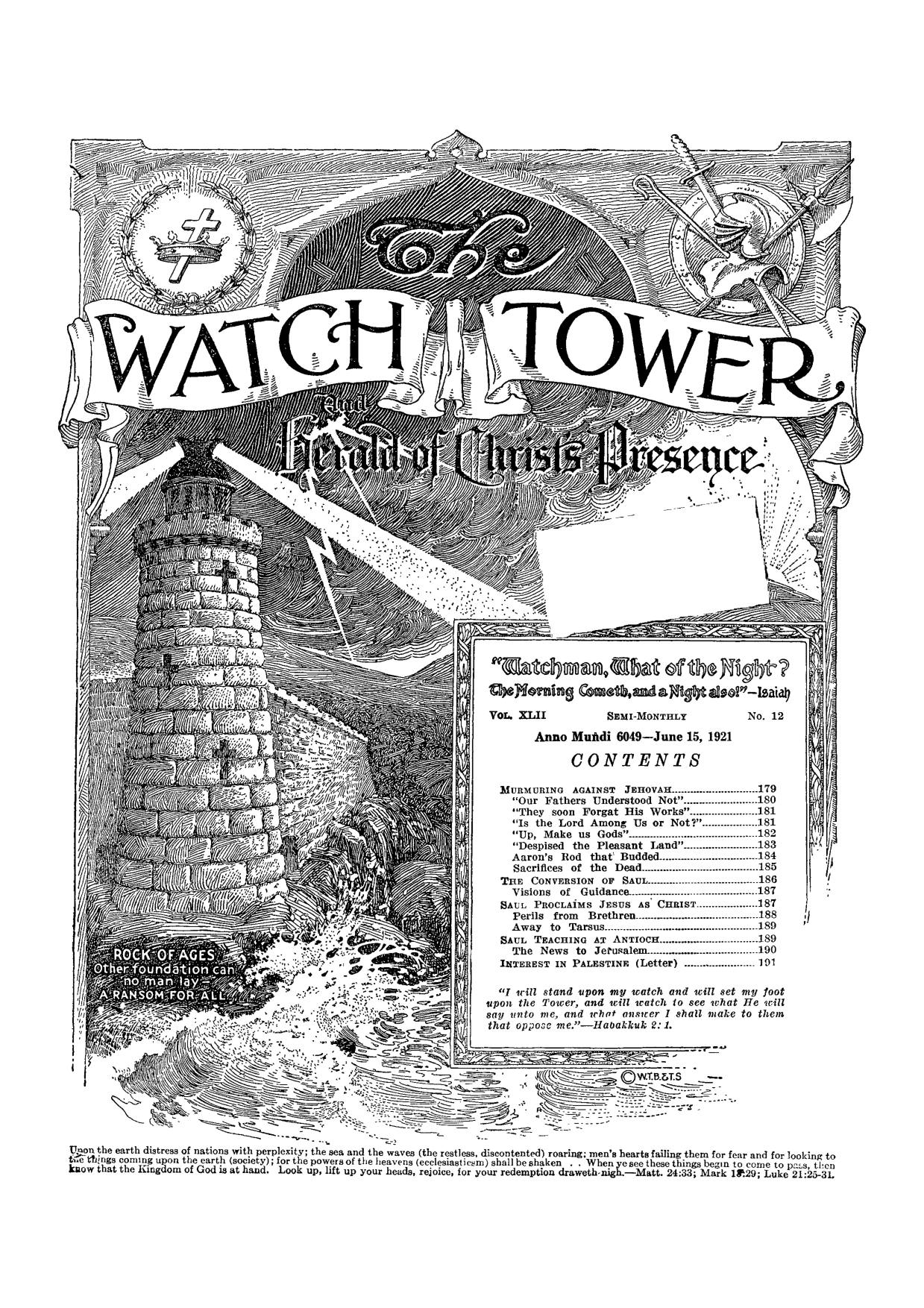
 View PDF
The content displayed below is for educational and archival purposes only.
Unless stated otherwise, content is © 1921 International Bible Students Association

No. 12
Unon the earth distress of nations with perplexity; the sea and the waves (the restless, discontented) roaring; men’s hearts failing them for fear and for looking to t>.e tilings coming upon the earth (society); for the powers of the heavens (ecclesiasticsm) shall be shaken . . When ye see these things begin to come to pass then Know that the Kingdom of God is at hand. Look up, lift up your heads, rejoice, for your redemption draweth-nigh.—Matt. 24:33; Mark 1S29; Luke 21:25-31.
WJ$*n»ing
VOL. XLII
Semi-Monthly
Anno Muftdi 6049—June 15, 1921
CONTENTS
„ ROCKiOFAGES^ 'Other founciation can 'no man
* AJ.RAH'SOM'FOR"a l
Murmuring against Jehovah...........
“Our Fathers Understood Not”.......
“They soon Forgat His Works”.....
“Is the Lord Among Us or Not?”. “Up, Make us Gods”.........................
“Despised the Pleasant Land”.......
Aaron’s Rod that' Budded...............
Sacrifices of the Dead.....................
The Conversion or Saul...................
Visions of Guidance.......................-
Saul Proclaims Jesus as Christ...
Perils from Brethren......................
Away to Tarsus.................................
Saul Teaching at Antioch...............
The News to Jerusalem...................
Interest in Palestine (Letter) .......
..179 ..180 ..181 ..181 ..182 ..183 ...184 ...185 ...186 ..187 ...187 ...188 ..189 ...189 ...190 . 191
“I will stand upon my watch and will set my foot upon the Tower, and will watch to see what He will say unto me, and what answer I shall make to them that oppose me."—Habakkuk 2:1.
THIS JOURNAL AND ITS SACRED MISSION
THIS journal is one of the prime factors or instruments in the system of Bible instruction, or “Seminary Extension”, now being presented in all parts of the civilized world by the Watch Tower Bible & Tract Society, chartered A. D. 1884, “For the Promotion of Christian Knowledge”. It not only serves as a class room where Bible students may meet in the study of the divine Word but also as a channel of communication through which they may be reached with announcements of the Society’s conventions and of the coming of its traveling representatives, styled “Pilgrims”, and refreshed with reports of its conventions.
Our ‘Berean Lessons” are topical rehearsals or reviews of our Society’s published Studies most entertainingly arranged, and very helpful to all who would merit the only honorary degree which the Society accords, viz., Verbi Dei Minister (V. D. M.), which translated into English is Minister o/ God’s Word. Our treatment of the International Sunday School Lessons is specially for the older Bible students and teachers. By some this feature is considered indispensable.
This journal stands firmly for the defense of the only true foundation of the Christian’s hope now being so generally repudiated —redemption through the precious blood of “the man Christ Jesus, who gave himself a ransom [a corresponding price, a substitute] for all”. (1 Peter 1:19; 1 Timothy 2:6) Building upon this sure foundation the gold, silver and precious stones (1 Corinthians 3: Ills; 2 Peter 1:5-11) of the Word of God, its further mission is to “make all see what is the fellowship of the mystery which. . .has been hid in God, ... to the intent that now might be made known by the church the manifold wisdom of God’’—“which in other --res was not made known unto the sons of men as it is now revealed”.—Ephesians 3:5-9,10.
It stands free from all parties, sects and creeds of men, while it seeks more and more to bring its every utterance into fullest subjection to the will of God in Christ, as expressed in the holy Scriptures. It is thus free to declare boldly whatsoever the Lord hath spoken—according to the divine wisdom granted unto us to understand his utterances. Its attitude is not dogmatic, but confident; for we know whereof we affirm, treading with implicit faith upon the sure promises of God. It is held as a trust, to be used only in his service; hence our decisions relative to what may and what may not appear in its columns must be according to our judgment of his good pleasure, the teaching of his Word, for the upbuilding of his people in grace and knowledge. And we not only invite but urge oui; readers to prove all its utterances by the infallible Word to which reference is constantly made to facilitate such testing.
TO US THE SCRIPTURES CLEARLY TEACH
That the church is “the temple of the living God”, peculiarly his workmanship” ; that its construction has been in progress throughout the gospel age—ever since Christ became the world’s Redeemer and the Chief Corner Stone of his ’temple, through which, when finished, God's blessing shall come “to all people”, and they find access to him.—1 Corinthians 3 :16, 17 ; Ephesians 2 :20-22; Genesis 28 :14 ; Galatians 3 : 29.
That meantime the chiseling, shaping, and polishing of consecrated believers in Christ’s atonement for sin, progresses ; and when the last of these “living stones”, “elect and precious,” shall have been made ready, the great Master Workman will bring all together in the first resurrection ; and the temple shall be filled with his glory, and be the meeting place between God and men throughout the Millennium.—Revelation 15 : 5-8.
That the basis of hope, for the church and the world, lies in the fact that “Jesus Christ, by the grace’ of God, tasted death for every man.” “a ransom for all,” and will be “the true light which lighteth every man that cometh into the world”, “in due time”.— Hebrews 2:9; John 1: 9 ; 1 Timothy 2 : 5, 6.
That the hope of the church is that she may be like her Lord, “see him as he is,” be “partakers of the divine nature’,’ and share his glory as his joint-heir.—1 John 3:2; John 17:24; Romans 8:17; 2 Peter 1:4.
That the present mission of the church is the perfecting of the saints for the future work of service; to develop in herself every grace; to be God’s witness to the world ; and to prepare to be kings and priests in the next age—Ephesians 4:12; Matthew 24: 14; Revelation 1: 6 ; 20:6.
That the hope for the world lies in the blessings of knowledge and opportunity to be brought to all by Christ’s Millennial kingdom, the restitution of all that was lost in Adam, to all the willing and obedient, at the bands of their Redeemer and his glorified church, when all the wilfully wicked will be destroyed.—Acts 3:19-23; Isaiah 35.
•puBLiSHE-D By
WATCH TOWER. BIBLE & TRACT SOCIETY
124 COLUMBIA HEIGHTS n a BROOKLYN, NY..U S A"
Foreign Offices : British: 34 Craven Terrace, Lancaster Gate, London W 2; Canadian: 270 Dundas St., W., Toronto, Ontario; Australasian: 495 Collins St., Melbourne. Australia; South African: 123 Plein St, Cape Town, South Africa.
Please Address the Society in Every Case.
VEARLY SUBSCRIPTION PRICE. United States. $1.00 ; Canada and Miscellaneous Foreign, $1.^0; Great Britain, Australasia, and South Africa, 8s. American remittances should be made by Express or Postal Money Orders, or by Bank Draft Canadian, British, South African, and Australasian remittances should be made to branch offices only. Remittances from scattered foreign territory may be made to the Brooklyn office, but by International Postal Money Orders only.
(Foreign translations of this journal appear in several languages)
Editorial Committee: This journal is published under the supervision of an editorial committee, at least three of whom have read and ipproved as truth each and every article appearing in these columns. The names of the editorial committee are: J. F. Rutherford, W. E. Van Amrurgh, F. H. Robison, G. H. Fisher, E. W. Brenisen. Terms to the Lord?a Poon AH Bible students who, by reason of old age or other in-drmity or adversity, are unable to pay for this journal, will be supplied free if they send t postal card each May stating their case and requesting such provision. We are not inly willing’, but anxious, that all such be on our list continually and in touch with the Berean studies.
fn Riihar>r4h^a • We do not. as a rule, send a card of acknowledgment for arenewal or
1<J Duuscnoers. for a new subSenpdan. Receipt and ?ntry nf -enewal are indicated within a month by change fn expiration date, as shown on wrapper label.
Entered as Second Class Matter at Brooklyn, N.Y., Postoffee under the Act of March Srd, 1879.
-
1 LOCAL CONVENTIONS
Lor’^iLLE. Ky., June 24-26.............W. IT. Dunn, 21G Norton Bldg
ohtland, Me., July 15-17: Mrs. F. M. Cummings, 3G3 Summer St., South Portland, Me.
ByMeansof -TABEONAOIC SHADOWS SACRlSsn
Chapter VII: The Red Heifer
Week of August 7 . . Q. 1-7 Week of August 21 . . Q. 1-7
Week of August 14 . . Q. 8-16 Week of August 28 . . Q. 8-14
New Tabernacle Shadows, with questions and notes, 25c each
STUDIES IN THE SCRIPTURES
These Studies are recommended, to students as veritable Bible keys, discussing topically every vital doctrine of the Bible. More than eleven million copies are in circulation, in nineteen.languages. Two sizes are issued (in English only) : the regular maroon cloth, gold stamped edition on dull finish paper (size 5"x7i")> and the maroon cloth pocket edition on thin paper (size 4"x6ij") ; both sizes are printed from the same plates, the difference being-in the margins; both sizes are provided with an appendix of catechistic questions for convenient class use. Both editions uniform in price.
Series I, “The Divine Plan of the Ages,” giving outline of the divine plan revealed in the Bible, relating to plan’s redemption and restitution: 350 pages, plus indexes and appendixes, 75c. Magazine edition 20c. Also procurable in Arabic, Armenian, Dano-Norwegian, Finnish, French. German, Greek, Hollandish. Hungarian, Italian, Polish, Roumanian, Slovak. Spanish, Swedish, and Ukrainian; regular cloth style, price uniform with English.
Series II. "The Time is at Hand” treats of the manner and time of the Lord's second coming, considering the Bible testimony on this subject: 333 pages, 75c. Obtainable in Dano-Norwegian, Finnish, German, Polish, and Swedish.
Series III. "Thy Kingdom Come,” considers .prophecies which mark events connected with “the time of the end”, the glorification of the church and the establishment of the Millennial kingdom; it also contains a chapter on the Great Pyramid of Egypt, showing its corroboration of certain Bible teachings: 3S0 pages, 75c. Furnished also in Dano-Norwegian, Finnish, German, Polish, and Swedish.
Series IV, “The Battle of Armageddon,” shows that the dissolution of the present order of things is in progress and that all of the human panaceas offered are valueless to avert the end predicted in the Bible; It contains a special and extended treatise on our Lord's great prophecy of Matthew 24 and also that of Zechariah G5G pages, ^5c. Also in Dano-Norwegian, Finnish, Greek, German, and Swedish.
Series V, “The Atonement Between God and Man,” treats an all important subject, the center around which all features of divine grace revolve. This topic deserves the most careful consideration on the part of all true Christians: 618 pages, 85c. Procurable likewise in Dano-Norwegian, Finnish, German, Greek, and Swedish.
Series 71. "The -.ye?c Creation " deals with the creative week (Genesis 1. 2), and with the church. God's new creation. It examines the personnel, organization, rites, ceremonies, obligations, and hopes appertaining to those called and accepted as members of the body of Christ': 730 pages. 8'5c. Suppli.xl also in Dano-Norwegian, Finnish. ’German, and Swedish.
Series VII, “The Finished Mystery.” consists of a verse-by-verse explanation of the Bible hooks of Revelation. Song of Solomon, and Ezekiel : 608 pages, illustrated, 85c. in cloth. 25c. in magazine edition—latter treats Revelation and Ezekiel only.

AND HERALD OF CHRISTS PRESENCE
Vol. XLII
June 15, 1921
No. 12
MURMURING AGAINST JEHOVAH
“neither murmur ye as some of them also murmured and icere destroyed of the destroyer."—1 Corlnthiuiis 10:10.
THE English word murmur means “to speak com-plainingly in a subdued or half articulate voice; grumble; repine; hence, generally to express dissatisfaction with one’s circumstances or destiny”. As used in the Scriptures the murmuring of God’s professed people has associated with it the thought of obstinacy, the choosing of one’s own will in preference to the will of God. The murmurer does not come out into the open but prefers to express his discontent in a more secret and sullen manner. In Isaiah 29:4 the Prophet, speaking of the woes that were some time coming and that have now come upon Ariel, the professed people of God, shows that in the humiliation of the ecclesiastical systems that are falsely claiming to represent him in the earth, “their speech shall be low out of the dust, and their voice shall be as one that hath a familiar spirit’. This is a good description of a murmurer. What sane child of God would wish to have his speech sound like one with a familiar spirit?
A TERRIBLE INDICTMENT
The Apostle Jude says some terrible things about a class of professed Christians that would be living “in the last time”. He says of them that “these are spots in your feasts of love when they feast with you, feeding themselves without fear”. Every assembly of the Lord’s saints is a feast of love. It is not possible for worldly people to comprehend the intensity of the love which the Lord’s saints have for each other. The moment we learn that any heart has committed its all to the Lord for time and eternity, happy and thankful for the privilege of being consumed upon the Lord’s altar in the service of the truth and the brethren, our hearts instinctively go out to that one with a love that passes understanding. It would be impossible for us to make plain to our nearest and dearest earthly relatives how and why it is that these new-found members of our Father’s family are dearer to us than even the ties of the flesh. Sometimes when they catch glimpses of this love they are disposed to object, and can hardly be blamed for it, not having the higher viewpoint of members of the divine family.
The Apostle continues to describe a class associated with the Lord’s saints in the last time, saying of them that they are “clouds without water, carried about of winds”. One of the principal offices of a cloud is to bring showers of water to a thirsty earth. One of the principal offices of a Christian is to bring refreshing of heart to all with whom he comes in contact. But here is a class that casts a shadow over others and brings no refreshment, but rather the reverse. Continuing, the Apostle says of them that they are “trees whose fruit withereth”, indicating that at one time they did have fruitage toward God, the fruitage of the holy spirit, but that now they are “without fruit, twice dead, plucked up by the roots”. This is a picture of some who have committed the sin unto death. What a beautiful appearance a tree presents when filled with foliage and fruit and when firmly imbedded in its native soil; but how ugly the tree whose foliage and fruit is gone, whose bark has been stripped from it and whose upturned roots are exposed to the sun, so lately the source of its life, but now its swift purveyor of death.
Continuing his description, the Apostle says of this class that they are “raging waves of the sea, foaming out their own shame”, an indication that an unwise use of the tongue has brought them to a condition of uselessness and of disgrace.
Again, they are “wandering stars, to whom is reserved the blackness of darkness for ever”. As the true apostles were light-bearers and as the seven angels to the seven epochs of the Christian church were lightbearers, all of these fitly represented by the planets of our solar system, or by the fixed stars of heaven; so there are false stars, pseudo-light-bearers, which claim to have a special brilliancy of their own, and which are fitly represented by meteors. Now meteors are pieces of dead planets rushing through space, which, caught in the atmosphere of the earth, burn brilliantly for a moment by the friction which they create as they rush through the air to their final ruin. Many of these meteors disintegrate completely before reaching the surface of the earth, and those which do reach the surface of the earth are thoroughly burned and devoid of everything that could support life in any form. The Apostle terminates his description of this class by saying, “These are murmurers, complainers”. (Jude 12, 13, 16) What a terrible indictment is this!
When the Lord’s saints are engaged in the work of murmuring it is not the new mind that is doing the murmuring. It is the flesh. Addressing new creatures the Apostle savs, “Ye died [according to the flesh] and your life is hid with Christ in God”. (Colossians 8:3) It is hard for the new creature to realize that from God's viewpoint the human hopes, privileges, and prospects are dead from the time when the begetting of the spirit takes place. But the difficulty is that the flesh itself is not dead. All of its tendencies remain, and need to be regulated by the new will.
MURMURINGS OF FLESHLY ISRAEL
In the words of our text the Apostle is calling our attention particularly to the experiences of fleshly Israel in the wilderness as being helpful to us in overcoming any tendencies we might have along this line. The Psalmist sums up these murmurings of the fathers in the wilderness in the one hundred and sixth Psalm, giving in verses 7 to 23 six illustrations. The illustration given in verses 16-18 belongs chronologically between verses 27 and 28, so that we have here an opportunity to murmur against David himself if we feel so inclined. Because David said a thing of this kind some in David's time might have been inclined to say that David had gone out of the truth, but that did not make it so. There was probably some reason for stating the envy against Moses and Aaron early in the narrative, perhaps because of the very great responsibility which any take upon themselves who find fault with the arrangements which the Lord has made for the feeding of the sheep of his pasture.
Going back to the story from which David penned his account in Psalm 106, we find no less than fifteen illustrations of this murmuring spirit among God’s professed people, and we cannot fail to be profited if we examine these and try to apply to ourselves the principles which they bring to light.
“OUR FATHERS UNDERSTOOD NOT”
The first instance is recorded in the fifth chapter of Exodus. Moses had come forth from the wilderness of Midian to deliver Israel, and by the signs of the serpent rod and the leprous hand God had testified to Moses that the time for the deliverance of Israel had come. Walking into the presence of Pharaoh, Moses and Aaron informed that monarch that their God had met with them and instructed them that they should lead forth the people of Israel three days’ journey into the wilderness so that they might worship him. This three days’ journey doubtless represents the wilderness journey of spiritual Israel during parts of the fifth, sixth, and seventh thousand-year days of human history. Pharaoh was indignant at the demand, accused Moses and Aaron of disturbing the people in their tasks, and implied if these disturbing prophets thought his slaves had time to go three days’ journey into the wilderness to worship their God it was evidence that they did not have enough to do. He thereupon commanded his overseers to see that thereafter these slaves, for such they were, should make as many bricks as formerly but should gather the straw for themselves.
The brick of that time could not be made without a suitable binder, and it is a significant fact that in the buried city of Pithom, twelve miles from Ismailia, built by the Israelites in the time of Barneses II and enclosed by walls twenty-two feet high made of unburned brick, discovered in 1883, the lower courses are of well made brick with chopped straw in them, while higher up the' brick are not so good, the straw is scanty, and in the last courses the bricks have no straw at all, but rushes instead. This was, in a way, the first test of the Israelites; and instead of having confidence in Jehovah and in the deliverer whom he had sent, the people as soon as they saw their tasks had been made harder said to Moses and Aaron: “The Lord look upon you, and judge because ye have made our savor to be abhorred in the eyes of Pharaoh, and in the eyes of his servants, to put a sword in their hand to slay us”. (Exodus 5:21) In speaking of this and of subsequent experiences while they were still in Egypt, the Psalmist says: “Our fathers understood not thy wonders in Egypt”.—Psalm 106: 7.
“PROVOKED HIM AT THE SEA”
Finally the deliverance from Egypt took place, and with a series of stupendous miracles—the turning of the rivers into blood, the bringing up of the plagues of frogs, of lice, of flies, the murrain upon the cattle, the boils, the hail, the locusts, the darkness, and the death of the firstborn, Pharaoh drove the Israelites forth from his presence and they started on their long journey toward the promised land. With such evidences of God’s care over them, in that these plagues came upon the Egyptians while the Jacobites and their land were spared, how could they henceforth doubt that all then-interests would be cared for? Yet, within three days from the time of their deliverance, they found themselves in a pocket, so to speak, with the Bed Sea in front of them, the mountains shutting off their further progress southward, and Pharaoh and all his horsemen and chariots coming against them. Here was an opportunity for them to exercise the faith which the Lord’s previous care over them should have developed, but the record is: “They said unto Moses, Because there were no graves in Egypt hast thou taken us away to die in the wilderness? Wherefore hast thou dealt thus with us, to carry us forth out of Egypt? Was not this the word that we did tell thee in Egypt, saying, Let us alone, that we may serve the Egyptians ? For it had been better for us to serve the Egyptians, than that we should die in the wilderness.” (Exodus 14:11, 12) The Psalmist in speaking of this said: “They remembered not the multitude of thy mercies; but provoked him at the sea, even at the Bed Sea”.—Psalm 106: 7.
Do we of spiritual Israel ever find ourselves pressed on all sides with difficulties and inclined to think or to say that perhaps it would have been just as well with us or better to have continued walking in the way of the world, the popular way, serving the prince of this world and those who partake of his spirit, rather than ever to have started upon this journey toward the promised land?
“THEY SOON FORGAT HIS WORKS!’
Again the Lord gave.Israel a miraculous deliverance; and when they had safely crossed the Bed Sea and the waters swept the Egyptians and their chariots and horsemen for ever from their sight, how happy they were, as the songs of jubilation of Moses and Miriam and the women of Israel showed. And yet within three days after that occurrence when they were encamped by the waters of Marah “the people murmured against Moses, saying, What shall we drink?” (Exodus 15: 24) By another miracle the Lord healed the waters, causing Moses to cast into them a tree, representing the cross of Christ, admonishing them with fatherly love to hearken diligently to his voice and endeavor to do that which was right in his sight so that he might continue to be their caretaker and their guide, terminating with the beautiful words, “I am the Lord that healeth thee”.
When we of spiritual Israel come to some of the bitter experiences of life and we find that the poison of sin, of imperfection in our own bodies and in the bodies of others, tempts us to fear lest we shall never enter into our promised inheritance, are we ever inclined to murmur that the waters of this way of life are not what we could wish? If so, let us look to the cross and remember him who passed through such deep waters on our behalf; and let us think not only of Jesus our Savior and Redeemer as our help in such an hour of need, but let us think of the Father watching over our spiritual interests with tender solicitude and remember that he says to us, as to Israel of old, “I am the Lord that healeth thee”.
“LEANNESS OF SOUL”
Thirty-nine days after the experience at the waters of Marah the Israelites were confronted with the need of food, and instead of remembering how the Lord provided for them when they were in need of water “the whole congregation of the children of Israel murmured against Moses and Aaron in the wilderness; and the children of Israel said unto them, Would to God that we had died by the hand of the Lord in the land of Egypt when we sat by the flesh pots and when we did eat bread to the full. For ye have brought us forth into the wilderness, to kill this whole assembly with hunger.” Moses told the people in reply that “in the morning, then ye shall see the glory of the Lord; for that he heareth your murmurings against the Lord: and what are we that ye murmur against us-? And Moses said. This shall be, when the- Lord shall give you in the evening flesh to eat, and in the morning bread to the full; for that the Lord heareth your murmurings which ye murmur against him; and what are we? Your murmurings are not against us, but against the Lord.”—Exodus 16: 2, 3; 7, 8.
Had the Israelites been content to wait upon the Lord they would surely have been provided .with the food as soon as they needed it, but they were not yet -inclined to seek his counsel. The Psalmist says of them: “They waited not for his counsel: but lusted exceedingly in the wilderness and tempted God in the desert. And he gave them their request; but sent leanness into their souls.”—Psalm 106:13, 15.
The same evening, great flocks of quail, wearied with their long flight across the Red Sea, came flying through the camp so near the ground as to be easily caught. (This is- a common circumstance on the Sinaitic Peninsula even to this day.) And in the morning manna, bread from heaven, typifying our Lord’s flesh, was deposited in or from the dew by some power of God working in harmony with the natural laws of chemistry not yet thoroughly understood. The Jews were to gather of this manna every morning, representing to spiritual Israel how very necessary is the bread from heaven on the part of all who would partake of life; and the gathering was to be a daily gathering, representing how that our supply of grace in Christ needs to be gathered daily. It will not keep over for succeeding days. None of the Israelites were able to gather too much, and so spiritual Israel is never in any danger of being overfed spiritually. When the attempt was made to keep some of it over until morning it spoiled, but this was not the case with the manna that was gathered the last of the week, seeming to suggest that there is unusual life-sustaining power in the spiritual food which is gathered by the Lord’s saints just -prior to the inauguration of the great seventh thousand year day of rest, and that the food which it is now our privilege to glean from the Word of the Lord will be good and sweet and life-giving throughout the Millennial day.
“IS THE LORD AMONG US OR NOT?”
Sometime within the next fifteen days the Israelites had reached Rephidim, one hundred miles from Marah, well down the peninsula toward Mt. Sinai. In the place where they pitched their camp there was no water for the people to drink. ‘‘Wherefore the people did chide with Moses, and said, Give us water that we may drink. And Moses said unto them, Why chide ye with me? Wherefore do ye tempt the Lord? And the people thirsted there for water; and the people murmured against Moses, and said, Wherefore is this, that thou hast brought us up out of Egypt, to kill us and our children and our cattle with thirst?” (Exodus 17 : 2,3) Moses, as usual, took his troubles to the Lord, telling him that the people were almost ready to stone him. Then the Lord performed another wonderful miracle, causing the waters to gush out of the smitten rock, representing for spiritual Israel the stream of life that gushed forth for a dying world when the Rock of Ages was cleft on Calvary’s brow for us and for all men.
Moses did not overlook the wrong spirit which the Israelites showed at this time, for he “called the name of the place Massah [temptation], and Meribah [strife], because of the chiding of the children of Israel, and because they tempted the Lord, saying, Is the Lord among us, or not ?”—Exodus 17: 7.
How many times, even in the harvest, time, when the blessings of the Lord have been poured out upon his people as at no other time in history, have the Lord’s saints been tempted to repine because in their judgment the truth on all subjects of God’s Word was not coming forth from the storehouse as rapidly as they thought it should come. How many times when the truth has been gradually finding its way to the light and while discussions respecting the matter were in progress have some of the Lord’s saints been tempted to raise the query, “Is the Lord among us, or not?” How thoughtless for brethren to imagine that they or other human instrumentalities are wiser than the Lord. The truth comes forth from the storehouse as fast as the Lord sees that it is necessary, but no faster, and nothing can prevent it from coming forth when it is due to come forth. Moreover, the effort to force it out of the storehouse is like attempting to force the nut out of a green chestnut burr. Brother Russell once made the statement that when he came into the truth he thought it was his duty to hammer away at the green nuts. Sometimes he was- able to open them and sometimes, with every effort, they would not yield their treasures. But he discovered that in due time the Lord of the harvest would open up the truths as they were needed by the household of faith.
“UP, MAKE US GODS”
On the forty-fifth day after their departure from Egypt the Israelites arrived at Mt. Sinai and made an agreement to keep the divine statutes and commands. There, a few days after their arrival, the Lord descended upon the mountain top in fire. Smoke ascended as the smoke of a furnace, the whole mountain quaked, and the voice of the Lord sounded long and waxed louder and louder, to the intent that the people should believe Moses for ever. Yet sometime within the next forty days “when the people saw that Moses delayed to come down out of the mount the people gathered themselves together unto Aaron, and said unto him, Hp, make us gods, which shall go before us; for as for this Moses, the man that brought us up out of the land of Egypt, we wot not what has become of him”. (Exodus 32: 1) Then followed the making of the golden calf, the declaration before it that “these be thy gods, 0 Israel, which brought thee up out of the land of Egypt”; and “they sat down to eat and to drink, and rose up to play”. (Exodus 32:4, 6) The Psalmist speaks contemptuously of these experiences of Israel, saying, “They made a calf in Horeb and worshipped the molten image. Thus they changed their glory [Jehovah] into the similitude of an ox that eateth grass.”—Psalm 106:19, 20.
Straightway the Lord sent Moses down from the mountain top, offering to consume these disobedient and obstinate people and to make a new race with Moses as its head. But Moses interce’ded for the people, although in anger he broke the tables of the covenant when he saw their nakedness and general misconduct after the custom of the heathen nations. He burned their golden calf, ground it to powder and mixed it with water, compelling them to drink the mixture. They are not the first people in the world that have swallowed their gods. (Philippians 3:19) Taking their stand upon the Lord’s side, the Levites at this time by the command of Moses slew three thousand of their brethren as punishment for this transgression.
When the Lord has delayed to bring in the great Deliverer, the great salvation, the promised kingdom, as early as we have wished that it might come, have we of spiritual Israel ever been tempted to question the divine arrangement and to seek to set up, in creeds and customs and in the general worship of mammon and politics, another god different from the One of the Bible? Have we made money our god, or our fleshly interests of any kind ? Have we permitted them to have dominion over us, while at the same time murmuring against the Lord’s providences as respects his church?
The people of Israel remained in the vicinity of Mt. Sinai ten months, and on the first day of the first month of the second year after their departure from Egypt erected the Tabernacle; and always above the Tabernacle the pillar of cloud rose by day and the pillar of fire by night ; so that the people seemingly had no excuse for doubting that the Lord was their Guide and was leading them on toward Canaan. While the Tabernacle was in process of construction the murmuring seems to have entirely ceased; and it is a fact worth noting that those who are busiest with the Lord’s work have the least time and inclination to find fault with the activities of fellow-members of the Lord’s body.
“THE UTTERMOST PARTS OF THE CAMP”
Fifty days after the opening of the second year the Israelites started from Sinai on their march toward Canaan. They had gone three days’ journey when they reached Taberah, and “when the people complained [margin, were, as it were, complainers] it displeased the Lord; and the Lord heard it; and his anger was kindled; and the fire of the Lord burnt among them, and consumed them that were in the uttermost parts of the camp”.—Numbers 11: 1.
It is very apparent that in the arrangement of the camp there is a picture of relative nearness to the Lord, a picture of relative holiness. The Most Holy represented the presence of Jehovah, heaven itself, the condition of spirit birth. The Holy represented the spirit-begotten condition, the highest form of the spiritual life obtainable on this side the vail. The Court represented justification, the condition of those made acceptable as sacrifices. About the outside of the Tabernacle were grouped the Levites; beyond them was the Camp, representing the condition of all during the gospel age who are professedly God's people; while outside the Camp represented the outcast condition, the condition of rejection, the condition of those who are or are esteemed to be cut oft from. God.
As the Tabernacle moved forward from point to point the more faithful ones of natural Israel would naturally seek to be as close to it as the Mosaic requirements would permit. And most of the murmurers and com-plainers would obviously be. among those who moved along grudgingly, keeping in touch with the Camp only because of the nater and food and companionship to be had. Hence -we may understand that this burning of the fire of the Lord in the edges of the Camp reached particularly the murmurers, the complainers. But when the people as a whole cried unto Moses because of these fires, Moses prayed to the Lord, and the Lord in mercy quenched them.
“LUSTED EXCEEDINGLY”
Sometime between the fiftieth day of the second year after leaving Egypt, or say about June 1 of that year, and the time of the first ripe grapes (which in that climate was perhaps not more than three months later) at a place called Kibroth-hattaavah “the mixed multitude that was among them fell a-lusting: and the children of Israel also wept again, and said, Who shall give us flesh to eat? We remember the fish which we did eat in Egypt freely; the cucumbers, and the melons, and the leeks, and the onions, and the garlic; but now our soul is dried away; there is nothing at all beside this manna, before our eyes. . . . Then Moses heard the people weep throughout their families, every man in the door of his tent: and the anger of the Lord was kindled greatly; Moses also was displeased.”—Numbers 11:4, 5, 6, 16."
Moses felt the crushing weight of the burden upon him, and prayed that unless the Lord would lift the burden his own life might be taken. The Lord gave him the needed assistance by appointing severity men to share his responsibilities, and instructed him to say to tire people, “'Ye have wept in the ears of the Lord, saying. Who shall give us flesh to eat? Lor it was well with us in Egypt. Therefore the Lord will give you flesh and ye shall eat. Ye shall not cat one day, nor two days, nor five days, neither ten days, nor twenty days; but even a whole month, until it come out at your nostrils and. it be loathsome unto you; because that ye have despised the Lord, which is among you and have wept before him, saying. Why came we forth out of Egypt?”—Numbers 11: 18-20.
For two days an enormous flock of quail fell into the camp and the people gathered them in such quantities and ate of them so gluttonously that thousands of them died from the plague which ensued. Is this not an lustration to spiritual Israel of the unwisdom of crying out against the Lord’s providences? Does it not prove that the Lord knows better what is good for us than we know ourselves, and that ofttimes an affirmative answer to our prayers would hot be for our good but for our injury?
“WERE YE NOT AFRAID?”
It was but a few days later,at Hazeroth, that “Miriam and Aaron spake against Moses because of the Ethiopian woman whom he had married; for he had married an Ethiopian woman. And they said, Hatl die Lord indeed spoken only by Moses ? Hath he not spoken also by us? And the Lord heard it.” (Numbers 12':.1,2) There are many people in this world 'who seem to think it their business to raise objections when their relatives marry. They object on general principles to their relatives marrying at all, and then object more particularly at iheir choice of partners. If there is anything 'in which the Lord’s people should studiously endeavor to mind their own business it is in respect to this matter of marriage. The Lord’s Word encourages an attitude of this .kind, not only by the scriptures which tell us, “■Study to be quiet, and to do your own business,” and “Let. none of you suffer ... as a busybody in other men’s matters” (1 Thessalonians 4: 11; .1 Peter 4:15), but also by the principle enunciated in Psalm 45:10, that it is the privilege and the duty of the prospective bride measurably to forget her own people and her father’s house in taking up her duties and privileges as the mistress of a household of her own.
Moses was too meek to quarrel with his brother and sister, but Jehovah took his part, and with stern justice inquired of Aaron and Miriam why it was that they had not been afraid to speak against his servant Moses; and in a moment Miriam, who was probably the chief transgressor, became leprous, white as snow. Here were two persons very prominent in the Jewish church— two who had already been greatly used by the. Lord— who were engaged in murmuring, thus showing that this sin is not necessarily confined to those in humble positions. But for the intervention of Moses Miriam would have remained a leper until the day of her death. No doubt there was something of pride on the part of Miriam and Aaron that made them take this stand against Moses, a holici-than-thou attitude such as the scribes and Pharisees manifested toward the disciples because of their association with publicans and sinners (Luke. 5: 30)., and such as they also manifested toward the Lord Jesus himself because he was willing to be a guest of Zacchreus, a sinner. The tax collectors were considered sinners by the Jews, including not only the noble Zacchasus but the equally noble Matthew Levi, to whom wc owe the Gospel according to St. Matthew.
“DESPISED THE PLEASANT LAND”
rhirty-five days after leaving Mt. Sinai the twelve were sent to spy out the land of Canaan, and after forty davs’ investigation returned, ten of them with an uniruthful report that the land was a land of giants, in whose sight the Israelites were as grasshoppers. “And all the congregation lifted up their voice and cried; and the people wept that night. And all the children of Israel murmured against Moses and against Aaron: and the whole congregation said unto them, Would God that we had died in the land of Egypt! Or would God we had died in this wilderness!” (Numbers 14: 1, 2) Moses, in speaking of this matter in Deuteronomy 1: 27, says: “Ye murmured in your tents, and said, Because the Lord hated us, he hath brought us forth out of the land of Egypt, to deliver us into the hand of the Amor-ites, to destroy us”. David, in speaking of the same matter, says: “Yea, they despised the pleasant land, they believed not his word; but murmured in their tents, and hearkened not unto the voice of the Lord. Therefore he lifted up his hand against them, to overthrow them in the wilderness.-” — Psalm 106: 24 - 26.
And are not the Lord’s people of spiritual Israel frequently tempted to exaggerate the difficulties in the way? Are they not sometimes inclined to think that the Lord is unable to complete the good work which he has begun in them? And are they not sometimes inclined to wish that they were dead and out of it all? Such ill-considered statements are surely out of place, dear brethren. Let us note that the Lord heard these words of fleshly Israel, “Would God we had died in this wilderness,” and that they did die in the wilderness. How much better it .is for us to accept the providences that God arranges for us, regardless of whether the difficulties in the way seem to be mountain-high or whether they seem to be trivial, as most of them are compared to the riches of the inheritance which awaits us beyond Jordan.
THE RIBBAND OF BLUE
How long it was before the next murmuring experience we may not know; but the command of the Lord at the hand of Moses that the people should. put a ribband of blue upon the borders of their garments developed a situation which had evidently been brewing for a long time. This ribband of blue added nothing of consequence to the Israelites’ garments, and fleshly Israelites found this ribband of blue as objectionable as some of spiritual Israel have found various things connected with harvest associations and activities. Korah, Dathan, and Abiram, and two hundred and fifty of the princes of the assembly “gathered themselves together against Moses and against Aaron, and said unto them, Ye take too much upon you, seeing all the congregation are holy, every one of them, and the Lord is among them: wherefore then lift ye up vourselves against the congregation of the Lord?”— Numbers 16: 3.
The story that follows shows how these three men, Korah, Dathan, and Abiram, were swallowed up by an earthquake, and how the two hundred and fifty elders who had assumed to stand before the Lord with their censors contesting for the places occupied by Moses and Aaron were consumed by fire. David narrates this incident in the following words: “They envied Moses also in the camp, and Aaron the saint of the Lord. The earth opened and swallowed up Dathan and covered the company of Abiram. And a fire was kindled in their company; the flame burned up the wicked.” (Psalm 106:16-18) “But on the morrow all the congregation of the children of Israel murmured against Moses and against Aaron, saying, Ye have killed the people of the Lord.” (Numbers 16:41) But for Moses’ intervention the Lord would have destroyed the whole congregation at that time. As it was, a plague broke out which slew 14,700 before incense could be offered and the plague stayed.
Has there not been in spiritual Israel a disposition like that manifested here to blame the mouthpieces of the Lord for driving some of the Lord’s people out of the truth? What folly! No person ever yet was driven out of the truth except by the Lord. It does not lie within the power of any child of God to expel another from the truth. There may be differences of opinion; and it is a favorite custom with some to accuse those who differ from them of being out of the truth; but that does not make it so.
AARON’S ROD THAT BUDDED
Immediately following the earthquake and fire and plague referred to in the last preceding item, Jehovah caused each tribe to write upon a rod the name of the prince of that house, while Aaron’s name was written upon the rod of Levi. The purpose of this was that these might be laid out before the Lord in the Tabernacle of the Congregation. “And it shall come to pass that the man’s rod, whom I shall choose, shall blossom: and I will make to cease from me the murmurings of the children of Israel, whereby they murmur against you.” (Numbers 17: 5) All Bible students are familiar with the fact that Aaron’s Tod was the only one that budded, and it not only budded but blossomed and yielded almonds, and was laid up in the ark of the covenant “to be kept for a token against the rebels-; and thou shalt quite take away their murmurings from me that they die not”.
Who can doubt in the face of this story the statement elsewhere made in the Scriptures that God hath set the members in the body as it hath pleased him? (1 Corinthians- 12:18) Who that has been in touch with the harvest work can doubt that the Lord selected those agencies which best pleased him? This view does not mean that Aaron made no mistakes. We have seen in this lesson that he did make a mistake in respect to Moses’ wife. It does not mean that Brother Russell never made a mistake. He did make an occasional one, as he acknowledged in the new prefaces to the volumes of Scripture Studies, which were about the last items that appeared from his pen; however, the notable mistakes that he made were few in number and not such as to interfere with the Lord’s work. Any servants in the church can be removed by a breath from the Lord. He can lift up whom he will and whom he will he can bring low.
WHY MOSES AND AARON DIED
Near the end of their forty years’ wandering in the wilderness, after Miriam had died, the water supply ran short again, “and the people chode with Moses, and spake, saying, Would God that we had died when our brethren died before the Lord! And why have ye brought up the congregation of the Lord into this wilderness, that we and our cattle should die there ? And wherefore have ye made us to come up out of Egypt, to bring us into this evil place? It is no pla>ce of seed, or of figs, or of vines, or of pomegranates; neither is there any water to drink.” (Numbers 20:3-5) This murmuring of the people was indirectly the cause of the death of both Moses and Aaron, for on this occasion instead of speaking to the rock as he had been commanded to do, Moses struck the rock twice. And although the Lord honored Moses’ imperious order, “Hear now, ye rebels; must we fetch you water out of this rock?” yet, because both he and Aaron failed to honor the Lord in the eyes of the congregation they were not privileged to pass over Jordan hut each in turn was taken up into a mountain top, there in silent majesty to die in the presence of the Lord, who for a period of nearly forty years they had served so faithfully. Is there not for spiritual Israel a lesson in this, to beware lest they be led into impatience, no matter how long they have been in the way, but to continue to trust their all to the Lord, realizing that he is abundantly able to adjust their affairs in a way that will be to their ultimate joy ?
DESPISING THE BREAD FROM HEAVEN
After being sentenced to death Moses endeavored to arrange for the passage of his people through the land of Moab, promising to touch nothing by the way and even to pay for the water that they drank. This the king of Edom refused, and the Israelites were compelled to encompass the land of Edom through one of the most difficult mountain countries conceivable. The hills are barren, and extremely rough, rugged, and “the soul of the people was much discouraged because of the way. And the people spake against God and against Moses, Wherefore have ye brought us up out of Egypt to die in the wilderness? For there is no bread, neither is there any water; and our soul loatheth this light bread. And the Lord sent fiery serpents among the people, and they bit the people; and much people of Israel died.”—Numbers 21: 4-6.
This experience of the Israelites murmuring at the bread from heaven reminds us of the murmuring of those Jews at the saying of Jesus, “I am the bread which came down from heaven”. And we remember also that even some of Jesus’ own disciples murmured on this occasion, calling it a hard saying. (John 6: 41, 60 61) As the Lord healed the fleshly Israelites when bitten by the fiery serpents by causing them to look upon a serpent of brass nailed upon a pole, so the same Lord heals all who have been bitten by the serpent of sin when they look upon the One who was made a sin-offering for us, the One who was nailed upon a tree in our behalf.
SACRIFICES OF THE DEAD
The last experience of murmuring—distrust of the Lord—on the part of fleshly Israel before they crossed the Jordan was when they were down on the plains of Moab, opposite Jericho. Thore the daughters of Moab enticed numbers of the people to sacrifice unto their gods, “and the people did eat, and bowed down to their gods”. (Numbers 25:2) The Psalmist, in speaking of this matter, ■ says: “They joined themselves unto Baal-peor, and ate the sacrifices of the dead”. (Psalm 106: 28) Because of this, twenty-four thousand of the Israelites were slain by a plague. We understand this eating the sacrifices of the dead to mean that the gods of the Moabites were really nothing but dead human beings deified after their wickednesses and meannesses had been largely forgotten. Such deifications occur in our own day, it being a custom of the various Catholic Churches to deify or turn into saints some very wicked men who have nevertheless been instrumental in helping to build up their systems.
It is the place of the Lord’s people not to worship men, good or bad, living or dead, but to make sure that at all times the worship of their hearts is toward the ever living God; and all who would have their hearts filled with a holy joy such as the world can neither give nor take away should gladly accept at the hands of their God whatever cup the Father in his wisdom may see fit to pour for them, and to do all that they do as unto the Lord, “without murmurings and disputings, that [they] may be blameless and harmless, the sons of God; without rebuke, in the midst of a crooked and perverse nation, among whom [they] shine as lights in the world”.—Philippians 2:14, 15.
The Apostle’s inspired comments on these murmurings of fleshly Israel imply that the reason for their murmurings against and provocations of God lay in their unbelief, their lack of faith. So he warns us: “Take heed, brethren, lest haply there shall be in any one of you an evil heart of unbelief, in falling away from the living God: but exhort one another day by day, so long as it is called Today; lest’ any one of you be hardened by the deceitfulness of sin: for we are become partakers of Christ, if we hold fast the beginning of our confidence [that confidence and assurance with which we made a consecration] firm unto the end” —Hebrews 3 : 12-14.
‘‘The human heart is prone to entertain Presumptuous thoughts, and feelings which arraign Th’ appointed course of things.; but what are we, Short-sighted creatures of an hour, That we should judge? Tn nnrt alone we see.”
THE CONVERSION OF SAUL
--,ln,Y 17 —Acts 9:1-19--
“Sudtlciili/ then
A DAJKK JOUBNEY ENDS
uhonc round about hint, a liylit out of heaven.”—Acts !>:S.
IN EIGHT — THREE DAYS Ol' GROPING—SAUL ENTERS THE LIGHT.
CONVERSION means a change from one state or character to another. In the case of Saul of Tarsus it was a change of miud, and to a certain extent a change of heart; for no one can shift from Judaism to Christianity without experiencing a revolution in thinking.
This ninth chapter of the book of Acts is the commencement of a very important part of apostolic history, since the remainder of the book is chiefly occupied with accounts of the activities of Saul, of his trials and labors in the establishment of churches and in spreading the gospel throughout the gentile world.
Saul was “breathing out" tnreatenings and slaughter against the disciples of the Lord Jesus. He was not satisfied with what he had done in the case of Stephen, and probably of others. (Acts 8:3; 26:10) The expression breathing out’ indicates deeply agitated emotion, breathing rapidly and violently. Emotion is absorbing, exhausting, and demands more rapid circulation, which in turn calls for more active use of the lungs. The figure of speech is therefore a very strong one, calculated to convey the thought that Saul was very strenuous in his denunciation of Christianity, which he did not look upon as a separate religion but as a heresy springing up among the Jews. The situation so spurred up his Pharisaic animosity that he was threatening the adherents of the Messianic society, so to speak, with every breath. His was the action of a man violently enraged. We are not left to guess on this subject; for the Apostle liimself in later years tells exactly how he felt: “Being exceedingly mad against them. I persecuted them even unto strange cities". (Acts 26:11) Nothing can more forcibly express his rage and violence. He was so indignant that he laid aside all appearances of moderation and endeavored to exterminate the despised heretics from the earth.
PAPERS OF AUTHORITY
In furtherance of his designs Saul sought out the high priest to secure from him letters commissioning him to carry on the work of persecution In points outside of Judea. The fact that he “desired" these letters shows the intensity of his wish to persecute the Christians, that, he was willing to ask for such employment.
Such letters, in order to be authoritative, would have to be sanctioned or ratified by the Sanhedrim, of which Hie chief priests were a part, but only a part. Such papers were in the nature of a blanket search warrant, and warrant for the arrest of all those who would not deny Jesus as being the Messiah.
From the wording of the account it seems that it was not certainly known whether there were Christians in Damascus or not. Doubtless Saul had some good reason for thinking that there were, otherwise he would not have undertaken so long a journey. His intended method was to call at every Jewish house and hold a sort of peremptory inquisition. If the members of the household disclaimed any belief in or allegiance to Jesus as the Messiah would pass on: but if anyone confessed Jesus as being the Christ he was to be taken in custody and brought, along with others like minded, to Jerusalem to be heard before Hie great Sanhedrim, which alone was empowered to determine in cases of blasphemy. The men who journeyed with Saul were probably in the nature of deputy marshals to look after the prisoners as they would be taken. The fury of the whole movement is shown in that no distinction was made between men and women. Three times the Apostle refers to his persecution of women.
As the dread party neared Damascus, a city since before Abraham’s time, something happened which turned the tide in Saul’s mind: “Suddenly there shined round about him a light from heaven”; The light must have been something in the nature of lightning, as far as the swiftness and brilliancy are concerned. Yet its chief intensity was centered upon Saul; for while other members of the party were smitten to the ground, they were not injured by the light, which was more brilliant to Saul titan the sun at noonday. This is no chance comparison. It was noontime (Acts 22:6) and the heavenly tight did actually exceed the sun’s brilliance. In the Near East travelers are accustomed to rest during the most heated portions of the day, and the fact that this party was pushing on adds but additional color to the impatience with which they sought to reach the city and begin their work.
This heavenly glory was like the shekinab, or glory-light of old, which accompanied the appearance of Jehovah’s messengers to and among his people.
JESUS THE NAZARENE
When. Saul fell to the earth he heard a voice saying. “Saul, Saul, why persecutes! thou me?” This mode of address is emphatic. The repetition*' of a name has the effect of fixing the attention. This mode of address was used by our Lord to Martha (Luke 10: 43 I. to Simon (Luke 22:31). ami toward the city of Jerusalem. (Matthew 23:37) Saul's answer was: “Who art thou, sir?" The Master’s reply was: “I am Jesus, whom thou porsecutest: it is hard for thee to kick against the pricks”. Years afterward, ir. giving an account of this incident, the Apostle says that the words ‘of Nazareth were contained in the Master’s reply. It was this word 'Nazareth which was so loathsome and disgusting to the Pharisees and chief priests of that time. They fairly turned up their noses at the thought of the Messiah being identified with that despised village. Jesus answer: ‘I am Jesus the Nazarene, the object ot your contempt and scorn.’ must have been quite as startling and quite as penetrating to the sensibilities of Saul as had been the light itself. Indeed, the Scriptures associate tlr-truth with light. “The entrance of thy words gitetli light." (Psalm 1-19:1:10) Here there was an overwhelming light and an overv. lining truth. The one was brilliant enough to shame the sun at noonday; the other was illuminating enough to make brilliant not only all the remaining years of Saul’s life but also the lives of many thousands of those who have walked in the same way with him.
From the Master's words, “It is hard for thee to kick against the pricks” (Acts 26: 14). we may safely understand that some arguments in favor of Jesus as the Messiah had come to the attention of Saul prior to this time. Instead of examining them dispassionately, out of pure love of truth, he kicked back at these goading and sharp-pointed ideas aud manifested an obstinate and refractory disposition. Like a goaded ox. lie resisted the authority of Him who has a right to command, opposed the leadings <>1 Providence—to his own injury.
“All truth is calm, refuge and rock and tower ;
Tlu mono >f truth the more of.calm, its calmness is its power. Truth is not strife nor is to strife allied
It is the error that is bred of storm, by race and pride. Calmness is truth, and truth is calmness soil :
Truth lifts its forehead to the storm, like some eternal hill ”
Opposition to the truth is seldom marked on the part of those who have no truth at all. Its chief enemies art those who have some measure of illumination and who therefore have pre-judice or pre-judgment on matters of doctrine. Their minds are already made up, and it is difficult for even the minutest ray of additional light to find lodgment. It is likely to be unwelcome, in proportion as the mind of the individual inclines to be orderly; for he has arranged and classified his previous knowledge in such a wayr.as to make it appear to fill out the space, very much as an orderly housewife arranges bits of furniture in a carefully cared-for room. Something like this was the mental state of Saul. Nothing short of a veritable cyclone would induce him to rearrange his mental furniture and to admit of new pieces.
18G
“He, trembling and astonished, said. Lord, what wilt thou have me to do?” This question indicates a subdued and humbled spirit. Just before this he had sought only to do his own will (believing that will to be In harmony with the divine will, as conscientious zealots are apt to do) ; now he was inquiring after the will of Jesus of Nazareth. Just before he was acting under a commission from the Sanhedrim ; now he was asking what the Lord Jesus would have him to do. Too much cannot be made of this question, however. It may have been merely the natural question of a very much surprised and astonished man, very much as anyone would say if suddenly accosted by a robber: “Wliat do you want?” or “What do you want me to do?”
We incline strongly to the thought that Saul’s conversion to Christianity was not so instantaneous as It is popularly pictured. It seems evident from the account that his conversion, or change of mind, took place gradually throughout the ensuing three days. In fact, it was three years before the Pharisaic cobwebs were quite brushed out of his mind and he was ready for the great work to which the Lord had called him. The effect of the great light was to arrest his attention and to make him a witness of Jesus, who appeared either in the light or as the light itself. The leader had to be first led into the city, apparently to the same house for which he was originally headed, that of one Judas or Judah. The Lord was dealing with him as gently as possible. He was not interfering with his social arrangements, knowing that in his blinded state he could think quite as well in the house of Judas as in that of Ananias. In fact, he would feel more at home there.
VISIONS OF GUIDANCE
During the three days of total blindness, or amaurosis, Saul had at least one vision; and Ananias, a devout Jew who had accepted Jesus as the Messiah, had another. The object of the vision to Saul was to prepare him for the visit of Ananias and to protect him against any possible fraud. The object of the vision to Ananias was to assure him that the mission on which the Lord directed him was one of great importance and of far-reaching results.
Ananias’ demurring to the suggestion of the Lord that he go and visit Saul of Tarsus, was likewise part of the vision. When Ananias awoke from his sleep or from the trance, whichever it was, all he did was to “go his way”.
The Lord’s assurance to Ananias that Saul was to be a chosen vessel, a means of conveying or communicating special things for him, to bear the name of the Lord, to communicate the knowledge of him before (1) the gentiles, and (2) kings, and (3) the children of Israel, is worthy of special note, because it seems to indicate the proportion of the Apostle’s labors, though not the order in time. Peter was the apostle to the circumcision, and Paul that to the uncircumcision. The major portion of his efforts was taken up with witnessing among the gentiles. Second in importance was his witness to kings. And third came his ministrations to the circumcision, to the Jews.
Saul belonged to a consecrated nation. It was therefore not necessary for him to go through the formality of a new consecration. He needed but to ratify the old one under the name of Jesus as the Messiah. This he did by confessing him. When he had readied this state of mind, Ananias came and, in obedience to the heavenly instructions, laid his hands on him and proclaimed that Jesus had sent him that Saul might receive his sight and be filled with the holy spirit. Immediately (just as suddenly as the blindness had come) the darkness left him and he was able to see. Ananias further admonished him, saying, “And now why tarriesr thou? Arise and be baptized and wash away thy sins.” The message which Ananias brought Saul intimated that sight would be first received and afterwards the holy spirit. The safe assumption is that the holy spirit was given after his baptism, inasmuch as this was a baptism for the remission of sins. First the receiving of sight, then Ilie baptism forthwith, and then the receiving of the holy spirit.
SAUL PROCLAIMS JESUS AS CHRIST
--July 24— Acts 9:19-30--
“Thou art the Christ, the son of the living God.”—Matthew 16:16.
SAUL’S PROMPT TESTIMONY--HIS PRAYERFUL PREPARATION — DANGER IN DAMASCUS--PERIL IN .1 LRU SALEM.
DAMASCUS, which was the city where Saul purposed to start his foreign persecution of believers in Jesus’ Messiahship, was honored with being the first city to hear this last-chosen apostle’s preaching. Saul was certain days with the disciples at Damascus, but he later tells us that he did not confer with flesh and blood. We may understand this to mean that he did not question them closely regarding matters of Christian doctrine; for they themselves could not have been extensively informed at that time.
“Straightway” he began to preach Christ in the synagogues. This is a favorite word with Luke, the writer of the Acts, probably because it most thoroughly expressed the facts as they touched upon Saul. That vigorous apostle had no room in his vocabulary for the word procrastination. It was. therefore, soon after his baptism and his receiving of the holy spirit as an indication of his acceptance with the Father as a joint-sacrificer with Christ that he began preaching or announcing in the synagogues that Jesus was the Messiah. There were evidently several synagogues; and these were the places where he would have been active as a persecutor. In these synagogues anyone had the right to speak if invited by the minister, elder or ruler of the synagogue. (Acts 13:15) Being a learned Jew, he would, quite as a matter of course, be asked to say something, and he employed his opportunities in a fulfillment of his determination to know nothing among them save Jesus Christ.— 1 Corinthians 2:2.
PROCLAIMING JESUS AS MESSIAH
He proclaimed Jesus to be the Son of God and therefore the long-expected Messiah. Questions were asked in the synagogues and he would have to face any number of them. His was not the inclination to hold inconsistent views in different hemispheres of his brain. He probably felt that he must study, must have time for further reflection. Hence his retirement into Arabia.
The Jews who heard Saul make this astonishing assertion were amazed at his sudden remarkable change. They had heard of him as a devout Pharisee and as a defender of the faith and traditions of their fathers. In their astonishment they inquired one of another: “Is not this lie that destroyed them that called on this name in Jerusalem?” And was not this the same one who came here for the purpose of stamping out this Messianic Society from our midst? The fact that Christians are described as calling upon the mime of Jesus implies that they were in the habit of praying to Jesus very much as Stephen did at the time of his death. This custom would appear to the Jews as being particularly blasphemous.
The account in Acts says nothing about the time intervening between the conversion of Saul and his i eturn to Jerusalem. Information on this point is supplied us by the Apostle himself, writing many years afterward to the Galatians. (Galatians 1:16-18) He there tells us that he was absent from Jerusalem about three years and that part of this time he was in Arabia. We would therefore understand that immediately after his conversion he proclaimed Jesus as the Messiah, that he encountered many difficult questions, and that possibly specific guidance from the Lord led him into retirement for many months. There he must have restudied the prophets, reexamined the law, and adjusted his mind to the change which he had undergone. Probably it was in Arabia where he had the vision of the third heavens, the kingdom of Messiah, some things concerning which he could not utter, possibly because the Lord did not wish to discourage the early church with a clear idea of the long time intervening before the establishment of that kingdom. It was concerning this time spent in Arabia that the Apostle says he did not confer with flesh and blood. That is, not only did he not ask help of the Damascus brethren but he did not go to Jerusalem to talk over the types and shadows of the Law, nor did he depend, on visions and revelations from other sources. He had visions and revelations of his own more than all the others. He wished to talk with God now, not with men; and, what is more important, the Lord wished to talk with him and to prepare him for his future work. His whole theory of life had been shattered. He was left almost bankrupt as respects religious philosophy, and these months of prayer and study and vision and revelation were necessary.
After this term of solitude he comes forth the only man of his time who was honored with a clear understanding of the change of dispensation. It was doubtless due to this extraordinary knowledge which the Lord had granted him that he “increased in strength”. His conviction of the truth concerning Christ became stronger every day, hence his moral strength or boldness increased each day. The word ‘increased’ is in the progressive form and really means “was increasing”. The expression implies continuous growth, as does also the word “was confounding”. He was continuously proving that Jesus was the Christ.
PERILS FROM BRETHREN
After many days, and months too, the Jews in Damascus laid a scheme to kill him. They took counsel together, implying deliberation and mutual thought on the subject. They did not know how else to rid themselves of Saul’s arguments. There it was that the ‘perils by his own countrymen’ began, from which he was never free as long as he lived.—2 Corinthians 11: 26.
It seems that Saul did not appeal to the rulers of the organized Jewish community in Damascus because they were in the plot. By his preaching of Jesus he had exposed himself to the same kind of irrational persecution which he himself had shown. It was Pharisaism turned back on him. He knew how to sympathize with them and to attribute it to a certain zeal.—Acts 22: 3.
The plot to kill Saul was no small one. The Jews were acting in conjunction with the governor. Either the governor himself was a Jew, appointed by the Arabian king Aretas (2 Corinthians 11:32), or else the governor saw it to be a stroke of policy to respond to the clamorings of the influential Jewish element for the life of Saul. Politicians are the same the world over. At this time there was difficulty between Aretas and Herod. Herod had married the daughter of Aretas and they did not get along happily together. Herod had put the Arabian princess away and war ensued between the monarchs. This war occurred during the time of Saul’s retirement in Arabia, which helps to account for the fact that the brethren hi Jerusalem had scant news about him, when he arrived in Jerusalem shortly after the attempt on his life in Damascus. The governor of Damascus may have thought to pacify a turbulent enemyalien element by agreeing to apprehend Saul. Accordingly he had the gates watched.
But the disciples in Damascus, hearing of the plot, which could not have been very secret, seeing there were so many involved, let him down at night by a rope and basket through a window in the wall of the city. (2 Corinthians 11:33) This escape of Saul was in accord with the direction of the Lord Jesus: “When they persecute you in this city, flee ye into another”. (Matthew 10:23) Saul was certain of death if he remained; and as he could secure his life by flight without abandoning any principle or denying his Lord, it was his duty to do so.
It was by this same romantic means that Rahab let the spies down from the wall of Jericho (Joshua 2:15); and Michal let down David, that he might escape from his father-in-law, Saul.—1 Samuel 19:12.
Disappearing in the darkness Saul was a hunted but happy man; whereas three years before he had approached the city in broad daylight as unhappy as an ox that kicks against the goad. Now he counted all things as loss and dross, that he might win the excellency of the knowledge Of Christ Jesus. Now he had learned love’s miracle, the giving that is gaining.
ARRIVAL AT JERUSALEM
The Apostle came, in all probability, directly to Jerusalem. Among all the comings of Saul to the Holy City there are three which stand out as distinct. First was his coming to study as a lad of some thirteen years. Just in from a long trip by sea and land, the storied streets and temple of the City of David must have made his childish heart beat fast with religious and historic emotion. Second is his coming from Damascus to the city whose ground was still moist, as it were, with the blood of Stephen, “thy martyr” (Acts 22:20), the city now grown precious as the place where his Master’s holy feet had trod, where he had been despised, rejected, and led as a lamb to the slaughter. Third was Saul’s coming later in life, knowing that he was to be bound and taken captive.
Saul essayed or endeavored to join himself to the disciples. that is, to meet with and among them in their devotional services. He knew now where he belonged. But the disciples were afraid of him. It is almost certain that they had heard something about his conversion three years before. But the circumstances above mentioned make it probable that they had heard nothing in the meantime and nothing of his recent preaching in Damascus. In addition to these probabilities was the deep-seated fear that somehow it was all a trick. The account does not justify the fears' of the Jerusalem brethren: it merely records them as a fact. The disciples in Jerusalem could not believe that he was a disciple also. We can approximate their feeling if we allow ourselves to imagine that John Lord O’Brian were to enter some of our gatherings and profess full consecration to the Lord and sympathy with present truth. Even the most sanguine well-wishers would feel like being cautious for a while.
Barnabas, son of consolation or exhortation, stepped into the breach. “He was a good man. and full of the holy spirit and of faith.” (Acts 11:24) It would be difficult to put higher commendation in fewer words. This Levite very early proved his devotion to Christ Jesus and to his people in a most practical way (Acts 4:36, 37) He sold a field and contributed the proceeds thereof to the common need which need was doubtless aggravated by the fact that many believers had been dispossessed of their goods. (Ezra 10:8; Hebrews 10:34) Barnabas now showed his kindly spirit in this instance with Saul. He had himself lived in Cyprus, which was in close touch with and proximity to Tarsus. With reasonable certainty he had been of the same synagogue as Saul and had known both Saul and Stephen. It may have been the loss of Barnabas as one of the “best members” of the Cilician synagogue in Jerusalem which spurred Saul on to go such lengths in resisting the wonderful testimony of Stephen. How often do we find such things duplicated.
SAUL’S MEETING WITH THE BRETHREN
Barnabas took, that is, received, Saul and brought him unto the apostles. He introduced him and gave some assurances of the genuineness of his conversion. Galatians 1:18, 19 shows that Saul at this time met only Peter and James the Less; so the expression, “the apostles”* must not be understood as applying to all the eleven, some of whom were probably absent in other parts. Barnabas related to Peter and James something of the circumstances surrounding Saul’s conversion. He mentions the one item which would naturally be questioned in their minds;—as to how Saul, a stranger to Jesus, could be his apostle. Barnabas assured them that he had “seen the Lord in the way” and that he had “spoken to him”. How Barnabas knew this we are not told. He may have had it by revelation, or by word from friends in Damascus, or by letter from Saul himself. Something there was which led him to the assurance that he would make no mistake in befriending Saul. Quite likely Saul was received into the home of Mary, mother of Mark and sister of. Barnabas.— Colossians 4:10.
While it is said that the Apostle was going in and out of Jerusalem, this could not have continued long; foi he was there only fifteen days. But that was- long enough for an energetic and influential man to stir np considerable feeling. His message rathei insisted that those who heard him do some thinking. And most people will resort to almost any expedient in order to avoid the trouble and responsibility of using their brains, especially on religious matters. Saul preached boldly in the name of the Lord. To preueh at all in that name required much boldness, for he was within reach of the Sanhedrim, which had the power of life and death in questions of blasphemy. More than this, he was within the reach of mob violence which was also lawful for certain kinds of transgression.
The courage of the Apostle is shown in that he went to the very synagogue with which he himself had been identified. He disputed “against the Grecian Jews”, or Greek-speaking Jews. He went right back to those with whom he had been associated in his former persecution. It was there, probably, that he began his persecuting career by disputing with Stephen. The Grecian Jews, insteael of appreciating his ministrations, sought to kill him. How much easier it is to hit a man in the head with a stone than it is to make place for a new idea in one's own inhospitable mind. The Hellenist Jews chose the easier course.
AWAY TO TARSUS
Lemming of the plot to kill Saul, the disciples bniught him to Cresarea, on the Mediterranean coast. This city was then the Roman capital. Philip, one of the seven and friend of Stephen, dwelt there. In all probability Saul met him at this time, for years afterward he was entertained at his home (Acts 21: 8), and where Agabus prophesied concerning the bonds which awaited him in Jerusalem. In later years also he was kept in Cresarea quite casually for two years, waiting for some move in respect to his case. From Cmsarea Saul left for his home in Tarsus. And after his departure the churches had peace in all Judea, Galilee, and Samaria. This rest was not due solely to the Apostle’s absence but was attributable in some measure to local political conditions. But the persecution had arisen originally at the hand of Saul; and his own conversion had but aggravated the matter. Under the circumstances it could not well be otherwise.
SAUL TEACHING AT ANTIOCH
July 31 — Acts 11:19-30; 12: 25--
“For a whole-year they were gathered together with the church, and taught much people.’’—Acts 11:26.
HOW THE GOSPEL WAS SPBEAD-PEBSECUT10N AND PROGBESS — THE TEBBIBLE FAMINE — BELIEF BY TBUSTW0BTHY HANDS.
FROM this point in the book of Acts a new historical train is introduced; the account takes a new direction. Excepting the conversion of Cornelius just recorded, the record has had chiefly to do with the preaching of the gospel to the Jews. But from this time on the middle wall of partition is broken down, and there is no longer respect of persons, “but in- every nation he that feareth him, and worketh righteousness, is accepted with him”. (Acts 10:34) Labors among the gentiles proper began in the important city of Antioch, lying something more than three hundred miles north of Jerusalem, but still in Syria. For a long time, in fact. Antioch was the capital of that kingdom.
The persecution which arose on account of Stephen and which was at first most lustily fanned by Saul himself, had the effect of scattering believers to the north and west. They evidently followed the military road to Ctesarea. thence embarking in such ships as were northward bound.
Some of them stopped off in Phoenician points; some of them went on to other ports on the east coast of the Mediterranean; some of them put in at Cyprus, an island off the southern shore of Asia Minor and not far from the east coast; some of them proceeded to Seleucia, which was. the seaport for Antioch, which itself lay some sixteen miles inland but also reached by the River Orontes and by a remarkable rock-cut canal, which was- one of the wonders of ancient engineering.
BRETHREN TO ANTIOCH
The city of Antioch lay half way between Alexandria and Constantinople—about seven hundred miles from each. The city was famous for the fact that the right of citizenship had been confei red by Seleucus on the Jews; as well as on the Greeks and Macedonians; so that here they had the privilege of worship, in their own way without molestation. It is probable that the Christians would be regarded merely as a sect of the Jews, and would be here allowed to conduct their worship without interruption. It may have been that on this account the early believers in Christ looked upon this City as of peculiar importance, because there they could find a refuge from persecution.
The citizens of Antioch were distinguished only for their luxury in life and licentiousness in manners, it being the city of the amorous Apollo. Humanly speaking, it certainly looked like an unpromising soil for Christianity to take root in. But there, nevertheless, it was planted and flourished vigorously. It was the city of Luke and Theophilus and Nicolas, one of the seven.—Acts 6: 5.
It appears that those believers who left Judea during the time of the persecution were Jews from Greek-speaking parts of the world. Some were from Cyprus, and some from Cyrene. Cyprus lay just off the coast of Cilicia, whereas Cyrene was in Libya on the southern shore of the Mediterranean, but because of its proximity to and commercial relationships with Alexandria it also was Greek in speech. It is but natural that those of the brethren who had command of a world language would be among the first to leave Judea and, quite probably, act as guides for groups of brethren who were unable to speak anything but Hebrew.
Thus they came to Antioch. Besides the Jews residing there, the inhabitants of the city were partly Syrians and partly Greeks; which latter had been invited to the city by Seleucus. To these Greeks in particular certain Cypriot and Cyrenian convert refugees addressed themselves; “and a great number believed and turned unto the Lord”. For it had transpired that between the time of their arriving in the city and the time of today’s lesson the seventy weeks of special favor to the Jews had expired, marked by the conversion of Cornelius. The connection of this story suggests that the Jewish believers in Antioch had heard of what had been done by the Apostle Peter and that they began to imitate his example by speaking to the gentiles.
“The hand of the Lord was with them.” This was one of the promises made concerning John the Baptist. (Luke 1:66; see also Psalm 80:17) The expression means that the Lord showed them favor and evinced his power in connection with the conversion of their hearers.
THE NEWS TO JERUSALEM
It was inevitable that such wonderful news should reach the brethren at Jerusalem and that they should be deeply interested therein. And when they were informed of the evident blessing of the Lord on the labors of brethren in Antioch they sent a representative to find out particulars and to encourage them in the good way. They had done similarly when Philip was preaching in Samaria and when the Lord’s blessing proved to be upon his efforts there. (Acts 8:14) In this case they chose to send Barnabas. Being a native of Cyprus, we was therefore probably acquainted with Antioch. At all events he was Greek speaking, which was an important item to take into consideration.
We may reasonably assume that Barnabas stopped at other points on the coastwise journey where there were believers and that he exhorted and encouraged them; for twenty years afterward we read of several ecclesias dotted along the eastern Mediterranean coast. Barnabas’ already large heart dilated still more when he reached Antioch and found gentile believers there. He had a word of cheer for them. It is not recorded that he said anything patronizing, such as, ‘We love you even if you are Greeks,' which is the prevailing American attitude toward nearly all who happen to be of foreign birth or speech. Quite to the contrary, Barnabas was “full of the holy spirit”. His attitude was that of the Lord himself. He was “glad”.
Barnabas exhorted the new believers, as surely also the older, that with purpose of heart they would cleave unto the Lord. He did not try with winsome and artful words to create the impression in their minds that the Christian way would mean popularity and wealth and worldly power and influence for them. He told them the truth, which was that it would mean something of tribulation, something of threshing floor experiences—the word ‘tribulation’ derives from tribulum, a threshing floor—and he urged them that they have a firm mind, a fixed, settled resolution concerning their belief in and faithfulness to Jesus as the great Messiah. He urged upon them more than intellectual understanding. He told them that their faith, if successful, was to be not only the guiding purpose of their wills but also the strength of their affections.
A NOBLE WORKER
The reason he told them these things, rather than feeding them some fancy mental confections, lay in the fact that he was (1) a good man, and (2) full of the holy spirit, and (3j full of faith. It is not said of Barnabas that he was a man of distinguished talents, or learning, or that he was a splendid and imposing preacher, as was Apollos; but merely that he was a pious, humble man whom the Lord could use under the circumstances. He was not only warm of heart; he had heavenly wisdom also. He was neither jealous nor ambitious for his own glory. He did not say: ‘Well, you know, we need help here and I have known Saul of Tarsus for a long time; some think I should go and ask him to help. But everywhere he goes he causes trouble. We had better keep him out of this. Things are moving along nicely now and we do not want the whole city in an uproar.’
Instead of entertaining any feelings like these Barnabas had the interests of the Lord’s work at heart. He went to Cilicia, not far distant, and sought Saul. The wording of the account rather implies that he had to do some searching. Possibly the Apostle was busy in neighboring towns addressing himself to the synagogues, and others. “When he had found him” suggests that Saul was not sitting idly twiddling his thumbs, pettishly waiting to be called on. There was no artificial dignity about him. He was the Apostle to the gentiles and the first messenger of the church. Both these facts must have been clear to him at this time. But he did not say: ‘I think the Antioch brethren have acted very inadvisedly in this matter. These things have been placed in my hands and they should have waited for my direction. I will have nothing whatever to do with it. The Lord will not bless any group of people that ignore his way of doing things.’ But Saul had no such spirit as this. He was not interested in trying to show people who was boss, but he was interested in the promulgation of the gospel. Furthermore he recognized that the anointing to preach had not come from him but from Jehovah, and that his part was to help others do the work for which they were already anointed. His object was not to build up a military system of discipline among those who had not and who never would have capacity for military things: his object was to be faithful, and while lighting his own good fight of faith to prove himself a true yoke-fellow to all others in the narrow way. It was because he had this spirit that he could be so widely used and so honored of the Lord.
FURTHER ACTIVITIES
Accordingly, he returned with Barnabas to Antioch. And the two, as prominent representatives of the whole ecclesia or assembly, were busy for a whole year in that one place. The city was large and Influential, having near to a halfmillion inhabitants at the time. This compact population presented an equally condensed opportunity for witness. Indeed, the attention of the Apostle was not only early but chiefly directed to cities, as being places of influence anil centers ot power. Thus the Apostle l’aul later passed three years in the city of Ephesus (Acts 20:31) ; thus he continued a year and a half in Corinth. (Acts 18:11) The first churches were established in cities and the most remarkable successes attended the preaching of the gospel in large towns.
Not only were Barnabas and Saul active in Antioch, but another part of Scripture tells us that they were joined by the Apostle Peter from Jerusalem, who was reproved by Paul for his dissimulation and his concession to the Jews respecting the observance of the law.—Galatians 2:11-14.
It was in Antioch that the disciples were first called Christians. Whether this name was applied to them in derision by enemies, or whether it was assumed by themselves, or whether brought to their attention by revelation from heaven, is not stated. It is not likely that it was given in derision by the Jews; for all Jews professed to be friends of the Messiah and the word Christian meant merely Messaist. When the Jews wished to use terms of derision they spoke of the Christian believers as Galileans (Acts 2:7) or as Nazarenes. (Acts 24:5) It is not likely that the appellation was taken upon themselves as finding it necessary to have something to distinguish them from Hie Jews. It is likely that such a necessity for distinguish-ment arose, but had the name Christian been self-assumed the account would surely have stated it that way. Also, if the name had been given by divine revelation something would surely have been said about that. The fourth supposition is of all the most probable: that it was merely a name given by relatives, neighbors, and friends to distinguish them from other religious groups and with no particular attempt at derision. The word Christian is used only two other times in the New Testament, once by King Agrippa (Acts 26:28) and another time by the Apostle Peter.—• 1 Peter 4:16.
A FAMINE FORETOLD
While the church in Antioch was experiencing the blessing of the Lord at the hands of Barnabas and Saul, there came a prophet from among believers in Judea, one Agabus by name, who used his prophetic gift to foretell a severe famine which was to come to "all the world". This expression means literally ‘all the habitable’. The whole distinctly Jewish economy is meant. Sometimes the word is used to include Samaria and Galilee, as well as Judea, as it is said that the whole world should be taxed. (Luke 2:1) But most frequently m Jewish writings the expression means merely Judea. Particularly is this true in the prophecies in the use of the words ‘world’ and ‘earth’. At all events, this particular famine was intense in Judea and hardly felt in other parts of Palestine.
When the brethren in Antioch heard this prophecy they were convinced that it was a revelation made by the spirit of the Lord by means of the gift which Agabus possessed, and which gift he used many years later to foretell the arrest of the Apostle Paul in Jerusalem. The Antioch brethren deterihined to send relief. The famine had not yet come. But they jointly determined, probably by vote, to prepare themselves by saving up for the future need of Jewish brethren in Judea.
They did according to their determination and after they had saved and accumulated their savings for some time they dispatched Barnabas and Saul to Jerusalem with the sum and entrusted it to the hands of the elders there, to be used when the famine should come. Probably it was then imminent. It lasted over parts of three years and wrought great destitution among the people. This is the first time the word ‘elders’ is used in the New Testament. It was the name of the office only in the Jewish synagogue. It did not indicate age but merely certain responsibilities ami activities. The word is presbyter, and a presbyter was always an elected or chosen servant of .the synagogue. The Lord saw fit through the apostles to establish the same kind of arrangement with respect to Christian synagogues, assemblies, or congregations.
The note about the return of Barnabas and Saul from Jerusalem occurs at the end of the next chapter. This suggests that a considerable amount of time had intervened between the determination of the Antioch brethren to contribute to the need of friends in Judea and the actual fulfillment of that purpose. The mention of Mark’s return with these two special messengers is made to prepare for the incident later recorded, in which Mark figures.
INTEREST IN PALESTINE
Veky Iloxoit-vmjs Gentlemen:
I cannot express to you the great joy I had at receipt of your gratifying and pleasant answer, which .you were so kind as to send me such a short time after 1 wrote you. I herewith give you a thousand thanks for the good words you have written to me and for the consolation you have breathed into my heart and into the hearts of the people of Israel by the message of the coming of the Redeemer and the Helper “speed’Iy in our days”—of the coming of the Messiah of our justification, who will take off from us the big. horrible, and heavy yoke which we have been burdened with these two thousand years, which caused our low state and caused our blood to be spilled like water.
Only the consolations and the hopes were the means of healing and restoring our despondent and degraded souls up to this time; and now in reality the spark of hope does become bright, in that the powerful of the earth have proclaimed our right to our land and have called on us to return and build our desolate land; the time draws near for the unveiling of the wonderful dream of a new morning, “the people of Israel in the land of Israel”. And all the millions of people who uphold us in our just claims, also all the kingdoms who stand by us, who have themselves accepted the historic mission of bringing back the ancient people to this land, will pass on I They will be the “millions now living [who] will never die”, lor they believe in God and in the words of his holy prophets, and are witnessing that their words will be fulfilled and that the day of the Lord is near, which will bring redemption to the people of Israel, as it is written.—Isaiah 12:1,2; 27:6; 2:2-4.
For you know that since Judge Rutherford gave in Jerusalem a lecture on the subject, “Millions Now Living Will Never Die,” at which my friend Isaac Tiktinsky (who signs below) was present, this friend of mine has cherished the idea of- corresponding with you; but to his sorrow he did not know to whom to write. Now, having the opportunity through my offer to assist him in this respect, he desires you to know that he wishes to do all that is possible in your work. Mr. Abd Mansur promised to send me papers that were written in Yiddish for distribution among the people, and I shall be glad to distribute these among the customers who come to my store. My friend also promised to help along in- the distribution. I appreciate very, very much the trouble you have taken upon yourself to translate your articles into Hebrew. This is very important for Palestine as the majority of our people use only Hebrew, and nearly all the young generation do not understand Yiddish at all. We will both work with you, for you are very near to our hearts. With the blessing of Zion,
Isaac Tiskovsky and Isaac Tiktinsky, Palestine.
International Bible Students Association Gasses
lectured <md Studies by Traveling Brethren
BROTHER R.
Warren, Pa.......................July 1
Erie, Pa.......................July 3, 4
Meadville, Pa............... ” 5,6
Oil City, Pa................. ” 7, 8
Kittanning, Pa...............July 10
Vandergrift, Pa.....July 11,12
H. BARBER
New Kensington, Pa. July 13,14
Butler, Pa............... ” 15,17
New Castle, Pa......... ” 18, 19
West Middlesex, Pa_________July 20
Sharon, Pa.............July 21, 22
Ellwood City, Pa.............July 24
BROTHER W.
Yankton, S. Dak. ..........June 24
Vermilion, S. Dak.....June 26, 27
Irene, S. Dak........... ” 28,29
Mitchell, S. Dak...........July 1, 3
Plankington, S. Dak.........July 2
Hartford, S. Dak.........July 5, 6
H. PICKERING Jasper, Minn.....................July 7
Mellette, S. Dak. ...... ” 14,15 Conde, S. Dak......... ”
BROTHER J.
A. BOHNET
BROTHER G. R. POLLOCK
Toledo, Ohio .....................July 1
Detroit, Mich.................July
Columbus, Ohio ................J uly 5
Lancaster, Ohio ................ ”
Nelsonville, Ohio ............July 10
Ironton, Ohio ................ ”
Medford, Ore.....................Julyl Stockton, Cal.............July 12, 17
Ashland, Ore. ..............July 3, 4 Modesto, Cal...................July
Macdoel, Cal_____________________July 5 Oakdale, Cal
Chico, Cal.............. " 7 Tuolumne, Cal............... ”
Paradise, Cal................... ” 8 Richmond, Cal............... ’’
Taunton, Mass.................July
Attleboro, Mass.............July 3, 4
Franklin, Mass................July
Milford, Mass................... ”
Worcester. Mass...........July 7, 8
Providence, It. I.....July 10, 11
BROTHER. B. H. BOYD
Pawtucket, R. I.....
Woonsocket R. I. ... Pall River, Mass. New Bedford, Mass. Newport, It. I.........
New Haven, Conn.
■July
10
12
13
14
15
17
BROTHER
Gaines, Pa.........................J nly 1
Williamsport, Pa............. ” 3
Northumberland, Pa. ....July 4, 5
Shamokin, Pa..............—July 6
Benton, Pa...................July 7, 8
Hazleton, Pa...................July 10
V. C. RICE Mahanoy City, Pa.........July 11
Tamaqua, Pa................. ”
BROTHER
Waco, Tex.........................July
Ardmore, Okla................ "
Galt, Ont.........................July
London, Ont................. " 4, 5
Petrolia, Ont.....................July
BROTHER C. ROBERTS
Ridgetown, Ont...............July 12
St. Thomas, Ont.......July 13. 14
Dundas, Ont. ..............July 15
Hamilton, Ont............... ”
Roosevelt, Okla.................July!
Hobart, Okla.................July 3, 4
Thomas. Okla...................July 5
Watonga. Okla............... ” 6
Enid. Okla.....................July 7 t,
Alva, Okla.......................July 10
BROTHER E. F. CRIST
Woodward, Okla.............July
Shattuck, Okla.........July 12, 13
Parsons, Kans................. ” 17
Sedalia, Mo..................... ” 18
BROTHER R. L. ROBIE
Little Rock, Ark...........July 1-4
Forest City, Ark...............July
Memphis, Tenn.............July 6, 7
Mounds, Ill. ___ .._______ July
Pana, Ill...........................July
Decatur, Ill..................... ”
Bloomington, Ill............. ”
Joliet, Ill......................... ”
BROTHER A.
Port Clinton, Ohio .............Inly 1
Detroit. Mich.................July
Brvan. Ohio ......................July 5
Elkhart, Ind.................July
J. ESHLEMAN
Mishawaka, Ind. ........July 10
La Porte, Ind................. ”
Hegewisch, Ill. ................ ”
BROTHER W. J. THORN
Sheridan, Wyo.........June 26, 27
Arvada, Wyo.................June 28
Lewistown, Mont. July 1 ” 30
Butte, Mont.................July 3, 4
Deer Lodge, Mont. ------ " 5,6
Missoula, Mont............. ” 7, 8
Pablo. Mont................July 9,10
Great Falls, Mont. ... ” 13,14
Virgelle, Mont.................July 15
Reserve,’ Mont...........July 17, 18
Outlook, Mont......... ” 19, 20
Hart, Sask. .....................July 21
BROTHER A. M. GRAHAM
Quincy, Mass.................July 5 Westerly, R. I.................July
N. Duxbury, Mass. ......... " G New London, Conn....... ”
Plymouth. Mass............... " i New Haven, Conn......... *’
New Bedford. Mass...... .. " 8 Bridgeport. Conn.....July 14, 15
Fall River. Mass........... ” 1'1 Brooklyn, N. Y.............July
Newport. R. I.................. " 10 Newark. N. J. ................ ”
BROTHER T. H. THORNTON
Springfield, Mo.................July
Monett, Mo....................... "
Verona, Mo....................... ”
Carthage, Mo...............July
Webb City, Mo...................July
Joplin, Mo.......................July 10
Golden City. Mo............. ” 11
Ash Grove, Mo.........July 12, 13
BROTHER
Jamestown, N. Y.............July!
Salamanca, N. Y............. "
Onoville, N. Y................. "
Olean, N. Y...................July
Shinglehouse, Pa. ...........July
Bolivar, N. Y.............July S, 10
M. L. HERR
Niagara Falls, N. Y......... ” 15
BROTHER W. A. THRUTCHLEY
Gilbert Plains, Man.......July 1, 2
Dauphin, Man...................July
Grandview, Man............... "
Kamsack, Sask.............July 5, 6
Durban. Man...............J uly 9, 10
Minitonas, Man...............July 12
Star City, Sask............... ” 14
Prince Albert, Sask. July 16,17
Denholm, Sask......... " 18,19
North Battleford, Sask. ” 20, 21
BROTHER M.
La Grande. Ore............... "
Union, Ore......................... "
Pendleton, Ore................. "
Walla Walla, Wash.....July 7, 8
A. HOWLETT
Dayton, Wash.................July 10
Waitsburg, Wash........... ■’ 11
Colfax, Wash.............July 13, 14
Latah, Wash...................July 15
Spokane, Wash............... "
BROTHER S. H. TOUTJIAN
N. Vallejo, Cal
Sacramento, Cal.............July 3, 4
Chico, Cal.........................July 5
Ashland, Ore.................July
Medford, Ore...........July 10, 11
Rogue River, Ore...........July 12
Roseburg, Ore...........July 13,14
Oakland, Ore................July 15
Eugene, Ore.............July 17,20
Eastside, Ore........... " 18, 19
Salem, Ore.......................July 21
BROTHER G
Leominster, Mass.........July 1, 3
Orange, Mass...................J”ly
Lowell. Mass..................... y
Lawrence, Mass............... ”
Haverhill, Mass............... ”
S. KENDALL Kittery, Me.....................July
Dover. N. H................... ”
Springvale, Me.............. ”
Saco, Me....................... ”
Portland, Me.............July 15-17
BROTHER W.
Reading, Pa.................July
Lancaster, Pa...................July 5
York, Pa........................... ”
Hanover; Pa ..........-......... ”
Hagerstown, Md............... "
Cumberland, Md............... ”
M. WISDOM
Frostburg, Md.................July 11
Eckhart Mines, Md....... ” 12
Oakland, Md................... ”
BROTHER
Scammon, Kans.................Julyl
Baxter Springs, Kans. July 3. 4
Pittsburg, Kans.................July
Croweburg, Kans............. ”
Girard, Kans..................... ”
Mound City, Kans.........July 8, 9
S. MORTON
Kansas City, Mo.............July
Manhattan, Kans.....July 12,19
Salina, Kans. .......... ” 13, 15
Gypsum, Kans...............July
Solomon, Kans............... ”
Conventions to be Addressed by Brother J. F. Rutherford
Detroit, Mich., July 2-4........E. A. MeCosh. 1427 W. Grand Blvd.
Portland, Me.. July 15-17.....Sirs. F. M. Cummings, 363 Summer St.,
South Portland, Me.
