 View PDF
The content displayed below is for educational and archival purposes only.
Unless stated otherwise, content is © Watch Tower Bible and Tract Society of Pennsylvania
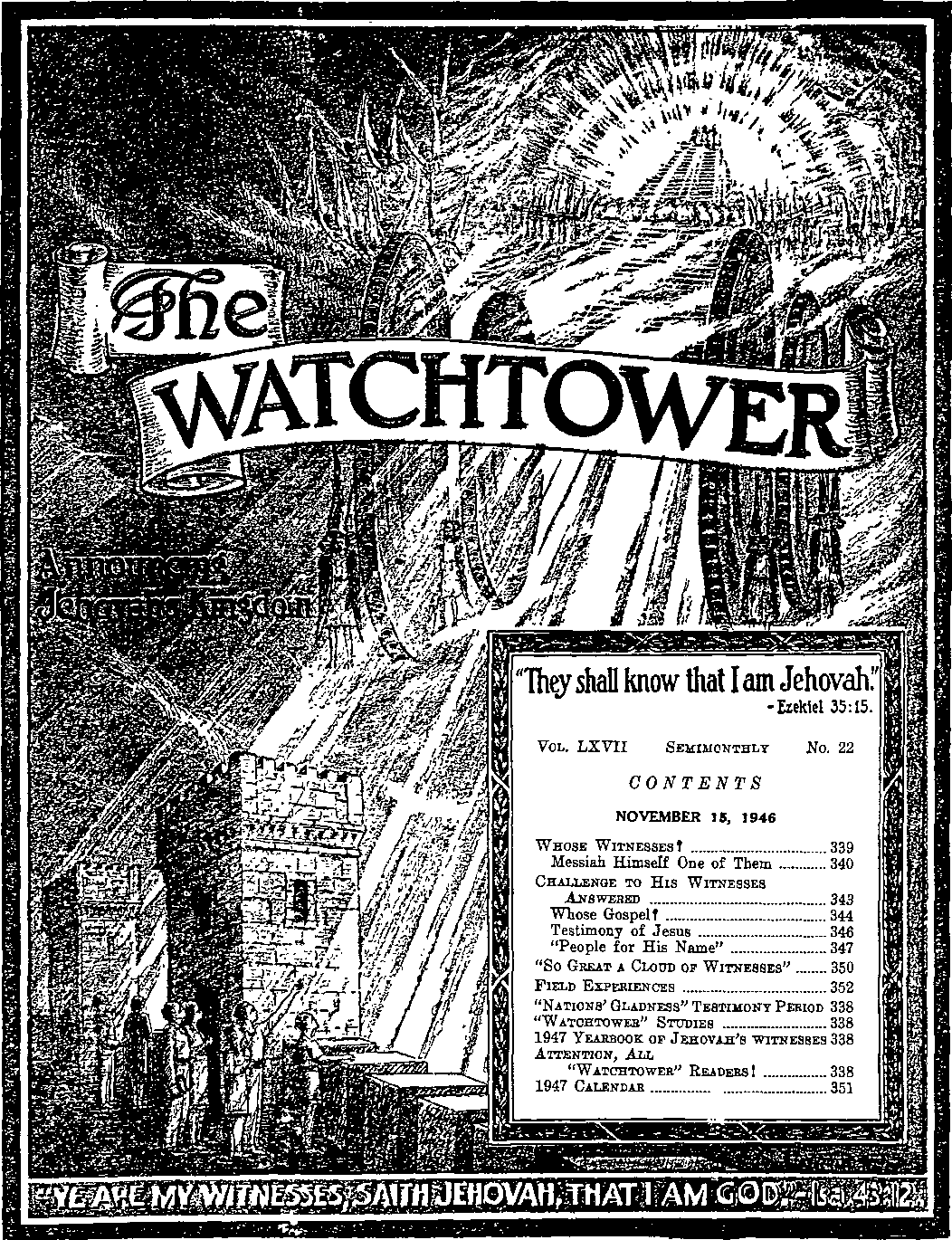
THE WATCHTOWER
Published Semimonthly By
WATCH TOWER BIBLE & TRACT SOCIETY 117 Adams Street - •- Brooklyn 1, N.Y., U.S.A
Officers
N. H. Knobs. President W. E. Van Ambubgh, Secretary “And all thy children shall be taught of Jehovah; and great shall be the peace of thy children.” - Isaiah 54:13.
THE BIBLE CLEARLY TEACHES
THAT JEHOVAH Is the only true God, from everlasting to everlasting, and is the Maker of heaven and earth and Giver of life to his creatures; that the Word or Logos was the beginning of his creation and his active agent in creating all other things; and that the creature Lucifer rebelled against Jehovah and raised the issue of His universal sovereignty;
THAT GOD created the earth for man, made perfect man for the earth and placed him upon it: that man yielded to unfaithful Lucifer, or Satan, and willfully disobeyed God’s law and was sentenced to deatii; that by reason of Adam’s wrong act all men are born sinners and without the right to life;
THAT THE LOGOS was made human as the man Jesus and suffered death in order to produce the ransom or redemptive price for obedient men; that God raised up Christ Jesus divine and exalted him to heaven above every other creature and clothed him with ail power and authority as head of God's new capital organization:
THAT GOD’S CAPITAL ORGANIZATION is a Theocracy called Zion, and that Christ Jesus is the Chief Officer thereof and is the rightful King of the new world; that the faithful anointed followers of Christ Jesus are Zion’s children, members of Jehovah's organization, and are His witnesses whose duty and privilege It is to testify to Jehovah’s supremacy and declare his purposes toward mankind as expressed in the Bible;
THAT THE OLD WORLD, or Satan’s uninterrupted rule, ended A.D. 1914, and Christ Jesus has been placed by Jehovah upon the throne, has ousted Satan from heaven, and now proceeds to vindicate His name and establish the “new earth”;
• THAT THE RELIEF and blessings of the peoples can come only by Jehovah’s kingdom under Christ, which has begun; that His next great act is to destroy Satan’s organization and establish righteousness completely in the earth ; and that under the Kingdom the people of good-will surviving Armageddon will carry out the divine mandate to “fill the earth” with righteous offspring, and that the human dead in the graves will be raised to opportunities of life on earth.
“NATIONS’ GLADNESS” TESTIMONY PERIOD
“Nations' Gladness” Testimony Period coincides with the last month of this calendar year, the yeartext for which is, “Be glad, ye nations, with his people.” (Rom. 15:10, Rotherham) A new booklet was specially prepared to be ready for delivering the testimony in this month of December, namely, ’"The Prince of Peace", and an edition of five million copies is being run off. This anticipates a wide and intensive distribution. That many others may conveniently be provided with copies to join in the distribution, the Kingdom publishers will specialize during December on placing the booklet from house to house, offering seven copies on a contribution of twenty-five cents, three copies ten cents, and one copy five cents. Its message deserves the widest reading, and the call for distributors is urgent. If you see your opportunity to take part with others in this house-to-house distribution, write us now for needed information and references. That the general report of all activity during the “Nations’ Gladness” Testimony Period may be compiled here, we remind you to turn in your report of field work during December.
“WATCHTOWER” STUDIES
Week of December 15: “Whose Witnesses,” 1-17 inclusive, The Watchtower November 15, 1946. Week of December 22: “Challenge to His Witnesses Answered,” fl 1-18 inclusive, The Watchtower November 15, 1946. Week of December 29: “Challenge to His Witnesses Answered,” If 19-29 inclusive, also “So Great a Cloud of Witnesses,” if 1-9 inclusive, The Watchtower November 15, 1946.

ITS MISSION
HIS journal te published for the purpose of enabling the people to know Jehovah God and his purposes as expressed in the Bible. It publishes Bible instruction specifically designed to aid Jehovah's witnesses and all people of good-wllL It arranges systematic Bible study for its readers and the Society supplies other literature to aid in such studies. It publishes suitable material for radio broadcasting and for other means of public Instruction In the Scriptures.
It adheres strictly to the Bible as authority for its utterances. It is entirely free and separate from all religion, parties, sects or other worldly organizations. It is wholly and without reservation Cor the kingdom of Jehovah God under Christ his beloved King. It is not dogmatic, but invites careful and critical examination of its contents in the light of the Scriptures. It does not indulge in controversy, and its columns are not open to personalities.
Ybarlt Subscription Price
United States, $1.00: all other countries. $1.50, American currency; Great Britain, Australasia, and South Africa, 6s. American remittances should be made by Postal Note cr by Postal or Express Money Order or by Bank Draft. Outside of the United States remittances should be made direct to the respective branch offices. Remittances from countries other than those mentioned may be made to the Brooklyn office, but by International Postal Money Order only.
Foreign Offices
Australia 7 Beresford Rd., Strathfleld. N. S. W. Canada 40 Irwin Are., Toronto 5. Ontario
England 34 Craven Terrace, London, W. 2
India ...............______________________________ 167 Love Lane, Bombay 27
Newfoundland P. O. Box 521, St. John's New Zealand _____________________________ 177 Daniell St., Wellington, S. 1
Philippine Islands 1219-B Oroquleta St. Manila
South Africa 623 Boston House, Cape Town
Please address the Society in every case.
Translations of this Journal appear In several languages.
. ALL SINCERE STUDENTS OF THE BIBLE who by reason of Infirmity, poverty or adversity are unable to pay the subscription price may have The Watchtower free upon written application to the publishers, made once each year, stating the reason for so requesting it. We are ffiad to thus aid the needy, but the written application once each years required by the postal regulations.
Notice to Subscribers: Acknowledgment of a new or a renewal subscription will be sent only when requested. Change of address, when requested, mav be expected to appear on address label within one month Old and new addresses must be given. A renewal blank (carrying notice of expiration) will be sent with the journal one month before the subscription expires
Printed In the United States of America
Entered as second-class matter at the post office at Brooklyn, N. Y., under the Act of March s, 1879.
1947 YEARBOOK OF JEHOVAH’S WITNESSES
The first postwar year of action by the Lord’s kingdom publishers in more than fifty lands is reported on in the 1947 Yearbook of Jehovah’s witnesses. This report was prepared by the president of the Watch Tower Bible and Tract Society. It discloses the growing magnitude of Jehovah’s visible organization and of the “strange work” he is accomplishing through it. Supplementing this interesting report is the president’s comment on the yeartext for 1947, together with a daily Bible text for the year’s 365 days and a comment thereon as taken from this past year’s issues of The Watchtower. The limited printing obliges us to post the contribution rate for this 1947 Yearbook at 50c a copy, mailed postpaid to you. AU group units should combine the orders of their members and forward same here through the appointed servant, to bring about economies of time and expense at this end.
ATTENTION, ALL “WATCHTOWER” READERS!
During December the Watchtower Society is releasing for general distribution its new publication, the 64-page booklet entitled “The Prince of Peace”. During December the thoughts and professions (if only outwardly) of aU nations of Christendom turn to sentiments of peace and good-will, but always the people are left without real knowledge of how ever-enduring peace is to come to all men of good-will on this earth. The booklet "The Prince of Peace" contains a distinctly different, and most up-to-
(Continued on page 351)

ANNOUNCING JEHOVAH’S KINGDOM
Vol. LXVII November 15,1946 No. 22
WHOSE WITNESSES?
“These things saith the Amen, the faithful and true witness, the beginning of the creation of God.” —Rev. 3:14.
JEHOVAH God ‘deft not himself without witness” at any time since man’s creation. So two missionaries, Barnabas and Paul, testified on an occasion when they were mistaken for being gods come down to earth in human form. Rather than accept the worship of the pagan Asiatics at Lystra who had thus mistaken them, Barnabas and Paul chose to bear witness to the “living God, which made heaven, and earth, and the sea, and all things that are therein”. (Acts 14:15-17) Thus, by their words and actions, two things are demonstrated: (1) Jehovah God the Creator gave witness to his Godship by the good he did in giving rain and fruitful seasons and material blessings to men; (2) he also raised up living, intelligent, speaking witnesses for himself on earth among men.
-
2 It would take a very prejudiced person indeed to deny that Barnabas and Paul were Jehovah’s witnesses on this occasion at least, for they bore witness to the One of whom the prophet Jeremiah boldly declared: “Jehovah is the true God; he is the living God, and an everlasting King:... He hath made the earth by his power, he hath established the world by his wisdom, and by his understanding hath he stretched out the heavens.” (Jer. 10:10-12, Am. Stan. Var.) Barnabas and Paul’s experience took place about A.D. 46, or nineteen centuries ago, and now the question has been thrown into the public forum and is hotly disputed, Has Jehovah actually any living, intelligent, speaking witnesses on earth today? and should Christians not rather be witnesses for Jesus Christ primarily and be known as “witnesses of Jesus”?
-
3 The accusation has been vigorously pushed by religionists of today that for any Christian to try to be a witness now of Jehovah God means to belittle Christ; it means to “de-Christ Christianity”. To any Christian that attempts to be such a witness they say: ‘Don’t you know that Christians never were
-
1. In what two ways did God not leave himself without witness?
-
2. How do we know whose witnesses Paul and Barnabas were? and what related question is disputed today?
-
3. What questions do objecting religionists put to Jehovah’s witnesses today? and with what intent" called witnesses of Jehovah? and that Jesus Christ said to his disciples, “Ye shall be witnesses unto me both in Jerusalem, and in all Judaea, and in Samaria, and unto the uttermost part of the earth”? (Acts 1:8) Where did Jesus and his disciples ever use the name Jehovah? and where is the name Jehovah to be found in the inspired writings of Jesus’ disciples, from Matthew to the Revelation, or Apocalypse? Did not Jesus say that “repentance and remission of sins should be preached in his name among all nations, beginning at Jerusalem. And ye are witnesses of these things” ? And don’t you know that his disciples speak of it as “the gospel of Jesus Christ” and “the glorious gospel of Christ”? Don’t you know that eventually “at the name of Jesus every knee should bow, of things in heaven, and things in earth, and things under the earth; and that every tongue should confess that Jesus Christ is Lord”?’ (Luke 24:47,48; Mark 1:1; 2 Cor. 4:4; 10:14; Phil. 2:10, 11) In asking questions in that form the clear intent of the religionists is to prove that no Christian is authorized or appointed to be a witness of the One (to quote Psalm 83:18) “whose name alone is Jehovah", and that to be known and designated as a "witness of Jehovah” now is presumptuous and un-Christian.
4 That the name “witnesses of Jehovah” or “Jehovah’s witnesses” is offensive to all Christendom goes without saying. It is also a tragic fact that the natural Jews or Israelites have been fearfully persecuted during the last nineteen centuries by professing Christians, and particularly since the rise of Fascism and Nazism, but this has not been for bearing the above name under discussion. On the contrary, it has been Christians that have been known by the name in the last fifteen years, and these marked Christians are the ones hated in all nations and persecuted in all Christendom for bearing the name and striving to live up to it lest they bear the name in vain. Such persecution upon them by professing Christians does not agree with the Bible’s
-
4. Who have been the ones persecuted for bearing the name? and by whom has such persecution been inspired, and for what purpose'’
definition of "Christianity”. Hence it cannot be inspired by the Founder of Christianity, Christ Jesus himself. It must be from his adversary, Satan the Devil. So it is proper to ask whether the persecution is not pushed by the adversary and his religious agents in order to prevent and frighten others from becoming witnesses of the Most High God as well as to destroy those who already bear the name. The answer to that question is so plain that we need not let it divert us from facing the afore-cited questions which religionists raise in objection to those who bear the name and answering such questions.
-
5 To bolster up their argument that Christians must be witnesses of Christ rather than of Jehovah, and that Christ must now take precedence over God with them, the religionists do this: They point to the number of times that the word God is used by the inspired Christian writers in comparison with Christ and Jesus. 'Look,’ say they, ‘at the hundreds of times that the words Jesus and Christ occur in the "New Testament”. Why,’ they will add, ‘the word Christ occurs 37 times in the Greek text of Paul’s letter to the Philippians as against only 23 times that the word God occurs.’ All that sounds very impressive until we proceed to make further examination by following along their own method of argument and calculation.
-
8 The above fact may, indeed, be the case with the book of Philippians, but that proves nothing as to the other books. Take the apostle John’s writings. He was the closest of the disciples to Jesus. Nevertheless, in his three epistles John uses the two words Christ and Jesus 14 times each, or 28 times together, as against using the word God 67 times. In fact, in John’s third epistle he does not mention Christ or Jesus or the Son once, but does use the word God 3 times. And in the very last book of the Bible, Revelation, which was delivered by Jesus Christ to John by an angel, the word Jesus occurs only 14 times, Christ only 11 times, and the Lamb 29 times, or 54 times all together, whereas the word God occurs 99 times in the Greek text of The Revelation, both alone and in such expressions as “Lord God Almighty”. According to the comparative weights of the number of references, whose witness was this John, the last of the twelve apostles to survive? He was primarily God’s -witness.
-In a count of the occurrences of the words Jesus and Christ in the entire “New Testament”, so called, we find the following comparison thereof with the occurrences of God, Lord and Father as applying to
-
5. To bolster up their argument, to what comparison do the objectors point?
-
6. What is the result of such a comparison with John’s three epistles and The Reflation? and whose witness Is John proved to be?
-
7, 8. What comparison is given of the numbers of occurrences of names and titles ? and whose witnesses were the Inspired writers ?
Jehovah. The Greek text* shows the following
usages:
|
Jesus (alone), in the four gospels From Acts to Revelation |
560 82 |
times » |
|
Christ (alone), in the four gospels |
46 |
n |
|
From Acts to Revelation |
247 |
a |
|
Lord (alone), as applying to Jesus, in the Gospels |
129 | |
|
From Acts to Revelation |
118 | |
|
Lord Jesus |
129 | |
|
Jesus Christ |
151 |
ft |
|
Christ Jesus, only from Acts to Philemon |
107 |
n |
|
God, in John 1:1 and 20: 28, and Hebrews 1:8 |
3 | |
|
Messias |
2 | |
|
Son of man |
84 | |
|
Son of God |
79 |
>> |
|
Son of Abraham, of David |
20 |
>* |
|
Total of such twelve styles of reference to Jesus |
1,757 |
times |
|
God, as meaning Jehovah, in the gospels |
307 |
times |
|
From Acts to Revelation |
1,012 | |
|
Lord, as meaning Jehovah |
275 | |
|
Father, as applying to Jehovah |
260 |
)} |
Total of such three styles
of reference to Jehovah 1,854 times
-
8 Thus 1,757 references to Jesus are obtained, to compare with 1,854 references to Jehovah God. To whom, then, does the superiority as based upon the number of references from Matthew to Revelation go, to Jesus Christ or to Jehovah God? On this basis, just whose witnesses were the inspired writers of the so-called “New Testament”, primarily of Jesus or of Jehovah? The honest answer is, Of Jehovah!
MESSIAH HIMSELF ONE OF THEM
’ One fact is slighted by many religious persons of Christendom. It is that Jesus Christ, the Son of God, was himself a witness. A witness is one that bears testimony or evidence concerning certain persons or things. He is one that sees or knows by reason of personal presence or experience. In Revelation 1: 5 stands the expression “Jesus Christ, who is the faithful witness”; and at Revelation 3:14 Jesus Christ himself speaks and says to the church at Laodicea in Asia Minor: “These things saith the Amen, the faithful and true witness, the beginning of the creation of God.” Critical students of the
•According to the Concordance to the Greek Testament by Moulton and Geden (1897).
-
9. What fact regarding Jesus Christ Is slighted by many? and why is it especially true at this Laodicean state or matters?
Bible and of world conditions readily agree we are in the period of Christianity which was foreshadowed by the state of matters in the church of Laodi-cea. Therefore at this particular time since A.D. 1918 these words of Jesus Christ, “The Amen,” apply.
-
10 Hence the question follows: Of whom or for what is h‘e “the faithful and true witness” ? The apostle Paul refers to him in this testimonial capacity, at 1 Timothy 6:13, saying to Timothy: “I charge thee in the sight of God, who giveth life to all things, and of Christ Jesus, who before Pontius Pilate witnessed the good confession.” (Am. St an. Ver.) Our search for what was his “good confession” draws our attention to the following interchange of words between Pilate and Jesus in the governor’s house: “Pilate therefore said unto him, Art thou a king then? Jesus answered, Thou sayest that I am a king. To this end was I born, and for this cause came I into the world, that I should bear witness unto the truth.” (John 18:37) In order to be a faithful and true or unerring ■witness, he had to give testimony to the truth. So the question now is, Whose witness or martyr was Jesus Christ? It is important to answer this question, because Christians must follow his example. Petei’ writes to them: “For even hereunto were ye called: because Christ also suffered for us, leaving us an example, that ye should follow his steps.” (1 Pet. 2:21) And at Romans 8: 28, 29 Paul writes: “All things work together for good to them that love God, to them who are the called according to his purpose. For whom he did foreknow, he also did predestinate to be conformed to the image of his Son, that he might be the firstborn among many brethren.” His Christian brethren must accordingly be conformed to him in this vital matter of giving testimony, following his example. Those claiming to be Christians cannot wriggle out of this obligation resting on them.
-
11 Proving that Jesus would serve in this testimonial wTay, the prophecy foretold hundreds of years before his day: “Behold, I have given him for a witness to the people, a leader and commander to the people.” (Isa. 55: 4) The speaker of those words is the One that inspired Isaiah to write them down, namely, Jehovah God. Since he gave Jesus his Son for a witness to the people, the fact is indisputable that Jesus Christ was a Witness of Jehovah and was a Leader and Commander of his footstep followers in this regard. Because he thus served for Jehovah God he said: “I am come in my Father’s name.” (John 5:43) He was continually testifying for his heavenly Father, and -with this agrees the fact that
-
10. What confession did Jesus Christ witness before Pontius Pilate’’ and why is it important to prove whose witness Jesus was?
-
11. What did Isaiah 65:4 foretell concerning Jesus? and whose name did be seek to honor, and how? in John’s gospel alone the title Father is applied 108 times to God by his Son Jesus. The request of his disciples to teach them to pray brought forth this model prayer from Jesus: “Our Father which art in heaven, Hallowed be thy name. Thy kingdom come. Thy will be done in earth, as it is in heaven.” In that prayer Jesus gives the first attention to the Father’s name. In his sermon on the mountainside he said the. following words with a view to having his Father’s name hallowed: “Again, ye have heard that it hath been said by them of old time, Thou shalt not forswear thyself, but shalt perform unto the Lord thine oaths: but I say unto you, Swear not at all; neither by heaven; for it is God’s throne: nor by the earth; for it is his footstool.” (Matt. 5:33-35) Here Jesus was referring to God’s law at Leviticus 19:12: “And ye shall not swear by my name falsely, and profane the name of thy God: I am Jehovah.”—Am. Stan. Ver.
-
12 Jesus knew that the promised Kingdom was the foremost doctrine of the Bible, and his own preaching helped to make it so and to keep it to the fore. “The kingdom of heaven is at hand” was the message with which he began his great Galilean ministry of preaching. (Matt. 4:17) Said he: “The time is fulfilled, and the kingdom of God is at hand: repent ye, and believe the gospel.” (Mark 1:15) The gospel or good news was of the kingdom of God, and to the time of his dying on the tree Jesus kept at preaching God’s kingdom and thus he held faithful and true to God’s side of the controversial issue of universal sovereignty. The record of him is that “he went throughout every city and village, preaching and shewing the glad tidings of the kingdom of God: and the twelve [apostles] were with him”. As to these twelve the record says: “He sent them to preach the kingdom of God, and to heal the sick.” (Luke 8:1; 9:2) In all this Jesus was proving himself to be a witness of Jehovah God.
-
13 It is idle talk to say he was not such a witness because no written record shows he ever used the name “Jehovah” on earth. Why so? Because the very name given to him by the command of God’s angel, namely, “Jesus,” bears testimony to God’s own name, for this given name “Jesus” means “Jehovah [is] salvation”, or “Jehovah the Savior”. Tliis does not mean that Jesus himself was Jehovah or was the same as Jehovah, because that name “Jesus” is also applied, at Acts 7:45 and Hebrews 4:8, to Moses’ successor Joshua, and, at Colossians 4:11, to a certain Justus. Hence the name is seen to mean that Jehovah is the Source of salvation and that salvation belongs to him. But the fact that Christ bore the
-
12. What is the Bible’s foremost doctrine? and how did Jesus help to make it so?
-
13. Why is it idle talk to say Jesus was not Jehovah’s witness because he never used the name “Jehovah” on earth? name Jesus on earth testifies to his being the One by or through whom Jehovah God brings about the salvation of humankind. Jesus must have known the name of his heavenly Father and just how it was pronounced, for he came down from heaven and after his anointing with God’s spirit he remembered how he had been with his Father in heaven before he became man. Just to what extent he pronounced the name of his Father to his faithful apostles is not certain from the record. But in prayer to God on the night of his betrayal he said: “And now, 0 Father, glorify thou me with thine own self with the glory which I had with thee before the world was. I have manifested thy name unto the men which thou gavest me out of the world.” (John 17:5,6) From this it is evident that he made some revelation to them as to God’s name.
-
14 Jesus when on earth confined his ministry of preaching to the circumcision, that is to say, the circumcised Jews. He left it for his disciples after him to preach to the Gentiles or uncircumcision later. The apostle Paul was one who preached largely to such uncircumcised Gentiles, and he writes, saying: “Receive ye one another, as Christ also received us to the glory of God. Now I say that Jesus Christ was a minister of the circumcision for the truth of God, to confirm the promises made unto the fathers: and that the Gentiles might glorify God for his mercy; as it is written, For this cause I will confess to thee among the Gentiles, and sing unto thy name. And again he saith, Rejoice, ye Gentiles, with his people. And again, Praise the Lord, all ye Gentiles; and laud him, all ye people.” The last of these three quotations by Paul is from Psalm 117:1, which reads: “Oh praise Jehovah, all ye nations; laud him, all ye peoples.” (Am. Stan. Ver.) By the foregoing statement of Paul, at Romans 15: 7-11, he shows that Christ’s followers must be witnesses of Jehovah God and must confess and praise his name.
-
15 As a writer the apostle John used the words “witness” and “bear witness” in the Greek text more often than all the other apostles. In proof that Jesus Christ was the chief witness of the true God, Jehovah, he writes, at 1 John 5:20: “And we know that the Son of God has come, and has given us power to recognize him who is true; and we are in union with him who is true, through his Son, Jesus Christ. He is the true God and eternal life.” (Goodspeed) The Catholic Confraternity edition of 1943 reads on this same verse: “And we know that the Son of God has come and has given us understanding, that we may know the true God and may be in his true Son. He
-
14. At Romans 15:7-11 how does Paul show Christ's followers must be witnesses of Jehovah?
-
15. How does John, at 1 John 5:20, prove Jesus was Jehovah’s chief witness ?
is the true God and eternal life.” (1 John 5: 20) This verse*, according to its reading in the King James Version Bible, has been used by religionists to argue in favor of their pet doctrine of a “trinity”. But now, from the above-quoted modern versions and others*, it is clearly seen that, in place of being the real, true Almighty God Jehovah himself, Jesus as His Son was merely the witness of Jehovah God, to give us an insight and understanding respecting the time God Jehovah.
18 As a faithful and true witness, Jesus taught men correctly on the worship of the Lord God. Early in his ministry he spoke to a Samaritan woman at a well in Samaria. He said: “Woman, believe me, the hour cometh, when ye shall neither in this mountain, nor yet at Jerusalem, worship the Father. Ye worship ye know not what: we know what we worship: for salvation is of the Jews. But the hour cometh, and now is, when the true worshippers shall worship the Father in spirit and in truth: for the Father seek-eth such to worship him. God is a Spirit: and they that worship him must worship him in spirit and in truth.” (John 4: 21-24) Jesus’ testimony is true and absolutely dependable as regards heavenly things because he has seen and knows. He said to the Jewish ruler Nicodemus: “Verily, verily, I say unto thee, We speak that we do know, and testify that we have seen; and ye receive not our witness. If I have told you earthly things, and ye believe not, how shall ye believe, if I tell you of heavenly things ? And no man hath ascended up to heaven, but he that came down from heaven, even the Son of man.” (John 3:11-13) Consequently John says of Jesus: “He that cometh from above is above all: he that is of the earth is earthly, and speaketh of the earth: he that cometh from heaven is above all. And what he hath seen and heard, that he testifieth; and no man receiveth his testimony.” The majority of men have not received his testimony, but what about those believers who do accept Jesus’ testimony? In answer, John says: “He that hath received his testimony hath set to his seal that God is true. For he whom God hath sent speaketh the words of God.”—John 3: 31-34.
1T John’s argument makes it clear that the chief thing is to prove that Jehovah God is true. The argument also shows that Jesus was a true witness of God, “whose name alone is Jehovah.” It shows that if we accept Jesus’ testimony concerning Jehovah, then we are acknowledging that God is true and are certifying to the truth of God. Thereby we are honoring God, and are also honoring his “faithful and true witness”, Christ Jesus.
•See the Douay and also Weymouth’s translation and footnote.
16, 17. (a) By bls teaching on worship how did Jesus prove himself a witness of Jehovah? (b) Why Is his testimony as to heavenly things reliable? and how does it affect God if we accept Jesus' testimony?
TIE truth of God concerning his Messiah or Christ has to be established; for he had promised to send a Messiah. In the garden of Eden, soon after man’s fall under the dominion of the first false witness, Satan the Devil, the divine promise was given: “I will put enmity between thee and the woman, and between thy seed and her seed; it shall bruise thy head, and thou shalt bruise his heel.” (Gen. 3:15) Ever since then men with faith in God, beginning with Abel the first martyr, have looked for the coming of the Messiah or Christ. They have wanted to identify him that they might accept him and follow him, out of honor to Jehovah God, who sent him.
-
2 To help toward this identification, it was necessary for God himself to give testimony in advance concerning the Messiah, for God alone knew who he would be and what would be his course of life on earth. God gave such prophetic testimony about Messiah or Christ by his heavenly angels and also by his faithful prophets on earth. Hence he used such prophets to bear testimony to Messiah or Christ. They were witnesses unto Christ, but this does not mean that they were not also witnesses of Jehovah. In fact, it was because they were Jehovah’s witnesses that He used them to testify as respects the coming Messiah or Christ. In view of such prophetic testimony the apostle Peter could say: “To him [the Messiah] give all the prophets witness, that through his name whosoever believeth in him shall receive remission of sins.” And in his first letter Peter wrote to the same effect, saying: “Of which salvation the prophets have enquired and searched diligently, who prophesied of the grace that should come unto you: searching what, or what manner of time the spirit of Christ which was in them did signify, when it testified beforehand the sufferings of Christ, and the glory that should follow.”—Acts 10:43; 1 Pet. 1:10, 11.
-
3 John the Baptist was the first prophet to identify the Messiah. Necessarily, then, he was a bearer of testimony to Jesus, concerning which fact it is written: “There came a man, sent from God, whose name was John. The same came for witness, that he might bear witness of the light, that all might believe through him. He was not the light, but came that he might bear witness of the light.” John fulfilled this stated mission, for we read this in the historical record of him: “And John bare witness, saying, I have beheld the spirit descending as a dove out of heaven; and it abode upon him. And I knew him not:
1. Why did God’s truth concerning his Messiah have to be established? 2. How did God help in this identification? and what does Peter say to prove He did?
-
3. How was John the Baptist a witness to Jesus and not less so a witness of Jehovah? but" he that sent me to baptize in water, he said unto me, Upon whomsoever thou shalt see the spirit descending, and abiding upon him, the same is he that baptizeth in the holy spirit. And I have seen, and have borne witness that this is the Son of God.” (John 1:6-8,32-34, Am. Stan. Ver.; 3:26) Did such testimony regarding Jesus make John the Baptist any less the witness of Jehovah? Not at all, for thereby John testified to the truthfulness of God’s word. To emphasize that John would be the witness of the Lord God the angel who told of his coming birth said to Zacharias his father: “Many of the children of Israel shall he turn unto the Lord their God.” And on the day that the babe was named John, Zacharias said: “Yea and thou, child, shalt be called the prophet of the Most High: for thou shalt go before the face of the Lord to make ready his ways; to give knowledge of salvation unto his people in the remission of their sins.”—Luke 1:16, 76,77, Am. Stan. Ver.
* In fact, the Lord God himself was obliged to vindicate his prophetic word respecting the Messiah. To do so, he gave convincing witness to support the truth that Jesus is the Messiah. Jesus relied chiefly upon this testimony of God and called attention to it. “If I bear witness of myself,” said he, “my witness is not true. There is another that beareth witness of me; and I know that the witness which he witnesseth of me is true. Ye sent unto John, and he bare witness unto the truth. But I receive not testimony from man: but these things I say, that ye might be saved. He was a burning and a shining light: and ye were willing for a season to rejoice in his light. But I have greater witness than that of John: for the works which the Father hath given me to finish, the same works that I do, bear witness of me, that the Father hath sent me. And the Father himself, which hath sent me, hath borne witness of me.” Then, to show that the Father’s prophet Moses had borne testimony to the promised Messiah, Jesus said to the unbelieving Jews: “Do not think that I will accuse you to the Father: there is one that accuseth you, even Moses, in whom ye trust. For had ye believed Moses, ye would have believed me: for he wrote of me. But if ye believe not his writings, how shall ye believe my words?” (John 5:31-37,45-47) Still, Moses’ writings regarding Messiah were true.
-
5 Due to the written testimony that Jehovah God had given through His prophets prior to John the Baptist, Jesus after his resurrection from the dead could turn to their writings as proof of his Messiah-ship. “And he said unto [his disciples], These are the words which I spake unto you, while I was yet with you, that all things must be fulfilled, which
-
4. Whose witness did Jesus chiefly rely upon? and how did he show that? 5. How did Paul copy Jesus’ method of identifying the Messiah? and did he thereby belittle Jehovah?
were written in the law of Moses, and in the prophets, and in the psalms, concerning me. Then opened he their understanding, that they might understand the scriptures, and said unto them, Thus it is written, and thus it behoved Christ to suffer, and to rise from the dead the third day: and that repentance and remission of sins should be preached in his name among all nations, beginning at Jerusalem. And ye are witnesses of these things.” (Luke 24:44-48) Copying Jesus’ method, the apostle Paul likewise referred to the written prophetic testimony about Jesus, and said to King Agrippa: “Having therefore obtained help of God, I continue unto this day, witnessing both to small and great, saying none other things than those which the prophets, and Moses did say should come: that Christ should suffer, and that he should be the first that should rise from the dead, and should shew light unto the people, and to the Gentiles.” (Acts 26:22,23) By thus offering testimony to Christ Jesus, neither the apostle Paul nor John the Baptist was belittling Jehovah God or pushing him into the background. Contrariwise, they were witnessing to Jehovah’s truthfulness and to the vindication of his written Word of prophecy.
-
8 In all this testimony the vindication of Jehovah God as true is primarily at issue. By what way we regard this testimony we make out God as either a truthteller or a liar, to ourselves. This is the argument of Jesus’ beloved apostle, John, who writes: “If we receive the witness of men, the witness of God is greater: for the witness of God is this, that he hath borne witness concerning his Son. He that believeth on the Son of God hath the witness in him: he that believeth not God hath made him a liar; because he hath not believed in the witness that God hath borne concerning his Son. And the witness is this, that God gave unto us eternal life, and this life is in his Son.” (1 John 5: 9-11, Am. Stan. Ver.) By such words John was not putting Jesus foremost and giving him more prominence than God his Father. No; but John was giving Jehovah God the chief importance because He is the Author of eternal life and such life is His gift by his Son Jesus Christ. Thus John did not back down from the apostolic position of being first Jehovah’s witness.
WHOSE GOSPEL?
-
7 Why, then, did Jesus say to his apostles just before ascending to heaven: “Ye shall be my witnesses both in Jerusalem, and in all Judaea and Samaria, and unto the uttermost part of the earth”1? (Acts 1:8, Am. Stan. Ver.) Since the Scriptures speak of it as “the gospel of Christ”, why, then,
-
6 . How did John show we make God either a truthteller or a ilar? and did John thereby minimize Jehovah’s importance?
-
7 . Why, in being Jehovah’s witnesses, may Christians not refrain from being witnesses also to Jesus? should any Christians put themselves forward as Jehovah’s witnesses? The answer to that challenging question is this: that a Christian could not be a faithful witness of Jehovah God without also giving testimony to His Son. Because God the Father framed his purpose about his beloved, only begotten Son and then gave such decisive evidence that the Son is his Messiah or Christ, a believer in God who acts as His witness would not be true to God or be telling the whole truth if he ignored the testimony that God has given. He would also be ignoring God’s Chief Servant, his Elect Servant. (Isa. 42:1) True Christians will not do this.
-
8 Almighty God has highly exalted his Son above all the rest of creation, and has given the Son all the needed power in heaven and in earth to act as God’s Servant for the fulfillment of God’s will. As it is written: “God also hath highly exalted him, and given him a name which is above every name [excepting, of course, God’s own name, Jehovah]: that at the name of Jesus every knee should bow, of things in heaven, and things in earth, and things under the earth; and that every tongue should confess that Jesus Christ is Lord.” Now, why is all this? Is it to give the chief honors to Christ Jesus? Not at all, for the apostle Paul adds the climax to the above statement by saying, “to the glory of God the Father.” (Phil. 2:9-11) Primarily, then, whose witness was the apostle Paul by giving such testimony ? His giving the ultimate and highest glory to God the Father supplies the unmistakable answer.
-
8 In order to prove that God the Father had sent his only begotten Son from heaven to be the Messiah, it was needful for Jesus’ apostles to be “his witnesses”. Their being such would be to the glory and exaltation of God the Father. The apostles had been with Jesus Christ on earth. They had seen and heard him. They knew the actual facts about him. Why should they not be responsible to make these facts known as evidence to the truth? The apostle Paul said: “Let God be true, but every man a liar.” Paul saw and heard Jesus Christ after his resurrection from the dead, and to prove God true this is what Paul wrote about Jesus’ ministry to the circumcised Jews, the descendants of the forefathers Abraham, Isaac and Jacob: “I hold that Christ has become an agent of circumcision to show God’s truthfulness in carrying out the promises made to our forefathers, and causing the heathen to praise God for his mercy.”—Rom. 3:4; 15: 8, 9, An Amer. Trans.
-
10 The apostle John was most intimate with Jesus
-
8. How, at Phllippians 2:9-11, did Paul show Jehovah’s witnesses may not ignore God's Son? and whose witness did Paul there prove himself primarily?
-
9. Why was it needful for Jesus’ apostles to be his witnesses?
-
10. In his first epistle what did John witness concerning Jesus? and just how do we have fellowship with the apostles51 in the flesh, and writes: “That which was from the beginning, which we have heard, which we have seen with our eyes, which we have looked upon, and our hands have handled, of the Word of life; (for the life was manifested, and we have seen it, and bear witness, and shew unto you that eternal life, which was with the Father, and was manifested unto us;) that which we have seen and heard declare we unto you, that ye also may have fellowship with us: and truly our fellowship is with the Father, and with his Son Jesus Christ. And we have seen and do testify that the Father sent the Son to be the Saviour of the world.” (1 John 1:1-3; 4:14) Only if we get such facts from the personal acquaintances of Jesus Christ on earth, only then can we have fellowship with the apostles by sharing in common knowledge.
-
11 Jesus instructed the apostles as to their responsibility when he said: “And ye also shall bear witness, because ye have been with me from the beginning.” (John 15:27) Having seen him after he was resurrected, they could give undeniable evidence of his resurrection such as none of us today can do. Acts 4: 33 tells us: “With great power gave the apostles witness of the resurrection of the Lord Jesus.” The apostles were appointed to be witnesses to that. (Acts 1:21,22) Note now some declarations of the apostles in evidence:
-
12 Peter on the day of Pentecost says as speaker for his fellow disciples there: “This Jesus hath God raised up, whereof we all are witnesses.” (Acts 2: 32) Later to the Jews at the temple he fearlessly declares: “Ye denied the Holy One and the Just, and desired a murderer to be granted unto you; and lulled the Prince of life, whom God hath raised from the dead; whereof we are witnesses.” (Acts 3:14, 15) Then to the Jewish Sanhedrin at Jerusalem the apostles say they must be witnesses in obedience to God, in these words: “We must obey God rather than men. The God of our forefathers raised Jesus to life when you had hung him on a [tree] and killed him. God took him up to his right hand as our leader and savior, in order to give repentance and forgiveness of sins to Israel. We and the holy spirit which God has given to those who obey him are witnesses to these things.” (Acts 5:29-32, An Amer. Trans.) To Cornelius and his household Peter says: “Him God raised up the third day, and shewed him openly; not to all the people, but unto witnesses chosen before of God, even to us, who did eat and drink with him after he rose from the dead. And he commanded us to preach unto the people, and to testify that it is he which was ordained of God to be the Judge of quick and dead.”—Acts 10: 40-42.
-
11. What did Jesus say as to the apostles’ responsibility for being with him? and how did they discharge it?
-
12. What were some of Peter's declarations in evidence?
-
13 To Jews in the synagogue at Antioch in Pisidia Paul says of Jesus: “But God raised him from the dead: and he was seen many days of them which came up with him from Galilee to Jerusalem, who are his witnesses unto the people.” (Acts 13: 30, 31) In his letter to the Corinthians Paul cites many witnesses of Jesus’ resurrection and then says: “Last of all he was seen of me also, as of one born out of due time.... we have testified of God that he raised up Christ.”—1 Cor. 15:8,15; also Acts 22:14,15; 23:11; 26:16.
-
14 Examine every one of the above apostolic testimonials respecting the resurrection, and what do you observe? Do they give the principal emphasis to Jesus as the resurrected One? No; but in each case they bear witness to Jehovah God as the Resur-rector, as the Almighty One who raised this dead Son to life. Thus they give the supreme glory to God and vindicate his word and power. The big fact is that God did the raising of Jesus to life and the making of him a princely Leader and Savior and Judge of the living and dead. By such testimony the apostles did not waver from being witnesses of Jehovah, while at the same time they were witnesses to Jesus. God held himself to his own stated rule: “In the mouth of two or three witnesses shall every word be established.” (2 Cor. 13:1; Deut. 17:6; Num. 35: 30) And so he produced the required two or three witnesses on earth, and many more, verily more than five hundred at one time. (1 Cor. 15: 6) God has the whole truth on his side, to His glory.
-
15 By his raising of Jesus from the dead and exalting him to the right hand of the Majesty on high, Jehovah gave life and power to the gospel or good news. Without His intervention when Jesus lay lifeless in the tomb the gospel would have failed. Hence the fact stands forth with brilliance that the gospel belongs to Jehovah God and originated with him. It is true that his Word speaks of “Christ’s gospel” and “the gospel of Jesus Christ”; but that does not separate the gospel from Jehovah God. Mark 1:1 reads: “The beginning of the gospel of Jesus Christ, the Son of God.” A number of times Paul, who had Mark for a companion, speaks of the “gospel of Christ”, and says: “The light of the glorious gospel of Christ, who is the image of God, should shine unto them.” (1 Cor. 9:12,18; 2 Cor. 2:12; 4:4; 9:13; 10:14; Gal. 1:7; Phil. 1:27; 1 Thess. 3:2; Rom. 1:9,16) The gospel is properly thus spoken of, because it deals with the Messiah or Christ, who is the divine agent to bring the blessings promised in the gospel. He is the “seed of Abraham” in whom all
-
13. What were some of Paul's declarations In evidence?
-
14. What is the big fact about all those apostolic testimonials? and bow did God show he has the whole truth on his side?
-
15. How did God give life and power to the gospel? and why Is it also spoken of as “Christ’s gospel’’ to be preached "In his name”? the families and nations of the earth are to be blessed. (Gen. 22:18; Gal. 3:16) Properly, then, the gospel is preached “in his name”.
-
16 However, both Mark and Paul, and Peter also, acknowledge the One to whom the gospel is due and who produced it and sent it forth by Jesus Christ. That One is Jehovah God. In no way does the gospel give less honor and praise to Him than it does to Christ Jesus. Hence Mark also calls attention to the fact that “Jesus came into Galilee, preaching the gospel of God”. (Mark 1:14, Am. Stan. Ver.) The kingdom of God is the main theme of the gospel that Jesus preached. (Matt. 4:23; 9:35; 24:14) Also Paul many times speaks of it as the “gospel of God”, also as the “gospel of the grace of God”, and as the “glorious gospel of the blessed God, which was committed to my trust”. (Rom. 15:16; 2 Cor. 11:7; 1 Thess. 2: 2, 8, 9; Acts 20: 24; 1 Tim. 1:11) He says: "Called to be an apostle, separated unto the gospel of God,... I am not ashamed of the gospel of Christ: for it is the power of God unto salvation to every one that believeth.” (Rom. 1:1,16) Also Peter warns us that divine judgment will be executed against Christians not living up to the purposes of the gospel, asking ominously: “What shall the end be of them that obey not the gospel of God?” (1 Pet. 4:17) And in proof that the gospel sprang from Jehovah God before Jesus appeared upon the earth, we have Paul’s words, at Galatians 3:8: “The scripture, foreseeing that God would justify the Gentiles by faith, preached the gospel beforehand unto Abraham, saying, In thee shall all the nations be blessed.” (Am. Stan. Ver.) Abraham, we must remember, is a prophetic type of Jehovah God, who gave Abraham that gospel statement telling of blessings to come.
-
17 In further proof that the gospel is Jehovah’s, chapter fourteen of Revelation refers to the time of the establishing of God’s kingdom, namely, from and after A.D. 1914. Referring to this transition period between the destruction of the old Satan-controlled heavens and the bringing in of the new Christ-controlled heavens, Revelation 14: 6 tells what John saw and heard: “And I saw another angel fly in the midst of heaven, having the everlasting gospel to preach unto them that dwell on the earth, and to every nation, and kindred, and tongue, and people.” That gospel is therefore the one that must be preached now; and hence with quickened interest we ask, What is the substance or content of this “everlasting gospel”? The next verse tells us what the angel with this gospel said: "Saying with a loud voice, Fear God, and give glory to him; for the hour
-
16. As not giving less honor to Jehovah than to Christ, how is the gospel also spoken of? and bow does Paul show it was preached before Jesus appeared?
-
17. How does Revelation 14: 6, 7 show whose gospel It is? of his judgment is come: and worship him that made heaven, and earth, and the sea, and the fountains of waters.” (Rev. 14:7) In those words the reference is all to God, without mention of his Son Jesus Christ, and the loud command is given to give glory to God and to worship God the Creator.
-
18 That is the last mention of “gospel” in the Bible, but from all the foregoing remarks it is seen that the inspired Christian writers refer to the gospel more often as being of God and of his kingdom (14 times) than as being of Jesus Christ the Son of God (13 times). Hence when Jesus said, "The law and the prophets were until John: since that time the kingdom. of God is preached,” Jesus did not mean that at that time Jehovah’s witnesses had ceased and that since that time he and his followers would cease to bear testimony to Jehovah God. Rather, God’s kingdom gospel must now be preached.—Luke 16:16.
TESTIMONY OF JESUS
-
19 Since the ascension of Jesus Christ to heaven he has not preached visibly and audibly to mankind, but from heaven he has supervised the work of gospel-preaching. Being now a divine spirit, unseen to man, he has committed to his consecrated followers the preaching of the gospel. While he was on earth he testified or bore witness to God’s kingdom, and now this work of testifying the same as he did he has left behind him for his followers to do. This makes it a partnership with Jesus Christ in giving the testimony, and this partnership is spoken of as the “testimony of Jesus Christ” or the “witness of Jesus Christ”.—Rev. 1:2; Rotherham.
-
20 One of those who received a special part of this work of testimony-giving or testification (martyria in the Greek) was the apostle Paul. To stress that he was acting in behalf of or in place of Christ Jesus, he said: “Now then we are ambassadors for Christ.” This was because Christ Jesus was invisible in the heavens, and so Paul acted as visible agent for him. But it was Jehovah God who sent forth Jesus Christ, and now, through Christ, God was sending out Paul and all fellow disciples of Paul. Hence Paul’s statement in full says: "Now then we are ambassadors for Christ, as though God did beseech you by us: we pray you in Christ’s stead, be ye reconciled to God.” (2 Cor. 5: 20) Paul was not beseeching sinners to be reconciled to Christ Jesus; but, acting instead of Christ, Paul was beseeching sinners to be reconciled to Jehovah God. Thus Paul was a witness primarily of the Most High God in order that he might aid in the reconciliation of sinners to God. For that reason
-
18. Although the law and prophets were till John the Baptist, why did not Jehovah’s witnesses then cease?
-
19. To whom has been committed the “testimony of Jesus”? and what, In effect, Is it?
-
20. Because Paul and fellow Christians were ambassadors for Christ, were they not Jehovah's witnesses? and what does 2 Corinthians 5 :18-20 show? Paul says: “All things are of God, who hath reconciled us to himself by Jesus Christ, and hath given to us the ministry of reconciliation [as agents for Christ]; to wit, that God was in Christ, reconciling the world unto himself [God], not imputing their trespasses unto them; and hath committed unto us the word of reconciliation.” (2 Cor. 5:18,19) In this manner Paul and his fellow Christians share with Jesus Christ in the work of reconciliation. Thereby they have the “testimony of Jesus Christ”, that is to say, the same work of testification that Jesus Christ had.
-
21 Another who confessed to having this “testimony of Jesus Christ” is the apostle John, and he was willing to suffer for it. He tells us how he received the book known as “The Revelation” or “The Apocalypse”, saying: “A revelation by Jesus Christ, which God granted him for his servants, to show them what must come to pass very soon; he disclosed it by sending it through his angel to his servant John, who now testifies to what is God’s word and Jesus Christ’s testimony—to what he saw. I John, your brother and your companion in the distress and realm and patient endurance which Jesus brings, found myself in the island called Patmos, for adhering to God’s word and the testimony of Jesus.” (Rev. 1:1, 2, 9, Moffatt) One point that John there shows is that the “testimony of Jesus Christ” is not given apart from the Word of Jehovah God, and that hence the one who gives the witness or testimony of Jesus Christ must be a witness for the Most High God. In fact, the book of revelations that was given John there on the island of Patmos was a “revelation of Jesus Christ” and thus a part of the testimony of Jesus Christ. It was God that gave it to Jesus, and then Jesus shared it with John. John thereafter shared it -with us.
-
22 In the Revelation John tells us what course the Devil takes like a devouring dragon after being toppled from the heavenly heights. Times "without number since A.D. 1925 The Watchtower has pointed out that the birth of the “man child” kingdom took place A.D. 1914 and that the “war in heaven” started immediately after it, and with the result that Satan the Devil and his demon hosts were cast down from heaven to this earth. (Rev. 12:1-12) John’s words, at Revelation 12:17, apply particularly to the consecrated, anointed Christians who are children of God’s “woman” or Theocratic organization in the present postwar epoch. We read: “And the dragon was angered against the woman, and went away to make war with the rest of her seed—with them who were keeping the commandments of God and holding
-
21. How Is the book of “The Revelation” a part of the “testimony of Jesus Christ”?
-
22. At whose command do the Christian remnant now deliver the “testimony of Jesus”, and with war from what quarter? the witness of Jesus.” (Rotherham) That proves that it is at God’s command that they deliver this witness which Jesus has committed to them, including the contents of the book of the Revelation. By all force of reason, then, the ones who now deliver the testimony must be Jehovah’s witnesses, the same as is Jesus Christ, who in this book of Revelation calls himself “the Amen, the faithful and true witness”. (Rev. 3:14) Those Christians who now act as such witnesses may here take warning that the dragonish Devil will make war upon them for it in this postwar epoch. Nevertheless, all who worthily bear the name of “Christian” must now be such witnesses. But in their witness work they may be certain of having the co-operation of the mighty angels of God who accompany Jesus Christ at the temple of God.
-
23 Such angels have an unseen part in the “testimony of Jesus”, but their co-operation is assured to us according to what the angel told John, who reports: “And I fell at his feet to worship him. And he said unto me, See thou do it not: I am thy fellowservant, and of thy brethren that have the testimony of Jesus: worship God: for the testimony of Jesus is the spirit of prophecy.” Later, toward the close of the revelation, John again yields to the inclination to do worship before the angel, and tells us: “And I John saw these things and heard them. And when I had heard and seen, I fell down to worship before the feet of the angel which shewed me these things. Then saith he unto me, See thou do it not: for I am thy fellowservant, and of thy brethren the prophets, and of them which keep the sayings of this book: worship God.” (Rev. 19:10; 22: 8, 9) It is noticeable here that the angel, while having the testimony of Jesus, is faithful to Jehovah God and reminds John to worship Jehovah God directly. Furthermore, because of having such “testimony of Jesus”, that angel and his fellow angels must co-operate unseen with the remnant of the woman’s seed who keep God’s commandments by holding forth the testimony or witness of Jesus Christ. This fact should greatly encourage Jehovah’s witnesses today.
“PEOPLE FOR HIS NAME”
-
24 Satan the Devil is the dragon who now makes war upon the rest or remnant of the woman’s seed. He is invisibly bringing about a gathering of all nations on the battlefield of Armageddon for the showdown fight against God’s King Christ Jesus over the domination of the world. Hence the work that the Lord God Almighty started nineteen centuries ago is very near its close. That work the disciple James, away back about the year 51 (A.D.),
-
23. Why must such angels cooperate with the remnant who hold the “testimony of Jesus” on earth? and as whose witnesses?
-
24. What work is therefore very near its close? and how did James call attention to that work? declared to be God’s taking a “people for his name” out of the nations, particularly the Gentile nations. After Simon Peter had declared how God sent him as the first missionary to the Gentiles, James called attention to this work of God as being according to His prophecy at Amos 9:11,12, wherein Jehovah God speaks. What James said we read at Acts 15:13-18, namely: “And after they had held their peace, James answered, saying, Men and brethren, hearken unto me: Simeon [Peter] hath declared how God at the first did visit the Gentiles, to take out of them a people for his name. And to this agree the words of the prophets; as it is written, After this I will return, and will build again the tabernacle of David, which is fallen down; and I will build again the ruins thereof, and I will set it up: that the residue of men [the Jewish remnant] might seek after the Lord [Jehovah], and all the Gentiles, upon whom my name is called, saith the Lord [Jehovah], who doeth all these things. Known unto God are all his works from the beginning of the world.”
-
25 These people whom He has taken out for his name, from Jews and Gentiles, must be the true Christians. As they are taken out for Jehovah’s name and his name is called upon them, they must be His witnesses. In being such, they are conformed to the image of his Son Jesus Christ. There is nothing gained by the opposers who put up as an argument that the name of Jehovah does not occur in the “New Testament”, as they call it. In such an argument they are incorrect, for the name of Jehovah was upon Jesus, inasmuch as his name means “Jehovah the Savior”. So every time that the name Jesus occurs in the “New Testament”, there the name of the God of Jesus occurs. Moreover, the people whom the Lord God Almighty takes out of the nations for His own name he hands over to Christ Jesus as a bride, to be his heavenly “wife”. Regarding the time that the “bride” people are united in heavenly wedlock with their spiritual Bridegroom we read these remarkable words, at Revelation 19:1-7:
-
26 “After these things I heard as it were a great voice of a great multitude in heaven, saying, Hallelujah; Salvation, and glory, and power, belong to our God: for true and righteous are his judgments; for he hath judged the great harlot, her that corrupted the earth with her fornication, and he hath avenged the blood of his servants at her hand. And a second time they say, Hallelujah. And her smoke goeth up for ever and ever. And the four and twenty elders and the four living creatures fell down and worshipped God that sitteth on the throne,
-
25. Who and what are these people taken out? and why Is it incorrect to say Jebosah’s name does not occur in the “New Testament”?
-
26. At Revelation 19:1-7, what does John hear the heavenly throng saying? saying, Amen; Hallelujah. And a voice came forth from the throne, saying, Give praise to our God, all ye his servants, ye that fear him, the small and the great. And I heard as it were the voice of a great multitude, and as the voice of many waters, and as the voice of mighty thunders, saying, Hallelujah : for the Lord our God, the Almighty, reigneth. Let us rejoice and be exceeding glad, and let us give the glory unto him: for the marriage of the Lamb is come, and his wife hath made herself ready.”—Am. Stan. Ver.
-
27 Four times that heavenly throng break out with the mighty cry of exultation, “Hallelujah!” This expression is made up of two Hebrew words, and means “Praise ye Jehovah”. It occurs a number of times in the ancient Hebrew psalms, in fact, 23 times, and there the translators of the American Standard Version rendered it “Praise ye Jehovah”.* If the translators had been uniform and had translated it also at Revelation 19:1, 3,4, 6, then the name “Jehovah” (or its abbreviation “Jah”) would literally and not combined in any name have occurred 4 times in the English translation of the “New Testament”, so called. An American Translation translates “Hallelujah” each time at Revelation 19:1, 3, 4, 6 and renders it “Praise the Lord!” But if “Jehovah” does not occur in the English translation, its abbreviation “Jah” does occur those four times in the original Greek text in which John wrote, and there is where it counts. Furthermore, among the languages into which the Greek Scriptures have been translated is the classical ancient Hebrew itself. In the year 1877 the “Hebrew New Testament” was published as translated by Franz Delitzsch, who was of Hebrew descent, and it had a wide circulation in Galatia and Russia. In this Delitzsch translation the name Jehovah actually occurs in its original Hebrew form 17 times in Matthew, 10 times in Mark, 37 times in Luke, 4 times in John, and 36 times in Acts, and 76 times from Romans to Revelation, or 180 times in all, not counting in the four occurrences of the exclamation “Hallelujah!” In the year 1891 the third edition of Salkinson-Ginsburg’s “Hebrew New Testament” was published, and it corresponds with Delitzsch’s translation in literally using the name Jehovah in original Hebrew form from Matthew to Revelation.
-
28 So those who say the name does not occur in the “New Testament” are incorrect. Let them read the original Greek text and they will see it at Revelation •Ps. 104:35; 105:45; 106:1, 48; 111:1; 112:1; 113:1, 9; 115:18; 116:19; 117:2; 135:1, 3, 21; 146:1, 10; 147:1; 148:1,14; 149:1, 9; 150:1, 6. Rotherham renders the expression “Praise ye Yah.”
-
27. If the translators had been uniform, what name would have been found in the English translation of the so-called “New Testament”? 28. Of how long known usage is the form of the name “Jehovah”? and why is it of no force to say his name Is not in the “New Testament”? 19:1, 3,4, 6 in abbreviation.* They might just as well say that the name “Jehovah” does not occur in the “Old Testament”, so called, because the name does not occur in the English translations of the various versions, such as the Roman Catholic Douay, the Jewish Lesser's, and Moffatt's, An American Translation, etc. Regardless of what the various English translations may show, God’s unique name (mm) occurs 6,823 times in the Hebrew Scriptures from Genesis to Malachi. Until within recent times the English rendering “Jehovah” was claimed to be an invention of Peter Gallatin (A.D. 1518), who was the confessor of Pope Leo X. But recent writers have found “Jehovah” as early as in Raymond Martini’s work entitled Pugio Fidei, of A.D. 1270. Hence the name is of long usage in this form, and who is the One to be understood and identified by this name is well known. Now, since the Bible is one Book and is not rightly split up into a so-called Old Testament and Aew Testament but has one'Author-
* In the third century B.C. in Egypt the Hebrew Scriptures began to be translated into Greek. This famous Greek translation came to be called “the Greek Septuagint” (LXX). The name “Jehovah” does not appear in most of the Septuagint manuscripts now in existence, but the original translators did retain the Hebrew letters for this name in the text of their Greek translation. Jerome translated the Bible into Latin from its original Hebrew and Greek texts about A.D. 400 and thus produced the Latin Vulgate. Jerome, in his Prologue Gaieatus, says this concerning God’s name:
•'We find the four-lettered name of God (that is, mil’) expressed in the ancient letters in certain Greek volumes down till this day.”
And in his 25th letter to Marcella, where he treats of ten names of God, Jerome says as regards the tradition of the Jews;
“The name of God is a tetragram [a word of four letters], which they thought unpronounceable, that is, ineffable, because it is written with these letters 1'ocl He Vau He. This certain misunderstanding persons have been accustomed to read as Pi Pi on account of the likeness of its elements whenever they found It in Greek books.”
From such statements it is clear that at and before Jerome’s time there were Greek manuscript translations of the Hebrew Scriptures in which the Tetragram was written with Hebrew letters which some readers mistakenly regarded as the four Greek uncial letters PIPI. This shows that the Hebrew square-letter alphabet was then in use.
Recently a Septuagint papyrus fragment of the second century B.C. has come to light which shows the ancient use of the name “Jehovah” in that Greek version of the Hebrew Scriptures, which Greek version was so often quoted by the inspired Christian Bible writers of the apostolic days. The new-found papyrus fragment is designated as “Inventory No. 266” and belongs to the Fouad collection of papyri in Cairo, Egypt. It was published in 1944 and 1945 in the Journal of Theological Studies (pages 159, 160), also in May, 1946, in Vol. IX, No. 2, of the Biblical Archaeologist of the American Schools of Oriental Research (Jerusalem and Bagdad).
This papyrus fragment and the Ryland papyrus No. 458 are the two oldest known bits of the Septuagint version. The ship, namely, that of Jehovah God, it is without force to say that the name “Jehovah” does not occur in the so-called “New Testament”. The highly important point is that the name occurs in The Bible, which includes the books from Genesis to Revelation.
” Jesus and his apostles, when studying the Scriptures, used the inspired Hebrew Scriptures or the Greek Septuagint Version translation thereof, which, in the Psalms, contains the expression “Alleluia” 20 times. So, with fitness, we ask about that “great multitude in heaven” described in Revelation 19:1-6, this question: When they cried out “Hallelujah” and gave their accompanying tributes to the One sitting upon the throne of the universe, just whose witnesses were they? And in recording these things, just whose witness did this Christian apostle John consider himself to be ? The one answer must be, Jah’s or Jehovah’s. Seeing, then, that this “Hallelujah" vi-
29. (a) Whose witnesses are that “great multitude in heaven” and also John? (b) What course, then, should Jehovah’s witnesses on earth take today?
Fouad papyrus is particularly valuable because it proves that ORIGINALLY THE GREEK SEPTUAGINT CONTAINED THE name “JEHOVAH” and that God’s memorial name was later suppressed by religionists. The editor of the IVesf-minster Bible Dictionary, H. S. Gehman, wrote in the Biblical Archaeologist, Vol. VIII, No. 4, of December, 1945, pages 101,102, as follows:
“It seems that out of reverence for the Divine name Yahweh and to avoid sacrilege, there had grown up by about 300 B C. the custom of pronouncing the tetragrammaton [the four consonants of the Divine name, YHWH] as Adonay [Lord]. If YHWH was preceded by Adonay, it was pronounced Elohim [God]. Later when vowels were added to the Hebrew consonants, the tetragrammaton was provided with vowels of Adonay or Elohim, as the case required. It may seem strange that by the time of Jerome (c. 400 A.D.) there were Christians who thought that the Hebrews pronounced the Divine name as Plpl. The Fouad papyrus which was mentioned above clearly furnishes the evidence as to how this came about. On this early document the scribe carefully measured his spaces before Inserting the. tetragrammaton in Aramaic [that is, in the square Hebrew type] characters. This proves that at first out of reverence for the Divine name the Septuagint did not translate or transliterate YHWH, but copied it everywhere In the Semitic alphabet. In the Fouad text the four Aramaic [square Hebrew] characters resemble Greek Pipi, and we can see how these Greek letters eventually became a convenient substitute for the tetragrammaton. Consequently Ignorant readers of a later time, not knowing their origin, misread the Divine name as Pipi.”
The apostles and diseiples of Jesus, in writing in Greek, quoted the Septuagint from ancient copies which either contained the sacred name or no longer contained it. It is very likely, therefore, that in their original writings, from Matthew to Revelation, they used the name “Jehovah” in its original form (niii’), which looked like the Greek Pipi (HIHI). Ben. Wilson, apparently suspecting that the name “Jehovah” originally appeared in such quotations, used it often in his English translation, “The Emphatic Diaglott,” though not consistently. Franz Delitzsch and C. D. Ginsburg, in their Hebrew versions of the Greek Christian Scriptures, were simply obliged to use the name “Jehovah”, when they translated back into Hebrew the quotations Jesus’ apostles and disciples made from the Hebrew Scriptures.
sion applies now, particularly from and after A.D. 1918, let all those courageous and faithful Christians who today choose to be distinguished from mere professing Christians by being known as “Jehovah’s witnesses” not be ashamed to be called such. Without embarrassment let them continue to face those who challenge their right to be called “Jehovah’s witnesses”, and continue to give testimony to His holy name.
“SO GREAT A CLOUD OF WITNESSES”
WITH considerable help toward solving the question of for whom Christians must be witnesses, the apostle Paul writes: “Now all these things happened unto [the Israelites] for ensamples: and they are written for our admonition, upon whom the ends of the world are come.” (1 Cor. 10:11) Among things written aforetime in the Hebrew Scriptures for a reminder and warning to us are these declarations below:
-
2 “Let all the nations be gathered together, and let the peoples be assembled: who among them can declare this, and show us former things? let them bring their witnesses, that they may be justified; or let them hear, and say, It is truth. Ye are my witnesses, saith Jehovah, and my servant whom I have chosen; that ye may know and believe me, and understand that I am he: before me there was no God formed, neither shall there be after me. I, even I, am Jehovah; and besides me there is no saviour. I have declared, and I have saved, and I have showed; and there was no strange god among you: therefore ye are my witnesses, saith Jehovah, and I am God. . . . to my people, my chosen, the people which I formed for myself, that they might set forth my praise.” (Isa. 43:9-12,20,21, Am. Stan. Ver.) “Thus saith Jehovah, the King of Israel, and his Redeemer, Jehovah of hosts: I am the first, and I am the last; and besides me there is no God. Fear ye not, neither be afraid: have I not declared unto thee of old, and showed it? and ye are my witnesses. Is there a God besides me ? yea, there is no Rock; I know not any.” —Isa. 44: 6, 8, Am. Stan. Ver.; also Young.
-
3 Objectors to the use of the name “Jehovah’s witnesses” by the Christians of today will say that the above texts befit only rmcient Israel or Jacob according to the flesh, and not Christians. However, according to the apostle Paul those texts of prophecy were written to Israel or Jacob as examples or types, and so they have an antitypical application and fulfillment. The apostle Peter so understands the matter, for in his first epistle he quotes from the above-given texts (Isaiah 43:20,21, Septuagint Version) and applies them to his fellow Christians. He writes, at 1 Peter 2:9: “But ye are a chosen generation, a royal priesthood, an holy nation, a peculiar people; that ye should shew forth the praises of him who 1, 2. Among things written aforetime for our admonition, what declarations in Isaiah help to solve the question about witnesses?
-
3. Contrary to the objectors, how do Peter, John and Paul show those declarations befit true Christians today? hath called you out of darkness into his marvellous light.” This shows that the preceding words of Isaiah, chapter 43, also apply to the Christians, the spiritual Israelites, and that Jehovah has declared these to be His witnesses. As such, they must show forth His praises. Furthermore, the apostles John and Paul both quote from Isaiah, chapter 44, to show it has an antitypical meaning,* and hence that verse 8 concerning “my witnesses” has an antitypical fulfillment in Christians today.
* That Jehovah God now has witnesses upon this earth should not appear strange, especially to those who know and understand his Word, the Bible. From the first martyr, Abel, onward, the true and living God has had his witnesses upon this earth as an answer to the slanders and reproaches issuing from Satan the Devil. The apostle Paul points up this weighty fact at Hebrews, chapters 11 and 12, where he uses the Greek word martyr and the Greek verb martyreo, which stems from martyr. quote the verses where he uses these words in the original text as they are translated in the American Standard Version Bible. Having started out by saying that “faith is assurance of things hoped for, a conviction of things not seen”, Paul goes on to say: “For therein the elders had witness borne [martyreo] to them. By faith Abel offered unto God a more excellent sacrifice than Cain, through which he had witness borne [martyreo] to him that he was righteous, God bearing witness [martyreo] in respect of his gifts: and through it he being dead yet speaketh. By faith Enoch was translated that he should not see death; and he was not found, because God translated him: for he hath had witness borne [martyreo] to him that before his translation he had been well-pleasing unto God.”
5 Then, after describing the acts of faith by other men whom he mentions from Noah to “Samuel and the prophets”, which would include John the Baptist, Paul adds: “And these all having had witness borne [martyreo] to them through their faith, received not the promise, God having provided some better thing concerning us [Christians], that apart from us they
* Compare Revelation 12:12 and 18: 20 with Isaiah 44 : 23 as to redeeming Israel from fallen Babylon; also 1 Corinthians 1: 20 with Isaiah 44: 25; also Revelation 16:12 with Isaiah 44: 27, 28 as to the victorious “kings of the east” who overthrow Babylon.
4, 5. How long has Jehovah had witnesses on earth? and how does Paul point up this fact at Hebrews 11:2-39; 12: 1, 2? should not be made perfect. Therefore let us also, seeing we are compassed about with so great a cloud of witnesses [martyr], lay aside every weight, and the sin which doth so easily beset us, and let us run with patience the race that is set before us, looldng unto Jesus the author and perfecter of our faith.” —Heb. 11:2,4, 5, 39, 40; 12:1,2.
-
6 By the “cloud of witnesses” Paul was referring to those faithful persons he describes from Abel to the last of the prophets of Jehovah God. He does not mean that they are witnesses in the sense of being lined up along our Christian race-course, to watch us and see how faithfully we run. He could not have meant that, for they were all dead, unconscious. (Heb. 11:13) If he had meant they were spectators observing us, then Paul would have used the word (autoptes, at Luke 1: 2) meaning eyewitness, or the word (epoptes, at 2 Peter 1:16) meaning onlooker. (Also 1 Peter 2:12; 3: 2) The reason'why Paul introduced the word martyr es or witnesses at Hebrews 12:1 is this: that in the preceding chapter he tells us, at verses 2,4, 5, 39, that those faithful ones of old time had gotten witness from Jehovah God that they had his approval and that he was their God. Hence, instead of being living witnesses today of our racecourse, they had been in ancient times God’s witnesses, Jehovah’s witnesses, with attestations of his approval. He had disclosed himself to them as the true and living God and now they had to disclose him to others by the testimony of their lives. If they endured such faith-testing trials and hardships in order to get witness from Jehovah God of his approval and to be His witnesses, then what ought we Christians to do? With such a cloud or crowd of Jehovah’s witnesses about us as examples of faith and loyalty, we should lay off all hindrances and should exercise all patient endurance in order to gain the divine approval as those faithful ones of ancient times gained it.
-
7 We should especially look to Jehovah’s greatest witness, namely, Christ Jesus, “the faithful and true
-
6. Of whom were they a “cloud of witnesses” ’ and what incentive does their example furnish us?
-
7. To whom should we specially look, and why? witness,” because he is our Leader. He gave us the Christian faith and showed us how to be perfected in this faith and thus how to win the prize of a place in the kingdom with him “at the right hand of the throne of God”.
-
8 Those consecrated persons today, therefore, who desire to be Christians in the genuine sense, without hypocrisy, must be witnesses of Jehovah. Let the religionists of Christendom scoff at us however they choose because we bear Jehovah’s name upon us, we will continue to join our testimony with those who “sit before God on their thrones” and who say since A.D. 1914: “We give thee thanks, 0 Lord God, the Almighty, who art and who wast; because .thou hast taken thy great power, and didst reign.” (Rev. 11:16,17, Am. Stan. Ver.) We will continue to join the great heavenly throng, ascribing all that is glorious to Jehovah God, saying “Hallelujah; Salvation, and glory, and power, belong to our God: for true and righteous are his judgments.” We will continue to be witnesses to Jehovah’s established Theocratic Government and to join the heavenly multitude in saying: “Hallelujah: for the Lord our God, the Almighty, reigneth. Let us rejoice and be exceeding glad, and let us give the glory unto him: for the marriage of the Lamb [Jehovah’s anointed Kang] is come, and his wife [the New Jerusalem class] hath made herself ready.”—Rev. 19:1, 2, 6, 7, Am. Stan. Ver.
-
9 We count ourselves honored to be a part of that long line of witnesses of Jehovah which stretches from Abel as the first witness over six thousand years of time down to the present, and which line of witnesses includes, most prominently of all, Christ Jesus the Son of God. Looking to Jesus because he was perfectly true and faithful when a man on earth, we will press on determinedly and faithfully in carrying out Jehovah’s commission to us, “Ye are my witnesses.” In this honored capacity we will continue to say to all righteously-disposed persons regardless of their nationality: “Be glad, ye nations, with his people.”—Rom. 15:10, Rotherham; Deut. 32: 43.
-
8. To act as genuine Christians, without hypocrisy, today, what course will we take?
-
9. How do we count ourselves honored? and what will we therefore continue to do?
(Continued from page 338)
date message, showing how peace is certain to come, and the human makeshift for world-wide peace and security will fail, so that people now need to be warned and to be given straight Scriptural instruction. Reading the booklet and its several features will make you want to pass it out to others. Out of regard for the importance of this information at this most unusual, destinyshaping time, the Watchtower Society would like to aid you in seeing that "The Prince of Peace” gets the wide circulation that will most benefit the people. Therefore we make a special offer of 30 copies of this beautiful booklet to all our Watchtower readers on a contribution of just $1.00, all mailed to the one address postpaid. Thereafter you can join the scores of thousands who will begin circulating “The Prince of Peace” during December, giving it to whomsoever you will either gratis or on the regular contribution announced elsewhere, on page 338, just as you choose.
1947 CALENDAR
The yeartext for 1947 is “Oh praise Jehovah, all ye nations”. (Ps. 117:1, Am. Stan. Ver.) The Society’s new calendar features this over a composite three-color picture that differentiates it from any previous calendar and shows the tangible agencies that will be used for time to come in extending the call of the yeartext to earth’s many nations. The calendar date-pad beneath is a real service reminder, designating the six testimony periods and the special objectives of the alternate months. The contribution is 25c a calendar, mailed postpaid, or $1.00 for five copies to one address.
FROM TOOWOOMBA, QUEENSLAND, AUSTRALIA
“Recently on a journey to another city I offered a lift in the ear to a pedestrian. During our conversation I asked if he had read any of the Watch Tower publications; to which he replied: ‘I read as many as I can obtain and have often met and camped with the pioneers on the track,’ He then told me that, as a youth, he was being educated for the priesthood, but at the age of sixteen he could see that religion was a racket, and cleared out to Scotland (from Ireland). After working in the coal mines there, he went to the U.S.A., and then worked on ocean liners for years before settling in Australia. He was definitely for The Theocracy. On my return the same afternoon I overtook an elderly man walking on the highway and invited him into the car, and, of course, the conversation turned to world conditions and the causes of these. On my relating the conversation I had with my previous companion, he said: ‘And what part of Ireland did he say he came from?’ I told him that I had not questioned him but that it must have been from the southern part, seeing that he was a Roman Catholic. He then said: ‘But I came from the western part and I was a Roman Catholic.’ I said: ‘You say you were one; what are you now?’ He replied: ‘I am a Christian socialist.’ I then asked him what were the beliefs of the organization and who was the head. He replied: ‘A man by the name of Judge Rutherford was the leader5; and explained how he had received some books from a person who had done him a good turn, how he had read them and greatly appreciated the truth and since then he had absolutely no time for religion. The seed being thus planted, it was a case of keeping it watered, which we all, in The Theocracy, have the great privilege of doing. He now has a greater knowledge of the truth and, as he stated, he has become free from the blight of religion.”
SPREADING GLADNESS IN NEWFOUNDLAND
“The country of Newfoundland is about 1,500 miles northeast of here [Cleveland, Ohio], and not as cold as most people think; it just lasts longer. Newfoundland is surrounded by water, with 1,500 small outports, and only 300,000 people. Jehovah, in providing gladness for His people, also uses navigation. The Watchtower Society operates a 42-foot boat called the ‘Hope’. For the past several months I have been working along with the boat. On this particular occasion we were working one of the small outports. The lady of the home invited me in, as she said she always has reverence for someone working with the Bible. The people are very conscientious, worshiping all day Sunday, and no divorces in Newfoundland. A week later I called back on the same lady to find out how she liked the literature and the sample ’Watchtower that went with the subscription. She was pleased to have more truth explained, as the neighbors started talking about her because of the welcome she gave me in her home. Another week, and the second welcome back-call. This time she said they started talking in the church that she was going to join those ‘Jehovahs’ and become their secretary. With this lady a book study was started. Also near-by a gentleman in business, who is working for the new government they are trying to set up, said, ‘Anyone not reading this literature does not have much backbone.’ A company may soon be organized here. So, many are the privileges in helping the people of Newfoundland to be glad, because of learning about the Kingdom blessings.”—G. W. S., missionary.
“THIS YEAR WE STARTED THE PUBLIC MEETING CAMPAIGN in a pretty village about ten miles from the Berne (Switzerland) Bethel home. We were seven brethren distributing the handbills. The first evening about twenty interested persons were present, including the vicar of the parish. He came, however, not because he was interested in the truth, but because next Sunday the minister wanted to warn his sheep from his pulpit against Jehovah’s witnesses. From my own section of the territory nobody appeared at the meeting. I therefore decided to go and fetch some people for the second talk. When I was distributing the handbills for that meeting a man promised me to come. I wished to make sure and went to bring him with me. Family had just had supper and he was helping his wife in the kitchen. Seeing me, he said it would not be possible for him to come this evening, as he had come in late from work and wanted now to help his wife, since there were five children present and she had all hands full of work. Nevertheless, I was determined to take him along and let him have the blessing of our lecture. Therefore I asked him to get ready and that I might in the meantime help his wife washing up dishes. With a smile his wife refused my offer, but told him to go and be very attentive and tell her afterwards what he heard. Quite a few times afterwards I fetched this man for the meetings and book studies, but today, however, that is not necessary, because he now recognizes the value of a study of God’s Word and is regularly attending our book study.
“After this series we counted about fifteen newly interested in that village. Our goal was to have them come to the book study. One kindly offered his home for that purpose. In a very small village this is not very easy, because everybody knows his neighbor, and the fear of men is very great there. In fact, for the first book study only three turned up. Therefore we, decided not to let these interested ones just go their own way but to help them into the organization of the Lord. We made it a point that each one of us should bring at least one newly interested person to the meeting. The effort was not in vain; at the next study ten of these new ones were again present. If one of the sheep seemed to be lost, we hunted after it and tried to lead it to bring it in again. Thus it continued from week to week. Notwithstanding the scorn and reproach of their neighbors, some six to twelve are now regularly attending the book study. The zealous ones among them 'started already to proclaim the message from house to house in a neighboring village. All are regularly getting some copies of The Watchtower and of Consolation. Thus the Lord recompensed our efforts, and we are thankful to him.”
0 Jehovah, thou art my God; I will exalt thee, I will praise thy name; for thou hast done wonderful things, even counsels of old, in faithfulness and truth.—Isaiah 25:1, A.S.F.
352
