 View PDF
The content displayed below is for educational and archival purposes only.
Unless stated otherwise, content is © Watch Tower Bible and Tract Society of Pennsylvania

CANADA’S GREATEST PETITION!
Its 625,510 signers call for a Bill of Rights
The Shame of Edmundston Canadian province of New Brunswick spoiled by mob rule, proving once again the need for a Bill of Rights
Green Gold
From the green banana in the jungle to the yellow one on your table
The Mysterious "Trinity” a Fraud
How this pagan doctrine reproaches God
MAY 8, 1949 semimonthly
The mission of this journal
News sources that Sfrc able to keep you dwake to the vital taues of our times must be unfettered by censorship And selfish interests. “Awake 1” has no fetters. It recognizes fact?, faces facts, is free to publish facets. It is not bound by political ambitions or obligations; it is unhampered by advertisers whose toes must not be treoa upon; £t is unprejudiced by traditional creeds. This journal keeps itself free that it may speak freely toyou. But it does not abuse Its freedom. It maintains integrity to truth.
“Awake I” uses the regular news channels, but is not dependent on them. Its own correspondents are on all continents, in scores of nations. From the four corners of the earth their uncensored, on-the*scenes reports come to you through these columns. This journal’s viewpoint is not narrow, but, is international. It is read in many nations, in many languages, by persons of all ages. Through its pages many fields of knowledge pass in review—government, commerce, religion, history, geography, science, social conditions, natural wonders—why, its coverage is as broad as the earth and as high as the heavens.
“Awake 1” pledges itself to righteous principles, to exposing hidden foes and- subtle dangers, to championing freedom for all, to comforting mourners and strengthening those disheartened by the failures of a delinquent world, reflecting sure hope for the establishment of a right* eous New World.
Get acquainted with “Awake 1” Keep awake by reading “Awake!”
puHLismsr brmimonthlt bt
WATCH TO WEH BILL® AND TRACT SOCIETY, IA_.
117 Adama Street
N. EL Knorr, Pretident Five cent* a copy
VMllttancn ilwuld be tout to ofllto In yter «mb-tjy In compHuet wllb regulation! to rwantee ■>[« delivery st ®<w. JtomittaDtes iw accepted at Brooklyn fr«m uunujes when m afioe li Jn»M, br luCimationil aficey orl< efiiy. fidtocrlpttou nto Ito dUferatt countriM an here auted to foeal cuniuy. '
Sotto of npiraHwi (frith remil tola ci) fa »nt ■t least two isiuea helot aubscrljrtlmi expires
Brooklyn 1. K Y,f V. S- A.
Grant 3git«k, Secretary
One dollar a year
China! «f UAnu when sent to our offia may toe expected tflNtlw within one mobtli, fiend your eld u well u now iddrese. -
Offlm
jtMfito. « lit Ada™ fit.. amoUyu 1. Jf.Y AirttnilA 11 Bertihtftl JW., fitrithflejd. H.S.W. Canada, 40 Irwin Art., Totonm 0, Ontario En|l*nd, 34 Craven Terrace, London, W. a Baath Afrida, 628 Boston House, Capo Town
it Ai ¥1 51 01
Entowi u •mod-dBM natter at BrnOu, N. Y.. Art of ktartb 3, 1879. frkted In U. & A.
Canada’s Greatest Petition Calls for a Bill of Rights
The Second Petition
Newspaper Response
Watchtower Booklets Clarify Issue
The Shame of Edmundston
Police Collaborate with Mobsters
Bibles Burned ,
Shame on You, Edmunds ton [
Animals and Civilization
Osteopathy Fights for Your Health Training of Osteopaths
6
7
8
3
10
11
12
13
14
“Let the Dead Bury Their Dead’*
Meet Friendiy Little Cuba
Rural Conditions
Housing Inequality
Green Gold
How It Grows “Upside Down** Where the “Gold’* Comes In Harvesting the “Green Gold*’ “Thy Word Is Truth’*
The Mysterious “Trinity** a Fraud From an American Citizen in Greece Watching the World
16
17
IB
19
20
20
22
23
24
26
23
CANADA’S GREATEST PETITION Calls for a Bill of Rights
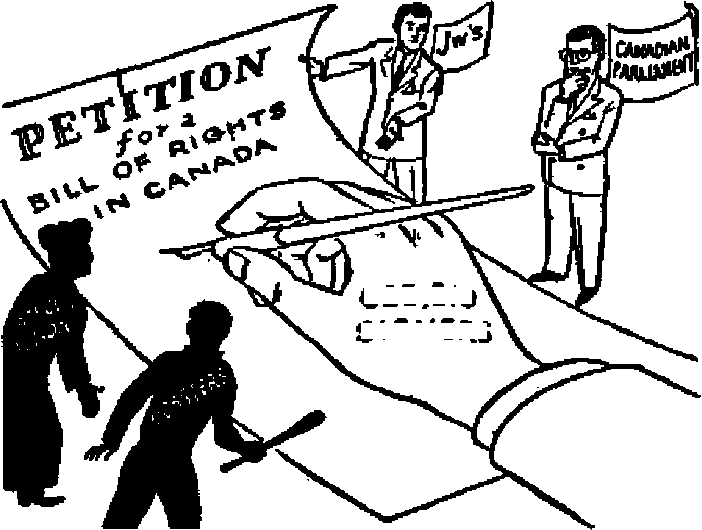
SEPTEMBER and October, 1948; two momentous months for Jehovah’s witnesses in Canada! Through cities, towns, villages, rural areas, isolated settlements and outposts, from coast to coast; 15,000 strong they swept as one man! The businessman in his office, the workman in the factory, the Indian and trapper in the far north, the farmer on the broad prairies, members of Parliament, doctors, lawyers, students, housewives, the man on the street; few missed the force of the campaign. From 450 public platforms in as many communities the message was heralded far and wide. By hundreds of thousands of handbills, posters, placards, newspaper advertising, house-to-house visits, interviews, radio announcements, sound-cars; the attention of all was focused on an undertaking of tremendous proportions. Mature men and women, youths, boys and girls, persons of all ages from every walk of life, enthusiastically, and energetically shared in the work of the campaign. Why all this activity! It is the fight for a Canadian Bill of Rights.
Paradoxically, although Canada is a member of
MXT 8, 1949
SIGNERS
the United Nations organization which recently proclaimed a great new Charter of Human Rights, she has no writ-ten Bill of Rights guaranteeing for her own people such fundamentals as freedom of worship, speech, press and assembly. Canada's present constitution was established in 1867 by the British Parliament in a statute called the British North America Act. This statute, with its later amendments, is the organic law from which all authority in the federal and provincial governments and legislatures is derived. In this constitution certain minority rights are guaranteed, but no “bill of rights” is in the Act expressly guaranteeing personal civil liberties.
BUI of Right* Needed
625.5)0
A Bill of Rights J Why, that was settled long ago by Magna Charta, many argue, as, for instance, the former minister of veterans affairs: “Let us never forget that we already possess in this conn* finned in Magna Charta on the nineteenth day of June, 1215r 'the declaration of rights in 1628, the Habeas Corpus Act of 1679, and
the great body, with its sweep and scope, of common law.” Magng Charts undoubtedly inaugurated some valuable principles of government, but it was executed at a time when some of the ideas of law and liberty were strange indeed, judged by modern standards. It could hardly be expected to be adequate under present-lay conditions. Much of the importance which has been attached to it has been added by later ages rather than extracted from the terms of the Charter as jt was originally drafted. This opinion is expressed by Professor W. S. McKechnie, of Glasgow University: “Much of its value (Magna Charta) does depend on sentiment. ... It is no disparagement of Magna Charta, then, to confess that part of its power has been read into it by later generations, and lies in the halo, almost of romance, that has gathered round it in the course of centuries.” The Magna Charta, the declaration of rights, apd the Habeas Corpus Act are inadequate to maintain fundamental freedoms. Their impoteney is demonstrated in the persecution and oppression of minority movements during the centuries since their enactment.
More than any other organization Jehovah's witnesses in Canada have been denied freedom of worship, freedom of speech, freedom of press and freedom of assembly. By means of long-range planning and determined organization they have over a period of two years so strbngly focused the spotlight of public attention on the lack of a Bill of Rights that public opinion has swung around to the point where many prominent men as well as thousands of citizens are demanding a Bill of Rights.
An early proceeding in the campaign was the presenting in the House of Commons on June 9, 1947, of a petition signed by 500,967 persons, the largest expression of public opinion on the matter to that date. This petition was not in vain, because about the same time Parliament resolved: “That a joint committee of both houses of Parliament be appointed to consider the question of human rights and fundamental freedoms, and the manner in which those obligations accepted by all members of the United Nations may best be implemented.” After sitting in numerous sessions and publishing 10 reports totaling 204 pages, the committee reached the conclusion that: “There is need for more public discussion before the task of defining the rights and freedoms to be safeguarded is undertaken ”
However, as most persons know, parliamentary committees are an old story. On this point we recall Robert Gourlay's account of a petition on behalf of the laboring poor presented to the British Parliament in 1817: “A committee sat on the subject of poor laws last summer, and, so far as was known, did nothing; a committee is now sitting upon it, but they will sit till all their eggs are addled under them, unless they adopt liberal principles.”
The Second Petition
Taking the committee's statement at its face value when it asked for more public discussion, Jehovah's witnesses proceeded to make the question of a Bill of Rights a vital, living, national issue. Battles are not often' won in thb- opening skirmishes, nor entrenched foes dislodged by a few quick jabs. The fight for a Bill of Rights had a good start, was on sound ground, and now must be pushed from province to province, openly and boldly, gathering weight like a great rolling snowball.
At a convention of Jehovah's witnesses in Canada’s capital in June of 1948, the president of the Watch Tower Bible and Tract Society announced to the thousands assembled that a second petition would be circulated throughout the nation, this time more specific in its terms. It read:
To the Honourable the House of Commons in Parliament assembled;
The Petition of the undersigned people of Canada humbly sheweth:
That in the year 1947 over five hundred thousand Canadian citizens joined in a peti-tion to। your Honourable House praying for the enactment of a Bill of Rights to protect the fundamental freedoms of all the people of this nation.
That the persecution of Jehovah’s witnesses referred to in that petition has not halted but has continued to further deprive this minority group of the right of freedom of speech, press and worship.
That these rights should properly belong to every Canadian, and we protest against their denial by any authority whether munici* pal, provincial or national.
That it has been contended our basic liberties are now adequately protected, but the facts of the continuing persecution in Quebec and the decisions of the courts there show that these individual rights are not really guaranteed by Canadian law.
That objection has been taken that the Dominion Government is incompetent from a constitutional standpoint to enact a Bill of Rights that would effectively safeguard freedom of speech, press, worship and due process of law against all official infringements in Ibis country.
Wherefore with the object of preventing deprivation of inherent freedoms, such as that experienced by Jehovah's witnesses, your petitioners humbly pray that your Honourable House do submit an address to His Majesty . praying that he be pleased to cause a Bill to be laid before the Parliament of the Unitod Kingdom to enact an amendment to the British North America Act incorporating into that statute constitutional guarantees of freedom of speech, press, worship and due process of law, and to make these rights enforceable by the courts.
And your petitioners, as tn duty bound, will ever pray.
At the time of circulating the first petition the charge was made that many would not have signed had they known it was for Jehovah's witnesses. Due to the manner in which the second petition
MAT 8} 1849
was conducted none could repeat this charge, and on February 8, 1949, Mr. Alistair Stewart, member of Parliament for Winnipeg North, as a result of the activity described in the opening paragraph of this article, was able to point to an eleven-foot stack of petition sheets containing 625,510 names, subscribed to the petition reproduced above. Imagine, the first petition being surpassed by more than 125,000 signatures, and Jehovah’s witnesses referred to more than once in it, too!
Prior to the invitation to sign the petition, each householder was handed a leaflet entitled Fight for Freedom! wherein were set out many facts concerning Jehovah’s witnesses illustrating the need for a Bill of Rights. One million, four hundred and ninety thousand copies of this leaflet were printed and distributed by Jehovah’s witnesses among a population of nine million; a monumental undertaking. In the province of Quebec, due to restrictive and unjust municipal bylaws, it was not possible to distribute the leaflet beforehand, which is in itself evidence of the need for a Canadian Bill of Rights. Freedom of the press could not be exercised there.
Campaign Experiences
The subsequent collection of 625,510 signatures speaks for itself. In addition to the actual names obtained, the results in favorable public opinion and general support were most remarkable. One of Jehovah’s witnesses in eastern Ontario received tlje following letter from a member of the Orange Lodge: "At our Lodge session this evening I ^poke on the Bill of Rights for our country and told of the great work that your organization was endeavouring to do for our benefit. Every member of our Lodge that was present signed this petition and I am returning it to you as I agreed to. ... I hope that through these few names that I have been able to get, it will help you out in some small way.”
5
a minister in western Canada relates: "WA had many other nive axperiences such as the man who read d<>wii as far as 'Jehovah's witnesses' in the heading of the sheet, then put up his hand and said, ‘That's enough r My first impression, of course, was that he was not favorable; but instead he called out to^hls daughter in another room: ‘Bessie, come here and sign this for me and ma and1 yourself !’ u Tn some communities as many as 80 and 90 percent of the population readily subscribed to the petition* Generally speaking, it can be said that a warmer and more intelligent reception was received to the second petition than to the first
Greatest opposition came from the province of Quebec. Writing from the tity of Quebec^ one of Jeho van's witnesses briefly outlines the foul methods used to counteract the petition and its circulation throughout the city:
Like a alow tide the opposition to the petition work has increased here in Quebec City. It has been in the form of the priests warning the people in church, the papers printing derogatory articles (L*Action Catholiqu# being the principal one). Small mobs from time to time have hindered the work. The police coining several times haVe caused some excitement on the streets. From time to time we have either been questioned by the police or taken to the station. As the priests continued their warnings the territories became harder to work, opposition more and names less. Small mobs became numerous as the people became alarmed, led to believe that we were communists. One brother . . . heard a priest tell a lady on the street that we were communists. I was taken in once because of a complaint which stated that I was getting signatures by telling the people it was a petition to have the Princess Elizabeth come to Canada, and that it was also a petition to stop conscription.
Newspaper Response
The enemy even went so far as to cause the arrest of three of the missionaries in Quebec City, in spite of the supposed guaranty the English BiE of Rights of to 69 which states: ‘ ... all commitments and prosecutions for such petitioning are illegal?* Under the heading ‘‘A Petition which does not have to be signed” L'Act? on Catholique of October 14,1948, printed the following: (fWe must refuse to sign this petition for two main reasons. First of all, because Jehovah’s witnesses want to get liberty to propagate their errors by anti-liberty means; and secondly because they are ■entreating the intervention of the British Government in Canadian affairs,”
Instead of having the effect of slowing down the number of signers, this publicity only aided the petitioners, and therefore with anxiety the same paper six days later cried out: “Don’t Sign. It has been pointed out to us that too many people are signing the Jehovah’s witnesses’ petition for freedom without reading it. . . . The people want Canada to return to colonization by petitioning the intervention of the London government in Canadian affairs; and then their movement is tantamount to a federal centralisation of all regulations concerning the distribution of public announcements. ... Warn your neighbours.” Anybody notice the Jaint but very distinct odor of a large red herring?
In contrast with this press attitude in Quebec are the comments of more important publications in Canada where literally dozens of editorials have been written on this subject during the past two years. Bruce Hutchison, writing in a western Canadian newspaper, humorously explains the situation pertaining to a Bill of Rights in Canada today:
We insist on every other country protecting the basic rights of *its citizens. We are busy at interminable international conference^ devising a Bill of Rights for Russians, Rumanians, Bulgarians, Ruthenians, Patagonians— everyone except Canadians. We intend to thrust a Bill of Rights on every country which will never accept it, doesn't want it and wouldn’t know what to do with it—so long
sr st cannot apply to Canada, one of the few •dates which could enforce if The B. N, A. Act, says the voice from the storm cellar, must not be touched. And in a whisper it adds: *Not until after the next election anyway.* Well, gentlemen, if we are all agreed on maintaining the rights of all Canadians, what is the objection to putting it down in writing so that all Canadians may be protected by it equally, even Japanese Canadians, even Jehovah’s Witnesses, even the men now wearing the Quebec Padlock!
Commenting on the size and value of the petition the Winnipeg Free Press of February 12,1949, carried the following editorial:
A petition circulated by Jehovah’s witnesses and signed by over 625,000 Canadians has been submitted to Parliament protesting against the invasion of civil liberties which certain religious and minority groups have suffered. It is stated that some 70,000 people signed the petition in the province of Quebec; 224,000 in Ontario, 176,000 in the prairies, 108,000 in British Columbia and 46,000 in the Maritimes. Only an insignificant fraction of these signatures could have come from mejn-bers of Jehovah’s witnesses themselves. . . . Such a mobilization of public opinion in protest against discrimination of Jehovah’s witnesses is in itself a victory for the spirit on which genuine civil freedom is based.
Watchtower Booklets Clarify Issue
Closely related to the petition and further stimulating the activity on behalf of a Bill of Bights two booklets en* titled The Dynamic American Bill of Rights and The Case for a Canadian Bill ■ of Rights were prepared and printed by the Watch Tower Society to the extent of 10,000 copies of each and mailed with a personal letter to lawyers, judges, legislators, editors, columnists, members of Parliament and professional men throughout the country. Their effect and the response in support of a Bill of Bights were startling.
Some lawyers had considerable to say about the subject, offering suggestions
MAI 8, 1949
to how a Bill of Bights could be achieved. “I read your article and It is a splendid exposition of the subject and the argument is unanswerable,** said one. “No lawyer who respects himself, his profession and the traditions of his profession can possibly disagree with any portion of this article,” remarked another.
That there are. members of Parliament in full accord with the movement for a Bill of Bights is noted by the following response received from the House of Commons: “I am in full agreement with the stand that you have taken with regard to our constitutional freedoms and necessity for a Bill of Bights. I believe that all our schools should teach the history of the development of our system of government and human rights so that even young children will learn how dearly they were won and how important it is to preserve them.”
The Convener of Laws for the National Council of Women for Canada requested 50 copies so that one could be filed with each of the 50 Local Councils of Women in the country, and a Civil Liberties Association in Manitoba requested several hundred for distribution to its members.
There are strong and powerful forces in Canada working against the enactment of a Bill of Bights. They have seized on a variety of arguments to try to convince Canadians that a Bill of Bights is unnecessary, but the record of events refutes their position. Parliament and the Canadian people have the privilege of enriching freedom by removing the blots which have fallen on the Canadian record, and by making a Bill of Bights part of the law of the land as a protection for even the most unpopular and weakest minority. Canada’s greatest’ petition of 625,510 names demands just that. It should not be ignored! —Awake! correspondent in Canada.
HERETICS! Friends of the anti’ christ! Sect of Insubordinates! Troublemakers! Underminers of the basis of Society! These were among publicized expressions of hate lighting the fufee which set off an explosion of mob violence against four Christian ministers. The place? Edmundston, a French Catholic town of over 7,000 people lying in the northwest corner of "Canada's Unspoiled Province” of New Brunswick. The victims? Four evangelist missionaries, graduates from the Watchtower Bible School of Gilead, Mr. and Mrs. Cecil Jones, Miss Olive Lundell and Miss Winnifred Parsons. The mobsters? Five hundred citizens of Edmundston, adults and children, both businessmen and common townfolk. The instigators? We leave it up to the readers to decide after hearing the facts.
Weeks before the actual outbreak of violence agitation against the ministers started when public announcements over the radio, in the schools and from the pulpits were made urging everyone to refuse them accommodation, but the first intimation of real trouble came on Janu-ary 22 when a businessman approached Margaret Jones, advising her she could not work on the corner and they were having a meeting that very morning to arrange some way of getting them and their magazines off the streets and putting her in jail. In the evening their land-lady, Mrs, Glenn, regretfully told' the group they would have to leave because during the afternoon "Father” Gagnon had called on the owner of the building and ordered him to put her and her husband out of his home unless they had the four, to whom they were renting rooms, evicted.
Monday morning found them in the Magistrate’s Court with a charge of 'distributing or scattering handbills, dodgers or other'advertising material on the streets* laid against Mrs. Jones. True to the businessman’s promise, a way had been found to deprive this minister of

o/r> EDMUNDSTON
her freedom to preach and to get her and her magazines off the streets. When the trial was held in Edmundston before Magistrate E. J. Hubert on February 2, 1949, the magistrate spared no words in denouncing her activities, though this had no bearing on the law in question, and ended his upbraiding with a conviction giving no reasons for judgment.
Lucien Fortin, who is responsible for the expressions of hate used at the introduction of this article, is in agreement with the magistrate in denying Godgiven freedom and the right to fair trial, and he outlines in the Madawaska newspaper the bourse of action that should be pursued >by all citizens of the community :
Our line of conduct then is to firmly refuse the entry of our homes to the witnesses. To that end, and to facilitate the thing to all the population, the Leagues of the Sacred Heart of the two parishes have taken the initiative to have a small card printed,. size 6" x 8", bearing the following inscription, in both languages: “Notice—The entry of my home is strictly prohibited to the witnesses of Jehovah or to their representatives.”
The Campaign Advances
Early on Friday morning, February 11, word began circulating through the town that a mob was to form at midnight for the purpose of running these falsely-accused "insubordinates” out of town. News of this planned uprising reached the ears of the victims, who immediately visited the police office where the chief of police, Mr. Alvernini, informed them he had already learned of the possible uprising and assured them that the mob-
When city Wrirtf «W<i6d with 500 to «• mtafeters
out of iJew BruBftwfflk province, they only proved again Canada's need for a written BUI of Rights
bing would not materialize, as he had talked the mobsters out of it. With this word of assurance from the police the missionaries returned to their home believing that the situation was well in hand; however, during the day a feeling of tension began to grow throughout the town and by 9:00 o’clock in the evening it broke. A call came through advising that the mob was sure to organize as planned, so contact was again made with the police authorities,'only to find that the chief was not available and the constable on duty feigned ignorance of the mob. To take precautions the four decided it best to accept an invitation to stay at a friend's home for the night; and what next followed is described in the graphic account of one of the victims:
We started to leave the house about 10:15 p.m. Cars were passing in front of the house. We hesitated to step out, and when we did a ear that had been standing without lights opposite the house started up its motor; so we slipped back upstairs to warn our other companions. Unfortunately they had gone out the back way. We decided to slip out the same way quickly. No cars were in view. We reached the corner of Michaud and Emerson when we saw a grey car with three men in it. It passed by. At the comer of Cfostigan and Emerson two men stood talking and one moved away as we approached. The other made what seemed to be a signal with his hand. The grey rar was now approaching from Canada Road but with three men clinging to the rear bumper. When we heard the ear slow down we started to run. It turned around. My companion who was ahead of me seemed to have her hand right on the door of the City Hall (where the police station is located) when footsteps pursuing us closed* in. Someone pounced "on her from behind. I saw her dragged back down the walk as some-ode behind tripped me and I fell. I got up and made a move toward my companion but two men had me. Both of us were screaming. In resisting being forced into a car I saw Winnie being dragged on the ground. The City Hall door opened and Alvernini with two other policemen sauntered out. Alvernini was smiling 1
Police Collaborate with Mobsters
Police Chief Alvernini witnessed the next acts of violation of law and order. In a brave attempt to show his office he ordered the mobsters to release one of the two girls, and Winnifred Parsons was freed and taken up to the chiefs office, but not before she had been subjected to manhandling, dragging along the ground; and having her clothing shamefully disarranged. Her companion was forcibly thrown into the back of a car on the floor and off it went.
In the police station Miss Parsons was expressing anxiety over her companion who was last seen being forced into a car. Her constant questioning brought surprising words from the chief: “Don’t worry, they won’t hurt her. She will be fed and given a good place to rest?’ Strangely enough, after similar questioning by Miss Lundell the mobsters replied: “You won’t be hurt—we are going to take you to a safe place for the night where you will be fed and taken care of I”
Uneasiness increased as the angry moty surrounded the police station. Spurred on by the mob that by this time had swelled to,proportions of from 300 to 500, those* in-the lead became bold enough to press pn to the very doors of the City Hall and jam the corridors of the station. Feeling was running high and Miss Parsons was advised by Alvernini that if the mobsters broke into the office she was to' go with them but was assured that she would not be injured.
Three times Miss Lundell was circled through town in the car and on one occasion noticed & solid mass of mobsters pouring out of Bard's transport truck. Finally she was brought back to.the' police station to join her companion and ushered through the howling mob to the chief's office, where, instead of any effort being made to dispel the mob, Alvemi-ni’s collaboration again came to the fore. Frequently he stepped out of his office to presumably reason with the mob, and at one time he was seen shaking hands with one of the mobsters and smiling. Even one of the attending constables tried to cover up the handshaking by closing the door, but too late. The two girls were informed that the rioters, who seemed to be running the whole show with Alverni-ni acting as mediator, were intent on kicking them out of town to Quebec City. A plea was made to be allowed to travel to Woodstock some hundred miles south of Edmundston where they had friends; but Alvernini consulted with the mob— the victims must go to Quebec 1
Pause and consider. Mobster after mobster, big, burly lumberjacks pouring Out of Bard's transport truck, uniting forces with townfolk and moving en masse, throwing aside all semblance of law and order to get these ministers, What were the grounds for this outbreak of intolerance! Had any acts of lawlessness been committed to warrant an uprising! Where was the freedom of worship in Edmundston of which Canada so proudly boasts!
Concerned over their two companions Mr. and Mrs. Cecil Jones, who had earlier managed a safe retreat, phoned the police station for word about the other two. Somehow this call identified their whereabouts, and not long afterward a section of the mob swarmed around the house clamoring for the Witnesses, Denial of their presence brought in Alver-nini. Under escort of police the two Witnesses were led through the seething throng and instructed to get into one of the mobster's cars. Mr. and Mrs. Jones reasoned with the occupant of the car to be allowed to go back and pack their belongings, but received the reply: “We will have to speak to the boss.” The group was then united at the police station and taken to their home to pack. On entering the home they found the landlady in tears and their rooms ransacked; their packing had, in mob style obviously, been done for them. Now to the railway station. Greeting them were some of their belongings junked in cartons ready to be put on the train. In the back room of the railway station the chief demanded to know how much money the missionaries had, and on finding them short of the train fare the mobsters were quick to supply the lack.
Bibles Burned
No longer is it necessary to go back to the days of the'bloody Inquisition to find God's Word torn to shreds and thrown to the flames of the persecution that marked the path of the early Christian martyrs, Edmundston, along with Quebec province, has brought this up to date. At 2:00 a.m. silhouettes of children and adults dancing around a bonfire could be seen for blocks as Bibles and printed Bible sermons were tossed to the flames, "Why this frenzied hate against the Bible by representatives of a church which falsely claims to have made the Bible and preserved it! And now in auto-da-fe style these ministers of the gospel, whom they have falsely labeled “faith destroyers”, are forced to the train on a path carpeted with shreds of Bible literature and pages torn from the Bible blowing around in the wind. How proud Monsieur ’ Fortin must feel with the progress of his campaign 1 Surely a proud possessor he must be of his religious faith that led to mob violence, and the ousting of four gospel-preachers out of town. Yes, a successful 'climax to his hate campaign, but at the cost of depriving these ministers of freedom of speech, press and worship according to the dictates of their own conscience.
Time for the departure of the trafai approaches, and we. see these publishers of the Kingdom pushed to their seats and guarded lest they tell others about the good news of God's kingdom. How vulnerable religion does fear the Bible!
Shame on You, Edmundston!
Your own citizens are ashamed of your foul deeds. The province in which you are privileged to live has been spoiled because of your actions. All Canada is talking about you, and soon the whole world will know. You have made a name for yourself that will not soon be erased, because it has been carved with-instruments born of the Inquisition period. Listen to these expressions now being made known to the public:
We trust that you people^ will prosecute to the very limit of the law those responsible for riots and kidnaping of members of your organization ... in Edmundston, N. B. Let us have a show-down on all anti-God influences. — From the Pacific Coast.
The action of a mob of 500 people who seized and burned religious pamphlets and forced four members of the Witnesses of Jehovah to flee from Edmundston, N. B., is most deplorable. There is no room for malicious discrimination of this kind in Canada. . . . Those guilty of inciting the violence should be brought to justice and dealt with severely.—From Saskatoon, Star Phoenix.
National Brotherhood week begins next Monday but obviously the people of Edmundston, N.B., haven’t heard about it yet. . , . .Of all the scabrous pestilences which afflict mankind from time to time, none is more mischievous or vicious than hate. And hate based on religious persecution of this sort is the most vicious of all, not only in the grim effect it has on its victims but also in the degrading effect it has on its perpetrators. Cruel suffering is the fate of the victim. But the consuming inner rottenness and warped mentality of the perpetrator is even worse. —From the University of Toronto.
Canadians may protest against what has happened recently in Hungary. And while they protest, they should blush. Something of the same sort has been happening in Canada. If there is an important difference it is not to our credit.—Toronto Globe and Mail.
While the Orange Lodge is not sponsoring the teachings of Jehovah's witnesses or any other religious group, we do most emphatically protest the disgraceful expulsion frpm the town of Edmundston members of this particular sect. Freedom of speech and freedom of worship are two of the cardinal principles of democracy and we call upon the proper authorities to take action to punish those responsible for this outrage, and to prevent any such further occurrence.—From New Brunswick, St. John Telegraph Journal.
It was decided at a Protestant rally held in the Reformed Baptist Church here tonight that a strong letter of protest would be forwarded to the Mayor of Edmundston regarding the denial of religious freedom to. Jehovah's witnesses.—From Moncton, New Brunswick. .
It's a laugh on the town to think that 500 persons had to get together to put four people out of town. And how can they expect to make people obey the law when the police themselves break it!—From Edmundston itself.
In March the four evicted ministers returned to Edmundston and brought charges against some of the -mobsters, but Magistrate Hubert dismissed the case against these ringleaders,
Edmundston, you are the one to suffer most as a result of this disgraceful episode, The four faithful ministers who suffered at your hands can now turn with confidence to God's Word for comfort, wherein Christ Jesus said, at Mat-.thew 5:11,12: '^Blessed a£e ye, when men shall revile you, and persecute you, and shall say all manner of evil against' you falsely, for my sake. Rejoice, and be exceeding glad: for great is your reward in heaven: for so persecuted they the prophets which were before you." —Awake! correspondent in Canada.
Animals and Civilization

*5? The United States Fish and Wildlife Service had its troubles counting1 ducks and geese. The desirable method is to make an aerial survey by flying over marshes where the wildfowl are feeding and photograph them, and from these pictures make counts and estimates. But the hitch was that the birds were frightened by the roar of the plane's engines and would fly out of the camera’s range. Not so now, however. Modern civilization swoops in over the birds at their winter feeding grounds before they hear what it is all about. A jet plane now streaks over the
marshlands at a 400-mile-an-hour clip and snaps the birdies beneath the camera before they are aware of the sound made by this monstrous metal bird that flies so fast without even flapping its wings.
•$* Sixty pigeon fanciers in New Jersey are seeking emancipation for their 1,650 feathered charges. They are highly bred racers, but the Jgw overtook them and banned them from the sky over Bayonne. Whyf The complaint was that pigeons roosting in the eaves were defacing St* Henry’s Roman Catholic Church, Tsk! tsk! Jesus said'the clergy should clean up within their systems first and not worry only about outward appearances. Investigation might show these birds smearing the church are “Communists”.
Warning: Mothers, if your young son balks at bathing don’t let him read this. Pacific fulmars, gull-like birds, have a passion for bathing. They will soak in the “tub” for more than an hour at a stretch. But the fastidious fulmar's love for bathing can be his updoing. Sometimes they take such d long bath they get water-logged' and sink and drown. See what a potent argument this could be for Junior on Saturday night f But, at least, it is a clean way to die.
*8? In hiew York city recently a little spider could not have made a bigger mark in the world if it had been an earthquake. In fact, it was mistaken for one. Home-hunting, it explored the mechanical bowels of a seismograph, leaped upon the sensitive pendulum and caused it to register a violent earthquakeiike reaction, and then spun a web that pre* vented delicate recordings. The spider’s fate? “You may say,” a spokesman murmured, “that it received a decent burial.”
*5? A “sea serpent” named “Bobo” has now been exposed as a faker. For some time he has frightened several fishermen in Monterey bay. California, by surfacing alongside their small boats. Swearing off the bottle did not dispel the snaky vision, but the death of the maligned “sea serpent” did. When Bobo's body was washed ashore (and'quite a body it was, being 174 feet long) it was identified as an elephant seal. With a trunk, eight-inch teeth, a face covered with barnacles, these seals can be confusing.
Freddie lives in Auckland. New Zealand. He has a steady job as an electrician’s helper, and is one of the best in the business. He is unorthodox in his methods, however. With a string around his neck he stands at o»e end of a pipe, a man at the other end blows into the pipe the scent and Freddie scrambles through, taking along the string, which then is used to pull wiring through the pipe. In one morning Freddie laid wiring in 60. pipes, the longest of which was 130 feet, This job would" have taken an ordinary electrician a month and cost $300. Then an electrician’s union objected: Freddie was underpaid, under 15 years of age, and not a union member. Freddie’s boss replied: he is a grandfather; he will join the union; he will get a rabbit a day. Terms agreeable ; no strike called. Freddie, in ease you never met him, is a five-year-old ferret.
A WAKE I
12
OSTEOPATHY
=x Fights for Your Health
THE science of medicine, like the science of transportation or of communication, has advanced more in the past hundred years than in all previous history of mankind. Only sixty-five years ago a few outstanding pioneers wore fighting for the recognition of facts which are now considered fundamental in the medical field. Almost the entire medical world was fighting against Pasteur and his theory that diseases are caused by germs. The surgical profession was opposing Lister and his use of antiseptics in his operative practice.
It was during this stormy period of medicine and its research that osteopathy had its beginning. It dates from its founding by Dr. Andrew Taylor Still, who was born near Jonesville, Virginia, in 1828. As a son of a pioneer doctorpreacher, he moved with his parents first into Tennessee and later to Missouri, and then to Kansas. At the age of 25, Andrew Taylor Still had started the practice of medicine under his father. He had the advantage of access to the few scientific books of his time. There were no laboratories where he could work.
Practicing, farming, pioneering, and as an officer in the Civil War, he passed the time until 1864. In that year he lost three of his own children in an epidemic of spinal meningitis. He had done all he could, all that was known to do for such cases. Realizing that he had been handicapped from the lack of knowledge for treating such a disease, his dissatisfaction with orthodox medical methods of treatment became more acute. His short college course about 1869 did not offer much light. Disease was just beginning to be studied. The most advanced scientists of the world actually knew less of its nature than does the average reading layman of today.
Immunity and Structural Perfection
In 1874, Dr. Still, as a result of his years of experience and observation, studying more closely the anatomical structure of man, announced two theories which are now firmly established. The discoveries resulting from modern study of the human body have contributed proof to his early statements. Dr* Still’s theory of immunity as he first stated it is: "The human body contains within itself all the elements and vital forces necessary to prevent the encroachment of disease; that the body takes from the ingested food and drink all the elements necessary to fight off illness. Nature develops in the body its own defense against disease/'
This statement of the modern theory of immunity announced by the mature mind of a thinking, observing, natureloving physician, as the result of his years of experience and observation, entirely without the aid of modern laboratory methods, antedates by eleven years the announcement of the famous Ehrlich who arrived at the same conclusion after years of laboratory study. This theory of immunity is practically undisputed today.
Dr. Still's second announcement is a corollary to the first. He said, in substance, that perfection of structure in the body is necessary for perfection of physiological performance. In order that the body immunity be perfectly exercised, it is necessary that the machinery shall be in proper adjustment. A perfectly operating body machine is necessary to bring about the desired flow of nerve impulses which control the circulation of the various body fluids. This is no doubt the reason for Dr* Still’s favorite expression, “The rule of the artery is supreme.” On these two theories, sane, sensible and understandable, is based the diagnosis and treatment of the osteopathic school of medicine and surgery.
The osteopathic physician and surgeon acts upon the principle that the human body is a living machine wbic^i, given wholesome physical and mental environment, good food and water, proper exercise and pure air, will be healthy 'just so long as all the interrelated parts of this mechanism remain in proper adjustment. When a derangement in such wonderful meehanism of adjustment is produced, a lowered immunity to disease is the result. The osteopathic physician corrects that maladjustment, if it is possible to do so by manipulation of the muscular and skeletonal structure^ and by such correction normal health is restored. However, osteopathy is not a system of rubbing or massage, nor is it chiropractic.
So much for theory. Most of us are interested in practical application of these theories and getting results. Besides appreciating the theory the osteopathic physician is interested in obtaining results and having satisfied patients. To obtain this goal, all modern methods of diagnosis, including the laboratory, X-radiance, and other methods, are used, as well as a careful, complete physical examination. Special search is made for mechanical defects, many of which have not given local symptoms. Many, but by no means all, mechanical defects are discovered in strategic positions, that is, in the local areas in which large nerves emerge from the spinal cord or the brain.
Osteopathic physicians spend years in developing their sense of touch. Perfecting the tactile sense to the highest degree, they are able to detect slight departures from the normal in the body tissues, not only superficial but deep. Patients often marvel at the physician's ability to detect by touch unsuspected painful areas, Just as the osteopathic physician uses all known methods of diagnosis as well as his own particular skill in finding mechanical body derangement, so does he use all other proved methods of treatment, and in particular his peculiar ability to correct the found mechanical difficulties. So with a skill and a technique acquired from years of careful, schooling and clinical experience, he is able to readjust and normalize the body structure so that health may return.
Training of Osteopaths
The first college of osteopathy was established at Kirksville, Missouri, 1892. The American School of Osteopathy opened with a charter stating its purpose to be: “to improve our system of surgery, midwifery, and the treatment of general diseases.” But the charter was not obtained easily. The attorney who was asked to draw the charter objected that he could not find “osteopathy” in Webster's Dictionary. To which Dr. Still replied: “Mr, Attorney, you get the charter issued and we'll put osteopathy in Webster's Dictionary r At the present time there are six colleges approved by the American Osteopathip Association. They are located in Chicago, Ill., Des Moines, Iowa, Kansas City and Kirkville, Mo., Los Angeles, Calif., and Philadelphia, Pa.
Each of these schools operates a large clinic in which every sort of diagnostic measure and treatment may be carried out. Efficient laboratories are provided. An out-patient department is operated as well, where students obtain wide experience in the care of bedfast patients. Each college has connected with it one or more general hospitals, and some are connected with hospitals for speciality practice.
The curricula of study in osteopathic colleges have been expanded gradually since the founding of the first school in 1892. All medical education has been sub-jeet to the growing demands of a thinking public since that time. Two- and three-year professional courses were necessary to teach the newly discovered field of therapy. Since 1916 the standard professional course has been four years of nine months each. And the requirements for the degree D.O. (Doctor of Osteopathy) are a minimum of two years of college p re-professional education in an accredited university or college! and then the four years of professional study in one of the approved osteopathic colleges. Thus modern osteopathic physicians have a minimum of six full years of college training.
Osteopathic physicians are schooled in the basic biological sciences, including anatomy, physiology, biochemistry, pathology and pharmacology, which comprise almost 47 percent of the 5,200 average hours of professional training. General surgery, obstetrics, gynecology, radiology, eye, ear, nose and throat diseases, kidney and genital conditions comprise 27 percent of the training, and osteopathic manipulative technique, pediatrics and public health the remaining 26 percent of the professional course.
Osteopathy Progressive
Osteopathic theory has progressed, accepting scientific truth where it was to be found. Osteopathy is today a growing, progressive therapy. New methods of diagnosis and manipulative treatment are daily discoveries. The actual methods of correcting faulty tissue are being defined. But some disease problems still defy solution. No single method of treatment is today complete, and none can truthfully claim to be a cure-all, but yearly steady progress is being made in the osteopathic profession in the prevention and control of disease.
Many have thought that osteopathy is opposed to surgery; but surgery is an integral part of osteopathy. Osteopathic physicians, however, because of their high regard for the physiologic correlation of all parts of the body machine, regard surgery as something that is not to be done promiscuously. The appendix, tonsils^ and other organs most commonly subjected to removal by surgery, are considered by the osteopath as parts of a carefully unified architectural structure, the human body. To remove a part of this unified structure weakens the body integrity and creates an unnatural condition of body mechanics. Yet there are conditions when an organ or a part must be removed. This is when it becomes diseased and menaces the health and life of the individual. Then there is no quibbling about surgery. The operation will be performed and the body vfill adjust itself thereafter; for this adaptive ability is one of the greatest powers with which the human body is endowed.
Osteopathy is today recognized by the laws of every state, the District of Columbia, in the Canadian provinces, and osteopathic physicians are licensed accordingly. Osteopathy is the least crowded of all the higher professions; there are 11,270 doctors of osteopathy practicing in Canada, U.S.A, and the British Isles, European Continent, South Africa, South America, India, China and Australia. To assist in their work here in the U.S.A. the doctors of osteopathy have established more than three hundred osteopathic hospitals and clinics.
Two great schools of medicine and thought have come down to us from recent decades. The allopathic, or medical, and the osteopathic. The allopathic majors on the idea of putting something into the body to make or keep it well. The other places chief emphasis upon the theory that the living body has the inherent ability to develop its own natural immunity to germs or to their products,, as well as adjusting itself to an amazing degree to other circumstances. But in order to do this, all parts of the body must be in correct structural relationship. These are the principles which are fundamental in osteopathy today.
“Let the Dead Bury Their Dead”
< Cardinal Spellman, of New York, in March accomplished his most important service in ten years. Fof seven weeks 300 men, most of them Catholic, had been on strike. They were gravediggers at two Catholic cemeteries operated by the trustees of St. Patrick’s Cathedral. They wanted a pay rise, a forty-hour wees, with time and a half for overtime. But they could not fool astute Spellman. He saw it all in a flash. “This is not a strike for hours or wages or other working conditions,” the cardinal confided, and then let the sinister eat out of the bag: “Its very nature and conduct from the beginning are reminders of the anti-Christian atrocities now being exposed abroad. They all spring from the same evil, sinful source.” That’s right, the union was as red as the cardinal’s cap I
C. So Spellman herded 100 students for the priesthood from their classrooms into buses and headed for the cemeteries. Through the picket lines they went under polite protection, and dug graves. With a grandstand flourish Spellman said he would “do anything the foreman tells me to do” and upon arrival Volunteered to go digging”, but the well-rehearsed monsignor in charge dutifully denied him hard labor. Apparently it is still a little early for fulfillment of Zechariah’s prophecy that false prophets would cast off their religious togs and dig in the dirt, in an endeavor to hide a hypocritical past—Zechariah 13; 4,5, Am. Stan. Ver.

< Bitterly the Catholic strikers watched the strikebreakers. A union lawyer said: “It is more important to . . . pay the living a just wage than to bury the dead.” Other strikers observed that as Catholics they supported the seminary, now the seminary took the bread and butter out of their mouths, and were strikebreakers. Of the cardinal they said: “His labor schools teach labor’s rights. They fail to practice it themselves.” Oh well, they 'also preach the Bible, 'but fail to practice it. Later the union met, took an anti-Communist oath, voted to disaffiliate the parent union attacked as Communist-dominated, asserted Communism was not the real issue hut a “red herring1’, and adopted a resolution condemning “the union-busting tactics of any employer, including the Catholic Church when it acts as an employer”.
<L Spellman responded: “They’re getting repentant kind of late.” This surprised the union workers, who had been taught by the priests that the penitent who repents, no matter how late, even on his deathbed, gains forgiveness. A committee of the strikers’ wives called on the cardinal, objected to the “reckless and misguided charges of Communism”, and sought settlement of the strike. But Spellman said he wanted the men to return to work as Catholics and individuals but not as union members. As to the union-busting charge he emoted: “I admit to the accusation of strikebreaker and I am proud of it- If stopping a strike like this isn't a thing of honor, then I don’t know what honor is.” Well, one man can’t know everything.
C During this negotiating the seminarians were grave-digging^ but after two days Spellman tired of going with them on the bus, though he had first vowed he would stick to the end. The third day he “punched the time clock” very late, arriving at noon in his private ear. Thereafter his hours were quite irregular. He had tired of the bus ride, and publicity was ebbing. The union then broke away from the parent union attacked as “Red”, affiliated with one of a duller color; but surprisingly Spellman now saw other issues: wages and hours! Eventually the strike was settled, the workers getting an 81/3 percent wage increase, with no immediate adjustment of hours or overtime pay.
<L In summation, it appears that anything that displeases the Roman Catholic Church is necessarily Communism. It is the popular smear of the day, Jesus said His followers should be fishers of men. The Catholic Hierarchy catches “red herrings” and publicizes these fish stories. At this tall tale’s end strikebreaker Spellman said: “This has been the most important thing which I have had to do in the 10 years I have been in New York.” That doesn’t speak very highly for his other activities, since this one that he puts at the head of the list was minimized by Christ Jesus, when He said: “Let the dead bury their dead.”—Matthew 8:22.
MEET FRIENDLY LI
TIE old expression “One half doesn't know how the other half lives’’ is gradually losing its significance as modern means of transportation, radio and television draw the four corners of the earth closer and closer together until it is really a “small world after all”. The extensive travels of Marco Polo with their exciting tales of strange peoples $nd distant lands lost much of their appeal as GLs wrote home of the places they visited and then returned to tell more. But still little known and perhaps even less appreciated by most Americans is their closest friend and sympathizer, Cuba.
Friendly, hospitable, kind, courteous, sympathetic, are only a few of the adjectives that describe the nationality as a whole. “This is your house” is their way of saying “You’re welcome”, and they mean it. When you meet an acquaintance on the street and stop to talk a few minutes he will say, “Let’s go have a little coffee or refreshment/ and if you are so disposed he’ll spend a half hour or so in a cafe talking with you over a little cup of strong black coffee.
If you wish to know how to get to a certain part of the city or to a particular address, just step into a cafe or corner grocery store and ask someone. He will be only too glad to tell you, but if his •answer seems a little vague or inaccurate to someone else standing near by he will graciously volunteer his opinion, whereupon, perhaps, an argument may ensue, heated but friendly, accompanied by much gesticulation and arm-waving. Meanwhile you stand patiently by awaiting the final decision. Before it comes, however, several others may join the discussion, each presenting his opinion pro or con. One gratifying thing is that after such a discussion the reply to your question is generally correct. It is not

uncommon either for someone on such an occasion to offer to accompany you to your destination to make sure that you do not go astray.
Conversation is the most popular-pastime for Latin Americans. No conversation is private in a cafe. Someone seated at a near-by table and overhearing your conversation may come over and join you,' not discourteously, but just from the sheer love of conversation, to express his thoughts and to hear others. If, on the other hand, you might become interested in the conversation of some others and they recognize your interest they voluntarily draw you into it.
The main topic of conversation is, of course, politics. The oft-changing political structure of Latin-American governments furnishes a never-ending variety of topics. The Cuban conversationalist not only seeks to transmit his opinions to others but is very anxious to learn and is teachable, always giving an opportunity to the other fellow to speak his mind. Arguments are frequent and heated but almost never end in violence. It seems as though the one who talks the loudest and fastest wins.
A few years back patience was a virtue; to be in a hurry, a vice. Recently, however, a gradual change has been taking place in several respects in the lives and customs of the people. Modern industrial and business methods and practices are beginning to leave their mark. The people associated in business organizations are more prompt and they follow better organizational lines of operation. They are beginning to real-i ge that organization is the best way to get things done and, rejoicing in what they can accomplish in a comparatively short time, they preach it to others. They are beginning to clamor for better and more dependable service from the bus company. Let us hope they get it soon.
Government offices, nevertheless, still follow the policy of never doing today what can be put off until tomorrow. With a few possible exceptions the hours are from 8 a.m, to 1 p.m. six days a week. Most of the employees arrive between 8:30 and 9 and start working around 9:30. At 10:30 they take off fifteen to thirty minutes for coffee and begin to quit about 11: 30 or a quarter to twelve. Everybody jokes about how hard the government workers work, but do not complain, because almost every family in Havana has at least one member or very close friend thus employed, and each secretly cherishes the hope that someday he himself may have a chance at such an easy job.
Cuban people are congenial, sympathetic, and for the most part sincere. They seem to derive much pleasure from helping those who may be less fortunate than themselves. Some who appear to be in extreme economic circumstances themselves have been observed giving a* penny or two to a beggar on the street. Particularly manifest is' this quality at the time of a cyclone. Then those living in lesp secure houses are divided and encouraged to take shelter in the stronger ones of the neighborhood regardless of the difference in economic or social 'standing that may exist. The householder also provides food and drink for those taking shelter under his roof.
Jtara/ Conditions
Country life is down to earth, simple and rustic. Most of the homes are thatched-roof dwellings made almost entirely of palm trees. The wood of the royal palm is fibrous, strong and durable, especially suited to this type of structure, but because of its religious significance to Cuban nationalism special permissioh must be obtained from the government to cut down a royal palm tree. The floors are earth packed down hard, but some of the better ones are made of concrete. This type of house 'is very cool, and the ingenious roof made of many layers of palm 'branches never. Sermits even a drop of water to pass uring the most torrential tropical downpour. Such roofs last for many years.
Water for the family use must be carried from the river or a small stream or perhaps from a crudely dug well which has little or no protection from surface water. Sanitary conditions are lacking. Cooking is done on an open fire of wood or charcoal, requiring much time and labor to prepare a meal. The laundry is the river banks. If the current is good the clothes can be fastened down with rocks and let the river do the work.
The percentage of illiteracy is quite high, especially in the rural districts, where the opportunities for education have been shamefully lacking. But under the administration 'of Ex-President Grau hundreds of rural schools were built all over Cuba and the privilege of education is to be granted to many thousands more children in the future. Education is compulsory but not enforced. Many of those who lacked the chance of education in their childhood have recently come in contact with Jehovah’s witnesses and their program of Bible education. When they see the great advantage and blessings that come from a knowledge of reading and writing they have set themselves with a determined effort to learn, and with the help of these Christian educators they have been able to do so.
This condition is also true in the cities and towns. Popular education is chiefly in the hands of private schools, where the tuition and other expenses make it difficult for the children of poorer families to attend. Public schools are inadequate for the need, and discipline is poor.
Saturday night is a big time. Early in the evening the people, young and old, begin to gather from ail parts of the town and surrounding rurals to the central park or promenade (every town and city has one), where they can discuss the various topics of the day. In the center of the park is generally a statue of a patriot or a fountain around and around which the young folks walk, the girls in one direction and the boys in the other. As each one passes the other upon which he or she has fixed a fancy they smile, speak or make some remark, until acquaintance is established, then the boy joins the girl in the march, going around in her direction until it is time to go home. Sandwiches of various classes as well as fruit, cakes, etc., can be bought from little stands set up on the curb for the occasion. Parents and other spectators stand around or sit on the benches and talk. The evening over, good-bys are said and the girl joins her family to go home^ If, however, the acquaintance is well established the boy can see the girl home, chaperoned, of course, by some member of her family.
Housing Inequality
Great contrast exists in the living conditions between the rich and the poor. The middle class is less in evidence in Latin America than in the United States. Fine, luxurious homes are built in the good residential sections, where the old Spanish style of architecture is rapidly giving way to very modern streamlined construction. Big apartment buildings have been built in the last five years, which, in spite of excessive rents, never have an empty apartment. In the older parts of the cities it is very difficult to distinguish the homes of the rich from those of the poor when seen from the outside ~n the street. All are built just alike, each joining the other as their faces form a solid wall along the sidewalk. Inside is where the difference is found. Luxurious furnishings and ornate “patios” mark the home as that of a wealthy family, while adjoining next door extreme poverty may exist
In behalf of the poor underprivileged a popular Havana weekly magazine Carteles has recently published a series of articles exposing their,miserable living conditions. The most popular type of apartment is called a solar,' in which many small rooms are built around a central court with one room for a family which may be composed of from two to ten individuals, yes, even more. The water situation, which may appear humorous to tourists and is often a source of jokes in travel magazines, presents a real problem for these people who try so hard to keep clean. There may be water six hours out of twenty-four, but more than likely even less. Although some get excited about it all, the majority seem to take it as a matter of course and in their carefree happy-go-lucky way say, “Why worry! It won’t do any good.”
Life in Latin America is interesting and exciting, where the stranger is made to feel welcome and at home. Although you rpay not speak their language, they will find someone who speaks yours, in order to help you out, even if it means going several blocks to fetch him. They never let the possible and unpredictable famine of tomorrow spoil the joy of today’s feast. If they have it today, fine; let tomorrow take care of itself.
Nevertheless, in spite of this philosophy, many Cubans do look forward to better and more joyous times in the future as they learn of the kingdom of Jehovah God and its blessings and put their hope and trust in it. They join in proclaiming these glad tidings to their friends and neighbors so that they may lay aside worldly philosophies and wait for the New World of righteousness, when the now existing inequalities and injustices wiH be done away with and peace and happiness reign world-wide forevermore.—Awake! correspondent in Cuba.

the wise men". Ancient books mentioned it as a tree of paradise,' But strangely enough the banana does not grow on a tree. It is the harvest of the largest terrestrial plants completely lacking a woody stem; it is a semi-bulbous, herbaceous plant with a large
t a “banana tree” is you know there are sixty different species of bananas, some being fourteen inches long, others reaching only two and a half inches in size f Bid you know that bananas can be instrumental in saving a life! Did you know that the banana, which you may eat as a special treat, is the main starchy food of millions of people! Did you know too that the exporj^of the banana is the basis of the economic welfare of many countries! The lowly banana begins to take on added prestige as we learn more of its use and importance as a food.
Where did the banana, come from! Histpry traces it as far back as around 175 B,C. In the lowland of India, on the avails of a Buddhist monument, sculptures of the plant were to be found. Later references were made to the fruit in early Chinese writings of the Tang dynasty, which was contemporary with the early Christian era. Chinese physicians brewed medicines from the roots of the plant; the fruit was considered a precious food and tonic, and even then stalk fibers were used for weaving mats.
It is probable that by the beginning of the Christian era banana roots were a well-established commerce of the Polynesians, having been carried by primitive ocean craft from Malayan coasts and Indonesia through the South Sea islands. Thence, having underwritten numerous dynasties and civilizations of Asia and the Orient, the non-American banana came to the New World by way of Panama, in 1519, being brought by a Spanish missionary priest It is the fruit that now contributes to the economics of about a third of all American republics.
How It Grows “Upside Down*
The “eating" banana's scientific name is Musa~sapientumf meaning "fruit of leaf structure. The banana plant is characterize^ by an underground root stalk or rhizome on which occur buds or “eyes" 'which grow out and up forming a new aerial portion or sucker. From one bit of root stalk many of these buds are formed, so that surrounding the original root there is formed a large mat or “stool" of plants. The banana plant does not possess a true stem above the ground. The pseudo-stem consists of the basal poi> tions of the leaf stalks which overlap one another and are tightly pressed together, so that ’a trunk of from eight to fifteen inches in diameter and a stalk from eighteen to twenty-five feet high is produced when mature.r
When the stalk is fully formed, a bud in the root stalk grows up through the center of the mass of leaf stalk to finally emerge from the certter of the crown. As the bud,gradually unfolds a large cluster of purple flowers opens up, each of which makes way for a tiny banana. Because of its great weight the flower cluster hangs toward the earth, and as the separate fruits begin to gro^ they turn upward, forming a fruit that grows upside down. After the fruit has been harvested the plant that produced it is cut down, for it can bear only one stem of bananas. A hill or stool comefe into bearing within twelve months after planting and one stool frequently produces about two bunches a year for as many as twenty-five or thirty consecutive years.
The firm, golden-yellow or red-skinned banana that you peel down to eat is not the way the fruit was cut for your enjoyment In the tropics one could not walk up to the large herbaceous plant and pluck off a ripe banana to eat and go on his way, as many might think. The heavy stems are harvested when the fruit is still green, since in the final processes of plant ripening natural flavor is destroyed and the '“fingers”, or individual bananas, split, exposing the edible pulp to insects and decay.
Know Your Bananas
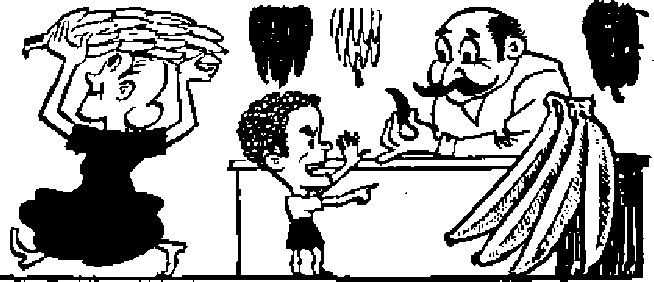
If you were a tourist passing through any of the Central American republics and had a yearn for bananas, you might quite naturally walk up to one of the quaint market booths and pick out, what you thought, was the biggest banana you could find. If you were not “in the know” you would probably pick up a ten- to fourteen-inch specimen and say, "Boy, what a whopper I” and start peeling it, your mouth all set for its mellow, tasty sweetness. You take a bite—but ugh! what’s this? Instead of an edible banana you are chewing on a tasteless, woody mass of pulp. What you have is not the eating banana. You picked up the Musa-paradisiaca, or cooking banana. This species of the banana plant is commonly called the "plantain”, and it is really delicious in its own way fried or baked, and goes well with the daily diet of the tortilla and beans of the natives.
If junior was accompanying you on
if AY 8, 1949
your trip you conld pick out the Musa-cavendishii, or Chinese dwarf banapa, for hint It is not very big, only two and a half to three inches long ; but one bite of its honey-sweetness would prompt junior to clamor for more. This species of the banana is now being grown to some extent in the Central Americas because of its resistance to disease.
Of the banana it can be said that it is the only sweet fruit that can be obtained fresh and in good condition in all parts of a country at all seasons. It has the further advantage of being put up by nature in a germ-proof package, for its inedible peel constitutes an airtight protection against every form of germ and dirt The banana is rich in food value. It contains vitamins A, B and C and is rich in natural sugar and starch, which makes it valuable from a food standpoint in manufacturing quick energy.
The fruit Has many uses. For human consumption not only can it be eaten fresh, but the dried fruit can be ground into flour; and it already is coming into use, as such, outside of tropical countries. It has been estimated that one pound of banana flour is equal in nourishment to two pounds of wheat flour. It has proved to be valuable as an ingredient of milk mixture for infants. For medicinal purposes the fruit has been used to fight a rare disease that affects babies and which requires a diet of bananas to successfully combat it. Such was the ease several years ago in a New York City hospital that put out a call for bananas to be donated for the case. They were and the infant-patient lived.
The banana fruit is one of the few crops that have become a staff of life for man and beast alike. Every year thousands of bananas would go to waste foj; lack of transportation, bruising, or because of other defects, if they were not fed to cattle .and pigs as fodder. Fed green to livestock, the banana approximates the nutritive worth of grass and grain, since starch and mineral content
21 of the unripened pulp compares with that of grain, while the green skins are a valuable Source of chlorophyll.
Where the "Gold’* Comet In
There is a possible commercial value to the discarded stalk, as it contains fiber that can be used in twine and the rest as pulp for paper; but neither has been exploited to any extent for such purposes. The large, long banana leaves have been used by the natives in the home and market places for wrapping hot foods. They have long been used by the native Indian for their soothing effect on bruises, swellings, sores and open wounds. The large leaves, six feet long, provide cCrol, refreshing shade from the hot tropical sun. It is not a strange sight to see along the wayside a hastily thrown together shelter of stalks and banana leaves with a neat row of bare sun-browned feet sticking out from under it, where the native worker takes his siesta. ’
All these various uses of the banana plant and fruit have made the lowly agriculture crop a prospect for big business. Especially since the middle of the nineteenth century business minds have worked toward making the banana trade a money-making proposition. Bananas as a food for peoples of temperate zones should pay off. They could, and have paid. Half a billion dollars of United States capital is invested in its production. The stability of at least six American republics, whose revenues and institutions are substantially shaped by bananas, stamp the Monroe Doctrine with a figurative watermark of bananas.
“Green gold” it is called by many and has well lived up to its name. It has become a cash crop that pays Central American governments more than $10,000,000 a year in direct revenues, hands at least $40,000,000 in cash wages to some 140,000 national citizens who are employed in the banafia industry, another $40,000,000 for general merchandise and properties incidental to banana production* many millions more in direct purchases of.jhe fruit from citizen planters. These figures leap each year.
Planting the "Green Gold”
Banana lands are surprisingly expensive in money and work. A modern banana plantation opens with the building of hospitals, the organizing of mosquitocontrol work, land drainage around living quarters and working plots, and thorough medication of native citizens. In the early setting up of operations, chemists must locate the all-important supply of safe drinking water. Jungle engineers don their jungle gear and wade out into swampy wildernesses to plot future bridges, culverts, levees and irrigation canals.
Jungle-busting railroaders., usually led by experienced road masters from the United States, then take, over the problems of clearing the wilderness, knocking over huge trees, dragging them out of the way using giant “bulldozers” or caterpillar-mounted drag lines, which slosh and roar as they buck up against the formidable jungle. As railroad grades are rapidly formed and culverts bridged, track crews follow placing crossties and rails on jungle mud, ballasting roadbeds as fast as they can be pushed. Speed is essential. Materials must get in before bananas can get out, and rails laid one day may carry trains the very next.
Actual planting is done by farm crews, who clear out all the small, dense undergrowth from the jungle. Miles of rows of shallow holes, spaced from fourteen to eighteen feet apart, are dug, into which are buried the bulbous roots of the banana plant. On their heels follow the timber crews, who attach the larger jungle growth with their sharp-flashing machetes, cutting down timber and slashing all vegetation, leaving it where it falls to rot,*which, with the tropical climate and abundant rainfall, undergoes quick decomposition.
Irrigation plays an essential part in modern ba nan a-plan ting. While banana land is traditionally country of heavy rainfall, with the advent of new modes of banana-growing, wet eouptry is no longer wet enough to keep up with the expansion. New-style banana irrigation consists of linked series of 25-foot metal towers fed by Diesel-driven pumps from artesian wells, rivers or canals. Each tower is topped by a patent “riser” rotated by a water-pressure motor to throw a fire-hydrant type of spray over about three acres of planting for the equivalent of two inches of rainfall every week. Spray for killing fungus and other banana diseases that could easily wipe out a Crop are in this manner also spread over the groves.
It is a breath-taking sight for anyone flying over Honduras to suddenly break out of the mountain ranges over the northern coastal plains and see the long, lazy, arched streams of water slowly revolving over the miles and miles of orderly, dark-green wonderland of bananas forming myriads of multicolored rainbows in the bright sunlight
Harvesting the “Green GM?*
Within one year after planting a crop can be ready for cutting. The banana harvest cannot be stored. The day, even the hour, it js reaped must see the green fruit on its way to market. When fruit company headquarters receive the calling dates of the big banana boats, shipping orders are immediately radioed and telephoned to farm overseers. It is a familiar phrase to hear “Tomorrow's fruit day”. Starting at early dawn cut-* ting crews lead pack mules into the closely crowded groves, notch the soft porous fruit stalks to “break” the fall of the heavy bunches, and then whack off the fruit stems with razor-sharp machetes. The bright-green stems are hefted onto insulated mule packs, which carry them to midget tramears, from where they are pushed to loading spots.
In short time banana trains loaded with their cargoes of “green gold” roar into shipping yards. A line of from five tq ten cars is hurried onto the long loading dock. Working in brilliant tropical sunlight or under bright night-lights, miniature armies of “tropics-model” stevedores lift the fruit tenderly from - the padded cars, hoist it onto padded shoulders, and head for the conveyors. As they pass by, men stationed near each row of workers deftly whack off an overly-long stem stalk with short wicked-looking banana knives. Under the sharp gaze of inspectors the stems of bananas are laid in canvas “pocket conveyors’1 which carry them into refrigerated hatches where storage crews stack the fruit in. compact tiers, after checkers with automatic recording meters have counted the car$o. Everything goes like clockwork, no time being lost. Twelve hours is average loading time for a 50,000-stem ship.
Aboard ship and until final delivery the bananas must be kept at accurately controlled temperatures and humidity, for the fruit must still be green when reaching final port after an ocean journey of five to eighteen days. From seaboard the green stems must be distributed rapidly by fan-ventilated and temperature-controlled freight cars or vans under supervision of expert handlers. Up-to-date banana wholesalers and jobbers keep specially built ripening rooms in which banana color changes from green to yellow at about 64 degrees Fahrenheit. After three to ten days in ripening rooms the clusters or “hands” are cut from the stplk and packed in cartons for distribution to retailers. Green gold has changed to yellow gold by the time you buy your bananas in your local store. Thus after an immense amount of work and care, after a trip of perhaps a thousand miles er more, far-off countries * receive the tropical fruit the banana.—Awake! correspondent in Honduras.

The Mysterious “Trinity” a Fraud
A LIE that is considered most sacred in Christendom but which has brought reproach upon God's name and confused mankind concerning who He is, is the religious doctrfne of the “trinity”. The doctrine is, in substance, that there is one God but He is in three persons, namely, God the Father, God the Son, and God the Holy Ghost, all equal in power and eternity and alike in substance. That is $ nice conglomeration of words, and because > it does not make sense and so cannot be explained, the religious clergy say it is a mystery. The truth is that it is a fraud and is not of Christian origin. The trinitarian doctrine was prominent in the religions of ancient Babylon and Egypt and of Oriental mythologists, all of which ar$ Devil religions.
The trinity doctrine began to be introduced among professed Christians toward the close of the second century, hence many decades after the apostles of Jesus Christ. The only defense the religious teachers of the trinity have when asked to explain the doctrine is to say: *That is a mystery you cannot understand and which you are not supposed to understand but olindly accept? To aid the gullible people to keep the thing somewhat fixed in mind as somehow possible various images were introduced, such as a triangle enclosed in a circle, or a trefoil, a three-pointed or three-lobed affair, to be used as an object lesson. Even an image has been made of a human body with a head having three faces. Of such foolish persons the apostle
JOHN
says, at Romans 1:21-23: “They . . . became vain in their imaginations, and their foolish heart was darkened. Professing themselves To be wise, they became fools, and changed the glory of the uncorruptible God into an image made like to corruptible man.” The fraud and deceit of Satan's religious agents appears in connection with the so-called “trinity” when it is seen that the doctrine attempts to nullify God's provision for saving.men by and through the sacrifice of Christ Jesus. The “trinity” denies, in effect, the value of; Christ’s shed blood.
The Holy Scriptures show conclusively there is but one Almighty God, who is the Life-giver of all creatures, and that Christ Jesus had a beginning as the begotten Son of God and so is the beginning of creation ; and as such He became the active agent of Almighty God in creating all other things. In giving His law to man at Mount Sinai, Almighty God said: “I am Jehovah thy God, . . . Thou shalt have no other gods before me. Thou shalt not make unto thee a graven image, nor any likeness of any thing that is in heaven above, or that is in the earth beneath, or that is in the water under the earth.” (Exodus 20:2-4, Am, Stan. Ver.) Also at Isaiah 42:8 He says: “I am Jehovah, that is my name; and my glory will I not give to another, neither my praise unto graven images.” At Isaiah 45: 5 He says: “I am Jehovah, and there is none else; besides me there is no God.” (Am. Stan. Fer.) The apostle speaks of Jehovah God as “one God and Father of all, who is above all, and through all, and in you air,—Ephesians 4:6.
Of coprse, from His beginning the only begotten Son of God was with God His Father and He was known as "The Word of God” or "The Logos of God”. (John 1:1,2) As the representation of divine wisdom He speaks, at Proverbs 8: 22, and says: "Jehovah possessed [ot, formed] me in the beginning of his way, before his works of old.’" (Am, Stan, VertJ margin) He became the man Christ Jesus for thirty-three and a half years. If He had been the immortal, incorruptible God at that time He would not have been able to die as the ransom sacrifice for mankind. Since His resurrection from the dead God has appointed this Son the heir of all things, and in His resurrection glory He says: “I am lie that liveth, and was dead; and, behold, I am alive for evermore, Amen.” He further says: "These things saith the Amen, the faithful and true witness, the beginning of the creation of God.” Thus He confesses himself to be the first one whom Jehovah God created.—Hebrews 1:1,2; Revelation 1:18; 3:14.
Showing His inferiority to Jehovah God Jesus Christ on earth said: "I am come in my Father’s name.” "For I came down from heaven, not to do mine own will, but the will of him that sent me.” (John 5:43; 6:38) It was from heaven that He was sent, because He is subordinate to God even up in heaven. Hence He said: "My Father is greater than I.” "For I have not spoken of myself; but the Father which sent me, he gave me a commandment, what I should say, and what I should speak.” (John 14:28; 12:49) He said: "I seek not mine own will, but the will of the Father which hath sent me”; and when He was finishing His Father's will on earth He prayed to Him and said: "Father, . . . glorify thy Son, that thy Son also may glorify thee” (John 5:30; 17:1) Now if the Father and the Son were one in substance and equal in power and glory, why should one send himself and pray to himself? One should not do so; but that thy Son is not equal or on a level with His Father, the apostle says: "The head of Christ is God.”—1 Corinthians 11:3.
On one occasion when telling how He co-operates with God Jesus said: "I and my Father are one.” (John 10:30) Did He mean that they were one person or substance? No; but that they were at unity, always working together in full harmony. In His prayer, not to himself, but to His superior Father, Jesus makes clear the meaning of the word "one”, as He says: “Neither pray I for these alone, but for them also which shall believe on me through their word; that they all may be one; as thou, Father, art in me, and I in thee, that they also may be one in us: that the world may believe that thou hast sent me.1 (John 17:20,21) Here Jesus was certainly not arguing for His disciples to be incorporated into a so-called "trinity”, but was praying for them to be at one with Him and God.
Jesus was sent down from heaven to earth that He might lay down His life as a ransom price for mankind. Likening himself to a shepherd, He said: "As the Father knoweth me, even so know I the Father: and I lay down my life for the sheep.” (John 10:10,14,15) Now, did we say above that the "trinity” doctrine tries to nullify God’s provision for saving men by Christ’s ransom sacrifice? Yes; for if the Father and the Son were one in substance according to the “trinity” belief, then it would be impossible for the Son to give His life as a redemptive price for His human sheep.
So the doctrine of the "trinity” finds no support whatever in the Holy Bible. On the contrary, the Bible proves beyond all doubt that it is Satan the Devil’s doctrine, fraudulently imposed upon Christendom and heathendom to destroy faith in Jehovah God and His gracious provision for redeeming humankind. It is now the time that this trinitarian mystery be exposed as a fraud.
From an American Citizen in Greece

My recent experience in Athens and the treatment I suffered as an American citizen will shed light on the inhuman methods employed by the Greek police toward their victims. This will permit you to come to your own conclusions. My story will give you an inside, uncensored report of conditions prevailing in Greece today and just what America is supporting with her aid to that country. But first let me explain how I came to be there, I am an American citizen, twenty-six years old, born and raised ik Lowell, Mass., by Greek parents and have my grandmother and other close relatives living in Greece. In November, 1946, with an American friend 1 traveled to Greece to visit my relatives and to represent an American organization there. In November, 1947, I went to Cyprus to take charge, of the interests of this American Society. While there I was informed that my relatives were in danger of losing their homes to the government, and they .were asking for assistance. I decided to take a trip to Greece tosee what was happening.
Accordingly I obtained a visa from the Greek - consul in Cyprus for this purpose, boarded a plane of the Greek airline FZZas, arriving at the Athens airport on Sunday morning, December 12, 1948. Clearing customs, I was leaving the airport when a policeman came calling after me. Returning, I was taken into a police office. Questioned as to what I wanted in Greece, I explained my intentions to visit my relatives, having obtained a one-month visa for this purpose. They stated that I would not be permitted entry into Greece, and refuaed to let me free. Despite repeated inquiries as to the reasons why I was being held, none were given. Repeatedly I requested to call the American consul so that he might assist me in whatever was wrong. This was refused.
Later, a policeman was assigned to take me to the Harbor Police Station of Piraeus where they had a prison. On his learning that my parents were from the same section of Greece as he, he offered to help me and took me to a restaurant to eat about five p.m. Up until this time I had not eaten anything that day, as my previous appeals for food had been denied. Late the next morning at the prison this same policeman arranged for me to have another meal. Several policemen and officials had boasted to 'me, "If no one brought you food from the outside, you would starve to death in prison.” While being booked at the prison I again asked to contact the American consul, but with the same results.
Later I was led to a room on the bottom floor where eight men were confined in a cold, damp, smelly room. There were no chairs or beds, but the men had improvised things to sit on. I had to "sleep” on a cold marble floor wearing my clothes.
Experiences of Prisoners
I was compelled tb endure these conditions for three days. During this period I learned some shocking things about conditions in Greece. Let me tell you these as I now remember them. One prisoner about thirty years of age had been in this prison for over fifty days without any charges filed against him nor did he know what his fate would be. The interesting thing about him was that he bad served two years and four months with the resistance movement in the northwestern mountains of Greece fighting the Nazis during the occupation. Now this his fate, languishing in prison without any charges. The reward for his fight for freedom.
One intelligent young man, about twenty-six years old, seems to have been the best-informed and to have given me the clearest picture of conditions in Greece. He had served id the resistance movement for one year against the^Nazis and Fascists during the occupation in the southern and western mountains of Greece.
His plight was particularly pitiful, as he had been picked up before by the police and then released but not before undergoing torture and seeing others so suffer. He spoke of two favorite methods of torture employed by the police which leave no marks when this effect was desired. One was the use of a rubber hdse which he had experienced. The other was tying the victim on a bed or table and then whacking on the bottoms of the shoes with a pipe or similar object. The pains are terrific, but when you are released you are booted to make you walk. This is impossible because your feet are now swollen and press against your shoes, causing excruciating pains and you stumble to the floor. From all the horrible treatment suffered he attempted suicide.
He had come from one of the wealthiest families of his town in southern Greece. His mother and sisters were in ^exile on a barren island off the coast of Greece. Their olive trees and lands were abandoned and desolate from the lack of care. His brother had fled to the mountains and was serving with the guerrillas. This is an all too familiar pattern of shattered family life in Greece.
One particular story that stands out vividly in my mind was told, as all the others, by way of conversation to the group as we were discussing various things. This had to do with a naval labor leader whose execution with several other labor leaders by a firing squad had been temporarily stayed by the worldwide protest against their execution. This labor leader while being tortured by the police was tying on a table or a bed. One of his torturers in the process of the punishment being meted out became so crazed and obsessed at the failure to get out of him the desired information that he leaped on the victim*® bare chest biting his teat muscle and lifting him off the table with his teeth. The weight of the prisoner pulled his body back to the table, ripping the flesh and leaving it in the mouth of this madman!
Horrible you say! But there are - many worse that can be told by others who can recount them more vividly than I, because of seeing them, such as one told me by a personal friend. One afternoon he and several other workers were on the roof of a building near the Central Headquarters of the Security Police building in Athens. They saw two policemen and a third person eome on the roof of the Security Police building. Suddenly they saw the two policemen fall upon the third person, striking him with, pipes. He crumpled to the rooftop. They continued raining blows on him until all that coiild be seen was a bloody mass! Another victim bludgeoned to death by the police!
Of the eight men in prison with me the three days of my confinement, five had been there for over fifty days with no charges against them and having no knowledge of what their fate would be. Two others had been picked up about five days before, and they too were in ignorance of the cause of their arrest. It must be admitted that they all had leftist views.
On the second day, December 13, 1948, I was separated from the other prisoners to another compartment. Here I contacted a man who was visiting a prisoner. While the other prisoners in the lower compartment kept the guard occupied talking to him from the distance, I was able to give him the addresses of some friends and money to pay for a taxi to go to the American Embassy in Athens and to tell them that I was being held and not being permitted to contact them and gave him the number of my passport. This total stranger risked his life to do this for me.
Further Facts
Later that afternoon my friends notified by this man found me. I was allowed to talk to them for a few minutes, which was sufficient time to get a further picture of the conditions in Greece. What they said confirmed and corroborated what I had been hearing but from a different angle. They stated that the Greek government had taken a very decided stand against freedom of religion and was intensifying its bitter persecution.
About two’ months ago, they said, eight Christians in a private Bible study in one of their homes in Athens had their meeting broken up by the police and all were taken to pr&on. The six women were still in prisoq, having had no trial—if they ever do have one—and the two men had been brutally mistreated and tortured and then exiled to one of the bleak, rocky islands in the Aegean sea called Long Island, where thousands of other Greeks were confined.
In addition, at least fourteen Christian young men (perhaps more by now) are due to be shot soon because they have refused to bear arms in the fratricide slaughter going on in Greece because of conscientious, objection to killing and in obedience to God's law not to kill. These men, some of whom are personally known to me, are not Communists and they have absolutely no connections yyhatso-ever with Communism, They are simply Godfearing Christian young men in the prime of life due to be shot by a firing squad. Their lives will be added to the mounting toll of modern Christian martyrs in Greece unless something is done to save these victims of religious intolerance. This all added up to show that the Greek government was trying to exterminate a religious minority found in their country. Even the American Society which I had represented in Greece and which has been operating a Branch office there since 1922 printing and distributing Bible literature was now threatened with extinction by the Greek government.
Shortly after the departure of my friends
:■ "T „ = the American vice-consul, Mr, Alexopoulos, visited me. He was known to me from iuy previous visit to Greece and I explained to him how I came to visit my relatives and the treatment given me by the Greek police. He stated that the Greek authorities absolutely refused to allow me to stay in Greece, and that the only way I could stay was to become a Greek citizen! He gave no explanation as to why I had been so treated, but he did say, "Conditions are pretty tough, worse than when you were here a year ago. They have even shot some people of your faith [Jehovah's witnesses].” A further confirmation of what I had been hearing, and this by an American official of the American Embassy.
The next morning, December 14, 1948, I was taken from the prison with a representative of the American Embassy, a driver and a policeman and brought to the airport. Ironically, I had been booked passage on a Czechoslovakian plane! a plane from one of the Communist-dominated countries. So I left Athens and landed at Rome, where I am now writing this story for the publishers of Awake?
Can You Read Greek?
Most likely your answer will be No, but this need not deny yon the pleasure of critically analyzing the original Greek words from which the Greek Scriptures were translated. How sol The Emphatic Diaglott contains an approved Greek text with various readings of the reliable Vatican Manuscript No, 1209 together with an inter linear translation of each word into English. With this invaluable hid even the layman can compare his Bible with the original words from which the Greek Scriptures were translated. The Emphatic Diaglott also contains brief information on Greek grammar and pronunciation as well as a new translation of the Greek Scriptures in a separate paralic’ col urun. Your copy will he mailed postpaid for only $2.
WATCHTOWER 117 Adams Bt. Brooklyn 1, N. y.
1 am enclosing $2. Pleuse send me a copy of The Emphatic Diaglott, postpaid.
Name
City.... ............... . .. ---------
Zone No.___ State__,_______

Atlantic Pact Text
and Members
<$> News about the Atlantic Pact far overshadowed in volume and significance information about the U. N. In the introduction to the treaty, according to the text released ,on March 18, it was asserted that "the parties to this treaty reaffirm their faith in the purposes and principles of the Charter of the United Nations and their desire to live In peace with all peoples and all governments’'. The pact provides that "all measures taken as a result [of armed attack] shall Immediately be reported to the Security Council. Such measures shall be terminated when the. Security Council has taken the measures necessary to restore and maintain international peace and security”. Russia called the pact a war Instrument and repeated an earlier charge that it was an aggressive encirclement 'program and undermined the U. N. Truman, on the other hand, said the treaty added strength to the U. N. Toward the close of March Denmark indicated it would sign the pact along with the other nine nations: Britain, Holland, Belgium, Luxembourg, France, Italy, the U. S., Canada and Norway, Representatives of the signatory nations began to arrive In the U< S. Churchill, making an incidental visit, talked about the Atlantic Pact (March 31) at the Boston Garden to,a large audience.
Churchill Speech
Winston Churchill’s speech at the mid-century Convocation of Massachusetts Institute of Technology at Boston Garden March 31 was apparently the chief if not the sole reason for Churchill's crossing the Atlantic. It came at a strategic time, when the Atlantic Pact was the great Issue before the world, and particularly before the nations that were about to become its first signatories. Churchill, In bls speech, held that, had It not been for the fact that the U. S.' has the atomic bomb, Europe would long ago have been overrun by the Communists and London would have been bombed. Ho still expressed hope in the U, N., of which the Atlantic Pact appears to be such a definite denial. He said that, although the U. N. has so far been “rent and distracted” by the antagonism of Soviet Russia and by the fundamental schism which has opened between Communists and the rest of mankind, there was do reason for despair. All in all, Mr. Churchill’s confidence reposed in men and certain imponderables, together with armaments and, specifically, the Atlantic Pact But, In any event, it was a notable speech.
“Cultural Conference”
$ Toward the close of March there were meetings of the “Cultural and Scientific Conference” held in the Waldorf-Astoria hotel, New York, while religious anti-Commnnlsts picketed and “prayed” In the rain. It was on account of the numerous Communists that had been allowed to come to the U. S. to attend the conference, even though the U. S. government viewed matters with suspicion. The chief aim of the conferees, supposedly here to discuss cultural and scientific matters, appeared to be to attack American foreign policy and to praise Russia. Yet the speeches were called relatively mild. Anti-government attacks had been anticipated. The State Department, in granting the foreign visitors visas, said it knew the meeting would be a sounding board for Communist propaganda. At the conclusion of the conference some eighteen of the Communist visitors began a speech-making tour of the country. That was something else again, and the State Department, feellpg that enough was enough, firmly indicated to the visitors that their "welcome*’ had expired. Their visas were for the conference only.
Battle of the Mark
The three Western powers in Berlin in late March took a drastic step when they outlawed the Soviet mark in the Western sector of the city. The British, French and American author!ties acted because they gave up hoping that the Russian occupation authorities would come to any kind of agrqpment as to the moil; etary situation. The Western mark had the advantage of being four times as valuable as the Soviet mark, the latter representing a far greater paper issue.
World Wheat Agreement
Forty-two nations on March 23, adopted an agreement by which five nations agreed to supply a total of 456,283,386 bushels in 1949, each contributing a share proportionate to its* production. The thirty-seven other nations agreed to take quantities according to their respective requirements and to equal the total to be produced. All that remains is for God to give the Increase.
Ckanmimtet Truda in U- B.
$ The trial of top U.S Co n monists in New York, though it had been under way for nine weekst impeded by defense tao ties, actually began the 21st of March. The Jory, chosen after no end of objections, consisted -of seven women and five men. One of the defendants, Eugene Denote, secretary of the Communist party/ chose to act as his own counsel/ and Federal Judge Medina gave him leave to do bo, over the objections of U, S. Attorney J- F. McGohey. Each defendant, accused of conspiracy to teach and advocate the forcible overthrow of the government faces possible penalties of ten years in prison and $10,000 in fines. Budenz, former Communist, testified that in i945 U. S. communists had been ordered by Mauuilsky to turn against the government.
Another Communist, Valentin A. Gubitcbev, employed by the U. N., faced trial in another p^rt of the courthouse. He had been arrested with a Judith Copion, a Department of Justice analyst, who, it was alleged, was about to give him a packet of defense documents. Their trial was due to begin April 1,
Rents in the U, &
From January 1042 to June 1947. rents, under control, rose only 7 percent in the U. 3, An ex-tension of controls was voted by Congress at that time, but allowed rises by "voluntary" agreement, up to IS percent The next year and a half witnessed increases averaging nearly 10 percent. The law expired March 31, and a new Rent Bill passed by Congress was signed by the president the day before, extending controls another fifteen months. The bill permits suit for treble damages where black market rents are exacted, but also allows states and localities to decide for themselves whether control shall be enforced.
U.S. Coal Tie-up
$ More than 460,000 miners were idle in mid March because of* » work-stoppage ordered by John L Lewis. The strike was called as a “memorial” to miners killed and injured last .year, but was generally recognized as a maneuver to reduce stock-piles of eoal on hand to Increase union bargaining power-.for nr? contracts and to make a later strike more effective. The miners were ordered back to work March 28, ending the two-week “memorial”,
U.S* Rail Pact
Au eleven-month dispute over wages and hours was settled ofi March 20 when U. 8. railroads and sixteen unions, embracing a million workers, agreed on a 40 hour week at the same pay as formerly received for 48 hours. There will also be a third-round p^y increase of seven cents an hour, retroactive to October 10 of last year.
Free Speech for Employers
The U. 8, National Labor Relations Board ruled March 17 that an employer might; call a union '‘outlaw”, “wildcat,” and “off-breed”, because such speech was privileged and did not constitute a violation of the Taft-Hartley act.
Destitute Indians
The American Red Cross, seeking to relieve Indians made destitute by the biIzzards of the past winter In four states, urged the U. 8. on March 27 to help the Navajoa end Hopls In Arizona and New. Mexico. The Navajos have lost a tenth of their sheep and half of their lambs In the blizzards.
Further Soviet Shifts
“What’s, going on In Russia?” That te the question that la puzzling Western powers, as one shift after another te made in Kremlin appointments. March witnessed another such shift, when on the 24th the Soviet radio announced that Marshal Nikolai A. Bulganin had been re-Heved of his post as minister of the Soviet armed forces and was succeeded by Marshal Alexander M. Vasilevsky, director of Soviet troopc in Manchuria in 1W5> Stfti another Shift occurred March 29, Marshal Vassily D. Sokolovsky, Soviet commander in chief in Germany being made first deputy minister of the armed forces of the Soviet Union. Gen. Vassily I. Chulkov succeeded him in Germany.
Russia Rewrites Encyclopedia
The Soviet Council of Ministers has ordered a new Soviet encyclopedia which will strictly '‘reflect the party line” of the Communists, it te to be a fast Job, completed In record time, six years as compared with the twenty-one years it took to get out the one in use at present. An article In Pravda stated that the new encyclopedia will show “the superiority of Socialist culture over the rotting culture of the capitalist world, expose Imperialist aggression”.
French Election Returns
Local elections Ln half of France in the, latter part of March showed thdt the Communists had lost much ground. The coalition government parties retained the lead. The De Gaullists made considerable ggjus, resulting in pressure on the government for a change in the cabinet. Premier Queullle, however, said no cabinet changes would now be made,
France and Italy Accord
<$> The French and Italian Foreign ministers on March 26 signed a treaty of economic accord pre-paring the way for a customs union between them. The pact is an outgrowth of the Marshall Plan alm to remove barriers to European trade. Count Sforza, on behalf of Italy, said, “It signifies the will of our two countries to work together,” and the French Foreign minister said “the treaty is the first step toward a European union”.
Italian Communhte
Lose Ground
The Italian Communist party lost 70,000 members during the year ending with March, reduc-tag it to 1,300,000 supporter?!. The result Is attributed to the effectiveness of the Marshall Plan. Local strikes cahed against the Atlantic Pact failed and also showed loss of power on the part of the Communist party.
Italy Becomes IRO Member
$ Ambassador Alberto Tarehla-ni, of Italy, on March 24 signed the constitution of the International Refugee Organization, making Italy the first government outside of the U. N. to Join that relief agency. Italy has been taking care of about 15,000 refugees from Poland, Yugoslavia, Czechoslovakia and other countries.
Greek Communiat Defeat
<$> A report based upon Informa* tion from the battle area In the Tzoumerka mountains in late March Indicated that, the Com* munist'ied guerrillas had sustained a major defeat practically an entire brigade having been wiped out. A sudden collapse of the entire rebellion is anticipated.
Greek Independence Day
$ Greece celebrated the 128th year of independence March 25. Gifts sent to the (J- S. as tokens of gratitude on the occasion included a stone from the Acropolis, three urns, of the 7th to 0th centuries B.C., containing earth from the latest battlefields, and olive branches from the "sacred olive tree” of the Erechtheum, to be placed on the tombs of Washington and Lincoln. Commemoration of the revolution of 1821, when the Turkish yoke was thrown off, was a memorable occasion. American soldiers .participated in marches and were enthusiastically applauded,
Iran Protest and U. S. Aid
<$> The Iranian Foreign Office on March 28 protested to Russia against an attack by Soviet troops on an Iranian frontier post, without provocation. The attack, March 22; resulted in the death of an Iranian soldier. Two were taken prisoner.
On Hardt 28 the first ship-meats of surplus U.S. arms were being delivered to Persian Gulf ports. More than 50 planes and a number of light tanks were included In the $26,000 deal. The supplies were said to be for the purpose of maintaining Internal order. Russian charges that Iran was being made an American military base were denied by the U, S. secretary of state, naturally.
Syrian Revolt
The close of March found all Syria under a military dictatorship. Students, parading the streets, cheered the leader, General Hnsni Zaylm. The army com* pleted on March 31 the work of taking over the country, begun by a bloodless coup d’dtat the day before. President Shukri al-Kuwatly and Premier Khalid el-Azem were under arrest, but the president refused to resign.
Egyptian Hooting Plan
In mId-March the Egyptian Ministry for Social Affairs presented to the cabinet an immense project for the construction of 1,400,000 homes. Under the plan a large number of villages are to be abandoned as unsanitary and not worthy of reconstruction. New villages will be built on healthier sites. Each dwelling is to contain a toilet, something new in Egyptian housing for the average family. The program is intended to further the campaign to eliminate diseases that plague three-fourths of the Egyptian people and to reduce the large number of deaths among children, a fifth of whom die under a year old. City and rural slums that have long shocked visitors to Egypt because of their filth are to go, too.
Lady Ambassador
<§> The long strides which India has made in the way of progress are shown in the fact that a woman, Mra. Vijaya Lakshmi Pandit, has been appointed India's ambassador to the U. S., as announced March 24. She was previously ambassador to Russia.
It is a far cry from the time, not so long ago, when widows were burned alive with the corpses of their husbands In the practice of suttee, to which Britain put a stop in 1829. If no one else has cause to appreciate British colonial control, the women of India surely have. Mrs. Pandit is the sister of Prime Minister Nehru.
Plebiscite In Kashmir
<$- A plebiscite is to be held in Kashmir to determine whether that predominantly Mohammedan country of 4,000,000, ruled by a Hindu, will become part of Pakistan or of India: Fleet Admiral Chester W. Nimltz was appointed by the U. N. (March 21) to be the administrator of the plebiscite.
Conununiat China’s Capital
<$> Peiping on March 25 became the capital of CoThmunlst China, Communist leader Mao Tze-tung moved Id with his secretariat and the party’s Centra! Committee. Supreme headquarters of the Communist army, commanded by General Chu Teh, have also been established in Peiping. Communist broadcasts are thenceforth to be sent out from Peiping as the new capital.
22 Children, More Wanted
A 48-year-olti Tokyo woman gave birth (March 20) to her 22nd child, which was the motherhood record for Japan. Hearing that the world record for dow Is 23 children, Mrs. Yoko Takahas! said she would beat It
’‘Wonder Drug”?
<$> What is regarded as a “wonder drug”, though artificially produced, was announced March 26 by a U. S. pharmaceutical firm. It Is named Chloromycetin, formerly produced from a mould. It.is said to be effective against typhus, typhoid fever, undulant fever, certain infections and some dysenteries. The new proc* ess makes it possible to produce the drug in quantities adequate to meet all the needs of physicians in this field.
Treasure at Your Finger Tips
If you had the opportunity to obtain the world’s choicest treasure, what would you do! You would grasp it firmly, of course I Just such an opportunity is yours right now. The treasure! Life everlasting in a world of righteousness I At your finger tips! Yes, because yen can learn how to obtain it by reading the books pictured below, together with your Bible,

“The Truth Shall Make You Free” is a book of 384 pages which traces the course of freedom from the time of its loss to the present; yes, and into the future when freedom from death itself will be realized by faithful creatures.
"Let God Be True” is a 320-page book which upholds the truthfulness of God’s Word and helps its readers to better understand the primary doctrines of the Bible.

"The Kingdom Is at Hand” is also a 384-page book. Its theme is the same as the central theme of the Bible, that is, the kingdom of God, the Treasure through which the blessings you seek will soon be made possible.
This wealth of Information is at your finger tips. For only fit all three of these books will be sent to you postpaid. Send for yours now and learn how you can obtain the treasure of me.
WATCHTOWER 117 Adam* St. Brooklyn 1, N. Y.
Eucfoaed in fl, Fka** Me poetpeid the three boolur "TAe Truth Make To* Free4*, "Let God Be Tfuc” and “TAe Kitcfdom /a st Hand"
Street
Kame___
City x„. ■ ..... -.........—........-.......— --------- Zone No,------ State--------------------------.
32
A WAKE I
