 View PDF
The content displayed below is for educational and archival purposes only.
Unless stated otherwise, content is © Watch Tower Bible and Tract Society of Pennsylvania

WOMEN AROUND THE WORLD
Their position like a great set of scales, weighted with privileges in some lands, oppression in others
‘Not a Truth in a Carload’
Government curbs on the cigarette advertisers forces a change of tactics
“The Life Is in the Blood”
Medical science confirms this Bible truth
Applying the Scriptural Rule
Misrepresentation of Witnesses refuted
THE MISSION OF THIS JOURNAL
New sources that are able to keep you awake to the vital issues of our time* murt be unfettered by censorship and aelfiah Iniereet^ "Awake?’ haa no fetters. It recognizes facts, faces facts, is free to publish facts* It is not bound by political ambitions or obligations; it is unhampered by advertisers whose toes must not be trodden on; it is unprejudiced by traditional creeds. This journal keeps Itself tree that it may speak freely to you. But it does not abuse its freedom. It maintains integrity to truth.
"Awake lo uses the regular news channels) but Is not dependent on them Its own correspondents are on all continents, in scores of nations. From, the four comers of the earth their Uncensored, on-the-scenes reports come to you through these columns. This Journal’s viewpoint is not narrow, but ie international. It is read in many nations, in many languages, by persons of all ages. Through its pages many fields of knowledge pass in review—government, commerce, religion, history, geography, science, social conditions, natural wonders—why, its coverage is as broad as the earth and as high as the heavens.
“Awake 1” pledges itself to righteous principles, to exposing hidden foes and subtle dangers, to championing freedom for all, to comforting mourners and strengthening those disheartened by the failures of a delinquent world, reflecting sure hope for the establishment of a righteous New World.
Get acquainted with “Awake 1” Keep awake by reading “Awake!”
Published Semimonthly By watchtower bible and TRACT SOCIETY, INC.
117 Adams Street Brooklyn 1. N. Y,r U. S. A.
N. H, Knorr, president Gmi Suthler, S«cr€t«v
Printing the 810,000 Fifty cents a copy
Published in the U.S. himwIm It fHblhhri: Hamlmuiitblf—Bermuda, (fermin, Spanish. Month-Tj—KfrikdiSi, butlih, French, Grt'k, Portuguese, Swedish, Ukrainian.

hat ctf Much 3. 1379. Printed In U.S.A.
Price Yearly Subscription Rate
Aatrlct, U.S., 117 Adams at, Brooklyn 1, N.Y, Australia, 11 Burrabridie Bd- Strathfield, N.3.W. 6a iO Irvin At»-, Toronto 6, Ontario |1 34 fri’m IflmiMJ, Wr 5 Ai
Stith Africl, 623 Boston Holbc, Cipe Towo h and M Main-Road matter in Brooklyn, N.Y.
CONTENTS
What the Bible Has to Say About Women 7
Human Lives
Watching the World
ZftV/lKE/
£/ “Now it is high time to awake."—Romans 13:1/ V
Volume XXXI
Brooklyn, N. Y.r September HZ, 1950
Number 18
WOMEN AROUND THE WORLD
WOMAN has been on earth virtually as long as man. And in the long period since she was first separated from man’s side and created, she has ably demonstrated her qualifications as helpmate at the side of man. Equally with him she has shouldered national and domestic hardship, and with her special characteristics she has made possible the prosperous and delightful family circle in all nations. Her traits, by the way they have complemented the nature of men, have pointed to the divine wisdom behind the creation of ail mankind.
However, administration of rights and privileges has not proceeded in the same equal way between the sexes. Men have fought for and obtained rights by law, but women have largely depended on the sufferance of men. To this day the female’s position the world over is to be likened to a great set of scales, heavily weighted with privileges in parts of the world, but totally devoid of opportunity over vast reaches of the earth. Where she has had the chance, the more aggressive woman has forged ahead into positions of professional and civic prominence, thus adding fuel to the flame that has, in civilized lands, already devoured the ancient theory of female inferiority on the basis of belonging to a baser foim of life than the male. Man too has come to recognize woman’s right to a place 3n the sun or, quaintly put, that woman is here to stay. But that is not the end of it.
The outstanding feminine progress in the United States has made many women ponder the most constructive means of employing their expanding liberties. The majority still undoubtedly believe their place is in the home and prefer to shun public life. However, another faction, small but clamorous, deplores such a conclusion and may even denounce it as bigotry and gross ignorance. In fairness this article wishes to review woman’s position throughout the earth and weigh her total needs in search of a just solution. Might not an examination of woman’s life on the globe’s six continents prove enlightening?
Women on the World Stage
Pull back the curtain on the world stage. Everywhere women will be seen playing their parts, usually without complaint In Europe woman can live free of barbarism, but not without want, privation and, since the war, the care for families in increased numbers of instances. The conquered peoples particularly feel the brunt of a shattered economy. In the days of the nazis the women were herded into factories to keep the parts moving into pdace for Hitler’s sprawling war machine, Subsidies were provided for large families. Since the war the factories have been largely silenced; and either the husband is gone, with the wife left to keep the family, or he is still there and the family is still increasing. In either case the woman is striving to help make ends meet and to hold together whatever German home there might be. One can talk of the opportunities now open in the availability of universities to women. But how many can afford it? Or, after graduating, who can break through the lines of the already overcrowded professions? The German woman today pathetically portrays the part historically played by women: sufferers in the wake of total war.
Letting our glance drop southeastward to the African continent, we view an Egyptian woman much more rigidly confined to the groove of a narrow life. Her one interest in life when single is her father’s home, and when married, her husband's. She does not even receive the benefit of a romantic courtship to bridge the change-over from her parents’ home to that of her husband. The marriage is arranged solely between the girl’s parents and an agent employed by the prospective groom to secure for Thim a suitable spouse. Not until after the marriage does the groom lift his bride’s veil and confront her face to face.
The uncivilized tribes of the interior of the “dark continent” add miserable physical oppression to political and social restraint of their women. The Wanyoros insist upon obesity as a beauty requirement and force it upon the weaker sex Some of the king’s wives have been known to become so fat that they had to wallow about on hands and knees. With many of the tribes it is the everyday custom to simply discard the body, of a dead woman in a convenient bush; and in the Congo men barter stray women relatives for the necessities of life. Zulu women are prohibited from even mentioning aloud the names of their fathers, husbands or heads of their husbands’ families.
Continuing the sweep of the compass eastward again, we enter the vast Asiatic continent- Behind Russia’s iron curtain women for years have been granted so-called “equal rights" with men in all forms of employment. However, observers charge that this “equality” is simply a joint claim on organized slavery whereby the government directs them into whatever employment is most gainful to the state. This principle is said to have been followed during the war, when women were drafted to fill military assignments for which they proved especially qualified.
Deeper penetration brings us to the gates of the dark Oriental lands of mystery, and the last spark of human rights with respect to women fades and dies, India’s Moslem men can divorce their wives at “the drop of a hat” by simply separating from them for three months and then formally renouncing them. Hindu women have some domestic control within their homes, but they can never expect to hold exclusive rights to their husbands, who may select as many women to share their affections as they choose. In Korea the miserable women are denied even a personal name and are mercilessly ground beneath their husbands’ heels. The men bear only one slight apprehension: they believe religion is exclusively for the women and that therefor® they may hold greater influence with the gods than the men and might at some unannounced time calJ down the wrath of the deities upon their poor husbands’ defenseless heads. Now push farther on, to a torn and divided China.
Oriental Mother s-in-Laiv
Chinese philosophy attributes death and all evil to the female principle in nature, Yin? and ail life and prosperity to the male principle, Yang. One may correctly presuppose from this that the lot of the female Chinese, at least in the common classes, is not considered a vital one. In fact, there is considered just one honorable occupation for a woman, marriage. The Chinese desire a male descendant to carry on the rites of ancestral worship, which rites are considered necessary to the prosperity of the family. Since a daughter cannot fill this office, she is married off as soon as possible after becoming of age. At the time of marriage the girl completely forsakes her individual identity, which is lost in that of her husband, whose exclusive property she then becomes. Her worship must then go to her husband’s ancestors exclusively and her abject obedience to her husband and his family alone. This precludes any possibility of the girl’s ever going home to mother for advice. In the home of her husband the wife will feel the iron rule of her mother-in-law more than that of her husband. The unbridled tyranny of some mothers-in-law has been known to drive young Chinese brides to suicide. However, if she can hold out, one consolation in life remains for her: the hope of one day herself becoming a mother-in-law, and with this goal always in view the Chinese girl prepares to endure a harsh youth.
No less tragic from a Western point of view is the lot of the Japanese girl. Americans have become increasingly interested in Japan since United States troops took up the occupation there in 1945, and many have made a close study of the people there. The Japanese woman always bears an impenetrable smile, the same smile with the same depth, whether speaking of trivial things or of grim disaster. It is this smile that may make foreigners believe the Japanese must be the happiest of people* However, students of their characteristics have in recent years come to believe differently. From her earliest youth the Japanese girl is taught strictly that she must endure every trial and experience with an unbreakable smile, regardless of the inward pain.
Plainly, the Japanese wife is no more than a slave, a slave to her husband* Not only is she the faithful keeper of his home, the first to rise and the last to retire, but she must endure the husband’s complete lack of regard for what she does, his total lack of common courtesy, and any and all of his worst habits. Whenever he may come home, perhaps following a late gay party, she is obliged to greet him, kneeling humbly before him and, of course, still smiling. She may never sit upon a cushion in his presence, which in Japan leaves the floor as the alternative, and whenever she is fortunate enough to be invited to go anywhere with her husband, she must walk not with but behind him at a respectful distance while carrying his bundles. It is considered degrading to the Japanese man to pay even the slightest compliment to a woman. If it can be imagined, the rules of Japanese “etiquette” even forbid the woman to cry aloud during childbirth.
To the Japanese, too, the one release through suicide remains. However, the poor Japanese girl is not even free to exercise her own will in this. She is not considered worthy to use the typical Japanese dagger on herself in hara-kiri. And in the event that she wishes the "honor” of dying with her husband, she must first obtain his consent. However, she may drown herself or leap into a volcano without permission.
“Beasts of Burden”
The aboriginal natives of the world’s largest island or smallest continent, Australia, also possess many quaint customs concerning women. In common with so many other localities, the woman is the general bea&t of burden. In moving place to place, she thinks nothing of carrying a child or two, the cooking utensils, tools, provisions, miscellaneous supplies and her husband’s spare weapons. When the site of a new home is decided upon, the woman builds the hut. Though the husband is the absolute owner of his wife, this does not prevent disturbance from rivals. If a woman is alluring, frequent attempts may be made to abduct her from her husband. Sometimes the rival will confront and challenge the husband openly. In this event, each will usually demand the woman come to him, and the one whom she refuses will hurl a spear at her in punishment for her “disobedience”. Beauty is no blessing to the poor girls whose lot it is to live in such tribes. For them married life is punctuated by battle scars.
A spanning of the broad Pacific brings us again to the Western Hemisphere, but not to the style of “western living” to which women of the northern American continent are accustomed. With the interior tribes the women perform most of the hard work while the men make hunting their chief pursuit. A white treasure seeker came upon a vast rubber empire in the jungles of the Amazon and discovered this trait when he tried to persuade men of the Wapisiana end Macusi Indian tribes that he could make it worth their while to gather latex from the rubber trees. To his offer, however, he received only a disgruntled reply of, “woman’s work.” Once started on doing "woman’s work”, the chiefs were afraid that they would know no peace and would surely have to do other things formerly left for the women to do. They reasoned that no temporary material enrichment could be worth such a sacrifice. In this instance, though, the trader and his Oriental assistant succeeded., in forcing the native;men to work by handing out some attractive dresses to a few Indian wives and letting the word get around that all the native women could have like things if they and the men would bring in sufficient rubber. The jungle wives proved as artful as their city sisters in getting action.thereafter.
Following such a globe-girdling glance at women in all nations,'a return to the United States is more like re-entering another world than simply a different continent or country. In view- of conditions to be found elsewhere, it seems a real accomplishment to even find a place where woman is considered a legitimate member of the human race.
‘Remember the Ladies’
However, Miss and Mrs. America have had their troubles too. When the Continental Congress was sitting, John Adams received a letter from his wife pleading for the members to ‘remember the ladies’ in the framing of laws that wouki give them a voice. But,. alas! the majority of women in those times were ill equipped to shoulder such obligations as they asked. Prior to the Revolution virtually the only education open to girls was to be found in the so-called “Dame Schools”, where they could learn to read and sew. In 1790 the town of Gloucester, Massachusetts, in following the trend to provide girls with some public education comparable to that received by the boys, made this provision in its resolution on time for schooling, after requiring eight hours per day for boys: . that two hours, or a propor
tionate part of that time, be devoted to the instruction of females—as they are a tender and interesting branch of the community, but have been much neglected in the Public Schools of this town.”
The education-for-girls idea spread throughout the land and scattered seed that in the । nineteenth century brought forth the opportunity for feminine higher education as well. All the while, the “equal rights” brigade kept up its onslaught. Near victory was detoured by the Civil War,
which postponed its realization until 1919, when the most important provision, woman suffrage, was granted. This signal triumph inspired the leaders of various “women’s rights” groups to renew their attack and, under their unrelenting slogan of “unconditional surrender”, spearheaded an assault on Capitol Hill while the Senate was debating the controversial equal rights amendment last January. The “tender and interesting branch” has grown into quite a tree!
Girded with such hard-won liberties, the amazing fair sex has continued working wonders for itself before the eyes of the curious male. One by one, former taboos have been knocked to the four winds as the ladies have taken up jury duty, invaded the legal prof ession and even crashed the gates of formerly Impregnable Harvard. Women members are to be found in both houses of Congress, and occasionally a bold voice will lift itself to suggest that one of the major parties nominate a woman for the office of president. On an international front, women held positions in the Secretariat of the League of Nations, do the same in the present United Nations organization, and have recently asked for more important jobs therein.
Nor are men to be accorded the sole right to a life of adventure, for women have successfully exploited the fields of aviation, hunting, exploring, and the like. Early in May this year, her fellow passengers on a Paris-bound airliner would have been surprised to learn of the mission of placid, maternal, 67-year-old Mrs. Belle Benchley. She is the director of the San Diego, California, Balboa Park Zoo, and her trip was undertaken in the hope of securing permission from the Belgian government to oversee a safari into the Belgian Congo to capture gorillas.
The facts thus testify for themselves as to the varied extremes in which women find themselves arouhd the world. Where opportunity has been given, there have risen able women to prove their sex is mentally qualified to warrant equal treatment with men. But as to her most Useful place, the average woman would select the home and give her own answer by placing herself in the domestic station of life. For the most part, they will doubtless admit that those women who have ascended to positions of great professional or governmental responsibility are unusual and an exceptional group from their kind. Does this seem, then, to prove, as woman shows by her natural desires, that she was created for a different position in life than man? For a fair answer it would be wise to turn to her Creator and find out.
What the Bible Has to Say About Women
While the Bible abounds with accounts of faithful women caring for their homes and assisting in furnishing their children with knowledge of God’s Word, it is consistent in always placing woman under the immediate headship of the man. This order places additional responsibility upon the man, who is obliged to provide for his wife. Within the Christian congregation this headship gives man the right to address the assembly and to lead it in Bible study. In Genesis man was told he must expect to work by the sweat of his brow while dwelling on a cursed earth, and woman was told the man would rule over her. Biblically, the rule remains unchanged. —1 Corinthians 11:3; 1 Timothy 2:11,12.
With regard to the tyranny that man has used in misruling in so many parts of the earth, one can only conclude that such is a further demonstration of humanity’s need for the just government of righteousness that has been promised for this earth for nearly 6,000 years. Perhaps women in liberal countries where they have had considerable freedom would consider it their
SEPTEMBER 22. 1950
duty to devote their lives to the improvement of such conditions. However, those that do are destined to the same bitter disappointment that men of the same mind have experienced for generations. Is this, then, a narrow attempt to further oppress women, stifle their freedom and enable the male to trample their rights to suit his own ends? Whenever this Scriptural order is cited remarks of.such kind are heard from some women of an exceptionally ambitious or domineering temperament. However, the Bible nowhere seeks to deprive women of their rights. In that book alone will guarantees for feminine security from oppression be found that have never been equaled by any human legislation or charters for human rights. Advised the inspired apostle, ‘husbands ought to love their wives—as if they were their ' own bodies.’—Ephesians 5:22-33.
Why, then, were the early Christians told to accord women different treatment from that of men? Simply because women are different. Their creation in the beginning was for the purpose of supplying what man lacked, not to repeat in another form the very things man already possessed. She was made a woman, not a second man. Whether its leaders care to admit it or not, the so-called “equal rights” or feminist program tries to destroy this difference and make woman what she is not nor ever can be. Neither the Bible nor any man of balanced mind would deny woman her privileges of education and cultural advancement; but such progress should be used to fit her for her place in life, not man’s place.
Does this stand the test of reason? Ask woman herself. Were the station of women in public life in'preference to the home to stand or fall on the decision of women, how many of them would vote for it? Is woman better physically qualified for competition in the professional world or for the bearing and rearing of children? And what a force for good she can prove to be by>her good example in attendance to her husband, home and children. Indeed, to remove woman’s distinction from man is to deprive her of her truly worth-while rights.
Women in more oppressed conditions readily accept the Christian order set out above and welcome the hope of the life of dignity that it offers. The Bible standard here is a great equalizer, perhaps pulling a few down from a lofty but artificial perch while raising so many from the depths of degradation. It is not nearly so difficult for the downtrodden ones to realize that only God’s kingdom can finally lift the entire human race from its degeneration in a new world of righteousness.
Regardless of differences in other matters, all honest men and women in every land under the sun earnestly desire peaceful homes and a life of contentment. Christian women of today join their male companions in announcing the hope of the new world to their neighbors everywhere, just as prophetesses were used of old to relay God’s Word. This is welcome news to all, for such happy homes on a glorified earth would not be complete without the man or without the woman. Godly women all over the earth will seek to please God now by fulfilling their present assigned station, while joyfully anticipating their places in that coming completely happy new world.

A WAKE !

AMID a tremendous splash on the American markets cigarette advertising continues to soar on to dizzier, crazier heights. From its small beginning at the time that Sir Walter Raleigh’s personal servant found his master smoking and threw water over him thinking he was afire, the tobacco industry has grown and sprawled to unbelievable dimensions. In the sagging depression year of 1931, the American Tobacco Company alone spent 520,000,000 in advertising. But the same company proved that 'it pays to advertise’, by reaping $46,-000,000 in profit the same year. Through the years that firm’s late president, George W. Hill, spent some $250,000,000 advertising Lucky Strike, the company’s foremost product. Add to this the picture created each year by the many other companies’ advertising, and the extent to which the American public is made “cigarette conscious” is somewhat appreciated.
Surely if such an expense is incurred for advertising, the returns in profit must make it worth while. They do. In 1949, 60 million Americans smoked to ashes 400 billion cigarettes. Every year converts to the habit some 800,000 nonsmokers, so that now two of every three men, two of every five women, and one of every seven fourteen-year-old boys smoke. Apparently the country feels more dependent upon its cigarette than its schools, for twice as much per year is spent on tobacco products as is used to pay all the schoolteachers.
Apparently, too, the massive and evergrowing body of smokers believe, or prefer to believe, the bewitching line of sorcery and salesmanship flowing from the pens of cigarette advertisement copy writers* For many years the claims made for various brands inflated to greater proportions as more boldness came with each success. “Not a cough in a carload” chanted the Lorillard Company as its Old Gold sales boomed; “I’d walk a mile for a Camel,” we are told; “Not one single case of throat irritation due to smoking Camels!”; “They’re toasted”; “With men who know tobacco best, it’s Luckies 2 to 1”; “Now medical science offers proof positive * * . No other cigarette is safer to smoke! No other gives you less nicotine, less throat irritants ...”
But more than words are used to thicken the tobacco smoke in your eyes. Ancient is the saying, “one picture is worth ten thousand words”; and the maximum advantage has been taken of this motto. In a lilting serenade to the public vanity, handsome and attractive celebrities have been flashed before the eyes of young and old. A famous singer assures that he smokes the brand that agrees with his throat. A prominent athlete declares his cigarette is “milder, much milder * . . that’s for sure”. Other tastes and weaknesses arc catered to. An attractive model does not have to have a name, not if she can look winsomely at you over a bare
SEPTEMBER 22, 1950
Would you and tall you to smoke the brand she is holding for a 'treat Instead of a treatment’.
Finally in 1942, following the Issue of a complaint, the Federal Trade Commission undertook a thorough investigation of advertising claims made by cigarette manufacturers to determine their truthfulness. Now, following such research and Investigation, the commission has issued “cease fire” orders to the advertising brigades of two leading manufacturers, with similar orders for other firms pending. Specifically, an order was sent to the P, Lorillard Company stating that it cannot claim that its Old Gold cigarettes or the smoke therefrom “contains less nicotine or less tars and resins, or is less irritating to the throat than the cigarettes, or the smoke therefrom, of any of the other leading brands of cigarettes*’. Similarly, the Reynolds Tobacco Company was told that it could not advertise less nicotine or less throat irritation from its Camel cigarette than from other leading brands.
Rulings or not, however, it will be well for the one reading the ads to train his eyes to penetrate the smoke screen of propaganda that Is spread out to stifle him. Overnight the tactics change. Their hands slapped for their lilting bogus health slogan, “not a cough in a carload,*’ Old Gold's manufacturers quickly discarded the cloak of virtue, went into a huddle and adroitly came out with the current Treat instead of a treatment' guarantee. Failing as a treatment, they now hope to succeed as a treat. The wiley tobacco companies will always be adept at side-stepping through the letter of the law, while not losing the punch of their advertising offensive.
Endorsements Exploded
Concerning testimonials used in advertising, the following is taken from the New York Times’ coverage of the FTC’s find-togs: “Discussing published testimonials of users of Camels, the Commission said it had questioned forty-three signers of such testimonials and found that some of them didn’t smoke cigarettes at all, others could not even read and that the testimonials had not been read to them before they signed them.**
If this surprises you, compare it with this specific instance: On Monday, April 15, 1946, one had but to open the Detroit News to page 23 and there, accompanied with a large picture of the athlete in question, read this testimonial; “ ‘There’s no hocus pocus about it!T says Hank Greenberg, baseball’s home-run star, Tve read the reports, and Medical Science has proved you can’t beat Raleighs for less nicotine . . . less throat irritants ... all around safer smoking! I recommend Raleighs to all my friends. Raleighs are right" ’’ Are you convinced? Then turn back to page 16 of the same edition and issue of the same paper in your hand and read the following quotation from the same man, Hank Greenberg, as he gave it to a reporter the day before: “I feel better now—better than I have for some time,'* said Greenberg. “The doctors said I had a stomach disorder, and I'm giving up cigarettes and coffee. I never was much of a smoker anyway. I'm sleeping better now and I feel much better.”
The foregoing needs no comment. But if you wonder why sq many underaged children are taking up the smoking habit, such misrepresentation by their practically idolized athletic and entertainment celebrities can give you the answer. While some, though not by any means all, adults will reason out the fallacy of such advertising, the impressionable youth, anxious to be in style, will not.
As for the claims that one cigarette contains less nicotine or less irritating tars and resins than another or takes longer to bum up in your mouth than other leading brands, you may be interested to know that these all come under the department of fiction and imagination. When the ciga-retteers started poking around In the field of scientific research, they opened the way for anyone with an ounce more will power than “nicotinitis” to laugh himself right out of the habit.
Testing the Testers
In July, 1942, The Reader’s Digest published the results of a series of tests performed with the five top-selling brands of cigarettes and two lesser-selling brands by a specially commissioned research laboratory. Said the finished report: “The differences between brands are, practically speaking, small, and no single brand is so superior to its competitors as to justify its selection on the ground that it is less harmful?’
So much cigarette advertising has been in the negative, that is, to the end of proving that the brand in question is less dangerous than others. This has been necessary because of tobacco's total absence of virtue and in part, at least, because of mounting medical research linking tobacco with critical ailments such as cancer of the lung and heart trouble. For example, it greatly deglamorizes flashy cigarette advertisements to learn that Dr. W. J. McCormick of Toronto, Canada, has discovered over a period of years that 94 percent of the fatalities from coronary thrombosis (formation of a blood clot in a blood vessel) that he has studied were smokers, and that some of the remaining six percent had quit smoking shortly before death.
Virtually all reputable doctors agree that tobacco should be shunned with the first appearance of any form of chronic heart trouble, because of the burden smoking places on the circulatory and respiratory systems. Oh yes, for those who wish to quibble, there is still room to wrangle over some conflicting authorities and to find many excuses for believing the attractive ads and going on with a full-scale cigarette program. But such ones may be forced to wince a bit from time to time when their dreams are interrupted as they were in April, 1935, to hear that “Wood F. Axton, 63, tobacco firm president . . > died today at his home . . . following a heart attack . . . ” or as in July the same year, when it was announced, “Bowman Gray, tobacco head, 61, . . . died of a heart attack aboard the motorship Kings-holm . . . ” or as in September, 1946, when the press announced that George W. Hill, 61, the president of the American Tobacco Company, “died of a heart attack at his Quebec fishing camp.”
Wot a Truth in a Carload*
What one will do with or because of the tobacco habit is his own inalienable right of choice. It would seem, though, a profitable thing for the average man or woman to at least investigate any product that must resort to such almost complete falsehood to sell itself as does the cigarette. To add a note of honesty to the multitudinous ads, it would seem more appropriate to change a well-known slogan, “Smoke the smoke tobacco experts smok^,” to “Die the death tobacco executives die”.
Indeed, all of their slogans and claims boomerang when tested with common sense and logic. Every carload is riddled with coughs, and if more doctors are smoking “Smokies” than ever before, it is only because more people are smoking now than ever. Many cigarette “endorsements” are complete frauds, and tests prove it is impossible to declare one brand less bad than another. Do what you will about smoking, but rely on something other than the ads for advice. Forget their claims, for one slogan truthfully describes them all: “There’s not a word of truth in a carload?’
Bugs Three Miles Up!
HAVE you ever stepped out into the fresh morning air, inhaled vigorously, glanced longingly at the wide blue depths of the open sky and marveled at its clear appearance? Maybe it was clear, but undoubtedly it contained some foreign elements and, quite likely, bugs of one form or another tossing and pitchIng high on the wings of the wind*
Naturally this presence of bugs in the air lanes is more true in some sections than others. However, the governments amazing discovery about the contents of our “clear” air has re* vealed it to be quite "buggy” over-all. Government planes equipped with ingenious traps to track down and catch insect fauna in the air have run into high-altitude inhabitants that have no business there, High over the swamps of Louisiana and Mexico, the traps have picked up boll weevils at 2,000 feet; spotted cucumber beetles at 3,000 feet; mosquitoes at 5,000 feet; leaf hoppers at 10,000 feet and spiders at 15,000* Agriculturists who continuously seek to prevent the spread of human and plant disease via the Insect are interested and alarmed with the volume and rapidity in the transfer of Insects from one region to another by wind.
< Even insects that cannot fly are swept away from the earth by high wind velocity and blown away Those with the heaviest bodies and smallest wing span, of course, move along at the lower altitudes, while lighter ones with larger wings take an upper berth. One astounding feature brought to light was that* some of the larger bugs take on free riders from among the smaller ones for these aerial jaunts, A number of worker ants have been found as high as 4,000 feet. Caterpillars have likewise been discovered in high altitudes. Often their larvae, seen dangling from trees, will be caught away by the wind and lofted into the heights. Tests have shown that gypsy moth caterpillars take to the air for trips up to 50 miles Jong* C The aerial tests have brought new facts to light concerning the movements of the destructive grasshopper* Great squadrons have flown from Montana as far as Missouri, and it is found that on fair days, with winds from the southwest, grasshoppers can fly with the wind as much as 200 to 300 miles. Nearly ail grasshoppers prefer to fly with the wind, and savage destruction of crops under a plague has been averted by a change in wind.
Smoking and Lung Cancer
C Lung cancer is a killer* A rare disease at the time of the first world war, it has become one of the commonest of ail cancers. Deaths from it have doubled in fifteen years, multiplied five times in thirty-five years, and last year about
20,000 more persons in the United States alone were added to its appalling record of death. Investigators have long blamed the increase of tobacco smoking since World War I for the parallel upswing of lung cancer; but since the statistical studies made by members of the New York State Department of Health and by Ernest L. Wynder and Dr* Everts A. Graham, dean of American chest surgeons and professor at Washington University Medical School in St. Louis, were published on May 27 in the Journal of the American Medical Association, tobacco has been left little ground for protesting innocence. The New York researchers said, “Ln a hospital population, cancer of the lung occurs more than twice as frequently among those who have smoked ciga rets for 25 years than among other smokers or nonsmokers of comparable age.” Dr* Graham reported that it
is a “rare phenomenon” to find cancer of the Lung in a nonsmoker, and that 96.5 percent of the 684 cases of lung cancer he studied had been smoking heavily for at least 20 years, while among other patients who did not have lung cancer only 73*7 percent were heavy smokers. Lung cancer kills five times more men than women, and he explained, “very few women have smoked for this length of time [over 20 years], and this is believed to be one of the reasons for the greater incidence of lung cancer among men today* Needless to say, just one of these medical reports contains more truth than a carload of cigarette advertisements!

PAPAL ENCYCLICALS ON LABOR
An ebjeetire study of tho Jteran Nooartun the Quadratteoimo Anno by Popes Leo XIII and Pius XI
TODAY, as never before, the Roman Catholic Church is playing a most vital and dominating role in the United States labor movement.* Catholic churchmen place much stress on the labor encyclicals.
Due to the claims made by Catholic churchmen many labor leaders as well as politicians have expressed themselves most favorably regarding these encyclicals. Secretary of Labor Tobin confesses: “You can certainly say that the social encyclicals of the popes have guided me in my public life.” Assistant Secretary of Labor Ralph Wright employs the weight of the encyclicals in his campaign against the Taft-Hartley labor law. Ralph Novak, of the C.I.O., once stated that “my economic philosophy comes from the papal encyclicals”. And then there is Joseph Keenan, of the A.F. of L„ who exclaimed: “It’s a pity that these encyclicals are not better known!” Is such praise of these encyclicals merited? What are the facts?
Issuing the "Rerum Novarum”
In the 1880’s the U. S. labor movement known as the Knights of Labor was growing by leaps and bounds, reaching a peak of some 700,000 in 1886. It was headed for many years by one T. V. Powderly, a devout Catholic, who, noting Catholic opposition to labor unions in other lands, was apprehensive as to what position this church would take regarding them in this land. A meeting was therefore arranged
* See Awake! May 3, 1950.
SEPTEMBER 22, 1950 between Powderly and Cardinal Gibbons. Not long thereafter the cardinal visited the pope. The issuing of the Rerum Novarum in 1891 was doubtless influenced by these circumstances.
The Rerum Novarum is referred to by some as a “Magna Charta of Labor”. Its patronizing tone about there being nothing in labor to be ashamed of, that there is dignity in labor, that Christ Jesus himself labored, however, is as far removed from the spirit of the workingman as a cardinal’s mansion is different from a coal miner’s shack. It makes the claim that the Catholic Church is interested in the laboring man and directs attention to her great and many charities. But what workingman wants charity? Continuing, it mentions the need of improvement in labor conditions and censures the rich and the employer classes for their avarice. It also holds that the laborer should have "reasonable” hours of work and sufficient wages to support himself and family.
But such recommendations on behalf of labor are a mere sop when compared with the consideration that big business gets in this “labor” encyclical. Being primarily interested in private ownership it is delighted to observe that “our first and most fundamental principle when we undertake to alleviate the condition of the masses must be the inviolability of property”. And that while we should have laws to protect the weak, the laborer, "the chief thing to be secured is the safeguarding, by legal enactment and policy, of private property.”
While advocating improvement in the
13
conditions. of labor , Leo Xm does not wish or expect any radical change to be made In its condition, and so he states: "Let It be laid down In the first place, that humanity must remain as it is . . . For to suffer and to endure is the lot of humanity and no strength and no artifice will ever succeed in banishing from human life the ills and troubles that beset it.” Not even the kingdom of God? At any rate, the clergy are counseled to incline the poor to "tranquil resignation” and to be content with “frugal living”.
Catholic Religion the Panacea?
Leo XIII would have us believe that there is just one thing that labor needs. According to him, it is because men and institutions have forsaken tile Roman Catholic religion that the ‘workingman has been given over, isolated and defenseless, to the greed of unrestrained competition’. He would have us believe that no practical solution will ever be found without the assistance of religion and the church, and that nothing is more powerful in drawing rich and poor together than the Catholic religion.
But, what are the facts? Is it not true that the workingman fares best in countries mostly Protestant, such as in the United States, in Switzerland and in the Scandinavian countries? And is it not true that he fares worst in the countries mostly Catholic, such as Spain, where, according to one correspondent of Life magazine, the laborer lives in “unbelievable poverty”? Not,to mention anything about the Catholic lands in Central and South America. And is it not a fact that communism has been able to make such notable progress in Italy, Catholic Italy, because the Catholic religion does not bring rich and poor together?
Proceeding on this false premise Leo XIH urges Catholic workmen wherever possible to organize their own unions and that in these religious instruction should have the foremost place. His concluding words of comfort for the laborer who, according to him, cannot expect relief in this life are, “charity is patient, is kind, seeketh not her own, . . . suffereth all things, endureth all things.”
"Reconstructing the Social Order”
What about the other papal encyclical on labor, the Quadragesimo Anno, of Pius XI? Issued on May 15, 1931, it begins by eulogizing Leo XIII, giving his encyclical on labor credit for practically all the social legislation enacted during the previous forty years. Yes, although Protestant lands had far surpassed Catholic countries in improving the lot of the workingman, Pius XI asks us to believe that such progress was largely due to the papal pronouncements on labor. And what about Mexico? When did its government show the greatest interest in labor? while it was being directed by Catholic policy or since? The answer is only too obvious!
The encyclical next advises the Catholic worker that where Catholic unions cannot be organized and he has no choice, he may enroll in a “neutral”, a non-Catholic union, provided the local bishop grants permission, which he may do if he is sure that no harm will result to the Catholic worker’s religion. It is interesting here to note that employers are also encouraged in these encyclicals to form associations, but nothing is said about the bishop passing on membership in those. Evidently capitalist associations are “safe” for Catholics’
Like Leo XIII, Pius XI in his Quadragesima Anno carries water on both shoulders. He balances his “unjust claims of capital” with his “unjust claims of labor”; tells that wages should not be too low—good, but also warns that they should not be too
14
A WAKE 1
high. It is against social justice! says he, to unduly lower or unduly raise wages. Lockouts are forbidden, yes, but so are strikes. A "Magna Charta of Labor”?
Pius XI next warns that all efforts at reconstruction and perfecting the social order will be of no avail without a reform of manners. Like Leo XIII he claims that social peace is impossible unless men return to "Christian life and Christian institutions”- But when did society ever have Christian life and institutions and "manners’ that men could return to them?
Evidently Pius is referring to a return to Catholic life, Catholic institutions, and Catholic manners—something quite different. Yes, quite different indeed if we are to judge by the pages of history with their records of a Bloody Mary, bloody Jewish pogroms, bloody inquisitions, bloody religious wars, bloody crusades, the prime instigator of them all being none other than the Roman Catholic Church! What workingman today, Catholic of non-Catholic, would want to return to the Dark Ages, when the Roman Catholic Church reigned supreme in Europe, when civil liberties weie unheard of, when illiteracy was the rule rather than the exception, when monopolistic guilds ruled industry with an iron hand, when all manners were "reformed”?
But, returning to the encyclical of Pius XI. Theoretically, of course, "with religion the rich will become more solicitous of their poorer brethren/ But lest the Catholic workingman expect too much, Pius hastens to add that religion will make laborers "cease to feel weary to the position assigned to them by divine providence in human society”. So that’s what’s wrong! The injustices of our modem social system are due to divine Providence! How that must make the common people love God! Well, we can hardly agree with that papal conclusion.
Continuing, he urges, "Let us devote all our energies to helplhg those unhappy souls who are turned away from God [the Roman Catholic Church]; let us withdraw them from the temporal cares in which they are too much involved, and teach them to aspire with confidence to things that are eternal.” How about urging the rich to take their minds off the temporal things and to aspire with confidence to things eternal? If the rich did that would it not be easier for the poor to do the same? In conclusion he urges all Catholics to abandon their individual schemes and to unite their efforts in support of the plan of action outlined by the Church,
The Rerum Novarum and the Quodrage-simo Anno, though written forty years apart by different popes, play the same tune: emphasis on the sacredness of private property; improve the lot of the workingman, but let him not expect too much, incline him to resignation and contentment; a slap on the wrist for the greedy rich; and the only solution for all economic ills is a return to the Roman Catholic Church, its religion and its medieval system of guilds. If these encyclicals state the basis and objective of Roman Catholic participation in the United States labor movement, then the less of it the better.
The true church of Christ did not receive any commission from her Lord to straighten out the present social order. Jesus’ primary purpose in coming to the earth was to bear witness to the truth and that kept him busy. He commanded his followers to do the same. (John 18:37; Matthew 28:19,20) When God’s due time comes he will reconstruct the social order of this old world by wiping it off the face of the earth and establishing a new world wherein will dwell righteousness,—Zephaniah 3:8; 2 Peter 3:13,
The Arts and Sciences
Surrealistic or Just Schizophrenic?
Surrealistic art has suffered another severe jolt to its pride. To those who have ever attempted to evaluate a work of a surrealist painter, it will come as no surprise that now some of their works have been confused with something else, this time with the art production of some patients afflicted with the mental illness schizophrenia, or split personality. The scene of this "crime”, as perhaps surreal-fats would view it, 'was Vienna, Austria. The Psychological Institute of Vienna University sponsored the contest between the works of a group of well-known surrealists, or abstract painters, and those submitted by mental patients. Thirty paintings, half of each group, were used, and an audience of 158 persons were asked to tell which were which. Their answers were only 50-percent correct, making the paintings about as indistinguishable as possible. <[_ Next, another test was made with poetry. To a different audience of 105 persons, ten poems were submitted. Five were written by surrealists, three were by schizophrenic mental patients and two were simply composed of a few haphazard words and phrases jumbled together in arbitrary sequence, Again the judges were at a complete loss and turned up with another 50-percent average. None of the audience could tell the faked *‘poems" from the others.
€, These tests were conducted by Dr. Eva Heinrich. Carrying her intense research a step further, she projected before a third audience a selection of surrealistic pictures and asked the observers to give their impressions of the meaning of the pictures. Alas, only a bare two percent could give a meaning anywhere in the vicinity of that claimed by the artist himself. One reason for the indefinite, meaning to the surrealistic works may lie in the fact that the artists are not always too sure themselves. At least, that opinion might be drawn from the experience of another Viennese doctor. After several surrealist friends had failed to give him a direct answer to his questions on the meanings of some of their paintings, the doctor injected them with a drug used for the treatment of shell-shocked soldiers during the war. Afterward, in a state of half conscious. Hess, they explained their pictures,
<1. Dr. Heinrich, who emphasized the fact that she had made no effort through her experiments to evaluate the surrealists' paintings as to their artistic merit, went on to give her own conclusions from the tests: "I came to the personal conclusion that a large number of surrealists are schizoid. This does not mean that they will necessarily become schizophrenic. But the development of the mentally 111 is downward. Surrealism Is also on the descent and that, I think, is one of the chief reasons why it is not generally acknowledged as art."
.Scientists Discover Food in Weeds
A three-year study of native plants from six Central American countries has revealed a vast untapped food reservoir. The survey has been carried out by the nutritional biochemistry laboratories of the Massachusetts Institute of Technology and included an analysis of 937 samples of 200 kinds of food from plants in Honduras, Guatemala, El Salvador, Costa Rica, Nicaragua and Panama. Three common weeds, bledo extranjero, or lamb's-quarters, chipilin and macuy or mora were found rich in minerals and vitamins. All three showed high values for calcium, iron, the B-vitamins, thiamin and riboflavin, and vitamin C. Analysis of parsley proved it very rich in food value and worthy of being eaten rather than just to be used as decoration. In recent years science has also reclaimed for good use the deadly Indian arrow poison, curare, once known as the *'flying death of the Amazon”. Chemically purified, it is used to produce muscular relaxation, thus serving to reduce the amount of anesthetic required in surgical operations.
Additionally, it is employed to relieve suffering caused from lockjaw, some forms of infantile paralysis and post-operative spasm and also to reduce danger of convulsions and internal fractures during electric shock therapy.
By 41 Awake!” correspondent in Colombia
COFFEE, emeralds, bananas. These are only a few of Colombia’s contributions to world commerce. The waters of the Pacific ocean lap at her western shores and the blue Caribbean rolls up on the sandy beaches of her northern coast. Her terrain is crumpled by majestic and fascinating mountain ranges. Air travelers are awed by her snow-capped peaks invading the realm of their above-the-clouds routes.
Yes, here is a land where vast plains and jungles along with mighty mountains stand as defiant challenges to railway and road builders. Her ports play host to ships from far-flung nations, and her cities shelter thousands of foreigners from Europe, North America and many other lands.
Would you like to know more about Colombia? If so, then let us take a little longer view of this fourth-largest Latin-American country, its people and customs, its prospects for future progress, and the existing conditions, together with the problems that confront it in its struggle with the twentieth century.
In emeralds Colombia is the world’s principal source. No doubt the pope was pleased to receive as a gift in "celebration of the Holy Year” one of these precious green stones from Colombia’s chancellor. Coal is plentiful in the mountains, and steps are now being taken to utilize the iron ore deposits. Many problems are encountered due to the immense cost of putting through proper transportation and equipment, besides setting up smelting plants. Petroleum exploitation has been directed by subsidiaries of the Standard Oil and Dutch Shell Colombians generally speak of their oil reserves as unlimited,
1
but this is questionable. Natives think that oil company officials are trying to minimize the size of the calculated oil deposits in the country, hoping that the government will not be so anxious to take over the oil production when their contracts and concessions expire but, instead, will sign new contracts for the continuance of the foreign oil companies. Oil officials contend, however, that they are ready to leave when their contracts run out, since they are losing money due to continual union and government interference.
Agriculture
Industrialization is in its infancy, with almost all machinery being imported from the United States and other countries. Although future prospects for her industrial progress are not discouraging, the present, as the past, finds Colombia still dependent upon her agriculture. Her economy is based principally upon the exportation of coffee to the United States. She ranks second only to Brazil in the coffee market. For example, during 1948-49 Brazil’s share of exported coffee was 53.9 percent, while Colombia contributed 18.5 percent. Colombian coffee is supposed to be of the mildest produced.
Not only is she noted for coffee production but also for coffee drinkers. Even small children have coffee on their daily fare. Businessmen, although renting offices, transact a good share of their dealings
SEPTEMBER 22, 1950
17
over steaming cups of tvnto (Diack coffee, at five centavos, equal to about two cents). A foreigner visiting Colombia, especially the cool cities such as Bogota, is always impressed with the number of cafes and customers. A man walking down the main street may encounter several friends along the way. Not uncommon is it for him to go into a caf£ with each of them to have some coffee. Besides coffee at mealtime,-a dozen small cups between meals is nothing unusual. If you happen to be visiting a government official on business when coffee is served, you are included. Special employees keep everyone content with his favorite drink.
It should not be taken for granted, though, that Colombians live on coffee alone. No, indeed. With a climate ranging from tropical to cool, crops are grown all year round, with at least two harvests for most fruits and vegetables. Papaya, pineapples, oranges and bananas grow in abundance, Rice, potatoes, yucca, beans and corn are principal vegetables, although all kinds of fruits and vegetables are seen in the markets. Grapes and apples are raised, but in limited quantities and are high-priced. As a result the people in general are not able to buy them consistently. Sugar is produced and refined within the country and is the most nationalised industry, since ail others are more dependent upon raw materials from other countries. A cane product, panela, which is sold in one-pound cakes, is the staple sweetening for the common people and is an essential item on their menu, replacing sugar. Cotton-raising is encouraged by the government to provide raw materials for the textile factories.
Despite the favorable climate, so conducive to food production, a great part of the population is poorly- or under-nourished. Whereas only 20 percent of the population in the United States provides well for the entire nation, in Colombia 70 percent of the inhabitants are engaged in agriculture and yet they are unable to give the people a sufficiently proper diet. Several factors combine to counteract the willingness of the soil to provide food for the people. Last to be found guilty is the farmer himself. Generally speaking, antiquated methods of cultivation are employed- Aside from the introduction of modern machinery in some areas, the majority of the farmers have not been educated or aided in modem methods of farming. The average peasant is content to raise enough food for himself and family and to take care of clothing and miscellaneous expenses by producing a few sacks (approximately 132 pounds per sack) of coffee to ship by mule or horse to the nearest coffee buyer. Lack of transportation for sending his crops to market discourages him from raising an abundance to provide for others.
His would be a peaceful life were it not for the ever-present religious and political agitators, craving power and the extermination of their enemies, that constantly stir up trouble in the small villages. Frequent killings and reprisals find the peasant as the victim, with him and his family murdered and his buildings destroyed, just because he happens to be affiliated with the opposite political party or because he chooses to remain neutral in the fratricidal political struggle. Hence, the scarcity amid plenty.
Transportation
It has been published that a great, paved Pan-American Highway from Caracas, Venezuela, to Buenos Aires, Argentina, runs through Colombia. Such information must be based upon someone’s dream, certainly not upon the facts. The principal highway extending from the Venezuelan border to the Ecuadorian line through 1,064 miles of Colombian territory is paved only 16 percent of the way, and this is only a secondary road. The remainder is dirt. Few roads are paved and then only for short distances. At the present time, with the government pouring its revenue into its police and military force, very little is being done about improving the roads or their maintenance. Added to this situation have been the daily rains for several weeks, causing floods and landslides. Hundreds of villages are not connected by roads of any kind, merely by trails for mules and horses and by waterways.
Perhaps the lack of transportation has aided Colombia to be a pioneer in the field of aviation. For inaccessibleness Bogota has been compared to Tibet’s Lhasa. Now, as formerly, it takes a week to reach the capital from the northern coast. The first lap is several days by river boat on the Magdalena and then for a day on the train that runs from the river up to the sabana, the 8,000-foot plateau on which Bogota is perched. From the west coast the inland journey is made in two days via automobile, train and bus. Thanks to aviation, and let it be remembered that Colombia was the first country in the world to successfully introduce commercial aviation, the trip inland from Barranquilla on the northern coast to the capita! takes less than two and a half hours.
Speaking of progress, one is impressed with the modern architecture in the principal cities of Colombia. One might almost conclude that a race toward modernization was on. In Bogota buildings by the hundreds are being constructed, with strings of old edifices razed to push through modem divided boulevards. New blunt-end Mack busses and electrical trolley busses lend efficient service for the urban dwellers.
Although undoubtedly the people in the rural areas will continue their simple, backward way of life, it is amusing to note the change in the Colombian’s attitude toward the dress and habits of Europeans and North Americans. Bobby socks, transparent raincoats, women’s short haircuts, people washing the windows of their own homes, these are mere samples of what brings stares of near-horror, wonderment and laughter from the Colombian. What strange creatures these foreigners! Later he accepts such customs. Finally, many adopt them. As yet it is still beneath his dignity to do his own work. Manual labor around the house is acaccomplished by servants, Even the poor families find someone yet poorer to act as their maid.
Catholic Church Influence
Much is said about divorce in other countries and the Catholic Church refuses to recognize it in this land. However, does she not wink at the man who is a good Catholic, married once legally (by the Church), yet having several mistresses? In this old corrupt world a man or woman will change mates when he or she wants to, regardless of whether it is legal, as in the United States, where every conceivable reason under the sun is recognized as cause for divorce, or whether it is illegal, as in Colombia, where even the Biblical reason of fornication is pushed aside as no cause for divorce.
As a religious outward demonstration of grief luto (mourning) is practiced. When one dies, the children and other relatives start weaving black, including black stockings. The only visible exception is white shirts for the men. Then, too, white is permitted in the hot, tropical areas. The mourning is kept for at least a year. After the first few weeksit is admitted that black gets tiresome and later repugnant However, the important thing to the mourner is how the religious public views him. One day I unsuspectingly remarked to a friend that the mother of two girls standing nearby had died two months previously. He was aghast because they were wearing
blight yellow, red and green clothing. It was explained that the customs where they came from did not embrace such an outward show of mourning. I knew few persons could have been closer to their mothers than those girls were to theirs,
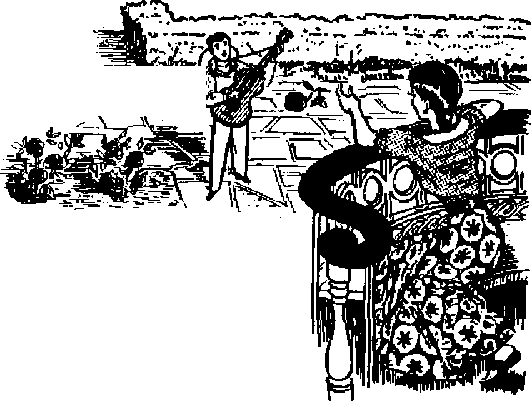
A delightful custom that usually fascinates visitors is the typical serenata. This is provided by about four professional musicians who have been hired by a Caballero to play three or four love songs in front of the home of his girl friend, in whose eyes he wishes to be enhanced. Many times one is awakened after midnight to hear the notes of guitars, violin and accordian harnionizingly providing a lively serenata somewhere nearby in the neighborhood, and not unusual are 3 a.m. serenades.
As for education, the very presence of the Church, long known and proved to be the foe of democratic education, is enough to explain the plight of the educational system. Of 21 Latin-A me ri can countries Colombia ranks eighth in illiteracy with 46 percent unable to read or write. As of 1950 it is calculated that 750,000 children of school age are without a school to attend. Well does the Catholic Church know that in the cities, where education of necessity is more advanced, she is losing followers daily* Her remedy: more religion, less education* ■
Colombia’s eleven million inhabitants are an Indian-Negro-Spanish mixture, especially Indian-Spanish- Although the actual Indian population numbers less than ten percent, the Indian blood is very noticeable in the average person* In many sections, including the capital city of Bogota, the people are quite fair-skinned, whereas on the coast Negro blood predominates, Generally speaking they love their liberty and have boasted (until recently) of having one of the finest democratic governments in the world Compared with other Latin-American countries, Colombia was revolution-free for many years, until 1948. Love as they might their liberty, the people have never thrown off the slavish yoke of bondage to the Roman Catholic Church religion foisted upon them by their Spanish conquerors, although under Simon Bolivar they emerged from under Spain’s rule*
Present conditions continue as Awake! has recently reported—martial law, radio and newspaper censorship, killings by armed bands in many sections of the country, including the vast llanos (plains), fear and unrest among the people* But, are not the same things happening world-wide? Are not selfish politicians doing as they please, with the welfare of the people in last place in their minds and schemes? Is not false religion riding high in the saddle, conscious only of her lust for wealth and power?
True, Colombia has its God-provided share of metals, minerals, raw materials and food* And, yet, the politicians, in their all-out light for domination, have not had the time to give attention to the needs of the people and the country’s natural resources* Yes, she has shown the desire and the ability to progress. But such advancement is brought to nought by the increase of violence, fear, hate and hypocrisy.
Along with honest, God-fearing persons from all over the globe, Colombians should lift up their heads to a real hope. God's kingdom- Shortly, in the zenith of its power, modern Babylon, the religious-politicai-commercial combine of this world, will fall even as did its counterpart in the height of its domination. Then will be a time of real joy and prosperity* “Then shall the earth yield her increase/’ “Thou openest thy hand, and satisfiest the desire of every living thing.”—Psalm 67:6; 145:16*

SO REPEATEDLY stated Moses, the inspired spokesman of Jehovah God, more than 3,400 years ago* Without benefit of any of the advantages of modem science he uttered a profound truth that has never been and never will be disproved. On the contrary, the more modem science learns about the marvelous mechanism of our bodies, the more it appreciates that those words of Moses are indeed true. Yes, press reports even tell us of scientists who are making a study of the blood with the hope of finding the secret of life.
Blood is found everywhere in the human body; in the heart, in the arteries and veins, in the thousands of miles of tiny capillaries. It forms the lymph which bathes all the cells of the body. Without it no tissue could exist. It supplies all the various organs of the body with the chemicals they need to do their work, and these in turn hand over to it the results of their activity, their secretions as well as their waste products. So by means of the blood one works for all and all work for one. It is the great unifier of the human organism.
The widespread use of blood products and the practice of blood transfusion have focused attention on this vital fluid, our stream of life. It is therefore most timely to give some thought to the blood, what its functions are, of what it is composed, and how it does its work.
The prime purpose of blood is to serve the cause of metabolism. Metabolism literally means change, the change that occurs in all living substances, consisting of the constructive
Red Corpuscles' / White Corpuscles'
changes of nutrition and repair known as anabolism, and the destructive or wasteproducing changes known as catabolism
Functions of the Blood
To carry out its nutritional function the blood obtains rich foodstuffs from three distinct sources: (1) From the lungs it obtains oxygen. This is its most important function, as cells are unable to store up oxygen and therefore without a continuous supply life could exist but for a few minutes. (2) From the digestive system the blood obtains proteins, the sugars (glucose), the fats, the salts, etc., that the cells need for the production of energy and for their repair and replacement. (3) From the various ductless glands the blood obtains certain valuable elements which aid the body in its various functions; such as the insulin of the pancreas, which aids in the digestion of the carbohydrates (sugars and starches); the adrenalin of the adrenal glands; and the hormones of the sex glands. The other part of metabolism in which the blood is active is hardly less important. The cells of the, body produce poisons so fast that unless these are continually carried away the cells would soon poison themselves- In fact, experiments have shown that a piece of tissue severed from the body requires a solution of 2,000 times its own bulk to avoid this self-poisoning. This waste consists of carbon dioxide, which is carried to the lungs and there disposed of, and the end products of protein metabolism, such as urea and uric acid, which are elim-
SEPTEMBER 22, 1950
21
inrted the liver, kidneys and the skln, A third function of the blood is to keep the body at a uniform temperature. When this rises the blood rushes to the surface, thus cooling itself as well as getting rid of moisture. When the temperature drops the blood rushes to the vital organs, thus conserving the heat and helping them to do the extra work required to keep the body at its normal temperature.
A fourth function of the blood is to supply the body with the secretions of the glands that act as regulators, such as the thyroxin of the thyroid gland. This secretion acts as a regulator of the oxidation process of the ceils, thereby controlling the heat-producing machinery of the body. For this reason it is said that the thyroid gland controls the basal metabolism.
A fifth function of the blood is to protect the body from the enemies that would and also do invade it and to act as repair medium in the case of injury. This it does by means of the white corpuscles and other elements, such as the protein globules known as antibodies, on which is based the use of penicillin, and which figure in immunity to disease.
And sixth, the blood works continuously to keep itself on the alkali side of reaction. Though carrying away all the acid waste of the myriads upon myriads of cells it feeds, it never permits itself to lose its slightly alkaline balance; to do so would mean death to the body. It keeps this chemical balance or reaction by means of certain elements in the blood which act as neutralizers, or, better stated, as buffers, which prevent the acids from accumulating in the blood and thereby causing it to become more acid than alkaline. Among such elements in the blood that serve this purpose are the phosphates, carbonic acid, etc.
Bloo4 a Moving Tissue
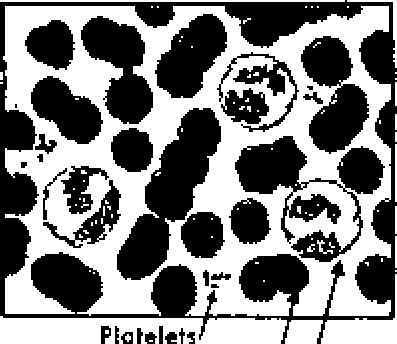
The blood is considered as being a tissue. Why? All tissue is composed of individual cells which are imbedded in a framework or, mesh known as a stroma (mattress). The blood has its cells, the red and white corpuscles, and platelets, which are imbedded m a liquid stroma or mesh or framework, the plasma. It is a liquid or moving tissue in'contrast to the rest of the tissues of the body, which are more or less stable.
How much blood does an individual have? According to the more recent estimates, our blood accounts for about nine percent of our weight. It is 55-percent liquid and has a specific gravity of 1.05 or 1.06, meaning that it is about 1/20 heavier than water, and five to six times as thick. Blood is composed of four main parts: the red corpuscles or erythrocytes (which simply means red cells), and which account for its red color; the white cells or leucocytes (literally, white cells); the platelets, tiny platelike objects of irregular shape; and the blood plasma.
Red Corpuscles
How many red corpuscles do we have and how large are they? In a man's blood we find about five million and in a woman’s blood about four and a half million per cubic millimeter (1/25 of an inch). The total varies from 25 to 40 trillion (one trillion being a thousand billion). They are like tiny discs, round and flat, with a depression in the center. They average about one three-thousandths of an inch in diameter and are about one-fourth as thick. They consist of liquid sacs that act as a mesh or stroma for the hemoglobin. The hemoglobin content of these is very definite and uniform in time of health.
The red corpuscles are formed in the red marrow of the bones. They have a
nucleus as they grow, but as they enter the blood stream they leave it behind. So, once having entered the blood stream they no longer grow. Their life-span fe from 30 to 60 days. And then what? When old and worn out they land in the spleen. That ductless gland salvages the iron and sends it on to the liver. The liver in turn supplies it to the red marrow as that red cell factory needs it.
The. production and destruction of these cells in normal healthy conditions keep pace with each other so that the blood is not only well supplied with oxygen carriers but there is always a goodly reserve available in case of emergency. The turnover of red corpuscles has been estimated at one trillion a day; which means that every second, yes, every second of our lives from 11 to 12 million leave the marrow of our bones and enter the blood stream, and also that that many are taken out of circulation every second. And we are assured that our blood manufacturing facilities are not at all taxed by this prodigious production but that it can be stepped up at any time conditions require, such as loss of blood due to hemorrhage, accident, or the rarified air of higher elevations.
The main job of these red cells is to supply the cells of the body with the oxygen they need, and the hemoglobin or iron and protein in them acts as the carrier for the oxygen. Concerning this process, A. Carrell, in his book Man the Unknown, says: “The method of oxygen transportation through the human body is one of life’s fundamental mysteries. Iron containing red blood pigment, named heme, functioning through a protein complex, hemoglobin, alone knows the secret of how to transport oxygen in a reversible process, in which it first picks it up and then releases it all along the assembly line of living bodies as it circulates through the body. It is in this manner that1 the fires life are kept burning/'
White Corpuscles
In contrast to the red corpuscles, the white cells or leucocytes are living organisms. They number hbout one to every 6 or 7 hundred red corpuscles, for a total around 40 billion. They originate in the marrow of the bones, lymph glands and spleen. They all have nucleuses and may well be likened to the amoebae, tiny onecelled parasites that are to be found in all fresh waters. Like these amoebae, the white cells are able to move about under their own power and to ingest substances, neither of which the red cells can do. Most numerous of the five varieties usually found in the blood are the polymorphonuclear (so named because of the varied forms of their nucleuses), which constitute some 70 percent of the total. Next most numerous are the lymphocytes, which resemble the lymph cells and account for about 20 percent; the giant monocytes (onecelled) number only 4 to 8 percent of the total; whereas the eosinophiles and the basophiles at best total 2 percent of the leucocyte population of the blood.
These various leucocytes have been likened to worms, fish and octopuses that act as scavengers in the river of blood, and like beavers capable of building and repairing. They seem to know where they are needed, and they will elongate themselves and go right through the walls of the capillaries to get to the point of infection or injury. The accumulation of pus we see at a point of infection is just so many white cells that have died doing their duty. At a place of injury they transform themselves into tissue cells and become part of the permanent tissue, thereby aiding in the healing of the wound. Thus we see that the leucocytes serve at once as de-
fense and attacking units, and as decontamination and reconstruction battalions.
Platelets and Blood Plasma
The platelets are little bodies of irregular shape, without color or nucleuses, and are found at the rate of about one to every eighteen red corpuscles. For a long time their function was not understood, although it was noticed that they dissolved as the blood came in contact with air. Now it has been definitely established that in dissolving they release an element without which the coagulation of blood could not occur.
The plasma of the blood consists of about 90 percent water, 9 percent protein, .9 percent salts, and the balance, fats, sugars, etc. It has been likened to raw egg white to which one percent salt has been added. Plasma is the most complex part of the blood, containing as it does all the elements that the digestive system provides for the body as well as all the secretions of the various ductless glands. Just as the red corpuscles supply the cells of the body with the oxygen they need, so the plasma supplies each cel] with just the particular chemicals it needs to continue in life.
The plasma also plays the vital role in carrying away the waste products of the cells. It brings nearly all of the carbon dioxide to the lungs, the red corpuscles accounting for only ten percent; and brings the other waste products to the liver, kidneys and skin so that they can expel them from the body. Its proteins form antibodies (globulins), which render immunity to disease and help the white corpuscles to fight bacteria. Some of the bacteria entering the blood are so large that they can easily overcome any of the body’s defense force. However, the antibodies of the plasma arc attracted to these giant invaders, attach themselves to such and thereby weaken them, permitting the white cells to then finish the job by enveloping them and eating them up.
Similar protective factors are responsible for the agglutinating qualities in the serum and the red corpuscles and which have made it necessary to classify blood into groups such as “A,” “B,” “AB” and “O”. The antibodies that are called forth when the “Rh” factor is transfused into a body which does not have it stay in the blood the rest of one’s life.
Miscellaneous Facts
The more men make a study of the blood the more they are convinced that each one of us has a blood personality the same as we have a mental personality. Discoveries have also revealed that mental ailments leave telltale marks of toxins in the blood. One scientist has even gone so far as to claim that the blood holds the key to all the skills and that it indicates race as well as mental and physical capacities.
Yes, many are the interesting facts regarding the blood. The foregoing has not begun to exhaust all that is known regarding our stream of life. But let us not make the mistake of some and think that in such knowledge lies man’s hope of life. In spite of all the information modem man has gained on the subject, there are no more octogenarians now, proportionately, than there were thousands of years ago. (Psalm 90:10) Search as hard, as long, and where he may, man will not unlock for his use the secret of life, Man will not be able to exult: “Eureka! I have found it! Now I can create life!” God alone is the fountain of life (Psalm 36:9), and to obtain it requires not a study of the blood of animals and man, but faith in God and in the blood of Christ Jesus, and a consistent course of action. “This means everlasting life, their taking in knowledge of you, the only true God, and of the one whom you sent forth, Jesus Christ.”—John 17:3, New World Translation

Applying the Scriptural Rule
G4TVTHAT Are 'Jehovah's Witnesses'?" Under this heading the Church of England monthly, The Sign, in its February, 1950, issue, had the following to say:
“This strange sect was founded in America in 1872, Its members believe that they alone will be saved and all others damned. As they deny the Holy Trinity, the Divinity of Christ, and His Resurrection, it is clear that they can scarcely be reckoned as a Christian body?'
Whether or not Jehovah’s witnesses are “strange” would, it seems, all depend upon what you are accustomed to. The Athenians considered the message that Paul brought them as strange. (Acts 17:18) And as for their being founded in 1872, the Bible speaks of Christ Jesus as the faithful witness (Revelation 1:5; 3:14); shows that the Jews were witnesses for Jehovah hundreds of years before Christ (Isaiah 43:10-12), and that as far back as Abel God had his witnesses in the earth,—Hebrews 12:1.
As to holding that all others are damned, Jehovah’s witnesses do not even believe in the teaching of damnation or eternal torment Rather, they hold that the “wages of sin is death", and that it is life eternal to know Jehovah God and Jesus Christ. (Romans 6:23; John 17:3) Yes, they even hold out hope for the dead.—John 5:28, 29; Acts 4:12; 24:15.
The doctrine of the trinity in brief is that there are three Gods in one God; God the Father, God the Son, and God the Holy Ghost; and that these three are equal in power, substance and eternity.
The whole tenor of the Scriptures is to the effect that Jehovah God is One, of whom are all things; and that he is from everlasting to everlasting, inhabiting eternity. (Deuteronomy 6:4,5? Am. Stun. Ver 1 Corinthians 8:6; Psalm 90:2; Isaiah 57:15) On the other hand we are told that all things are by the Son; that he did have a beginning; that he is God’s only-begotten Son; that he is the firstborn of every creature; and that he is the beginning of the creation of God- (John 1:18; Matthew 16:16,17; Colossians 1:15; Re relation 3:14) Clearly God and Christ Jesus are not equal as regards eternity.
Unequivocal also is the testimony of the Scriptures that God and Christ Jesus are r\ot equal in other respects. God showers blessings upon his Son, and, as Paul states, the greater blesses the lesser. (Hebrews 1:9; 7:7) God sent Jesus into the world, and surely the Sender is greater than the one being sent. (John 17:3,18,25) God is the head of Christ, and therefore his superior, even as Christ is the head of the church, and therefore her superior, (1 Corinthians 11:3) Jesus worshiped his Father, Jehovah God, but nowhere do we read that God worshiped his Son. (Matthew 4:8-10; John 4:22-24) Throughout ■r
eternity Christ Jesus will be subject to his Father. (1 Corinthians 15:24-28, Douay) Also, we have Jesus’ plain declaration on the subject: “My Father is greater than 1”—John 14:28.
And what about the third “person” of the “holy trinity", the “Holy Ghost”? In telling of the heavenly visions he saw on
the Isle of Patmoa, John repeatedly speaks of seeing God and Christ Jesus, the Lamb, but never tells of having seen the “Holy Ghost”. (Revelation, chapters 4 and 5; 7:9,10) If the “Holy Ghost” is equal with Jehovah God and Christ Jesus, why thus slight him? But all is reasonable and consistent when once we understand that the holy spirit (obsoletely rendered “Ghost”) is God’s active force or power in operation. —Luke 3:22; Acts 2:17,33,38, A. 8. V.
According to the doctrine of the “divinity of Christ”, Jesus was both human and divine while a man on earth. However, there is nothing in the Scriptures to indicate that he was a mixture of human and spirit, a hybrid, as it were. To say that he was not divine but merely human is not to deny that God was his Father, but merely to accept the Scriptural testimony that he divested himself of his spirit qualities and glory and became a man. (Philip-pians 2:7, Diaglott) His life was transferred from his spirit organism to the womb of Mary. It was not a divine creature being clothed with a human body. Jesus was made flesh, made of a woman, made under the law.—John 1:14; Galatians 4:4.
Had Jesus been Jehovah God he could not have died for man’s sins, for the Almighty is not subject to death; whereas the Scriptures plainly state that in due time Christ died for the ungodly, that he was dead but now is alive forevermore. (Romans 5:6; Revelation 1:18) Immortality and the divine nature were his reward for faithfulness.—Philippians 2:9-11; 1 Timothy 6:16; 2 Timothy 1:10; 2 Peter 1:4.
As to the resurrection of Christ from the dead, Jehovah's witnesses most certainly hold that Christ Jesus was raised from the dead. (Matthew 28:6; Luke 24:6; 1 Corinthians 15:12-20) But it is neither reasonable nor Scriptural to hold that he was raised with the same body which hung on the torture stake. We read that Jesus was put to death in the flesh but made alive in the spirit, (1 Corinthians 15:42-45; 1 Peter 3:18, Am. Stan. Ver.) He laid down his life as a ransom for all. (1 Timothy 2:5,6) Had he been raised in that same human body which he sacrificed for our sins he would have had no offering to present in the presence of God for us. —John 1:29; Hebrews 9:24-28.
Then how do we understand the disappearance of Jesus* body from the tomb, and his appearing in human form after his resurrection? you ask. Without doubt Jehovah God disposed of the human body of Jesus in the tomb, that it might not “see corruption”. The bodies he appeared in after the resurrection were materialized for each occasion.
That Jesus Christ did not have the same body after his resurrection that he had before it is very apparent from the fact that repeatedly his followers failed to recognize him until they saw or heard some familiar expression or action on his part. (John 20:14-16; 21:4-12; Luke 24:30,31) It was in such a body as this that his disciples saw him ascend into heaven, for flesh and blood cannot inherit the kingdom of God. —Acts 1:9; 1 Corinthians 15:50.
But didn’t he appear in the same body to doubting Thomas? No, he merely materialized in a similar body that would satisfy Thomas that his Master and Lord had actually risen from the dead, that he was the same Jesus, not that he had the same literal body.—John 20:26-29.
In summing up we can readily see that the doctrines of the trinity, the divinity of Christ (prior to his resurrection) and the resurrection of Jesus’ human body are not the teachings whereby to identify the true Christian organization. In fact, just the opposite is true. Any organization holding such unscriptural teachings cannot be considered Christian.
Dope Running-—Trafficking in Human Lives
OUTLAWED narcotics are smuggled throughout the world by boat, plane, pack animals, and every conceivable means, and this smuggling provides for the enslavement of countless persons. It is a traffic in human lives that leads to violence, gang warfare, prostitution, sex
Many attempts have been made to control the destroyer. National laws, customs inspections, police narcotic squads, and even the League of Nations and United Nations have fought it. When Switzerland’s legal requirements for heroin were about 30 pounds a year police swooped down on factories that produced 7,000 pounds annually, much of which probably went through the underground to Egypt, where there is a great demand for it. In eight years the Egyptian government imprisoned 12,576 persons for drug trafficking.
News reports telling of the capture of dope runners show the vast scope of their operations. Heroin worth $1,147,500 was discovered on a ship in New York harbor in March, 1947. A million dollars’ worth of opium was found on a French ship there in January, 1949; and in 1948 alone $10,-000,000 in illegal drug shipments was apprehended in "New York. Several million dollars in heroin was found among the possessions of a man who died on a United Airlines plane near Los Angeles in November, 1948, and a half million dollars’ worth of the same drug was found hidden in the tail assembly of an Air France plane in New York in June, 1948. In Vancouver harbor in October, 1947, eight million dollars’ worth of opium was discovered on one boat!
If these amounts are found, how much more gets away? Perhaps even the report that smuggled dope costs the United States $28 million a year and costs Canada $80,000 a day is an underestimate!
In 1948 it was estimated that the world was being flooded with more than 350 tons of narcotics annually, and this is sold not by the pound, nor even by the ounce, but by the grain.
<<re encountered 'in trying to stop dope smuggling, because a fantastically small quantity of it has enormous value. When dope may bring from several hundred dollars to $2,500 for each ounce, several thousand dollars’ worth can be hidden in a very small place. Dope has been found in hollowed-out door frames, under loose floor boards, in lamp bases and tea kettles. Opium has been found in the cord of a sailor’s undergarments, in a case of fried fish, in handkerchiefs^ in people’s, mouths, and in other inconceivable places.
Yet the efficiency of narcotics officials drives smugglers ever onward in their efforts to conceal the contraband they carry. Take, for example, the report in the League of Nations Opium Section, in 1939, that Arabs smuggled hashish into Egypt in the stomachs of worthless old camels. An Egyptian policeman became suspicious of a camel when its Arab owner refused to sell it for $40. The camel was examined, ami its stomach and fne stomachs of 18 others was found 164 pounds of narcotics, valued at 16,560, or almost $32,000! Up to 80 pounds of hashish (variously called marijuana, ganjah and Indian hemp) has been put in metal tubes and forced down the throats of these beasts before they were driven into Egypt.
When guards began using detectors to indicate the presence of the metal tubes containing hashish, the dope runners switched to rubber and. leather to escape detection. How are the containers removed from the camel’s stomach?
SEPTEMBER 22, 1950
The camel is slaughtered, of course. Its life is given as an unwilling sacrifice to the abominable weed, but before its cargo has run its course even human sacrifices may be demanded by it in the form of horrible, blood-chilling crimes!
In New York city in 1939 the police raided an entire block on Sixty-second and Sixty-third streets and reported finding a "modern catacomb” with secret tunnels, hidden passageways and sliding doors that formed an intricate network through the dope-peddling, vice-ridden block. Leong Sai Lun’s dealings in heroin in New York’s Chinatown would make an excellent background for a detective thriller story.
Dope runners and peddlers are often respected people in the community. A man described as "the best-known retail drug trafficker in all Egypt” was an elder in the Greek Church. A Roman Catholic priest in Montreal was among those arrested in 1949 after the Canadian Mounties seized
$90,000 worth of heroin. At Laredo, Texas, customs men found, in a Cadillac registered in the name of a member of the Mexican Presidential Security Police, a secret compartment containing $40,000 worth of opium.
It’s an ugly mark on today’s world that trafficking in human lives is so widespread that more than ten percent of the inmates of United States federal prisons were convicted under the narcotics laws, that the inhabitants of this old world have become so degraded that they choose to becbme slaves to poisonous weeds in a futile attempt to deaden their senses to this world’s woes. But be not disheartened. Look up! Dope running is to pass! Man will no longer deal in human lives or wish to black out the horrors of world conditions when God’s Kingdom blessings soon will cover the earth, for then this old world’s woes will be replaced with abundant blessings from the hand of Jehovah.
•>i.
How Did It All Get There?
Have you ever pondered the marvels of creation about you? the majesty of the heavens, the beauty and grace of the animals, the exquisite form and coloring of myriads of flowers and plants, the remarkable adaptability of the earth as a home for man? Does it seem reasonable to you that all these things “just happened”? Where did they come from? How long will they remain?
An accurate knowledge of the origin of man and all of these things about him is essential to an understanding of what the future holds. If you are even faintly curious you will profit greatly by reading the 64-page colored-cover booklet Evolution versus The New World, The facts it presents are comforting and enlightening. Sent postpaid for 5c a copy.
WATCHTOWER 1T7 ADAMS ST. BROOKLYN 1, N.Y.
Enclosed Is 5c. Please send nif a copy of the booklet Evolution versus The New World.
Name ................................................................................................... Street..................................................................................................
City........................................................................................................
Zone No.........Slate .............................................................

Korean War
$ The Korean situation grew ?ven more critical during the latter part of July, when North Korean troops continued to push back the defenders. Battlefront dispatches were grim. By the end of July the invaders held the entire West coast, and mopped up the entire southwestern corner of the peninsula, while U. S. and IL N, forces tried to hold the North Koreans back from the port city of Pusan on the East coast, and thereby prevent a mass evacuation like the one at Dunkirk in World War IL Troops were under orders to hold their ground or die. North Koreans continued to pour southward, and Gen. Mac-Arthur's staff reported, as a “conservative11 estimate, that 37,500 communists had been killed or wounded. Still they rolled onward. One officer can’ didly said that the communist troops “beat hell out of us” and grabbed the town of Chin-ju with one of the best airfields in Korea. Reinforcements were on the way to the defenders, but one unnamed Washington official predicted that a major counteroffensive in Korea might have to be put off as far as next spring,
Comments and Predictions on War
In Washington President
Truman asked congress (7/19) for $10 billion for men and equipment for Korea and to thwart communist aggression anywhere else, The communist Doily Worker in New York accused Truman of showing “readiness to convert the Korean war into World War III”. Bernard M. Baruch, the “elder statesman”, testifying before the Senate Banking Committee (7/26), called for immediate all-out mobilization, including rationing and blanket price, wage and rent controls. John Foster Dulles, Republican adviser to the U.S. State Department, said (7/31) that he did not believe Soviet leaders had decided to start a third world war, although they are willing to run greatly increased risks,
England added £100,000,000 ($280,000,000) to her war prep a rations (7/26), and (7/30) Prime Minister Attlee told Britons sitting by their radios that “the fire that has been started in Korea may burn down your house”. He outlined the necessity of increased pro-duction, volunteer service, guarding against the energy from within, and keeping in mind the value of freedom, democracy, justice and moral law.
U, N. Participation in Korea
The LL N. flag was flown over army headquarters in South Korea on July 16 for
the first time. Leaflets printed both in English and Korean were distributed, stating, “The United Nations has appealed to American forces in Japan to ^assist you peace-loving citizens of the Republic of Korea in h your struggle against the unprovoked aggression from the North. We shall give you every support, Be steadfast. Be calm. Be courageous, Resist firmly. Together we shall drive the aggressor from your territory.” General MacArthur issued a “United Nations Command communique No. 1'* (7/25), inaugurating a new system under which he will issue communiques concerning U. N. directives and affiliated announcements. Replies to the U, Security Council's re-quest for member nations to supply troops brought promises for about 27,000 men from Australia, the United Kingdom, New Zealand, Turkey, and Siam. Some nations declined and others offered various types of assistance, such as officers and medical aid.
Russian Delegate Back in U>N. $ The Soviet representative to the U. N. Security Council, Jacob A. Malik, advised that he would take his turn as Council president in August, thereby ending his walkout started over" six months earlier, on January 13, over the Council’s refusal to expel Nationalist China.
“Peace Appeal”
Sweden’s premier, Tage Er-lander, protested (7/16) the use of the name “Stockholm” in connection with the communist “peace petition” that is being circulated around the world. He termed it the “brandishing about of the name of our capital by international communist propaganda”, and said that one of the main points of the “Stockholm Appeal” is that the government which first used the atomic bomb committed a
crime against humanity, while Sweden believes that aggresr si on, with or without atomic bombs, is a crime against flu* inanity.
U. S. secretary of state Acheson charged that the appeal is "a propaganda trick in the spurious 'peace offensive' of the Soviet Union”, Violence has broken out in scattered places over the signing of the appeal. In Western Berlin, 1,556 person^ from the Eastern (communist) sector were arrested (7/18) while seeking signatures to it. A total of 668 of the 1,556 faced prosecution for distribution of illegal literature. In the U. S. five million signatures were sought. It was reported that 100 million signed in Russia. In Denmark 10,000 persons, about a tenth of the signers, recalled their pledges, stating that they had signed under false pretenses.
Theocracy’s Increase Assembly <$> The Theocracy’s Increase Assembly of Jehovah’s witnesses opened (7/30) in Yankee Stadium, New York, with delegates present from 67 countries. The first day’s attendance was 79,247, Much publicity was given by the press, but the greatest advertising was done by the thousands of Jehovah’s witnesses who personally contacted the residents of New York, offering them the Kingdom message and inviting them to the assembly.
McCarthy Confusion Continues
The U.S. Senate accepted a committee report (7/17) that said that Senator McCarthy’s charge that there are communists in the State Department is a fraud. The Republicans strictly opposed the report, saying that it was a whitewash, “political” and "insulting”; while Senator Tydhigs, a democrat who headed the investigation, accused McCarthy of perjury and said.
"It ought to make Americans’ blood boil that they have been told these foul charges.” Then (7/25) McCarthy accused another member of the State Department, Edward G. Fosnlak, of being a communist.
U. 8. Draft Increased
<•> Stepping up its demands for manpower, the army called for 50,000 men in September (instead of the 20,000 that had previously been called for), and an additional 50,000 in October, making a total of 100, ■ 000 to be drafted in two months. Simultaneously President Truman extended for one year all enlistments of persons now in the armed forces, and the army added six months to the tours of duty of troops now overseas.
Two Alleged Atom Spies Held <$> The F.B.I. swooped down on two more Americans Who were allegedly involved in the international atomic ?py ring with both Dr. Klaus Fuchs, who is now in prison in England, and the confessed espionage agent Harry Gold. Gold named Abraham Brothman as his one-time associate in espionage activities for Russia. Brothman and an associate, Miriam Moskowitz, were arrested in New Jersey (7/29).
Hoarding in the <7. S.
<$> "Scare” buying of food and other items was prompted in many parts of the U. S. by the Korean war. Both President Truman (7/19) and the Department of Agriculture (7/22) stated that the nation’s food supply is plentiful. Many stores and wholesalers took action to stop hoarding, and in some places picket lines were planned by unions, not against the stores, but against the customers who could cause artificial shortages by panic buying.
150 Million Live In U, S.
The Census Bureau tentatively placed the population of the U. S. at 150,520,198, an increase of almost 19 million since 1940. New York State still stood in first place, vrtth California passing Pennsylvania to become second in population.
Mackenzie King Dies
<$> Former Canadian prime minister Mackenzie King at his home near Ottawa (7/22) at the age of 75. Before resigning in 1948 he had been prime minister for nearly twenty-one and a half years, longer than any other prime minister in British Commonweal th history.
Big Steal Unsuccessful
<$■ Sentences totaling 80 years in prison were imposed on four men in New York (7/18) who were implicated in a plot to steal $3 million from the Cuban national treasury and substitute counterfeit U.S. money,
Violence in Guatemala
<$> Revolution seemed near in Guatemala from July 19 to 26. A daily one-min ute-of-sftence campaign for the resignation of President Juan Jos£ Arevalo flared into violence. A state of siege was declared by the president, and constitutional guarantees, including the right of assembly, were suspended. University students went on strike, and were followed by professional and commercial men. The strike was ended by the army, and Juan Jos£ Arevalo survived the 28th attempt against his regime in his five years in office.
Unpopular Belgian King
The Social Christian (Catholic) party in Belgium had won an absolute majority In Parliament, and they insisted on the return of Leopold III as king. His foes left the assembly before the vote, saying, "You will stay alone, to take one of the gravest and most disastrous decisions in his-
tory.” When exiled Leopold returned to Belgium (7/22), violence broke out Less than 300 yards from the palaee rioters shouted “Leopold to the gallows!" Elsewhere there >vas wild rioting. Civil war impended. Leopold announced that he would delegate his powers to his 19-year-old son, when the youth reaches 21 years of age. Leopold's toes had previously indicated that they would accept Prince Baudouin as king.
Price Controls tn Finland
Price' controls were restored in Finland (7/29) in a fight against the growing inflation in that land since the controls were abolished a year ago. The price controls cover many consumer goods such as milk, bread, meat, furniture, electricity, along with barber shops, shoe repair shops, and other services.
Enslavement at Lithuanians
<$> A former Lithuanian diplomat, Vaclovas Sldzlkauskas, reported on his arrival in New York (7/17) that 500,000 persons, comprising one-sixth of the prewar population of his tiny country on the Baltic sea, have been banished to Soviet labor camps in Siberia.
Serba Stage Unusual Protest
<$> Peasants in Yugoslavia staged the greatest protest demonstration ever allowed in an Eastern European communist country when between 500 and 600 Serbs marched in an orderly manner into Belgrade (7/28) to protest alleged excessive taxation by their local communist leaders. They carried no signs or banners, but these stubbornly independent peasants were deadly serious when they tramped in to present their protest petition at the office of the premier of the Republic of Serbia.
Food Shortage In Hungary
<§> A severe shortage of food is plaguing Hungarian cities,
SEPTEMBER 22, 1950
according to reports from Budapest Supplies of meat, milk and butter are about 30 percent below normal, and potatoes, vegetables, and even fruit have been hard to And, while they are usually plentiful during this season.
Floods and Famine In China
<$> Wide-scale mobilization to fight the threat of floods in North and Central China was reported in July. Famine conditions are still prevalent, and apparently the Peiping regime is trying m forestall new disasters. It was reported from Shanghai that the 1949-1950 famine was not as bad as the great famine of 1931, yet It affected 40 million people.
Japanese War Prisoners
<$> The Soviet Union bluntly informed the U.S. that the matter of Japanese war prisoners in Russia had been “exhausted in full”, according to the Moscow radio (7/16). On June 9 the Moscow radio had said that only nine war prisoners had remained in Russia for medical treatment, and that 971 were turned over to the Chinese communists. This is in contrast with the Japanese government’s insistence that 300,000 war prisoners have not been repatriated-
Burmese Rebels Foiled
<$> Near Rangoon, Burma, 600 Karen rebels made a bold attempt to isolate the city (7/31). They captured four towns on the Rangoon-Mandalay rail line, but the rebels walked into an army trap and after five hours of fighting they had to withdraw, leaving more than a third of their number dead.
Strife In Malaya
During the past two years the toll taken by the strife in Malaya has been 1,292 terrorists killed, with 445 police wounded and 406 police killed. Additionally, 965 civilians have been killed, 570 wounded and 310 reported missing, according to a government communiqué Issued July 21
New Government for Indonesia
A new strongly centralized government to unify the Indonesian islands and replace the dual governments of Jakarta and Jogjakarta was approved July 20. It is to be fonnally set up August 17. Its seat will be at Jakarta and President Sukarno will remain the chief of state. The unification ends a campaign to bring the ordinal 16 island states under one government. The 40-year-old Dutch colonial army in Indonesia was disbanded (7/25) and the affairs of the Netherlands’ regular army In Indonesia were concluded. A few days later (7/28) the Indonesian government reported that her troops had landed on the Moluccan islands and occupied them, suffering only a “few dozen” casualties, although facing well-armed opposition.
Volcano Erupts In Alaska
<$> A long-dormant volcano, the 8,900-foot Mount Pavlof on the Alaskan peninsula, blew off (7/31), sending a dous cloud of flame and ash up thousands of feet.
Rocket-on-Rocket Successful
<$> With the sound of a thunderclap a German V-2 rocket rose from the ground in Florida (7/24), and, in a burst of orange flame, it rose from a resting position to 1,000 miles an hour in a matter of seconds. Ten tons of fuel was consumed in a minute. Then a smaller rocket, the “WAC Corporal”, separated from the V-2 and shot away on its own- The speed of the smaller missile was described as "the sum of the two rockets”, or, according to private estimates, possibly 5,000 miles an hour, The test was described as the first successful horizontal flight of a guided long-range missile-
31
'Tfetu/ ^feant-fceueatotfyf
New World Translation
At last, the book you have longed for is off the press: The New World Translation of the Christian Greek Scriptures! Into its writing have gone many years of careful research. It is an entirely new translation, written in modem English but without sacrificing accuracy of expression. Now you may have the Greek Scriptures in all of their force and purity! Bound in green leatherette, the New World Translation measures 7|"x4i"xl". Large, readable type, copious cross references, chain references on over 1,000 different words and expressions, footnotes, an appendix and other features combine to make the New World Translation the outstanding translation of the Greek Scriptures. Available for only $1.50 postpaid.
“This MeaAs Everlasting Life”
is a new 320-page book and a fitting companion to the New World Translation. Drawing its theme from John 17:3, NWj this book is “dedicated to the unsectarian education of all people of good will in the requirements for everlasting life in the righteous new world now at hand”. Throughout its 30 chapters are Scripture references taken from 11 different Bible translations. To aid in study, the book features a question on each paragraph and an index to scriptures cited or quoted. “This Means Everlasting Life” contains numerous colored illustrations and is attractively bound in cardinal red, and gold embossed title. The publishers’ edition is now available at 50c per copy,

Now is the time to forward your order for these two new and indispensable volumes. Both will be sent postpaid for $2.
WATCHTOWER 117 ADAMS ST. BROOKLYN!, N.Y.
Please send, mt the new publications I have checked below.
□ The New World Translation of the Christian Greek Scriptures and “This Means Everlasting Life’’, for which $2 is enclosed.
-
□ The New World Translation, for which $1.50 is enclosed.
-
□ "This Means Everlasting Life”, for which 50c is enclosed.
Name.................................................................................................... Street..................................................................................................
City.............................................................................. Zone No. ........State................................................................
32 AWAKE!
