
 View PDF
The content displayed below is for educational and archival purposes only.
Unless stated otherwise, content is © Watch Tower Bible and Tract Society of Pennsylvania

"LIFE” MAGAZINE SMEARS CHRISTIAN MISSIONARIES Jehovah’s witnesses reply to smear
Can Hypnotism Serve Criminal Ends?
Dangers of posthypnosis and autosuggestion --
Are They Peddlers or Preachers?
Luxembourg’s High Court hands down decision
Scientists” and Scientists
Compare men’s work with God’s
AUGUST 22, 1953 SEMIMONTHLY
intwnooiun vr ima uuuKPIAL
News scqrces that are able to keep you awaka to the vital iwu — of our timea must ba unfettered by censorship and selfish interests. “Awake!” has no fetters. ft recodhlzes feats, faces facta, Is free to publish facte, ft to not bound by political ambitions or obligations; it la unhampered by advertisers whose toes must not be trodden on; it is unprejudiced by traditional creeds. This Journal keeps itself free that it may speak freely to you. But it does not abuse its freedom. It maintains integrity to truth.
“Awake lw uses the regular news channels, but is not dependent on them. Ite own correspondents are on all continents, in scores of nations. From ths four corners of the earth their uncensored, on-the'Scenes reports come to you through these columns. This journal's viewpoint is not narrow, but is international. It is read in many nations, in many languages, by persons of all ages. Through its pages many fields of knowledge pass in review—government, commerce, religion, history, geography, science, social conditions, natural wonders—why, its cover* age Is as broad as the earth and as high as the heavens.
“Awake 1° pledges itself to righteous principles, to exposing hidden foes and subtle dangers> to championing freedom for all, to comforting mourners and strengthening those disheartened by the failures of a delinquent world, rejecting sure hope for the establishment of a right* eons New World.
Get acquainted with “Awake!” Keep awake by reading “Awake
PDBLISHfcn BEMlMOMTaLT By WATCHTOWER BIBLE AND TRACT SOCIETY, INC.
117 Adame Street Brooklyn 1, N, T„ U, B. A,
N. H. Knobs, Pre ft text Grant Sditer, Secretary
Printing this fesue: 1,100,000
LMgwifH Is wtfefr tfiJk ngaita h ffbtiriW; StnlnoDtiUj—AfrWuuu, SbcUib. Finnish, Frwch, Otrtiin, BofltudWi, Iforntiitn, Spvilih, Bwedlih. Monthly—Qrwk, Portupftje, Ukralnisn.
Offices Teatly nuiraerlption Bite
Narita, U.S.,117 Adirntfit, Brooklyn 1, N.Y. >1 Airtrdh, 11 Bsrwford Bd., stratblteld, N.S.W. 8s Cauda, 4# Irwin Are., Toronto 5, Ontario *1 EnflMiL 34 Craren Twraea, Loudon, W. 2 7s 8*ith Attica, Print* Bm, P.O. Elandsfocteto,
Transvaal 7s
Entered u mond-elMa matter M Brooklyn, N. Y.
Five cent* a copy
AMtftbtttNf JftonM be KtLt ta aKes Js your txm-try in compliance with regulations to guarantee ■aft delivery of money. Remlttiju» are accepted at Brooklyn from countries where no oflftce is located, by international money order only. RnbscriptiotL rates in different countries are hen stated in local currency. Notlc» af aalratlin (with renewal black) is nut at least two Issues before subscription expires, Change of aiiren when sent to our offico au be expected effective within one teouth. Send j*wr old as well as new kiMmg.
Act of March 3. 1879. Printed In V. 8. A
CONTENTS
|
“Scientists’* and Scientists |
3 |
Are They Peddlers or Preachers? |
19 |
|
Political Revolution in British Guiana |
5 |
Appeal to Higher Court |
20 |
|
The Waddington Commission |
5 |
Can Hypnotism Serve Criminal Ends? |
21 |
|
White South Africa Confirms Its Choice |
9 |
Weighed and Found Wanting |
23 |
|
Weighed in the Balances and |
“Your Word Is Truth” | ||
|
Found Doubtful |
12 |
Christianity versus Hypnosis |
25 |
|
Life Magazine Smears Christian |
Jehovah’s Witnesses Preach in All | ||
|
Missionaries |
13 |
the Earth—South Africa |
27 |
|
What Is Practical? |
16 |
Do You Know? |
28 |
|
The Foxy Fox |
18 |
Watching the World |
29 |
Volume XXXIV

Brooklyn, N. Y., August 22, 1053
"Scientists” and Scientists
TO MANY devout Hindus of India the cow is a sacred animal. So sacred in fact that it can do as it pleases, wander where it will on the streets, and that even its dung is considered sacred. Well, there are many people throughout the world who are just that superstitious as regards science. To them science is a sacred cow. Whatever is said in the name of science is accepted unquestioningly regardless of the few facts to support the theories or the lack of logic in the deductions made. But there are “scientists” and scientists.
Some scientists are proud that they know so much. Others, humble that they know so little. For example, at the diamond jubilee convocation of the Case Institute of Technology held at Cleveland, Ohio, on April 10, 1953, some scientists boasted of their ability to make “computation machines that could play a tolerably good game of checkers, translate crudely from one language to another and leam from experience as higher animals do”.
One even spoke of machines reproducing themselves, although upon closer examination it appeared that what they were inventing were machines capable of assembling parts that had been previously prepared; so that, far from reproducing themselves in the way that man had produced them in the first place, these machines were merely assembling machines. And as far as actually producing such fantastic machines, it was admitted that all that was had as yet was an “abstract model”. With great satisfaction these men compared the works of man with the works of God and boasted that man’s supremacy over the machine was being rapidly whittled away. Truly men who speak thus are proud of their achievements.
But just how does a scientist, who is not intoxicated with the success of his own achievements, view the machine that God made, man, as compared with the machines that men make? A Dr. Norbert Wiener, termed “probably the world’s most eminent authority on the theory of automatic controls and of the automatic factory”, assures us that man’s machines can never rival in complexity, broad intelligence, and in discrimination the most fabulous control system of all, the human brain. Said he:
“We couldn’t even come close to duplicating the brain. It really is a superb instrument. Perhaps I could give you an idea of how complex it is by sketching the efforts you’d have to make to try to build even something remotely like it.
“The machine would have to be about the size of Rockefeller Center, and it would take several lifetimes to wire it up. The electrical power requirements would be about equal to the power used to supply the greater part of New York city. The necessary cooling system would be so enormous that you’d probably have to divert the Hudson to supply it. And in the end, when you got the thing going, it would operate on a very much lower level, except as a mathematical computer, than the brain of anybody you'd meet on the street. It hardly seems worth it, does it?”
Dr. Wiener not only makes such a comparison between the machines that man makes with the one that God made, but he also wisely points out the danger associated with man’s machine-making. "What we have to make clear is that we cannot treat machines as gods and survive. If we worship know-how for its own sake without taking into account its proper purpose —the service of humanity—we are doing something as stupid as to worship an idol, an idol of our own manufacture. What we must do is to use these remarkable new devices to raise the dignity of labor, not to cast it aside—to bring about shorter working hours and create extra leisure, not unemployment and chaos.”—This Week, January 25,1953.
. Similar testimony was given by Dr. M. V. Wilkes, who directs the mathematical operations of the University of Cambridge, London. While telling of a machine that has been "taught” a conditioned reflex action on the basis of experience similar to that of a trained dog, he pointed out that actually the machine no more thinks than does a locomotive engine when it approaches points that have been set automatically by the passage of a previous train.—New York Timea, April 30, 1953.
Yes, scientists who have a sober perspective of what they are able to do point out that far from machines’ whittling away man’s superiority over them, they merely are serving to relieve man of much tedious time-consuming labor, thus making it possible for man to spend his time and powers in doing things that no machine could possibly do, creative work in the fine arts. At least that is their theory.
Only a theory? Yes, for while scientists ostensibly are working for the good of mankind, what are the facts? Is it not true that although the machines have lightened man’s burden, man has not produced greater creative works? Do we have playwrights today that can compare with Shakespeare? poets to compare with Milton? composers to compare with Bach and Beethoven? painters to compare with Rembrandt? sculptors to compare with Mi-chaelangelo? And is it not true that the owners of the machines that science produces are not concerned with the welfare of the workingman, necessitating his organizing unions, staging strikes and agitating for legislation so that he gets at least a little of the benefit of these machines?
Obviously man is doing just what Dr. Wiener warned that he must not do, placing all the emphasis on scientific knowhow and ignoring the use to which his machines are being put, and therefore is guilty of worshiping idols, the works of his hands. Well did the prophet Isaiah describe the present situation: "Their land also is full of silver and gold, neither is there any end of their treasures; their land is also full of horses, neither is there any end of their chariots: their land also is full of idols; they worship the work of their own hands, that which their own fingers have made.”—Isaiah 2:7, 8.
By such folly modem man is not only creating economic confusion and chaos, but worst of all, man, by worshiping such idols, is handing his own Maker an insult. Jehovah God, being the Supreme One, will not always take that insult. He therefore sounds the warning: "And the loftiness of man shall be bowed down, and the haughtiness of men shall be brought low; and Jehovah alone shall be exalted in that day.” Therefore quit trusting in man. Of what account is he, compared with Jehovah?—Isaiah 2:17, 22, Am. Stan. Ver.

By “Awake!'* correspond*nt in Britith Guiana
ONCE upon a time there was a man who was very wealthy. He had vast acreage of growing timber; his men slaved in his bauxite mines in order for shareholders in another country to live comfortable lives. Hundreds risked their lives in search of gold and diamonds, that others might become wealthy. Thousands huddled in tiny range-houses that flooded with the rains in order that tens of thousands of tons of sugar might be sold at low cost to the ‘mother country’. Every year peasant farmers fought a losing battle as crops were lost through lack of drainage or from disease. For years this situation had continued. The wealthy man had made'hiany promises to alleviate this condition. Here and there concessions were made: extra pay for the sugar workers. Why, old-age pensioners could have $3.50 a month at sixty-five years of age if they could establish evidence of need! Unable to afford more teachers, hundreds of children get only half-day schooling on a shift system. Medical specialists leave for greener pastures while thousands suffer in need of specialized treatment.
For generations the people had little voice in affairs of government and, though keeping law and order, little was done to raise the living standard. And then it happened. No, there was no bloodshed, but in a legal and peaceful manner the tables were gently turned completely over. While the rich man had been taking his ease things had been happening and in one epoch-making day the usually inaudible voice of the workers changed the entire face of the government.
But to begin at the beginning. “She is a region in Guiana, all gold and bounty,” said
Falstaff to an audience familiar with the legend of Eldorado. This was the attraction to the numerous English adventurers of the sixteenth century among whom was Sir Walter Raleigh, and sUch was the beginning of Guiana’s ties with England. Trading posts were established with the aboriginal Indians, The sugar industry was developed and to sustain it slaves were brought from Africa and people from India were indentured, and thus has grown up a population of rather less than half a million people of African and Indian descent, almost equally divided. There are also some Chinese, Portuguese and about fifteen thousand aboriginal Indians, A governor is appointed by Britain, as are men to other administrative posts. Profits from the large industries go mainly to the British owners, while the people remain ill-fed and poorly housed. Vast sources of wealth in this “region of gold and bounty” thus lie out of reach of the people; a region greater in extent than Britain, Scotland and Wales together. Thus in the hope for a remedy the cry has gone up for “self-government” or “federation with the West Indies” and complete emancipation from Britain.
The Waddington Commission
In answer to these cries for a change the Waddington Commission was sent by Britain in 1950 to make investigation and to make a report for a change of constitution, Prior to this time the franchise was exercised only by adults who satisfied certain monetary qualifications, which resulted in a rather one-sided representation and seldom in favor of the masses. At any rate the commission seemed satisfied from their inquiries of the numerous individuals and organizations who testified before it Now universal adult suffrage is a reality, and Its vote for the first time on April 27, 1953, turned the tables. And this despite the allegation of the Roman Catholic Sword of the Spirit that many were too ignorant or illiterate to exercise the vote. They had suggested that bishops of the leading churches be nominated to the State Council, but this was quickly rejected.
The party system of government was eventually accepted, and immediately numerous parties were formed- Most of the former rulers organized the National Democratic Party, N.D.P. However, the Peoples Progressive Party, P.P.P., had been organized four years earlier although only their leader, dapper, thirty-five-year-old Dr. Cheddie Jagan, and affectionately called "Cheddie” had actually been in the previous government. In debates he was often a lone dissenter. Being outspoken in the worker’s interests, he became very popular among them. A great following was soon evident as electioneering got under way. The race was on and in the field contesting the twenty-four seats in the House of Assembly were one hundred and thirty candidates; among them lawyers, doctors, fanners and six ministers of religion and Independents. Every night one could lie in bed until past midnight listening to the blare of their loud-speakers addressing street-comer crowds, while by day loud-speakers toured the streets telling of that night’s meeting and for whom to vote. House-to-house preaching was done by doctors and lawyers alike; and very necessary, too, for those seeking re-election. Many of them seemed at great pains to give account of their stewardship to the electorate.
The Fight
Prior to the campaigning no one thought a particular party would get a working majority in the new government, but when campaigning got under way It was a different matter. A visit to a meeting of the P.P.P. saw literally thousands gathered, while sometimes only one hundred were at someone else’s meeting. The P.P.P. had long been branded as '‘Communistic” and “directed from Russia” but now the matter was serious. “It is now a life and death struggle against Communism,” proclaimed all the other candidates. All three dailies, the Roman Catholic Church, and other churches marshaled forces against communism, alias the P.P.P. They said, “Vote for anyone, no matter whom, except a P.P.P* candidate.” One week prior to the election a four-page supplement was included in every newspaper telling of the awful conditions existing in Communist countries and then showing the relationship to the P.P.P/S policy, their methods, their leaders’ visits to Communist countries and with other Communists. Not one word or letter could be read in the papers in favor of the P.P.P, Every willing piece of artillery was directed against it by the wealthy sugar industry, the churches and other influences. God’s blessing was asked in order that voters would be directed aright.
So one may ask: What was the policy of this so-called “Communist” P.P.P. so much feared? Printed copies were easy to obtain. The program includes: Strong and militant trade unions though free and voluntary as in the United Kingdom, holidays with pay for every worker, implementing the findings of Royal Commissions now long delayed, currency to return to former rate of exchange, free trade, development of local industries, limit exportation of profits, tax those who can afford to pay, drainage and reclamation of Jand, pernaanent all-weather roads, equal educational opportunities, adequate medical services and state lottery to raise funds for it, and
security of tenure for worsen living on company -owned, land. Fedoatiun with the West Indies is favored as the shortest cut to the goal of national independence.
Had the general public not been yearning for a "change'1 the propaganda against the P.P.P. might have been more effective. Cartoons and editorials all threw in their weight A slogan in bold print in the papers for many works said, "You cannot be a loyal Guianese and bo a Communist.” To thia a spokesman replied, 4You cannot be a loyal Guyanese and be a Colonial Secretary” (a dig at foreign administration). To the accusation that the ‘“Communists” would pull down the factory chimneys it was pointed out that the British-appointed governor still holds the power of veto to any bill. To refute the stigma of “a godless party” candidates Iqudly displayed their religious affiliations if they had any and used as well as misused numerous scriptures in an attempt to have a godly appearance. But that is an age-old method of politicians.
So confident of victory were the candidates that after a number of supporters had spoken the candidate himself would be introduced together with his future title, as for example, “The Honorable Ashton Chase, minister of labor,” amidst loud applause. Their policy was well aired at meetings and everything took on the trend Of a thorough and businesslike organization, which, if used to implement their policies, can well bring a long overdue change to British Guiana. But the question remains in many minds: Will the change be for the best?
But what of the methods of the other eamp, and particularly the main opposing party, the N.D.P.? The character of the candidate seemed to be a matter of primary concern, and as one preacher said when speaking In behalf of their leader:
“If y® do oot return hlto «t the top of the poB it would be an ingratitude for his past services.” Another typical and winsome phrase: “I know Mr.-----and can
recommend him as an honest man.” But in neither case did it win the majority vote. Plenty was said about the P.P.P. and its dangers, and so much so that no one seemed to know about anyone else's policy or whether they bad one. As the campaign drew to a close the Christian Social Council, representing the leading churches, requested that Sunday, the day before election, be devoted to prayer and meditation in order that the will of God should be expressed on Monday. This suggestion came as the climax to their campaign of warning against the inroads of godlcssness. A few candidates heeded the suggestion, but apparently must of them put more faith in another day's oratory than in prayer and meditation.
The New Government
On Monday night the handwriting was on Lhe wall. Yes, a landslide victory for the P.P.P. was certain as ballot boxes were opened and voles counted. All together they gained eighteen out of the total twenty-four seats, with the N.D.P. supplying just two along with four Independents. When it is remembered that In 1935 only 9,000 were allowed to vote, in 1947, 59,000, but now 210,000 were on the eligible list, it is very apparent that the working classes did not let the opportunity slip. In some constituencies Lhe P.P.P. received 60-80 per cent of the votes and in victory secured a dear majority, a result that staggered even its own members.
Both the campaign and the election-day activities were orderly, and the police, though out In numbers, had little to do. As to whether the will of God was done as prayed for depends on who is asked and
which god is -referred to. It Is hardly likely that the losing party would agree that it was, and whether the alleged “godless party” claims his will was done or not has not been emphasized. If the majority of voters, many of them Catholic or Protestant worshipers, have chosen a godless party in defiance of counsel to do otherwise, then we ask, Why this lack of confidence in the clerical element? Can there be something wrong with their spiritual training that they cannot discern what is godly from what is ungodly?
So British Guiana as a result of a new constitution now has a new government to last for four years before there can be another general election. The majority party have nominated six of their number for ministries of labor, communications, agriculture, health, education and social welfare. A notable feature is the youth of those placed in these key positions, some being yet in their twenties and in their thirties.
In an interview with the chairman of the P.P.P., 29-year-old congenial L. F. S. Bumham, brilliant lawyer and dynamic personality of the party, he told the writer that the party had around 10,000 members. Asked whether they were Communists he replied, “No, but we are not anticommunists, not witch-hunters. We do have members of the extreme ‘left* but we also have representatives of all classes including businessmen, Catholics and of all churches except perhaps Jehovah’s witnesses, who believe in a theocratic government. We respect the right of all men to follow the religions of their choice.” A leading newspaper in its editorial recently emphatically denied that the party was a Communist one, thus reversing its previous attitude.
The new Legislature is bicameral in structure: the House of Assembly comprising the 24 elected members among whom are 10 traae unionists along with the 3 ex-officio members, the colonial secretary, financial secretary and attorney general, and a speaker. The State Council or upper chamber consists of 6 persons nominated by the governor, 2 from the majority and 1 from the minority party. Thus those 9 members, respected personalities, will serve as a check and balance upon the lower house. The Executive Council is made up of the afore-mentioned 3 ex-officio members, 6 ministers and minister without portfolio, while the governor presides. As this article is being written the first session of the new house is getting under way and it is reported that there is common accord between a broad-minded and co-operative governor and the new party.
And what of public reaction? Some are fearful, some are hateful, many are very optimistic, while a large number, still wondering if they have done right, say: “Well, we have nothing to lose anyway and we can always change again in another four years.” But the question still remains unsettled in most minds, “Is it communism?” The new party is now on trial as a public servant and the ensuing years will answer that question.
But two questions can be answered right now: (1) No human government can bring the desired peace, prosperity and progress, because Almighty God Jehovah has already appointed his own government through Christ Jesus as his great Executive Officer to do that. (2) God has no part in any political elections of this world, because we are told, 'My kingdom is not from this source’ and ‘you are no part of the world’. Until now all good intentions at government in every land have proved disappointing and none can be a model and claim God’s blessing.*—Matthew 6:10; John 17:16; 18:36.

White South Africa Confirms Its Choice
By “Awak®!” carrtapondunt in South Africa
HE Union of South Africa is numbered among the nations of the West. Economically and strategically she is no mean asset to her allies. Politically she is a problem, Her racial policies, a perfect theme for Communist indignation, censure and propaganda, are a constant source of embarrassment to her friends. For this reason the nations of the West watched with interest the South African general election of April, 1953, and did little to conceal their hope for the overthrow of the ruling Nationalist party, with its unyielding policy of white domination in Africa, and for the election of a government touched with at least the tinge of liberalism. Hoping did not help. The Nationalist party was returned to power with its parliamentary majority more than doubled.
The Nationalists’ 1953 victory was an extension of their sensational victory in 1948. For fifteen years prior to 1948 the United party had ruled South Africa with a ponderous majority. It guided South Africa into and through the second world war. Under the leadership of hero-worshiped, pro-British Field Marshal J. C. Smuts it enjoyed unparalleled popularity in a country enjoying much of the profits of war and comparatively little of its suffering. During these war years the Nationalists were in the political wilderness, hoping for and expecting a German victory and dreaming of the republic that was to be victorious Germany’s gift to "national-minded” South
Africans. Three years after Germany had been ground into the dust, to the incredulous amazement of the Nationalists themselves, the United party’s huge majority melted away at the first postwar election and the anti-Brltish, pro-German Nationalist party was placed in power, albeit with a meager majority of seven.
The election of the Nationalists to power in 1948 was largely a gesture of defiance by white South Africa to the rest of the world. South Africa’s racial policies had been under heavy fire since the war ended. In the postwar fervor for freedom South Africa became the whipping-boy of the nations, an example of archaic racial discrimination, an oppressive anachronism In a world hurtling headlong toward freedom and fraternity. At the United Nations South Africa endured a chorus of condemnation.
Liberalism in South Africa was undoubtedly encouraged by this world interest. The nonwhite races in South Africa were undoubtedly encouraged to consider equality with white South Africans, a right to which they were inherently entitled and of which they were being unjustly deprived. For the sake of world opinion the internationally minded United party was not disposed to tell them bluntly that such equality could not be theirs. The Nationalist party, in its fierce insularity, had no such scruples. Its election slogan in 1948 was forthright and simple: In South Africa the white man was dominant. He must remain so. It proposed a clear-cut policy of total apartheid, separation, a sweeping extension of the laws and customs of segregation and the color bar, which have al-
ways been features of South African llfi®. It won,
The following five years were politically among the stormiest South Africa has endured, By adroit moves the Nationalist government increased its parliamentary majority to thirteen. It went ahead to legislate in accordance with its election promises. Total apartheid, which had been the main plank in its election platform, did not appear, and it soon became clear that it never would. But the segregation laws were tightened and extended, in the face of bitter opposition inside and outside parliament. In 1953 it again faced its opponents at the hustings and appealed to the voters for a further term of office.
The 1953 election campaign was the bitterest in South Africa’s history. The United party, with its election ally, the tiny South African Labour party, worked doggedly and determinedly for success. The War Veterans’ Torch Commando, a political pressure group dedicated to ousting the Nationalist party from power, joined them as the third member of the “United Front”. Together they worked grimly to round up every vote that could be cast against the Nationalist government.
The Nationalists had provided their opponents with much political ammunition during their five years in office. In the first flush of their success they had embarked upon a program of “retribution”, of paying off old scores. Considered most likely, however, to bring about the government’s defeat was the constitutional crisis provoked in March, 1952, by the Nationalists’ refusal to accept the ruling of the Supreme Court that certain of their apartheid legislation was unconstitutional.
The election appeal of the United Front was two-edged. It stressed the foregoing “sins’1 of the government (and many others that it had no difficulty in adding) with all the indignation it could muster, and it promised much better things to cpme. It must be admitted its promises were lavish even for a general election. No section of the electorate was omitted. Said the Nationalists: “Tell us to whom the United party has not promised something and we will grant him his heart’s desire immediately.”
On the negative side the United party did its best to convince the electorate that the Nationalist accusation that the United party was “liberal” with a “liberal” color policy was false. (In South Africa the term “liberal” carries almost the same degree of opprobrium as does “Communist” in other countries.) It stated its color policy clearly, and, lo, there was little to choose between it and the one offered by the Nationalists. The difference was a matter of tone. While the Nationalists denied that there ever could be or would be equality between white and black in Africa, the United Front was willing to agree that centuries hence the black man might begin to aspire to such equality.
The Nationalists declared they stood upon the same political platform on which they had stood in 1948. It was not quite the same, however. Early in the campaign the prime minister, Dr. D. F. Malan, openly abandoned total apartheid as a practical policy. The Nationalists, he said, had never really considered total apartheid possible. It had merely been a means of stressing the vital need for the maintenance of South Africa traditional policy of segregation, which the United Party government, under the influence of its “libera! left wing”, had allowed to fall into decay. The Nationalists counseled distrust of the United party's newly declared devotion to segregation. The United party, it said, was a sheep in wolf’s clothing. Weakened by its “liberals”, it was without the unanimity necessary to pursue a strong, determined color policy. The Nationalist party , it claimed, was the only party with the homogeneity and resolution to pursue such a policy. Upon this claim, and this alone, the Nationalists requested the votes of the electorate. The United party stigmatized this election policy stale and barren, But it paid dividends beyond the hopes of the most optimistic Nationalist. The final results of the voting gave the Nationalists an over-all majority of thirty seats in the new parliament.
Why? is the question bewildered United Front supporters asked themselves and are still asking. The answer is that the Nationalist party had an ally against which reason, logic, promises and persuasion were helpless. That ally was fear, the fear that is always present in a white community living among nonwhites and outnumbered by them many times. Events in Africa during the past five years have served to feed that fear until it has become the dominant theme of South African life.
The granting of political power to natives in West Africa by a British Socialist government sent a shiver down white South Africa’s spine, and converted many to the ranks of the anti-British. British Spcialist policy in other parts of Africa continued that conversion. When the Mau Mau began their murderous uprisings in Kenya, South^ African Nationalists and others shrugged their shoulders and said, “We told you so. What else could you expect from policies based on an unrealistic sentimentality?” The Nationalist election machine made full use of the Mau Mau. The Mau Mau undoubtedly brought thousands of votes to the Nationalist party. So did the South African native riots of October-November, 1952. Port Elizabeth, a former United Party stronghold and scene of the first of the riots, returned a Nationalist candidate to parliament for the first time in its history.
As if this were not enough, the Nationalists were helped by an incident that, for them, was a gift from their gods. A few weeks before the election the Supreme Court handed down a judgment giving nonEuropeans the right to use certain facilities on the railways hitherto reserved for Europeans. The judgment was given on a technicality that could easily be remedied by amending legislation, but the Nationalists called to high heaven to witness that the wicked Supreme Court was now threatening the validity of all segregation legislation. It was useless for the United party to point out the reason and the simple remedy. In its controversy with the Supreme Court the Nationalists now gained strong support. The constitutional issue was now seen by many in another light. If the people had to choose they would sacrifice both court and constitution rather than forego segregation and the color bar.
The United Front finds some consolation in the paradoxical fact that it can claim a good 120,000 more votes than the victors. However, if the number of colored votes is deducted from the United Front’s total, it is found that white South Africa was divided almost evenly at the polls. That division was and is bitter, and the lines of division are many: color policy, language, national descent and old but still aching wrongs, disputes and antipathies.
Yet there is hope for South Africans of all colors. What fear and hate cannot do love is doing. In South Africa, as in every country of the world, love of Jehovah, and of his Word and kingdom, is uniting men of all nations and welding them into a New World society, a nation for Jehovah’s name. To South Africans who have become a part of that New World society the fears, hatreds and divisions of the South African political scene are foolish and futile. They rejoice in their unity and freedom under their great Leader, Christ Jesus.
Weighed In the Balances and Found Doubtful
CHLOROPHYLL has recently become the A stimulus for selling everything from fl tooth paste to dog food. Some drugstores have W set up exclusive chlorophyll displays from fl which one can conveniently buy mouthwash, y shampoos, gum, lozenges, toilet paper and fl chlorophyll-impregnated baby pants. Why, a Z chlorophyll cigarette is even supposed to take A away a smoker's "bad breath”! Finally, there X are chlorophyll pills one can swallow to keep S from having strong body odor. Chlorophyll, fl then, seems to be extolled as an all-round *} deodorizer. Is it?
C An early pioneer in chloropl#ll (Greek: X cKloros, green; and phyZZon, leaf), Dr. Ben- jjj jamin Gruskin, stated in 1940 that chloro- fl phyllln dressings promptly eliminated offen- Wi slve odors in pus-discharging wounds. Another fl early researcher reported that a single tablet taken in the morning reduced perspiration fl odors throughout the day in 67 patients. But \ more recent tests have indicated that chloro- / phyll may not be the odor-destroyer it is a claimed to be. S
€, Tooth paste manufacturers, notorious for fl liking strange names such as "Irium” or "am- y monlated”, etc., eagerly jumped on the chlo- *fl rophyll band wagon. Hence it was enlighten- z ing when Dr. Saul Schluger, nn assistant pro- X feasor at the Columbia University Dental X School, said concerning chlorophyll denti-trices: "It's a wonderful thing. It has a lovely fl green color. It deodorizes your mouth for a y few minutes. And it enriches the manufacturer fl no end. Outside of that it has absolutely no V value.” X
<L Now as to the pills. Dr. Sam Granick of Z the Rockefeller Institute for Medical Research y said that United States extractors of chloro- fl phyll "do not have a leg to stand on” in y claiming that a pill taken by mouth can "de- fl odorize”. Earlier, Consumer Reports (Octo- x ber, 1950) had said; "In short, reliable evl- a dence is lacking that chlorophyll has any de- fl odorizing powers, whether used in surgical dressings, or kitchen deodorizers, or taken fl internally.” y
<L The British Medical Journal (March 7, fl 1953) reported on tests conducted by British Z chemists who, in one test, used a chemical re- $ action instead of the human nose as an in- fl dicator. The result? Plain water absorbed as f) much of an Intestinal gas as chlorophyll did. In all the tests chlorophyll did not remove smells except in one^ and that was abandoned after twenty-four hours because the smell of the chlorophyll-treated onions was worse than the odor that was overcome! In another test, doctors gulped down more than twenty-five times the number of chlorophyll pills usually recommended. They found that the characteristic urinary odor caused by eating asparagus was not removed. Nor was there any effect on armpit perspiration. "It is evident,” the British Medical Journal concluded, "that the wave of credulity that has swept the United States has not overwhelmed everyone and it is to be hoped that it will not overwhelm too many in Britain,”
<L Since the American Chlorophyll Division maintains that commercial chlorophyll is nontoxic "beyond the shadow of a doubt”, and that it is effective “when of the proper type and when used in proper dosage”, it is interesting to note the observations of Dr. Al-soph Corwin, head of the chemistry department in the Johns Hopkins University:
C. "Chlorophyll derivatives taken by mouth to deodorize perspiration and other odors probably do not get into the blood stream in sufficient quantity to deodorize, and, if they did, they would be ‘extremely dangerous' In making their user sensitive to light, Prof. Corwin declared.” (Science News Letter, December 20, 1952) Dr. Corwin also explained that commercial chlorophyll is not the chlorophyll of nature but copper salts of a natural substance that has been radi-ally changed by chemical means to meet the demands of a large market. And copper taken in large amounts is known to damage the liver.
C "Pure chlorophyll has never been produced on a commercial scale. In any case, chlorophyll itself is insoluble in water and most oils, and probably has none of the deodorizing and other remarkable properties credited to it. If it did, horses, cattle and spinach eaters would have sweet breaths,”—Science Digest, October, 1952.
Thus after weighing chlorophyll claims in the balances of recent scientific tests and opinions, it appears doubtful that chlorophyll is a miracle deodorizer.

Missionaries
Accu«tt Th«m of Abetting African'* Wont Daydreams*
ONE of the foremost United States weekly picture magazines, Life, featured a report on Africa in its May 4, 1953, issue. The greater part of its some two hundred pages was devoted to giving a word and picture story of what is going on in Africa today, from Tangier in the north to Johannesburg in the south. Repeatedly it voiced ominous warnings as to what could be expected if the present policies of the white man in Africa were not altered.
In telling about the activities of missions one of its writers stated: “Even the Christianity we have given them seems to be superficial/* and then made an unfavorable comment on what the Protestant missionaries were accomplishing as compared with the Catholic. Throughout its report the phenomenal Christian missionary activity of Jehovah’s witnesses was entirely overlooked.
Life, however, was not content with merely ignoring the quickly expanding missionary work of Jehovah’s witnesses. On its editorial page, in summing up what it felt to be wrong and what should be done, it did its best to smear the missionary work of Jehovah’s witnesses by observing; “Of U. S. missions in Africa, not the least influential are Jehovah’s witnesses, whose gospel, so far from encouraging 'civilization’, abets the African’s worst daydreams.”
Answering that slur, Mr. M. G. Henschel, a director of the Watch Tower Bible and Tract Society, legal instrument of Jehovah’s witnesses, addressed the following letter to Life:
May 12,1953 “Gentlemen:
“Your May 4 special issue of Life was especially interesting to me because I recently returned from Africa. As a director of the Watch Tower Bible and Tract Society, I visited Sierra Leone, Liberia, South Africa, Nyasaland, Northern and Southern Rhodesia, Kenya, Egypt, Ethiopia, and Libya for the purpose of assisting the missionaries and branch representatives of the Society and to attend conventions of Jehovah’s witnesses.
“Your editorial, ‘Americans and Africa, mentions the missionary work of Jehovah’s witnesses. Since I am in an excellent position to know the facts about the missions and activities of Jehovah’s witnesses, I cannot help wondering how the writer reached his conclusions.
“The word civilization is placed in quotes. Perhaps Life has a special definition for this word. Are our missionaries 'far from encouraging “civilization” * when they teach Africans how to read and write? Are they not bringing about a refinement of the people by teaching them how to live up to the high moral standards of the Bible? Is it not humanizing people when Jehovah’s witnesses show them how to dwell together in peace and unity and how to show love for their fellow man? Do we discourage civilization among the Africans by training them in Africa to perform Christian ministry, by bringing students to America for education and through proper Christian education making them the most industrious, law-abiding people in Africa?
“By teaching Africans the gospel that the kingdom of God is the hope of the world—exactly what the Bible teaches— are Jehovah's witnesses ‘abetting the Africans’ worst daydreams’?
“Numerous examples to show how teaching and training by Jehovah’s witnesses are improving the standards of the Africans could be cited. If your writers would have Inquired in Ethiopia they would have found the Watchtower Mission Schools among the best in the country. If they had spoken to the managers of the mines in Northern Rhodesia's Copperbelt or in Southern Rhodesia they would surely have brought back reports showing Jehovah’s witnesses in their employ were among the most trustworthy and industrious 'boys.* A check-up would have revealed that none of Jehovah’s witnesses are ever involved in the race riots of South Africa.
“Here is one example of what our missionaries in Africa are accomplishing. I attended the National Assembly of Jehovah’s witnesses held for the African witnesses in the bush near Kitwe, Northern Rhodesia, December 25-28, 1952. It involved approximately 18,000 African delegates, from nearly every tribe in Northern Rhodesia and a few from Tanganyika. Government officials and other Europeans there had never seen anything like it. They did not think that any group of Africans as large as that could demonstrate such high standards of Christianity and advancement and get along peacefully together.
“Preparations had begun months ahead, readying the site for the assembly. An American missionary directed the efforts of the Africans, Advance requests from the delegates showed that accommodations for 16,000 would have to be provided. Only about 8,000 could be housed at the nearest mine townships, so at the assembly grounds 17 thatched-roofed shelters were constructed, each about 700 feet long, A pipeline provided by the Nkana Mine supplied the necessary water. Toilet facilities were set up. In this way 8,004 people were accommodated there—a city of no small size for Central Africa.
“The sleeping shelters were like giant spokes of a wheel, with the seating araia as the hub. In the seating arena, a cleared area, bamboo benches were erected to seat about 18,000. These were set out in sections with dividing aisles.
“An unusual platform was built by cutting down a large abandoned ant hill and constructing a shelter on it as a protection for speakers and public address equipment from the rain or’sun. Some buildings were erected nearby to house the various assembly administration departments and offices.
“This vast construction project involved the hauling of 30,000 bundles of grass, 3,500 large poles and 16 truck loads of bamboo poles. In addition to this, 60 truck loads of logs were brought in to be used in construction of seating. Besides, many supplies were carried on the head or bicycles by both men and women. All of this was done by Africans, natives trained by Jehovah’s witnesses.
“The 18,000 Africans came from every part of the country on foot, bicycles, trucks, buses, and trains. There were no less than 7,000 bicycles parked at the assembly grounds. The people traveled for a week or more and they knew why they came. Close attention was given to everything that was said during the convention. The Africans took notes for use upon returning to their villages and congregations.
“Everything was orderly. Not one policeman was ever on duty at the assembly. None was needed. Though men from many tribes were present, not one fight or clash occurred. There was no stealing. If lost articles were found they were delivered to the administration office to be restored to the rightful owners. An usher force of some 145 men directed the delegates and about 100 camp guards were on the lookout for strangers who might think to come in and help themselves to the property of the conventloners,
“The peak attendance was 20,000 for the public lecture delivered by the president of the Watch Tower Society, Mr. N. H. Knorr. On the first day of the assembly 1,195 were baptized,
“Here are some photographs which I took while others were speaking to the convention in assembly. They show a well-dressed, advanced group of Africans, These are Jehovah's witnesses. They are an earnest, sincere and convinced group of Christian people whose hope is centered solely in God’s kingdom rule as man’s hope. They keep on praying for its coming just as Christians throughout the world do.
“As in all other 126 lands where Jehovah’s witnesses are now preaching, these Africans of Northern Rhodesia are not teaching nor participating in politics or the many programs for self-rule. I am well aware of the unrest in Africa, but I know the rulers there have nothing to fear from Jehovah’s witnesses, for Jehovah’s witnesses have nothing to do with the Mau Mau or like violent groups. Jehovah’s witnesses are devoted to God’s service and are trying to follow the example of Christ Jesus. I was there. I have been with them. I know them.
“Jehovah’s witnesses are helping the Africans to become mature Christians. Bibles and Bible study literature in many African languages are produced by Jehovah’s witnesses, who teach the Africans how to read. Our missionaries are definitely raising the standards of the African wherever they are working. In numbers, Jehovah’s witnesses are increasing about 20 per cent annually in the 30 countries, colonies and protectorates of Africa where they are now found. Jehovah’s witnesses are in Africa to stay and the good they are doing will be felt more and more as Africa progresses toward civilization.
"From July 19 to 26 inclusive, Jehovah’s witnesses are going to meet in Yankee Stadium, New York, for their international convention. Some Africans will atjend. In fact, people from 90 different lands will be present. They meet for worship of God, but they will demonstrate how people from all nations and races can be united through God’s way of neighbor love.
“Many people have told me they were shocked that Life would make such comments about the work of Jehovah’s witnesses. In fairness to all readers of Life, I request that this information, Jehovah’s witnesses’ side of the story, be published.”
Sincerely yours,
M. G. Henschel, Director
“Life” Replies
In reply to the foregoing letter, Life magazine, on June 5,1953, wrote Mr. M. G. Henschel as follows:
“Dear Mr. Henschel:
“Thank you for your letter to Life regarding our May 4 editorial ‘Americans and Africa/
“Life’s comments center on the fact that the continent of Africa is seething with unrest and that what is needed is a common goal toward which the administrators and the people of Africa may actively and constructively strive. In your letter you say, ‘As in all other 126 lands where Jehovah’s Witnesses are now preaching, these Africans of Northern Rhodesia are not teaching nor participating in politics or the many programs for self-rule . . . ' This is precisely the point where we differ. Life recognizes and lauds the educational pn> grams carried out by Jehovah’s Witnesses. But we feel that an educational program is most effective when directed toward encouraging in the citizen an attitude of responsibility and self-rule. We believe in the teachings of Christ as Jehovah’s Witnesses do, but we urge the practical application
■ d ilir-.M- p' i->;■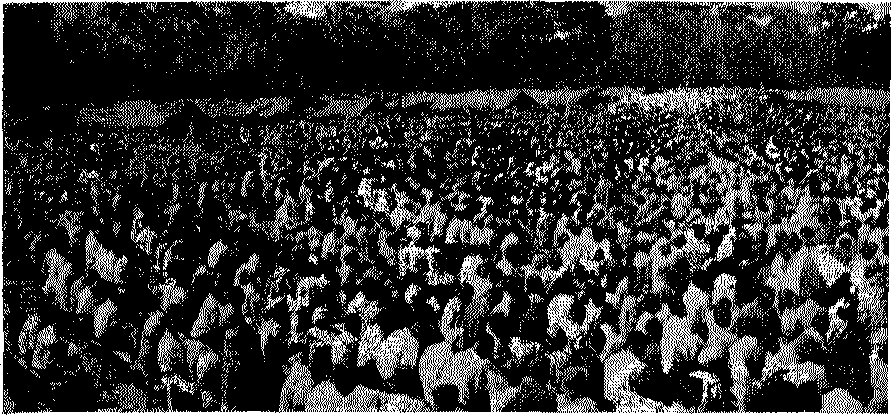
the African to want self-rule? How long would missionaries who did so be allowed to remain in Africa? Does Life fully comprehend life in Africa?
Life magazine writers say about the Africans: “The witch doctor still holds power and prestige among them.” “I do not think that we have touched them mentally or that they can grasp our point of view.” “Even Albert Schweizer, after a lifetime spent among the natives, says he does not fully understand their minds. Gentleness and generosity are interpreted as fear. Our ideas of democracy are inconceivable to them/’ More such expressions could be quoted. If such do express the true situation, then certainly Life by its own report is estopped from urging participation in government on the part of the African in general. To do so would appear to be most impractical.
Life quotes Europeans like author Cleote as saying: “What madness is this to think that we can tame the African in an hour?” Yet that is just what proper Bible teaching by Jehovah’s witnesses is doing. In the space of just a few short years tens of thousands of Africans have made the principles of the Bible their own, rejected juju magic, polygamy, tribal strife, etc., and dwell In peace the same as do Jehovah’s witnesses in other parts of the world. Cities such as Johannesburg ‘may be so dangerous that no one in his right senses would walk about the streets alone at night’ but not because of the presence of any Africans educated by Jehovah’s witnesses, for their conduct is most exemplary, as Mr, Henschel's report has shown. Could anything therefore be more practical than the educational work of Jehovah’s witnesses?
Besides, Life claims to believe the Bible, but can it point to one text urging Christians to take part in politics, or to bring the gospel down to today’s low level of politics? Did Christ Jesus mix in politics? Did he commission his followers to try to reform worldly governments? On the contrary, he said his kingdom was no part of this world; that he and his followers were not part of it and that he did not pray for the world. (See John 17:9,16; 18:36.) He said it was folly to put a new patch on an old garment. Are not the principles of the Bible a new piece of'cloth that cannot be used to patch up the old garments of worldly politics? (Mark 2:21) And the apostle Paul asks: “Is Christ divided?’* Can Christians engage in politics without becoming divided?—1 Corinthians 1:13.

God’s Word assures us that his kingdom by Christ Jesus will bring about justice and equality, health and life, and will solve all of mankind’s problems. Then men will love their neighbors as themselves. Since God is the one to do this, is it not presumptuous folly and the height of impracticalness for men to endeavor to do it? Professed Christians in all parts of the world have been dabbling in politics since the time of Constantine, but what is there to show that they have improved matters? Has the world ever been in a worse state of tension and confusion than now, after sixteen centuries of such intermeddling? Is there anything practical about that?
If others want to teach such politics Jehovah’s witnesses will not interfere. But Jehovah’s witnesses will not follow their example. They will continue to put their hope in God’s kingdom, which is the panacea of the ills of the Africans, Europeans, Asiatics, and all men alike, and they will keep on teaching this gospel in ail the earth. As they do this Jehovah’s witnesses will await God’s due time to bring about a righteous rule, in the practical new world which will further prove them to have been both Scriptural and practical.—Isaiah 2:24; 65:17-25.
THE fox, often the animal that gets in trouble in Aesop's fables, is really foxier than most people realize. This is especially so with the red fox. He is so clever in escaping and eluding his enemies that he frequently outwits hunters by following them! When accidentally meeting a man, the fox pretends not to see him but changes his course casually. He does not increase his speed in the slightest degree until he Is behind some tree or rock; then he whizzes away.
C To throw any pursuers off his scent a fox may dash along a stone wall, run along the wet stones of a shallow brook and even scoot over a newly fertilized field. He likes to zigzag to confuse hounds. The red fox is so clever that he has been known to take a “horseback” ride on a sheep just to break off his scent. Cross a frozen stream without testing the ice’s covering for thickness? Not the fox! Why, a favorite in his bag of tricks is crossing over deep water on thin ice just strong enough to bear him. Then he will calmly sit down on the other side and gleefully watch the heavier hounds crash through into the icy water. <L Uncannily adept at entering chicken coops, the fox is a relentless poultry stealer. Usually he Is smart enough though not to visit the same hen roost the second time. So the farmer and the fox are inveterate enemies. But strangely enough they benefit each other quite unintentionally. The fox destroys numberless mice and woodchucks, and the farmer in return supplies him with poultry. But perhaps the fox gets the best of the “benefit deal": The farmer builds bridges across streams that the fox crosses oftener than the farmer, the fox being as sensitive as a cat about getting wet feet.
<L Some foxes have been known for their shrewdness in making friends with the farmer’s dog. At first the dogs hardly know what to make of the fox’s advances, but the fox is fairly confident of winning them over to his1 side. After that they may be seen playing together day after day. If the fox makes friends with dogs for the express purpose of making it easier to raid chicken coops, the fox is gifted with more shrewdness than he is credited with.
< When it comes to getting rid of fleas, the fox is as smart as a treeful of owls. The book American Wild Life Illustrated says that, grasping a stick in his mouth, the fox submerges himself in a pool of water. As he slowly sinks, the fleas move upward to drier territory. Finally, only the wood remains out of the water and the fleas desert the fox like a sinking ship to take refuge on the stlck-raft. Then the fox releases the “raft", leaving the fleas to their fate. Foxy—those foxes I
Are They Peddlers or Preachers?)
By “Awak«r correspondent In Luxembourg
JEHOVAH’S witnesses are known the world over for their court cases in behalf of freedom of speech, press and worship. They have done more to preserve these rights than any other people. For their dogged determination to hold to these rights, they have often been belittled, slandered, ridiculed and misrepresented. This has not caused them to turn aside. Rather, they have persevered, and prospered, and preserved for mankind some of their most cherished rights. Consider their recent court victory in Luxembourg.
Over one hundred years ago the tiny Grand Duchy of Luxembourg was overrun with foreign peddlers. To safeguard its citizens from dishonest sales Parliament passed a law to regulate all peddling activity. This, law became effective January 1, 1850. The courts of Luxembourg held to this law and to the principle that “this law is to protect the local commerce against the competition of house-to-house peddlers”. In 1923 the highest court held that the law applied only to commercial peddling, which had as its aim “to make profit”; again, in July 1924, this same court held that “to make profit” was the necessary element for one to be classified as a peddler.
Before this same court, November 29, 1930, a minister of Jehovah’s witnesses stood trial. His preaching from house to house, even as Jesus and his disciples preached, was misconstrued as peddling. Even though he was not selling, was not engaged in any kind of commercial activity, and there were no profits involved, yet the highest court ruled against this minister and condemned him as a peddler. This inconsistent, prejudiced decision did not deter Jehovah’s witnesses from preaching from house to house. They went ahead with their ministerial work, not to defy a law, but rather to obey “God as ruler rather than men”.—Acts 5:29, New World Trans,
After World War n many things in Luxembourg changed, but not the 1850 law nor Jehovah’s witnesses in their determination to preach. In 1952 three missionaries, graduates of the Watchtower Bible School of Gilead, were accused of peddling. At the court trial in* the village of Mersch, the state's witnesses (13 of them) stated very plainly that the missionaries spoke to them about religion; that they talked of God; that they felt that the missionaries were religious teachers who offered books to read, not to sell, and that they did not ask a price for these publications. A policeman testified: “I was advised by telephone that the Bibelforschers [Jehovah’s witnesses] were working in Burglmster. I visited several houses. The people said that the Bibelforschers had books, but didn't ask a price for them. In one house a book was given free.” Only one witness testified otherwise.
After these favorable testimonies the defense attorney told the court that there was much more at stake than just peddling. Peddling really was not the issue at all, because Jehovah’s witnesses are not peddlers. Rather religious freedom was at stake, because this is the way that Jehovah’s witnesses worshiped and served God. And the court had to shoulder the responsibility as to whether this minority was entitled to religious freedom or pot.
The state’s attorney presented his case. He quoted the previous decision of the higher court and asked for the conviction of two of the three missionaries. The judge retired to consider the evidence and make his decision. In about ten minutes he returned to the courtroom. His decision, four pages of it, was made. He found two of the missionaries guilty of peddling. He based his decision on the argument of the'state and on the court's policy. The missionaries were each sentenced to $50 or twenty-five days in prison. The case was immediately appealed to a higher court.
Appeal to Higher Court
The upper court is the “Tribunal Correc-tionnel” erf the district of Luxembourg. It is composed of three judges. Here again, Jehovah’s witnesses presented their case. One of the missionaries had the splendid opportunity to explain to the court the preaching work done by the witnesses. The attorney for Jehovah’s witnesses presented the legal arguments and submitted to the court decisions of the courts of other lands, especially of Switzerland and of the Supreme Court of the United States. One of these United States court decisions distinctly shows that “preaching from house to house occupies the same high estate under the constitution as do worship in the churches and preaching in the pulpits. That it has the same claim to protection as the orthodox and conventional exercises of religion and has the same claim as the others to the guarantees of freedom of speech and freedom of the press'*.
After the defense attorney had concluded his arguments, the representative of the state attorney’s office was to present his case. Being a different attorney than the one who appeared in the lower court, he stated that after he reviewed the case he four^d that the accused ones did not violate the peddling law, and that their activity did not constitute a sale, offer of sale, or soliciting of orders.
Oh March 26, 1953, at three o'clock the court rendered its verdict. It reversed the lower court’s decision and acquitted all three missionaries. The decision stated that the missionaries of Jehovah's witnesses began discussions at the doors of the people on religious subjects; that they tried to encourage the people to take and read literature that explains the religious conceptions that they had discussed; that they neither tried to sell books or booklets nor made an offer of sale; that if individuals desired to contribute, Jehovah's witnesses did not regard that as a payment for the literature, but as a contribution toward their preaching activity.
Finally, the court held that the highest court's policy since 1930 was outmoded, and that the new policy does no longer regard the activity of Jehovah’s witnesses in distributing Bible literature as sale, offer for sale, or soliciting orders for literature. Thus the activity of the witnesses does not come within the prohibition of the peddling law of 1850.
With the handing down of this new decision, the “Tribunal COrrectionnel” of the district of Luxembourg corrected a wrong (the lower court’s decision) that actually was an infringement upon the individual’s right to preach, teach, believe and worship God as he pleased. It also paid high respect to the Luxembourg Constitution, and it did not try to degrade religious preaching to the low level of peddling. The apostle Paul said regarding the preaching of the good news: “We are not peddlers of the word of God as many men are, but as out of sincerity, yes, as sent from God, under God’s view, in company with Christ, we are speaking.” And Paul was one who preached from house to house.—2 Corinthians 2:17, New World Trans.; Acts 20;20.
This was d victory not only for Jehovah’s witnesses but for all lovers of freedom and truth.
Criminal Ends?
HYPNOTISM has been defined as a heightened state of suggestibility brought about by artificial means. In that hypnotic state a subject will do almost everything that the operator who brought him into that state may suggest. Can a subject while in that stale be made to do something that he knows to be wrong? The answer to that question is as much disputed among those making use of hypnotism as is the question of the therapeutic value of hypnotism among psychologists, psychiatrists and psychoanalysts.
Arguing against such a possibility' an authority on the subject, Dr, M. H. Erickson, states: '‘Suggestions leading to antisocial acts or even mere improprieties are rejected.” This view Is held by many who want to popularize hypnotism and feel that they must take this position so as to overcome the antipathy that Is felt by large numbers toward hypnotism.
The majority of authorities on the subject, however, agree that hypnotism can be used for criminal ends. Says Prof. Wesley R. Wells of Syracuse University: ‘‘This investigation has been devoted to the problem whether a hypnotized subject, who is noneriminMl in character, can be made to commit real crime. The answer, on the basis of actual experimental results, is emphatically in the affirmative.”—Los Angeles Examiner, March 18, 1941,
And Estabrooks, in Hypnotism, devotes an entire chapter to showing the possibilities of hypnotism in crime as well as In detecting crime, and another to showing the amazing things it could accomplish in time of war. However, he minimizes the likelihood of hypnotism’s being used for criminal ends because of the possibility of its use being discovered.
Conditioning
In the first place let it be noted that not every subject under hypnosis could be influenced to commit a criminal act, but many subjects could. This could be determined by asking the subject to forge a check on the basis of some subterfuge. The one complying would likely bo amenable to further suggestions or "conditioning".
Science News Letter, April 19, 1947, gave a good example of conditioning. A soldier in a trance was told that his superior officer was a “dirty Jap” who had a bayonet and it was a case of either his strangling the Jap or being bayoneted by him. The soldier literally flew at the officer in a flying tackle, forced him against the wall and began to strangle him. Guards had to pull him away. The officer stated that the grip was “strong and dangerous”.
A young woman in a trance was given a revolver and told to shoot a certain person. She refused. When the operator repeatedly and strong/y insisted she pointed the weapon to the ground and fired it. This failing, the conditioning approach was then tried. The operator insinuated that that person had evil designs on a loved one and that it was her right and duty to shoot him. Then the suggestion took effect. Sho stiffened, pointed the revolver directly at the back of that person and, without f altering her aim, fired. Fortunately the revolver had blank bullets.—London Veu* C/ironi-cle, March 12, 1950.
Poathypnotlc Dmgera
Hypnotists usually are very careful to remove all traces of such suggestions from the subject’s mind. But suppose an unscrupulous hypnotist wanted to develop a criminal attitude in a subject. He would not bother to wipe from the mind the suggestion to steal or kill. In fact, even though while under a trance a subject refuses to do a certain act, upon coming out of the trance state he may have acquired the impulse, Thus Estabrooks tells of the total abstainer who had been asked to drink whiskey while in a trance and who had refused. Seemingly that proved that hypnotism cannot be used to cause a person to go against his scruples. But that person confessed that the next day he felt an almost irresistible impulse every time he passed a bar to enter it and get a drink of whiskey, without knowing why. It was necessary to rehypnotize him and remove this impulse or posthypnotic suggestion.
Says Dr. Kritzer, in the Journal of the National Medical Society: “What assurance is there that implanting evil suggestions during a trance state may not germinate and be carried out, when provoked by a real or fancied grievance at some future time?” Yes, the danger that conflicts may be instilled in the mind is very real. A young woman may be given improper suggestions while in a trance and be able to resist them. But she may afterward find herself in greater difficulty than ever before as regards keeping from yielding to improper advances.
Another serious danger in the use of hypnotism as regards morals is that a person may have certain impulses that he restrains in the conscious state but not in a trance. One hypnotist, wishing to show the power of hypnotic suggestion, “suggested to Smith that, on awakening, he would go over and insist on sitting on Brown’s chair.
Smith and Brown were relative strangers. When he was awakened, Smith paused for a moment, then got up and walked over to Brown. ‘Mind if I sit in your chair?’ ‘Yes, I like the chair myself.’ Without a word Smith reached down, took Brown by the shoulder, and literally hurled him across the room, muttering savagely that if Brown so much as opened his mouth he'd send him through the window as well. And he meant just that. A few such experiences,” comments Estabrooks, “teach the operator to 'take it easy'.”
Of course, it is not likely that a very mild-tempered person would have acted that way. There usually is ar basis in the person’s disposition. Such as when it was “suggested to a certain subject in hypnotism that an individual who he particularly disliked was standing in front of the door. Without a moment's hesitation the subject strode up to the door and drove his fist through the panel”. Here no violence was directly suggested, merely the pointing out of one the subject disliked was sufficient to get such a reaction.
From these examples it can be seen that a person may commit a crime in the trance state because of certain tendencies in his disposition. German scientists experimenting on this subject of crime in hypnotism are fairly agreed that it could be used in sex offenses, the weakest part of most persons’ moral armament.
Operator Attitude
Two basic factors that give hypnotism its criminal possibilities are operatorattitude and the strong desire of the subject to co-operate. These factors are so vital that it is impossible for scientists experimenting on hypnotism to come to the same conclusions on basic matters, for it all depends upon what they want to prove. Scientist A sets out to prove that in a trance a person can do much more work, and he obtains proof therefbr. Scientist B, out to prove A wrong, finds his subjects supporting his side of the argument
Says Dr. Liegois, of the famed Nancy School, on this subject: “Every person put into the somnambulistic state becomes in the hands of the experimenter a pure automaton, as much in a moral sense as in a physical respect. It is not even enough to compare him to the clay that the potter molds as he will and fashions in a thousand forms; often, in fact, the somnambulist seems to carry out of his own accord the wishes of the person who has put him to sleep.”
Another authority tells us that the subject is extremely anxious to co-operate, doing so in a wonderful fashion and being at times almost uncanny in his ability to figure out what the operator wants, while Qua£kenbos, onetime president emeritus of Columbia and the authority on hypnotism of a previous generation, goes so far as to observe: “I have often been startled by having patients tell me days after hypno-tization of feelings and incentives to actions of which I had said nothing, but which I knew to be in the background of my consciousness at the time of treatment”
With these facts in mind it is easy to appreciate what The Oregonian, December 26, 1952, reported about the use of hypnosis by the Russians under the heading, “Purge Trials Recall Experiments with Hypnotism.” In the early 1920’s a number of such experiments were made. In one case a young woman was put in the hypnotic trance and then accused of beating a child with a stick. She vigorously denied the accusation. Coming out of the trance she remembered nothing, but was nervous and irritable. Through further conditioning she admitted more and more and finally not only fully admitted the charge but invented the details of the circumstances, al] of which sounded very creditable.
In times past Victims of Russian purges would embarrass the judges by hurling defiance at them or denying everything, but all that has been changed. Now they make the most abject, fantastic and even impossible confessions. There seems to be no evidence of third-degree methods; rather the results seem to have been obtained through “a minute subconscious reconstruction, under careful guidance and prodding, of a ‘crime’ that never occurred, or at best is connected only distantly with reality, to such a point that the crime becomes real to himself*. They actually change the personality of the individual.
Terrible as such devilish use of hypnosis may be, Christians whose chief concern is that of maintaining integrity need not feel apprehensive. Why not? Because although confessions have been forthcoming from politicians, newspapermen, Protestant and Catholic clergymen, the Russians have singularly failed in causing any of Jehovah’s witnesses to confess to the crime they tried to fasten on them.
Weighed and Found Wanting
We have seen that hypnosis can be induced by various ways: by impressing a subject or throwing him off guard; by inducing relaxation via monotonous sleep talk; by subterfuge and by drugs. That in deep trance there is not only hallucination of the senses, so that the subject imagines he sees, hears, smells, tastes and feels whatever the operator wants him to and is unable to perceive with his senses whatever the operator does not want him to perceive, but also delusion so that he impersonates another person or even a lower animal.
That by posthypnotie and autosuggestion a subject can be made to perform a certain deed at an exact moment, a day, a month, a year hence, which suggestion the subject is powerless to resist, and which he rationalizes regardless of how foolish it may be.
We have noted the “cures” wrought by hypnotherapy and the harm done by stage hypnotists and amateurs; that even hypnotherapists urge the greatest possible care in its use, as there arqjnfinite possibilities> oXffinn^to thepatient, while other auOiori-ties categorically c^ndemiClajruse^r EphpsiSj.
And we have considered the moral aspects and have seen that hypnosis can be used for criminal purposes particularly by means of “conditioning”, depending upon the skill and morals of the operator and the suggestibility of the subject, and that even though a suggestion to do wrong is resisted in the trance it can have posthypnotic effects setting up conflicts in a person’s mind. In fact, so real are the dangers associated with hypnosis that those who deal with it feel called upon to justify their course:
“Hypnotism may be a very dangerous thing in the hands of the unscrupulous, but so is the aeroplane, the rifle, the disease germ. Science wishes to know the facts. Once discovered, these truths are handed over to the public. If that public uses the aeroplane to drop bombs, rather than to carry passengers, the scientist is in no way to blame. So with hypnotism. The psychologist seeks to unearth the truth. That is his problem. The use to which his discoveries may be put is something different again and something for which he has no responsibility.” And again, “These truths should not be discussed in public. They are too dangerous, too mysterious, in fact too anything in this broad wide world if only we will let sleeping dogs lie. But science never was and never can be concerned with the possible, even probable, mal-usage of its discoveries. ... So we maintain that we are quite justified in writing all we know about hypnotism.” —Hypnotism, Estabrooks, pages 31, 230, 231.
But that is no excuse. Why put tools into the hands of men before they are mature enough to use them properly? Such a course is about as sensible as would be the giving of machine guns to teen-aged neighborhood gangs to use to settle their differences. In spite of all scientific progress man is less happy today than he
ever was. The proof is seen in the increasing divorce rate, the rise in adult and juvenile delinquency, in the multiplication of mental patients, in the ruins of bombed-out cities, in the slavery behind the 'Iron Curtain. Surely the wisdom of this world is foolishness with God.—1 Corinthians 1:20,21. '
Yes, why not rather devote one’s time and energies to bringing men to maturity, to helping them understand Jehovah God, his purpose and requirements for them, so that they can be happy and get along with one another in peace, harmony and love? That is what Christ Jesus did and what his true followers are doing today.—Matthew 7:12; 22:37-39; John 17:3, New World Trans.
For information as to how a person can protect himself against the unscrupulous use of hypnosis as well as a summary of Scriptural reasons why a Christian should avoid having anything to do with it please see “Your Word Is Truth” on page 25 of this issue.
Let your reasonableness become known to all men.
—Philippians 4:5, New World Trans.

Christianity versus Hypnosis
^UNCE the Word of God is a complete O guide, the Christian does not need to resort Lo the wisdom of th is world as manifested In the science, art or therapy known as hypnosis or hypnotism. (2 Timothy 3:16, IT) Tn fact, it would seem best, in view of all the facts, that he have little or nothing to do with it.
In the first place note that hypnosis is an unknown quantity. We orc told that “nothing is known about how it. relieves pain. In that respect science is as much at sea as Mesmer wa^”? And again, ‘hypnotism is a psychological phenomenon but as to what it actually Is can be explained only in descriptive terms, any understanding heyond that is purely speculative’.3 And tn commenting on the latest work nn the subject, Hypnosis in Modern Medicine, we an? told regarding its editors, “For all that they have learned about hypnosis and when to use it, Dr. Schneck and his collaborators still have very little idea of what the hypnotic state really is. When that Is better understood, hypnosis will have a better chance of being more widely accepted.”*
Further, wc arc warned that a bungling hypnotist can do “irreparable harm”/ that there are “almost infinite possibilities of actual danger”,1 that hypnosis is “positively dangerous"?
The true worshiper appreciates that God has given him, “not a spirit of cowardice, but that of power and of love and of sound-lies of mind?’ (2 Timothy 1:7, New World Trans.) But hypnosis is really a form of insanity, for weare told, “Indeed, so closely related is all functional insanity to the phenomena of hypnotism and suggestibility that the picture seems over-simplified.’*" So why be made insane even temporarily, though one may not know it at the time nor be able to recollect that fact afterward ?
Wp find that hypnotism in its various aspects has from earliest times boon used by the professional practitioners of pagan religions, by the priests of ancient Egypt, China, Rome, and Greece, by the magia of Persia and the yogis and fakirs of India, But not a word regarding it do we find in God’s Word, the Bible. Christians are warned that true worship has nothing In common with false worship.—2 Corinthians
In modern times hypnotism comes to us mainly under the aegis of psychologists and psychiatrist, whose philosophy in the main runs In direct opposition to the principles enunciated in God’s Word. For example, we are told: “It was long the custom to contrast instinct and intelligence. Instinct represented the baser side of man, whereas intelligence was something on a much higher plane, the pure and noble side of man’s nature. Actually, intelligence is the servant of instinct, of the pleasure principle. We use our intelligence to gratify our search for pleasure, be these pleasures low or idealistic.”5 Certainly such is not the wisdom that comes from God, but selfish, worldly wisdom.—James 3:15, New World Trans.
Another fact regarding hypnosis that should make a Christian refuse to use it is that at times the line uf demarcation be-
tween hypnotic phenomena and mental telepathy and clairvoyance Is so indistinct aa to be baffling. A striking example of mixing mental telepathy and clairvoyance with hypnosis is Dr. Polgar, America’s foremost stage hypnotist? Then there was Esdaile, an English surgeon, who in the 1840’s in India pioneered the use of mesmerism as an anesthetic in surgery, performing some 2,000 operations with no other anesthetic, 300 of which were major operations. In describing his successes he tells how he mesmerized water so that anyone who drank it went into the mesmeric (hypnotic) trance. Can any modem scientist explain or account for such phenomena? Yet Esdaile is time and again credited with being a pioneer in hypnotherapy. Would the fact that his book Mesmerism in India was republished by the Psychic Research League of Chicago and London throw any light on the phenomena of mesmerism and hypnotism? And why are ouija-board users, crystal-ball gazers and those able to do automatic writing especially good subjects for hypnosis?5
The fact that persons under hypnosis can be "conditioned” to do wrong, that posthypnotic suggestions can set up conflicts within a person should give further pause. Also the fact that subjects startle their operators by seemingly being able to read their minds, possessing an almost uncanny ability to know what is wanted of them?'7 The fact that many universities forbid hypnotic experiments within their walls must give one pause?
Still another objection can be raised on the basis of the use of suggestibility in hypnosis. The more suggestible a person is the more easily he is hypnotized. It seems also that the more often one is hypnotized the more easily he is influenced by suggestions even when not in the hypnotic trance.® A Christian must be ever alert not to let the wrong kind of suggestions influence him. The Devil, his demons and his agents on earth are ever ready to suggest, by way of temptation or pressures, the taking of a selfish, a wrong course. Eve, the angels that fell, and the nation of Israel, with few exceptions, all proved suggestible. The line of faithful witnesses from Abel to Christ Jesus and down to our day steeled themselves against such suggestions.
Nor do the servants of Jehovah God need posthypnotic suggestions to overcome bad habits or to ferret out complexes. They are able to overcome their bad habits without resorting to “an instrument of fantastic power” and that requires “neither faith, nor hope, nor confidence” for satisfactory results. The record of Christians for the past nineteen centuries proves that men have been able to make their minds over, let go of their former vices, and “put on the new personality which was created according to God’s will in true righteousness and loving-kindness” without resorting to psychiatry or to hypnotherapy. (See Romans 12:1, 2; 1 Corinthians 6. j-11; Ephesians 4:20-32, New World Trans,} Following such Scriptural advice has made Jehovah's servants the happiest, the best-oriented people on the face of the earth. They alone have taken an unequivocal stand when brought face to face with totalitarian threats.
The Christian has agreed to do Jehovah’s will. He may not surrender his will to another even temporarily. He will therefore studiously avoid having anything to do with hypnosis.
REFERENCES
-
1. Ai/6, July 25, 1949,
-
2. Medical Record, December 5, 1934, 3. Time magazine, March 30, 1953.
-
4. New York Times, September 30, 1951.
-
5. Hypno Ham, Estabrooks.
-
6, CoRier^s, June 25, 1949.
-
7. Rural Health, November 1947.
-
8. Reader* $ Digest, April 1936.
-
9. Journal of Nenious and Mental Diseases, November 1931.

Jehovah’s Witnesses preach in AH the E a r th

South Africa
UP-TO-DATE South Africa is not what most people think it to be. There are towering skyscrapers, spacious parks, modem streamlined transportation facilities, modem houses, hotels, stations, theaters, cars, and all the conveniences and luxuries the “atomic civilization” has right at its elbows. In fact, the city of Johannesburg is often called the New York City of South Africa. In busy Johannesburg there are twenty-six different congregations of Jehovah’s witnesses.
The African does not live with the white people in the up-to-date city areas, but in “locations”. Very often they are just singleroom hovels made of mud bricks, with odd scraps of iron for roofs. Many of these single rooms are inhabited by seven or eight persons. In some areas, though, the municipalities have done something for the African and there we find some very nice little brick buildings. It is among the Africans in these locations that Jehovah’s witnesses do a good deal of their preaching work and conduct many Bible studies.
Just recently in Johannesburg, Jehovah’s witnesses held a national convention in the Wembley Stadium, where upward of 7,000 of Jehovah’s witnesses gathered together in united praise to their God Jehovah. There were more than fifteen different races and tribes represented, and yet there was complete and absolute harmony during the full three days of assembly. Even the stadium officials, who have seen many a gathering for different purposes, stated that they had never before had the experience of seeing such a peaceable and well-behaved crowd as Jehovah’s witnesses. Pure worship makes the witnesses forget national and racial prejudices.
A Country of Contrast
True, South Africa is a country of diversity and contrast. There is the ultramodern city of Johannesburg, but there is another view also—the bush country. Much of the country is very flat, although between five and six thousand feet above sea level. There are many farms, some obviously very productive while others seem to be struggling for even recognition as farms. These farms are owned and managed by white people but the farm labor is quite often done by the African. The men work for three or four months a year for as little as $2.80 a month.
Stopping at a larger village, one soon learns the customs of the people. Women pound their grain in a mortar, a bowl-like vessel. This grain or com is the staple diet of these people. These little villages, are usually filled with small children, because almost every man has two to four wives, depending on his wealth and standing in the community. The African buys his wives with cattle; pays the father about eleven cattle for each wife. This is lobola.
Not many of the Africans here can read English, but quite a few read Zulu. Incidentally, these thoroughly enjoy the Watchtower magazine in the Zulu language. One of the Africans relates the experience of how he became one of Jehovah’s witnesses. It was while in the “big city” that he first heard of Jehovah’s witnesses. There he arranged for a Bible study to be held with him. It was after only a few studies that he realized what he was learning was the truth and that the kingdom of God is mankind's only hope. He began to tell others about what he had learned. And now there are twenty people in this area who share with him in the work of preaching the good news.
Difficulties Encountered
There is a great difficulty in getting people to accept the Bible and the Kingdom hope, because they are all so superstitious and steeped in witchcraft. To them the witch doctor is a man with tremendous powers who, by his magic, can kill anyone who displeases him. Others will not accept Christianity because it means getting rid of their many wives and living with only one. The sincere are overcoming these many barriers. This is well illustrated in the fact that during the month of January, 1953, there were over 10,500 witnesses in South Africa conforming themselves to the clean organization of Jehovah God. Considering that South Africa has a population of only about 11,000,000, it means that almost one out of every thousand is one of Jehovah’s witnesses.
One full-time African minister recently visited the headman of a village in the course of his preaching work. After telling what his message was, the headman called a meeting of all the inhabitants of the village so that all could hear the good news. Sixty-eight attended that talk. So impressed was the headman with the information given that he immediately offered the witness two houses or huts free, one for him to live in and one to use as a hall for meetings.
Another experience occurred when one of the European witnesses was preaching in a farming area just outside the city. One of the farmers asked him to come inside and tell him about the work he was doing. This farmer took a complete set of books and explained why he wanted them. He said that he had an African who had worked for him for more than fifteen years. When he first hired him the African was a drunkard and unreliable, and it was only because of his capability while sober that the farmer kept him. Four years ago there came a sudden change over the man. He stopped drinking and became the most reliable servant he had on the farm. His reason was that he became one of Jehovah's witnesses.


KNOW?
-
• How big a machine would be necessary to compare even remotely to the human brain? P. 3, U6.
-
• What staggering political change recently occurred in British Guiana? P. 7, |4.
-
• Why the 1953 election campaign in South Africa was the bitterest in history? P. 10, 1l2.
-
• How the Nationalist Party election machine made full use of the Mau Mau uprising? P. It, H3.
-
• What attitude the “British Medical Journal” took toward the American craze for chlorophyll? P. 12, 1>5.
-
• How “Life” magazine contradicts itself? P. 16, H2.
-
• The good effects of the work of Jehovah's witnesses upon Africans? P. 17, fl2.
-
• Why £ fox rides a sheep? p. 18, JJ4.
-
• How a fox gets rid of his fleas? P. 18, 117.
-
• How misapplication of a hundred-year-old law almost restricted freedom of religion in Luxembourg? P. 19, f|3.
-
• Whether hypnotism could be responsible for the fantastic '‘confessions” in Communist' courts? P. 23, 1T4.
-
• Why Christians avoid hypnosis? P. 26, 112.
-
• What a wife costs in South Africa? P. 27, HS.
-
• What recommended true faith to a South African farmer? P. 28, 133.

THB ORLD
Flood Ravages Japan
<$► In Japanese modem history there has never been a flood of such monstrous proportions as that which devastated Japan's southern island of Kyushu the latter part of June. About 1,000,000 were forced, by swirling waters and landslides, to flee their homes, and the death toll was at least 622. The flood disrupted communication and power lines, the public works damage being estimated at 22,000,000,000 yen (about $60,000,000). Entire villages were inundated, and in one case the whole population of 488 was said to have drowned. When an asylum collapsed at Kumamoto, central Kyushu, 36 elderly men and women were buried alive. Police in the Fukuoka prefecture reported 192,000 acres of valuable farm land inundated. A driving typhoon precipitated the flood disaster by leaving river dikes in a battered condition just as drenching rainstorms began.
Drought Grips Southwest U. S,
The longest, most intense dry spell on record has scorched southwest U. S. In June little rain fell and temperatures were in the 100's almost daily. At Laredo, Texas, the Rio Grande stopped flowing until upstream irrigation was curtailed. The burning drought threatened to reduce the Texas wheat crop to one third of normal, the cotton crop one half. As the shortage of cattle feed became acute, the animals were dumped on the market, causing prices to crash. Some cows sold for as little as five cents a pound. (The great depression’s all-time low was three cents.) The shortage of water became critical in small villages. Hamlin, Texas, out of water for more than a year, had to import water in railroad tank cars at a cost of 60 cents for 100 gallons. So severe was the drought that gripped southwest U. S. that President Eisenhower granted $8,000,000 in emergency relief funds.
The Korean Air War
<§> When June ended, the LT. N. had cause for rejoicing, at least in one phase of the Korean war. During June, Sabre jet pilots set a new monthly record by shooting down 74 Russian-built MIG-15 fighter planes. The most remarkable success occurred (6/30) when the Sabre jets downed 15 MiG’s. From January to June the Sabre jets had set a phenomenal kill ratio of more than 20 to 1. But the last 75 days ending June 30 saw an even more phenomenal kill ratio: The Commander of the Fifth Air Force announced that the F-86 Sabre jets had shot down 143 MIGT5’s and that in this same period only one Sabre jet had been lost in air-to-air combat—a kill ratio of 143 to 1. Historians may well debate whether the U. N. achieved its goal in waging the Korean war, but they seemingly will have little doubt as to who won the air phase.
Tension in Cambodia
For months Norodom Sihanouk, king of Cambodia, has demanded more independence for his country. In June he dramatized the demand by exiling himself to Thailand, but realizing that the French would not negotiate with an exiled king, he returned. Upon his return tension mounted. The king authorized the Cambodian premier, Penn Nouth, to continue negotiations with the French, but he warned that if the talks were not productive, there would be action to secure more independence by "other than peaceful means.*’ France then ordered strong reinforcements ' to Pnompenh, the Cambodian capital. To offset this move. King Norodom Sihanouk ordered Cambodian Army units moved into the capital (6/29) to take over all official buildings. The same day they also accused French troops of "provocation and unjustified intimidation” by their setting up of defense lines around the capital’s airfield and by training long-range artillery on the city itself. The Cambodian government said it would be forced to take “similar measures” if the French did not withdraw such measures. Tension continued to mount.
Asylum for the Captain
The pride of Communist Poland is the liner Batory, a 17-year-old ship that made a name for itself and for its captain, Jan Cwiklinsky. Captain Cwiklinsky, who had been an anti-Nazi during World War II, served under the Red Polish government with "outstanding service.” Under his command the Batory effected the escape of Gerhart Eisler, a German-born Communist leader who fled from the U. S. in 1949. It was this “outstanding service” that merited Captain Cwlklin-sky the Polish Gold Cross of Merit In June this year the Batory docked in England for refitting. When the vessel sailed for Poland, the captain was not on board. He had heard a rumor that the Polish Communist regime planned to arrest him as a Western spy upon his return. The captain, together with the ship’s doctor, had requested and received political asylum in Britain. As the Batory sailed without its master for It's Communist homeland, Captain Cwiklinsky, secure in England, sighed: "I feel like a bird from a cage.”
Longest French Cabinet Crisis <$> “A moral and social crisis,” was the way President Vincent Auriol summed up the dire need for a French premier. President Auriol spoke aptly, for France was experiencing its longest Cabinet crisis in history. With the need for a French premier at the impending Bermuda Big Three conference, the need was doubly urgent. Because of this strong outside pressure France had to resolve its crisis. It did (6/26) when the National Assembly approved Joseph Laniel of the Independent party as premier. The vote was 398 to 206. Only the Communists and the Socialists voted against him. The new premier, a 63-year-old linen manufacturer from Normandy, was perceptably aided in his bid for premiership by his wartime record as a leader of the French resistance movement.
Wheat Grant for Pakistan
$ Famine-threatened Pakistan heard heart-cheering news (6/25) when President Eisenhower signed the Congressional authorization granting the country up to 1,000,000 tons of wheat Within a few hours after the signing, the first shipment of 9,600 long tons of grain began to be piped aboard the Anchorage Victory at Baltimore. President Eisenhower commended Congress for the swift action in approving the wheat grant, thus averting a desperate famine that had threatened 80,000,000 people in Pakistan.
Tunisian Heir Assassinated
<$> France had a friend in the heir apparent to the throne of Tunisia, Prince Azzedine Bey. The pro-French Tunisian heir was murdered (7/1) when an assassin sneaked into the palace and fired two bullets at the prince, one of which lodged in his stomach. Quickly captured, the attacker turned out to be a 33-year-old former convict who said he had been paid to assassinate the prince. The prince’s death placed his brother, Sad ok Bey, in the position of heir pre* sumptive to the Tunisian throne, and it also placed a new obstacle in the way of the peace negotiations that the French say have been in preparation for some time.
20,000 Troops Moved to Formosa # After the defeat of Chiang Kai-shek’s forces, over 20,000 Nationalist troops fled to IndoChina. France decided to solve the problem by interning the troops, not by sending them to Formosa, for this may have offended the Communists. But the picture changed when the U.N., with the support of the Communist bloc, called for the repatriation of Nationalist troops from Burma. France then agreed to repatriation, and the Chinese Nationalist government announced (7/2) that the transfer of more than 20,000 troops to Formosa had been completed.
Train Plunge Kills 100
<$> An 18-car passenger train with two locomotives was winding its way through east Indo-China (6/23) when it approached a ravine at the Col des Nuages (Pass of the Clouds). It was literally a pass of the clouds that day, for the viaduct that spanned the gap was not there. Sabotage had been at work. Before brakes could be applied, the two locomotives hurtled off into soul-chilling space, dragging with them the 18 passenger cars 50 feet to the bottom of the ravine. The plunge killed at least 100, most of the victims being Indo-Chinese civilians. The pass has been the site of frequent attacks by the Communist-led Vietminh forces.
How Many People In China?
<$> No one knows just how many people there are in China—not even the Chinese government. In 1742 the last official census was taken by Emperor Chien Lung. It showed the population figure at 143,411,559. In 1952 the Shanghai newspaper Ta Kung Pao published the “People's Handbook,” which estimated the population at 486,000,000. Now the Chinese Communist government wants precise population figures for “economic and cultural construction” and also to provide data for the election of the “People’s Congress.” The population count began July 1 and is scheduled to end before October 31. Census takers were instructed to beware of “duplication or omission”; hence the census promises to be a reliable one and the first comprehensive modem census to be taken in China. When alt the statistical returns are in, the final figure may be 500,000,000 or more. But whatever the figure, it seems certain that China will come out the largest country in the world in population.
Israeli Growers Dump Tomatoes <$> Destroying food to keep prices up is something that is occasionally done in the U. S. But it is not confined to the U, 3., as a report in the New York Times (7/2) states: "Israeli growers have destroyed 200 tons of tomatoes rather than accept low prices for them from cannery operators. Trucks dumped the vegetables on the so-called French Carmel near Haifa and left them to rot in the sun. Some Israelis were disturbed at the growers' action because this country still depends on foreign philanthropy and many kinds of food are still scarce.” It is heartening to know that all food destruction will soon end at Armageddon when God brings in hishiew world of righteousness.
Teachers Condemn
Book Burning
Leading educators at the 91st annual convention of the National Education Association recently added their voice to President Elsenhower's words on book burning. The pssocla-tlon, which represents' nearly all the public schoolteachers in the U. S.( adopted, through its Commission on the Defense of Democracy Through Education, this statement: "The National Education Association believes that the American people, in order to maintain and advance the American democratic way of life, must be free to think and write as they please and to read books of their own choosing. It condemns the efforts of those who advocate book burnings, purges or other devices which restrict freedom of thought and which are, in effect, an expression of lack of confidence in the integrity, loyalty and good judgment of the American people.”—New York Times, July 1,1953.
U.£k Debt Pika Up
♦ June 3o marked the end of the fiscal year of the U. S. government, and the books were closed with a deficit set at $9,389,000,000—the highest deficit in peacetime history. Many budget experts went on to anticipate the 1954 fiscal deficit at $7,000,000,000. The legal limit is $275,000,000,000, and the aggregate debt has now piled up to $265,203,000,000. Officials predicted that Congress would have to face the reality of the situation by raising the debt limit to $285,000,000,000.
Calcutta: Free Bides for All!
When the British-owned Calcutta Tramways Ltd. raised the streetcar fare, it so enraged riders that they took over the line's streetcars (7/1) and forced free rides for all. The police, amazed at such: a thing as a streetcar-rider's revolt, stood by helpless.
After Armageddon-Gn Vs New World
HERE in a printed booklet of 32 pages is the - arable address by the president of the Watchtower Society at Yankee Stadium, New fork, July 26. The mammoth stadium overflowed with the largest crowd in Its entire history; and many, many thousands of people in the trailer and tent city in New Jersey heard by direct telephone wire. Radio station WBBR flashed the hour-long speech over the air simultaneously so that millions not at the stadium would have the opportunity of hearing this heart-cheering Bible discourse.
If you are interested in news that is really goad news, then send for a copy of this booklet. Better still, write for seven copies, on a contribution of 25 cents, and let your friends, neighbors and relatives enjoy the best news people could possibly hear today. “After Armageddon—God’s New World” is a booklet you should not miss reading.
WATCHTOWER 11T ADAMS ST. BROOKLYN 1, N.Y.
After Armageddon—(JotFe New World □ Please send me one copy (5 cents). □ Please send me seven copies (25 cents).
Street and Number Name ........................... ,....... or Route and Box ................................. t
City............................................... Zone No.........State........................................ ;....................
I'lew 'W&tfd
Svuflfane&

<L Here is an entirely new translation of the first eight books of the Hebrew Scriptures, Genesis to Ruth. In modern English, it gives you a “new look” at the Bible. An extensive foreword, more than 31,000 cross references, and footnotes that serve as a critical apparatus, all add to the value of this translation. Maps, drawings and a helpful appendix complete the volume. It is bound in green leatherette and measures 7 5/16" x 5" x 1", Sent, postpaid, anywhere for $1.50 a copy.
<L At the right is a sample of the text, margin and footnotes, actual size. Superior letters and signs in the text denote cross references and footnote references. Notice the excellent readability of the type face. Write today, returning the coupon below.
5 Consequently Jehovah saw that the bad- i ness of man had become great in the earth and I every inclination® of the thoughts of his heart® was only bad all the time.d® 6 And Jehovah felt
13 After that God said to Noah: "The end0 of all flesh has come before me, because the
earth0 is full of violence as a result of them, and here I am bringing them to ruin together with the earthe 14Make for yourself an arkf
• Or, “the Gib.bo.riiTi'” (Hebrew) b Or, “who were of old.” • Or, “name.” •* Literally, “day.” • Or, “These are the historical origins.” See Genesis 2:4, footnote*. f “Contemporaries.” Literally, “generations.” < “The God.” Hebrew, El'OJwn', with the definite article.
WATCHTOWER 117 ADAMS ST. BROOKLYN lf N.Y.
Enclosed is SI.50. Please send me one copy of the New World Translation of lh& Hebrew Scripture".
Name
Street and Number or Route and Box
City ............ Zone No.........State ................
AWAKE/
32
