
 View PDF
The content displayed below is for educational and archival purposes only.
Unless stated otherwise, content is © Watch Tower Bible and Tract Society of Pennsylvania

rPAGES
Freedom Within Limits
Snoring_pjjght of the Night

PAGEI6
Soviet Master Plan for World Control

who Says the Space Age Is Superstitious?

THE MISSION OF THIS JOURNAL
News sources that are able to keep you awake to the vital Issues of our times must be unfettered by censorship and selfish interests. "Awake!" has no fetters, it recognizes facts, faces facts, is free to publish facts. It is not bound by political ambitions or obligations; it is unhampered by advertisers whose toes must not be trodden on; it is unprejudiced by traditional creeds. This journal keeps itself free that it may speak freely ta you. But it does not abuse its freedom. It maintains integrity to truth.
“Awake!" uses the regular news channels, but Is not dependent on them. Its own correspondents are on alt continents, in scores of nations. From the four corners of the eorth their uncensored, on-the-scenes reports come to you through these columns. This journal’s viewpoint is not narrow, but is international. If is read in many nations, in many languages, by persons of all ages. Through its pages many fields of knowledge pass in review—government, commerce, religion, history, geography, science, social conditions, natural wonders—why, its coverage is as broad as the earth and os high os the heavens.
“Awake!" pledges itself to righteous principles, to exposing hidden foes and subtle dangers, to championing freedom for all, to comforting mourners and strengthening those disheartened by the failures of a delinquent world, reflecting sure hope for the establishment of a righteous New World.
Get acquainted with “Awake!" Keep awake by reading "Awake!"
Published Simultaneously in the United States by the WATCHTOWER BIBLE AND TRACT SOCIETY OF NEW YORK, INC. 117 Adams Street Brooklyn 1, New York, U.S.A.
and in England by WATCH TOWER BIBLE AND TRACT SOCIETY
Watch Tower House, The Ridgeway London N.W. 7, England
N. H. Knohb, President Grant Suites, Becretarg
Printing this issue: 3,075,000
"Aw»k»!” Il eabRshed In tie fallowing 21 langimgn: Semimonthly—Afrikiam. dnyfluji, Danldi, Dut,?b. English. Finnish. French, Herman. Greek, Italian, Japanese, NnmeslSD, Portuguese, Spanlih, Swedish, Tagalog, Zulu. Monthly—Indonesian, Korean, Polish, Ukrainian.
Yearly siibecrlptkin rates
Offtes tor semimonthly editions
AmerlsB, U.S., 117 Adams St. Brooklyn 1, N.Y. 51 Australia, 11 Beresford Ed., Slrathflold, N.a.W. Sternads, ISO Brldgeldad An., Tmmto IS, OnL England, Watch Tower House,
Tbs Ridgeway, London N.W. 7 7/-
Ntw Zealand. 821 Now North Bd., Auckland, S.W. 1 Tt-Scstk Africa, Prime Bag, Elatidalmteln, Tri. PtMonthly edluuns cost halt the shore ratm.
4d ■ copy (Australia, 5d) fiewlttantcs for aubsrrtnUnns should be sent in the cd in your country. Otherwise send your remittance Inmlnn. UMI si of expiration la sent at least two l« before subscription expires.
changes OF ADDRESS should reach is thirty dm before ynr rawing data. Gin is yonr old and new ■ddtsn (H possible, yrir old addnu label). Watch Tower, Watch Tower Hoiaa, Iba Hideaway tsndra N.W. 7, Ena land.
Entered aa second-class matter at Brooklyn. N.Y. Printed in England
The Bible translation ased In '‘Awake!” la tba Naw Wnrld Trsnrlnitoo of the Holy Ssrlptano. When other translations are bead the following symbols will appear behind the citations:
|
- American Standard Verdon |
Dv — Catholic Douty version |
Mo - James Moffalt's version |
|
AT- An American Translation |
The Emphatic DUglutt |
ffo — J- B. Ro theft am ks version |
|
— Authorised Version (1611) |
JP - Jerleh Publinatfon Boe. |
JBS — Revised Standard Version |
|
JPs — J, N, l>arhyJs version |
Le — lune Leeser'a veraLm |
Yg - Robert Toung'e version |
CONTENTS
Indifference Will Not Save You
Soviet Master Plan for World Control 16
The Puzzle of Cambrian Fossils
Evolution Contradicted by a Fish 20
Who Says the Space Age Is Superstitious 21 Gilead Graduates Its Thirty-fifth. Class 25 “Your Word Is Truth”
"You Are the Salt of the Earth" 27
Watching the World 29

INDIFFERENCE

INDIFFERENCE is no protection from disaster, yet many persons seem to think it is. Unlike animals that flee for safety at the first sign of danger, these persons blissfully continue their daily routine refusing to believe that an approaching disaster will affect them. As long as they cannot see what is coming they pay no attention to advance warnings. Little do they realize that indifference digs the graves of fools.
The inhabitants of Jerusalem in the days of the prophet Jeremiah are an example of such folly. For forty years Jeremiah gave them advance warning of a national disaster that was coming upon them because of their failure to obey the laws of God, but they refused to listen. Even when the city was under siege they continued to be apathetic to his inspired warning. He said to them: “This is what Jehovah has said: ‘Here I am putting before you people the way of life and the way of death. The one sitting still in this city will die by the sword and by the famine and by the pestilence* ... ‘For I have set my face against this city for calamity and not for good,’ is the utterance of Jehovah. ‘Into the hand of the king oi Babylon it will be given, and he will certainly burn it with fire.' ” (Jer. 21:8-10) True to these words, famine, pesti

lence and the sword decimated the inhabitants of the city. The survivors were taken away captive, and Jerusalem was left as a heap of smoldering ruins.
People living today can profit greatly from this experience. Like those inhabitants of Jerusalem, the modern generation in general are indifferent to the laws, purposes anti advance warnings of God. Partially to blame for this are religious leaders who are more concerned about winning friends and influencing people than in courageously proclaiming the hard-hitting truths of God’s Word as did Jeremiah. Spiritually dulling sermons, purposely vague and watered down so as to be pleasing to all who hear them, encourage spiritual indifference. What a contrast they are to Jeremiah’s fiery denunciations of the apathetic inhabitants of Jerusalem. They act as tranquilizers instead of stimulating people to spiritual alertness and activity.
The spiritual life of the average churchgoer reflects the indifference that permeates Christendom, an indifference that is dangerously similar to what existed in the days of Jeremiah. Clergyman Ian. Brown bemoaned it when he said: “What
has the life of the average Christian become, in the average church in our average society? It consists of attending church one service per Sunday . . . being a member of one or more of the church social clubs besides belonging to some ‘lodge’ or other, loyalty to which often conflicts with loyalty to the church. If he is a fairly conscientious church member he tries to keep abreast of his financial obligations to the church. He makes his children go to Sunday School. He does not pray other than during church services. He very rarely reads his Bible except in church. . . . His family very rarely meets together to pray or to discuss Christian matters. He is tragically ignorant about his Christian beliefs. Where then is the sense of utter dedication and devotion which real Christianity demands? Where is the Christian stand which is fearless in face of adverse opinion?”
Obedience to the laws of God is not of great concern to such persons, just as it was not of great importance to the residents of Jerusalem, although they had an outward appearance of religious devotion. When someone calls at the home of such a person to encourage him to examine the Bible to learn what God requires of him and to learn that God purposes to bring an end to the present wicked system of things, he is indifferent. The coming war of the great day of God the Almighty is not immediately evident to him, so he imagines that it will not materialize or, if it does, it will not affect him.
As far as he is concerned, his obligation to God is fulfilled by his association with a church, and he feels that he should not be expected to take time from personal pursuits to study the Bible. That is what he pays his minister to do for him. There . is no real love for God in such a man. How is he any better than the condemned inhabitants of ancient Jerusalem who were probably far more religious than he?
Time and time again God warns in his written Word of how he has purposed to bring an end to the present wicked system of things. His prophets of old urged people to give heed and to seek him. “Seek ye Jehovah, all ye meek of the earth, that have kept his ordinances; seek righteousness, seek meekness: it may be ye will be hid in the day of Jehovah’s anger.” (Zeph. 2: 3, AS) As the day of Jehovah’s anger came upon the nation of Israel in 607 B.C., bringing destruction upon those disobedient, apathetic people, so it will come upon professed Christians today who are indifferent to the One they claim to worship.
Christ compared this coming day of God’s anger with the flood of Noah’s day and said that when the prophesied evidences of its approach are seen you should flee to safety. Those evidences are in existence. “The day of judgment and of destruction of the ungodly men” is at hand. That includes indifferent persons who have “a form of godly devotion” but prove “false to its power.” They can no more expect to survive the “war of the great day of God the Almighty” than persons who are obviously wicked. “Because you are lukewarm and neither hot nor cold, I am going to vomit you out of my mouth.”—2 Pet. 3:7; 2 Tim. 3:5; Rev. 16:14; Rev. 3:16.
This is no time to delude yourself by thinking that nothing will happen if you keep ignorant of God’s purposes and ignore his warnings about the end of this present system of things. Indifference will not save you. Heed his advice: “Incline your ear and come to me. Listen, and your soul will keep alive.”—Isa. 55:3.

OU may live within a nation that en- I joys a large I measure of I freedom, but I that does not mean you have absolute
FREEDOM
dom for the good of their subjects; so
I does God. As the Supreme Sovereign
[ and Creator he has a greater right than human
freedom. It does .
not mean you can do whatever you please without regard for other people. Limits must be placed on your actions by lawmaking bodies to protect the rights and interests of others. This is vitally necessary when people live together as a community.
Freedom to travel may be granted you, for example, but you can operate vehicles only within lawful limits. These limits were established as a protection to others. Thus traffic regulations prevent you from traveling at an excessive speed or in any manner that endangers the safety of others. Similar laws that limit your freedom of action in other respects are in your best interests as well as the interests of those about you.
Having the privilege of freedom does not mean you have the right to destroy property, to take what does not belong to you, to do physical injury to someone or to do anything that may violate the rights of others. Laws rightly establish boundaries on your conduct and provide sanctions if you go beyond them. Freedom may be enjoyed but within limits, and properly so. When defining freedom, Black’s Law Dictionary takes this fact into consideration, “Freedom,” it says, “is the state of being free . . . without other check, hindrance, or prohibition than such as may be imposed by just and necessary laws and the duties of social life.”
Human governments recognize the need for placing boundaries on personal free-governments to do this, and he is justified in providing punishment for those who disregard the boundaries he has set. It is a greater offense to violate his laws than it is to violate laws made by puny humans. Only a fool would be so presumptuous as to charge him with being bloodthirsty and cruel because he lawfully executes punishment upon persons who flagrantly ignore the limits he rightly places upon their actions. Adam and Eve, for example, were justly sentenced to death because they willfully exceeded the boundaries placed upon their freedom.
Total Freedom
God alone enjoys total freedom because he alone is totally independent. He alone is complete within himself, requiring nothing from other living things. He alone is able to act according to his own will without restraints, without any limits. There is no one capable of placing limitations on his freedom or of giving him advice, for no one is superior to him or equal to him. He is the Superior One and all other living things are inferiors who are dependent upon him for existence. “Oh the depth of God’s riches and wisdom and knowledge! How unsearchable his judgments are and past tracing out his ways are! For ‘who has come to know Jehovah’s mind, or who has become his counselor?’ Or, ‘Who has first given to him, so that it must be repaid to him?' Because from him and by him and for him are all things,”—Rom. 11:33-36.
Since he has absolute freedom and is the Superior One, he is in position to set limitations upon the freedom of others, and he has the right to execute sanctions upon anyone who exceeds those limits. In his due time he will carry out those sanctions despite the wagging tongues of self-righteous critics.
It is impossible for a man to have total freedom, being able to act as he pleases without any restraints. Even if he lived by himself in a wilderness he would still have limitations to his freedom that are imposed by the natural demands of his body and by his dependence upon his environment. God established these natural boundaries and has established others by means of his laws and principles.
Because a man may foolishly refuse to acknowledge the authority and existence of the Supreme One, that makes no difference. His freedom isstill under divine limitations. His refusal to recognize Jehovah’s authority does not make him free of sanctions any more than a person’s refusal to recognize a human government frees him from punishment for violating its laws. Punishment will come in God’s due time: “He brings due punishment upon those who do not know God and those who do not obey the good news about our Lord Jesus. These very ones will pay the penalty of everlasting destruction.”—2 Thess. 1:8, 9.
Relative Freedom
The limitations to human freedom that God has set down in his written Word are not so restrictive that they cramp a person, making him feel oppressed. Instead, they allow a wide range of freewill action. Since man is inferior to God and must stay within these boundaries, it can be said that he has relative freedom, freedom within limits. Going beyond those boundaries means to commit sin, which can bring a sanction of death, as it did for Adam and Eve.
As you recognize the right and need for human governments to establish laws that limit personal freedom for the good of everyone, so you must recognize the right of God, the Supreme Sovereign, to set boundaries on personal actions. Because he is in position to know what is for your best interests, you cannot go wrong by staying within the limits he establishes by nature, by principles of truth, by laws and by revelations of his will.
Way to Life
By exercising your freedom of action within the divinely set boundaries you can walk in a way that leads to the gift of eternal life that the great Source of life has promised. “Furthermore, this is the promised thing which he himself promised us, the life everlasting.” (1 John 2:25) Merely professing to worship God and to be a Christian does not mean you are entitled to that gift. You must prove yourself worthy of it by walking at all times in a way that is pleasing to the great Lifegiver. “Obey my voice, and I will become your God and you yourselves will become my people, and you must walk in all the way that I shall command you in order that it may go well with you.”—Jer. 7:23.
If you think you are justified in violating a law of God when there is an emergency, a war or when popular opinion is against obeying it, you are mistaken. When there are trying circumstances his laws cannot be scrapped as if they are of little value. The boundaries he has set on your freedom of action apply under all circumstances, even when your life is threatened. Christ showed this by being obedient to Jehovah's will at the expense of his life. Because popular opinion in the world sees no wrong in exceeding the legal boundaries God has set, that does not mean you can do it and still walk in the way of life. Popular opinion, even among those professing to be Christians, does not make an action right when it is forbidden by God.
Note what the apostle Paul said about how you should walk in order to get divine approval: “This, therefore, I say and bear witness to in the Lord, that you no longer go on walking just as the nations also walk in the unprofitableness of their minds, while they are in darkness mentally, and alienated from the life that belongs to God, because of the ignorance that is in them, because of the insensibility of their hearts. Having come to be past all moral sense, they gave themselves over to loose conduct to work uncleanness of every kind with greediness.” (Eph. 4:17-19) How can a person who wants God’s approval and his gift of life permit the popular opinions of such persons to govern his actions? If he does he places himself in line for the same divine sanctions that will, in due time, come upon them.
Persons who turn from the religious philosophies and traditions of men to Scriptural truth are made free from many religious superstitions and false doctrines that held them in bondage. No longer are religious leaders able to control what these read, how they think and even how they live. No longer do they have fear for such men, and no longer are they prisoners to traditions and superstitions, because the truth causes “the wide opening of the eyes even to the prisoners.”—Isa. 61:1.
But while the truth brings freedom from religious bondage, it does not bring total freedom. There are divinely set boundaries that you must not mistakenly think you are free to exceed. Your freedom is still within limits. Thus Peter cautions those who have been liberated by the truth; “Be as free people, and yet holding your freedom, not as a blind for moral badness, but as slaves of God.” Paul’s counsel is similar: “You were, of course, called for freedom, brothers; only do not use this freedom as an inducement for the flesh.”—1 Pet. 2:16; Gal. 5:13.
With the freedom that God’s truth brings comes responsibility to conduct yourself in harmony with his laws and purposes. That requires‘you to keep yourself informed and your mind refreshed on what is written in his Word. It requires you to develop a sensitive conscience about doing anything that is contrary to the Scriptures. It requires you to make a diligent effort to uphold the name and purposes of Jehovah God in a world that has no genuine regard for them.
The great God of freedom has made arrangements for liberating obedient humans from bondage to sin and death as well as from sickness, crime and war. In due time he will bring this grand purpose to fruition, but only for those who exercise their God-given freedoms within the boundaries he has set and who walk in the way that is pleasing to him. “The righteous themselves will possess the earth, and they will reside forever upon it.”—Ps. 37:29.
‘Mental Sickness”
•j; When a country spends over $100 billion a year for weapons which everyone hopes it will never have to use . . . weapons in a war that no one could win
. . . this is a clear mark of a kind of mental sickness in the world that necessitates some very careful treatment and the treatment that I propose is to slow down the arms race ... to disarm the international atmosphere of the fear and the hysteria which grip it.”—Senator Humphrey. (/. F. Stone’s Weekly, March 14, 1960)

two continents, the teeming crossroad of Europe and Asia, well symbolizes the nation of Turkey. Each is a bridge between continents, cultures and ages.
Throughout Turkey one finds the interesting mixture of European and Asiatic civilizations, a meeting of East and West. Add to this the existence side by side of modem and ancient ways, and you have the picture of a nation that has jumped from the distant past into the twentieth century. Within this generation Turkey abandoned the veil, the fez and the harem in exchange for a new alphabet, modem life in the cities and an ascending industry.
Located both in Europe and in Asia, Turkey’s picturesque coast line is washed by three seas, the Black, the Mediterranean ,and the Aegean. Its warmer southern shore contains more than two hundred miles of splendid beaches, The central plateau of some 500 miles is girdled on the north, west and south by mountains. To the east are the wilder and more rugged mountain areas on the frontiers of the U.S.S.R. and Iran. Thirty-one peaks in this region are topped by famous Mt. Ararat, a lofty 16,-946 feet, where mankind had its start after the flood of Noah’s day. Surrounded by these mountains is scenic Lake Van, south of which the garden of Eden was probably located. In this area too are the sources of the Tigris and Euphrates rivers, whose waters flowed through the ancient cities of Nineveh, Babel and Ur.
Turkey covers more than 300,000 square miles of territory, but only three percent is in Europe. This part is called Thrace and is separated from Asia Minor by the famous Dardanelles, the emerald Marmara Sea and the narrow Bosporus with its green hillsides. The Asiatic part, Anatolia, is more than twice the size of Italy. In its high central plateau, where the capital of Ankara is situated, the characteristics are continental: warm, dry summers and cold, snowy winters. Along the coasts the milder Mediterranean climate dominates, while at the Black Sea in Eastern Anatolia it is hot enough for the Turkish national drink, tea, to be. raised.
The Great Change
The modernizing of Turkey has progressed within the last few decades and represents a startling departure from ancient customs and traditions. For more than six centuries Turkey, along with many other nations, was under the control of the Ottoman Empire. At its peak this empire embraced an area roughly equal to the United States, excluding Alaska. It extended over three continents: Europe, Asia and Africa. This empire was named after its first sultan, or ruler, Osman (Othman), whose reign began about 1290 (A.D.) The Moslem religion influenced all phases of life. The rule of the sultans and caliphs, or spiritual leaders, made the empire a religious rather than a national community. It was administered by religious authorities according to the “holy law” called the “sheriat.”
This religious rule continued unbroken for 623 years, up to the year 1922. During this time the Ottoman-Moslem Empire was without peace, waging war almost continually. For the first four centuries there were wars of Ottoman aggression. Then for two centuries came wars for the defense of the empire. Finally, at the turn of the twentieth century, there were wars against uprisings from within and foreign intervention from without. There was no generation or decade when the Ottoman sultans were not mobilizing Turkish soldiers for conflict.
But then in 1920 the significant departure from the old began. The first Grand National Assembly was developed, which claimed to represent the Turkish nation instead of the Ottoman sultan. Three years later, in 1923, the National Assembly proclaimed Turkey a republic and elected Mustafa Kemal as its first president,
Mustafa Kemal undertook a broad program of hitherto undreamed of proportions. He was concerned about the mentality that had resulted from centuries of Ottoman rule and was determined, to build a new Turkish state. He proceeded to pull out the roots of the age-old institutions of the Ottoman sultanate and Moslem sheriat. This fundamental reform removed the Ottoman palace and the Moslem church-state (though not the religion) from Turkish life. The sultans and caliphs no longer would rule the Turkish people. Church law was replaced by state law.
. Yet, to build a Turkish nation, more was required. What had to be carried out was a basic remolding of the mind, not merely to “Westernize,” but to create a new outlook. Because of this need, Mustafa Kemal Introduced important changes in the long-established Turkish way of "life. For one thing, the Turk was to remove his fez, which was not a Turkish but an Ottoman headdress compulsory for all nationalities within its empire. Then came the unveiling of Turkish women and freeing them from this ancient tradition. Another important step toward a modern outlook was the enforcing of the family name. As a subject of the Ottomans, no Turk had a family name, but was merely the property of the empire. In June, 1934, the National Assembly passed a law.enforcing the family name, thus making each Turk conscious of the individuality of his person and his family.
For his efforts in the creation of the modem Turkish state, Mustafa Kemal was granted the family name of “Ataturk” (“father of the Turks”) by the National Assembly in 1934. He remained president until 1938, when he died at the age of 57.
People and Cities
The population of Turkey, some 27 million, contains many sizable national groups: Greeks, Arabs, Armenians, Jews and others. Because of this variety of nationalities and Turkey’s strategic position between East and West, it is easy to understand why so many languages are spoken here. When walking through Istanbul, it is said, you can hear more than thirty different languages. Most of the people understand Turkish and some, including children, speak four or more languages, such as French, German, Greek, English, and so forth. In smaller rural communities it is difficult to get along without knowing Turkish.
Istanbul, with its 1,200,000 people, is not only the largest city in Turkey, but is the economic and educational center. Located on both sides of the Bosporus, just at the opening of the Marmara Sea, this extended city with the minarets and domes of more than 200 mosques, with lovely green hills surrounding the Bosporus in the background and the lovely Princes Islands offshore, provides one of the most beautiful views in the world.
When the city was founded is not quite clear. But in 660 B.C. a city was built called Byzantium. It grew to be one of the most famous cities in the ancient world because of its location at the border of two civilizations and was renamed Constantinople. In the Middle Ages it became the capital not only of the Byzantine Empire but also of European culture. In 1453 Constantinople, today called Istanbul, was taken by the Ottoman Empire and became the residence of the sultans, accounting for the many palaces and mosques that highlighted their architecture. Istanbul now is becoming more modernized, but many of these ancient Eastern characteristics are to be found here. New dwellings stay in sharp contrast to old buildings crowded together along narrow streets.
The city of Ankara was once a. small dusty country town. However, since it was made Turkey’s capital by Mustafa Kemal in 1923, it has grown to an important city of 450,000 people, with broad streets, parks and buildings in European style. Besides having many institutions for education and government, Ankara is an interesting center of culture. Noteworthy is the archaeological museum. It is the only one in the world with such an abundance of artifacts of the Hittites, mentioned in the Bible, who were a mighty nation in the time of Abraham. Their capital, Hatussa, was about 125 miles east of present-day Ankara. Only fifty or sixty years ago Bible critics challenged the historicity of the Hittite nation. But the capital of this “nonexistent” nation with all its splendor and thousands of tablets containing cuneiform writing was excavated, verifying the Bible’s accuracy.
Another city of particular interest is Izmir, ancient Smyrna, on the coast of the Aegean Sea. Surrounded by high mountains, this modern city of 290,000 is an industrial and shipping center. Many are attracted to Izmir by famous ancient sites nearby. To the north was Troy. Archaeologists have unearthed nine different cities there, built one upon the other, among them the Troy of Homer, which was destroyed during the Trojan wars. Halfway down to Izmir is Pergamum, a flourishing city of 200,000 in the days of the apostles. South of Izmir, a two-hour trip, is Ephesus with its famous temple dedicated to Artemis (Diana), said to date back to the second millennium B.C. Here too are the ruins of the ancient theater, capable of holding 24,000 people. It was in Ephesus nearly 2,000 years ago that silversmiths in religious fanaticism incited a mob against the apostle Paul and the early Christians.
Religious Activities
While the Turkish Republic made a separation between church and state and the country is no longer governed by church law, still the religion of Islam predominates. All but about 400,000 of Turkey’s people are Moslems. They have as their holy book the Koran and believe in one God, Allah, and in Mohammed as his prophet.
Besides this Moslem majority, there are minority religions such as the Jewish, Greek-Orthodox, Armenian-Gregorian, Catholic and Protestant. Under the constitution of the Turkish Republic all Turkish citizens have equal rights, no matter which religion or race they belong to.
In Turkey, as in all other nations of the world, you find Jehovah’s witnesses preaching the good news of God’s kingdom. These diligent, law-abiding individuals are interested in the hospitable Turkish people and enjoy discussing God’s purposes with them.
Economy and Living Conditions
In recent years Turkey has worked to develop its natural resources and to improve industry. Steel mills, power plants, automobile assembly lines and other essential factories are now in operation and help to improve the standard of living.
There are modern conveniences in all the principal cities. These have electricity, public water facilities, telephone service, and so forth. Refrigerators and washing machines are available for purchase. Modern buses, taxis, trains, steamers and planes serve the needs in between cities. Education is provided by public and private schools. In the larger cities Turkish, Greek, French, German, English, American and Italian schools and colleges can be found. A major effort is being made to stamp out illiteracy, which was 90 percent under Ottoman rule. Education was aided greatly when the Arabic alphabet was replaced by the modified Latin alphabet in 1928 by a nation-wide campaign, in which Mustafa Kemal himself took a prominent part. Schools and students have more than tripled since that time.
Although industry is receiving much attention, Turkey continues to be primarily an agricultural nation. About 80 percent of the population engage in work related to agriculture, producing about two thirds of the national income. All kinds of products have come under cultivation in an area that has doubled under the Republic. The principal crops, wheat, barley, cotton, tobacco and others, are supplemented by an abundance of juicy peaches, oranges, tangerines and apricots, along with vegetables in great variety. Strawberries are raised near Istanbul; figs and grapes come from Izmir. Fifth in world olive production, Turkey is' also a leader in producing raisins. If one buys foodstuffs in season, he can get along quite economically.
It is not difficult for foreigners to find work if they are specialists in some profession. There are some foreign companies that employ foreigners also. Wages for specialists pre adequate to meet the increasing cost of living. A family of four, for example, would need 1,800 Turkish lira a month to subsist fairiy well in Istanbul, At the present exchange rate this would amount to about $200.
With so many striking changes coming so quickly, one can understand why some of the Turkish people, especially in the smaller towns, maintain the older ways of life. In the larger cities one can see the contrasting modern trend and also the influence of both Orient and Occident. Most people wear modern dress as in any European city, but you will also meet women dressed the old way in long black robes. Do not consider all this strange. Remember, Turkey is a nation that only recently jumped from the distant past into the twentieth century.
C '‘Historians, philosophers and sociologists have . . . always observed that political morality is a social phenomenon. The lapses of public officials do not reflect merely their characters as individuals, but rather the structure and customs of the entire community.1'—Telford Taylor, author of the article “The Ethics of Public Office'' appearing in The Saturday Eveninj? Post.

AVE you ever marveled at a tree? You will at “El Palo Borracho’' or “The Drunken Pole.” This is the common name for a most unusual tree, called the
’Yuchin” or “Lluchan,” meaning bottle tree or drunken pole.
fl “El Palo Borracho” is not a stately tree like the royal palm, nor has it gained fame for its height or age as the giant sequoia; nevertheless, it has its own very outstanding characteristics to cause man to marvel, the most outstanding of which is the unusual shape and appearance of the trunk. It resembles a huge bowling pin or bottle with limbs and leaves,- giving plenty of reason to call it the bottle tree. At the bulge it may reach a circumference of two and a half meters, or about eight feet. But no two trunks take on the same shape or bulge at the same places. Another eye-catching feature is the hard, grayish-green wood streaked with yellow, resulting from the accumulation of water in the fibers. And as if the strange shape and color were not enough to call attention to itself, there are the thorns the size of a man’s thumb covering the trunk, with smaller ones on the branches, discouraging any little boys from climbing it. The leaves are frail and sensitive, shiny bright green, bursting forth from the very end of the smaller branches in a palmated cluster of five, loking like an open hand hanging frorq a too small arm.
fl. Just when you have come to the conclusion that “El Palo Borracho” is the tree least likely to win the beauty contest, during the fall and winter months of April, May and June it bursts forth with a lily-shaped flower of five free petals. It is a beautiful flower without perfume, some being rose and others yellow, depending on the species. As the days pass you tajre “The Drunken Pole” for granted. It becomes just another beautiful flowering tree in your mind to take " its place alongside the chinaberry tree (paradise tree), the aroma, and many others that adorn the boulevards and parks.
fl Unnoticed, one by one, the flowers fall, leaving short, oval-shaped rather thick pods that turn from green to a dark brown. One day while waiting for a bus or streetcar you see cotton scattered over the ground. Knowing that there are no cotton fields in the vicinity, you look around for the source of all the cotton. Again the “drunken pole” has captured your attention. All the way to its crown, which may be sixteen to twenty-six feet, "El Palo Borracho” is as white as a cotton plant at picking time. You may have thought the tree was beautiful covered with all its lily-shaped flowers, but now you begin to respect the hoary head of “El Palo Borracho.” What happened was this: those pods, now dark brown and dry, had burst open into large cotton bolls, releasing the black shiny seeds that were wrapped up In the cotton-like fiber, making provision for more “drunken poles” in the years to come.
fl Do not think for a minute that “El Pato Borracho” is for ornamental purposes only. The ball of cotton-like fiber is used to fill life preservers and cushions; also it is used to fabricate mats, hats and ropes. The trunk is hollowed out by the Indians to make canoes and troughs, and to make a rare musical instrument called the “piu-piu.” From the trunk is extracted a resinlike substance that is used to calk small boats. The sap is used also as a tonic and the powder from the roots is used to combat spasms and convulsions.
fl Without doubt, it is a marvel among trees.
□ □□D ADVICE
A Brussels Insurance agency now attaches this note to all automobile policies: “Please drive carefully so that this contract will expire before you do.”
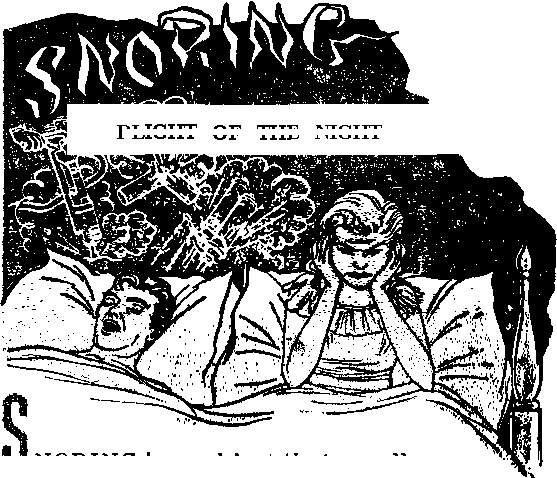
PLIGHT OF THE NIGHT
W NORING is a subject that usually evokes more laughs than sympathy. But
for an estimated 21,000,000 persons in the United States it is no laughing matter. How so? Because that is the estimate of the country’s number of snorers—and the moderate estimate is that at least one other person per snorer has his sleep disturbed. How to cope with this plight of the night is a problem often confronting family members, especially husbands and wives.
Snoring, of course, is no health problem for the snorer; his own hisses, gurgles, buzzes, snorts and raspings are unlikely to disturb his sleep. Ah, but for the audience it is a different matter. Family members may suffer from sleeplessness, tension and nervousness, as well as lowered efficiency in doing their work.
It should be understood that the snorer cannot be blamed. He snores involuntarily, and as soon as consciousness is regained the snoring stops. “He” seems to be the appropriate pronoun, since more men than women snore, the ratio being about three men to one woman. “Women,” says James Bender in How to Sleep, “snore less resonantly and also less staccato [than men]. But women lead in the stridor. This is a kind of crowing in sleep, caused by spasmodic narrowing of the larynx. Stri-dorers run the gamut from faint to fierce.”
Young persons are not as likely to snore as older ones; but virtually everyone, at one time or another, snores in his sleep. This is because some conditions that cause snoring are likely to occur in everyone’s life. When one has a cold or hay fever, the severe nasal congestion causes one to breathe through his mouth, and snoring usually occurs when one is breathing through his mouth. The forceful stream of inflowing or outflowing air sets into vibration the various soft structures of the mouth and throat, even as the breeze flutters the flags on a pole or the laundry on the line.
A Vexatious Problem
Even though the snorer seems insensitive to his self-made nocturnal cacophony, he can hardly remain oblivious to this plight of the night. His own wife, for example, may suffer from sleeplessness and nervousness; and the loving husband could not ignore such a problem. When the persons disturbed by snoring are not long-suffering and are not one’s family members, the plight could involve court action. In New York city more complaints are registered in Manhattan against loud snorers for disturbing the peace than in any of the other boroughs; this is probably because there are fewer private homes in Manhattan. Reported the New York Times Magazine: “The usual history leading to a Manhattan court complaint against a snorer is this: the stertorous fellow is usually
given a night or two of peaceful snoring once he moves into a new apartment. Then protests are sent through thin walls by fist or frying pan. Then the mounting resentment is relayed by radiator and heating pipes. The bravest protesters either finally yell out of the window into an echoing court or telephone before storming to court.”
One who has never had his sleep disturbed by intermittent bursts of snoring may find it somewhat difficult to understand this plight of the night. But the vexation can be tremendous. If snoring is frequent the sleep-disturbed person eventually brings up the subject, and some kind of action as to coping with the problem is instituted.
That efforts to discourage snoring are not to be ridiculed is evident from the sound intensity of some snoring. The Journal of the American Medical Association reports that Professor Donald Laird took audiometer readings of snorers and found the sound, intensity to be forty decibels, or about the volume of heavy street traffic. The loud snorers, however, exceeded forty decibels; they reached sixty-nine decibels. At ten feet a pneumatic drill registers seventy to eighty decibels; thus the really loud snorer produces sounds approaching that of the pneumatic drill—and not many persons can sleep well with such a drill operating nearby. Even faint snores bother some persons. So whether one’s snore is like the soft putt-putt-putt of a distant motorboat or like the seventy-decibel roar of a pneumatic drill, someone may not be sleeping well.
Those who have to cope with snoring only occasionally use emergency measures to cause the snorer to move on his side and take a rest from snoring. These measures usually involve a tug at the snorer’s bedcovers of some kind of noise that is just loud enough to produce the desired results.
Even a book slapped to the floor of some similar such noise does not awake the snorer, yet it often does stop the snoring. But when snoring is frequent such makeshift measures may not be adequate.
Antisnore Devices
Illustrating the immensity of the snoring problem is the fact that the United States patent office lists about 300 antisnore devices. Many of these devices force the snorer to sleep on his side or stomach. Nosnore wrist bands, for example, prevent the snorer from turning on his back. Such bands are attached firmly to the bedpost and tied on the wrist; thus the snorer is “handcuffed,” as it were, into a position where he is unlikely to snore. Other devices allow the snorer to sleep in whatever position he chooses, since their direct purpose is to keep the snorer’s mouth shut. Should these various devices fail to bring satisfactory results or if the snorer is reluctant to wear one of them, there are also devices for the disturbed persons. The most common aids are ear plugs, which are available in most drugstores. Ear plugs have the disadvantage of popping out on occasions; finding them in the dark is not always an easy thing.
Further illustrating the magnitude of the snoring problem is the fact that some firms devote considerable attention to the matter. Such firms market specialized devices that are not usually available in drugstores and even offer antisnore kits that may cost from $13.95 to $19.95. One such firm in New York city offers a variety of antisnore kits. One of these kits includes; (1) A ball that is fastened on the back of the snorer’s night garment to keep him sleeping on his side; (2) an elasticized helmet to discourage mouth breathing; (3) a battery-operated vibrator that is placed under the pillow of the snorer, the controls of which are near the wife, who can push the button if her husband begins snoring, and (4) a box of ear plugs. In August this firm marketed a device that does not require the wife to wake up and push a button. This new device, worn in the ear of the snorer, amplifies his own snores so that the sound slightly wakens him—just enough to stop the snoring. Then there is also a helmet that can be worn by the person whose sleep is disturbed. Such a helmet, which shuts out noise, is much more expensive than ear plugs; but some persons find ear plugs disagreeable.
What works for one person may not work for others. Sometimes considerable experimenting will be necessary to find the best solution. The one who snores may do well to visit a doctor and find out whether there are any nasal obstructions causing his mouth breathing at night. If there is no physical reason for one’s snoring, then some of the mechanical devices or even homemade remedies should do the job. For some persons strips of adhesive plaster across the corner of the mouth or any kind of mouth-closing bandage will satisfactorily prevent mouth breathing. Or one could sew a hair brush or hard object on the back of the snorer’s night garment. Perhaps even a small pillow under the nape of the snorer’s neck will solve the problem. In this regard there was an interesting letter published in the Journal of the American Medical Association, Written by a St. Louis physician, Dr. Robert Elman, the letter was also published in the Scientific American under the title “Cure for Snoring":
“A young patient wrote me from his honeymoon expressing fear that his marriage would fail because his snoring kept his bride awake so much that they were forced to occupy separate cabins. He could not afford separate bedrooms when he returned and therefore asked my help." Conventional remedies to induce the patient to sleep on his side were tried but they failed to bring relief. Dr. Elman tried a different method:
“I remembered the stertor [snoring] that frequently occurs during general anesthesia when the chm is allowed to drop and that Is relieved immediately by hyperextension of the neck. Acting on this idea, I had lateral roentgenograms taken of the patient’s pharynx and was able to demonstrate that both the epiglottis and uvula were almost in contact with the posterior pharyngeal wall. I therefore fitted the patient with a simple, easily applied and removable Thomas collar, asking him to use it that night. When he came in the next day, he was greatly pleased, for the device had eliminated his disability, and for the first time his wife had been able to get a good night’s sleep. The patient subsequently discarded the Thomas collar and merely slept on his back with a small pillow at the nape of the neck."
With so many aids and devices available today and by all persons involved being cooperative, much can be done about the snoring problem. Perhaps more sympathy for both the snorers and those disturbed might help, too, in alleviating this plight of the night.
YOUTHFUL MARRIAGES
<L According to Dr. Judson Landis of the University of California, marriages among persons in the United States under twenty-one are less likely of success than among persons who are thirty-one and over. He found that divorce is six times more frequent in the first group than in the latter.
riE spirit of communism bums with a desire for world control. Whatever turns the Par-
ty road has taken since the Communist Manifesto of 1848, the ambitious goal remains the same: “The immediate aim of the Communists is . . . overthrow of the bourgeois supremacy, conquest of political power by the proletariat.” Western observers see frightening evidence that Soviet strategy follows a master plan for world control.
Success of the blueprint has been fantastic. At the close of World War II the Communists controlled 8 million square miles of territory and 170 million persons. Today the Communist empire embraces 16 million square miles and 970 million persons.1 Surveyed for eventual absorption are many underdeveloped and emerging nations, as well as Capitalist countries with large Communist parties, such as Italy and France.
Chief base of operations is the Union of
Soviet Socialist Republics. Its population of over 200 million and area totaling one sixth of the earth’s land surface make up the largest nation in the world. Only one of its fifteen republics is actually named Russia, but since it is the largest by far, the names Soviet Russia and Russia are used synonymously with Soviet Union.
The brains of the Soviet master plan, of course, are all members of the Communist party, the influential, policy-making body that uses the formal Soviet government as a figurehead. Strict discipline rules. Mere sympathizers cannot join the party. Its call is open only to dedicated disciples who are willing to demonstrate faith by militant, obedient works.
Every country in the world is said to have its own Communist party, legal or illegal, with programs based on the general principles outlined by Marx and Engels in

WORLD CONTROL
the Communist Manifesto of 1848. Italy, France, India, Indonesia and Finland have large parties, with an estimated total membership of 3,500,000. Another 2,500,000 dedicated members are on duty in parties of various dimensions scattered around the globe.
In executing the plan for world control the Communist machine utilizes every conceivable weapon—diplomatic, military, economic, literary and scientific. This struggle for conquest is far-reaching and much wider than one might suspect from Western news reports. Its true scope was aptly stated by William J. Jorden, former chief of the Moscow bureau of the New York Timex: “We are conditioned by history and headlines to think of our differences with Moscow in terms of power balances and of long-standing conflicts—the German problem and Berlin, disarmament and nuclear testing, NATO versus the Warsaw Pact, and the like. Yet outside these problems, carefully spotlighted by Mr. Khrushchev, another and perhaps more meaningful conflict is going on. This is the struggle between communism and free institutions for the minds and loyalties of men thus far deeply committed tb neither."
The Economic Front
Soviet economic expansion is a vital cog in the Kremlin's master plan. By Herculean efforts in manufacturing and industry the Communists hope to convince the world of the superiority of their system. To catch up to the United States, the Soviets plan to reach 80 percent of American production in ten years. Output of goods and services is expected to rise 80 percent above present Russian production by the end of the current seven-year plan.
Western observers are uncomfortably impressed by industrial growth in the Communist bloc. This growth not only has propaganda value but fills a vital role, as explained by General C. P. Cabell of U, S. Central Intelligence: “The Communists want nations to become increasingly dependent economically upon the Communist Bloc. The stage is then set for ultimate Communist takeover.” Economic warfare lays down a barrage of trade agreements, long-term loans and related trade policies that nudge the target nation away from the West, into a neutral position and eventually into the Soviet bloc or as close as possible. The natural resources and treasures of the target nation thereby flow into the domain of the Soviet colonialists.
In his recent article, “The Blueprint for Communist Conquest,” William J. Jorden illustrated the Soviet formula. When a colony erupts into a struggle for independence, the Central Committee of the Communist party in Moscow outlines three immediate goals: (1) The Communist bloc must be identified as the leading champions of the struggling nationalists. (2) The radio and printed page, the vast material and literary resources of the Party stir up antagonism toward the Western colonialists and the West at large. (3) Active preparations are made for the day when independence finally comes.
The birth of a new nation is saluted by quick recognition from the Soviet government. Through offers of aid and trade, efforts are made to get the baby nation looking to Moscow for political and economic help. A program of cultural exchanges is inaugurated—students, teachers, performers and technicians flow into the target area. A military mission arrives to instruct citizens in the use of modern arms purchased from the Communist bloc. As reported in one case, “A campaign was launched to limit Western influence, exclude foreign capital, discourage foreign investments, and raise the taxes of foreign business interests.” “Secret party members sought jobs in key groups such as the police, trade unions, educational organizations, the press and Ministry of Information. There was an active program to recruit people already in critical positions.” “Neutrality” is the theme played over and over again in the ears of the new nation to wean it away from the West.
Additional economic tactics are pursued, such as buying up the young nation’s surpluses and dumping them on nearby world markets, thereby creating havoc for the new nation’s economy and dissatisfaction toward its government. Western imports are greeted by strikes; rumors of an antiCommunist military alliance, by student riots. At the opportune moment the Communist radio and local Workers party turn on the new government. There are street demonstrations testing the strength of the Communist-led groups and the govem-ment A Communist coup can happen any time, with even a small hard core of dedicated party members ready, willing and able to take over. Mr. Jorden observes that this is the situation in “a good part of the real world around us." He finds little comfort in past Western efforts to counteract the Communist blueprint. Rather, “as the Communist bloc advances, it clearly intends to devote increasing efforts and resources to its program for victory in the underdeveloped areas."
¥>
The Notorious "Popular Front”
The Soviet master plan is not so rigid as to ignore the weapon of expediency. When a local Communist party finds it advantageous it will join a coalition movement and pretend to abandon the revolutionary objective for the common good. Socialists, nationalists, radicals, Catholics or anticolonialists are readily joined in a popular front. If the coalition front takes over the reins of government, the Communists are in a key position to influence its affairs or take it over completely.
Mme. Suzanne Labin comments on the devastating gains made by this feature of the master plan: “The popular fronts best known for having increased CP (Communist Party) strength or carried it to power were those of 1936 and of the Resistance in France; the postwar popular fronts in Italy, Ceylon, Indonesia and Iraq; the one that brought Ho Chi Minh to power in Indo-China in 1954; and two made by the Kuomintang in 1924 and 1937, which served as steppingstones for Mao Tse-tung’s accession to power; the one that turned Guatemala over to CP henchmen; and all those which, in Poland, Rumania, Bulgaria, Hungary and Czechoslovakia, helped make Soviet satellites of their countries and bloody victims of those democrats who had joined the popular fronts in good faith.”
Military and Scientific Front
Thirty years ago the Communists proclaimed: “War to the hilt between Communism and Capitalism is inevitable. Today, of course, we are not strong enough to attack. Our time will come in 20 or 30 years.” Whether the Kremlin will now risk an all-out war is said to depend on the balance of power, or “balance of terror,” as some call it. The Soviet plan calls for spending one ruble out of every four for military purposes. Already Russian ground forces have been completely modernized. The Soviet fleet is second only to America’s; its submarine force, the largest in the world. Her formidable air strength is mainly jet fighter planes. The ballistic missile is leaned on heavily to span the oceans and influence the crucial balance of power.
Scientific achievement is closely related to the military program. Reluctantly the West hailed Russia’s photographing of the far side of the moon by Lunik III as “a brilliant example of rocketry and technical precision.” The Communists boast the world's largest operating atom smasher and the largest astronomical observatory. Soviet chemists annually produce research that is both original and of high quality.
To maintain and increase the rate of scientific achievement the master plan emphasizes scientific education. Right now Russia is producing scientists and technicians faster than the United States, and the gap is widening. Western fears were well expressed by John Gunther’s Inside Russia Today: “The thought of what the Soviet Union may be like after two or three generations of increasing educational advantages is staggering."
Propaganda and Diplomacy
When Nikita Khrushchev unleashed a tirade of invective upon President Eisenhower not long after the scuttling of the May summit conference, some observers wondered if the Communist boss was losing his sanity. Time magazine better appraised what was happening: “Viewed in the light of his aims, methods and past behavior, Khrushchev’s outburst was a calculated tactical thrust that fitted into a sinister pattern: to destroy U. S. prestige around the globe by straining the bonds between the U. S. and its allies, and by making a grandstand play to public opinion in the vast areas of Latin America, Asia and Africa and thus encourage the overthrow of proWestern political leaders.... The ‘great flights’ of attitude that President Eisenhower noted in him spring not just from an erratic personality, as is often
INFORMATIVE! ENJOYABLE!
• HOW FIRM IS YOUR FAITH? la (t strong or are you filled with doubts? What can be done to give it a firm -foundation? Be sure to road the article.
• what is behind those head. ACHES? Finding the answer may put you well on the way to avoiding them. If you are one of the millions who suffers from head, aches, you will want to read this article.
• CAN YOU GAMBLE ANO WIN? Is it a sure way to get rich? Is it harmless enter, tainment? What effect does it have on society? These questions are answered in this factual article.
All tn tile nett fame.'
thought, but from Communist tactics.”
Soviet diplomacy will call for a “thaw” in the cold war if it is thought that concessions, such as Western withdrawal from Berlin, might be gained through “goodwill” tours and conferences. Communist diplomats gained much at Yalta and are willing to hope for more, but their strategy never excludes the propaganda weapon, because the Soviets are dealing with the Western world, where public opinion is a powerful force on government policies.
The Beat-laid Plans
Uprisings behind the Iron Curtain spur Western patriots to call for more economic, military and counterpropaganda efforts in a grand counteroffensive against the Soviet master plan. “Fight fire with fire” is the1 theme of alarmed observers who cry for better integration of Western strategy to stop the Communist advance. It is said that more than economic and military aid to underdeveloped lands, the West must quickly provide information for underdeveloped minds. There must be more exchanges of students, professors, books, films and assorted missions between uncommitted nations and the Western world. A call has even gone out for Western youth to enter the fray as “missionaries of freedom,” with the aim of exposing the Soviet strategy and spreading principles of democracy to the Communist target areas.
Recently Western newspapers found comfort in Soviet press tirades against the increased activity of Jehovah’s witnesses behind the Iron Curtain. The Soviet master plan, which slanders all religion as the “opium of the people," has hit a snag in this growing underground organization of Christians who are more dedicated and fearless than the Communist party members, Throughout the Iron Curtain countries Jehovah’s witnesses continue to tell the searching, spiritually hungry people that, neither communism nor capitalism, but Jehovah God will soon settle the question of world control in favor of his kingdom in the hands of Jesus Christ.
Observers everywhere will be interested to learn that God’s Word foretells a coming all-out attack by the Soviet planners against the servants of Jehovah. (Dan. 11: 44, 45) This aggression by the Communist world-grabbers constitutes grounds for Almighty God’s predicted destruction of international communism, “and there will be no helper for him.” Designers of the Soviet master plan will lean) the hard way: “Many are the plans in the heart of a man, but the counsel of Jehovah is what will stand.”—Prov. 19:21.
The Puzzle of Cambrian Fossils
fl Geologists are still scratching their heads over the sudden appearance of fossils in the Cambrian layers of rocks. One of the blackest marks against the theory of evolution is that the older rocks just below the Cambrian betray no hint of the great variety of creatures that was destined to burst into existence all over the earth in a flash of time.
fl In the face of this overwhelming proof of the work of a Creator, scientists keep proclaiming their faith in evolution. They keep trying to impugn the testimony of their star witness, the documentary record written in stone. Dr. Daniel I. Axelrod, professor of geology at U.C.L.A., puts the dilemma very frankly in the July 4, 1958, issue of Science:
fl "One of the major unsolved problems of geology and evolution is the occurrence of diversified, multicellular marine invertebrates in Lower Cambrian rocks on all the continents and their absence in rocks of greater age. These Early Cambrian fossils included porifera, coelenterates, brachioplds, mollusca, echinoids, and arthropods. In the Athropoda are included the well-known trllobltes, which were complexly organized, with well-differentiated head and tall, numerous thoracic parts, Jointed legs, and—like the later crustaceans —a complex respiratory system. . . . Their high degree of organization clearly indicates that a long period of evolution preceded their appearance in the record. However, when we turn to examine the Precambrian rocks for the forerunners of these Early Cambrian fossils, they are nowhere to be found. Many thick (over 5,000 feet) sections of sedimentary rock are now known to lie in unbroken succession below strata containing the earliest Cambrian fossils. These sediments apparently were suitable for the preservation of fossils because they often are identical with overlying rocks which are fosslliferous, yet no fossils are found in them. Clearly, a significant but unrecorded chapter in the history of life is missing from the rocks of Precambrian time.”
fl It Is characteristic of evolutionists, just when the evidence is most puzzling, from their standpoint, to affirm how clearly it proves a long period of evolution. The chapter that is unrecorded Is clearly—to them—the most significant one.
fl Obviously, it is not clear to the evolutionist. If it were, it would not be necessary for Dr. Axelrod to write an article to try to explain this failure of the rocks to record the course of evolution. He reviews briefly ten theories that have been proposed to explain the missing evidence. They have been knocked down one after another, all ten of them. He then proceeds to put forth an eleventh theory, which he thinks will solve the difficulty. You can be sure that later issues of the scientific journals will carry articles written by equally eminent scientists to prove that Dr. Axelrod’s explanation also is all wrong.
fl If the scientists would take off the prejudiced dark glasses of evolution that they have been wearing ever since they took their first course in biology, if they would just look at the evidence in the plain light of day, perhaps they could really see the matter clearly. If the fossil record shows anything, it surely shows that the Cambrian invertebrates did not arise through evolution. Only their being created as separate kinds is consistent with the record in the rocks. Nothing could be clearer.
EVOLUTION CONTRADICTED BY A FISH
•j? A living fish that is the same as its fossilized ancestors contradicts evolution’s theory that living forms change into different creatures with the passing of time. Reporting on this fish, Life magazine said; "The oldest fish still swimming in the oceans of earth today is the cpelacanth, which has existed virtually unchanged for 300 million years.” The coeiacanth is living proof that creatures were made according to their respective kinds. Although time may bring variations within the kinds, it does not bring a change in kinds. ‘‘God proceeded to create the great sea monsters and every living soul that glides, which the waters swarmed forth according to their kinds.”—Gen. 1:21.
WHO says this "enlightened” twentieth century is superstitious? Of course, there may be a few who still knock on wood, toss salt over their left shoulder, carry rabbits’ feet and go around ladders. But no intelligent person takes those things seriously any more. They do it "just to be on the safe side.” Like the atheist who said: "I do not believe in God. But since so many others do, perhaps they are right,

nuclear, space age.
When Premier Nuri as-Said of Iraq visited President Eisenhower after his slight stroke in 1957, reporters asked as-Said how the president looked. He said: “He looks excellent.” Then he hurried over to a mahogany table and asked the reporters to. “touch the wood” or to “knock on wood” with him as a superstitious precaution to keep from jinxing the president’s recovery—this in
and I am wrong. It can do me no harm to say a few prayers.”
Is this the reasoning behind the widespread superstitions of today? Is this twentieth century superstitious in word only but not in deed? What do the facts show?
Today, over 10,000,000 rabbits’ feet, that cost from ten cents to $5 each, are being carried around by Americans as good-luck pieces. Over 4,000,000 four-leaf clovers a year are purchased by Americans. To date one concern has sold well over 30,000,000 of them. An estimated $1,000,000 is spent annually in three states for charms and hoodoo bags. According to one estimate, any Friday the 13th costs America at least $250,000,000 in business lost. Over $125,000,000 a year is reportedly spent on fortunetelling, and additional millions are spent on mystic love potions, magic philters and similar gimcracks. Why all this if the people are not truly superstitious?
When the United States submarine Seawolf went to sea in 1958, it had a Buddha figurine on its nuclear reactor as a good-luck charm—proof that ancient superstitions have kept pace with the All seriousness.
When John R. Saunders, associate Curator of Education at the American Museum of Natural History, placed a large ladder over the main entrance of one of America’s high schools, he found that, due to superstition, out of 700 students only about fifty would walk under the ladder and back again. The rest sought side entrances or walked around it. Why these antics if modernists are not truly superstitious?
Today millions of children and grownups do things without having the faintest idea of why they do them. They also have fear of things without knowing why they fear them. Take for example the case of the black cat. Why do people fear to have a black cat cross their path? It is bad luck, they say. But why? They do not know. How many can explain that Friday-the-13th feeling? And why do people say, "God bless you,” when someone sneezes? Why are they afraid of passing under an open ladder or of breaking a mirror? Getting at the root of some of these pet superstitions will show how foolish they are, and it will be a means of erasing the fear of them.
In ancient Egypt the ladder became a religious symbol of the sun god’s victory over the forces of evil. The open ladder formed a triangle, which was to the pagans the symbol of the trinity as well as of life. To walk under the open ladder meant a breaking of the trinity and a defying of the gods, thus incurring their wrath. You may avoid walking under a ladder for the sake of your own safety, but do not let superstition direct your feet.
Tree Spirits and Number 13
Primitive people believed that spirits lived in trees. Anyone who knocked on wood or touched a tree would forestall bad luck. The knock was the way to entreat the tree spirits. When pagans became converts of Christendom they were allowed to carry on their superstitions in the name qf Christianity. The wood came to represent the stake on which Jesus was put to death, and. the touching of it was to assure protection. It is certainly no credit to Christendom for having allowed such pagan practice to continue to this day. It is demoralizing and defaming to say the least. True Christians have always trusted in the true God Jehovah for their protection and never in some knock-on-wood superstition. —1 Tim. 4:10.
In sophisticated New York city nearly every tall building is without a thirteenth floor. Despite the progress of science and education, the superstition persists that the number “13” is unlucky. So potent is this superstition that few hotels and business buildings will number a floor as the “13th,” because they know that customers will refuse to do business on that floor. In Springfield, Illinois, so many people refused to transact business with the teller of a bank assigned to window 13 that the ill-omened number was removed. After that customers used the window as willingly as any other. It was the same window, the same teller, but “No. 13” was missing.
Triskaidekaphobia (fear of the number 13) dates back to Scandinavian mythology. According to legend, twelve good gods, including one called Balder, were feasting. A thirteenth, named Loki, invaded the party and put an end to Balder by killing him. Others say that this phobia dates back to Christ’s time. Since Jesus was put to death on Friday, the day is looked upon as unlucky. And since at his last Passover feast there were thirteen at the table, Jesus and his twelve apostles, the number is referred to as unlucky. Therefore, Friday the 13th is considered doubly unlucky.
What can be said of religions and people that allow such superstitious nonsense to go unchallenged? The people may plead ignorance of the facts, but certainly Christendom’s clergy and rulers ought to know better. The truth would set all men free.
Rabbit Paws and Black Robes
It is astounding indeed that in this nuclear age 200,000 rabbit paws can be sold at a clip! Any connoisseur of the rabbitfoot superstition knows that it is the left hind foot of a rabbit that is a mighty lucky thing to have—especially if you are a rabbit! Charles Brand of New York city, who has been in the rabbit-foot business since 1938, calls the superstition “a lot of baloney.” But even if it is, it is surprising how many otherwise intelligent people find this superstitious “baloney” palatable.
How many times a day do we hear people say, “God bless you,” or “GesundtaEtt,” to someone who sneezes? The reason for invoking a blessing at a time of a sneeze stems back to the days when people believed that good and bad spirits dwelt in people. When someone sneezed, pagans believed that an evil spirit escaped from him, and they congratulated the sneezer. Other primitive peoples maintained that good spirits made their presence known by making a person sneeze, and that, too, was an occasion for good wishes. For similar reasons the pagans held a hand over the mouth when they yawned. They were afraid that an evil spirit might force its way into the body. Today the hand over the mouth when yawning is considered good manners.
The pagans were terrified of evil spirits and death. To hide from evil spirits the white man disguised himself by taking on black clothes, hoping that the evil spirit would not find him in the reverse of his ordinary color. The black man for the very same reason painted himself white. The garments worn by clergymen today have assertedly stemmed from this superstition. Jesus and his apostles wore no special garb to distinguish themselves as God’s ministers, and there is no good reason why Christian ministers should today.
Blood and Sex Superstitions
Some superstitions have been responsible for many strange and cruel practices. From early times people believed that blood had therapeutic powers to beautify and to heal. In 1610 the wife of a Hungarian count enticed young girls into her castle for the sole purpose of extracting blood from them, in which she bathed herself, believing that their blood beautified her skin. She murdered 650 girls before her crimes were discovered.
Strack, author of Jews and Human Sacrifice, tells of a man who suffered from paralysis of the right arm and a constant trembling of the head. Blood superstition led him to murder a six-year-old girl, cut out her heart and devour it. He thought he could recover if he ate a human heart. Another man murdered a woman and drank her blood because he believed it would rid him of his epilepsy.
Many cases of rape of innubile girls find their explanation in the maniacal superstition that contact with a virgin is requisite for the cure of sexual disease. Ope account reads: “A wretched superstition prevails among the populace that gonorrhea of the male organ vanishes if the organ is brought in contact with a hymen and many an enticement to immorality is yielded to because of this belief.” Another says: “I can refer to a whole series of cases of children between 4 and 10 years old who fell victims to savagery, demoralization, or a certain superstition. ... It is well known that among the common people ... the absurd and dreadful prepossession rules that a venereal evil can be most surely and quickly cured by coitus with a pure maiden, and most certainly with a child.”
The Vlachs, a superstitious people in Yugoslavia, Greece, Bulgaria and Romania, still publicly initiate adolescent boys and girls to sex. This primitive pagan rite has resulted in numerous child marriages, and abortion rate is high also. The New York Times reported that “twenty-two percent of inhabitants of the Vlach villages are afflicted with syphilis,” and that the Vlachs of Yugoslavia face extinction for adhering to “savage customs and superstitions.”
A few years ago an account appeared in Ireland of a woman who was slowly roasted to death because she was believed to be a witch. As recent as 1929, a farmer near York, Pennsylvania, was murdered by three neighbors who believed his hair had “hexing” magic. At the trial it was reported that “half the people in that part of Pennsylvania believed in witchcraft.”
In Russia a young girl’s body was chopped up and made into candles of human tallow. Thieves believed it was impossible for human eyes to see their evil deeds when such candle were burning.
Superstition is directly responsible for the physical blindness of many Chinese. A young man refused to wear glasses because his father and grandfather had worn the same kind. He thought it would be presumptuous if he put himself on the same level by wearing the same kind of lenses. Other Chinese wear glasses without submitting to an examination to determine whether they need them or not. They wear them to prevent evil spirits from flying into their eyes. As a Chinese girl explained, the evil spirits will be dashed to death against the lenses. The Better Vision Institute says that in view of such superstitions it is not surprising that there are 2,000,000 blind persons in China and 3,000,000 others blind in one eye.
In progressive America of 1953, special precautions were taken to assure the breaking of the champagne bottle at the christening of a vessel, because failure to break the christening bottle is viewed with disfavor by superstitious mariners. Doubtless, few persons present at the christening were aware that the practice is a survival of barbarism, when ships were christened by offering a sacrifice of human blood. In bygone days, when a ship was launched it was thought necessary to provide it with a guardian spirit by making it roll over the body of a human victim; the blood of the victim thus became a part of the vessel. The Norwegian Vikings used to redden the ship and rollers with human blood by lashing the victims to the rollers over which the vessel was run down to the sea, so that the stem and keel were sprinkled with their spurting blood. It is incredible that in this twentieth century persons would insist on carrying on this diabolical custom, even if it is only in symbol.
Stop Superstition with Truth
Since World War II the Japanese government has waged an intensive campaign to wipe out old superstitions among its people, but it has encountered little but opposition so far. So serious has been the opposition from some Buddhist and Shinto priests who claim that the campaign infringes on their religious freedom, that the government was forced to modify its aims.
Despite the inhumanities and degradations, corruptions and filth resulting from superstitions, it is mostly the worldly religious element that is behind it and insists on its continuance. Whether such insistence stems from fear and ignorance or from a selfish thirst for power and profit, it in no way lessens its rottenness. If anything, it highlights what a blinding, oppressive force false religion can be. At no time should superstition be tolerated, because its fruitage is rotten, worthy only of destruction.—Matt. 7:17-19.
Superstition thrives on fear and ignorance; therefore, its greatest enemy is truth, namely, truth about Jehovah God the Almighty, about spirit creatures and their behavior, about the human soul and the condition of the dead, which truth is found in the Book of Freedom, the Bible. Jesus said of God’s Word: “Your word is truth." To Jews that believed him Jesus said: “The truth will set you free.” Bible truth, coupled with the love of God, will rid men of their fears and of all the superstitious nonsense. Saunders stated: “If we could achieve freedom from fear we would find very little superstition left in the world.” It would have nothing to thrive on. —John 17:17; 8:32.
Who says this space age is superstitious? Those who know the facts. Do not excuse superstition; resist and refute it. Conquer it with Bible truth, for the truth of God will set you free.
You men are those leaving Jehovah, those forgetting my holy mountain, those setting in order a table for the god of Good Luck and those filling up mixed wine for the god of Destiny.—Isa. 65:11.


AMIDST the paradisaic surroundings of the beautiful campus grounds at the Watchtower Bible School of Gilead at South Lansing, New York, some 5,684 persons gathered to witness the graduation of the thirty-fifth class of missionary graduates on Sunday, July 24. The principal speaker for the occasion was M. G. Henschel, a director of the Watch Tower Society, from Brooklyn, New York.
Brother Henschel explained to his audience that N. H. Knorr, the Society’s president, was serving with an assembly of Jehovah’s witnesses in Vienna, Austria, at that time and so was unable to be present for the graduation. Brother Knorr, however, had sent a message of Christian love and greetings to the graduates and their friends assembled.
Then for the next hour Brother Henschel spoke about missionary work, its problems, hardships and joys. Having traveled extensively visiting missionaries in every part of the world, he was able to speak from firsthand experience about missionary service. He related how the apostle Paul set a wonderful example in enduring hardship, surmounting problems and becoming a successful missionary. He pointed out that Paul had numerous problems and that missionaries today could expect the same. He admonished the graduates to learn the language of their new country as soon as possible upon arrival so that they would be able to talk to people.
Next he exhorted: “Keep your vision of the Kingdom clear. Keep your faith in Jehovah strong. Find your happiness in being with your Christian brothers and never seclude yourself from God’s people or theocratic arrangement.” Here he was admonishing the new missionaries to steer clear of materialism and the anxieties of the old world and to concentrate wholeheartedly on finding the scattered sheep. He mentioned that each missionary should be successful in directing at least one person to the point of dedication during each year of foreign service.
Prior to the principal address there were short talks by the Farm servant, J. F. Markus, and each of the four instructors at the School, R. E. Porter, J. D. Redford,. M. G. Friend, and A. D. Schroeder. These brothers also gave good words of mature counsel to the graduates and exhorted them to faithfulness in their new assignments. Then at the close of Henschel’s address each of the eighty-four graduates filed up on the platform, situated out on the lawn in front of the Gilead library, to receive his diploma.
On Saturday night some 3,655 had assembled before the stage for the weekly Watchtower study, which was followed by an interesting musical variety program produced by members of the graduating class. It was a most uplifting experience for each of those able to attend this last graduation program of Gilead School at South Lansing. It was pointed out, however, that the Society’s educational program was merely being expanded, that in the future the facilities at Kingdom Farm would be used for training congregation servants at the rate of a hundred a month in the new Kingdom Ministry School, beginning September 19, 1960. Those who will be used in foreign service will be trained at the Society’s new school, now nearing completion at the headquarters in Brooklyn, New York. Fittingly Brother Henschel said in concluding the last session: “You young people who want to expand your ministry and be used by Jehovah in foreign service, keep up the pioneer service, and future opportunities may be available to you for such service.”
Thirty-fifth Graduating Class of the Watchtower Bible School of Gilead
Left to right: Front row: Aerhle, H-, Benson, Heuney, M,, Cowun, 8.,. Dysart, D., Wingo, C.« Humphiiea. L,, JeeperSCO, A,, Ceterson, D. Second row: Buyny, M., Kelly, F,, bfussrattah, J., Stauffer, R., Grafton, C., A'Neats, L., Hcotield .U.-, Zimmerman, IS., Madaay, E., darks, A. Third row: Isblli, C„ GodbOUt, G., Ftauagati, B., Christ, M., Modsay, J„ r1" Thompson, J,, fngoW, ft, Witherspoon, H., Haut, R,, Ferko J., Forward, F. Fourth row: Dunaond, J.,. Cowan, B., Ash, V.,
S Jenkins, S., Sain th ill, M., Johnson, B., Carretta, A., Jenkins, R., Flanagan, R., Aldrich, R,, Wingo, M'., Borts, JU. FEfttl row:
, Owena, O., Howard, B„ Wltite. ft,, Guy, H.., jesperttett, V., Jfarka, L., Burkhart. B,, Compton, N., HtH, Jones, It.,
Downing, R'., StsIIing, C., Kelly; W., NuMTWlI&Tt, A, Sixth row; Redford, J., A'N’ce.lA A., Madeay, J. !>., Scofield, It, Ratner, R, r*8 Humphries, Q., Steillng, ir.-, Re ter son, R<, Madeay, !>., Zinutoorman, R,, Stauffer, a., Aeriile, It., Henney, W„ Uueas, A, Seventh
Es row: PettouB, B,, Ingold, It, Aldrich, I.<., Forward, C., Bortz, T., Grattan, R., Witherspoon, E., Tbompsan, it, Grant, G„ lahtll, O„
%, Atkinson, A., lAimby, M'., Benson, V.r Rogers, CI.

AMONG the many striking metaphors used by the great Teacher, Jesus Christ, was one in which he likened his true followers to salt: “You are the salt of the earth.” Appreciation of the aptness of this metaphor will prove enlightening as to just what it means to be a true follower of Jesus Christ,—Matt. 5:13,
In ancient times salt was very costly— by no means as cheap and as common as it is today. Wars were fought over it and it served as a medium of exchange. Salt was in great demand as a seasoning agent, and that at least as far back as the days of Job, for he asked: “Will tasteless things be eaten without salt?”—Job 6:6.
Important also was the use of salt as a preservative, to keep foods from spoiling, from putrefaction, particularly in the hot climate of Palestine and in days when refrigeration was unknown. Because of this quality salt became a symbol of purity, incorruptibility, of permanence; so much so, in fact, that ancient peoples ate salt together to denote steadfastness and loyalty.
God commanded the Israelites to use salt in their sacrifices. Salt preserved the sacrifices and kept them fresh and sweet until offered up. And since salt bums readily, it expedited the consuming of the sacrifice by the flames. In the case of some of these salted sacrifices certain parts were burned on the altar and certain parts eaten by the offerer who thereby, as it were, ate salt with Jehovah.—Ezek. 43:23, 24; Mark 9:49, RS, margin.
Because salt is a symbol of permanence, in the Scriptures the enduring quality of a covenant is stressed by referring to it as “a covenant of salt.” Such was God’s covenant with the house of David for a kingdom, which covenant found its fulfillment in the permanent heir of the kingdom, Jesus Christ.—Num. 18:19; 2 Chron. 13:5.
In view of the foregoing, the true followers of Christ are the salt of the earth first of all in that they are its sole seasoning element. They alone bring joy to the heart of Jehovah God by maintaining their integrity, whereas all the rest of mankind are as tasteless food without salt to him. Men of good will, lovers of righteousness seeking after God, likewise find these Christians earth’s sole seasoning element. —Prov. 27:11.
True Christians also are the salt of the earth by reason of the message they preach, which is based upon ‘the pure sayings of Jehovah.’ “All flesh is as vegetation” that becomes withered, “but the word spoken by Jehovah endures forever.”—Ps. 12:6; IPet. 1:23-25.
However, to be the salt of the earth Christians must keep their Bible message free from all impurities. They may not let it become contaminated by spiritual uncleanness, by destructive higher criticism, by science that is falsely so called, or by any pagan dogmas. The message they bring must also be of saltlike purity in that it does not make common cause or compromise with any of the corrupt political governments of this world or the futile schemes of imperfect men. They must preach solely “this good news of the kingdom.” And they may neither connive with dishonest business practices nor wink at the ever worsening immorality, but must cry aloud, full-throated, and hold not back from rebuking Christendom’s wrongdoing and warning of what it will lead to.—Matt, 24:14; Isa. 58:1; Rev. 18:4.
Those who heed the message true Christians bring find that this message is a healing one, .even as Elisha used salt to heal the waters of the city of Jericho.—2 Ki. 2:19-22.
True followers of Christ are also the salt of the earth by reason of their living by the incorruptible principles of the sacred Scriptures. In fact, what good would their preaching do if they failed to live by it? Unless they walk circumspectly they might do more harm by their actions than good by their words. The saying “actions speak louder than words” applies here also, even as the apostle Peter points out that Christian women with unbelieving husbands may win them without a word by their chaste conduct So by their very lives, by behaving “in a manner worthy of the good news about the Christ,” Christians are a saltlike power for combating corruption in the earth.—1 Pet. 3:1, 2; Phil. 1:27.
Illustrating this principle is the following recent incident. A person, seemingly of good will toward God, was being called upon by Christian ministers but without any apparent results. Then this person had occasion to help with the building of a Kingdom Hall for the local congregation. The fine principles, peace, harmony and love displayed by the Christian ministers working on this hall so impressed this man that he at once became convinced that Jehovah’s witnesses had the truth, dedicated himself, was baptized and is now zealously sharing in preaching the good news of God’s kingdom. What saltlike words had failed to accomplish, saltlike actions did!
True Christians also are the salt of the earth in that they alone successfully resist all of Satan’s efforts to corrupt humankind, thereby proving God true and Satan a liar, even as did Job of old. (Job, chaps. 1 and 2) But should they fail to preach the incorruptible and pure Word of God or become careless in their conduct, they would become like salt that has lost its strength. Such savorless salt is cast out as absolutely worthless, not even having the value of manure, as Jesus pointed out on another occasion.—Luke 14:34, 35.
And finally, true Christians are the salt of the earth in that due to them this earth will never become a barren waste as did Sodom and Gomorrah. (Isa. 1:9) Noah and his family proved to be the salt of the earth in their day because of their incorruptible, integrity-keeping course, by reason of which the human race has continued uninterrupted to the present time. So likewise today, the human race will continue uninterrupted, surviving the Delugelike world-wide destruction of Armageddon because of the presence of the salt of the earth, true Christians. By ‘seeking Jehovah, meekness and righteousness,’ these, as a New World society, will be hidden in the day of God’s anger to emerge into God’s new world of righteousness, there to enjoy enduring blessings in keeping with their enduring integrity.—Matt. 24:37-39; Zeph.2:3.
Truly, with ample good reasons did Jesus liken his followers to the salt of the earth. They alone are its seasoning agent as far as God and men of good will are concerned, they alone have an incorruptible and pure message, and they alone are the earth’s incorruptible, healing and enduring element.


Nixon and Lodge Nominated
<A> On July 27 the twenty-seventh National Republican Convention meeting in Chicago nominated Vice-president Richard M. Nixon as their presidential candidate. The following day Henry Cabot Lodge was unanimously nominated for vice-president to complete a Nixon-Lodge Republican ticket for the coming elections this fall.
Submarine Fires Missiles
& On July 20, from about thirty miles off Cape Canaveral, Florida, the U.S. Navy fired two Polaris missiles from a submarine submerged fifty to sixty feet underwater to a target 1,150 miles away, half way between Bermuda and Puerto Rico. Rear Admiral William F. Raborn, Jr., director of the Navy’s Special Projects Office, which developed the Polaris missile, called the mating of the missile and the nuclear submarine the "most significant happening in weaponry since the day when the airplane first flew,” Thus far nine such missile-firing submarines have been or are being built, and the Navy hopes to eventually operate forty-five to fifty. Including the missiles, each costs $100,000,000 to $120,000,-000.
Massacre In Tibet
-
• $> On July 25 it was reported that Chinese Communist troops on June 25 and 26 massacred 3,000 Tibetan men, women and children who were fleeing toward Nepal. The report is attributed to Chawang Puncho, who said that he saw the killings and. was one of the few Tibetans to have escaped,
Japan’s Auto Production Up
-
• $> On July 16 Japan’s automobile industry associations reported that for the first half of 1960, 199,331 units were produced, representing an increase of 66.4 percent over the corresponding period last year.
University Education In India
-
• $> The present number of students in Indian universities and colleges is 900,000, which represents more than a fourfold increase since the war. Every year the number goes up by over 50,000.
Atomic Age 15 Years Old
July 16 marked the fifteenth birthday of the atomic era, introduced by the exploding of the first atomic bomb on the desert near Alamogordo, New Mexico. Three weeks later atom bombs knocked out the Japanese cities of Hiroshima and Nagasaki.
China’s Sea of Soldiers
<$> Marshal Lq Jui-ching, army chief of staff, writing in the Chinese Communist journal Red Flag, indicated that at least one third of China’s 650 million people is being mobilized into militia divisions. Marshal Lo wrote: “By issuing a single order hundreds and thousands of divisions will rapidly be formed.,Every people's commune, factory, mine and school can be turned into a stronghold in battle. If any nation attacked China, we would certainly drown the enemy In the vast sea of our soldiers, made up of all the people.”
Khrushchev and the Bible
<$> On July 2, during his trip through Austria, Premier Khrushchev, in answer to the question What an atomic war would mean, said, "Everything would be destroyed. The few people who would survive, would vanish because of horrible radiation.’' He made reference to the ark of Noah’s day and then explained why he quotes from the Bible. “I know that book well because when I was a little boy and was going to school I used to read the book, and I was also a believer.”
U.S .-Latin- American Trade
Every month Latin America buys, on the average, $300 million worth of merchandise from the U.S., which means they are buying $1 worth of goods for every $3.56 that the U.S. sells to others. Latin America pays the U.S. additional millions for services of many kinds, transportation, money spent by travelers, etc., resulting in a total of about $5.1 billion that Latin America pays the U.S. every year. This compares with the $18.2 billion that the U.S. gets from all other countries. Contrary to the Communist charge, the U.S. is not bleeding Latin America, for she spends on an average of $310 million a month for Latin-American goods, which amounts to $1 for every $3.12 that the U.S. spends with all other nations.
Rising Tide of Alcohol
<$> On July 25, at the opening session of the Fifth Annual Institute of Scientific Studies for the Prevention of Alcoholism, Dr. Andrew C. Ivy, head of the Department of Clinical Sciences of the University of Illinois, reported: “There are more than 8,000,000 Americans who are either heavy drinkers, addictive drinkers or chronic alcoholics, and the number is increasing at about 450,000 annually.”
Polio Down from 1950
<$> According to figures recently released, there were 526 polio cases in the U.S. up to the third week of July, compared to 1,203 cases for a corresponding period in 1959, New York city reported 170 cases of paralytic polio in 1959, but only twelve cases by the middle of July this year.
Blood Transfusions Stop Heart
<£> A research team representing the Brooklyn Veterans Administration Hospital and the State University of New York has established that blood transfusions are a cause for heart stoppage during surgery. Dr, Harry H. LeVeen explained that when blood is stored in a blood bank a high concentration of potassium builds up in the plasma, and when large amounts of blood are transfused this amount of potassium is sufficient to stop the heart. In surveying 157 cases of heart stoppage, according to Dr. LeVeen, about one third were attributable to blood alone, while in eighteen other cases transfusions were a contributing factor.
Destructive Forest Fires
<$> During the week of July 19 -26, 200,000 acres were blackened by forest fires in the western United States. On July 24 James Spencer, Jr., died from bums suffered from fighting a b 1 a z e in southeastern Washington. He was the sixth fire fighter to die within the week.
British Crime Increases
<$> On July 27 the Londoij and provincial police officials' published reports revealing that in 1959 the number of indictable crimes in London increased by 10 percent over 1958, and by 8 percent in other parts of England and Wales.
Births and Abortions
It is reported that from 1945 to May 15, 1959, the average maternal mortality in the United States was 8.6 per 10,-000 births. Dr. Jerome S. Kummer, psychiatrist of Santa Monica, California, said that in the U.S. in 1960 there can be expected to be 1,000,000 criminal abortions, with a possible death toll of 5,000. There are more than 200,000 illegitimate births in the United States every year, according to Dr. George A. Friedman of New York.
Answering Bible Questions
C, Miss Margaret Hill for the past twenty-two years has been librarian at the American Bible Society in New York. Commenting on the 21,015 volumes under her charge—ail Bibles—she said: “The Bible has been printed in 1,151 languages, and in thousands of different editions over the years. So I have to keep in my head all the information about the different volumes, languages and editions to answer questions.’* Of the many questions she is bombarded with every day, she said that the two most often asked were, “Why do they use italics in the Bible?” and “What’s the Apocrypha?” Although having at her fingertips information on 21,015 Bibles, Miss Hill modestly admitted that many people know far more about the Bible than she does. As she pointed out, "Its not how many Bibles you handle that matters but how often you read the Bible.”
Cigarette Sales Increase
Despite Medical Warnings ♦ The American Heart Association recently warned that heavy smoking “may contribute to or accelerate the development of coronary heart dis-ease or its complications.’' Nearly all studies show that death rates from coronary heart disease are 50 to 150 percent higher among middle-aged men who are heavy cigarette smokers than among non smokers. On July 26 the president of the American Tobacco Company, Paul M. Hahn, reported that the company had set a record in sales for the first half of 1960. For that period sales amounted to $583,-514,000, representing a $20,858,-000 increase over the same period last year.
Clergyman Swears at U.S.
Rev, John Collins of St. Paul’s cathedral in London said that Britons are "wasting their time in civil defense when everybody at the top knows that there is no defense against nuclear weapons. We are being fobbed off with a ... lie because we are a satellite of a nation whose people are charming, but whose government is riddled with the folly of living in the past.”
“Are We Baptizing Democrats ?” <$> At the Democratic convention during July a member of the convention publicity com mittee, on answering the telephone, was informed that “the mass immersion of the 800 candidates will take place this afternoon.” “Are we baptizing Democrats?” the amazed committeeman asked. “Oh heavens,” apologized the voice, “I thought this was the Jehovah’s Witnesses Convention.”
Global Deluge Did Not Come <$> Dr. Elio Bianca, of Milan, Italy, predicted that on July 14 a new “mercury bomb” would be accidentally exploded . to touch off a second global deluge. At the 7,150-fopt level of Mt. Blanc, Europe’s tallest mountain, Dr. Bianca and 100 of his followers awaited the world’s end. As the deadline neared, thousands in Bologna, Italy, sought to confess their sins. In London, England, twenty-seven persons sought safety in a bar called "World’s End.”
Church Attendance
—Why Slumping
& During a debate in Scotland over Sunday Sabbath observance a university lecturer, Andrew Shaw, commented on church attendance, saying: "The thing which keeps more people away from church than anything else is this—that they cannot see any real difference between church people and ordinary people.”
Lying a Dig Industry
Comedian Groucho Marx, in his autobiography, said that 90 percent of autobiographies are 90 percent Action. If the real truth were ever written about most men in public life, there would not be enough jails to house them. Lying has become one of the biggest industries in America.
Expensive Television Time
Twenty-two senators introduced a bill that would require the television industry to provide eight hours of free time for the nominees of each of the major political parties. Adlai Stevenson, in recommending such a bill, pointed out that "prime TV time on all networks this fall may cost . . . over $6,000 a minute.”
Russian and U.S.
Women Workers
<$> It is reported that approximately 80 percent of all Russian able-bodied women work at full-time jobs, compared to 28 percent of the U.S. women. In Russia it is the socially accepted thing for mothers of young children to hold down jobs.
Priests Guilty of Assault
<$> On July 19 two priests, Matthew Doyle and Henry Sinnott, were found guilty by the Wexford District Court, Ireland, of assaulting Alexander McHardy Turner, one of Jehovah’s witnesses. The assault took place on April 7 as Mr. Turner was making ministerial calls at the homes of the people.

■Jesus taught us to pray: “Your will be done on earth.” But are the religions of the world really looking to God to learn his will? Or, has their interest in world affairs and their active participation in men’s programs actually caused men to lose sight of God’s way?
Obtain and read the two enlightening hard-bound books
“Your Will Be Done on Earth” and What Has Religion Done for Mankind?
Send only 7/- (for Australia, 8/-) and receive two booklets free.
WATCH TOWER
( ■■
/■
AMERICAN STANDARD VERSION
found- this piu'kci.
s.'i.-i-jcvid Sic'ndnrd
\ :b JW-puge <? .< enncurU-.;-n no runt r til nd ip

WArcH f°”t* :.....
Please send me at nn« »r*»X, LONDON NW 7
1 .» .»*«,„ v„„,. • ••
............................-..........................................Sasswsr........... a.................. a ,h.r POStfll .............................. (J1 .
-A WAKE!
