 View PDF
The content displayed below is for educational and archival purposes only.
Unless stated otherwise, content is © 1909 International Bible Students Association

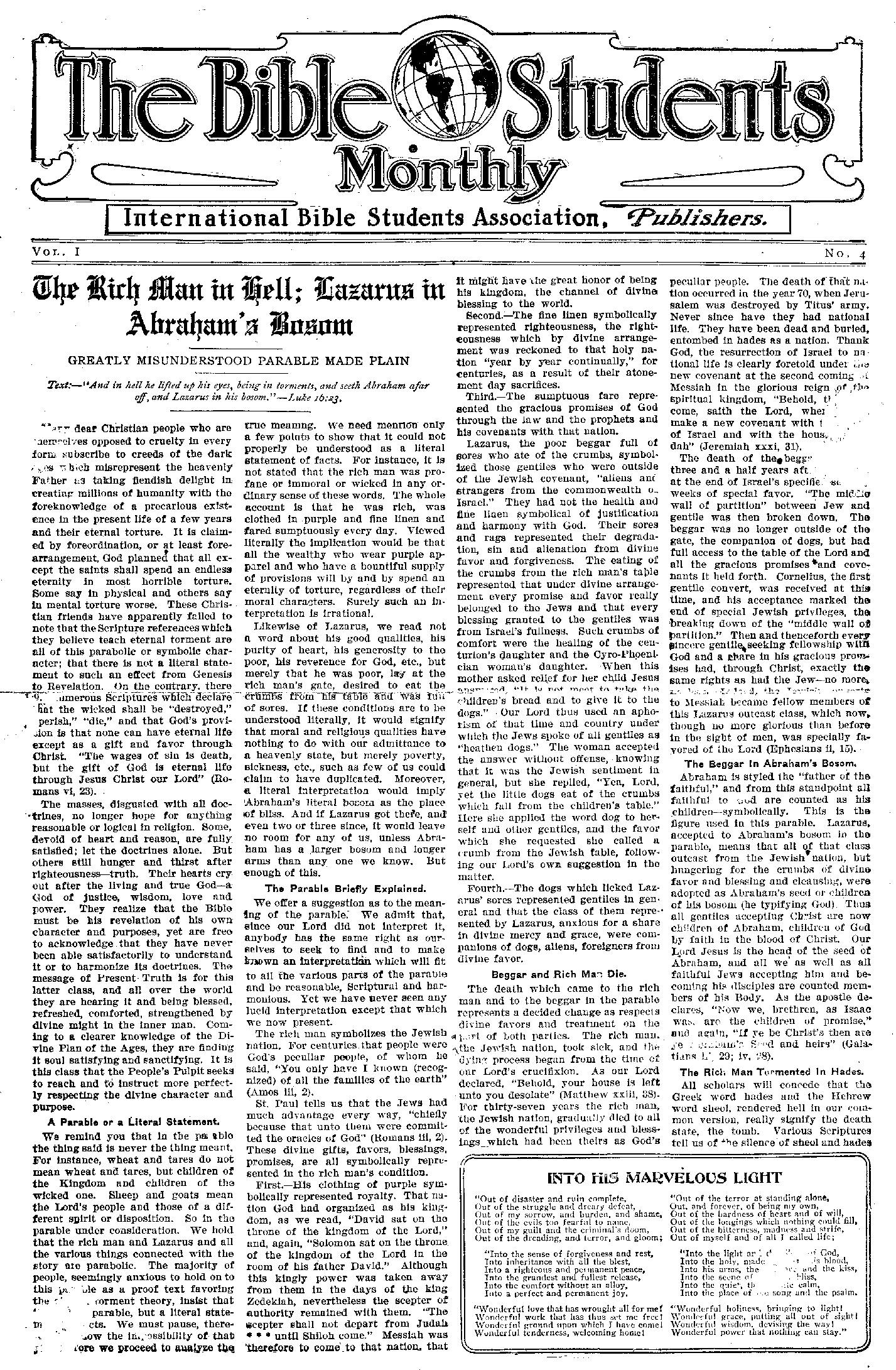
Birlj Matt tit IM; Cazarus in Ahraliant’;5 Ifrwitt
GREATLY MISUNDERSTOOD PARABLE MADE PLAIN
Text:—“And in hell he lifted up his eyes, being in torments, and seeth Abraham afar off, and Lazarus in his bosom.”—Luke 16:23.
’%ry dear Christian people who are ’aerprolves opposed to cruelty in every .torn.- subscribe to creeds of the dark ' :.es eh misrepresent the heavenly Father us taking fiendish delight in creating millions of humanity with the foreknowledge of a precarious existence in the present life of a few years and their eternal torture. It is claimed by foreordination, or at least forearrangement, God planned that all except the saints shall spend an endless eternity in most horrible torture. Some say in physical and others say lu mental torture worse. These Christian friends have apparently failed to note that the Scripture references which they believe teach eternal torment are , all of this parabolic or symbolic character; that there is not a literal statement to such an effect from Genesis ___to Revelation. On the contrary, there 1 -9/ umerous Scriptures which declare Sat the wicked shall be "destroyed,” * perish,” “die,” and that God’s provision is that none can have eternal life except as a gift and favor through Christ. “The wages of sin is death, but the gift of God is eternal life through Jesus Christ our Lord” (Romans vi, 23).
The masses, disgusted with all doctrines, no longer hope for anything reasonable or logical in religion. Some, devoid of heart and reason, are fully satisfied; let the doctrines alone. But others still hunger and thirst after righteousness—truth. Their hearts cry out after the living and true God—a God of justice, wisdom, love and power. They realize that the Bible must be his revelation of his own character and purposes, yet are free to acknowledge that they have never been able satisfactorily to understand It or to harmonize its doctrines. The message of Present- Truth is for this latter class, and all over the world they are hearing it and being blessed, refreshed, comforted, strengthened by divine might in the inner man. Coming to a clearer knowledge of the Divine Plan of the Ages, they are finding it soul satisfying and sanctifying. It Is this class that the People’s Pulpit seeks to reach and to instruct more perfectly respecting the divine character and purpose.
A Parable or a Literal Statement.
We remind you that in the pa tble the thing said is never the thing meant. For instance, wheat and tares do not mean wheat and tares, but children of the Kingdom and children of the wicked one. Sheep and goats mean the Lord’s people and those of a different spirit or disposition. So in the parable under consideration. We hold that the rich man and Lazarus and all the various things connected with the story arc parabolic. The majority of people, seemingly anxious to hold on to this pi die as a proof text favoring the c' . torment theory, Insist that ‘ ' parable, but a literal state-
. in w cts. We must pause, there-_.ow the Impossibility of that ;: » ore we proceed to analyze the
true meaning, we need mention only a few points to show that It could not properly be understood as a literal statement of facts. For instance, it is not stated that the rich man was profane or immoral or wicked in any ordinary sense of these words. The whole account is that he was rich, was clothed in purple and fine linen and fared sumptuously every day. Viewed literally the implication would be that all the wealthy who wear purple apparel and who have a bountiful supply of provisions will by and by spend an eternity of torture, regardless of their moral characters. Surely such an interpretation is irrational.
Likewise of Lazarus, we read not a word about his good qualities, his purity of heart, his generosity to the poor, his reverence for God, etc., but merely that he was poor, lay at the rich man’s gate, desired to eat the crumbs from his “fable and was in-of sores. If these conditions are to be understood literally, it would signify that moral and religious qualities have nothing to do with our admittance to a heavenly state, but merely poverty, sickness, etc., such as few of us could claim to have duplicated. Moreover, a literal interpretation would imply Abraham’s literal bosoia as the place of bliss. And if Lazarus got thefe, and even two or three since, it would leave no room for any of us, unless Abraham has a larger bosom and longer arms than any one we know. But enough of this.
The Parable Briefly Explained.
We offer a suggestion as to the meaning of the parable.' We admit that, since our Lord did not Interpret it, anybody has the same right as ourselves to seek to find and to make knujwn an Interpretation which will fit to all the various parts of the parable and be reasonable, Scriptural and harmonious. Yet we have never seen any lucid interpretation except that which we now present.
The rich man symbolizes the Jewish nation. For centuries that people were God’s peculiar people, of whom he said, “You only have I known (recognized) of all the families of the earth” (Amos iii, 2).
St. Paul tells us that the Jews had much advantage every way, “chiefly because that unto them were committed the oracles of God” (Romans iii, 2). These divine gifts, favors, blessings, promises, are all symbolically represented in the rich man’s condition.
First.—His clothing of purple symbolically represented royalty. That nation God had organized as his kingdom, as we read, “David sat on the throne of the kingdom of the Lord,” and, again, “Solomon sat on the throne of the kingdom of the Lord in the room of his father David.” Although this kingly power was taken away from them in the days of the king Zedeklah, nevertheless the scepter of authority remained with them. “The scepter shall not depart from Judah • ♦ * until Shiloh come.” Messiah was therefore to come.to that nation, that
It might have the great honor of being his kingdom, the channel of divine blessing to the world.
Second.—The fine linen symbolically represented righteousness, the righteousness which by divine arrangement was reckoned to that holy nation “year by year continually,” for centuries, as a result of their atonement day sacrifices.
Third.—The sumptuous fare represented the gracious promises of God through the law and the prophets and his covenants with that nation.
Lazarus, the poor beggar full of sores who ate of the crumbs, symbolized those gentiles who were outside of the Jewish covenant, “aliens anc strangers from the commonwealth o_ Israel.” They had not the health and fine linen symbolical of justification and harmony with God. Their sores and rags represented their degradation, sin and alienation from divine favor and forgiveness. The eating of the crumbs from the rich man’s table represented that under divine arrangement every promise and favor really belonged to the Jews and that every blessing granted to the gentiles was from Israel’s fullness. Such crumbs of comfort were the healing of the centurion’s daughter and the Cyro-Phoenician woman’s daughter. When this mother asked relief for her child Jesus
children’s bread and to give it to the dogs.” Our Lord thus used an aphorism of that time and country under which the Jews spoke of all gentiles as “heathen dogs.” The woman accepted the answer without offense, knowing that it was the Jewish sentiment in general, but she replied, “Yea, Lord, yet the little dogs eat of the crumbs which fall from the children’s table.” Here she applied the word dog to herself aud other gentiles, and the favor which she requested she called a crumb from the Jewish table, following our Lord’s own suggestion in the matter.
Fourth.—The dogs which licked Lazarus’ sores represented gentiles in general and that the class of them represented by Lazarus, anxious for a share in divine mercy and grace, were companions of dogs, aliens, foreigners from divine favor.
Beggar and Rich Man Die.
The death which came to the rich man and to the beggar in the parable represents a decided change as respects divine favors and treatment on the 4 p-i’l of both parties. The rich man, -tthe Jewish nation, took sick, and the dying process began from the time of our Lord’s crucifixion. As our Lord declared, “Behold, your house is left unto you desolate” (Matthew xxiil, 38).
peculiar people. The death of that nation occurred in the year 70, when Jerusalem was destroyed by Titus’ army. Never since have they had national life. They have been dead and buried, entombed in hades as a nation. Thank God, the resurrection of Israel to na tional life Is clearly foretold under A, a new covenant at the second coming >t Messiah in the glorious reign of ,tb° spiritual kingdom, “Behold, tl ' come, salth the Lord, whei make a new covenant with t of Israel and with the hous., r dah” (Jeremiah xxxi, 31).
The death of thegbegg-three and a half years aft at the end of Israel’s specific’, st weeks of special favor. “The middlq wall of partition” between Jew and gentile was then broken down. The beggar was no longer outside of the gate, the companion of dogs, but had full access to the table of the Lord and all the gracious promises *and covenants it held forth. Cornelius, the first gentile convert, was received at this time, and his acceptance marked the and of special Jewish privileges, the breaking down of the “middle wall o.1! partition.” Then and thenceforth every (Sincere gentlle^seeking fellowship with God and a chare in his gracious pro*n-Ises had, through Christ, exactly the same rights as had the Jew—no more*.
V.'.'C. th? — -*-*-<*■
to Messiah became fellow members of this Lazaros outcast class, which now, though no more glorious than before In the sight of men, was specially favored of the Lord (Ephesians ii, 15).
The Beggar In Abraham’s Bosom.
Abraham is styled the “father of the faithful,” and from this standpoint all faithful to nud are counted as his children—symbolically. This Is the figure used In this parable. Lazarus, accepted to Abraham’s bosom in the parable, means that all of that class outcast from the Jewish* nation, but hungering for the crumbs of divine favor and blessing and cleansing, were adopted as Abraham’s seed or children of his bosom (he typifying God), Thus all gentiles accepting Ch'flst are now children of Abraham, children of God by faith in the blood of Christ. Our Lord Jesus is the head of the seed of Abraham, and all we’ as well as all faithful Jews accepting him and becoming his disciples are counted members of his Body. A.s the apostle declares, “?-ow we, brethren, as Isaac was, are the children of promise,” and aga’n, “If ye be Christ’s then arc
tiars J?
.am'r’ 8 --‘d and heirs” (Gala-29; iv, ”8).
For thirty-seven years the rich man, the Jewish nation, gradually died to all of the wonderful privileges and blessings which had been theirs as God’s
The Rich Man Tormented In Hades.
All scholars will concede that the Greek word hades and the Hebrew word sheol, rendered hell in our common version, really signify the death state, the tomb. Various Scriptures tell us of *he silence of sheol and hades
INTO HiS MARVELOUS LIGHT
“Out of disaster and ruin complete, Out of the struggle and dreary defeat, Out of my sorrow, and burden, and shame, Out of the evils too fearful to name, Out of my guilt and the criminal’s doom, Out of the dreading, and terror, and gloom;
“Into the sense of forgiveness and rest, Into inheritance with all the blest, Into a righteous and permanent peace, Into the grandest and fullest release, Into the comfort without an alloy, Into a perfect and permanent joy.
“Wonderful love that has wrought all forme! Wonderful work that has thus set rne free! Wonderful ground upon which I have come! Wonderful tenderness, welcoming home!
“Out of the terror at standing alone, Out, and forever, of being my own, Out of the hardness of heart and of will, Out of the longings which nothing could fill, Out of the bitterness, madness and strife,
Out of myself and of all
“Into the light ar c1 Into the holy, made
I called life;
Into Into Into Into
his the the the
arms, the scene of quiet, th place of 11,
?. ..f God,
-1 ,5s blood, ic; and the kiss, . bliss, .:te calm, song and the psalm.
“Wonderful holiness, bringing to light!
Wonderful grace, putting all out of sight! Wonderful wisdom, devising the way!
Wonderful power that nothing can stay.”
,, ■ I.
BIBLE STUDENTS MONTHLY
PUBLISHED BY THE
International Bible Students Association
London Tabernacle, Craven Terrace, Lancaster Gate, W. Monthly, 1,- per year. Sample Free.
DIV'NE WORSHIP EVERY SUNDAY, LONDON TABERNACLE.
< 11 A.M., 3 P.M. and 6.30 P.M.
Seafs Free. No Collection. You Are Invited.
Correspondence invited from those desirous of cbtainlng Christian counsel. Address as above.
and that ere Is neither wisdom nor knowledge nor device there; that the dead knew not anything. Scholars .therefore have been perplexed greatly at the statement of this parable that the rich man lifted up his eyes in spiritual ^and Tieavenly conditions? C,hrist!,s death and the death of tjiese his elect members to earthly interest's constitute the terms upon which he and they shall be the mediator of the new covenant for Israel, to give Israel a share on the earthly plane in the work of blessing all the families of the earth under their*new covenant. Thank God, this will mean restitution, uplifting out of sin and death conditions not only for those who have not yet entered the tomb, but for all of the race who will accept this favor of God( through Christ, including those who have gone into the tomb. All refusing this grace will die the Second Death, symbolized by Gehenna.
hades, being in torments. The difficulty dissolves as soon as we have the proper Interpretation to the parable and see that tl_e Jewish people, died as a nation and were buried as a' nation, but did not all die individually. The people of Israel, outcast from their own land among all the nations of earth, are very much'alive, socially and personally, having'suffered for all these centuries.
Only very recently we have had an exhibition of how this rich man (Israel), dead as aviation, but alive as a people, has appealed to Father Abraham to have Lazarus cool his tongue with a drop of water., Of course the thought would not be that a spirit finger would take a drop of literal water to cool a literal tongue. The interpretation must be looked for along the lines of the parable. The fulfillment came when the* Jews of this country in a general petition requested the president of the United States to cooperate with other “Christian nations’’’ and intercede^on behalf of their members in Russia that they might have more liberty and less persecution, that1 their torments might be cooled.
If we look for the rich man’s “five brethren” we find them. There were twelve tribes of Israel, and, although all jpf these . tribes were in . a general way represented in Israel in our Lord’s clay, yet, strictly speaking, that rich man was composed mainly of the two tribes—Judah and Benjamin. Now, if the two tribes yyere represented in the one man the other ten tribes would l>e properly enough represented in liis ■'‘five brethren.” The suggestion of the parable that something be done for these five brethren is for the purpose of showing us that nothing would be clone for them. The answer of the ap-• I>eal was: “They have Moses and the prophets. * ♦ ♦ If they hear not MOses and the prophets, neither will they be persuaded though one rose from the dead” (Luke xvi, 29, 31). 5
Here, dear friends, we have a consistent interpretation of this parable, ■ and it relieves our minds greatly. It assists also in illustrating to us the special relationship of the Jews under the Law Covenant and how this special relationship was lost by reason of their unbelief and how their unbelief alienated them from the divine favor of this gospel' age and constituted a deep and wide gulf between them and. the spiritual Israel class represented In Lazarus in Abraham’s bosom. W® thank God that the promise of the ’ Scriptures is that with the end of this gospel age this gulf of unbelief and consequent separation from divine favor will be done away and Israel wilt be delivered from the torments of these centuries and experience a national-resuscitation or resurrection under the glorious privileges, favors and advantages of the new covenant, “Even so have these also not believed thgt • through your mercy they also, may, ob- ? tain mprey” (Romans xi, 31). v
Israel’s New Covenant.
God’s great covenant, the cath bound covenant, “In thee and in thy Seed shall all the families of the earth be blessed,” applies specifically ‘ tQ the Christ, to our Redeemer and Lord, the Head, and to the “elect” Church, the members of his. Body. '
All of the privileges of?blessing the. world belong to- this class, but they, are received conditionally—that they will sacrifice their earthly rights and interests that they may have instead.
“3ln tlie (Chths of (Christ Wv (Klunj”
Text:—''•The preaching of the Cross is to them that perish-foolishness; but unto us "which are saved it is the power of God.'"—I Cor. 1:18.
It fs very remarkable that the Cross, which symbolized the most ignominious form of capital punishment under the laws of the Roman Empire, should be the symbol of Christianity. Thus, believers who are deeply learned in the Bible, will have no difficulty in discerning that the same Divine providence which in advance marked bread as a symbol of the Bread of Life from heaven, and water as a symbol of the water of life from the throne of God, and marriage as a picture of the relationship between Christ and the Church, directed also that the Romans should adopt the Cross as a symbol of ignominy. Was not this anticipated in the Divine prophecy which declared, “Cursed is every one that hangeth on a tree”—a cross? And did not our Lord Jesus use this very word Cross with a proper figurative signification considerably in advance of his own crucifixion, saying^ “If any jpan would be my disciple, let him deny himself, and take up his Cross, and follow me.”—• Mutt. 16:24.
Evidently the Cross, the shame of the Cress, the ignominy of the Cross, the ordeal pictured by the Cross, were foreordained picture-lessons—lessons of the self-denials and sacrifices expected not-only for- Messiah, but for all those who would be associated with him as his “Bride” class, “members of his Body,” his “Royal Priesthood,” his “Peculiar People,” his “Holy Nation.”
It will be discerned that we are drawing a sharply-defined contrast between the meaning of the cross presented to our minds in th^ Scriptures and the unregenerated sentiment which sees it merely as the symbol of pride and ostentation, whether upon banners or buildings or bestudded with jewels for personal adornment. Let us be understood, that the People’s Pulpit stands for the Cross in the simplicity of its original institution a symbol—in the words of our Lord and his apostles—a symbol of self-denial, self-sacrifice, suffering for righteousness’ sake in opposition to the spirit of the world, the flesh and the Adversary.
for ®ne of the nails reputed to have been
driven'through our Saviour’s flesh. We" Creator, nevertheless all of his rights
On the other hand, let us not be understood to .have any superstitious reverence for a splinter from the Cross of Christ or do not bow down to them nor reverence them in any sense. Our thought goes out to the Cross,of Christ on a much higher and nobler plane when we recognize the work of grace connected with our Saviour’s sacrifice, which was finished on the Cross. In the proper understanding of the matter our Lord took up his Cross as soon as he reached manhood’s estate . under the Law—when thirty years of< age. Immediately he presented himself-to John at Jordan and made a full con-, secration unto death, symbolizing it by water immersion. There, begotten by the holy Spirit, he came up out of the water and for three and a half years figuratively, symbolically, was bearing his Cross.
His Cross consisted not in his living separate from sin, for he had lived separate from sin up to that time. “He knew no sin.”—2 Cor. 5:21.
His Cross, on the contrary, consisted in self-denial as respects things which would have been entirely proper and right, against which there would have been no law. These he sacrificed in the doing of the Father’s will, in laying down his life a ransom for mankind. Although his own will was a righteous one, he tells us that he •came, not to do bis own wiJL but. the will
TELL ME ABOUT THE MASTER
“Tell me about the Master!
I am weary and worn to-night; The day lies behind me in shadow, And only the evening is light!
Light with a radiant glory
That lingers about the west. My poor heart is aweary, aweary, And longs, like a child, for rest.
“Tell me about the Master!
Of the hills he in loneliness trod, When the tears and blood of his anguish
Dropped down on Judea’s sod.
For to me life’s seventy mile-stones
But a sorrowful journey mark;
Rcuvh lies the hill country before me, The mountains behind me are dark.
ofTiim that sent" him—the TatbeFs will.
He tells us what this will was, namely, humanity are still heathens totally ig-that he should lay down his life, giving - • - - • •• •
himself a ransom for many, and that ultimately he should receive his life again as a reward, on a higher plane, and that thus, by the sacrifice for our sins, he should be qualified not only to atone for our sins and thus to purchase the world by the sacrifice for sin, but additionally that he should have power and authority to save the world from its lost condition —from sin and death.
PURCHASED BY HIS BLOOD.
The Apostle Peter states the same matter in other words, saying, that we were redecned “with the precious blood of Christ, as of a lamb without blemish and without spot.” (1 Pet. 1:19.) As the Cross of Christ was not merely the timber to which he was nailed at death, so the blood of Christ was not that which issued from the spear-thrust in his side after his death. The Scriptural statement is that -the “life is in the blood.” In accord with this the Lord’s sacrifice of his life was the shedding of his blood. “Bloodshed,” Indeed, is a proper name for any violent death. When it is said that we were bought vzith the precious blood of Christ it signifies that the valuable sacrifice of his life -was made on our behalf. That sacrifice, that shedding of his blood, began when he was thirty years of age, at the moment of his consecration unto death. It continued for the three and a half years of his ministry. It was finished when he cried with a loud voice and gave up the spirit of life. His life, his blood, was thus gradually shed, and the shedding was completed before the Roman soldier pierced his side. As we see this proper, broad conception of the Cross of Christ and the shedding of the blood of the Lamb of God, wre find that the two thoughts are identical, merely stated from different standpoints and represented by different figures of speech.
The value of the self-sacrifice of our Lord, represented in these two pictures, is the Gospel theme. On it hang the Law, the prephets, the promises Of the Scriptures, both of the Old and New Testaments. Without it our race is undone, in hopeless despair. Without it death to humanity would mean the same as to the brute beast. For although man was made in the image of his Creator and with noble qualities of mind and heart, constituting him an earthly image of his heavenly
Were forfeited, lost, through Adam’s
disobedience and the death sentence upon him would reduce him to the level of the brute. Only by the “Blood of his Cross” is recovery through redemption made possible. He sacrificed himself. He died, the just for the unjust, that he might bring mankind back into harmony , with God. The entire transaction was - aside from humanity. Our heavenly Father planned it all from before the creation of the world, for we read that our Redeemer was the “Lamb slain from before the foundation of the world”— in the Divine purpose or intention.— Rev. 13:8.
t THIEVES IN PARADISE J
The sermon on the text, "Verily I say unto thee, today shalt thou be with me in Paradise” is delayed.
It may be expected in our August issue, jT -
sr
“Tell me about the Master!
Of the wrongs he freely forgave;
Of his love and tender compassion.
Of his love that is mighty to save;
For my heart is aweary, aweary,
Of the woes and temptations of life, Of the error that stalks in the noonday, Of falsehood and malice and strife.
“Yet I know that whatever of sorrow Or pain or temptation befall,
The infinite Master hath suffered, And knoweth and pitieth all. .
So tell me the sweet old story
That falls on each wound like a bairn. And my heart that is bruised and broken
Shall grow patient and strong and calm."
THE WORLD’S SHARE IN THE CROSS.
That the Church has a share in the Cross is freely admitted, but many do not see that every member of the race has an interest in the work of Jesus, began at Jordan and finished at Calvary. A little radiance from the Cross and the Gospel message encircling it has indeed blessed people of every nation! But oh, how little has yet been really accomplishes for the race as a whole! Three-fourths of norant of the Lord—and this after mora than eighteen centuries. And more than this, the natural increase of heathenism so far outstrips our most energetic missionary effort that disproportion doubles with every century; for instance, today there are twelve hundred millions of heathen, while a century ago there were six hundred millions. What does it tnean? Has the Cross of Christ proven a failure? Did Christ die in vain, even relatively? Will the blessing of the Cross never bring reconciliation to any but tha few blessed by the sanctifying influences ©f the present life?
THE TRIUMPH OF THE CROSS.
Ah! we have made a great mistake in the reading of our Bibles. We have failed to discern that God’s time for dealing with the heathens is future; that a Millennial Age is to be introduced, in which Christ with power and great glory will suppress the power of Satan' and drive away the mists and fogs of ignorance and superstition ana lift frina tnac degradation of sin and death all’w.not will then a* ept his gracious provisions.’e This is the 1 ingdom for which the Master told us to pray, saying, “My Kingdom is not of this world (age).” (John 18:36.) Again, he said, “Pray ye: our Father which art in heaven; hallow7ed be thy name; thy Kingdom come; thy will be done on earth, as it is in heaven.” (Matt. 6:9,10.) Ah, yes, while doing all that we can for ourselves and our neighbors, let us remember that the work is not' ours but the Lord’s, and that he has declared that the coming Millennial Age of the reign of Christ and the Church is his time appointed for the blessing of all the families of the earth. Then the Cross of Christ will triumph, because without his Cross no such Millennial Kingdom and its “Times of Restitution of all things” would be possible. First, the sacrifice for sins needed to be made before the “ curse ” could be lifted and the blessing could come to the race of sinners.
PREACHING OF THE CROSS
FOOLISHNESS.
If, then, it is the Divine program that Christ shall establish his Kingdom, shall overthrow the rule of Satan and sin and death and enlighten mankind and deliver the -willing and obedient, why did he not begin that work eighteen centuries ago? Why has valuable time been lost? Is it not a foolish waste of time to preach the Cross of Christ and faith and obedience, under the present adverse conditions? Do not the results of the;e eighteen centuries of preaching show the folly of this procedure?
We answer in the words of our text, Yes, the preaching of the Cross of ChrLt seems foolishness to the perishing ones— to the world in general. But it does net so seem to us. The saved ones, we who have come into relationship with the Father through faith in the precious blood and have come to an understanding of the Divine Plan of Salvation, realize the "cross to be the power' ST God.” (1 Cor. 1:18.) To us the message of the Cross has been a transforming one, which, more and more as we have come to appreciate it, has been changing our characters and lives from glory to glory, enabling us to more nearly approximate the glorious character of our dear Re-
deemer and to become at heart “copies of. .others. It is of this Gospel of the Cross of God’s dear Son.”—Romans 8:29. ^Christ that the Apostle says, “It is a In a word, while all mankind were im- • savour of life unto life, or of death unto
perfect, sinners, “children of wrath,” condemned, yet amongst them were two classes. One class was in sympathy with its environment and general condition of alienation from God, and at enmity, not only outwardly but also in their hearts loving sin. The other class, outwardly the same, much fewer in number, had a love for righteousness and an opposition to iniquity and loathed their own weaknesses and blemishes. This latter class longed for righteousness and perfection, which they were unable to attain, because of their weaknesses of the flesh; because of their inability to do perfectly; because they were “born in sin and ghapen in iniquity.” It is this latter class that God is now drawing to his Son and permitting to be justified by faith, and then admitting by begetting of the holy Spirit to the relationship of Spiritual Sons of God and prospective Joint-Heirs with Jesus Christ their Lord and Redeemer. Of these Jesus said, “ No man can come unto me (now) except the Father which sent me draw him.” —John 6:44.
In a word, God has divided mankind into two general classes, and has made arrangements that only one of these classes will be specially drawn,blessed and saved by faith now, leaving the other to be dealt with during the Millennium. The class favored in this present time are guch as have the “hearing of faith” and came into relationship to God under the terms of the great Abrahamic Covenant. Their special blessing now is not because they are sinless, “for there is none righteous, no, not one” (Rom. 3:10), but because they loved righteousness and hated iniquity. On this account they may be the “fellows” or “brethren” of Christ, because they have this heart likeness to him of whom it is written, “Thou hast loved righteouness, and hated iniquity; therefore God, even thy God, hath anointed thee with the oil of gladness (holv Spirit) above thy fellows.”—Heb. 1:9.
Those who are now specially drawn of 8he Father are not compelled to become fellows with his Son, their Redeemer, but are privileged to have this honor if they wish on certain terms and conditions. To attain this relationship they must stand trial in this present time, while sin and death are still reigning and while it will cost the sacrifice of earthly interests to be fo estop followers of their Lord and Saviour. In a word, the Scriptures declare that they can have the great prize of joint-heirship with Christ in his Millennial Kingdom and its work of blessing all the families of the earth only upon condition that they “make their calling and election sure” by faithfulness under trials and testings and difficulties.
TH ^MYSTERY OF THE CROSS.
Comparatively few of the hundreds of thousands of those who have named the Dame of Christ, and who have come under various denominational yokes, have any knowledge of the Mystery of the Cross of Christ, the Mystery of the Gospel, “The Mystery which hath been hid from ages and generations, but now is made manifest to his saints.” (Col. 1:26.) Alas, the majority seem content to have merely a “name,” to live and to wish merely to be called Christians and to wear a jeweled cross. It is but the few of those who have tasted that the Lord is gracious and have felt an earnest desire to kfiow and to do the Father’s will atthe cost of self-sacrifice. With the majority the intimation that a certain course in life is the “narrow way,” the way of the Cross, is sufficient to turn them in an opposite direction; for, while they would like to share the heavenly glories and honors of the Lord, they are unwilling to be sharers in his ignominy, sufferings and death. These, without relinquishing their desire for righteousness, are disinclined to go to >uch lengths as the Master and the apostles taught and exemplified. Hence, they are not interested in the “deep things” of God’s Word, but merely in the more superficial. In the language of the Scriptures, they are willing to say, “We will eat our own bread, and wear our own apparel; only let us be caller’ by thy name, to take away our reproach.) —Isa. 4:1. ' )
However, inside and outside of all denominations wre may expect to find the Lord’s “little flock,” following in his footsteps through evil report and through Sood report, singing and making melody i.their hearts upto th© Lord .for the privilege granted them of having fellowship with Christ in his sufferings, in prospect of the fellowship in his glory which will soon be theirs. So far from the preaching of the Cross being a failure it is a great success in this particular work which the Lord intends. It has served to attract the loyal-hearted and to repel all death.”—2 Cor. 2:16.
The Mystery of the Cross, then, is that it is the Divine purpose that the Lord Jesus should be the Head or Chief Priest and that during this Gospel Age God would draw out from amongst this world and santify to himself through the merits of Jesus’ sacrifice an UnderPriesthood, who as “members of the Body of Christ,” would delight “to fill up that which is behind of the afflictions of Christ.”—Col. 1:24.
So, then, be it understood, the great Christ, foreknown of the Father and ordained to be the World’s Deliverer during the Millennial Age, is primarily our Lord Jesus the Head, and secondarily the members of the Body, the “saints” of the Gospel Age, “Members in particular of the Body of Christ.” Thus seen there is a good reason, a very particular reason, why the Millennial Restitution work for the world did not begin immediately after our Lord’s resurrection. The interim of time was set apart for the selection of the members of his Body, elsewhere spoken of as the betrothed Church, which at our Lord’s Second Coming, will become “the Bride,” “the Lamb’s Wife,” and “Joint-Heir” in the Kingdom with the heavenly Bridegroom. ’ ;
FOOLISHNESS WITH MEN, WISDOM WITH GOD.
Behold, then, in the light of these Scripture testimonies, the power and wisdom and love of God connected with the Cross of Christi See how now it is the power of God unto salvation to everyone that believeth and who is of a ready heart to accept the Divine mercies. Note the grace of God in permitting sinners from the very lowest plane to be justified by faith and to be made heirs of glory and, as the Apostle declares, to be made “partakers of the Divine nature.” (2 Pet. 1:14.) If this present grace which comes only to those who have the hearing ear and the appreciative heart were all, were the end of the triumph of the Cross of Christ, it would be a wonderful triumph, a glorious one, even though all the remainder of the race except these saintly .ones of the First Ressurrection class, the Body of Christ, should perish should never come to a knowledge of the grace of God, should never attain to eternal life on any plane.
But God declares emphatically that it is not his will that any should perish^ but that all might turn unto him and live. And he has made full provision whereby every member of the race may be brought to a knowledge of the Truth, that all may thus be saved—“Who will have all men to be saved, and to come unto the knowledge of the Truth.”— 1 Tim. 2:4.
The selection of this favored Seed of
Abraham, The Christ (Gal. 3:16-29), is but the beginning of God’s great work of salvation through the Cross of Christ; as soon as the “elect” shall have been completed and all tested and proven and glorified with their Lord, the “New Covenant,” sealed with the precious blood, will become operative. The blessings withdrawn from natural Israel when our Lord was crucified will be restored to them under that New Covenant. Spiritual Israel will rule and bless the world through natural Israel, and all the families of the earth will then be encouraged to come into harmony with God under the terms of the New Covenant by becoming “Israelites indeed.” Thus Abraham’s Seed eventually will bless all who love righteousness, all who under full knowledge and opportunity will demonstrate their love for righteousness and their hatred for iniquity. What wonder, then, that while others are speaking slightingly of the Cross of Christ and claiming that there was no need of redemption, that our race never fell and will never be restored—what wonder, we say, that we who see something of the “length and breadth and height and depth of the love of God,” glory in the Cross of Christ!
Truly did the Lord declare through the Prophet, “ For as the heavens are higher than the earth, so are my ways higher than your ways, and my thoughts than your thoughts. For my plans are not your plans, neither are your methods ms methods, saith the Lord.”—Isa. 55:9. 8,
wIn the cross of Christ I glory, Towering o’er the wrecks of time;
All the light of sacred story
Gathers,roundits.head sublime.”
Iboeanna! Ibosanna! (Th Ilir Smt nt Sattth!
Text:—"Blessed is he that cometh in the name oj he Lord." •—Matt, 2i:g,
"Four daysTbefore his crucifixion oun Lord rode to Jerusalem on the ass.
The people preceding and following him shouted, “Hosanna to Messiah, Son of David and King of Israel,” and spread their outer garments and palm branches on the road, as was the custom with great heroes in triumphal procession.
For three and a half years from the time of his baptism at thirty years of age our Lord had been preaching the Kingdom of heaven at hand. Additionally he had sent forth dis disciples two and two; first the twelve, and later seventy others, to preach the same thing, namely, “Repent, for the Kingdom of heaven is at hand”—get your hearts into a condition of readiness that you may be received into that Kingdom, to be associated with Messiah in the blessing of all the families of the earth, in harmony witib the promise made to father Abraham, Our Lord had become quite noted. “The common people heard him gladly.” Some of them said, “Never man spake like this man.” “And they all bare witness to the gracious words that proceeded out of his mouth, for he spake as one having authority (knowledge) and not as a scribe.” On more than one occasion it appeared as though the people would take him by force to make him a king; but our Lord avoided the matter and withdrew himself and discouraged the efforts. The scribes and Pharisees, jealous of his popularity, ashamed of his following and afraid that he would yet become the center of a futile movement antagonistic to the Roman government and their own prestige, had already threatened his life. As it is written, “Jesus could no longer walk in Jewry because the Jews sought to kill him.” Their antagonism to kirn Was all the greater after the awakening of Lazarus.
Behold, Thy King Cometh.
Suddenly a change was manifest in 0esus’ attitude. He came to Bethany, notwithstanding the protest of his disciples, who then valiantly said, “Let us go that we may die with him.” Discarding caution he went directly to the borne of Lazarus and his sisters. There fie was the guest of honor with his disciples at a special feast. There Mary, poured upon him the precious spikenard perfume which Jesus declared was an anointing for his burial. In that expression we have the key to his outward course. He knew that his hour was come: that the end of his ministry was at hand; that he wa^ about to be crucified.
It was under these circumstances that the next morning he not only did not hinder the people from proclaiming him King, but he sent his disciples to bring the ass upon which he was to ride in triumph as a King, for it was the custom of Israel’s kings to be thus presented to the people. The account tells us that the people hailed Jesus as the Son of David, the King of Israel, the Messiah; and that in the concourse were Pharisees who had come from Jerusalem to Bethany to see Jesus and Lazarus whom he had awakened from death; these beheld the proceeding and expostulated with Jesus’ disciples, telling them that Jesus should call the attention of the people to what they were saying and that he should reprove them. Our Lord’s answer shows how Important was the event. He said, "If these should hold their peace the very stones would cry out.” (Luke 19:40.) The Evangelist calls our attention to the fact that the entire procedure was in fulfilment of the prophecy of Zechariah, as through him the Lord had declared centuries beforehand the events which must transpire at the appointed hour, namely, “Shout, O daughter of Jerusalem; behold, thy King cometh unto thee; fee is _jus.t,. and having salvation; low-ly, an<T riling upon an ass? and upon a colt the foal of an ass.”—Zech. 9:9.
Here we see the reason why our Lord said that if the people would hold their peace and not shout the stones would cry out; because the Lord through prophecy had foretold a shout apd the Scriptures must be fulfilled.
How strengthening it is to faitE lb realize that even the jots and tittles of prophecy must all be fulfilled! Thus realizing the Divine supervision of the affairs of our Lord and of his followers we may indeed have a strong consolation and good hope, realizing that all things written in the Law and by the prophets shall have their fulfilment in due course.
Little did the Jews on that Palm Sunday realize what was taking place! And indeed very few Christians to this day realize the purport of that occasion. Let us see what it was. God had promised a Messiah and that he should be of the Seed of Abraham and of the family of David. Zechariah’s prophecy quoted had foretold his formal entry. All those things must be fulfilled: God must keep his part of the contract. If failure occurred it must be Israel’s failure. And so it was. Israel, as represented by her rulers who “sat in Moses’ seat,” were not ready for the Messiah. If they had believed the preaching or John the Baptist a genuine reformation would have made them ready to receive the Messiah. But not being in heart condition led them tp expect a worldly conqueror rather than a “Lamb of God” to take away the sin of the world. We read that “All men were in expectation of him.” And yet, when he offered himself, they were ashamed of him and of his peculiar following of fishermen, publicans, etc. The rulers of the people received him not but plotted his destruction, and the common people furnished not only multitudes to cry, Hosanna, on this occasion, but also later multitudes to cry, “Crucify him, crucify him,” under the influence of their leaders.
As for our Lord, he knew that his hour was come. He had foretold that' he would be rejected a«d crucified, but It was his duty to make the tender of himself as Israel’s King. The very prophecy he was fulfilling declared not only that he would come as King, but foretold that the people would “shout” and also that Israel would be cast oft and have a “double” part of disfavor— the length of the favor they had enjoyed as God’s peculiar people. The prophet specified, saying, “Even today dox I declare that I will render double unto thee.” (Zech. 9:12.) Thus he indicated that particular Palm Sunday as the turning point of Israel’s career. Our Lord also indicated the importance of that day as the turning point in Israel’s history; for when he had ridden to the brow of Mt. Olivet, overlooking Jerusalem, the procession stopped, Jesus saying, “O Jerusalem, Jerusalem, which killest the prophets, and stonest them that are sent unto thee; how often would I have gathered thy children together, even as a hen doth gather her brood under her wings, and je would not! Behold, your house is left unto you desolate. Verily I say । unto you, Ye shall see me no more until the time come when ye shall say, Blessed is he that cometh in the name of the Lord.”—Luke 13:34, 35. ®
In other words, that first Palm Sunday was the turning point marking the rejection of natural Israel as a nation and the inauguration of Spiritual Israel as the “holy nation,” the “royal priesthood,” the “peculiar people” for a purpose. Other Scriptures show us/ that natural Israel is to return to Divine favor as soon as the “election” of spiritual Israel shall be accomplished. But at his Second Advent Messiah will no longer present himself as a man riding upon an ass, but, as the Scriptures declare, he shall come a spirit being, invisible to men, but nevertheless with great glory and power, which shall be “revealed in flaming fire,” symbolical of judgments. We are assured that then the blinded eyes of Israel’s understanding will be open and they shall look upon him whom they nierced and shall mourn for him; and the Lord declares that then he win pour upon them the spirit of prayer and supplication and the blessing of the New Covenant shall be theirs. As it is written, “Behold, the days come, saith the Lord, that I will make^a New Covenant with the house of^srael, and wij;h the house of Judah. Aftei
Hose days, saith the Lord, 1 will put my law in their inward parts, and write it in their hearts. I will forgive their iniquity, and I will remember their sin no more.” (Jer. 31:31-34.) "And I will take the stony heart out of their flesh, and will give them an heart of flesh.”—Ezek. 11:19.
Rejecting the Lamb.
But that Palm Sunday was a notable and important day to Israel from another standpoint. At the beginning of their national existence, when they were delivered from the bondage of Egypt, God specially arranged for their Passover. This will be our topic for next Sunday; but today we notice that their passover lamb was to be taken up and brought into the house on the ninth day of the month Nisan, while it was to be killed on the fourteenth day. As John the Baptist has declared, our Lord was the antitypical “Lamb of God, which taketh away the sin of the world.” (John 1: 29.) And now the antitypical Passover sacrifice was due, when the Lamb of God was to be slain for the sins of the world; and Israel as a nation should nave received the Lamb of God into their house by faith on that very Palm Sunday on which he presented himself as King. He filled the double role of King and Passover Lamb. However, as they rejected him as King, so likewise as their Passover Lamb he was not accepted or received; thus as a nation they were not passed over or saved, but, contrariwise, their national de-etruction followed. As the rich man of the parable of Dives and Lazarus they died nationally from divine favor.
. But while our Lord whs rejected both as Lamb and King by the Jewish nation there were individual exceptions. All the “Israelites indeed,” in whom was no guile, were granted special enlightenment of the eyes of their understanding. These recognized Jesus as the Lamb of God—their Redeemer. And not only so, but they recognized him also as the great King, the King of Glory, the Messiah. As indicating the blindness of the nation and the spiritual sight of the small remnant who received him, our Lord said, “Blessed are your eyes, for they see, and your ears, for they hear.” These who now recognize their Redeemer, and voluntarily become obedient to him by a full consecration Of their hearts, are a very exceptional class, as well as a very small class. His cause has really been unpopular from the first, and only such as are willing to endure hardship as good soldiers have the courage to volunteer to be soldiers of the Cross. There is an outward religion today that is pop-ular. just as there was an outward religion in our Lord’s day that was popular. But to be true disciples, followers of Jesus, to walk in his footsteps, to forsake the world and follow him, means to all his disciples since what it meant to his disciples at the First Advent — alienation and separation. Our Lord said, “If the world hate you, ye know that it hated me before it hated you. If ye were of the world, the world would love its own; but because ye are not of the world, but I have chosen you out of the world, therefore the world hateth you.” (John 15:18,19.) Again he said, “He that reape th receiveth wages, and gathereth fruit unto life eternal.”-— John 4:36.
“Fea? Not, Little Flock."
A point that is not generally recognized is that where natural Israel was rejected the selection of spiritual Israel began, and that what natural Israel failed to get, spiritual Israel is to receive, namely, God’s Kingdom—not God’s Kingdom in the flesh, but on the spiritual plane. True, there will be an earthly or fleshly Kingdom of men and amongst men and of Israel. It will be Inaugurated at the Second Coming of Christ and be his representative amongst men. Meantime, however, during this Gospel Age the Lord is selecting a still higher class—Spiritual Israel—to constitute a spiritual- Empire, of which he is Head. The spiritual, the higher Kingdom class, must be developed first and the spiritual promises inherited by these must first be at-tained; afterward the earthly blessings will all be sure to God’s earth;y people, Israel, under their New (Law) Covenant.—Rom. 11:27-32.
Note how the Apostle Paul, the Divinely appointed Teacher, explains this, saying, “Blindness in part (for the time) is happened to Israel until the fulness of the Gentiles be come in; and so all Israel shall be saved.” Then all Israel shall be recovered from their blindness. “As it is written, There shall come out of Zion [spiritual Israel] the Deliverer [the Christ]; and he shall turn away ungodliness from Jacob; for this is the covenant unto them, when I shall take away their sins. As concerning the Gospel, they are (treated as) enemies for your sakes; but as touching the election, they are beloved for the fathers’ sakes. For the gifts and calling of God he \vill not repent of. For as ye in times past have not believed God, yet have now obtained mercy through their unbelief; even so have these also now pot believed, that through your mercy, they also may obtain mercy.”—Rom. 11:25-31.
. The New Covenant which God will
^eal. with ..Israel ..after these Gospel SBintu^.L.IsraeL. ..Thus It ls. written.
days will be “of your [the Church’s] mercy,” in that it will be sealed with the blood of The Christ—Head and Body. This is the meaning of our Lord’s words to us spiritual Israelites, “This is my blood of the New Covenant—drink ye all of it”—all who participate in it. It is a great privilege to suffer with Christ, to be dead with him, to drink of his cup, to be privileged with him to seal the New Covenant of Israel. All who thus join with him will be permitted to share with him the glories of his Kingdom, his spiritual Kingdom, through which Israel will be blessed, restored to prominence, made the channel of Divine blessings to every nation under heaven.
Two Antitypical Fulfilments.
We have noticed that our Lord’s riding on the ass to Jerusalem was a fulfilment of a prophecy and a type. We note now that there are secondary fulfilments of the same on a still higher plane, (1) The proclaiming of Jesus by the multitude shouting “Hosanna,” was a proclamation of faith in him as the Messiah; so we today, and all of the Lord’s followers down through the Gospel Age, have first hailed him Messiah and proclaimed ourselves believers in him—and this to us was Justification by Faith. Hence, Palm Sunday may be considered as symbolizing the attainment of justification-by those who recognize Jesus and are willing to acknowledge him.
(2) Subsequently at the Memorial Supper Jesus passed the cup to all of his followers, saying, “Drink ye all of it.” This signifies full consecration, even unto death, on the part of all who accept the Lord’s invitation to thus share his cup, the sufferings of Christ. In this sense of the word, dear friends, I trust that all of us have thus declared our faith in the Messiah, the Redeemer, I trust that we have all taken the Lamb into our hearts, into our homes.
A second antitypical fulfilment of today’s lesson is brought to our attention by the fact that everything pertaining to the Jewish people was typical of that nation’s connection with spiritual Israel’s experiences. As Jesus offered himself in the flesh to fleshly Israel at the proper time as their King, so in the parallel of time he must or-fer himself to spiritual Israel at the appointed time as their King of Glory. As the time of natural Israel’s visitation was at the First Advent, so the time of spiritual Israel’s visitation is at the Second Advent. As nominal Israel stumbled and was blinded and failed to receive the King and lost the blessing, so will it be with nominal
"lie shall be for a stone of stumbling and rock of offence to both houses of Israel.” As with the Jews (every “Israelite indeed,” in whom was no guile, was specially blessed and kept and assisted), so it will be here. All others will stumble and, as it is written, “A thousand shall fall at thy side.” That which to the one class will be the stepping-stone to higher favors and the Kingdom blessings, will to the other class be a stumbling-stone. As amongst the Jews it was necessary that the proclamation of the presence of Messiah be made, so here the Second Presence of Messiah must be made known. Nevertheless the parable will be complete, “Behold, ye devisers, and wonder, and perish; for I work a work in your days, a work which ye shall in no wise believe, though a man declare it unto you.’* (Acts 13:41.) We see here the force of the Scriptural declaration that it is given or granted to some to understand the deep things of God and not given or permitted to others. “To you ft is given to know the mysteries of the Kingdom of heaven, but to all outsiders (to all not members of the inner circle of “Israelites indeed”) these things are spoken in parables and dark sayings, that hearing they might hear and not understand.” <
Few see that, as the Lord declared, to the Jews, “Your house is left unto you desolate;" so now he declares to nominal spiritual Israel the same thing. Addressing them; under the name of the Church of Laodicea, he says: “Behold, I stand at the doorand knock. Every man who hears my knock, let him open the door and I will come in and sup with him.” It must be an individual matter. Neither sects nor parties will be acknowledged in this testing time—only the “Israelites indeed” in whom is no guile, who get ready for and receive the blessing promised. To Laodicea, the nominal system as a whole, the Lord says, “Thou sayest, I am rich, and increased with goods, and have need of nothing; and knowest not that thou are wretched and miserable and poor and blind and naked; I counsel thee to buy of me gold tried in the fire, that thou mayest be rich; and white raiment, that thou mayest be clothed, and that the shame of thy nakedness do not appear, and eyesalve to anoint thine eyes, that thou mayest see.”—Rev. 8:17,18.
Let us individually heed this our Lord’s warning, that we may have a share as true spiritual Israelites in the glorious Messings now due to us, and thus be prepared for the Millennial glories just in advance of us.
SANCTIFY THEM THROUGH THY TRUTH a,a.a
“STUDIES IN THE SCRIPTURES"
“MY PEOPLE PERISH FOR LACK OF KNOWLEDGE,” SAITH THE LORD.
INFIDELITY, HIGHER CRITICISM, ETC., ARE DESTROYING FAITH:
BECAUSE THE BIBLE IS MISUNDERSTOOD; BECAUSE “THE FOG the DARK AGES” STILL BECLOUDS our MENTAL VISION
OF

The “Peoples Pulpit” Seeking to Uphold God’s Word at Any Cost, Seeks to Shed Abroad “The Light of the Knowledge of the Glory of God, as it shines in the Face of Jesus Christ Our Lord”
It is not sufficient that we go back a few centuries for the true light on God’s Word. We must go clear back to the words of Jesus and the Apostles and the Prophets. Their teachings were quickly lost in the great falling away foretold, and only of late have we the Bible-Study Helps necessary to our full enlightenment. These are God’s gifts at the opening of the New Epoch called the Millennium. Th& electric light and other wonderful blessings of our day are from the same "Giver of all good.”
We commend to the thousands of our readers the careful study of the Six Series of “ Studies in the Scriptures A Many of yon must already have them in your homes, for over three millions of the first series is announced by the publishers, The Bible and
Tract Society] London, W.
We urge that you read these Studies, yea that you study them, if you would have the greatest blessing imaginable by a
Christian in the present life. Never mind the fact that some dear Christian people our Master and his words. They are prejudiced, blinded, like Saul of Tarsus of old.
speak evil of this work as many spoke evil of

Hearken to the words of C. T. Smith of The Atlanta Constitution, which we heartily endorse:—
“This wonderful book makes no assertions that are not well unstained by the Scriptures. It is built up stone by stone, and upon every stone is the text, and it becomes a pyramid' of God’s love and mercy and wisdom. There is nothing in the Bible that the author denies or doubts, but there are many texts that he throws a flood of light upon that seem to uncover its meaning.
In ignorance they oppose, not having read.
“ It is impossible to read this book' without loving the writer and pondering his wonderful solution of the great mysteries that have troubled us all our lives.” The set of six volumes, cloth, 3,000 pages, is supplied by the Bible and Tract Society, Lancaster Gate, London, W., for the usual price of one such volume, namely 7/6. This includes postage or carriage to your home anywhere.