 View PDF
The content displayed below is for educational and archival purposes only.
Unless stated otherwise, content is © 1910 International Bible Students Association
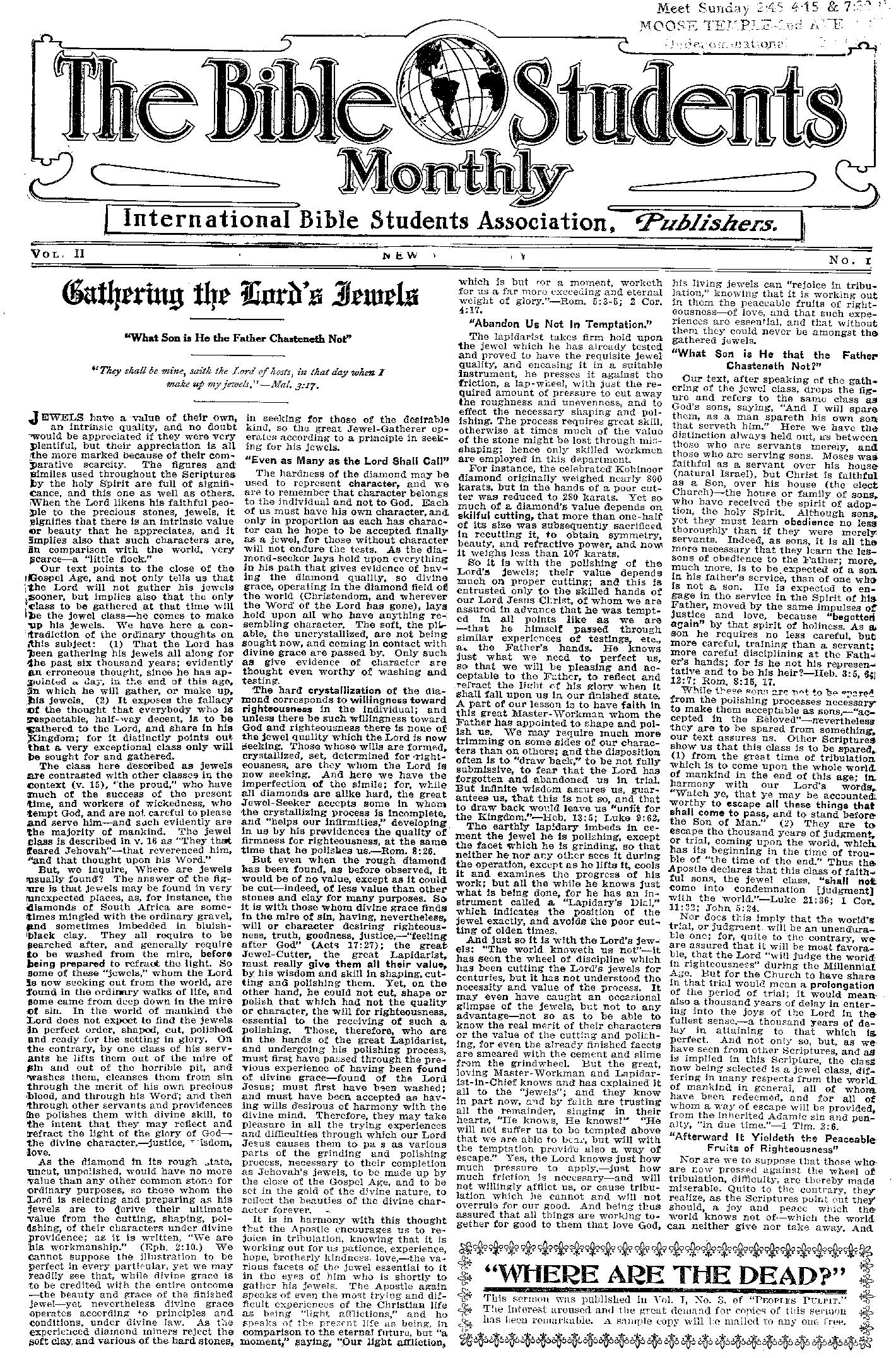
Meet Sunday 2:45 4'15 & 7 . 1 -

International Bible Students Association, ‘Publishers. j
Vol. II
Ch^nttg tip Jtaete
**What Son is He the Father Chasteneth Not”
*lThey shall be mine, saith the Lord of hosts, in that day 'when 1 make up my jewels. ”—Mal. 3:17.
J EWELS have a value of their own, an intrinsic quality, and no doubt "would be appreciated if they were very plentiful, but their appreciation is all <the more marked because of their comparative scarcity. The figures and similes used throughout the Scriptures by the holy Spirit are full of significance, and this one as well as others. iWhen the Lord likens his faithful people to the precious stones, jewels, it signifies that there is an intrinsic value ©r beauty that he appreciates, and it implies also that such characters are, 3n comparison with the world, very jscarce—a “little flock.”
Our text points to the close of the (IGospel Age, and not only tells us that (the Lord will not gather his jewels .sooner, but implies also that the only ?class to be gathered at that time will •be the jewel class—he comes to make nip his jewels. We have here a contradiction of the ordinary thoughts on this subject: (1) That the Lord has been gathering his jewels all along for the past six thousand years; evidently Bn erroneous thought, since he has appointed a. day, in the end of this age, in which he will gather, or make up, bis jewels. (2) It exposes the fallacy ©f the thought that everybody who is respectable, half-way decent, is to be gathered to the Lord, and share in his Kingdom; for it distinctly points out that a very exceptional class only will be sought for and gathered.
The class here described as jewels are contrasted with other classes in the context (v. 15), “the proud,” who have much of the success of the present time, and workers of wickedness, who tempt God, and are not; careful to please and serve him—and such evidently are the majority of mankind. The jewel Class is described in v. 16 as “They that ffeared Jehovah”—that reverenced him, "and that thought upon his Word.”
But, we inquire, Where are jewels (usually found? The answer of the figure is that jewels may be found in very (unexpected places, as, for instance, the diamonds of South Africa are sometimes mingled with the ordinary gravel, find sometimes imbedded in bluish-black clay. They all require to be searched after, and generally require to be washed from the mire, before being prepared to refract the light. So Borne of these “jewels,” whom the Lord 3s now seeking out from the world, are found in the ordinary walks of life, and Etome came from deep down in the mire of sin. In the world of mankind the Lord does not expect to find the jewels 3n perfect order, shaped, cut, polished and ready for the setting in glory. On the contrary, by one class of his servants he lifts them out of the mire of Sin and out of the horrible pit, and washes them, cleanses them from sin through the merit of his own precious blood, and through his Word; and then through other servants and providences (he polishes them with divine skill, to the intent that they may reflect and refract the light of the glory of God—• the divine character,—justice, w isdom, love.
As the diamond in its rough jtate, Uncut, unpolished, would have no more value than any other common stone for ■ordinary purposes, so those whom the Lord is selecting and preparing as his jewels are to <jerive their ultimate value from the cutting, shaping, polishing, of their characters under divine providence; as it is written, “We are his workmanship.” (Eph. 2:10.) We cannot suppose the illustration to be perfect in every particular, yet we may readily see that, while divine grace is to be credited with the entire outcome —the beauty and grace of the finished jewel—yet nevertheless divine grace operates according to principles and conditions, under divine law. As the experienced diamond miners reject the 30ft clay and various of the hard stones, which is but ror a moment, worketh for us a far more exceeding and eternal weight of glory.”—Rom. 5:3-5; 2 Cor. 4:17.
“Abandon Us Not In Temptation.”
The lapidarist takes firm hold upon the jewel which he has already tested and proved to have the requisite jewel quality, and encasing it in a suitable instrument, he presses it against the friction, a lap-wheel, with just the required amount of pressure to cut away the roughness and unevenness, and to effect the necessary shaping and polishing. The process requires great skill, otherwise at times much of the value of the stone might be lost through misshaping; hence only skilled workmen are employed in this department.
For instance, the celebrated Kohinoor diamond originally weighed nearly 800 karats, but in the hands of a poor cutter was reduced to 280 karats. Yet so much of a diamond’s value depends on skilful cutting, that more than one-half of its size was subsequently sacrificed in recutting it, to obtain symmetry, beauty, and refractive power, and nowi it weighs less than 107 karats.
So it is with the polishing of the Lord’s jewels; their value depends: much on proper cutting; and this is entrusted only to the skilled hands of our Lord Jesus Christ, of whom we are assured in advance that he was tempted in all points like as we are '—that he himself passed through similar experiences of testings, etc., a<. the Father’s hands. He knows just what we need to perfect us, so that we will be pleasing and acceptable to the Father, to reflect and refract the light of his glory when it shall fall upon us in. our finished' state. A part of our lesson is to have faith in this great Master-Workman whom the Father has appointed to shape and polish us. We may require much more trimming on some sides of our characters than on others; and the disposition often is to “draw back,” to be not fully submissive, to fear that the Lord has forgotten and abandoned us in trial. But infinite wisdom assures us, guarantees us, that this is not so, and that to draw back would leave us “unfit for the Kingdom.”—Heb. 13:5; Luke 9:62.
The earthly lapidary imbeds in cement the jewel he is polishing, except the facet which he is grinding, so that neither he- nor any other sees it during the operation, except as he lifts it, cools it and examines the progress of his work; but all the while he knows just what is being done, for he has an instrument called a “Lapidary’s Dial,” which indicates the position of the jewel exactly, and avoids the poor cutting of olden times.
And just so it is with the Lord’s jewels: “The world knoweth us not”—it has seen the wheel of discipline which has been cutting the Lord’s jewels for centuries, but it has not understood the necessity and value of the process. It may even have caught an occasional glimpse of the jewels, but not to any advantage—not so as to be able to know the real merit of their characters or the value of the cutting and polich-ing, for even the already finished facets are smeared with the cement and slime from the grindwheel. But the great, loving Master-Workman and Lapidar-ist-in-Chief knows and has explained it all to the “jewels”; and they know in part now, and by faith are trusting all the remainder, singing in their hearts, “He knows, He knows!” “He will not suffer us to be tempted above that we are able to bear, but will with the temptation provide also a way of escape.” Yes, the Lord knows just how much pressure to apply,—just how much friction is necessary—and will not willingly afflict us, or cause tribulation which he cannot and will not overrule for our good. And being thus assured that all things are working together for good to them that love God, his living jewels can “rejoice in tribulation,” knowing that it is working out in them the peaceable fruits of righteousness—of love, and that such experiences are essential, and that without them they could never be amongst tha gathered jewels.
in seeking for those of the desirable kind, so the great Jewel-Gatherer operates according to a principle in seeking for his jewels.
“Even as Many as the Lord Shall Call”
The hardness of the diamond may be used to represent character, and we are to remember that character belongs to the individual and not to God. Each of us must have his own character, and only in proportion as each has character can he hope to be accepted finally as a jewel, for those without character will not endure the tests. As the diamond-seeker lays hold upon everything in his path that gives evidence of hav-1 ing the diamond quality, so divine grace, operating in the diamond field of the world (Christendom, and wherever the Word of the Lord has gone), lays hold upon all who have anything resembling character. The soft, the plir able, the uncrystallized, are not being sought now, and coming in contact with divine grace are passed by. Only such as give evidence of character are thought even worthy of washing and. testing.
The hard crystallization of the diamond corresponds to willingness toward righteousness in the individual; and unless there be such willingness toward God and righteousness there is none of the jewel quality which the Lord is now Seeking. Those whose wills are formed, crystallized, set, determined for righteousness, are they whom the Lord is now seeking. And here we have the imperfection of the simile; for, while all diamonds are alike hard, the great Jewel-Seeker accepts some in whom the crystallizing process is incomplete, and “helps our infirmities,” developing in us by his providences the quality of firmness for righteousness, at the same time that he polishes us.—Rom. 8:26.
But even when the rough diamond has been found, as before observed, it would be of no value, except as it could be cut—indeed, of less value than other stones and clay for many purposes. So it is with those whom divine grace finds in the mire of sin, having, nevertheless, will or character desiring righteousness, truth, goodness, justice,—“feeling after God” (Acts 17:27); the great Jewel-Cutter, the great Lapidarist, must really give them all their value, by his wisdom and skill in shaping, cutting and' polishing them. Yet, on the other hand, he could not cut, shape or polish that which had not the quality or character, the will for righteousness, essential to the receiving of such a polishing. Those, therefore, who are in the hands of the great Lapidarist, and undergoing his polishing process, must first have passed through the previous experience of having been found of divine grace—found of the Lord Jesus; must first have been washed; and must have been accepted as having wills desirous of harmony with the divine mind. Therefore, they may take pleasure in all the trying experiences and difficulties through which our Lord Jesus causes them to pa s as various parts of the grinding and polishing process, necessary to their completion as Jehovah’s jewels, to be made up by the close of the Gospel Age, and to be get in the gold of the divine nature, to reflect the beauties of the divine character forever.
It is in harmony with this thought that the Apostle encourages us to rejoice in tribulation, knowing that it is working out for us patience, experience, hope, brotherly kindness, love,—the various facets of th? jewel essential to it in the eyes of him who is shortly to gather his jewels. The Apostle again speaks of even the most trying and difficult experiences of the Christian life as being “light afflictions,” and he speaks of the present life as being, in comparison to the eternal future, but “a moment,” saying, “.Our light affliction,
I “WHERE ARE THE DEAD?” J
This sermon was published in Vol. I, No. 3, of “Peoples Pulpit.”
The interest aroused and the great demand for copies of this sermon -wo. has been remarkable, a sample copy will be mailed to any one free.
<^5^5
“What Son is He that the Father Chasteneth Not?”
Our text, after speaking of the gathering of the jewel class, drops the figure and refers to the same class as God’s sons, saying, “And I will spare them, as a man spareth his own son that serveth him.” Here we have the distinction always held out, a's between those who are servants merely, and those who are serving sons. Moses was faithful as a servant over his house (natural Israel), but Christ is faithful as a Son, over his house (the elect Church)—the house or family of sons, who have received the spirit of adoption, the holy Spirit. Although sons, yet they must learn obedience no less thoroughly than if they were merely servants. Indeed, as sons, it is all th© more necessary that they learn the lessons of obedience to the Father; more, much more, is to be. expected of a son. in his father’s service, than of one who is not a son. He is expected to engage in the service in the Spirit of his Father, moved by the same impulses of justice and love, because “begotteri again” by that spirit of holiness. As au son he requires no less careful, but more careful, training than a servant; more careful disciplining at the Father’s hands; for is he not his representative and to be his heir?—Heb. 3:5, 64I 12:7; Rom. 8:15, 17.
While these sonn arc not to he ‘’’'are1? from the polishing processes necessary to make them acceptable as sons,—“accepted in the Beloved”—nevertheless they are to be spared from something, our text assures us. Other Scriptures show us that this class is to be spared, (1) from the great time of tribulation, which is to come upon the whole world of mankind in the end of this age; in. harmony with our Lord’s words, “Watch ye, that ye may be accounted worthy to escape all these things that shall come to pass, and to stand before the Son of Man.” (2) They are to escape the thousand years of judgment, or trial, coming upon the world, which, has its beginning in the time of trouble of “the time of the end.” Thus the. Apostle declares that this class of faithful sons, the jewel class, “shall not. come into condemnation [judgment] with the world.”—Luke 21:36; 1 Cor. 11:32; John 5:24.
Nor docs this imply that the world’s trial, or judgment, will be an unendurable one; for, quite to the contrary, we are assured that it will be most favorable, that the Lord “will judge the world in righteousness” during the Millennial Age. But for the Church to have share in that trial would mean a prolongation of the period of trial; it would mean also a thousand years of delay in entering into the joys of the Lord in the fullest sense,—a thousand years of delay in attaining to that which is. perfect. And not only so, but, as we have seen from other Scriptures, and aS is implied in this Scripture, the class now being selected is a jewel class, differing in many respects from the world, of mankind in general, all of whom, have been redeemed, and for all of whom a way of escape will be provided, from the inherited Adamic sin and penalty, “in due time.”—1 Tim. 2:6.
“Afterward It Yieldeth th© Peaceable Fruits of Righteousness”
Nor are we to suppose that those who' are now pressed against the wheel of tribulation, difficulty, are thereby made miserable. Quit© to the contrary, they realize, as the Scriptures point out they should, a joy and peace which the world knows not of—which the world can neither give nor take away. And
The mie ^indents
PIBLISHEII AT
82 BAEKMA5 ST., NEW YORK CITY
C. W. Hek, Publisher
An Independent, Unsectarian Religious Newspaper, Specially Devoted to the Forwarding of the Laymen’s Home Missionary Movement for the Glory of God and Good of Humanity.
when it is remembered that their severe experiences and polishings are “but for a moment,” as compared with the longer disciplines of those who will be dealt with in the Millennial Age,— when it is remembered also that in proportion to their trials and difficulties they are granted the “more grace,” and additionally th?.t the reward shall be exceedingly, abundantly more than they could ask or think, according to the exceeding great and precious promises of the divine Word,—then ye can see that this house of sons, these “jewels” now being prepared by the Lord, are truly highly favored above all men, and may well take the spoiling of their goods <worldly reputation, etc., included) joyfully; knowing that these things are but working out their "far more exceeding and eternal weight of glory.”—■ 2 Cor. 4:17.
In speaking of us as sons of God, the Scriptures declare that we are in the school of Christ (the same thought as the cutting of the jewels); and of those who will ultimately be accepted as sons, they show that they will be such as finish their course with joy,—such as will have complied with the predestinated conditions; viz., that all who will be of that son class (the jewels) must be copies of God’s dear Son, who himself is the greatest, most brilliant and absolutely perfect one.—Rom. 8:29, 30.
The process of seeking the house of sons, the jewels, ’and polishing them, has already been in progress for over eighteen centuries; and the Scriptures Indicate to us that now the end of the age is upon us, the time for making up or gathering the~e jewels, and setting them in the glory of the divine nature, preparatory tf> the new age in which they shall be exalted as the light of the world. The signs of the times clearly indicate, in harmony with this, that the great time of trouble for the world is nigh, even at the door, to prepare the world for the coming blessings. Hence we see that if we are to be amongst the acceptable jewels, amongst the sons who shall be spared from the calamities approaching, we have need to give diligence, and to cooperate with the great Master-Workman, that the shaping and polishing of our hearts, our wills, may be perfected quickly, and that we may be ready to share a glorious part, when he comes to make up his jewels, his loved and his own.
“Then Shall Ye . . . Discern Between the Righteous and the Wicked"
The Lord, through the prophet, indi-' cates that as soon as the jewels shall have been gathered there will be a general change in his dealings with the world of mankind. Verse 15 shows how it is at the present time, while the polishing of the Lord’s jewels progresses; ’the unfaithful and the worldly frequently seem to have the advantage; but v. 18 points out that after this polishing of the jewels is completed, and! they have been set in the great crown of rejoicing at the end of this age, “Then shall ye return, and discern between the righteous and the wicked, betjveen him that serveth God and him that serveth him not.”
Now, while evil predominates, while “the prince of this world” (John 14:30) reigns unbound, and while “they that tempt God are even delivered,” it would be difficult, by outward evidences, to judge of who are the Lord’s favored ones. Indeed, his favored ones, his “jewels,” seem to be less favored: and to have more afflictions, more trials, more persecutions, more difficulties, a narrower way, than others. And amongst them, consequently, are not found many great or rich or wise, but chiefly the poor of this world, rich in faith, and prospectively heirs of the Kingdom (Jas. 2; 5). But when these shall be glorified with their Lord in the Kingdom—then there shall be a general change, a turning round. No longer will the wicked and those who tempt God be found in power and in influence and in prosperity, and the humble, the meek, the godly, suffer persecution and tribulation; but contrariwise, of
r, -■
Thieves in Paradise
Luke 23:43.—This greatly misunderstood text explained in Vol. I, No. 7, of Peoples Pulpit. Send post-card for free sample. that time, when Christ’s Millennial reign shall be inaugurated, it is declared prophetically, “In his day the righteous shall flourish,” and the “evildoer shall be cut off.”—Satan shall be bound also.—Psa. 72:7; 37:9; Rev. 20.2. “They . . . Spake Often One to
Another”
But glancing back at the context we see another suggestion respecting the disposition of this “jewel” class during their time of polishing. We read, “They that feared [reverenced] the Lord spake often one to another” (v. 16). Ah, yes! What could be more natural than a desire for communion with all who are of “like precious faith,” all who are similarly in the hands of the Lspidarist, undergoing polishing, all who are of the same character, disposition, as respects God and his righteousness? Our Lord points out that “love of the brethren” will be a marked quality in ail his servant-sons, for he that loveth him that begat loveth also him that is begotten of God. (I John 5:1.) And the tendency of the mutual love of the “brethren” is to meet frequently and (personally or through the printed or written page) to speak to each other. The Apostle Paul distinctly calls to our attention the propriety, yea, the necessity, for this class meeting together. He exhorts, “Forget not the assembling of yourselves together, .... and so much the more as ye see the day [the day of gathering of the ‘jewels’] drawing nigh.” It is to the same end that our Lord has made some of his promises to his people collectively saying, “When two or three of you are met in my name, there am I in the midst.”—Matt. 18:20; Heb. 10:25.
There is a thought also in the word! “together”; the sons of God are not merely anxious for a meeting in which the world, the flesh and the devil will commingle—they are anxious specially for fellowship with each other, with those who have similar characters, similar faith in the precious blood, similar consecration, and who are similarly passing through the hands of the great Polisher, to be prepared for association in glory. This desire for fellowship with one another is not selfishness, nor an impropriety; on the contrary, our L’ord declares that those who love the light come to the light, while those who love darkness shun the light; and the Apostle inquires, “What communion hath light with darkness?” and he points out distinctly that while Satan and the children of darkness may simulate the table of the Lord and the grace of his truth, yet there is no real harmony or fellowship between their table and the Lord’s table, upon which he sets forth the precious truth for his beloved.
When we read that these faithful “spake together,” we naturally inquire respecting the topic of their converse, the subject upon which they communicate. It is not stated here, but is clearly stated elsewhere in the inspired! Word. The Apostle points out that such “mind heavenly things,” and contrasts them with others of the earth, earthy who “mind earthly things,” and whose god is their belly. Their converse, therefore, will not be respecting earthly pleasures, food and raiment, the ambitions of the natural mind, the pride of life, etc., but will be respecting “the things which belong unto their peace,” the things which are uppermost in their hearts; for these are all seeking “first the Kingdom of heaven and its righteousness,” and in earthly matters are “content with such things as they have,”—as the Lord’s providence shall arrange for them.
The New Song in Their Mouth.
Neither do they come together to lament the trials and difficulties by the way, although there may be some occasions when the majority may “weep with those that weep.” Usually, however, the proper condition is that in which each should live so in the light ef the Father’s countenance that the trials and difficulties of the present life, which would be terrible and burdensome to the world unsustained by divine grace, will be to these but “light afflictions;” and as children of the heavenly King, instead of going mourning all their days, they will rejoice— rejoice in the tribulation and adversity, as well as in prosperity. Accordingly, as the sentiment of this class, it is written,—“He hath put a new song in my mouth, even the loving kindness of our God.”
It is quite in harmony with this that the Apostle prays for some, that they may be enabled to “comprehend with all saints the length and the breadth, the height and the depth of the love of God which passeth all understanding.” Those who have received this “new song,” and have comprehended its meaning, with the saints in general, will have, in this love of God, and in the wide and deep, high and glorious plan of God for the salvation first of the elect Church, and subsequently of the world of mankind—“whosoever will”—an abundant theme, a never-ending theme, a theme above all others, which will fill their hearts and fill their minds. It will crowd out worldly
topics, as being not worthy to be compared. It will crowd out complainings; and murmurings, as being wnolly improper on the part of those who have been recipients of so many divinefavors, and “much advantage every way,” in that we have delivered unto us the divine oracles—and especially in view of our adoption into the family of God as sons and “joint-heirs with Jesus Christ our Lord, if so be that we suffer with him, that we may be also glorified together.”—Rom. 8:17.
While it would be wholly improper for the consecrated ones to thrust out others who desire to meet with them, or to attempt to judge the hearts of those who profess faith in the ransom and full consecration to the Lord, yet to the extent that those who have received the holy Spirit of adoption let their light shine out properly, and seek to “edify one another,” and to “build one another up in the most holy faith,” in that proportion the insincere, the unconsecrated and the hypocritical, will find less and less to attract them. And in consequence “those who fear the Lord and who think upon his Word” find all the more of blessed spiritual communion and edification.
The class of whom the Apostle says that they are sensual, earthly, having not the Spirit of the Lord, make disturbance when they come amongst the true sons of God, and do injury, because with them as with others it is true, as it is written, “Out of the abundance of the heart the mouth speaketh,” and their hearts, filled with pride, selfishness, vain-glory and ambition, overflow through their mouths; and communication with such is unprofitable. From such evil hearts come evil words of envy, slander, hatred, malice, strife, selfish suggestions contrary to the Woid and Spirit of the Lord. Such edify no one; their influence is always pernicious; they build not up in the most holy faith, but, on the contrary, tend to develop and to cultivate roots of bitterness, whereby often “many are defiled.”—Heb. 12:15.
Those who fear the Lord, who reverence his name, who think upon his ? Word, who are seeking to copy his disposition, and to be fashioned under the hand of divine providence, should see to it that the class we have described, of whom the Apostle declares that their envy, malice, hatred, strifes, etc., are works of the devil, do not get ’opportunities to work their evil works.1 They should do this, first, by showing their disapproval of all evil speaking and evil works; and those who cannot show their disapproval by words of kindly admonition, pointing out that such things are not from God, but from the Adversary, should at least manifest their disapproval in their withholding any look of sympathy with such a course and by breaking off the conversation, and very generally avoiding the company of such; and by the
I The RICH MAN in HELL t f LAZARUS IN ABRAHAM’S BOSOM f
A highly instructive and interesting sermon on this subject appeared
A. in Vol. I, No. 4, of Peoples Pulpits Send
post-card for free sample.
more strict attention to their own words and conduct, that therein they may “show forth the praises of him who hath called us out of darkness into his marvelous light.”
Another thought in this connection that we should not overlook, is that brought to our attention in the words, “And the Lord hearkened and heard it.” How often would the sons of God be greatly blessed as they meet together to talk over the divine plan, the divine goodness, wisdom, love, justice, and to help one another, and to encourage one another with psalms, hymns, spiritual songs, and by refreshing one another’s minds with the exceeding great and precious promises which belong to them that reverence the Lord,—how much would such be blessed, if they could always have in memory this statement, that the Lord is hearkening, is listening to our conversation when we speak together. He listens to see who, out of good hearts, speak forth those things which are loving, gentle, pure, good, true, as distinguished from those who are careless of the truth, and whose words are vain or frivolous, or Worse than this, slanderous, enmitous and selfish.
Let all the sons of God remember the importance of honesty, “truth in the inward parts,” when they come together as members of the Body of Christ, to study the divine Word, and to help one another, and “let nothing be done through strife or vain glory,” but let each esteem the other greater in saintliness than himself,—seeking to see in each other, so far as possible, the good, the noble, the true; and let each seek to watch his own heart, and to know of his own blemishes. Thus let personal humility and love of the brethren keep pace with our growth in knowledge of divine things; otter-rise let us be assured that we are in the sifting and separating time, and oat all who have not this spirit of humility, patience, gentleness, brotherly kindness, love, will surely be separated.—1 John 2:19.
Some will not be amongst those who are gathered as jewels, because the jewels which the Lord will gather will be pure, “first-water” d amends—stainless. They are to be faultless in love before the Father; and perfect love not only casts out fear, but casts out also selfishness, animosity, evil surmises and evil speakings as well as self-love, pride. Oh, how beautiful will be the Lord’s Jewels! How full of meaning is the statement that our Lc -d Jesus, the great Jewel, polished by the divine hand, and af4er whose likeness we are to be polished, “shall come to be glorified in his saints, and to be admired [Head and Body] of all them that believe in that day,” by all those who, during the Millennial day, come into harmony with God, through Christ, under the terms of the New Covenant sealed by the precious blood.—2 Thess. 1:10.

THIS IS NOT AN ADVERTISEMENT BUT AN EDITORIAL.
“Studies in tire JB’miiture/’ “MY PEOPLE PERISH FOR LACK OF KNOWLEDGE,” SA1TH THE LORD,, INFIDELITY, HIGHER CRITICISM, ETC., ARE DESTROYING FAITH.
The “People’s Pulpit,” Seeking to Uphold God’s Word at Any Cost, Seeks to Shed Abroad “The Light of the Knowledge of the Glory of God, as it Shines in the Face of Jesus Christ Our Lord”
We commend to the thousands of our readers the careful study of the Six Series of “Studies in the Scriptures.” Many of you must already have them in your homes, for over three millions of the first series is announced by the publishers, The Bible and Tract Society of Brooklyn Tabernacle, Brooklyn, N. Y.
We urge that you read these Studies, yea that you study them, if you would have the greatest blessing imaginable by a Christian in the present life. Never mind the fact that some dear Christian people speak evil of this work as many spoke evil of our Master and his words. They are prejudiced, blinded, like Saul of Tarsus of old’. In ignorance they oppose, not having read. Hearken to the words of C. T. Smith of the “Atlanta Constitution,” which we heartily endorse:
“It is impossible to read this book without loving the writer and pondering his wonderful solution of the great mysteries that have troubled us all our lives. There is hardly a family to be found that has not lost some loved one who died outside the church—outside the plan of salvation, and, if Galvanism be true, outside of all hope and inside of eternal torment and despair.
“This wonderful book makes no assertions that are not well sustained by the Scriptures. It is built up stone by stone, and upon every stone is the text, and it becomes a pyramid of God’s love and mercy and wisdom. There is nothing in the Bible that the author denies or doubts, but there are many text§ that he throws a flood of light upon that seem to uncover its meaning.”
tEfjruSt in Qtyp £>iMe
■’The World that Was”—“The Present Evil World”—“The World to Come”
Text:—“Thrust in thy sickle, and reap; for the time is come for thee to reap.”—Rev. 14:15.
Intelligent people appear to reason ■upon every subject under the sun except on religion. Approach a man upon any matter of industry or social progress or political economy or finance and we find him reasonably alert to the general law of Cause and Effect, but when it comes to religion the same man refuses to recognize or follow such laws. To illustrate: If a thousand religious men and women were asked to give some general outline of the Divine Plan under which humanity is being dealt with by the Almighty, Nine Hundred and Ninety-Nine of them would look at you in blank astonishment as though it were absurd to suppose that God would conduct his affairs along the lines of •order, reason and common sense— Cause and Effect. On the contrary the Scriptures everywhere hold that our Creator is systematically ordering the affairs of earth and “working all things according to the counsel of his own will” (Ephesians, i, 11).
St. Peter divides the world’s history into three great epochs, which our -common version Bible designates as “worlds” The first of these, he says, lasted from the creation of our first parents to the flood. The flood was the harvest time, the reaping time, of that epoch. It was the conclusion to the course of sin which, he tells us, there prevailed. And only eight persons, Noah and his family, were carried over as a nucleus for another great epoch or “world,” which St. Peter calls, “The world that now is,” .and which St. Paul calls, “This present evil world” or epoch, and of which Jesus states, “My kingdom is not of this world (epoch)” while again he informs us that Satan is “the Prince of this world.”
Certain things have been in progress—certain great instructions and blessings from the Almighty during this long period of over Forty-three Hundred years. “This present evil world” or epoch is to have a harvest time and its affairs are to be as thoroughly wound up, completed, as were the affairs of “the world before the .flood.” Then a new epoch or “world to come” will dawn, the character of which is clearly delineated in the Scriptures as being very contrary in every way to that of “this present •evil world.” It will be “The world to come, whereof we speak,” the new epoch, figuratively said to have “a new heavens and a new earth,” in which the Lord will dominate human :affairs. His elect Church of the present time associated with him as his Bride, will constitute the “new heavens” or new spiritual domination under which human regeneration will bring the “new earth.” Under that new dispensation everything will be in accord with the character of its King, the Prince of Light and Righteousness, just as the conditions of “the present evil world” are in harmony with the characteristics of the “Prince of this world, who now work-eth in the hearts of the children of •disobedience”—“the Prince of Darkness.”
“The World That Was.”
The “world” or epoch which end id at the flood accomplished a great work. It was during that period of Sixteen Hundred and Fifty-six years that God first tested Satan by permitting him t© have an opportunuity to show the traitorous attitude of his heart in connection with our first parents. Desiring to establish himself as an Emperor over earth, separate and distinct from the Empire of Jehovah, Lucifer became Satan, God’s Adversary, and has since continued in his opposite™ tr. tho Divine will. Our firs' parenis, tnrough Satan's lie, were led into disobedience to God, which resulted in the death sentence on Adam and his race. Subsequently for centuries the holy angels were allowed to have intercourse with fallen men, with a view to helping them back into harmony with God, not that God expected any such results, for he already knew that there could be no recovery of humanity, except through the merit of the Redeemer, whose sacrifice would purchase the world and whose reign as the King of kings and Lord of lords would ultimately restore the willing and obedient of the race. But the angels to all eternity might have supposed that an easier way of saving men was possible; that if permitted they could educate, assist and uplift mankind out of sin and death conditions back to harmony with God. God not only desired to show that all such results were impossible, but also he desired to use the opportunity to test, to prove, the loyalty, the faithfulness of the angelic hosts.
Amongst the liberties granted to all the angels at that time was the power to materialize—to assume human forms. We need not stop to discuss the possibility of this, for we are addressing those who believe the Scriptural record, and to such it will be quite sufficient for us to cite one of the many Scriptural instances; the case of the three men who appeared to Abraham and were subsequently found to be angels—spirit beings. They looked, talked, ate and were clothed like men. Abraham knew not who they were until subsequently they revealed their identity, as we read in the account of Genesis xviii. The Apostle Paul adds his testimony to this incident, saying to the Church, “Be not forgetful to entertain strangers; for thereby some have entertained angels unawares” (Hebrews xiii, 2).
For long centuries this relationship between the angels and mankind continued. We have no record of any human being receiving an uplift from their ministrations. On the contrary, as God had foreseen, the influence of sin was contagious and ere long some of the angelic hosts became so enamored of the daughters of men that “they took to themselves wives of such as they chose,” and preferred to leave their own habitation or spirit condition and to remain in a materialized form and to raise earthly families, although their course was contrary to the Divine arrangement and must have been so understood by them. Divine power was not interposed to hinder them. The error of this sedition, the leaving of their own habitation or plane of spirit being, from a small beginning, spread, and God’s non-interference justified the supposition that he was either not able to cope with the situation, or unable to enforce his own Law. Thus centuries rolled by, while the earthly children of “those angels which kept not their first estate” became “giants and men of renown” at a time when maturity was not reached for at least One Hundred years (Genesis vi).
During all those centuries we may be sure that every one of the holy angels had fullest opportunity to participate in the seductive pleasures of sin. And we may be quite sure during that epoch or age God demonstrated fully, completely, which of the angels were in heart and in deedt in spirit and in truth, loyal to him and to all the principles of his righteousness. This work having been accomplished, that “world before the flood” was brought to an end, was overwhelmed by a flood of waters, the Lord declaring that the whole earth had become corrupt through this evil.' The influence of the angels along licentious imes seemingly tended more and more to degrade humanity, so that we read that God beheld that “every imagination of man’s heart was evil, and only evil, and that continually.”
“This Present Evil World.”
“This present evil world” differs from “the world before the flood” in that it is not under the ministration of the angels—but man, in a general sense, is left to himself. Since the flood, the world in general has been going on just as if there were no God, the exceptions, aside from the Jewish nation and the Church of Christ, being the destruction of the Sodomites and the preaching of Jonah to the Nine-vites, warning them that they were about to perish. In other words, so far as outward appearance goes, God has allowed the world to take its own course, interfering only when the corruption became so great as to make life injurious rather than a favor.
St. Paul, reviewing the question of human degradation as exhibited in heathendom, etc., explains that the great deterioration in the human family is the result of man’s being left to himself as respects the Divine supervision. He says, looking back along the line of Noah’s descendants, “When they knew God they glorified him not as God, neither were thankful. . . . And even as they did not like to retain God in their knowledge, God gave them over to a reprobate mind”—they giving themselves over to things that were not profitable, defiling themselves, etc. (Romans i, 21-28).
This condition of things continued from Noah’s day until three and one-half years after our Lord’s crucifixion, when the special favor of God toward the nation of Israel terminated and the “middle wall of partition was broken down”—Cornelius being the first Gentile admitted to the privileges of the Gospel.
During the long period from Noah to Christ—-Twenty-Five Hundred years— God, as we have seen, had no dealing with the world, but he did have very special dealings with Abraham, Isaac and Jacob, and then subsequently with the nation of Israel. To those patriarchs he gave an Oath-Bound Covenant, that through their posterity he would ultimately bless all the families of the earth. Moreover, the character of the promise was such that it implied not only the resurrection of the patriarchs, but the resurrection also of all the families of the earth that have gone down into death under the great Adamic sentence (Romans v, 12, 17, 19).
The nation of Israel was segregated from all the other nations of the world and bound to the Lord and he to them by the Covenant of the Law entered into at Mt. Sinai. Under the terms of that Covenant it was implied that that whole nation should constitute the seed of Abraham and rule and bless all other nations, but the conditions were the keeping of the Law perfectly. God, of course, knew that, as imperfect men, Israel had undertaken an Impossible contract. But he also knew that under his supervision the contract would not eventually be to their disadvantage, but the reverse. He used that nation as a typical people, their junilees representing the “times of restitution” (Acts iii, 20) coming to tne world under the Millennial reign of Christ. Their day Sabbath typified a coming blessing to Spiritual Israel. Their year Sabbath typified a coming blessing to the world, to the universe. Their Day of Atonement for sins typified the day of better sacrifices, of Christ and the Church. Indeed, we may understand that fleshly Israel and all of its great affairs were typical foreshadowings of God’s greater blessings to come in after dispensations.
Jewish Favor Culminated.
The culmination of the Lord’s dealings with Israel was reached, as he had intended from the beginning, when our Lord Jesus left the glory of the Father on the heavenly plane and was made flesh, being born linder the Law Covenant. Not being a direct member of the human family, but “holy, harmless and separate from sinners,” he was perfect and fully able to keep all the terms of that Law Covenant, and did so. Thus under the provisions of the Law Covenant he, and he alone of all the Jewish nation, could claim the rights of the Abrahamic Covenant—the blessings foretold and the rightful authority to bless men, for, as the ruler of earth, he took the place of Father Adam with all his rights and authorities described in Psalm viii, 4-6.
By keeping these rights and privileges as a man our Lord indeed would have been an earthly potentate of considerable dignity, the highest amongst men. But the Father’s place for him and for the world was far higher than this. As an earthly potentate he would have ruled over a falling and dying race and would have been privileged merely to counsel, rule and direct their imperfect energies; but he never could have brought them to eternal life. Hence the Divine Plan was that he should die as the Redeemer of Adam and his race, that thus he might have the just, the legal right to lift out of sin and degradation and death all of mankind who would fall in line with the gracious arrangements of the Divine purpose which center in Christ. It was in fulfilment of this feature of the Divine Plan that our Lord laid down the earthly Kingdom, the earthly rights, all that he had, as man’s ransom price (Matthew xiii, 44). “Who gave himself a ransom for all, to be testified in due time” (I Timothy ii, 6).
“Every Knee Shall Bow.”
We now have Messiah exalted and in his possession the authority justly, legally acquired, whereby he may bless all the families of the earth— all the children of Adam, by restoring to the willing and obedient “that which was lost”—earthly perfection and dominion. Where will he begin his blessing work? All the prophecies implied that Messiah would begin his work with Israel and that it should progress through Israel to all nations. But the prophecies did not even hint at the fact that before giving the “restitution” blessing to Israel, under the New (Law) Covenant of Jeremiah xxxi, 31, Messiah would first make use of his “restitution” authority for the gathering of a special class of people, “a holy nation, a peculiar people, a royal priesthood.” This, as the Apostle tells us, was kept a “Mystery,” and, generally speaking, it is still a “Mystery” not only to Israel, but to the world. The gathering of the Spiritual Israelites was the first step in the new program. Those of the Jewish nation at our Lord’s First Advent who were of the right attitude of heart when transferred from Moses to Christ, from natural Israel to spiritual Israel. Then, as we have seen, from the time of Cornelius onward, the Gospel message has been free to all who have the believing heart and hearing ear to take it. These, as a whole, as our Lord intimated, are but a “little flock.” His words were, “Fear not, little flock; for it is your Father’s good pleasure to give you the Kingdom” (Luke xii, 32).
The Kingdom, the life eternal, etc., which the Lord has to give away, are those of Adam, which were lost through his disobedience and re-purchased by our Lord at Cavalry. These he gives to his followers, the “little flock,” but not to keep. Earthly restitution blessings are theirs to sacrifice only. Whoever will not accept them on these terms cannot be Jesus’ disciples. Such are the terms of the heavenly or high calling, bestowed upon his followers. They must take upon their cross and follow him in the sacrifice of earthly life and earthly restitution rights, if they would share with him the glory and honor that will be his in his exalted station.
“The World to come” merely signifies the epoch to come, the epoch wherein dwelleth righteousness, where righteousness will be in the ascendant, and where sin will be absolutely under the control of the great Redeemer, who then will be the King of glory, ruling; reigning, enlightening, blessing, uplifting, restituting, purging, purifying, and bringing to perfection so many of Adam’s race as will heartily respond to the rules of his Kingdom. All others will be destroyed as brute beasts.—2 Pet, 2:12,
A SHADOW OF THINGS TO COME.
Pastor Barton’s Letter to an Adventist Brother
“Let no man therefore judge you, in meat or in drink, or in respect of an holy day, or of the new moon, or of the Sabbath days: which are a shadow of good things to come.”—Colossians 2:16, 17.
QEAR SIR AND BROTHER:
Even though differing from you in my views of the Law, I feel constrained to express admiration for the zeal with which you and your co-workers have endeavored to promulgate what you believe to be the truth of God. If we believe anything to be right we must act upon it until the Lord grants us to see otherwise. I had far rather be wrong and consistent than right and inconsistent, though it is best of all to be both right and consistent.
I feel justified in addressing you as a Brother in Christ because of the many points upon which we can hold harmonious fellowship. We look to the same Father in heaven. We trust in the merit of the same great sacrifice for sin. We are seeking light from the same inspired Scripture. We are both striving to live in the way that will be to the glory of God. We see eye to eye upon the nature of the soul, the penalty for sin, earth’s restitution to Edenic conditions, the Babylonian state of so-called •Christendom, and the impending time of trouble along financial, political and social lines. Then last, but not least, we each see the necessity of suffering with Christ if we would be glorified with him, and have already suffered a little of the scorn and derision which the world hurls at the soldier of the cross. The enumeration of all these points on which we are agreed will enable you to realize that what I am about to say respecting our differences is not meant in a spirit of wrangling, but solely for the purpose of sharing with you the blessedness and joy which has dawned in our hearts with this comforting light.
A Greater Sabbath.
We agree with our Adventist friends that God never authorized anyone to change the Sabbath of the Decalogue from the seventh day of the week, to the first, but we do believe that just as truly as the Christian has a greater High Priest, and a greater sacrifice, and a greater tabernacle than Israel had, so, too, the follower of Christ has a much greater Sabbath than the follower of Moses. Everything under the Jewish dispensation was typical of “good things to come.” (Heb. 10:1.) The Atonement Day, the passover, the sabbatic years, the jubilees, etc., were all figures of more important things, so why should it seem strange that the seventh or Sabbath day was typical any more than the seventh or sabbatic year? But in order that you may see this to be the Scriptural thought hear Paul in Col. 2:16, 17: “Let no man therefore judge you, in meat or in drink, or in respect of an holy day, or of the new moon, or of the Sabbath days: which are a shadow of good things to come; but the body is of Christ.” The seventh-day keepers will argue that the Sabbath here refers to some of those yearly occasions, which were also called Sabbaths, because part of their observance required rest from ordinary labor; for instance, the Day of Atonement. Bi t this cannot be the meaning of Paul’s language, for he had already included all these yearly sabbaths under the words, “an holy day.” In harmony with his usual systematic forms of expression Paul first spoke of the yearly holy days, then came the monthly festivals, the new moons, and next the weekly rest days. The Christian has a sabbath, too, but, as we shall see, his sabbath is as much greater than the Jewish sabbath as the substance of a thing is greater than its shadow.
You may ask: Did not the Lord in Ex. 3'1:16 speak of the seventh day Sabbath as being given for “a perpetual covenant”? I answer to this that the very identical language which the Lord used here of the Sabbath he uses elsewhere of the the harvest offering (Lev. 23:14), the Pentecostal sacrifice (Lev. 23 :21), the Day of Atonement (Lev. 23 : 31, 32) and the feast of tabernacles (Lev. 23 :41). The same Hebrew work “olam,” which is translated “perpetual” in the seventh-day reference, is the word translated “forever” in the other passages. See Young’s Analytical Concordanc-'. So if the Advent view is correct we should still be keeping the feast of tabernacles as well as the Sabbath, but as some of your own brethren have shown, when dealing with the punishment of the wicked, the word “olam,” like the Greek “aion,” really means “age-lasting,” or “lasting to a consummation.” It is sometimes used in the sense of eternal, but not necessarily. Thus in Ex. 29:9 we read of the priestly office being given to Aaron and his descendants “for a perpetual statute,” the same word “olam” being used. But that it does not properly mean “perpetual” in this passage is evident, for Aaron’s family lost the priesthood 1800 years ago. Note Heb. 7 :11-14.
Let us keep in mind, however, that Christ’s fulfilment of the Law was not for the Jew who rejected Him. The Law has not passed away to such a one, but it still holds him in its bondage. Christ was the end of the Law only to the believer, as we read in Rom. 10:4.
A Higher Law.
Then is the follower of Christ under no law? Yes, he is under a new law, a higher law. Just as he has a better High Priest, a better sacrifice, a better everything than the Jew had, so he has a better law, and it contains a better sabbath. Isa. 42:21 foretold that Christ was to “magnify the law and make it honorable,” and we are now under this magnified law. The law said: “Thou shalt not kill,” but Christ magnified that when he taught that whosoever hateth his brother without a cause is guilty of murder. (See Matt. 5 :21, 22, 27, 28.) The Law said: “Thou shalt not steal,” but Christ taught us that we should not merely refrain from robbing our neighbor, but be ever ready to share with him what we had, even to the extent of laying down our lives for our brethren. (John 15:13, 14; 1 John 3:16.) The Law said: “Honor thy father and thy mother,” but we are instructed to “honor all to whom honor is due.”—Rom. 13 :7.
Now, dear brother, the Adventists see that Christ magnified the 1st, 2d, 3d, 5th, 6th, 7th, 8th, 9th and 10th commandments, but they fail to realize that he magnified the 4th, the Sabbath commandment, too. To the contrary, they •believe he made it smaller. One of your brethren put it to me this way: “Before Christ every little act contrary to the Sabbath commandment, even the building of a fire, was to be severely punished, but since Christ’s sacrifice, so long as we try to do our best to keep the Sabbath, the Lord will pardon and overlook where we come short in our obedience to that command.” That would have magnified 'God’s mercy, but it would not have magnified the commandment. Would it be magnifying the 6th commandment if we should say: “Before Christ murder was to be severely punished, but since then, if you try to keep the Law—“thou Shalt not kill”—it will be all right if you do kill a man once in a while”?
All That We Are and Have
Let me now present our understanding of how Christ magnified the Sabbath Law. The Israelite was to consider onetenth of what he had as holy unto the Lord; but do we ever hear the Christian advised to rive a tithe to the Lord? (Not once. How much are we advised to give him? All that we are and have. We are to give all that we can, in as direct a way as we can, and the remainder is to be given him in a more indirect way; e. g., we give him the money we spend for food and clothing, because our body belongs to him and is being used to glorify and serve him. The food gives us strength to do more for him, therefore the money' we spend for food is being spent for our Lord. (Rom. 12:1; 1 Cor. 6:20; 10:31; 2 Cor. 5:15.) In Luke 14 :33 our Master does not teH us to forsake or surrender a tenth, but “all that he hath.”
The Jew sang: ‘‘Some of self and some of thee.” The Christian sings: "None of self, but all of thee.”
Likewise the Jew gave God one-seventh of his time, but the Christian is to give him seven-sevenths. The Lord said in Lev. 19:30, “Ye shall keep my sabbaths and reverence my sanctuary.” The sanctuary was the holy structure through which God manifested himself
X the RICH MAN AND LAZARUS^
All Christians have wondered re- A specting this parable. When taken Js literally it seems unreasonable. & Why should a man suffer torture & wt merely because he was rich, well & clothed, and bountifully fed? And & why should another man be car- & ried to glory simply because he was w sick and poor and a companion of & V dogs? In the clear light now shin- v V ing, this parable is luminous and X beautiful to such an extent that one x X is compelled to laugh at his own x foolish misunderstanding of it in X the past.
The full explanation of this par- X V able is given in another number, X X which we shall be glad to send you, X X free of charge, upon postal-card X X request. Address, Bible & Tract X V Society, 17 Hicks St., Brooklyn, X X New York. X to Israel, so to them the word meant a certain definite holy place; ibut the Christian finds his sanctuary wherever he is; every place is a holy place to him. Similarly every day is a holy day, a sabbath of rest to him. He has a better sanctuary to reverence and a better sabbath to keep. But not only does his sabbath differ from the typical sabbath, the nature of his rest also differs. It does not merely mean a cessation from manual labor, but a rest from laboring for self in order to work and live for God. It means to rest as God rested after he had completed the work of creation, as the Word expresses it: “To enter into his rest.” God’s rest does not mean idleness: “He sends his rain and causes his sun to shine” on the seventh just as much as on any other day. Then how did he rest? He ceased working for himself in order to work for man through his -Son. And how do we rest like him? By ceasing to work for self in order to work for him through Christ. Hear Heb. 4:10, “For he that is entered into his rest, he also hath ceased from his own works, as God did from his.” And then Paul continues in verse 11, “let us labor therefore,” not let us cease from labor, but labor to put down those selfish propensities which would lead us, contrary to God's will, to live for self, instead of permitting us “to enter into that rest.” This rest of which the seventh day was a type will not end with this life, but it will continue an eternal rest, begun here and consummated in eternity.
Let me digress here to say that God’s rest day was not a period of 24 hours ; but, like the six days of creation, was a long period of time. In our own language this is a very common use of the word “day,” and it is equally frequent in Bible language. (2 Pet. 3:8; Ps. 95:7-10.) While “the day of salvation” of 2 Cor. 6 :2 is already over 1800 years long, so it was with the great days of creation; they were long periods of time, and likewise the seventh day, in which God rested, is a long period; it is not over yet.
Every Day a Sabbath.
But to return to the subject of this letter. In Isa. 58:13 we have a description by the inspired Prophet of what constitutes Christian sabbath keeping. We must refrain from doing our own ways, and from finding our own pleasures, and from speaking our own words. That is sabbath keeping. But the Christian must do that every day, therefore every day must be a sabbath to him. For fear you may not apply the latter part of the verse to the Sabbath let me refer you to the Revised Version, which reads: “And Shalt honor it, not doing thine own ways,” etc. Every day we are to “speak as the oracles of God.” (1 Pet. 4:11.) Every day God is to work in us “to do of his good pleasure” (Phil. 2:13). Every day “the steps of a good man are ordered of the Lord.” (Ps. 37 :28.) So again I say, every day is a sabbath to him who liveth “not unto himself.” Is not this a glorious magnifying of the Law?
We can now see how “'Christ is the end of the Law for righteousness to every one that believeth.” (Rom. 10:4.) We can understand why Paul could say in Gal. 3:19, “The Law was added * * TILL TH® SEED (SHOULD COME,” and then in verses 23 to 2'5 he boldly compares the Law to a severe pedagogue to whom they were committed for a season, “but after that faith is come we are no longer under a pedagogue.” And we can comprehend why Paul mourns because “ye observe days” (Gal. 4:10, 11), and intimates that the brother is weak who “esteems one day above another”1 (Rom. 14:5—read verses 1 to 7), failing to realize that they are all to be counted as days in which God’s glory is to be sought.
The Letter and the Spirit.
, I know 'how the seventh-day Adventists divide the Law into two parts, calling the Decalogue “the law of God,” and the remainder “the law of Moses,” and then claiming that Christ did away with the Law of Moses, but not with the Law of God. This is an awful mistake ; it was all the Law of God, because it came from him, and it is all the Law of Moses in that it came through him. (Lev. 26:46; Deut. 5:5.) Thus our Saviour, in Mark 7 :10, quotes one of the ten commandments (Ex. 20:12; Deut. 5:16), and then in the same verse a law which was not in the Decalogue (Ex. 21:17; Lev. 20:9), and yet attributes them both to Moses. He was not the author of either, but he was the agent through whom God delivered both commands. Furthermore, the fact that the Law, which -was until John (Luke 16:16; iMatt. 11:13), included the Decalogue as well as the ceremonial features of the Law, is proved by Rom. 7:6, 7; for Paul, after saying, “we are delivered from the law,” leaves no doubt as to what law is meant by quoting from the tenth commandment. And as his words show we are no longer under the letter (it was the letter which was on the stones) ; but under the spirit, the anti-type, that which was shadowed forth in the w,ords on stone, the greater law of love. (James 1:26; 2:8.) When we read, therefore, in the books from Acts to Revelation about the redeemed keeping “the commandments of God,” we do not think of the letters in stone given through Moses, but of the magnified law of the spirit of life in 'Christ Jesus. (Romans 8:2.) Notice another passage, viz., 2 Cor. 3 :3-ll. The expression, “written and engraven in stones,” and the reference to Moses’ face shining at the time, is evidence that Paul is speaking of the Decalogue. In verse 7 he tells us how the Law was accompanied with such glory that it even caused Moses’ face to shine. Then in verse 8 he refers to something which would be accompanied with more glory, and following this up shows that ■when “the glory that excelleth” (v. 10) Should come then that which was given with glory—i.e., the Law written and engraven on stones—was to be “done away” (v. 11). Note the remarkable similarity between the Revised Version rendering of verse 11 and Matt. 5:18. Then in verses 12 to 18 Paul shows that while Israel had Moses cover his face so they could not see the glorious results of the giving of that glorious Law, yet we should refrain from covering our hearts with the veil of prejudice, etc., as we wish to see the more glorious results of this more glorious law upon the hearts and lives of our brethren, especially as it was reflected in our great Elder Brother, the Lord Jesus.—2 Cor. 3 :18.
St. Paul Preached Every Day.
Dear brother, much more might be written, but I must refrain from more than one or two brief statements. Paul’s preaching upon the seventh day, etc., is no endorsement of seventh-day Adventism. That was a day when the cessation from labor brought the Jews together in their synagogues and gave Paul an opportunity which he gladly used. Wherever and whenever he found ears to hear he was ready' to preach. There were crowds in the synagogues on the seventh day, so Paul went there, and there were numbers at the market every day, so Paul preached there on other days. (Acts 17:17.) So just as Paul esteemed those opportunities, so we esteem the opportunities afforded us on the first day, not because there is a divine command to consider that day a sabbath above other days, although we consider it a very appropriate day for meetings of the people of God, being our Lord’s resurrection day. However, refraining from actual labor on the first day is not an endorsement of the wrong ideas many have held about it, any more than a belief in the Bible would mean an endorsement of the many wrong views which have been entertained of its teaching. It has been a great comfort to me to find that salvation did not hang upon such a slender cord as the keeping of a weekly rest day.
There are other features of the Sabbath, for instance its foreshadowing of the Millennium, which I have not touched upon at all. Pastor Chas. T. Russell, of Brooklyn Tabernacle, Brooklyn, N. Y„ has treated that phase of the subject most 'beautifully. Have you ever read his book, “The Divine Plan of the Ages”? It is a book of 386 pages, cloth bound, for 25 cents. The Watch Tower Bible and Tract Society, 13-17 Hicks street, Brooklyn, N. Y., supplies them.
Your Brother in the service of the King of kings, B. H. BARTON.
X FREE LITERATURE! V
Send postal-card request to the A editor for free copies of this paper. X. & Some of the interesting subjects you may have for asking are:
& Calamities—Why Permitted? X
Creed Idols Smashed! X
Spiritism Is Demonism!
X Cardinal Gibbons’ Sermon.
Prince Lucifer of Old Now Prince X of De? ons.
Vt The Ho; ? of Immortality.
Do You Believe in the Resurrec-
X tion of the Dead?
A The Handwriting on the Wall.
X Some Foreign Mission Facts.
The Great Pyramid a Divine x Oracle.
X The Necessity for Messiah's X.
(Gathering the Lord’s Jewels. What Is Baptism? Immortal Worms and Unquench-able Fire. 4?
False Theories of God’s Plan. A
Purgatory Fires—Not Now, but & Soon!
Social Conditions Beyond Human 4?
Power. S?
Why Does the Lord Permit Evil? X Thousand-Year Day of Judgment, x Sinner One Hundred Years Old. X « Lake of Fire and Brimstone Re- X X pudiated. X
\ ~’’e Law of Retribution. X
A Sin Atonement. X
The Lost Key of Knowledge, etc.
