 View PDF
The content displayed below is for educational and archival purposes only.
Unless stated otherwise, content is © 1910 International Bible Students Association

InternationaliBible Students Association, Publishers.
VOL. II.
LONDON ■ No. 4.
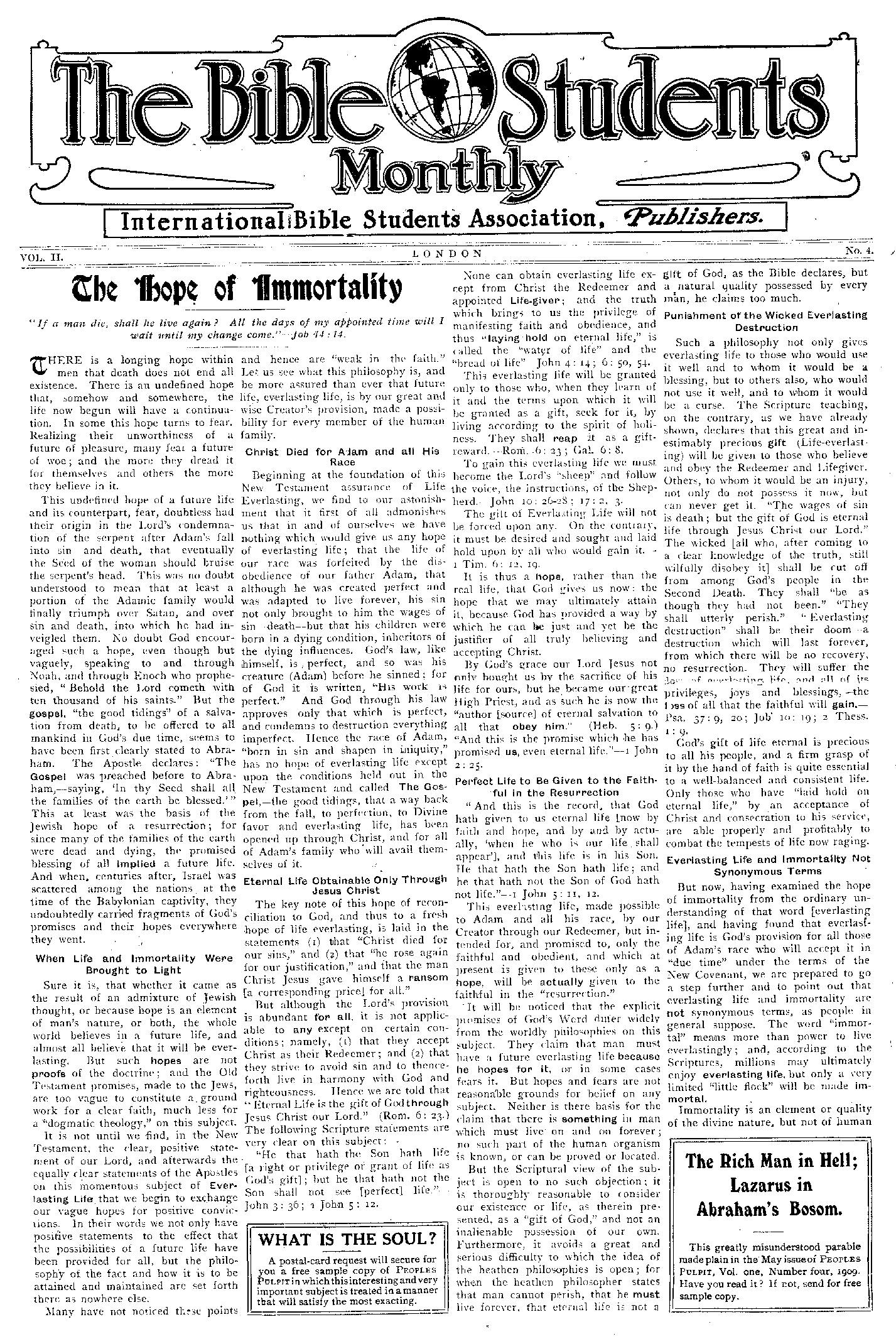
Cbe 1bopeofImmortality
"If a man die, shall he live again? All the days of my appointed time will I wait until my change come.’’—Job -14:14.
'TT’HERE is a longing hope within Vr men that death does not end all existence. There is an undefined hope that, somehow and somewhere, the life now begun will have a continuation. In some this hope turns to fear. Realizing their unworthiness of a future of pleasure, many fear a future of woe; and the more they dread it for themselves and others the more they believe in it.
This undefined hope of a future life and its counterpart, fear, doubtless had their origin in the Lord’s condemnation of the serpent after Adam’s fall into sin and death, that eventually the Seed of the woman should bruise the serpent’s head. This was no doubt understood to mean that at least a portion of the Adamic family would finally triumph over Satan, and over sin and death, into which he had inveigled them. No doubt God encouraged such a hope, even though but vaguely, speaking to and through Noah, and through Enoch who prophesied, “ Behold the Lord cometh with ten thousand of his saints.” But the gospel, “the good tidings” of a salvation from death, to be offered to all mankind in God’s due time, seems to have been first clearly stated to Abraham. The Apostle declares: “The Gospel was preached before to Abraham,—saying, ‘In thy Seed shall all the families of the earth be blessed.’ ” This at least was the basis of the Jewish hope of a resurrection; for since many of the families of the earth were dead and dying, the promised blessing of all implied a future life. And when, centuries after, Israel was scattered among the nations at the time of the Babylonian captivity, they undoubtedly carried fragments of God’s promises and their hopes everywhere they went. .
When Life and Immortality Were Brought to Light
Sure it is, that whether it came as the result of an admixture of Jewish thought, or because hope is an element of man’s nature, or both, the whole world believes in a future life, and almost all believe that it will be everlasting. But such hopes are not proofs of the doctrine; and the Old Testament promises, made to the Jews, are too vague to constitute a. ground work for a clear faith, much less for a “dogmatic theology,” on this subject.
It is not until we find, in the New Testament, the clear, positive statement of our Lord, and afterwards the equally clear statements of the Apostles on this momentous subject of Everlasting Life that we begin to exchange our vague hopes for positive convictions. In their words we not only have positive statements to the effect that the possibilities of a future life have been provided for all, but the philosophy of the fact and how it is to be attained and maintained are set forth there as nowhere else.
Many have not noticed these points and hence are “weak in the faith.” Let us see what this philosophy is, and be more assured than ever that future life, everlasting life, is by our great and wise Creator’s provision, made a possibility for every member of the human family.
Christ Died for Adam and all His Race
Beginning at the foundation of this New Testament assurance of Life Everlasting, we find to our astonishment that it first of all admonishes us that in and of ourselves we have nothing which would give us any hope of everlasting life; that the life of our race was forfeited by the disobedience of our father Adam, that although he was created perfect and was adapted to live forever, his sin not only brought to him the wages of sin—death—but that his children were born in a dying condition, inheritors of the dying influences. God’s law, like himself, is . perfect, and so was his creature (Adam) before he sinned; for of God it is written, “His work is perfect.” And God through his law approves only that which is perfect, and condemns to destruction everything imperfect. Hence the race of Adam, “born in sin and shapen in iniquity,” has no hope of everlasting life except upon the conditions held out in the New Testament and called The Gospel,—the good tidings, that a way back from the fall, to perfection, to Divine favor and everlasting life, has been opened up through Christ, and for all of Adam’s family who will avail themselves of it.
Eternal Life Obtainable Only Through Jesus Christ
The key note of this hope of reconciliation to God, and thus to a fresh hope of life everlasting, is laid in the statements (i) that “Christ died for our sins,” and (?) that “he rose again for our justification,” and that the man Christ Jesus gave himself a ransom [a corresponding price] for all.”
But although the Lord’s provision is abundant for all, it is not applicable to any except on certain conditions; namely, (i) that they accept Christ as their Redeemer; and (2) that they strive to avoid sin and to thenceforth live in harmony w'ith God and righteousness. Hence W’e are told that “ Eternal Life is the gift of God through Jesus Christ our Lord.” (Rom. 6: 23.) The following Scripture statements are very clear on this subject: —
“He that hath the Son hath life fa right or privilege or grant of life as God’s gift] ; but he that hath not the Son shall not see [perfect] life.”— John 3 : 36 ; 1 John 5 : 12.
WHAT IS THE SOUL?
A postal-card request will secure for you a free sample copy of Peoples Pulpit in which this interesting and very important subject is treated in a manner that will satisfy the most exacting.
None can obtain everlasting life except from Christ the Redeemer and appointed Life-giver; and the truth which brings to us the privilege of manifesting faith and obedience, and thus “laying hold on eternal life,” is called the “water of life” and the “bread of life”—John 4: 14; 6: 50, 54.
This everlasting life will be granted only to those who, when they learn of it and the terms upon which it will be granted as a gift, seek for it, by living according to the spirit of holiness. They shall reap it as a giftreward. -Rom. .6: 23 ; Gal. 6: 8.
To gain this everlasting life we must become the Lord’s “sheep” and follow the voice, the instructions, of the Shepherd. -John 10:26-28; 17:2, 3.
The gift of Everlasting Life will not be forced upon any. On the contrary, it must be desired and sought and laid hold upon by all who would gain it. -1 Tim. 6: 12, iq.
It is thus a hope, rather than the real life, that God gives us now: the hope that we may ultimately attain it, because God has provided a way by which he can l*e just and yet be the justifier of all truly believing and accepting Christ.
By God’s grace our Lord Jesus not only bought us bv the sacrifice of his life for ours, but he became our great High Priest, and as such he is now the “author [source] of eternal salvation to all that obey him.” (Heb. 5:9.) “And this is the promise which he has promised us, even eternal life.”—1 John 2 : 25.
Perfect Life to Be Given to the Faithful in the Resurrection
“ And this is the record, that God hath given to us eternal life [now by faith and hope, and by and by actually, ‘when he who is our life shall appear’], and this life is in his Son. He that hath the Son hath life; and he that hath not the Son of God hath not life.”—1 John 5: 11, 12.
This everlasting life, made possible to Adam and all his race, by our Creator through our Redeemer, but intended for, and promised to, only the faithful and obedient, and which at present is given to these only as a hope, will be actually given to the faithful in the “resurrection.”
' It will be noticed that the explicit promises of God’s Word differ widely from the worldly philosophies on this subject. They claim that man must have a future everlasting life because he hopes for it, or in some cases fears it. But hopes and fears are not reasonable grounds for belief on any subject. Neither is there basis for the claim that there is something in man which must live on and on forever; no such part of the human organism is known, or can be proved or located.
But the Scriptural view of the subject is open to no such objection; it is thoroughly reasonable to consider our existence or life, as therein presented, as a “gift of God,” and not an inalienable possession of our own. Furthermore, it avoids a great and serious difficulty to which the idea of the heathen philosophies is open; for when the heathen philosopher states that man cannot perish, that he must live forever, that eternal life is not a gift of God, as the Bible declares, but a natural quality possessed by every man, he claims too much.
Punishment of the Wicked Everlasting Destruction
Such a philosophy not only gives everlasting life to those who would use it well and to whom it would be a blessing, but to others also, who would not use it well, and to whom it would be a curse. The Scripture teaching, on the contrary, as we have already shown, declares that this great and inestimably precious gift (Life-everlasting) will be given to those who believe and obey the Redeemer and Lifegiver. Others, to whom it would be an injury, not only do not possess it now, but can never get it. “The wages of sin is death ; but the gift of God is eternal life through Jesus Christ our Lord.” The wicked [all who, after coming to a clear knowledge of the truth, still wilfully disobey it] shall be cut off from among God’s people in the Second Death. They shall “be as though they had not been.” “They shall utterly perish.” “ Everlasting destruction” shall be their doom—a destruction which will last forever, from which there will be no recovery, no resurrection. They will suffer the :lo~ ''’’vH'tstir'rs 1’fr. and all of yc privileges, joys and blessings,—the I jss of all that the faithful will gain.— Psa. 37:9, 20; Job' 10: 19; 2 Thess. 1 : 9-
God’s gift of life eternal is precious to all his people, and a firm grasp of it by the hand of faith is quite essential to a well-balanced and consistent life. Only those who have “laid hold on eternal life,” by an acceptance of Christ and consecration to his service, are able properly and profitably to combat the tempests of life now raging. Everlasting Life and Immortality Not
Synonymous Terms
But now, having examined the hope of immortality from the ordinary understanding of that word [everlasting life], and having found that everlasf-ing life is God’s provision for all those of Adam’s race who will accept it in “due time” under the terms of the New Covenant, we are prepared to go a step further and to point out that everlasting life and immortality are not synonymous terms, as people in general suppose. The w7ord “immortal” means more than power to live everlastingly; and, according to the Scriptures, millions may ultimately enjoy everlasting life, but only a very limited “little flock” will be made immortal.
Immortality is an element or quality of the divine nature, but not of human
The Rich Man in Hell;
Lazarus in
Abraham’s Bosom.
This greatly misunderstood parable made plain in the May issueof Peoples Pulpit, Vol. one, Number four, 1909. Have you read it ? If not, send for free sample copy.
PEOPLES PULPIT
International Bible Students Association.
London Tabernacle, Craven Terrace, Lancaster Gate, W.
MONTHLY, l/- FER YEAR.
SAMPLE FREE.
DIVINE WORSHIP EVERY SUNDAY LONDON TABERNACLE
11 A.M., 3 P.M. and 630 P.M.
SEATS FREE. NO COLLECTION. YOt| ARE INVITED.
Correspondence invited from those desirous of perfect life, which would have been obtaining Christian counsel. Address as above.
or angelic or any other nature than the divine. And it is because Christ and his “little flock,” his “Bride,” are to be “ partakers of the divine nature ” that they will be exceptions to all other creatures either in heaven or on earth.—2 Pet. 1; 4.
The word Immortal signifies not mortal—death-proof, indestructible, imperishable. Any being whose existence is dependent in any manner upon another, or upon conditions such as food, light, air, etc., is not immortal. This quality inheres in Jehovah God alone, as it is written,—“The Father hath life in himself” (John 5: 26); i. e., his existence is not a derived one, nor a sustained one. He “only hath immortality” (1 Tim. 6:16) as an innate or original quality of being.* These Scriptures being decisive authority on the subject, we may know beyond peradventure that men, angels, archangels, or even the Son of God before and during the time he “was made flesh and dwelt among us” were not immortal—all were mortal.
But the word “mortal” does not signify dyipg but merely die-able— possessing life dependent upon God for its continuance. For instance, angels not being immortal are mortal and c6uld die, could be destroyed by God if they became rebels against his wise, just and loving government. In him [in his providence] they live and move and have their being. Indeed, of Satan who was such an angel of light, and who did become a rebel, it is distinctly declared that in due time he will be destroyed. (Heb. 2: 14.) This not only proves that Satan is mortal, but it proves that angelic nature is a mortal nature—one which could be destroyed by its Creator. As for man, he is a “little lower than the angels” [Psa. 8: 5), and consequently mortal also, as is abundantly attested by the fact that our race has been dying for six thousand years and that even the saints in Christ are exhorted to seek for immortality.—Rom. 2 : 7.
Adam Created a Mortal Being
’ So, then, Adam did not become mortal by reason of sin, but was created mortal—by nature he was subject or liable to the death penalty. Had he been created immortal nothing could have destroyed him; for, as we have seen, immortality is a state or con-
dition not subject to death, proof.
What, then, was Adam’s before he sinned ? and in did the curse affect had he to lose if he tai ?
We answer, that
but death-
condition what way
him ?—What life was created mor-
his condition in
. life was similar to that of the angels; he had life in full measure—lasting
* This Scripture may be held to apply to our
Lord Jesus Christ in his present and future- company of sons of God to “glory, condition, “highly exalted,” “the express image - - - ■ -
of the Father’s pferson.” But even so understood, this passage would be subject to the rule of interpretation laid down by the same writer in 1 Cor. 15: 27, “It is manifest that he [the Father] is excepted [in all comparisons—for he is the fountain from which all blessings proceed].
THIEVES IN PARADISE
Luke 23:43—This greatly misunderstood text explained in the August number of Peoples Pulpit.
Send post card for free sample.
life—which he might have retained for- -elected the number to be. thus exalted only those . found in fullest heart-ever by remaining obedient to God. (Rev. 7:4), and predestinated what sympathy, as well as in outward But because he was not death-proof, must be their characteristics if they harmony with God and his righteous because he did not have “life in him-
self,” but was dependent upon conditions of divine pleasure and favor for its continuance, therefore God’s threat, that if he disobeyed he should die, meant something. Had he not been mortal God’s sentence would have been an empty threat. But Adam’s
continued forever had he continued obedient, was forfeited by disobedience,
and he died.
only hath im-himself” origi-whom are all various orders human, in his
Jehovah God, “who mortality” or “life in nally, innately and of things, having created of beings, angelic and own moral and rational likeness, but mortal and not of his divine nature, has declared that he designs a new creation,—an order of beings not only morally and rationally in his resemblance, but in “the express image of his person” and partakers of his “divine nature”—a prominent stituent or element of which is mortality.—2 Pet. 1 : 4.
own con-im-
Glory, Honor, and Immortality Obtainable Now—Rom. 2:7
With amazement we inquire upon whom shall this high honor and distinction be conferred? Upon angels, or cherubim, or seraphim? No; but upon his Son—his specially “firstborn” and “only begotten” Son, that he who was always obedient “should in all things have the pre-eminence1’ over others. But before he could be so highly honored he must be tested, proved “worthy” of so great a distinction and so high an esaltation “above his fellows.” This test was in view when the sentence of death was pronounced upon Adam and all his children in his loins: the test was that he, Christ, should lay down his life as a ransom-price for the life of Adam, and all who lost life in his transgression. And he was equal to the test, and gained the prize of “the divine nature,” “life in himself,” “immortality.”
Consider him, who, for the joy set before him, endured the cross, despised the shame, and is now in consequence set down at the right hand [place of favor] of the throne, of God. He was rich, but for our sakes became poor. Inasmuch as the man and race to be redeemed were human, it was needful that he become human so as to give the ransom or corresponding price. He therefore humbled himself and took the bondman’s form; and after he found himself in fashion a man, he humbled himself even unto death— even unto the most ignominious form of death—the death of the cross. “Wherefore, God hath highly exalted him [to the promised divine nature, at his resurrection], and given name that is above every (Jehovah’s name excepted—1 15:27].—Heb. 12:3, 2; 2 Cor. Phil. 2 : 8, 9.
him a name Cor. 8:9;
“Worthy is the Lamb that was slain to receive power, and riches, and wisdom, and strength, and honor, and glory, and blessing.”—Rev. 5 : 9, 12.
But more, the opulence of divine favor does not stop with the exaltation of one, but has arranged that Christ Jesus, as the Captain, shall lead a honor and immortality” (Heb. 2: 10; Rom. .2: 7), each of whom, however, must be a spiritual “copy” or likeness of the “First-begotten.” And as a grand lesson of the Divine sovereignty, and as a sublime contradiction to all evolution theories, God elected to call to this place of honor fas “the Bride, the Lamb’s wife’’ and “joint-heir” Rev. 21 : 2, 9 ; Rom. 8: 17], not the angels and the Cherubim, but some from among the sinners redeemed by the precious blood of the Lamb. God would make their calling and election sure to a place in that company to be so highly honored; and all the rest is left to Christ, who worketh now as the Father worked hitherto.—John 5: 17.
The present age, the Gospel Age, from Pentecost to the present time, is the time for the selection of this elect class, variously termed “the Church,” “the Body of Christ,” the “royal Priesthood,” “the Seed of Abraham” (Gal. 3 : 29), etc; and the permission of evil is for the purpose of developing these “members of the Body of Christ” and to furnish them the opportunity of sacrificing their little and redeemed all, in the service of him who bought them with his precious blood; and thus of developing in their hearts his spiritual likeness, that when, at the ■end of the age, they are presented by their Lord and Redeemer before the Father, God may see in them “the image of his Son.”—Col. 1 : 22 ; Rom. 8 : 29.
As the reward of “glory, honor and immortality,” and all the features of the divine nature, were not conferred upon the “First-begotten” until he had finished his course by completing his sacrifice, and obedience in death, so with the Church, his “Bride”—counted as one and treated collectively. As our Lord, the First-born and Captain, “entered into his glory” at his resurrection ; as he there became partaker of the divine nature fully by being “born from the dead,” “born of the spirit” ; as he there was highly exalted to the throne and highest favor [“right hand”] of God, so he has promised that his Church, his “Bride,” shall in her resurrection be changed, by resurrection power, from human nature to the glory, honor and immortality of the divine nature.
And so it is written respecting “the resurrection” of the Church: “It is sown in corruption; it is raised in in-corruptidn [immortality]. It is sown in dishonor, it is raised in glory. It is sown in weakness, it is raised in power. It is sown a natural [animal] body, it is raised a spiritual body.”—1 Cor. 15 : 42-44, 49-
Everlasting Life May be Obtained by all the Obedient in the Millennium
God’s plan of salvation for the, race of Adam is to extend to each member of it, during the Millennium, the offer of eternal life upon the terms of the New Covenant, which will be scaled for all with the precious blood of the
Lamb, where
But there is no suggestion any-that Immortality, the. Divine
Nature, will ever be offered or granted to any except the “elect” Church of the Gospel Age—the “little flock,” “the Bride, the Lamb’s wife.” For the others of Adam’s race the offer will be “restitution” (Acts 3: 19-21) to life and health and perfection of human nature —the same as Adam possessed as the earthly image of God, before his fall from grace into sin and death. And when at the close of the Millennial Age all the obedient of mankind shall have attained all that was lost in Adam and Redeemed by Christ,—then all, armed with complete knowledge and experience, and hence fully able to stand the test, will be tested severely (as was Adam), but individually; and arrangements, will be permitted to go beyond the Millennium into the everlasting future or “world [age] without end.” All others will be destroyed in the Second Death—“destroyed from among the people.”—Acts 3: 23.
Where Are the Dead?”
This interesting sermon was published in a former issue of “ PEOPLES PULPIT.” The interest aroused and the great demand for copies of this sermon has surpassed all expectations. A sample copy will be mailed to any one free upon receipt of post card request.
“ The Wages of Sin is Death ” and Not Eternal Torment
But although there shall be no more death, neither sorrow nor crying, it twill not be because the victors of the Millennial Age will be crowned with Immortality, but because, having learned to judge between right and wrong and their effects, they shall have formed characters in full accord with God and righteousness; and because they will have stood tests which will demonstrate that they would not wish to sin if the way were opened and no penalties attached. They will not have life in themselves, but will still be dependent upon God’s provision of food, etc., for the sustenance of life. This is particularly stated in Rev. 21 : 4, 6, 8 ; 7 : 16; Matt. 5:6.
Seen in this, the Scriptural light, the subject, of immortality shines re-splendently. • It leaves the way clear for the general “gift of God, eternal life,” to be extended to all whom the Redeemer shall find willing to accept it upon the only terms upon which il could be a blessing; and it leaves the unworthy subject to the just penalty always enunciated by the great Judge of all, viz :—
“The wages of sin is death.”—Rom. (5: 23.
“The soul that sinneth, it shall die.” —Ezek. 18:4, 20.
“He that believeth not the Son shall not see life; but the wrath of God [the curse, death] abideth on him.”— John 3: 36.
Then again we find, on this subject as on others, that the philosophy of the Word of God is deeper as well as clearer, and more rational by far, than the heathen systems and theories. Praise God for his Word of Truth and for hearts disposed to accept it as the revelation of the wisdom and power of God!
A PERFECT TRUST
O Blessed peace of a perfect trust, My loving God in thee;
Unwavering faith, that never doubts Thou choosest best for me.
Best, though my plans be all upset;
Best though the way be rough ;
Best, though my earthly store be scant;
In thee I have enough.
Best, though my health and strength be gone, Though weary days be mine,
Shut out from much that others have;
Not my will, Lord, but thine!
And e’en though disappointments come. They, too, are best for me,
To wean me from a clam’ring world, And lead me nearer thee.
O ! blessed peace of a perfect trust That looks away from all;
That sees thy hand in everything, In great events or small ;
That hears thy voice—a Father’s voice— Directing for the best : —
O ! blessed peace of a perfect trust, A heart with thee at rest!
“Eye hath not seen, nor ear heard, neither have entered into the heart of man the things which God hath in reservation for them that love him— but God hath revealed them to us by his Spirit; the Spirit searcheth all things, yea, the deep things of God.” — 1 Cor. 2 : 9, 10.
Che Iking’s Daughter, Che Eride, Cte lamb’s We
"The King's Daughter Is AU Glorious Within; Her Clothing Is of Wrought Gold. She Shall Be Brought Unto the King in Raiment of Fine Needlework.”—Psa. 45 : 13, 14.
Our text poetically and pictorially principalities and powers, to the divine draws our attention to one of those nature. Yet here are the Apostle’s beautiful figures by which the close words, and what else can we make and dear relationship between Christ of them ? He tells us that God has and His Elect Church is Scripturally given unto us “exceeding great and portrayed. Whether it be the figure precious promises, that by these we of the Captain and his Soldiers, the might become partakers of the divine Shepherd and his Sheep, the Master nature.” (2 Peter 1 : 4.) It is proper and his Servants,- the Head and the for the Lord’s people to accept these Body members, or the Bridegroom and great things with that simplicity which the Bride, each illustration of our the Scriptures tell us is best illustrated Lord’s relationship to the church car- in a “little child”—“nothing doubting.” ries its own important lesson. Says St. Paul: “He who hath freely
But surely none of them is more given us Christ, shall he not with him important or more beautiful than the also freely give us all things?”
St. John assents, saying: “Beloved, now are we the sons of God (even in our imperfect condition), but it does not yet appear what we shall be (how glorious); but we know that when he shall appear we shall be like him, for we shall see him as he is.” (I John 3: 2.) To be with him, to share his glory, to be like him, who is the express image of the Father’s person, is the highest possible conception we can have of the glorious things which God hath in reservation for them that love him supremely.
Raiment of Fine Needlework.
Look again at the Queen and her glorious apparel. Notice the pure linen, clean and white, representative of her purity and righteousness. Remember that she was once of the world, her members “children of wrath, even as others.” Remember that by faith she accepted the merit of her Redeemer’s sacrifice and thus she was reck-onedly covered with his robe of righteousness, which the world saw not, but which the heavenly father regarded. Remember, that it was because of that robe covering her natural blemishes that she was permitted to consecrate herself and to become the espoused virgin of her Anointed Redeemer and prospectively his joint-heir in the Kingdom. How wonderful these steps of grace! Looking but a little way into the future, we behold her clothed, not with an imputed robe of righteousness, but with her own robe of righteousness. The imputed one was hers to wear up to the time of her change from earthly to spiritual nature in the First Resurrection. Then and there perfected, it became actual. On the’ spirit plane she becomes righteous without spot, without blemish, a suitable companion and joint-heir for the great King of Glory.
But look more closely. Note that the robe of fine linen is beautifully embroidered—“fine needlework.” This, too, must have significance. The embroidered figures represent the graces of the Spirit, meekness, gentleness, patience, long suffering, brotherly kindness, love. Ah, yes, the Queen indeed is all-glorious within and without. The power of the Lord will accomplish this. She is his -workmanship, though not without her own willingness and co-operation. The Lord’s operation upon her will be through his Word and by his Spirit; and in proportion as she yields herself thereto she is now being “changed from glory to glory,” and, by the final change, will be perfected, glorified.
We noted a difference between the imputed robe which the betrothed wears now and the one which she will possess when changed—that the present one is Christ’s imputed robe covering her blemishes, and that the glorious one of the future will be her own righteousness, “the righteousness of the saints.” Let us notice also that there is an embroidery connected with them both. The robe that is now imputed to us has stamped upon it the gracious designs or patterns which our Lord would inculcate and which he assures us will be advantageous to us, pleasing to him and necessary to our calling,” and “our heavenly calling,” is future glory.
an invitation for us to step, not only Our appreciation of our high calling, out of sin, but from the earthly plane our faith in it, and . our love for the of being, a little lower than the angels, heavenly Bridegroom and desire to be
one we are now considering—our Lord, the King’s Son, highly exalted to Jehovah’s right hand on the Throne, and the Church in glory, his Queen and joint-heir with him in his Millennial Kingdom soon to be established.
The study .of these pictures of heavenly things is intended to lift the minds of the “new creation.” God's spiritual sons, from things earthly and sensual to the things eternal, which “eye hath not seen nor ear heard, neither have entered into the heart of man the things which God hath in reservation for them that love him supremely.”—I Cor. 2 : g.
The proceeding verses of the Psalm describe the grandeur of the Heavenly Bridegroom—that in his earthly life he was fairer than the children of men; that Divine grace was poured from his lips, and that the Father, because of his faithfulness, greatly blessed and exalted him. Next it tells of the inauguration of his Millennial Kingdom at his second advent, when as the Mighty One he will come forth in glory and 'majesty, conquering Satan, sin and death.
We are assured that prosperity will attend and truth, mercy and righteousness will be established in the earth, even though it be accomplished by a great time of trouble. His arrows of Divine truth are represented as piercing all of his opponents to the heart, even as the Apostle’s words on the Day of Pentecost pricked his hearers and cut them to the heart and led them to cry out, “What must we do to be saved ! ’ ’
Thus will the people fall before the rising Kingdom of Righteousness. Every knee must bend and every tongue confess. All who will decline to do so under those favorable conditions of full knowledge will be utterly “destroyed from amongst the people.’’ (Acts 3 : 23.) Then the declaration is made, “Thy throne, O God, is forever and ever; the scepter of thy Kingdom is- a right scepter. God, thy God, hath anointed thee with the oil of gladness above thy fellows.” "r
“The Queen and the Gold of Ophir.”
The picture is in the future. At the present time the Church is not the Queen, not the Bride, not in the glorious garments; she is merely the “espoused virgin,” called to Brideship. At present she is in her body of humiliation, or “vile body,” according to the statement of our Common Version. But she shall be “changed” in the First Resurrection, and thereafter be the “Glorious Body,” the Glorious Bride. (Phil. 3: 21.) Now she is a mixed company of both wise and foolish virgins, and many “strangers” commingle, who are not virgins at all. The testing time is not yet finished. It is not yet fully determined which, by faithfulness, will make their calling and election sure to a place in the Bride class, and which will constitute the virgins, her companions, that follow her—mentioned in verse 14. ' >
We cannot wonder that some refuse to believe that so great an honor has been provided for the “elect” Church. It is almost too wonderful that this, which the Apostle terms “oiir high pleasing to him are the incentives to us, urging us to spend every hour, every moment possible, in the working out of the glorious embroidery designs stamped upon our robe. '’Each stitch must be taken carefully—painstakingly. Each feature of the outline must be carefully studied. The robe itself must be kept clean, spotless. Who is sufficient for these things? Surely only those truly betrothed to the heavenly King, and who love him with all their hearts, and who are waiting in faith and patience for his promised. Second Coming to receive the Bride unto himself and to establish his Kingdom for the blessing and uplifting of the world!
Adding to Faith.
St. Paul tells of this embroidery work and the adding of stitch to stitch in its development, saying: “Tribulation worketh patience, and patience, experience; and experience, hope; and hope maketh . not ashamed, because the love of God is shed abroad in our hearts by the Holy Spirit, which is given to us.” (Rom. 5-: 3-5.) St. Peter says: “Add to your faith, virtue ; and to virtue, knowledge; and to knowledge, temperance; and to temperance, patience; and to patience, godliness ; and to godliness, brotherly kindness; and to brotherly kindness, love. For if these things be in you and abound, they make you that ye shall be neither barren nor unfruitful in the knowledge of our Lord Jesus Christ; for so an entrance shall be ministered unto you abundantly into the everlasting Kingdom of our Lord and Saviour Jesus Christ.” (2 Peter 1 : 5-11).
When we think of the imperfection of our very best endeavors along the lines of this embroidery work, this development of the. graces of the. Holy Spirit, we ask ourselves, “Whose garment would be fit to wear in the presence of the Father and of the holy angels ?” The answer is, “None of them.” It is in harmony with this that we see that the Lord has provided something different. He allows us to practice upon our robe of imputed righteousness, but the new robe which he will give us as our own will be absolutely perfect, as well as glorious.
There will not be a flaw in the embroidery. How so ? Because that glorious dress of perfect righteousness will be given only to those who have earnestly desired it, however short of it were their best endeavors. Inasmuch as their hearts were perfect, inasmuch as their endeavors were for perfection, the Lord will accept the heart and its endeavors, and grant that the new bodies shall possess to full perfection all these glorious traits and qualities which were tlie Bride’s ideal and endeavor in her betrothed condition, when she practiced upon the imputed robe.
So in the Psalm under consideration;
“Studies in the Scriptures”
Six Wonderful Bible Keys by Pastor Russell of London Tabernacle.
Our readers by this time doubtless feel well acquainted with Pastor Russell through his sermons, which we publish in common with more than five hundred of the leading American and Canadian journals.
We are advised that many of our readers already have the Pastor’s celebrated books in their homes and are using them effectively, to their delight and intellectual and spiritual profit. It must be so, since there are in circulation about three millions of copies of the first volume, “The Divine Plan.” The Bible and Tract Society of Brooklyn. N. ¥., 13-17 Hicks street, publishes the volumes at cost price so as to secure for them a wide circulation. This brings them within the reach of all.
Set I., three vols. handsomely bound, over 1,100 pages, are supplied, post or express charges prepaid, for $1. (4/-.)
Set II., three vols. to match, nearly 1,900 pages, for $1.20. (4/6.)
Some Still Remember “Bill Arp.”
Such will be interested in the “Southern Philosopher’s” review of the first volume of Series I. He wrote some time before he died :
“It is impossible to read this book without loving the writer and pondering his wonderful solution of the great mysteries that have troubled us all our lives. There is hardly a family to be the Prophet says, “Hearken, O daughter, and consider and incline thine ear.” The world says, “Look, see, and be attracted by the things of this present time.” 'J'he Lord says, “Hearken, consider that the present life, at the very most, is brief and that in the Lord’s providence, under our call, we have an opportunity to sacrifice it and thus to gain the highest of all blessings in the eternal life of the future.”
The “foolish virgins” do not hearken enough to the voice from heaven, to the words of Jesus, the Apostles and Prophets. They are more or less absorbed with the cares of this life, the deceitfulness of riches, and thus do not fully please the Lord, even though, because of loyalty to him, he will by and by give them a good, portion. The “wise virgins,” who will constitute the elect, the Bride in glory, do hearken, do consider and are guided by the counsel from on high, and press with vigor on in the narrow way of self-sacrifice, which leads to the Kingdom glory.
The King Shall Desire Thy Beauty: He Is Thy Lord, Worship Him.
The Psalmist proceeds, “So shall the King greatly desire thy beauty, for he is thy Lord and worship thou him.” Ah! there is the thought. If we rightly admire the King; if we rightly appreciate the wonderful privileges granted us of being now his espoused, as under his loving protection and provision, and by and by his bride and joint-heir in glory; if we appreciate these things, surely all earthly things and interests will necessarily fade, because of their comparative insignificance. And these are the terms upon which the King will desire us as members of his glorious bride. He will not consign us to demons and eternal torment, if we fail to rightly appreciate this situation, and, while not repudiating his love and grace, give a portion of our love to our father’s house and our own people, the world; but he will not choose us as members of his bride class, unless this condition of full consecration to him be the attitude of our hearts. Surely this is not unreasonable. Had we been called even from the ranks of the highest order of angels to be joint-heirs with the King of glory, the honor conferred would have been so great as to merit an undivided love, devotion. Surely, then, we, redeemed by his precious blood from our fallen, sinful state, and then invited to share his glory on the divine plane, should be. so enthused, so filled with appreciation of the . honor proffered, that we would gladly, will-inglv, voluntarily, lay aside every earthlv weight and interest and strive with patience and loving devotion to attain the prize of the high calling set before us of joint-heirship with the. King of kings and Lord of lords.
found that has not lost some loved one who died outside the church—outside the plan of salvation, and, if Calvinism be true, outside of all hope and inside of eternal torment and despair. We smother our feelings and turn away from the horrible picture. We dare not deny the faith of our fathers, and yet can it be possible that the good mother and the wandering child are forever separated?—forever and forever?
“I believe it is the rigidity of these teachings that makes atheists and infidels and skeptics—makes Christians unhappy and brings their gray hairs down in sorrow to the grave—a lost child, a lost soul! . . .
“This wonderful book makes no assertions that are not well sustained by the Scriptures. It is built up stone bv stone, and upon every stone is the text, and it becomes a pyramid of God’s love and mercy, and wisdom.
“There is nothing in the Bible that the author denies or doubts, but there are many texts that he throws a flood of light upon that seems to remove from them the dark and gloomy meaning. ‘-I see that editors of leading journals and many orthodox ministers of different denominations have endorsed it and have confessed to this new and comforting light that has dawned upon the interpretation of God’s Book. This is an age of advanced thought,—men dare to think now.”....
©pen letter to a 5eventb«2>ap adventist
The Jewish Sabbath a Shadow of Good Things to Come
EAR SIR AND BROTHER:—
Even though differing from you in my views of the Law, I feel constrained to express admiration for the zeal with which you and your co-workers have endeavored to promulgate what you believe to be the truth of God. If we believe anything to be right wre must act upon it until the Lord grants us to see otherwise. I had far rather be wrong and consistent than right and inconsistent, though it is best of all to be both right and consistent.
I feel justified in addressing you as a Brother in Christ because of the many points upon which we can hold harmonious fellowship. We look to the same Father in heaven. We trust in the merit of the same great sacrifice for sin. We are seeking light from the same inspired Scripture. We are both striving to live in the way that will be to the glory of God. We see eye to eye upon the nature of the soul, the penalty for sin, earth’s restitution to Edenic conditions, the Babylonian state of so-called Christendom, and the impending time of trouble along financial, political and social lines. Then last, but not least, we each see the necessity of suffering with Christ if we would be glorified with him, and have already suffered a little of the scorn and derision which the world hurls at the soldier of the cross. The enumeration of all these points on. which we are agreed will enable you to realize that what I am about to say respecting our differences is not meant in a spirit of wrangling, but solely for the purpose of sharing with you the blessedness and joy which has dawned in our hearts with this comforting light.
We agree with our Adventist friends that God never authorized anyone to change the Sabbath of the Decalogue from the seventh day of the week to the first, but we do believe that just as truly as the Christian has a greater High Priest, and a greater sacrifice, and a greater tabernacle than Israel had, so, too, the follower of Christ has a much greater Sabbath than the follower of Moses. Everything under the Jewish dispensation was typical of “good things to come.” (Heb. 10:1.) The Atonement Day-' the passover, the sabbatic years, the jubilees, etc., were all figures of more important things, so why should it seem strange that the seventh or Sabbath day was typical any more than the seventh or sabbatic year? But in order that you may see this to be the Scriptural thought hear Paul in Col. 2 :i6, 17 : “Let no man therefore judge you, in meat or in drink, or in respect of an holy day, or of the new moon, or of the Sabbath days: Which are a shadow of godd things to come; but the body is of Christ.” The seventh-day keepers will argue that the Sabbath here refers to some of those yearly occasions, which were also called Sabbaths, because part of their observance required rest from ordinary labor; for instance, the Day of Atonement. But this cannot be the meaning of Paul’s language, for he had already included all these yearly sabbaths under the words, “an holy day.” In harmony with his usual systematic forms of expression Paul first spoke of the yearly holy days, then came the monthly festivals, the new moons, and next the weekly rest days. The Christian has a sabbath, too, but, as we shall see, his sabbath is as much greater than the Jewish sabbath as the substance of a thing is greater than its shadow.
You may ask: Did not the I.ord in Ex. 31 : 16 speak of the seventh day Sabbath as being given for “a perpetual covenant”? I answer to this that the very identical language which the Lord used here of the Sabbath he uses elsewhere of the harvest offering (Lev. 23 :14), the pentecostal sacrifice (Lev. 23 :2i), the Day of Atonement (Lev. 23131, 32) and the feast of tabernacles (Lev. 23:41). The same Hebrew w;ord “olam,” which is translated “perpetual” in the seventhday reference, is the word translated “forever” in the other passages. See Young’s Analytical Concordance. So if the Advent view is correct we should still be keeping the feast of tabernacles as well as the Sabbath, but as some of your own brethren have shown, when dealing .with the punishment of the wicked, the word “olam,” like the Greek “aion,” really means “age-lasting,” or “lasting to a consummation.” It is sometimes used in the sense of eternal, but not necessarily. Thus in Ex. 29: 9 we read of the priestly office being given to Aaron and his descendants “for a per

petual statute,” the same word “olam” being used. But that it does not properly mean “perpetual” in this passage is evident, for Aaron’s family lost the priesthood 1800 years ago. Note Heb. 7:11-14.
We find, then, that Jehovah used the very same language in speaking of the weekly Sabbath which he used respecting other Jewish institutions which passed away when that of which they were typical came, so similarly may not the Jewish Sabbath have passed away, being supplanted by a greater sabbath? Notice our Lord’s words in Matt. 5117, 18, “think not that I am come to destroy the Law or the prophets ; I am not come to destroy but to fulfil ; for verily I say unto you, till heaven and earth pass one jot or one tittle shall in no wise pass from the Law till all be fulfilled.” Our Saviour did not say the Law should not pass away, but that it should not pass away until it was fulfilled. But he tells us first that he came to fulfil it, so if it was fulfilled in him it has passed away. There is a vast difference between a thing being destroyed and passing away as a result of fulfillment. The law of circumcision wras never destroyed, but it passed away and was abolished when that to which it pointed, circumcision of the heart, was set forth, and it is this higher circumcision we must observe. (Rom. 2 128, 29.) Likewise Christ did not destroy the Law, or set it at naught, but his perfect life fulfilled its every requirement, as we imperfect creatures could not, and thus he became the great inheritor of all the promises of the Law, with the right to distribute what he inherited under the Law to all who would become his. Additionally the Law led to Christ and pointed him out as the Holy One of whom Moses had said, “Hear ye him.” (Acts 7 =37; Gal. 3:24, 25.) Therefore to consider the Law given through Moses as binding upon the Christian is to doubt whether Christ has accomplished what he came for; “to fulfil” the Law. Of course the Christian must study that Law, and he finds jewels .of inspired wisdom in it, but he studies it as a shadow of better things, as typical of the blessings promised under the greater than Moses-Christ.
Then is the follower of Christ under no law? Yes, he is under a new law, a higher law. Just as he has a better High Priest, a better sacrifice, a better everything than the Jew had, so he has a better law, and it contains a better sabbath. Isa. 42: 21 foretold that Christ was to “magnify the law and make it honorable,” and we are now under this magnified law. The law said: “Thou shalt not kill,” but Christ magnified that when he taught that whosoever hateth his brother without a cause is guilty of murder. (See Matt. 5:21, 22, 27, 28.) The Law said: “Thou shalt not steal,” but Christ taught us that we should not merely refrain from robbing our neighbor, but be ever ready to share with him what we had, even to the extent of laying down our lives for our brethren. (John 13:24; 1 John 3:16.) The Law said: “Honor thy father and thy mother,” but we are instructed to “honor all to whom honor is due.”— Rom. 13
Now, dear brother, the Adventists see that Christ magnified the 1st, 2nd, 3rd, 5th, 6th, 7th, 8th, 9th and 10th commandments, but they fail to realize that he magnified the 4th, the Sabbath commandment too. To the contrary, they believe he made it smaller. One of your brethren put it to me this way : “Before Christ ev~ry little act contrary to the Sabbath commandment, even the building of a fire, was to be severely punished, but since Christ’s sacrifice, so long as we try to do our best to keep the Sabbath, the Lord will pardon and overlook where we come short in our obedience to that command.” That would have magnified God’s mercy, but it would not have magnified the commandment. Would it be magnifying the 6th commandment if we should say: “Before Christ murder was to be severely punished, but since then, if you try to keep the Law—‘thou shalt not kill’—it will be all right if you do kill a man once in a while”?
Let me now present our understanding of how Christ magnified the Sabbath Law. The Israelite was to consider one-tenth of what he had as holy unto the Lord; but do we ever hear the Christian advised to give a tithe to the Lord? Not once. How much are we advised to give him? All that we are and have. We are to give all that we can in as direct a way as we can, and the remainder is to be given him in a more indirect way; e. g., we give him the money we spend for food and clothing, because our body belongs to him and is being used to glorify and serve him. The food gives us strength to do more for him, therefore the money we spend for food is being spent for our Lord. (Rom. 12 : 1 ; r Cor. 6 : 20 ; 10 : 31 ; 2 Cor. 5 : 15.) In Luke 14: 33 our Master does not tell us to forsake or surrender a tenth, but “all that he hath.”
The Jew sang : “Some of self and some of thee.” The Christian sings .-“None of self but all of thee.”
Likewise the Jew gave God one-seventh of his time, but the Christian is to give him seven-sevenths. The Lord said in Lev. 19 : 30, “Ye shall keep my sabbaths and reverence my sanctuary.” The sanctuary was the holy structure through which God manifested himself to Israel, so to them the word meant a certain definite holy place; but the Christian finds his sanctuary wherever he is ; every place is a holy place to him. Similarly every day is a holy day, a sabbath of rest to him. He has a better sanctuary to reverence and a better sabbath to keep. But not only does his sabbath differ from the typical sabbath, the nature of his rest also differs. It does not merely mean a cessation from manual labor, but a rest from laboring for self in order to work and live for God. It means to rest as God rested after he had completed the work of creation, as the WTord expresses it: “To enter into his rest.” God’s rest does not mean idleness, “He sends his rain and causes his sun to shine” on the seventh just as much as on any other day. Then how did he rest? He ceased working for himself in order to work for man through his Son. And how do we rest like him? By ceasing to work for self in order to work for him through Christ. Hear Heb. 4:10, “For he that is entered into his rest, he also hath ceased from his own works, as God did from his.” And then Paul continues in verse 11, “let us labor therefore,” not let us cease from labor, but labor to put down those selfish propensities which would lead us, contrary to God’s will, to live for self, instead of permitting us “to enter into that rest.” This rest of which the seventh day was a type will not end with this life, but it will continue an eternal rest, begun here and consummated in eternity.
Let me digress here to say that God’s rest day was not a period of 24 hours, but, like the six days of creation, was a long period of time. In our own language this is a very common use of the word “day,” and1 it is equally frequent in Bible language. (2 Pet. 3:8; Ps. : 95 : 7-10.) While the day of salvation of 2 Cor. 6 : 2 is already over 1800 years long, so it was with the great days of creation ; they were long periods of time, and likewise the seventh day, in which God rested, is a long period; it is not over yet.
But to return to the subject of this letter. In Isa. 58 : 13 we have a description by the inspired Prophet of what constitutes Christian sabbath keeping. We must refrain from doing our own ways, and from finding our own pleasures, and from speaking our own words. That is sabbath keeping. But the Christian must do that every day, therefore every day must be a sabbath to him. For fear you may not apply the latter part of the verse to the sabbath let me refer you to the Revised Version, which reads: “And shalt honor it, not doing thine own ways,” etc. Every day we are to “speak as the oracles of God.” (1 Pet. 4: 11.) Every day God is to work in us “to do of his good pleasure” (Phil. 2: 13.) Every day “the steps of a good man are ordered of the Lord.” (Ps. 37:23.) So again I say, every day is a sabbath to him who liveth “not unto himself.” Is not this a glorious magnifying of the Law?
We can now see how “Christ is the end of the Law for righteousness to every one that believeth.” (Rom. 10: 4.) We can understand why Paul could say in Gal. 3: 19, “The Law was added * * TILL THE SEED SHOULD COME,” and then in verses 23 to 25 he boldly compares the Law to a severe pedagogue to whom they were committed for a season, “but after that faith is come we are no longer under a pedagogue.” And we can comprehend why Paul mourned because “ye observe days” (Gal. 4: 10, 11), and intimates that the brother is weak who “esteems one day above another” (Rom. 14:5—read verses 1 to 7), failing to realize what they are all to be counted as days in which his glory is to be sought.
I know how the seventh-day Adventists divide the Law into two parts, calling the Decalogue “the law of God,” and the remainder “the law of Moses,” and then claiming that Christ did away with the Law of Moses, but not with the law of God. This is an awful mistake ; it was all the Law of Cod, because it came rom him, and P is all the Jaw of Moses in that it came through him.. .-(Lev. 26 : 46 ; Deut. 5 : 5.) Thus our Saviour, in Mark 7: 10, quotes one of the ten commandments (Ex. 20: 12; Deut. 5: 16), and then in the same verse a law which was not in the Decalogue (Ex. 21 : 17 ; Lev. 20: g), and yet attributes them both to Moses. He was not the author of either, but he was the agent through whom God delivered both commands. Furthermore, the fact that the Law, which was until John (Luke 16: 16; Matt. 11 :i3), included the Decalogue as well as the ceremonial features of the Law, is proved by Rom. 7 : 6, 7 ; for Paul, after saying, “we are delivered from the law,” leaves no doubt as to what law is meant by quoting from the tenth commandment. And as his words show, we are no longer under the letter (it was the letter which was on the stones) but under the spirit, the antitype, that which was shadowed forth in the words on stone, the greater law of love. (James 1 : 26 ; 2:8.) When we read, therefore, in the books from Acts to Revelation about the redeemed keeping “the commandments of God,” we do not think of the letters in stone given through Moses, but of the magnified law of the spirit of life in Christ Jesus. (Rom. 8: 2.) Notice another passage, viz., 2 Cor. 3:3-11. The expression, “written and engraven in stones,” and the reference to Moses’ face shining at the time is evidence that Paul is speaking of the Decalogue. In verse 7 he tells us how the Law was accompanied with such glory that it even caused Moses’ face to shine. Then in verse 8 he refers to something which would be accompanied with more glory,-and following this up shows that when “the glory that excelleth” (v. io) should come then that which was given with glory—i. e., the Law written and engraven on stones—was to be “done away.” (v. 11.) Note the remarkable similarity between the Revised Version rendering of verse 11 and Matt. 18. Then in verses 12 to 18 Paul shows’ that while Israel had Moses cover his face so they could not see the glorious results of the giving of that glorious Law, yet we should refrain from covering our hearts with the veil of prejudice, etc., as we wish to see the more glorious results of this more glorious law upon the hearts and lives of our brethren, especially as it was reflected in our great Elder Brother, the Lord Jesus.—2 Cor. 3:18.
Dear brother, much more might be written, but I must refrain from more than one or two brief statements. Paul’s preaching upon the seventh day, etc., is no endorsement of seventh-day Adventism. That was a day when the cessation from labor brought the Jews together in their synagogues and gave Paul an opportunity he gladly used. Wherever and whenever he found ears to hear he was ready to preach. There were crowds in the synagogues on the seventh day, so Paul went there, and there were numbers at the’ market every day, so Paul preached there on other days. (Acts 17: 17.) So just as Paul esteemed those opportunities, so we esteem the opportunities afforded us on the first day, not because there is a divine command to consider that day a sabbath above other days, although we consider it a very appropriate day for meetings of the people of God, being our Lord’s resurrection day. However, refraining from actual labor on the first day is not an endorsement of the wrong ideas many have held about it, any more than a belief in the Bible would mean an endorsement of the many wrong views which have been entertained of its teaching. It has been a great comfort to me to find that salvation did not hang upon such a slender cord as the keeping of a weekly rest day.
There are other features of the Sabbath, for instance its foreshadowing of the Millennium, which I have not touched upon at all. Pastor Chas. T. Russell, of Brooklyn Tabernacle, Brooklyn, N. Y., has treated that phase of the subject most beautifully. Have you ever read his book, “The Divine Plan of the Ages”? It is a book of 386 pages, cloth .bound, for 25 cents. The Watch Tower Bible and Tract Society, 13-17 Hicks street, Brooklyn, N. Y., supplies them.
Your Brother in the service of the King of kings, B. H. BARTON.
The RichManinHell;
Lazarus in < Abraham’s Bosom.
This greatly misunderstood parable made plain in the May issue of Peoples Pulpit. Send for free sample copy.
