 View PDF
The content displayed below is for educational and archival purposes only.
Unless stated otherwise, content is © 1911 International Bible Students Association

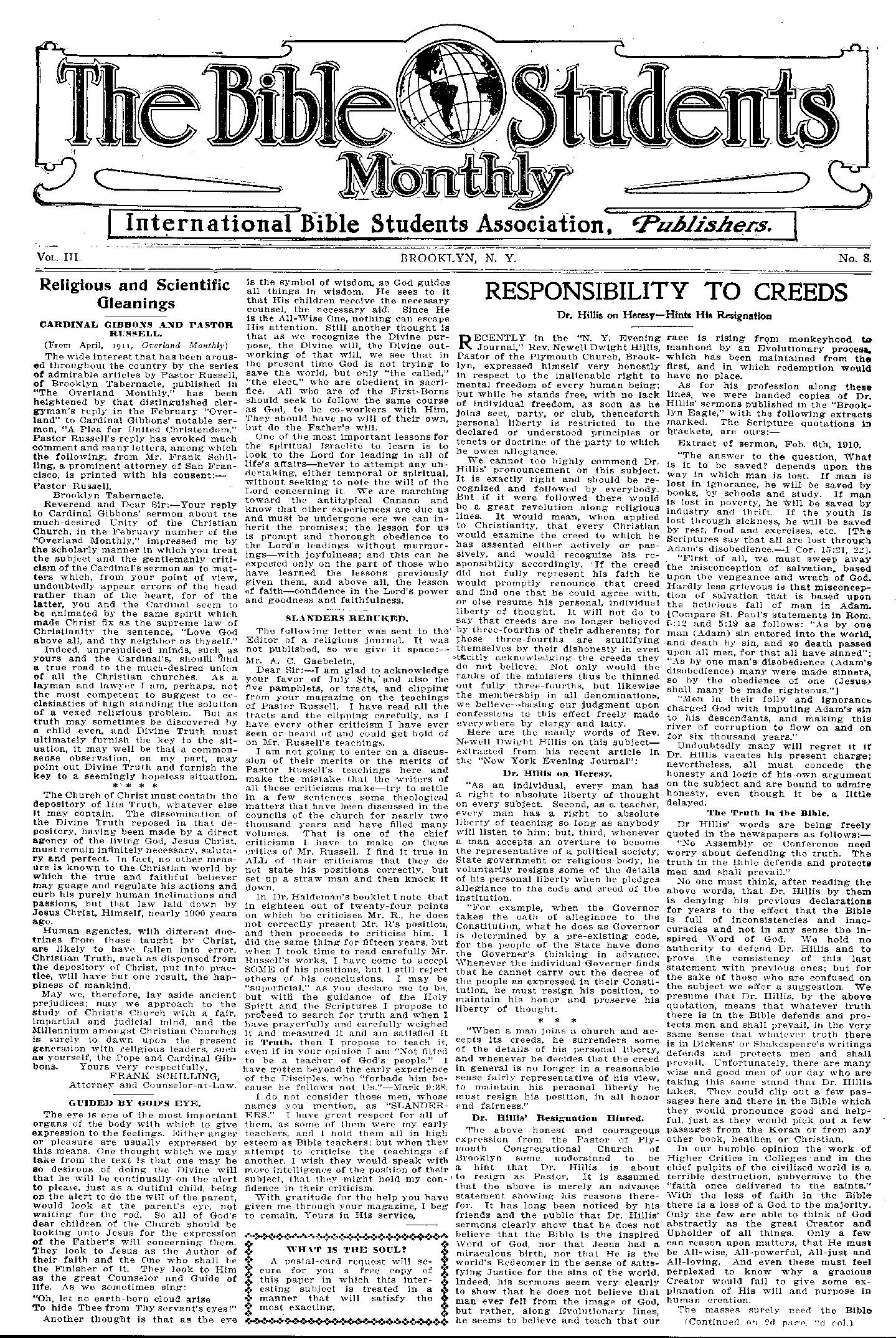
International Bible Students Association, ^Pu-blisJiers.
Vol. III. BROOKLYN, N. Y. No. 8.
Religious and Scientific Gleanings
CARDINAL GIBBONS AND FASTOR RUSSELL.
(From April, 1911, Overland Monthly)
The wide interest that has been aroused throughout the country by the series of admirable articles by Pastor Russell, of Brooklyn Tabernacle, published in “The Overland Monthly,” has been heightened by that distinguished clergyman’s reply in the February “Overland” to Cardinal Gibbons’ notable sermon, “A Plea for United Christendom.” Pastor Russell’s reply has evoked much comment and many letters, among which the following, from Mr. Frank Schilling, a prominent attorney of San Francisco, is printed with his consent:— Pastor Russell,
Brooklyn Tabernacle.
Reverend and Dear Sir:—Your reply to Cardinal Gibbons’ sermon about the much-desired Unity of the Christian Church, in the February number of the “Overland Monthly,” impressed me by the scholarly manner in which you treat the subject and the gentlemanly criticism of the Cardinal’s sermon as to matters which, from your point of view, undoubtedly appear errors of the head rather than of the heart, for of the latter, you and the Cardinal seem to be animated by the same spirit which made Christ fix as the supreme law of Christianity the sentence, “Love God above all, and thy neighbor as thyself.”
Indeed, unprejudiced minds, such as yours and the Cardinal’s, should ^htid a true road to the much-desired union of all the Christian churches. As a layman and lawyer I am, perhaps, not the most competent to suggest to ecclesiastics of high standing the solution of a vexed religious problem. But as truth may sometimes be discovered by a child even, and Divine Truth must ultimately furnish the key to the situation, it may well be that a commonsense observation, on my part, may point out Divine Truth and furnish the key to a seemingly hopeless situation.
' Jjc * *
The Church of Christ must contain the depository of His Truth, whatever else it may contain. The dissemination of the Divine Truth reposed in that depository, having been made by a direct agency of the living God, Jesus Christ, must remain infinitely necessary, salutary and perfect. In fact, no other measure is known to the Christian world by which the true and faithful believer may guage and regulate his actions and curb his purely human inclinations and passions, but that law laid down by Jesus Christ, Himself, nearly 1900 years ago.
Human agencies, with different doctrines from those taught by Christ, are likely to have fallen into error. Christian Truth, such as dispensed from the depository of Christ, put into practice, will have but one result, the happiness of mankind.
May we, therefore, lay aside ancient prejudices; may we approach to the study of Christ’s Church with a fair, Impartial and judicial mind, and the Millennium amongst Christian Churches is surely to dawn upon the present generation with religious leaders, such as yourself, the Pope and Cardinal Gibbons. Yours very respectfully,
FRANK SCHILLING, Attorney and Counselor-at-Law.
GUIDED BY GOD’S EYE.
The eye is one of the most important organs of the body with which to give expression to the feelings. Either anger or pleasure are usually expressed by this means. One thought which we may take from the text is that one may be so desirous of doing the Divine will that he will be continually on the alert to please, just as a dutiful child, being on the alert to do the will of the parent, would look at the parent’s eye, not waiting for the rod. So all of God’s dear children of the Church should be looking unto Jesus for the expression of the Father’s will concerning them. They look to Jesus as the Author of their faith and the One who shall be the Finisher of it. They look to Him as the great Counselor and Guide of life. As we sometimes sing:
“Oh, let no earth-born cloud arise
To hide Thee from Thy servant’s eyes!”
Another thought is that as the eye is the symbol of wisdom, so God guides all things in wisdom. He sees to it that His children receive the necessary counsel, the necessary aid. Since He is the All-Wise One, nothing can escape His attention. Still another thought is that as we recognize the Divine purpose, the Divine will, the Divine outworking of that will, we see that in the present time God is not trying to save the world, but only “the called,” “the elect,” who are obedient in sacrifice. All who are of the First-Borns should seek to follow the same course as God, to be co-workers with Him. They should have no will of their own, but do the Father’s will.
One of the most important lessons for the spiritual Israelite to learn is to look to the Lord for leading in all of life’s affairs—never to attempt any undertaking, either temporal or spiritual, without seeking to note the will of the Lord concerning it. We are marching toward the antitypical Canaan and know that other experiences are due us and must be undergone ere we can inherit the promises; the lesson for us is prompt and thorough obedience to the Lord’s leadings without murmur-ings—with joyfulness; and this can be expected only on the part of those who have learned the lessons previously given them, and above all, the lesson of faith—confidence in the Lord’s power and goodness and faithfulness.
RECENTLY in the “N. Y. Evening Journal,” Rev. Newell Dwight Hillis, Pastor of the Plymouth Church, Brooklyn, expressed himself very honestly in respect to the inalienable right to mental freedom of every human being; but while he stands free, with no lack of individual freedom, as soon as he joins sect, party, or club, thenceforth personal liberty is restricted to the declared or understood principles or tenets or doctrine of the party to which he owes allegiance.
We cannot too highly commend Dr. Hillis’ pronouncement on this subject. It is exactly right and should be recognized and followed by everybody. But if it were followed there would be a great revolution along religious lines. It would mean, when applied to Christianity, that every Christian would examine the creed to which he has assented either actively or passively, and would recognize his responsibility accordingly. ■ If the creed did not fully represent his faith he would promptly renounce that creed and find one that he could agree with, or else resume his personal, individual liberty of thought. It will not do to say that creeds are no longer believed by three-fourths of their adherents; for those three-fourths are stultifying themselves by their dishonesty in even -ticitly acknowledging the creeds they do not believe. Not only would the ranks of the ministers thus be thinned out fully three-fourths, but likewise the membership in all denominations, we believe—basing our judgment upon confessions to this effect freely made everywhere by clergy and laity.
Here are the manly words of Rev. Newell Dwight Hillis on this subject— extracted from his recent article in the “New York Evening Journal”:
Dr. Hillis on Heresy.
“As an individual, every man has a right to absolute liberty of thought on every subject. Second, as a teacher, every man has a right to absolute liberty of teaching so long as anybody will listen to him; but, third, whenever a man accepts an overture to become the representative of a political society, State government or religious body, he voluntarily resigns some of the details of his personal liberty when he pledges allegiance to the code and creed of the institution.
“For example, when the Governor takes the oath of allegiance to the Constitution, what he does as Governor is determined by a pre-existing code, for the people of the State have done the Governer’s thinking in advance. Whenever the individual Governor finds that he cannot carry out the decree of the people as expressed in their Constitution, he must resign his position, to maintain his honor and preserve his liberty of thought.
* * *
“When a man joins a church and accepts its creeds, he surrenders some of the details of his personal liberty, and whenever he decides that the creed in general is no longer in a reasonable sense fairly representative of his view, to maintain his personal liberty he must resign his position, in all honor and fairness.”
Dr. Hillis’ Resignation Hinted.
The above honest and courageous expression from the Pastor of Plymouth Congregational Church of Brooklyn some understand to be a hint that Dr. Hillis is about 1 to resign as Pastor. It is assumed that the above is merely an advance statement showing his reasons therefor. It has long been noticed by his friends and the public that Dr. Hillis’ sermons clearly show that he does not believe that the Bible is the inspired Word of God, nor that Jesus had a miraculous birth, nor that He is the world’s Redeemer in the sense of satisfying Justice for the sins of the world. Indeed, his sermons seem very clearly to show that he does not believe that map ever fell from the image of God, but rather, along Evolutionary lines, he seems to believe and teach that our
SLANDERS REBUKED.
The following letter was sent to the Editor of a religious journal. It was not published, so we give it space:--Mr. A. C. Gaebelein,
Dear Sir:—I am glad to acknowledge your favor of July 8th, ‘ and also the five pamphlets, or tracts, and clipping from your magazine on the teachings of Pastor Russell. I have read all the tracts and the clipping carefully, as I have every other criticism I have ever seen or heard of and could get hold of on Mr. Russell’s teachings.
I am not going to enter on a discussion of their merits or the merits of Pastor Russell’s teachings here and make the mistake that the writers of all these criticisms make—try to settle in a few sentences some theological matters that have been discussed in the councils of the church for nearly two thousand years and have filled many volumes. That is one of the chief criticisms I have to make on these critics of Mr. Russell. I find it true in ALL of their criticisms that they do not state his positions correctly, but set up a straw man and then knock it down.
In Dr. Haldeman’s booklet I note that in eighteen out of twenty-four points on which he criticises Mr. R., he does not correctly present Mr. R’s position, and then proceeds to criticise him. I did the same thing for fifteen years, but when I took time to read carefully Mr. Russell’s works, I have come to accept SOME of his positions, but I still reject others of his conclusions. I may be “superficial,” as you declare me to be, but with the guidance of the Holy Spirit and the Scriptures I propose to proceed to search for truth and when I have prayerfully and carefully weighed it and measured it and am satisfied it is Truth, then I propose to teach it, even if in your opinion I am “Not fitted to be a teacher of God’s people.” I have gotten beyond the early experience of the Disciples, who “forbade him because he follows not Us.”—Mark 9:38.
I do not consider those men, whose names you mention, as “SLANDERERS.” I have great respect for all of them, as some of them were my early teachers, and I hold them all in high esteem as Bible teachers; but when they attempt to criticise the teachings of another, I wish they would speak with more intelligence of the position of their subject, that they might hold my confidence in their criticism.
With gratitude for the help you have given me through your magazine, I beg to remain, Yours in His service,
X WHAT IS THE SOUL?
Y A postal-card request will se- Y *t* cure for you a free copy of X X this paper in which this inter- A A esting subject is treated in a A Y manner that will satisfy the Y Y most exacting. Y
RESPONSIBILITY TO CREEDS
Dr. Hillis on Heresy—Hints His Resignation
race is rising from monkeyhood to manhood by an Evolutionary process* which has been maintained from the first, and in which redemption would have no place.
As for his profession along these lines, we were handed copies of Dr. Hillis’ sermons published in the “Brooklyn Eagle,” with the following extracts marked. The Scripture quotations in b.rackets, are ours:—
Extract of sermon, Feb. 6th, 1910.
“The answer to the question, What is it to be saved? depends upon the way in which man is lost. If man is lost in ignorance, he will be saved by books, by schools and study. If man is lost in poverty, he will be saved by industry and thrift. If the youth is lost through sickness, he will be saved by rest, food and exercises, etc. [The Scriptures say that all are lost through Adam’s disobedience.—1 Cor. 15:21, 22J.
“First of all, we must sweep away the misconception of salvation, based upon the vengeance and wrath of God. Hardly less grievous is that misconception of salvation that is based upon the ficticious fall of man in Adam. [Compare St. Paul’s statements in Rom. 5:12 and 5:19 as follows: “As by one man (Adam) sin entered into the world, and death by sin, and so death passed upon all men, for that all have sinned”; “As by one man’s disobedience (Adam’s disobedience) many were made sinners, so by the obedience of one (Jesus) shall many be made righteous.”]
“Men in their folly and ignorance charged God with imputing Adam’s sin to his descendants, and making this river of corruption to flow on and on for six thousand years.”
Undoubtedly many will regret it if Dr. Hillis vacates his present charge; nevertheless, all must concede the honesty and logic of his own argument on the subject and are bound to admire honesty, even though it be a little delayed.
The Truth in the Bible.
Dr Hillis’ words are being freely quoted in the newspapers as follows:—
“No Assembly or Conference need worry about defending the truth. The truth in the Bible defends and protects men and shall prevail.”
No one must think, after reading the above words, that Dr. Hillis by them is denying his previous declarations for years to the effect that the Bible is full of inconsistencies and inaccuracies and not in any sense the inspired Word of God. We hold no authority to defend Dr. Hillis and to prove the consistency of this last statement with previous ones; but for the sake of those who are confused on the subject we offer a suggestion. We presume that Dr. Hillis, by the above quotation, means that whatever truth there is in the Bible defends and protects men and shall prevail, in the very same sense that whatever truth there is in Dickens’ or Shakespeare’s writings defends and protects men and shall prevail. Unfortunately, there are many wise and good men of our day who are taking this same stand that Dr. Hillis takes. They could clip out a few passages here and there in the Bible which they would pronounce good and helpful, just as they would pick out a few passages from the Koran or from any other book, heathen or Christian.
In our humble opinion the work of Higher Critics in Colleges and in the chief pulpits of the civili&ed world is a terrible destruction, subversive to the “faith once delivered to the saints.” With the loss of faith in the Bible there is a loss of a God to the majority. Only the few are able to think of God abstractly as the great Creator and Upholder of all things. Only a few can reason upon matters, that He must be All-wise, All-powerful, All-just and All-loving. And even these must feel perplexed to know why a gracious Creator would fail to give some explanation of His will and purpose in human creation.
The masses surely need the Bible (Continued on 2d pace. 2d col.)
THE BIBLE STUDENTS MONTHLY
W. F. HUDGINGS, Editor.
13, 15, 17 HICKS ST., BROOKLYN, N.Y.
Monthly—12 cts. a year. Single cop es, lc.
Ail Independent, Unsectarian Religious Newspaper, Specially Devoted to the Forwarding of the Laymen’s Home Missionary Movement for the Glory of God and Good of Humanity.
Ministers of the I. B. S. A. render their services at funerals free of charge. They also invite correspond* encefrom those desiring Christian counsel.
NOMINAL CHRISTENDOM ARRAIGNED.
"Is Christianity Christian? No. So long as this horrible specter of militarism, with its emphasis upon iron instead of good-will, upon force instead of love, upon nationalism instead of human brotherhood, upon destruction instead of justice, overshadows all sweeter, finer things, all science, culture and ideals, all happy, joyous life, in the Christian countries of the world, laying intolerable burdens upon peoples who have no enemies in the world, keeping hatreds, strifes, and jealousies alive, ChristicrHy is not Christian.
“Think of two so-called Christian nations, Great Britain and Germany, going on today piling up huge warships by the half-dozen or more a year with which to destroy each other. England sick with poverty, paupers walking her streets in swarms, and she spending $250,000,000 this year on armament! As Mr. Lloyd-George said the other day, taking one dollar a week off every family’s wages to build implements of mass murder. What most impresses a Japanese or Chinese tn his tour through Christian Europe as the most conspicuous product of our Christianity? Big guns. And all this the Church could stop immediately were it Christian.”
“Is Christianity Christian? No. Not while it sits supinely by in its great wealth—for it has most of the wealth of the world inside its churches—and lets little children, because of human greed, be dwarfed and stunted in mines and shops and factories, and lets little boys shiver on the streets ‘through stormy winter nights with papers or messages, and lets thousands of little children go underfed, while one man pays $100,000 for a dinner set to use in his vulgar house three or four times a year to entertain already overfed people, and lets thousands more die from tuberculosis because they can get neither food nor air nor light.
“All this while thousands of its professed followers squander great sums on eating and drinking and living far, far beyond even extremest comfort, spending more on a ball or a dinner or sports than would suffice to run a business giving lucrative employment for a whole year. While Christianity permits this without crying "shame” through all the streets of the land it is not Christian.”
“Is Christianity Christian? No. We want to be fair here. We believe that thousands of good Christians all over the world and the great majority of pastors—at least, those pastors who lead and think—-bear very heavily upon their hearts the poverty of the world and the uncertainty and dread of coming poverty that is always hanging over the heads of our millions of workers. Our Socialist friends are quite mistaken in accusing the Church as a whole of hypocrisy because its leaders do not attempt the amelioration of the economic condition by Socialist measures. We believe that there is hardly a clergyman in this land who would not become a Socialist tomorrow could he see plainly that it would bring in the kingdom of goodwill, happiness, and justice.”--Exchange.
THE NEW ANTI-CLERICAL LAW IN SPAIN.
The new law in Spain divorces the State from the influence of the Catholic church, much the same as has been done in France. It will greatly reduce the number of religious orders in Spain and throw restrictions around those that remain that will greatly reduce their power. Under the law, too, the religious bodies will not escape taxation where they engage in other than strictly religious work, as they have in the past.
“CRAZE FOR MONEY IS CURSE OF THE CHURCH.”
With his charge that the craze for collections is the curse of the church today, Bishop Berry, of the Methodist Episcopal church, has caused a sensation among pastors of the denomination in Milwaukee. “We are paying too much attention to the money end of our churches,” he asserted. "I tell you that if you keep on with your collections, the church will break. The people will not stand for it much longer.”—Pittsburg Post.
“The wages of sin is death, but the gift of God is eternal life through Jesus Christ our Lord.”—Rom. 6: 23.
(Continued from first page) and they need assistance in understanding it. It seems a pity that our so richly endowed colleges and seminaries are busily engaged in destroying faith in the blessed Book which has exercised such a power for good in the world. It seems a pity, too, that young men sent to college by devoted parents can get their education only in conjunction with a loss of such faith-sproutings as they receive at the home fireside.
There is a soul hunger, however, which neither Darwin nor Huxley nor the Higher Critics can satisfy. And with the growth of Higher Criticism we note the growth of graft and dishonesty, from the highest circles to the lowest—from the life insurance exposures of a few years ago to the manifestation of political corruption on every hand. Surely men and women without God, without Christ, without religion, without a ‘‘faith once delivered to the saints,” are much more likely to succumb to temptations than when they believed in the All-seeing Eye and in the promises to the faithful recorded in the Scriptures.
Perish for Lack of Knowledge.
God declares, “My people perish for lack of knowledge.” Civilization has brought to millions of people power to read and incentive to reason. Consequently, there never was a period in the world’s history when correct knowledge of God was so greatly heeded by so many people. In the ignorance and lethargy of the “Dark Ages” people thought less, either of good or bad. Now is the time when there is a special need for a clear, explicit, harmonious understanding of the Bible, and we have it. Now, as St. Peter said, We are able to give an answer to every man that asketh of us a reason for the hope that is in us. But, alas! that so many have gone the way of unbelief and Higher Criticism and are using their talents to destroy the Bible and to undermine faith in it. Alas, too, for those who still maintain their reverence for the Bible and continue to wear the creed spectacles of the “Dark Ages” which distort and discolor all the precious promises, as well as threatenings, of God’s Word! Now is the time to make use of the wonderful assistances that God has given us, both in the study of His Word and in the teaching of it to others, that it may be seen in its beauty and harmony, its simplicity and strength. Thus seen, no other Book in the world can compare with the Bible.
To such as have not seen the consistency and beauty of God’s Word we recommend a careful and prayerful reading of a book entitled “The Divine Plan of the Ages.” It is from the pen of the well-known Pastor Russell of Brooklyn Tabernacle, who, according to newspaper reports, has recently consented also to serve the London Tabernacle about one-third of each year. He charges no royalty to the publishers of his books, but insists, on the contrary, that they shall be sold at barely cost price. Some of these peculiarities of his are sneered at by his enemies, but, nevertheless, to many these facts commend the Pastor, his sermons and his books. He certainly conceals nothing respecting his own faith. And he certainly has lifted a great cloud of fear and doubt from the minds of many and thus helped them nearer to God, to the Bible and to holiness. Perhaps we cannot do better here than to auote the words of a deceased editor of the Atlanta Constitution, Mr. C. T. Smith. Reviewing one of Pastor Russell’s volumes, “The Divine Plan of the Ages,” in his Journal, Mr. Smith said:—
Strong Words of Commendation.
“It is impossible to read this book without loving the writer and pondering his wonderful solution of the great mysteries that have troubled us all our lives. There is hardly a family to be found that has not lost some loved one who died outside the church—outside the plan of salvation, and, if Calvinism be true, outside of all hope and inside of eternal torment and despair. We smother our feelings and turn away from the horrible picture. We dare not deny the faith of our fathers, and yet can it be possible that the good mother and the wandering child are forever separated?—forever and forever?
“I believe it is the rigidity of these teachings that makes atheists and infidels and skeptics—makes Christians unhappy and brings their gray hairs down in sorrow to the grave—a lost child, a lost soul! * * *
“This wonderful book makes no assertions that are not well sustained by the Scriptures. It is built up stone by stone, and upon every stone is the text, and it becomes a pyramid of God’s love, and mercy, and wisdom.
“There is nothing in the Bible that the author denies or doubts, but there are many texts that he throws a flood of light upon that seems to remove from them the dark and gloomy meaning. I see that editors of leading journals and many orthodox ministers of different denominations have endorsed it and have confessed to this new and comforting light that has dawned upon the interpretation t of God’s Book. Then let every man read and ponder and take comfort, for we are all prisoners of hope. This is an age of advanced thought, and more thinking is done than ever before— men dare to think now. Light—more
GOD’S KINGDOM
"Of those born of -women there is not a greater prophet than John the Baptist, but the least tn the Kingdom of Heaven it greater than he " —Luke ?:z8.
THERE CAN BE no better illustration of the sharp line of distinction between the earthly and the heavenly classes and their calling than is shown by our text. The great Teacher freely attested to the loyalty and courage and saintliness of His cousin John, as evidenced by the words of our text. But if so great and honorable a Prophet, why could not John be a member of the Bride class? Why could he not be numbered with the disciples of Jesus and be an Apostle, or at least a footstep follower? The answer is that he was not called to the heavenly plane, but to the earthly. He was honored of God in being made one of the Prophets of the Jewish Age —the last of them. Although a different honor from that conferred upon the Apostles, John’s was a great honor, and we have reason to believe that, under Divine providence, when perfected in the resurrection, he will appreciate the earthly blessings and privileges which will be his, more than the spiritual and heavenly privileges bestowed upon the Apostles and the less prominent members of the Church.
The Lord “will choose our inheritance for us,” we read (Psalm 47: 4). Happy are those who repose implicit confidence in Divine goodness and who seek to obtain whatever may be God’s choice for them. If we have been called with the heavenly calling, let us not shrink back and declare ourselves unworthy and decline to accept the favors of God and to choose an inferior position. Let us, rather, be glad to say, Thy will be done in my heart, in my life, in all my future. “Order Thou my steps in Thy Word.”
A Friend of the Bridegroom.
Jesus had a two-fold mission:—
-
(1) He came “that the world through Him might be saved”—that He might give Himself “a ransom for all, to be testified in due time” (1 Timothy 2:6).
-
(2) Incidentally His mission was to proclaim the acceptable year of the Lord—the time in which God is willing to accept the sacrifices of such as desire to walk in the Redeemer’s footsteps, and to constitute these the Bride and Joint-heir of Messiah.
John the Baptist referred to the latter feature of our Lord’s work, saying, He that hath the Bride is the Bridegroom, but the friend of the Bridegroom heareth His voice and rejoiceth greatly. This, my joy, therefore, is fulfilled (John 3: 29). It was not for him to be a member of the Bride, but he rejoiced to be a friend of the Bridegroom. As our Lord’s forerunner he announced the Bridegroom; he called upon the nation of Israel to turn from sin, to purify their hearts, to come back into harmony with God and thus to be prepared to receive the Bridegroom and to become the Bride. So far as the nation was concerned John’s mission was a failure, as God had foreknown and foretold. But so far as the Bride class was concerned John’s mission was a success, for, as the Scriptures intimate, those who believed John’s testimony accepted Jesus and He accepted them.
Greatest in the Kingdom.
We must remember that the Church is the Kingdom of God — now in a formative or embryotic state, but in the end, by “the resurrection,” to be spirit beings and partakers with Jesus, their Bridegroom, in His wonderful glory, honor, immortality and Kingdom work. This Kingdom class is not reigning now, but merely forming. It is joined “on probation,” after the Methodist style. If the probationary period of the present life be faithfully used, the full induction into the Kingdom, its glories, honors and immortality, will surely follow—by participation in the First Resurrection.
Amongst the faithful followers of the Master there will be differences, as St. Paul explains, “as one star differeth from another star in glory” (1 Corinthians 15: 41). We cannot know, and it is not necessary for us to guess, who shall occupy the chief places in the Kingdom. These shall be given to those whom the Father
The Hope of Immortality
This subject, which has been so misunderstood, is convincingly and Scripturally treated in Volume 2, Number 4.
Send post card for free sample. light is the watchword.”—C. T. Smith ("B. Arp”).
This wonderful book is in its fourth million, so doubtless it is unnecessary to advertise it; nevertheless we should not wonder if it is in the libraries of many of our readers who are not aware of its priceless value; !♦ is a veritable Bible Key. The Bible & Tract Society, 13-15-17 Hicks Street, Brooklyn, are the publishers.
prefers, as the Redeemer explained to the woman who asked that her two sons might sit, one on His right hand and the other on His left hand in the Kingdom (Matthew 20:21).
If we were to guess who shall be closest in position to the Master we would suppose that St. Paul would be first, with St. John, St. Peter and St. James near by in glorious excellence. And yet we know not how nearly up to the Apostolic standard some may be who have lived very humble and obscure lives, have fought a good fight and finished their course with joy. Indeed, the twelve Apostles seem to occupy, by Divine decision in advance, the very highest stations in the Kingdom, next to that of the Redeemer, Who said of them, “Ye who have followed Me, in the regeneration * * * shall sit upon twelve thrones judging the twelve tribes of Israel” (Matthew 19:28). Again, they are pictured to us as the “crown of twelve stars” to the Church in her future glory, and again they are pictured to us as the twelve precious foundation stones of the Church in future glory, as the New Jerusalem (Revelation 21:14).
Those called of God to this high salvation, as members of the spiritual Kingdom which shall bless natural Israel and through her all the nations, are required to demonstrate their loyalty to God by faithfulness even unto death—in the narrow way of self-sacrifice. As there is no other name than that of Jesus whereby any may be saved to eternal life, so, likewise, there is no other path whereby any may reach the Kingdom except the narrow way, “and few there be that find it.” All who attain to the Kingdom must be overcomers of the world to the extent of self-sacrifice. The gradations of gloi-y will be because of special manifestations of zeal for the Lord and His cause of righteousness and Truth against sin and error.
A Lesser Spiritual Salvation.
The Scriptures clearly show another class in process of salvation during this Gospel Age, quite separate and distinct from the Bride class. These are referred to in various parts of the Scriptures. They will all be loyal, to the extent that they would not deny the Lord nor wilfully practice sin. Their failure to reach the status of the Bride is indicated in an insufficiency of zeal in connection with their loyalty. This class is described in Revelation 7: 14. They are represented as having failed to keep their garments unspotted from the world — failed to live circumspectly, carefully enough.
Hence in a great time of trouble in the end of this Age these are represented as washing their robes and making them white in the blood of the Lamb and then coming up through that tribulation to glory and honor, but not to immortality, nor to the same degree of glory and honor as the Church, the Bride. The distinction in their glory is indicated in that instead of being in the Throne they are before it; instead of being the Bride, they will serve; instead of wearing the crown, they will bear palm branches; instead of being the Temple, they will be servants in the Temple.
This same class is referred to by the Apostle in his declaration respecting the end of this Age. He intimates that some will have an abundant entrance (2 Peter 1:11) into the Kingdom, while others will be “saved so as by fire” (1 Corinthians 3: 15). The fire of this Day will test every man’s work of what sort it is. Some will be proved to be gold, silver, precious stones. These the “fire” will not consume. Others will be proved to be an admixture of hay and stubble, which will be consumed, though themselves will be saved so as by fire (1 Corinthians 3: 12, 13).
The tribe of Levi pictured the entire “Church of the First-born,” but it contained two classes—the “little flock” of priests and the “great company” of Levites—the Bride class and the servant class, none of whom have any inheritance in the earth, all of whom have the heavenly inheritance.
As Isaac typified our Lord, the Redeemer, and as Rebecca typified the Bride class, so Rebecca’s maidens typified this “great company” class. This same thought is brought to our attention in Psalm 45, where the Bride class is pictured as being presented to Jehovah in the end of this Age in glory, honor and immortality, illustrat-■ed by raiment of fine needlework and <gold. Following the Bride come “the virgins, her companions, who follow her.” These also will be greatly honored, greatly blessed, though theirs will be a lesser honor. This “great company” will not constitute the Kingdom, although they will be identified with it and its wonderful salvation and blessing for mankind.
Keeping or Breaking Commi mdments.
The great Teacher’s declaration that they who break God’s commi.ndments and teach others so to do shall be called “least in the Kingdom” has caused considerable perplexity in the l>ast. The question has been, How could anyone be fit at all for the Kingdom who breaks God’s commandments and teaches others so to do? The answer is that many of God’s people •have labored under more or less of blindness and have done things which they ought not to have done and left undone the things which they ought to have done. As an illustration, John Calvin, noble man as he was, burned his Christian brother, Servetus. Such violation of the Divine commands and such wrong teaching must, according to our human judgment, assign Brother Calvin to a lesser place in the Kingdom than if he had more carefully, more earnestly sought the will and Bpirit of God. However, it is not for us to judge. We are merely seeking to ascertain the spirit of our Lord’s words.
Begotten of the Holy Spirit and privileged of the Lord to be disciples and to be guided of the Holy Spirit, we should be so faithful in the study of the Scriptures as not to be mistaken in respect to the general application of their meaning. Wrong practice and false teachings do not always represent disloyalty to God, but they surely do always represent slackness or inattention to the Divine message; though we may be sure of the Lord’s faithfulness in enlightening all who are 3f the proper, teachable spirit.
John the Baptist Class.
To what class does John the Baptist belong, and what will be his share in the Kingdom, according to our text?
Since the call of God began with the call of the Church, and since the Church began at the First Advent of Jesus, it follows that no one was called •of God to salvation prior to Jesus’ time —none for forty-one hundred and fifty years after sin entered the world.
God did, however, recognize the loyalty of heart of His Prophet Enoch and communed with him and blessed (him, etc. God also recognized Abraham’s faith and spirit of obedience, and Isaac’s and Jacob’s, and that of Moses and Aaron and numerous prophets and other faithful ones less notable.
Did He not call these? We answer that He did not call them to salvation, for no salvation could be positively •offered until the Redeemer had sacrificed; nor were they called to the Kingdom, for the same reason. God did tell them that in due time He would bless all the world. He did tell them that in due time the great Ruler of the world would come forth from Abraham’s posterity in the line of Isaac and Jacob and the nation of Israel. But telling them of a coming blessing and giving them eternal life are different matters. St. Paul declares that none of them got everlasting life, and that “by the deeds of the Law no flesh can be justified before God.”
Israel’s Law Covenant served to instruct the Chosen People. It was a call to do right, and a promise of eternal life if they would keep the Law. “He that doeth these things shall live." Israel learned the lesson that a perfect Law could not be kept by Imperfect beings. Some of them and some of the Gentiles in due time heard of Jesus and how God has provided justification through His sacrificial death.
Some Better Thing for the Church Than for Ancient Worthies.
St. Paul tells us the status of those noble characters, of whom John the Baptist was the last. They were volunteer servants of God, so to speak. Those of them who were born under the Law Covenant, by their faith lived above It and will be fully rewarded, although they lived before any specific call or offer of eternal life was made. Their faith and obedience were pleasing to God; as S+. Paul relates, “All these died in faith, not having received the things promised (them), God having provided some better thing for us (the Gospel Church), that they without us should not be made perfect” (Hebrews 11: 13, 40).
“The Church of the First-born” Is to be perfected first, and on the spirit plane, “partakers of the divine nature” (2 Peter 1: 4). In due time those Ancient Worthies will come forth from the tomb to receive the blessing which God declares shall be the reward of their loyalty. As the Church will have the “better resurrection” on the spirit plane, so those Ancient Worthies will have the “better resurrection” or the earthly plane. They will come forth from the tomb actually perfect, while the remainder of mankind will be obliged to attain perfection by the slow process of faith, works, obedience, during the thousand years of the Kingdom.
Ancient Worthies Will Be Princes in All the Earth.
Moreover, those Ancient Worthies, ■while not members of the Kingdom, per se, which will be spiritual, will be members of that Kingdom in its earthly phase. They will be the Kingdom’s earthly representatives, princes or rulers, in all the earth, as the Scriptures declare (Psalm 45:16). We remember the words of Jesus to this effect: “Ye shall see Abraham, Isaac and Jacob and all the Prophets in the Kingdom,” but He said not a word about Himself or His disciples being seen; properly so, because they, as spirit beings, will be invisible to men.
The Scriptures still further intimate that during the thousand years of Messiah’s reign, all the faithful of mankind, all the obedient, will be privileged to come into relationship with the King. This is figuratively represented in the statement that the great ones of earth “will bring their glory and honor into the New Jerusalem.”
With such glorious hopes before us, with such appreciation of our Heavenly Father’s glorious character and wonderful Plan, with such a grand view of our Savior’s work, with such a hope of a share with Him in His Kingdom, what manner of persons ought we to be in holy living and godliness! Nor should it be thought strange that any of the spirit-begotten now, or the restored of the future, who would turn their backs upon the gracious provisions made for their salvation, would be considered unworthy of further favor or blessing at the hands of God and should die the Second Death — annihilation. As Paul says they shall be punished with everlasting destruction from the presence of the Lord and the glory of His power” (2 Thessalonians 1: 9).
CHRIST’S SACRIFICE IGNORED
Editor Peoples Pulpits—
Having observed that your paper is devoted exclusively to the publication of the Gospel, as preached by our Lord and the Apostles, I am impelled to write you this letter.
Recently the Tercentenary Celebration of the King James Version of the Bible was held at Carnegie Hall, New York City. There happened to be in the Metropolis at that time four ministers of the Gospel—one of Texas, one of Canada, one of Missouri, the fourth being a resident of the city of New York—all of whom, having received invitation to be present, attended the celebration together.
The great Carnegie Hall was filled to its capacity, the platform being occupied by some of the leading D.Ds. of the world, and other high dignitaries. The principal speakers of the occasion were, The Rt. Rev. David H. Greer, D.D., LL.D., Bishop of the Protestant Episcopal church in the Diocese of New York; The Rt. Hon. James Brice, British Ambassador; The Rt. Rev. Henry W. Warren. D.D., LL. D., Senior Bishop of the Methodist Episcopal Church, and Professor William Lyon Phelps, A.M., Ph.D., Professor of English, Yale University. The prayer of the evening was offered by The Rev. Edward B. Coe, D.D.
With this great array of theological talent we anticipated some choice gems of oratory, and in this our expectations were fully realized. We expected to hear the King James Version of the Bible praised as a masterpiece of English Literature, and in this we were not disappointed. We hoped to hear something laudatory of our Lord and Savior Jesus Christ as the Ransomer and Deliverer of the human race, who shed His precious blood that now makes possible the hope of man for eternal life and happiness, and around whom, as a central Gem, the Holy Scriptures are beautifully clustered, but in this we were doomed to disappointment.
Jesus Not Mentioned as the Redeemer.
Not once was the name of Jesus mentioned as the Redeemer of man. No voice was raised in that great assembly in acknowledgment of His sacrifice and the blessings to follow therefrom to the human family. Nothing was said about man’s hope of life being dependent upon His redemptive work. No mention was made of the fall of man through sin, nor that the cross of Christ, bathed in the blood of the Beloved One, points to the way for man’s recovery and to the hope of immortality. As the words of eloquence fell from the lips of these oratorial giants, we were reminded of the words of the Christian poet, of the past:—
“In the Cross of Christ I glory, Towering o’er the wrecks of time.
All the light of sacred story,
Gathers round its head sublime.”
But, alas, such sentiment was con-spicious because of its total absence
TELL ME ABOUT THE MASTER
Tell me about the Master!
I am weary and worn to-night;
The day lies behind me in shadow, And only the evening is light!
Light with a radiant glory
That lingers about the west.
My poor heart is aweary, aweary, And longs, like a child, for rest.
Tell .me about the Master!
Of the hills he in loneliness trod, When the tears and blood of his anguish Dropped down on Judea’s sod.
For to me life’s seventy mile-stones
But a sorrowful journey mark;
Rough lies the hill country before me, The mountains behind me are dark.
Soon the disciples of the Master will be one with Him beyond the veil, sharers of His glory and Kingdom. Then will come the time when the world will believe. The knowledge of the Lord will fill -'e earth and all the blinding and stumbling influences of the present will be at an end. The Savior will then exercise His y wer on behalf of the world, overthrowing evil and uplifting every good principle and all who love righteousness, and destroying those whb would corrupt the earth.—Rev. 11: 18.
from their utterances. Man’s need of a Savior was foreign to anything there expressed. On the contrary, the greatness of man was lauded to the skies, and his marvelous achievements were compared with the things God has wrought, the sum of the expressed sentiment being, How great1 2 is man! One distinguished speaker, emphasizing this point, used a phrase from the eighth Psalm, translating it thus, What is man? 2 2 2 Thou hast made him a little lower than God!
Truly the old, old story of Jesus and the cross, which the Apostles gladly declared, is now ignored by the majority of the professed witnesses of the Gospel of Christ. These no longer (if they ever did) believe in the doctrine of the vicarious atonement. With them it is a relic of the past, unworthy of this enlightened twentieth century. Both they, and the larger portion of their congregations, have lost interest in the redeeming power of Jesus’ blood, and seek to edify and be edified by things of worldly wisdom, loving the plaudits of men.
“Turned Unto Fables.”
Surely of this very day did the Apostle write, “The time will come when they will not endure sound doctrine, but after their own lusts (desires for something out of the ordinary) shall heap to themselves teachers, having itching ears; and they shall turn away their ears from the TRUTH and shall be turned unto fables.” (2 Tim. 4: 3, 4.) Wise in their own conceits, after the fashion of worldly wisdom, such teachers have turned their ears from the truth as set forth in God’s Word, and are teaching the fabulous doctrine of the evolution of man from the monkey, who, by reason of the evolution process and his own efforts, has grown to his present greatness, and by the same process hopes to attain to perfection ere long. To these the preaching of the Gospel is obsolete, because they have turned their hearts away from the Lord and His Word to the deceptions of the great Adversary.
But what shall the true Christian do? Shall he stick to the old sinking ship of Churchianity ? The Word of the Lord answers, “Come out of her, My people, that ye be not partakers of her sins, and that ye receive not of her plagues.” (Rev. 18:4.) Surely we are in the separating time mentioned by our Lord in His great parable of the “wheat and the tares”; therefore, “Flee out from the midst of Babylon, and deliver every man his soul; be not cut off in her iniquity.”
Permit me to say a word in strong commendation of the work you are doing in spreading the Glad Tidings through the printed page, that those “who have an ear to hear may hear.” The Lord bless your efforts.
Yours in the blessed hope,
J. Koheleth.
Tell me about the Master!
Of the wrongs he freely forgave;
Of his love and tender compassion,
Of his love that is mighty to save;
For my heart is aweary, aweary,
Of the woes and temptations of life. Of the error that stalks in the noonday, Of falsehood and malice and strife.
Yet I know that whatever of sorrow
Or pain or temptation befall,
The infinite Master hath suffered, And knoweth and pitieth all.
So tell me the sweet old story,
That falls on each wound like a balm, And my heart that is bruised and broken
Shall grow patient and strong and calm. —Selected.
THE WISE CHOICE.
The Children of Israel had crossed Jordan. Moses was dead and Joshua was their Leader. They were having no difficulty at that time; but Joshua thought that it was proper just then for them to make their decision— proper for them to decide whether or not they would be faithful to the Lord, or would allow themselves to be led away by the idolatry of the people who lived in Canaan. Joshua had called them together and had recounted to them the Lord’s blessings and favor which they had thus far enjoyed, and then expressed himself in those grand and noble sentiments which have come down to us.
So those who realize that the Lord has been blessing, guiding and sustaining them in the past, should come to a full, positive decision as respects their course of life. The very fact of coming to a positive decision is a great blessing and a great help in the formation of character. Every time one comes to a wise decision on any question, it strengthens mind and character, and makes him much more ready for another test—along some other line.
The Lord’s Word the Touchstone.
The consecration which the Christian makes, leaves nothing out; but a touchstone is needed, something which will enable the mind to reach a decision quickly, and this touchstone should be God’s will, so that to perceive the Lord’s will on any subject would be to settle it without any temporizing. Again, it is highly proper that the consecration should be reiterated, and thus make It prominent before others.
We are to recognize the difference between making a new covenant every day, and the daily renewing of our covenant; the one would be an impropriety; the other would be proper. If we have made a binding covenant for life, we should no more think of breaking it than would a man who had leased a house or sold it.
Every day we should renew our covenant with the Lord—renew it and make it fresh in our minds, thus showing that there has been no change on our part; that we are still in the same attitude. This is the same thought as was in the making of our consecration; we are dead with Christ—“Ye are not your own, ye are bought with a price.” We are exhorted to make this review of our lives and renewal of our consecration daily; to continue to keep this before our minds and hearts; to render our sacrifice to the Lord. Thus we are baptized by baptism into his death; and this baptism continues just as it was with our Lord. He had made his consecration and it had to be completed; so it is with us; our vow, our covenant is unto death.
If the Lord’s consecrated people could be brought to the point where the chief aim in life, the burden of all their prayers, would be that they might have a larger measure of the Spirit of the Lord, the spirit of holiness, the spirit of the Truth, the spirit of Christ, the spirit of a sound mind, what a blessing it would mean! If2 then they should wrestle with Him until the breaking of day, their hold upon Him would be sure to bring the desired blessing. The Lord reveals Himself for the purpose of giving this blessing; but He withholds it until we learn to appreciate and desire it.
IS IT FOR ME?
Is it for me, dear Savior, Thy glory and thy rest?
For me, so poor and humble, Oh! shall I thus be blessed?
Is it for me to see thee In all thy glorious grace, And gaze in endless rapture On thy beloved face?
Is it for me to listen To thy beloved voice, And hear its sweetest music Bid even me rejoice?
A thrill of solemn gladness Has hushed my very heart
To think that I may really Behold thee as thou art;
Behold thee in thy beauty;
Behold thee face to face;
Behold thee in thy glory And rest in thine embrace.
| WHERE ARE THE DEAD? |
X This article was published in X Vol. I, No. 3. The great demand X for copies of it has been re- X markable. A sample copy will V
-
*t2 be mailed to any one free. Ad- Y
-
*t2 dress, Bible Society, 17 Hicks X «2♦ Street, Brooklyn, N. Y. X
^♦♦♦♦♦♦“,.3 4 5.6.3.3.3.3.3.6.3l6?3X3l3t3?3l3l65»^
The Earthly Paradise Not the Christian's Heaven
"For David is not ascended into the heavens."—Acts 2:34.
THE OLD TESTAMENT Scriptures we accept as of equal authority With the New Testament, said Pastor Russell, because Jesus and the Apostles so accepted them, and indeed based all of their teachings upon them. The false impression which has gone abroad amongst Christian people, that the Old Testament Scriptures are obsolete, that their predictions have ail been fulfilled, is very erroneous. This has greatly hindered Bible study, and has paved the way to grievous errors. It should be remembered that the Old Testament represents the only Divine revelation made to man during the 4158 years from the creation to the time when Jesus at His baptism was proclaimed "the Lamb of God which taketh away the sin of the world.”
In all the Old Testament, from Genesis to Malachi, not a single suggestion 18 offered of a change of nature from human to spiritual, nor of any other heaven than that which God had originally provided for man—the Garden of Eden. The hopes inspired in Israel by the Divine promises pointed them forward to the time when God’s blessing would obliterate the curse of sin and death and uplift mankind from present degradation, back to the original perfection. The Seed of the woman, it was promised, should ultimately "crush the Serpent’s head,” destroying the evil that is in the world, and establishing a reign of righteousness Instead of the reign of sin and death. Messiah, as Emmanuel, would bring these great blessings to Israel; and, through Israel, they would be Spread amongst all nations by Divine power. Paradise, lost through disobedience, will be restored by Messiah.
Instead of expecting a change of nature from human to spiritual, the teachings of the Old Testament led the Israelites to expect that God would make no change from His original purpose. He made not the earth to be destroyed by fire nor to be perpetually under the cloud of sin and death (Eccles. 1:4). He formed it to be inhabited by a human race, in His own image and likeness, Adam in his original purity being a sample.
David’s Soul in Hell.
As the Old Testament tells nothing about a heavenly condition, likewise it tells nothing about a hell of fire or torment. Such devilish theories were invented by the heathen, from whom many Christians have since absorbed more or less of the false doctrines. The Law and the Prophets do refer to hell some sixty-six times, but the hell which they teach is the grave, the tomb, the state of death. From first to last all mankind, both good and bad, go to hell, sheol, the tomb. Abraham, Isaac and Jacob and all the Prophets died without giving the slightest intimation of Purgatorial suffering for anybody, or a hell of eternal torture.
The writers of the New Testament were also Jews, and it might here be noted that nowhere did they describe the Hell and Purgatory which we Protestants and Catholics conjured up during the Dark Ages. The New Testament, written in Greek, ist in full accord with the Old Testament, written In Hebrew—the sheol of the latter is the hades of the former. Unfortunately our translators have, in the English Bible, mixed things up in a terrible fashion, giving us hell and pit and grave as synonymous Interpretations of sheol and hades. "Orthodoxy” made hell fiery and thus our eyes of understanding have been darkened through the machinations of our great Adversary, "the Prince of darkness.”
But all this demoniacal misrepresentation of the Divine character and Plan is soon to be scattered. The morning is at hand; the Prince of Light, the Savior, Messiah and His glorious Church, will soon shine forth as the Sun in the Kingdom of the Father, while Satan will be bound for that thousand years that he may deceive the people no more. “Then all the blind eyes shall be opened and all the deaf ears shall be unstopped;” and "the knowledge of the glory of the Lord shall fill the whole earth;” and "to Jesus every knee shall bow and every tongue confess, to the glory of God.”
"Slept With His Fathers.”
All through the Scriptures natural sleep is used as a figure for death, as the present time of the reign of sin is represented as a night time, and the coming reign of Messiah is prophetically described as the morning of a New Day, a New Epoch. “Weeping may endure for a night, but joy cometh in the morning,” wrote David. The night has lasted for six thousand years; the New Day is the sevenththousand, the Sabbath of the great week. It will be the awakening time, •8 the six thousand years of the reign of sin and sorrow are the time in which our race has been going down
into death—into the deep sleep from which none will come forth except by the Call of Messiah.
The penalty of death upon our race Would have blotted us out of existence like the brute beasts had not God’s mercy from the beginning made provision for a Redeemer and for His Church and Joint-heir; and for the Messianic Kingdom; and for the resurrection, the awakening of all mankind, through this Kingdom. It was in view of that hope of a resurrection of the dead that believers spoke of their deceased friends as falling asleep.
This expression is used frequently in the New Testament. St. Stephen fell asleep in death; St. Paul, having in mind the great work of Christ on behalf of the world and the eventual awakening of all, declared that believers need not sorrow as others over the death ot their friends and neighbors, but might realize that aft "sleep in Jesus,* and that eventually God, through Him, will bring to pass the general awakening of the dead, all of whom are yet to be brought to a knowledge of the truth.
Pastor Russell quoted the Scripture, "Abraham slept with his fathers,” and declared that Abraham’s fathers were heathen. He called attention to the fact that good and bad, kings and princes and others, are, in the Scriptures, declared to have fallen asleep. So it was with David. These all slept in the Bible hell—in the tomb. They are all unconscious; as the Scriptures declare, “The dead know not anything; their sons come to honor and they know it not; they come to dishonor and they perceive it not of them”; "There is neither wisdom nor knowledge nor device in sheol [hell, the grave] whither thou goest”— whither all go (Job 14:21; Eccles. 9:10).
"Thou Wilt Not Leave My Soul in Sheol.”
The Prophet David declared his faith In a resurrection of the dead when he wrote, “Thou wilt not leave My Soul in hell (sheol, the grave), nor suffer Thine Holy One to see corruption” (Psalm 16: 10). St. Peter (Acts 2: 25-31) calls our attention to the fact that the Prophet David did see corruption, and hence that this statement was not in regard to himself but Jesus —that the soul of Jesus was not left in sheol (Greek, hades); and, additionally, the flesh of Jesus was not allowed to corrupt.
St. Peter was pointing out the fulfilment of this prophecy of the resurrection of Jesus from the dead on the third day, when he made use of our text, “David is not ascended into the heavens; * * * his sepulchre is with us unto this day.” St. Peter’s argument is that David was in his sepulchre and was still dead, but that his words were a prophetic reference to Jesus’ resurrection.
Many Christian people repeat every Sunday what is styled the Apostles’ Creed, which declares the crucifixion and death of Jesus and His descent into hell—into hades—and that “God raised Him from the dead on the third day.” All intelligent Christians understand that the hell to which Jesus went was not Purgatory nor a place of eternal suffering, but the grave, sheol, the tomb, the state of death. This is proved to be the Apostle’s thought by the words, "God raised Him from the dead, for it was not possible that He should be holden” of death.
David Will Not Go to Heaven.
King David will not go to heaven, said Pastor Russell, and he will not desire to go to heaven, for the same reason that a fish has no desire to perch upon the limb of a tree nor a bird to make its home under the water. As these animals have natures distinct and are adapted to the conditions which God has provided, so the nature of man, even when brought to human perfection, will enjoy and appreciate more the earthly blessings which God has provided for him than he would enjoy the heavenly blessings which God has provided for the Elect “little flock”—“the Church of the First-Borns” (Hebrews 12: 23).
The reason for this is plain when we remember the Apostle’s words. He declares, "The natural man receiveth not the things of the Spirit of God, neither can he know [appreciate] them, for they are spiritually discerned” (I Corinthians 2: 14). Only those who have been begotten of the Holy
Spirit are enabled to understand the deep things, the spiritual things of the Divine promise, and to fejbice therein, as the Apostle explains (I Cor. 2: 9, 10).
And even when thus Spirit-begotten and with their affections set on things above, the Lord’s consecrated "little flock” experience difficulty in keeping their affections on the Heavenly things and off of the earthly things, because the latter appeal to them continually through all of their earthly senses. They are therefore exhorted to “look not at the things that are seen, but at the things that are unseen,” which "eye hath not seen nor ear heard, neither have entered into the heart of man the great things which God has in reservation for those that love Him”—love Him more than they love houses or lands, parents or children, or self.
We can plainly see, then, that without this begetting of the Holy Spirit, which belongs, of course, to the servants and handmaidens of God during this Gospel Age, none are able to appreciate the things unseen. And hence the world ef mankind m general, brought back to perfection—and all the way back, appreciating human perfection—will be willing not to sacrifice their earthly nature to obtain a heavenly, but will enjoy the earthly, under perfect conditions, in a Paradise restored (Isa. 35; Ezek. 37).
David Was a Prophet.
On a previous occasion we saw the teaching of the Scriptures to be that the first to be blessed by Messiah’s Kingdom will be the Ancient Worthies —Enoch, Abraham, Moses, David, and the Prophets—and that these will be made Princes in the earth. As one of these Princes, the Prophet David will have a very glorious station. His long career, his "ups and downs,” said the Pastor, show us the lights and shadows of the Prophet’s character more particularly, perhaps, than in the caf e of any other Bible character. And they show us a noble character, despite David’s human weaknesses and the frailties of his flesh, augmented in power by his kingly office and the misconceptions of kingly prerogatives which prevailed in his day.
The beautiful traits of the character of David on account of which he was declared to be, not a “new creature," not a "son of God,” not an "heir of God and joint-heir with Messiah,” but "a man after God’s own heart”—these traits were his loyal obedience and his repentance of everything which in any degree was displeasing to God and interrupted the fellowship Divine.
God’s Spirit-begotten children may not, therefore, take the Prophet David or any of the Ancients as their pattern. Only Spirit-begotten ones can serve as examples to the Church. They should walk in the footsteps of Jesus, and may even take the Apostles and other faithful brethren for examples. The Apostle, however, suggests that the Church may look back with profit upon the Worthies of the past, to note their degree of faith in God and their obedience to that faith. St. Paul, however, explicitly reminds us that God has provided some better
“Christ in You, the Hope of Glory”
What Say the Scriptures About, SHEOL—HADES—HELL A very interesting pamphlet, explaining every verse in the Bible in which the original words are found that are translated into the English as “Hell,” will be sent on postal card request, free of charge, to any one. Address Brooklyn Tabernacle, Brooklyn, N. Y.
*T*HIS expression in various slightly different forms occurs many times in the New Testament. The consecrated children of God are spoken of as being "in Christ Jesus,” whom God gave to be Head over the Church ■which is His Body. We are “baptized into Christ.” This the Apostle explains as the Mystery hidden from the Ages, but now made known to us—■ that God was in Christ reconciling the world unto Himself.—2 Cor. 5:19; Col. 1:26.
This Christ is composed of many members. (1 Cor. 12:12.) The Greek word Christ corresponds to the Hebrew word Messiah. In either language the significance of the word is, The Anointed. In olden times the Priests were anointed with oil, as were also the kings of Israel. This ceremony seems to typify the anointing of the antitypical kings and priests. The Messiah, therefore, is the anointed King and Priest, whom God hath foreordained from before the foundation of the world—for putting some down and lifting up all who will be obedient to His arrangements.
This Gospel Age is the time in which the Messiah is prepared. The Head of the Messiah, therefore, very properly, is first; and following Him the Apostles and all down through the Age the various members of the Body. This Age will end when the full number of the “elect” shall have been found and tested. Then the Body will have been completed. When The Messiah is complete, The Christ will be complete.
This part of God’s Plan is hidden from the natural man, who sees nothing in it. Only those who reverence God sufficiently and who are in close touch with His arrangement can see. It was hidden from the Jews, who saw not that Jesus was the Head of thing for us—the Church—that the Ancient Worthies, without us [members of the Messiah], cannot be made perfect (Hebrews 11: 38-40).
Joint-Heirship With Christ the Better Thing Reserved For Christians.
The "better thing” reserved “for us” who are called of God during this Gos pel Age is the joint-heirship witr> Christ, Jehovah’s Only-Begotten Son and Heir of all things, the partaking with Him in all His future work for the blessing of God’s intelligent creation. Therefore it is, as the Apostle states, that the reward of the Ancient Worthies tarries until first the overcoming Gospel Church is exalted to the throne with Christ in the dawn of the New Dispensation, now so close at hand.
As soon as the spiritual phase of the Kingdom is established in power the setting up of the human phase will begin. In humble recognition, therefore, of the Divine purpose and order in the superior exaltation of the Gospel Church, we repeat the Apostle’s statement that “they (those noble, loyal, righteous, faithful Ancient Worthies) without us shall not be made perfect.”
But as to whether we shall be numbered among the "us” depends upon our successful running of the race set before us. Surely, no less faithfulness and nobility of character can be expected of us than of those who ran for the earthly prize. And since all the blessings of God’s Plan—the exaltation of the Ancient Worthies, the liberation of the whole world from the bondage of sin and death and the final judgment of angels—await the manifestation of the spiritual sons of God, the Gospel Church, therefore the Apostle (chapter 12), in forceful metaphor, points us back to those Ancient Worthies as a stimulus for faith and zeal, saying:—
"Therefore also we, being compassed about with so great a cloud of martyrs [Greek inarturon—who so nobly witnessed for God and righteousness], let us [emulate them and] lay aside every weight and the sin which doth so easily Heset us, and let us run with patience the [higher, heavenly] race that is set before us, looking unto Jesus, the Author and Finisher of our faith, who, for phe joy that was set before Him, endured the cross, despising the shame, and is set down at the right hand of the throne of God.”
Jesus, our Ransomer, is also our Forerunner and Pattern m this race. He ran successfully, ana, in consequence, is even now at the right hand of the throne of God, whither we also may go to Him.
Jesus’ way to the crown was the way of the shameful cross, and He said, If any man love Me, let him take up his cross daily and follow Me; the servant is not above his Lord, etc. Persecution and shame and grief and' loss are our portion in this present world, but exaltation and glory will' follow in due time, if we faint not. Therefore we are urged to consider Hl» example and teaching lest we be weary and faint in our minds under the trials of faith, patience and endurance of thf'* "evil day." this Messianic Body, and was to be a Spirit-being, not human; and that God is, taking from them and from all nations those who shall compose this Body.
“Ye Have an Unction from the Holy One and Ye All Know It”.
In view of the various statements of Scripture relating to this subject, we see how Christ is represented in us. In proportion as we have the Holy Spirit, in that proportion we are faithful members of His Body, and have the anointing in us. As the Apostle says, “The anointing that ye have received of Him abideth in you”; "Ye have an unction (or anointing) from the Holy One, and ye all know it." (1 John 2:27, 20.) It manifests itself to us as it would not to the world. We know that we have the mind of Christ—the opposite of selfishness This we can more and more discern in others—better than in ourselves As every good seed will bring forth gooct fruit, so we, if we abide in the Vine, shall bring forth the fruits thereof—meekness, patience, brotherly-kindness, long-suffering, love.
Christ in you is the hope of glory in the sense that to this Christ, this Anointed One, God has promised glory, honor and immortality, the divine nature. Only those who possess this anointing, the Spirit of Christ, can properly possess this hope; for what we now have is merely an earnest of our inheritance and a foretaste of what is to come. But this call is to ignominy now. "They shall say all manner of evil against you” who have this anointing. The world will know you not, even as it “knew Him not.’ (1 John 3:1.) This, which we have now, is a bitter foretaste; but coupled with this there is a joy which the World cannot give.
PASTOR RUSSELL’S SCRIPTURE STUDIES.
These volumes deserve a careful study by all who are not thoroughly satisfied with the Bible interpretation* of the “dark ages.”
* *
The set of six volumes, cloth, 3,000
pages, is supplied by the BIBLE AND
TRACT SOCIETY, No. 17 HICKS ST.,
BROOKLYN, N. Y., for the usual price of one such volume, viz., $3.30 prepaid.
