 View PDF
The content displayed below is for educational and archival purposes only.
Unless stated otherwise, content is © 1912 International Bible Students Association

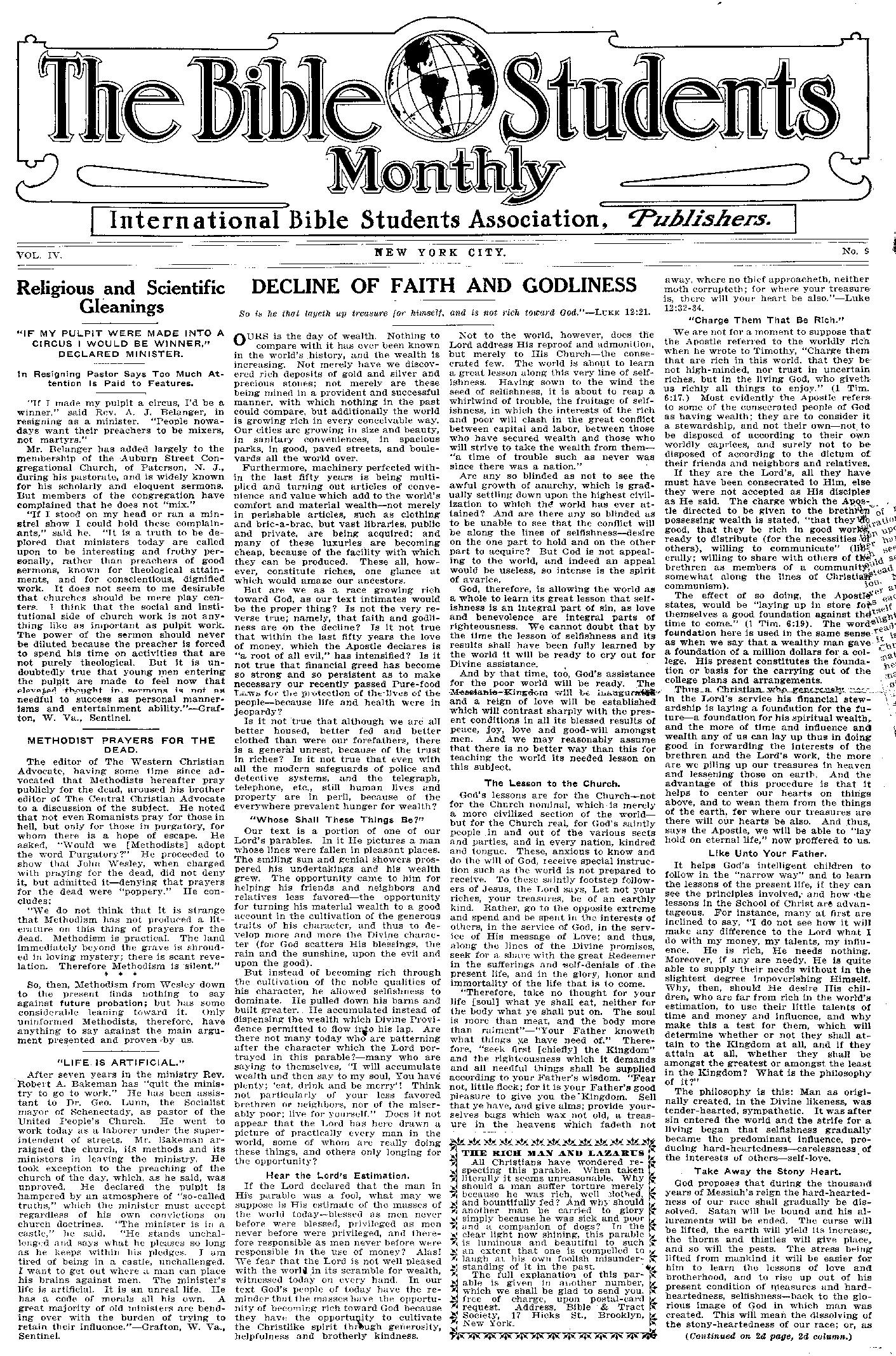
International Bible Students Association, ^PuHishers.
VOL. IV.
NEW YORK CITY.
No. 9
So is Tie that layeth up treasure for himself, and is not rich
toward God.”—Luke 12:21.
away, where no thief approacheth, neither moth corrupteth; for where your treasure is, there will your heart be also.”—Luke 12:32-34.
“Charge Them That Be Rich.”
“IF MY PULPIT WERE MADE INTO A CIRCUS I WOULD BE WINNER,” DECLARED MINISTER.
In Resigning Pastor Says Too Much Attention Is Paid to Features.
“If I made my pulpit a circus, I’d be a winner,” said Rev. A. J. Belanger, in resigning as a minister. “People nowadays want their preachers to be mixers, not martyrs.”
Mr. Belanger has added largely to the membership of the Auburn Street Congregational Church, of Paterson, N. J., during his pastorate, and is widely known for his scholarly and eloquent sermons. But members of the congregation have complained that he does not “mix.”
“If I stood on my head or ran a minstrel show I could hold these complainants,” said he. “It is a truth to be deplored that ministers today are called upon to be interesting and frothy personally, rather than preachers of good sermons, known for theological attainments, and for conscientious, dignified work. It does not seem to me desirable that churches should be mere play centers. I think that the social and institutional side of church work is not anything like as important as pulpit work. The power of the sermon should never be diluted because the preacher is forced to spend his time on activities that are not purely theological. But it is undoubtedly true that young men entering the pulpit are made to feel now that elevfijied thought In.pArtnnns not ns needful to success as personal mannerisms and entertainment ability.”—Grafton, W. Va., Sentinel.
METHODIST PRAYERS FOR THE DEAD.
The editor of The Western Christian Advocate, having some time since advocated that Methodists hereafter pray publicly for the dead, aroused his brother editor of The Central Christian Advocate to a discussion of the subject. He noted that not even Romanists pray for those in hell, but only for those in purgatory, for whom there is a hope of escape. He asked, “Would we [Methodists] adopt the word Purgatory?” He proceeded to show that John Wesley, when charged with praying for the dead, did not deny it, but admitted it—denying that prayers for the dead were “poppery.” He concludes:
“We do not think that it is strange that Methodism has not produced a literature on this thing of prayers for the dead. Methodism is practical. The land immediately beyond the grave is shrouded in loving mystery; there is scant revelation. Therefore Methodism is silent.”
* ♦ *
So, then, Methodism from Wesley down to the present finds nothing to say against future probation; but has some considerable leaning toward it. Only Uninformed Methodists, therefore, have anything to say against the main argument presented and proven by us.
“LIFE IS ARTIFICIAL."
After seven years in the ministry Rev. Robert A. Bakeman has “quit the ministry to go to work.” He has been assistant to Dr. Geo. Lunn, the Socialist mayor of Schenectady, as pastor of the United People’s Church. He went to work today as a laborer under the superintendent of streets. Mr. Bakeman arraigned the church, its methods and its ministers in leaving the ministry. He took exception to the preaching of the church of the day, which, as he said, was unproved. He declared the pulpit is hampered by an atmosphere of “so-called truths,” which the minister must accept regardless of his own convictions on church doctrines. “The minister is in a castle,” he said. “He stands unchallenged and says what he pleases so long as he keeps within his pledges. I am tired of being in a castle, unchallenged. I want to get out where a man can place his brains against men. The minister’s life is artificial. It is an unreal life. He has a code of morals all his own. A great majority of old ministers are bending over with the burden of trying to retain their influence.”—Grafton, W. Va., Sentinel.
/"1URS is the day of wealth. Nothing to ” compare with it has ever been known in the world’s history, and the wealth is increasing. Not merely have we discovered rich deposits of gold and silver and precious stones; not merely are these being mined in a provident and successful manner, with which nothing in the past could compare, but additionally the world is growing rich in every conceivable way. Our cities are growing in size and beauty, in sanitary conveniences, in spacious parks, in good, paved streets, and boulevards all the world over.
Furthermore, machinery perfected within the last fifty years is being multiplied and turning out articles of convenience and value which add to the world’s comfort and material wealth—not merely in perishable articles, such as clothing and bric-a-brac, but vast libraries, public and private, are being acquired; and many of these luxuries are becoming cheap, because of the facility with which they can be produced. These all, however, constitute riches, one glance at which would amaze our ancestors.
But are we as a race growing rich toward God, as our text intimates would be the proper thing? Is not the very reverse true; namely, that faith and godliness are on the decline? Is it not true that within the last fifty years the love of money, which the Apostle declares is “a root of all evil,” has intensified? Is it not true that financial greed has become so strong and so persistent as to make necessary our recently passed Pure-food Laws for the protection of the Ilves of the people—because life and health were in jeopardy?
Is it not true that although we are all better housed, better fed and better clothed than were our forefathers, there is a general unrest, because of the trust in riches? Is it not true that even with all the modern safeguards of police and detective systems, and the telegraph, telephone, etc., still human lives and property are in peril, because of the everywhere prevalent hunger for wealth?
“Whose Shall These Things Be?”
Our text is a portion of one of our Lord’s parables. In it He pictures a man whose lines were fallen in pleasant places. The smiling sun and genial showers prospered his undertakings and his wealth grew. The opportunity came to him for helping his friends and neighbors and relatives less favored—the opportunity for turning his material wealth to a good account in the cultivation of the generous traits of his character, and thus to develop more and more the Divine character (for God scatters His blessings, the rain and the sunshine, upon the evil and upon the good).
But instead of becoming rich through the cultivation of the noble qualities of his character, he allowed selfishness to dominate. He pulled down his barns and built greater. He accumulated instead of dispensing the wealth which Divine Providence permitted to flow ir^o his lap. Are there not many today who are patterning after the character which the Lord portrayed in this parable?—many who are saying to themselves, “I will accumulate wealth and then say to my soul, You have plenty; ‘eat, drink and be merry’! Think not particularly of your less favored brethren or neighbors, nor of the miserably poor; live for yourself.” Does it not appear that the Lord has here drawn a picture of practically every man in the world, some of whom are really doing these things, and others only longing for the opportunity?
Hear the Lord’s Estimation.
If the Lord declared that the man in His parable was a fool, what may we suppose is His estimate of the masses of the world today—blessed as men never before were blessed, privileged as men never before were privileged, and therefore responsible as men never before were responsible in the use of money? Alas! We fear that the Lord is not well pleased with the world in its scramble for wealth, witnessed today on every hand. In our text God’s people of today have the reminder that the masses have the opportunity of becoming rich toward God because they have the opportunity to cultivate the Christlike spirit through generosity, helpfulness and brotherly kindness.
Not to the world, however, does the Lord address His reproof and admonition, but merely to His Church—the consecrated few. The world is about to learn a great lesson along this very line of selfishness. Having sown to the wind the seed of selfishness, it is about to reap a whirlwind of trouble, the fruitage of selfishness, in which the interests of the rich and poor will clash in the great conflict between capital and labor, between those who have secured wealth and those who will strive to take the wealth from them— “a time of trouble such as never was since there was a nation.”
Are any so blinded as not to see the awful growth of anarchy, which is gradually settling down upon the highest civilization to which thd world has ever attained? And are there any so blinded as to be unable to see that the conflict will be along the lines of selfishness—desire on the one part to hold and on the other part to acquire? But God is not appealing to the world, and indeed an appeal would be useless, so intense is the spirit of avarice.
God, therefore, is allowing the world as a whole to learn its great lesson that selfishness is an integral part of sin, as love and benevolence are integral parts of righteousness. We cannot doubt that by the time the lesson of selfishness and its results shall have been fully learned by the world it will be ready to cry out for Divine assistance.
And by that time, too, God’s assistance for the poor world will be ready. The Me seiame--Kingdom will Lc Inaugurates" and a reign of love will be established which will contrast sharply with the present conditions in all its blessed results of peace, joy, love and good-will amongst men. And we may reasonably assume that there is no better way than this for teaching the world its needed lesson on this subject.
The Lesson to the Church.
God’s lessons are for the Church—not for the Church nominal, which is merely a more civilized section of the world— but for the Church real, for God’s saintly people in and out of the various sects and parties, and in every nation, kindred and tongue. These, anxious to know and do the will of God, receive special instruction such as the world is not prepared to receive. To these saintly footstep followers of Jesus, the Lord says, Let not your riches, your treasures, be of an earthly kind. Rather, go to the opposite extreme and spend and be spent in the interests of others, in the service of God, in the service of His message of Love; and thus, along the lines of the Divine promises, seek for a share with the great Redeemer in the sufferings and -self-denials of the present life, and in the glory, honor and immortality of the life that is to come.
“Therefore, take no thought for your life [soul] what ye shall eat, neither for the body what ye shall put on. The soul is more than meat, and the body more than raiment”—“Your Father knoweth what things y.e have need of.” Therefore, “seek first [chiefly] the Kingdom” and the righteousness which it demands and all needful things shall be supplied according to your Father’s wisdom. “Fear not, little flock; for it is your Father’s good pleasure to give you the‘Kingdom. Sell that ye have, and give alms; provide yourselves bags which wax not old, a treasure in the heavens which fadeth not
We are not for a moment to suppose that the Apostle referred to the worldly rich when he wrote to Timothy, “Charge them that are rich in this world, that they be not high-minded, nor trust in uncertain riches, but in the living God, who giveth us richly all things to enjoy.” (1 Tim. 6:17.) Most evidently the Apostle refera to some of the consecrated people of God as having wealth; they are to consider it a stewardship, and not their own—not. to be disposed of according to their own worldly caprices, and surely not to be disposed of according to the dictum of their friends and neighbors and relatives.
If they are the Lord’s, all they have
must have been consecrated to Him, else
they were not accepted as His disciples as He said. The charge which the Apos-^ tie directed to be given to the brethren?'of 1 possessing wealth is stated, “that theyVfo YaU°’ good, that they be rich in good wor)^^ ready to distribute (for the necessities vr Yia1 others), willing to communicate” (lftJ$ se<= erally; willing to share with others of tke.^ s< brethren as members of a communi t^’,u_ad somewhat along the lines of Christia9r 1 communism). -oTl' ai
The effect of so doing, the Apostl^e eac states, would be “laying up in store fo^s themselves a good foundation against thd1®^ time to come.” (1 Tim. 6:19). The word®^^’ foundation here is used in the same sense as when we say that a wealthy man gave
a foundation of a million dollars for a college. His present constitutes the foundation or basis for the carrying out of the college plans and arrangements.
Thus_a Christian.-Ac” in the Lord’s service his financial stewardship is laying a foundation for the future—a foundation for his spiritual wealth, and the more of time and influence and wealth any of us can lay up thus in doing good in forwarding the interests of the brethren and the Lord’s work, the more are we piling up our treasures in heaven and lessening those on earth, And the advantage of this procedure is that it helps to center our hearts on things above, and to wean them from the things of the earth, f®r where our treasures are
there will our hearts be also. And thus, says the Apostle, we will be able to “lay hold on eternal life,” now proffered to us.
Like Unto Your Father.
It helps God’s intelligent children to follow in the “narrow way” and to learn the lessons of the present life, if they can see the principles involved,- and how -the lessons in the School of Christ arft advantageous. For instance, many at first are inclined to say, “I do not see how it will make any difference to the Lord what I do with my money, my talents, my influence. He is rich, He needs nothing. Moreover, if any are needy, He is quite able to supply their needs without in the slightest degree impoverishing Himself. Why, then, should He desire His children, who are far from rich in the world’s estimation, to use their little talents of time and money and influence, and why make this a test for them, which will determine whether or not they shall attain to the Kingdom at all, and if they attain at all, whether they shall be amongst the greatest or amongst the least in the Kingdom? What is the philosophy of it?”
All Christians have wondered re-specting this parable. When taken L literally it seems unreasonable. Why should a man suffer torture merely L because he was rich, well clothed, &■ and bountifully fed? And whs should L another man be carried to glory simply because he was sick and poor L and a companion of dogs? In the clear light now shining, this parable is luminous and beautiful to such [x an extent that one is compelled to laugh at his own foolish misunder-standing of it in the past. #x
The full explanation of this par- pt able is given in another number, hr which we shall be glad to send you. pt
The philosophy is this: Man as originally created, in the Divine likeness, was tender-hearted, sympathetic. It was after sin entered the world and the strife for a living began that selfishness gradually became the predominant influence, producing hard-heartedness—carelessness of the interests of others—self-love.
free of charge,
request. Society,
Address,
New York.
17 Hicks St.,
upon postal-card tx , Bible & Tract pt
Brooklyn,
Take Away the Stony Heart.
God proposes that during the thousand years of Messiah’s reign the hard-heartedness of our race shall gradually be dissolved. Satan will be bound and his allurements will be ended. The curse wili be lifted, the earth will yield its increase, the thorns and thistles will give place, and so will the pests. The stress being lifted from mankind it will be easier for him to learn the lessons of love and brotherhood, and to rise up out of his present condition of measures and hardheartedness, selfishness—back to the glorious image of God in which man was created. This will mean the dissolving of the stony-heartedness of our race; or, as
(.Continued on 2d page, 2d column.)
The ^ible intents
1’IBI.ISHEI) AT
83 HEEKMAX ST., NEW YORK CITY C. W. Hue, Publisher
An Independent, Unsectarian Religious Newspaiper, Specially Devoted to the Forwarding of the Laymen’s Home Missionary Movement for the Glory of God and Good of Humanity.
THE CHRISTIAN-PAGAN NATIONS.
The paradox of the twentieth century is that everywhere Christian relationships prevail between individuals, but pagan relationships between the nations to which these individuals belong. This is the observation of Dr. Frederick Lynch of The Congregationalist (Boston) from the vantage point of a summer holiday at Lucerne, Switzerland. In this summer meeting-place of Europe he has seen English and Germans grouped together, “their talk full of the utmost good-will,” the .relations “Christian through and through.” “The German would never think of stealing the Englishman’s purse, and the Englishman would never suspect the German of murderous designs upon him.” If they differed in a dispute, they would not fly at each other’s throat; they w ould refer the judgment to the nearest friend, or if it were a serious quarrel, to an impartial jury. “As a matter of fact, nationality is not uppermost in their talk.” “But the moment the German Government and the English Government exchange words, the whole atmosphere changes from Christian to pagan.” In fact,
“It is as if Christianity had never ex-*■ e’se had no part in the relation-
The talk is all of lerous assault of one ar. Each declares the gns of invasion, and elieve that the other nd at once did it dare, viil there is recrimina-in pre-Christian Europe eif against a fellow man these nations is arming the other. Should the .e arise, these nations are . each other’s throats, and :ause the few who believe ics should prevail between influential enough to be se days that these two great e kept from flying at each
.-bats last, year.__Lt., stews. too .
be believed, but it is true; and .till are all the codes of national spite of Hague conferences and igresses. that it would take little e these two nations into war.
e are a good many Italians in ; and a good many Italian papers d here. . I have been interested in ; the Italian point of view on the ith Turkey. The simplicity of that is the most striking thing about it, )t its barefaced paganism. It is ly this: Italy needed Tripoli and want-it, and, having become strong enough take it from Turkey, proceeded to take
The beauty of it all is that no one ees anything wrong in doing it.
“It would be wrong and un-Christian for an Italian to steal a Turk’s purse or to kill a Turk on the street. But there is nothing wrong in Italy’s stealing Turkey’s purse or destroying Turks in so doing. (The only man I have met whose conscience troubled him a little, justified Italy’s act on the ground that she was simply taking back what once was hers, for ancient Rome once owned North Africa.)
“Even the Church has fallen in with the Government and is blessing the armies—to little avail. • The most encouraging thing has been the unprecedented condemnation of Italy’s act by the European press. A German said to me that 25 years ago no daily paper in Europe would have seen anything wrong in a nation robbing or destroying another nation.”
Dr. Lynch finds a “rather striking instance of how this pagan ethics for nations persists right in the midst of our Christian ethics” in the daily avocations Of his Lucerne neighbors, which he reports with these comments:
“Opposite our terrace, across the lake, is the station of the airships. Every afternoon at five there come out a great yellow dirigible balloon, fish-shaped, with sweeping propellers, and a monoplane whose resemblance to a great bird is startlingly striking. They circle around the city several times, the big Zeppelin ship slowly, the monoplane with the .wiftness of an eagle. Now the people who sip tea on our terrace are the most estimable people. They go to church and ’hey are full of brotherly kindness to sach other. But all the talk as these new adventurers of the heavens fly above 's is of their use in killing somebody. It ts of the possibility of dropping bombs on cities, of building up aerial navies.
“Already France has gone crazy over a navy in the air, and even the children.of the nation have contributed their pennies and a new outburst of so-called patriotism. Of course Germany and England &~e endeavoring to outstrip her, and so a new, mad race of armament has begun. Lucerne is full of military officers studying their airships.”—Literary Digest.
(Continued from 1st page, 1th column.) the Scriptures put it, the Lord will take away the stony heart out of their flesh, and give them a heart of flesh—a heart of sympathy. All under that favorable condition who will refuse to return to harmony with God, and to the likeness of God, will be destroyed from amongst the people in the Second Death.—Acts 3:19-23.
But while such a restitution under the favorable conditions of the Messianic Kingdom is God’s provision for the world, He has a different provision for the Church, now being called, tested, proven. By nature our hearts are hard and selfish; and, as the Apostle says, “We were children of wrath, even as others.” The fact that God has called us to joint-heirship with His Son in the glorious Kingdom that is shortly to bless the world does not signify that He will accept us in our present condition of hard-heartedness and selfishness.
On the contrary, if we are to be the kings, priests and judges of the world, in association with our Lord and Head, the great King, we can readily see that we ourselves must get rid of this condition before being capable of helping the world up out of its hard-heartedness.
“We Walk by Faith.”
In various respects the Lord’s dealings with His called Church at the present time are different from what His dealings will be with the world by and by. This is'because ours is so high an honor; and, correspondingly, it is appropriate that we should manifest the more love, the more zeal than will be expected of the world.
To illustrate: We must walk by faith and not by sight, and voluntarily accept the Lord’s providences, and voluntarily undertake to co-operate in putting away the stony heart, accepting instead the Spirit of the Lord, and the Spirit of the Father—a spirit of love, kindness, gentleness, meekness, patience and long suffering toward all. Moreover, during the thousand years of the world’s recovery from sin and selfishness and hard-heartedness, doubtless each individual will have several centuries for his gradual development, but the Father seeks in the Church class such as will manifest so much zeal for Him, and such as will give such heed to His instructions, and show such earnestness to copy His character, that they will succeed in attaining a heart condition of tenderness, sympathy and love like unto the Heavenly Father’s, in the present years of their Christian experience.
FAITH, FIDELITY AND OBEDIENCE NECESSARYJTC^SALVATION
“'Watch and pray, lest ye enter into temptation; the spirit indeed is trilling, but the flesh is weak.’'—Matt. 26 :41.
ll/ATCHING and praying are both ne-cessary to escape entering into temptation. But first it is proper that we inquire who are addressed. Who are to watch? Who are to pray? Who are to escape entering info the temptation? We reply that this prescription is not given by the Great Physician to the /world in general. True, our dear Redeemer called sinners everywhere and at all times to repentance, but He has no dealings with fckem until they respond -to that-eaU--------
It were well if the entire world could realize our Lord’s attitude toward them— that while not unsympathetic toward them in respect to their weaknesses and blemishes of the fall, He, nevertheless, has closed up all methods of reconciliation, all avenues of approach to Himself and His favor except one, namely, the door of repentance and faith.
Regenerate and Unregenerate Prayers.
Manifestly there is not only justice but wisdom in this Divine arrangement. For the Lord to undertake to hear the prayers and to care for the unconsecrated would be to discount and to make void His own arrangement, which assures us that there is no other Name given under heaven and among men whereby we must be saved—whereby members of Adam’s race, all sinners, may be reconciled to God and enjoy in any measure, here or hereafter, Divine favors—except through the Name of Christ.
And not only has the Lord made gracious provision for the unjust as well as the justified during this Gospel Age, • for the evil as well as for the good, but He hy.s made general provision for all in His great plan, in that He has provided “a ransom for all,” the great Atonement for the sins of the world, and has assured us that in due time every member of the race shall enjoy a full privilege and opportunity of benefiting by that redemption, and, if they will, to come fully back to reconciliation with God, fully back to all that was lost in Eden, fully back to all that is meant by the words, “In the image and likeness of God created He him.”
We see, then, that God’s refusal in the present time to hear the prayers of the world in general is not through any evil sentiment or grudge that He bears against them, not through any narrowness or animosity, but because in His great and glorious Plan of salvation there are two parts. The first of these, belonging to the present time, the Gospel Age, is for the special class who can and will and do exercise faith in Him and seek to walk, not after the flesh, but after the spirit; and, second, a place for the world in general in the next Age, in which all, however degraded, however lacking in faith, however prone to sin, shall have the fullest assistance for their uplift and restoration to all that was lost, and more— greater knowledge, and, to those obedient under test, eternal perfection.
“Lord, Teach Us to Pray.”
True, there is in the unregenerate at times a desire to pray to God—usually in times of distress or fear. This is a natural trait, the result of certain mental qualities in combination: First, veneration, and second, fear. But it is not the Divine purpose to encourage such a combination, but rather a combination of
And if we shall ultimately demonstrate this fixity of our hearts, the Lord will own us as His children in the First Resurrection and grant us perfect bodies on the spirit plane, when it will be possible for us to be absolutely like Him. That is the glorious condition for which we are waiting, hoping, praying, striving. And it is within our reach, for the Lord has not called us in vain: “Faithful is He who hath called us.”
So, then, dear fellow-Bible students, let us gird up the loins of our minds, determining that with the Lord’s help we will be rich toward God. Let us think less and less of earthly riches, and more and more prize the Kingdom which the Lord has promised to His faithful ones. All who shall attain to it will be rich in the highest sense, rich toward God. Not only will they be rich in the possession of the highest prize that God has to give—His very best—but following the process and lessons of our Great Teacher we shall be rich in His character-likeness, rich in experience, rich in faith, rich in benevolence, rich in all that is good and great, however poor we may be in earthly goods, at the finish of our course.
veneration, faith and conscience. For the natural man to approach the Lord in prayer, with the selfish motives and instincts of the old will, would mean that his prayers would be of a wrong kind, from the selfish standpoint.
Our Lord clearly marks out the kind of petition which His people will offer, the kind of petition which He will be pleased to entertain and surely grant and answer at some time. Describing this proper prayer He says: “If ye abide ,in Me and My words abide in you, ye shall ask what ye will and it shall be done unto you.” (John 15:7.) Ah, yes! If the Lord’s words abide in us it will imply our love for them, and diligent study to know the words of the Lord and the will of the Lord expressed in those words; and if we abide in Him it will mean that we abide loyal to His will, and are desirous of having His will done in us and not our own wills.
This will signify in turn that not only will the Lord’s disciples abiding in Him be searching to know His will through His Word, but that they will be striving to apply that will and Word according to His guidance and direction—according to His will and not according to their own wills, according to the spirit of the Truth and not according to the spirit of the world, according to the spirit of love and not according to the spirit of selfishness.
Thus those who are truly the Lord’s will petition Him in their prayers, “Not mj' will but Thine be done,” in everything, in matters temporal and spiritual.
Prayers, Public and Private.
Some may ask, Did not the publican pray and was he not heard? Yes; but he prayed as a sinner and merely asked for Divine mercy, and his request Implied his desire to escape from sin, his resolution to do so, and his desire for the Lord’s assistance in this matter. Moreover, the publican belonged to the nation that God had accepted through faith, belonged to His adopted nation, Israel after the flesh, and to this publican therefore pertained the promises and blessings which up to that time had been extended by the Almighty to that one nation alone. For the publican to return to God was represented in the return of the prodigal son in the parable; the relationship was already there and he had merely disregarded it for a time.
What and Why We Watch.
Let us now look at the other ingredient in this prescription which the Lord gave for our benefit and which so many of us have proven to be beyond price. If we pray why should we watch? For what should we watch? On another occasion our Lord intimated that the reason, the necessity for watching as well as praying, lies in the fact that we have an Adversary, an invisible foe, who seeks to seduce us, turn us aside from our vows of consecration to the Lord and His way of righteousness./
Our Lord says that this Adversary is the Devil, and we understand that the Devil is not only a personal being, but that he has many minions or associates, the fallen angels, who kept not their first estate when on trial before the flood. .(Jude 6.) Not only so, but Satan has' millions of representatives and agents in the world—millions who are his agents without really being aware of the fact. According to our Lord’s testimony on one occasion, we may understand that the whole world of mankind is divided into two hostile camps, the one a little flock, under the guidance and control of Jesus, their invisible Lord and Head, whose will they seek to do; the other the remainder of the world, who unwittingly are in the , service of sin, because they are in the service of sin. and because, as the Apostle expressed it, “His servants you are to whom you render service.”—Rom. 6:16.
From this standpoint, with this view before our minds, how many agents our great Adversary has who unconsciously are working for him, working for sin, working against the Lord, and hence are the opponents of the few who have tasted of the grace of God, who have accepted the Divine conditions and who have consecrated themselves to walk in the footsteps of Jesus. No wonder we are urged to “watch” as well as to “pray,” to watch against these various seductive influences of the Adversary, through the world and its spirit operating through social, financial and churchianity channels, to draw us away from that full consecration to the Lord and to the Truth to which we have already pledged our lives.
True, the Lord could answer our prayers by defending us from every adverse influence, by shielding us from every temptation by making us immune to all manner of temptations. But for Him to do this would be to change His own plans, and hence He will not do it. And when we come to understand what the Divine plans are, and how the watching and resistance of sin are a necessity to our proper development as the Lord’s people, we will no longer be expecting to be “carried to the skies on flowery beds of ease, while others fought to win the prize and sailed through bloody seas.”
Character Development.
Jehovah’s object in the special call of the Church during this Gospel Age is the development of a class of people into the character-likeness of His dear Son, our Redeemer. This means a condition of heart that will be in opposition to sin, that will have its special delight in opposing sin, that would die rather than yield to sin. We must remember, however, that we have this treasure of a new mind in earthen vessels, our mortal bodies (2 Cor. 4:7); we must remember that to will is present with us, but that the performance is another matter.
To will right is of absolute necessity from the very beginning of our Christian course. He who wills adverse to righteousness and truth and goodness and the Lord is-rrot begottrm ~rfi ttre'Hoty ’Spirlt. Everyone that is begotten again wills to do right, wills to follow the Lamb whithersoever He goeth. But with all our willing we have difficulty in performing, because of the adverse conditions of our own flesh and because also of the adverse conditions of the world about us. So, then, the present life, with its praying and watching, is the Lord’s time; in it He tests us respecting our faith and our obedience to Him and His principles.
If we realize the temptations about us and have faith we will surely appeal to the Lord for His promised assistance. We will surely not neglect the throne of grace. If we do neglect it, it is a sign that we are lacking in faith, that we are in that respect not fit for the Kingdom, because all who are inheritors of the Kingdom must have faith. “Without faith it is impossible to please God.” “This is the victory that overcometh the world, even your faith.”—Heb. 11:6; 1 John 5:4.
The New Nature’s Pickets.
Our obedience, while it cannot be perfect because we are still in the flesh, and because we have only the imperfect mortal bodies through which to act, nevertheless our efforts toward obedience must fully demonstrate the positiveness of our will for righteousness, must fully demonstrate that if we had perfect bodies there would be no question whatever respecting the perfection of our word, thought and deed. The realization, then, of our weaknesses and imperfections, and that the whole world and its spirit are adverse to the Lord and His Spirit and His Message, will lead the Lord’s faithful people not only to appeal to Him, but also to watch against the snares of the Adversary.
They watch themselves not only by taking heed to the admonitions of the Lord’s Word for the resistance of these temptations, but also they watch their own weaknesses, failures, shortcomings, that they may protect themselves along the lines of their weaknesses—that, as the Apostle says, they may make straight paths for their feet, lest that which is weak or lame be turned out of the way. They may be overtaken in a fault, because attacked from some new quarter; they may discover a weakness in their own natural make-up of which they had not previously been aware; but with these to discover their weakness will mean not only an appeal to the Lord for assistance at that point, but also energetic endeavors for defense against the inroads, the seductions, the snares of the Adversary.
The point known to be a weak one should be doubly picketed by the new mind, lest it should be overtaken unawares and should again meet defeat. To this class of true disciples, watching and praying, a temporary defeat at some point does not spell disaster, but rather
renewed energy and a stronger character because of the setting up of defenses at the point found to be weak. Thus, throughout life, those who watch and pray are gradually making stronger their characters along every line of defense, and in thus building up character they are demonstrating to the Lord the transformation of their hearts, their minds, the sincerity of their vows, and their loyalty to the principles of righteousness set before them in His Word and in the glorious example of their Redeemer and Leader.
The Lord’s Jewels.
These eventually will constitute the Lord’s jewels. At the beginning of their course their hearts were honest and loyal for righteousness, but character had not been developed. The trials, the difficulties, the contacts with the world, the flesh and the Adversary, all developed character by leading them to exercise faith, which manifests itself in prayer, and loyalty to righteousness, which manifests itself in watching against the various temptations and besetments to which they are exposed.
The latter part of our text is in full accord with the foregoing: “The spirit indeed is willing, but the flesh is weak.” This does not apply to the world, but only to those who have accepted the Lord and turned their backs on sin.
We must surely expect that from every standpoint of opposition there will be more or less seductive allurements on the part of the flesh seeking gratification. Our safety is in watching and in praying, not that we can hope that by watching and praying we can fully escape temptations, but that holding fast to the Lord and being covered with the mantle of His love and mercy, these temptations will all be overruled for our good, developing us in heart and character in the likeness of our glorious Master and thus will fit and prepare us for participation in the First Resurrection, “His Resurrection.”—Rom. 6:5; Phil. 3:10.
By that glorious change all those who constitute the very Elect will be made absolutely perfect, for they will there receive their perfect or spirit bodies, which will be in full harmony with the changed characters already attained by the Lord’s grace through obedience to the Word and the watching and praying which He directs. For that glorious attainment we are to strive, and the method is to be through the watching and praying—the watching of the Word, the watching of our hearts, the watching against temptations, the prayer of faith and the exercise of faith in Him who loved us and bought us with His precious blood.
MEN DARE TO THINK NOW.
Atlanta Constitution—Editorial.
The former Associate Editor of this well-known Journal of the South spent many sleepless nights in worry concerning the “Hell-Fire and Brimstone” theory. Later he came into ■ possession of “The Divine Plan of the Ages,” the first of a series of six volumes of “Studies in the Scriptures,” by Pastor Russell. After reading the book a great burden was lifted from his mind and he then said:
“It is impossible to read this book without loving the writer and pondering his wonderful solution of the great mysteries that have troubled us all our lives. There is hardly a family to be found that has not lost some loved one who died outside the Church—outside the plan of salvation, and, if Calvinism be true, outside of all hope and inside of eternal torment and despair. We smother our feelings and turn away from the horrible picture. We dare not deny the faith of our fathers, and yet can it be possible that the good mother and her wandering child are forever separated?—forever and forever?
More Light the Watchword!
“This wonderful book makes no assertions that are not well sustained by the Scriptures. It is built up stone by stone, and upon every stone is the text, and it becomes a pyramid of God’s love, and mercy, and wisdom. There is nothing in the Bible that the author denies or doubts, but there are many texts upon which he throws a flood of light that dispels many dark and gloomy forebodings. I see that editors of leading journals, and many orthodox ministers of different denominations, have indorsed it and have confessed to this new and comforting light that has dawned upon the interpretation of God’s Book. Then let every man read and ponder and take comfort, for we are all prisoners of hope. This is an Age of advanced thought, and more thinking is done than ever before—men dare to think now. Light—more light, is the watchword.”
Four Million copies of “The Divine Plan of the Ages” have been placed in the homes of Christian people. The book is published in fourteen different languages. Aside from the Bible itself, the demand for this book has been the greatest of any ever published. Students of the Bible have found that “The Divine Plan of the Ages” is indispensable to their studies. It removes the stumbling stones. The book of 384 pages, neatly bound in imported cloth and containing an interesting Chart of the Ages, is published and distributed by the Bible and Tract Society, No. 17 Hicks St., Brooklyn, N. Y., for the nominal sum of 35 cents per volume, any language. This book has made Pastor Russell famous, and has made thousands of Bible students strong in the faith of God’s Word and a mighty power in the battle for the Truth.
OUR RESPONSIBILITY AS CHRISTIANS
“Am I my 'brother’s keeper?”—Genesis 4 :9.
MO ONE can dispute that individual-ism, personal independence, personal responsibility, have done much for the development of our race. The serfdom and paternalism of the past were unfavorable to individual thought, responsibility and action. No wise and good man would desire to rob his fellows of independence of mind.
One Extreme, Then the Opposite.
We are in danger, however, of going to the opposite extreme—in danger of carrying the subject of personal independence too far—in danger of neglecting some who should have assistance— in danger of thinking of all men as being not only free but equal. While we all should have proper freedom of will, yet all are more or less handicapped in the exercise of the will. As St. Paul said, “We cannot do the things which we would.” We are slaves of sin and death, some more and some less. The Prophet David’s explanation applies to us all, “I was shapen in iniquity, in sin did my mother conceive me.”—Psalm 51:5.
It was in view of such inequalities of the flesh that St. Paul wrote to the Church, “We that are strong should bear with the infirmities of the weak, and not please ourselves” [merely]. (Rom. 15:1.) This principle, applied by the Apostle to the Church, would certainly be appropriate and beneficial in the natural family. And as our hearts enlarge we should all come to realize more and more the oneness, the solidarity of our race—the entire human family, of which St. Paul says, “Of one blood God created all men, to dwell upon the face of the whole earth.”—Acts 17:26.
“Where Is Thy Brother?”
God’s inquiry of Cain implied Cain’s responsibility, and teaches us a lesson respecting our responsibility in God’s sight for one another. We will begin with the Church, the highest type of brotherhood imaginable: We should not be content to split into sects and parties. Whatever was the ignorance of the past, which led to the formation of the various creeds and denominations, there can be no excuse for these now, because Christians of all denominations have come to discredit the old creeds. Should there not, then, be a movement toward heart unity and fellowship, outside of denominational and creedal lines, amongst those who recognize God as Father, the Lord Jesus Christ as the Redeemer, and the Bible as the Divine Revelation?
It is not proper to say as did Cain, “Am I my brother’s keeper?” Every true Christian should realize that today Christianity is being assaulted in its own house and by its professed friends. In the universities, colleges and seminaries of all denominations a battle is raging, which threatens the destruction of our Christian faith. Possibly a few are blind to the situation, but the insurgents—the Higher Critics and Evolutionists—realize the situation and are craftily saying to the people, “We are the Watchmen upon the walls of Zion! Hearken to our cry: All is well!” These Higher Critics seem to have no conscience. They claim that the people must be gradually taken by guile. They encourage them to “sleep,” while they raise over them the banner of infidelity called Higher Criticism.
Many who see the killing of this anti-typical Abel shirk the responsibility by saying, “Am I my brother’s keeper?” not realizing that from the Divine standpoint they have a responsibility toward every other Christian with whom they are in contact. They should realize that loyalty to God means that they “should show forth the praises of Him who hath called us out of darkness into His marvelous light.”
In a word, every true Christian who has made a full consecration of himself to the Lord, to walk in the footsteps of the Saviour, should waken to the fact that we are in a critical time. We are in the time mentioned by St. Paul, when “every man’s work shall be tried so as by fire.” (1 Cor. 3:13.) The testing will be along the lines both of faith and of works. Only those holding firmly to “the faith once delivered to the saints” will be able to bring forth such fruits, such good works, as the testings of this hour require. This class, awake to their responsibility toward God and the brethren and the Bible, and full of zeal, therefore, will thereby be kept in this “evil day.” God will bless them in their endeavors to glorify Him.
My Brother’s Keeper—Socially.
In the days of slavery and serfdom, every master, every feudal lord, recognized a responsibility for his servants or slaves. He was interested in their health and in their morals, for they were his property, and any depreciation meant financial loss to him. Thus selfish interest kept him alive to his responsibility, to a considerable degree. But now all that has changed. sSerfs and slaves, released from obligation, are without supervision and care. TheMess fit of our rate are in serious danger, of being crowded to the wall. Our lawmakers have recognized the fact and have thrown around the weaker sex and children safeguards in the laws, protecting them from designing people 'who would exploit them for selfish purposes.
totally depraved; but surely none are totally depraved except the idiotic. We
believe that there is an element favorable to righteousness in every member of our race, and that sin is largely the result of unfavorable environments; and that the majority of mankind would be glad, indeed, if some Divine interposition were to lift them and their affairs out of present conditions and put them upon a plane of absolute righteousness, justice, equity. This, we believe, is the desire of a large element in every’ nation, a predominating class. Such a reign of righteousness, justice, equity in the world, will speedily’ result from the establishment of Messiah’s Kingdom, for which we pray, “Thy Kingdom come; Thy will be done on earth as it is in heaven.”
Most explicitly do the Scriptures declare this, saying, “The desire of all nations shall come.” (Hag. 2:7.) This declaration is in conjunction with the foretelling of the establishment of Messiah’s Kingdom. The reign of righteousness which it will inaugurate will be the ideal of the masses of mankind, although quite probably the overthrow of Trusts and Combines will, for a time, not be viewed sympathetically by the rich, the wise, the preferred, the favored class, under present conditions. As it required time for the slave holders of the past to become reconciled to loss of their slaves and to see the righteousness of their being freed, so it will be with those who at present are closely identified with great institutions which are bringing mankind into slavery. Our Lord sized up the situation, saying, Blessed are y’ou who weep and mourn, for you shall be comforted. Woe unto those who are full, for they shall have distress.—Luke 6:21, 25.
The reign of justice and righteousness will ultimately appeal to all in heart harmony with Jehovah, and all who fail to thus come into heart harmony with Him will be accounted as unworthy of His gift of everlasting life; for “He who loves not his brother whom he hath seen, how could he love God whom he hath not seen?”
The thousand years of Messiah’s reign, during which His Bride, the Elect Church, will be associated with Him, will be quite sufficient for the equalization of all of life’s affairs for the entire race. “In His day shall the righteous flourish,” and not merely the strong. In His day evil doers and not well doers will be crushed. It is written of His Kingdom that it “shall lift up the poor out of the dunghill, and shall bring down the mighty from their seats.”
The Disciplines According to Previous Character- Development.
The whole world of mankind will then be transferred into the hands of Messiah, who will take them just as they are. They will be in various conditions. Some will be more depraved, others less depraved; some will be more seared in their consciences and some less; and these deficiencies of character will depend upon the way in which each one accepted or rejected light and opportunity in the present time. Those who knew not His will and did it not will receive few stripes; those who knew His will and did it not will receive many stripes, because of previous hardening of character. Everybody will be required, eventually, to come up to the full standard of Divine requirements. Those more depraved will have greater difficulty and those less depraved will have less difficulty and receive fewer stripes, in the coming up to Divine requirements.
Those who most willingly and most gladly assent to the leveling process, will most quickly receive the Divine blessing, and make the most rapid progress along the Highway of Holiness, back to full human perfection and eternal life. And those who now in advance of the establishment of the Kingdom, love righteousness and hate iniquity, come at present into favor with the King of kings, and thus are specially favored with light and knowledge, and are invited to become associates with Messiah in His glorious Kingdom, which is to effect the long-promised, great reformation of earth’s affairs. Let us all take to heart and apply well this lesson, but especially those who have heard and who have responded to the Divine invitation to become heirs of God and joint-heirs with our Redeemer.
Nevertheless, with all that human law has yet been able to accomplish, the danger is increased. As knowledge increases, trusts and combinations selfishly boost the price of life’s necessities and luxuries. Those members of our race less favorably equipped for the battle of life are seriously disadvantaged, some by reason of less intellectual powers, others by reason of unfavorable circumstances and environments.
Under such conditions it is not surprising that all who are able are banding together into unions for their own protection; nor should it surprise us that these, also, selfish and hard of heart, should sometimes be unjust in their demands, and sometimes cruel and ready to slay their brother who joins them not in their organization. In their desire to promote the best interests of their craft they may, indeed, reasonably exhort fellow-craftsmen to support the organization, and may show its advantages, but beyond that they dare not go without infracting the principles of justice and bringing Divine condemnation which, sooner or later, in one way or another, will surely be meted out.
Seen from this standpoint, unionism has a responsibility toward brethren not members of the union—to treat them justly, kindly, helpfully. And no doubt this attitude would bring the larger blessing and truer prosperity.
My Bro ,.er’s Keeper—Financially.
Gradually the world is realizing its responsibility to the weak and incompetent and aged. The Orphanages, Hospitals, Homes for the Foor, etc., are all proper recognitions of the brotherhood of man— aside from the higher brotherhood in Christ. We cannot claim that these institutions are the product of pure benevolence. We must admit that politics has much to do ■with them. The desire for contracts and for labor in connection with these institutions, has, of course, much to do with their existence. The expenditure of such enormous sums as annually go to these institutions naturally enough draws an army of political heelers and onlookers.
The Day of Recompense.
The All-Seeing eye of our Creator keeps watch over the affairs of His creatures today as it kept watch over Abel’s interests. God allowed Cain to have his way; allowed him to kill his brother; allowed the righteous to suffer: yet Cain did not escape, but was held accountable for the death of his brother.* God’s sentence upon him separated him from his brethren until he cried out that his punishment was greater than he could bear. And, similarly, we may be sure that the Cain class of our day will be held accountable for the wilful slaying of their brother, especially to the extent that the brother despised may be a child of God. As God declared that the blood of Abel cried to Him from the ground— cried for justice—so the intimation of the Scriptures is that all injustice of every kind, everywhere, will bring a “just recompense of reward.”
St. James figuratively represents the laborers, the toilers in the field of labor today, as crying out to God, and as being heard, and its resulting in a great “time of trouble,” in which the great, the mighty and the rich shall weep bitterly. (Jas. 5:1). As these are not the union men, generally’, who are crying out at the present time, we may look more especially amongst those on the outside; but the lesson is that those who suffer oppression will ultimately have Divine power exercised in their defense and far their relief. St. James intimates that this relief will come to this class at thp coming of Messiah, in power and great glory, for the establishment of His Kingdom of Righteousness in the world. To those who are the Lord’s people he says> “Have patience, brethren, for the coming of the Lord draweth nigh.” The Lord speaks of this “Day of Recompense” as a “time of trouble”—of the overthrow of oppression, the uplifting of the poor and those that have no helper.—Psalm 72:12.
“The Desire of All Nations Shall Come.”
Those who are entirely satisfied with present conditions are the comparatively’ few who have special advantages. The masses are discontented—some of them ■ properly so, and others of them more dis- ; contented than is reasonable. All but the ■ very poorest and worst situated are bet- ; ter off today than were their grandfathers—yet less contented. The spirit of discontent, selfishness and a failure to note and to enjoy the great blessings which God has provided so bountifully, as well as wonderfully, in our day, prevails. Nevertheless, some have reason for discontent; and some, looking into the future, are fearing worse conditions, as the monopolies have gained a firmer grip upon all the necessities of life. J*
Surely their forebodings are not without grounds. Unless something shall 0901*1 to lift matters out of their presenJk rtit, human intelligence sees, at a not fan distant day, a new serfdom, with masters O directing all the forces of the world, and with the common people at their mercy, glad to have a sufficiency of work and of wage for life’s necessities.
Long ago we harbored the theory’ s tausffit us in our creeds, that mankind is ’
FREE LITERATURE.
Upon postal-card request, addressed to Bible and Tract Society, Brooklyn. N. Y„ we will send you, free of charge, papers containing any three or more of the following interesting topics:—
“The Rich Man in Hell”
“The End of the Age”
“Thieves in Paradise”
“Christ Our Passover”
“Foreordination and Election” “The Desire of All Nations” “Sin’s Small Beginnings” "Paradise Regained”
“The Coming Kingdom”
“Sin Atonement”
“Gathering the Lok-d’s Jewels”
“An Open Letter to an Adventist” “Refrain thy Voice from Weeping” “What is the Soul?”
, “Do You Believe in the Resurrection?’ “Most Precious Text”
"Our Lord’s Return”
“Which Is the True Gospel?”
Write your name and address plainly, so you may surely get the papers. Mall your postal-card today.
The Kingdom of Heaven is at Hand
"Freely ye have received, freely give.”—•Matthew 10:8.
3(ESUS had been preaching for more eM than a year when he appointed twelve of his followers to be specially his representatives sent forth—Apostles. He sent these two and two throughout Judea. They had not the Father’s appointment. They had not yet received, the holy Spirit from on high and did not receive it until Pentecost, some two years later. The holy Spirit was not yet given, because Jesus was not yet glorified (John 7:39). But by virtue of the holy Spirit given without measure to Jesus at the time of his baptism, he conferred upon these Apostles his own special powers that they might heal the sick, cast out demons, etc. But their special mission, like his own, was not that of healing physical ailments merely, nor chiefly. They were to proclaim the Lord Jesus to be the King, the long-expected Messiah, and to. tell the people that the time was at hand for the establishment of his Mediatorial Kingdom, in conjunction with their nation.
This message would be in harmony with the expectation of all the Jews. For centuries they had been waiting for the fulfillment of God’s promise made to Abraham that through them all the families of the earth would be blessed. The miracles of Jesus and the Apostles were to call attention to the proclamation, “The Kingdom of Heaven is at hand” (Matt. 3:2). This message, in harmony with that of John the Baptist, was expected to arouse all the “Israelites indeed” and to attract their attention to Jesus as the King. They were particularly warned that their message was not for the Gentiles, nor even for their neighbors, the mongrel people called Samaritans. True Jews, and these only, were called upon to make ready their hearts and minds that they might be participants in the Kingdom and its glories. Their message was only “to the lost sheep of the house of Israel.”—V. 6.
They were to make no provision for their journey—neither money nor extra clothing. They were to learn a lesson of absolute dependence upon the Master who sent them forth. They were not to be beggars seeking from house to house. On the contrary, they were to recognize the dignity of their mission and service for God and Messiah and were to inquire in each village for the most worthy, the most saintly, the most holy people, because these would be the ones who would be specially interested in their message—whether rich or poor. And such of these as received their message would be glad indeed to treat them as representatives of the King, whose Kingdom they announced. Their stay in each place was to be as guests until they were ready to depart to the next place. On entering into a house they were to salute the householder in a dignified manner, advising him of the object of their call. If received peacefully, cordially, their blessing would be upon that house. Otherwise they were not to lose their own confidence and iserenity, but to pass along and look for one more worthy of the message and of them as its representatives. Those receiving them would receive a blessing. Those rejecting them and their message would lose a great privilege.
The Gospel of the Kingdom
Many wonder greatly why it was proper for our Lord and the Apostles to declare the Kingdom of Heaven at hand when, as a matter of fact, it has not yet come and, by the Lord’s directions, his followers still pray, “Thy Kingdom come; thy will be done on earth as it is done in heaven.” The understanding of this furnishes the key to the appreciation of much of the Bible that is now misunderstood. We must, therefore, outline the matter in some detail.
For more than sixteen centuries Israel has been waiting for the fulfillment of God’s promise that they would become so great that through them the Divine blessing would extend to every nation. Our Lord through the Apostles signified that God’s time had come to fulfil all of his promises made to the Jewish nation if they were ready for them. To be ready they must be a holy nation. And to instruct them and prepare them their Law Covenant had been introduced to them through Moses centuries before. And now, just preceding Jesus, John the Baptist had preached to them reformation, repentance, getting into harmony with the that f they. jnight be ..ready ;tp res-, tiie Messiah. While as a people they were the most religious nation in the world at that time, nevertheless ^ut few of them were “Israelites^ in-<fecd”—at heart fully consecrated to td; fully in accord with the prmci-ss of holiness. As a consequence, instead of the whole nation being ready fbr. God’s work, only a small remnant of them were saintly and received the message.
Kingdom Privileges Transferred to Spiritual Israel
God foreknew this, however, and through the prophets declared that a remnant only would be found worthy. To the nation as a whole our Lord declared, “The Kingdom of God shall be taken from you and given, to a nation bringing forth the fruits thereof” (Matt. 21:43). Accordingly five days before his crucifixion our Lord said to them, “Your house is left unto you desolate. • Ye shall see me no more until that day when we shall say, Blessed is he that cometh in the name of the Lord.”—Matt. 23:38, 39.
The Kingdom privileges or opportunities which were first offered to natural Israel were transferred to Spiritual Israel, whose existence began at Pentecost. All “Israelites indeed” of the fleshly house were privileged to become members of the spiritual house— to receive the begetting of the holy Spirit and adoption into the Body of Christ, which is the Church. Of this Church St. Peter says, “Ye are a Royal Priesthood, a Holy Nation, a peculiar people.”—1 Pet. 2:9.
After selecting as many Jews as were worthy a place in Spiritual Israel, nominal Israel was cast off from Divine favor until the completion of Spiritual Israel, when God promises that his favor shall return to them (Rom. 11:25, 26). Meantime the invitation has gone through the Lord’s faithful members to every nation, seeking such as have the spirit of loyalty to God, the spirit of “Israelites indeed.” All such are accepted with the Jews as members of the same Kingdom. Around these Spiritual Israelites have gathered all sorts, so that there is an outward or nominal body or Church numbering millions, as well as a real body or Church scattered amongst them.
As at the end of the Jewish Age Jesus came to inspect them and to set up his Kingdom if enough worthy ones were to be found, so he will do in the end of this Gospel Age; he will come to Spiritual Israel to find the saintly. The Scriptures assure us that from first to last, from _Pentecgst until the end of thisT^ige," a suTffOWSt number of saints will be found tot constitute the «lect Chu.j^i of Christ, designed: of God to b^his Queen and Joint-Heir in the Mediatorial Kingdom, which will then be set up and begin the work of blessing the world. After the spiritual Kingdom of God shall have been exalted, the Bible assures us. (Rom. 11:25-32), that God’s favor will return to natural Israel and they will be the first nation to be blessed under the New Order of things that will then prevail and through those of that people in harmony with God the blessing will extend to every nation.
“More Tolerable for Sodom” Than Capernaum
The Sodomites were wickedly immoral; yet, in the Master’s estimation, less wicked than those who, after hearing the Gospel, rejected it. This principle applies to many people and many cities of our day, as well as to Capernaum. The Master assures us that when the age to come, otherwise called the Day of Judgment, shall furnish opportunity for the whole world to be on trial for everlasting life or everlasting death, it will be more tolerable for the Sodomites than for many others. In proportion as anyone has come to a knowledge of Christ he has become responsible. The death of Christ secures for Adam and all of his race one full opportunity for salvation and no more. The majority have died in heathenish darkness without any opportunity; and many in Christian lands have disregarded their opportunity, as did the people of Capernaum. All must be brought to a full knowledge of their privileges in Christ and then all rejectors will be destroyed.—Act 3:23, 1 Tim. 2:4; Matt. 20:28.
“WHAT A FRIEND WE HAVE IN
JESUS.”
“ ‘What a friend we have in Jesus,’ Sang a little child one day;
And a weary -woman listened To the darling’s happy lay.
“All her life seemed dark and gloomy, All her heart was sad with care;
Sweetly rang out baby’s treble— ‘All our sins and griefs to bear.’
“She was pointing out the Savior, Who could carry every woe;
And the one who sadly listened
Needed that dear Helper so!
“Sin and grief were heavy burdens
For a fainting soul to bear;
But the baby singer bade her ‘Take it to the Lord in prayer.’
“With a simple, trusting spirit,
Weak and worn, she turned to God, Asking Christ to take her burden, Owjiipg Him as. her dear Lord.
“Jesus was her only Refuge,
He could take her sin and care, And He blessed the weary woman When she came to Him in prayer.
“And the happy child, still singing, Little knew she had a part
In God’s wondrous work of bringing
Peace unto a troubled heart.”
—Unknown.
Instruction.”
fl ITS WORK is world-wide in scope; extending to every land under the sun. Nefer in the history of the human race has there peen such an extensive proclamation of the Triith. It is carried on by means of the printed page in the publication and distribution of Bibles, Bible-Helps, Religious Journals, newspapers and books, and, orally by Public Lectures delivered in every land and in all languages by men of recognized ability and Christian character. Its Lecturers include some of the greatest Bible Scholars of the Age. (
fl ITS PURPOSE is to enlighten all mankind as to the true teachings of the Scriptures, untainted by creeds, traditions and opinions that have come down to this generation from the darker past; to defend the Scriptures against the rapid encroachmentsof Modernism, Higher Criticism, Evolution and Infidelity; to make known the cause of all the ills of mankind, and to point man to the way that leads to Everlasting life and happiness.
THIS LECTURE
and those to follow, will make ck,-.r many Bible questions long shrouded in mystery and doubt. You should hear th* ■-!
flWHAT IS IT? It is an association.pf Christian Bible Students regardless of denominational lines, for the promotion of Christian Knowledge in all languages. “ The, from Above is the Noblest Science and^i'e Best

Free Bible Lecture
Under the auspices of
INTERNATIONAL BIBLE STUDENTS ASSOCIATION
topic:
SEATS FREE
NO COLLECTION
The Kingdom of Heaven is at Hand
"Freely ye hate received, freely give."—•Matthew 10:8.
□fESUS had been preaching for more W than a year when he appointed twelve of his followers to be specially his representatives sent forth—Apostles. He sent these two and two throughout Judea. They had not the Father's appointment. They had not yet received the holy Spirit from on high and did not receive it until Pentecost, some two years later. The holy Spirit was not yet given, because Jesus was not yet glorified (John 7:39). But by virtue of the holy Spirit given without measure to Jesus at the time of his baptism, he conferred upon these Apostles his own special powers that they might heal the sick, cast out demons, etc. But their special mission, like his own, was not that of healing physical ailments merely, nor chiefly. They were to proclaim the Lord Jesus to be the King, the long-expected Messiah, and to tell the people that the time was at hand for the establishment of his Mediatorial Kingdom, in conjunction with their nation.
This message would be in harmony with the expectation of all the Jews. For centuries they had been waiting for the fulfillment of God's promise made to Abraham that through them all the families of the earth would be blessed. The miracles of Jesus and the Apostles were to call attention to the proclamation, “The Kingdom of Heaven is at hand” (Matt. 3:2). This message, in harmony with that of John the Baptist, was expected to arouse all the “Israelites indeed” and to attract their attention to Jesus as the King. They were particularly warned that their message was not for the Gentiles, nor even for their neighbors, the mongrel people called Samaritans. True Jews, and these only, were called upon to make ready their hearts and minds that they might be participants in the Kingdom and its glories. Their message was only "to the lost sheep of the house of Israel."—V. 6.
They were to make no provision for their journey—neither money nor extra clothing. They were to learn a lesson of absolute dependence upon the Master who sent them forth. They were not to be beggars seeking from house to house. On the contrary, they were to recognize the dignity of their mission and service for God and Messiah and w’ere to inquire in each village for the most worthy, the most saintly, the most holy people, because these would be the ones who would be specially interested in their message—whether rich or poor. And such of these as received their message would be glad indeed to treat them as representatives of the King, whose Kingdom they announced. Their stay in each place was to be as guests until they were ready to depart to the next place. On entering into a house they were to salute the householder in a dignified manner, advising him of the object of their call. If received peacefully, cordially, their blessing would be upon that house. Otherwise they were not to lose their own confidence and serenity, but to pass along and look for one more worthy of the message and of them as its representatives. Those receiving them would receive a blessing. Those rejecting them and their message would lose a great privilege.
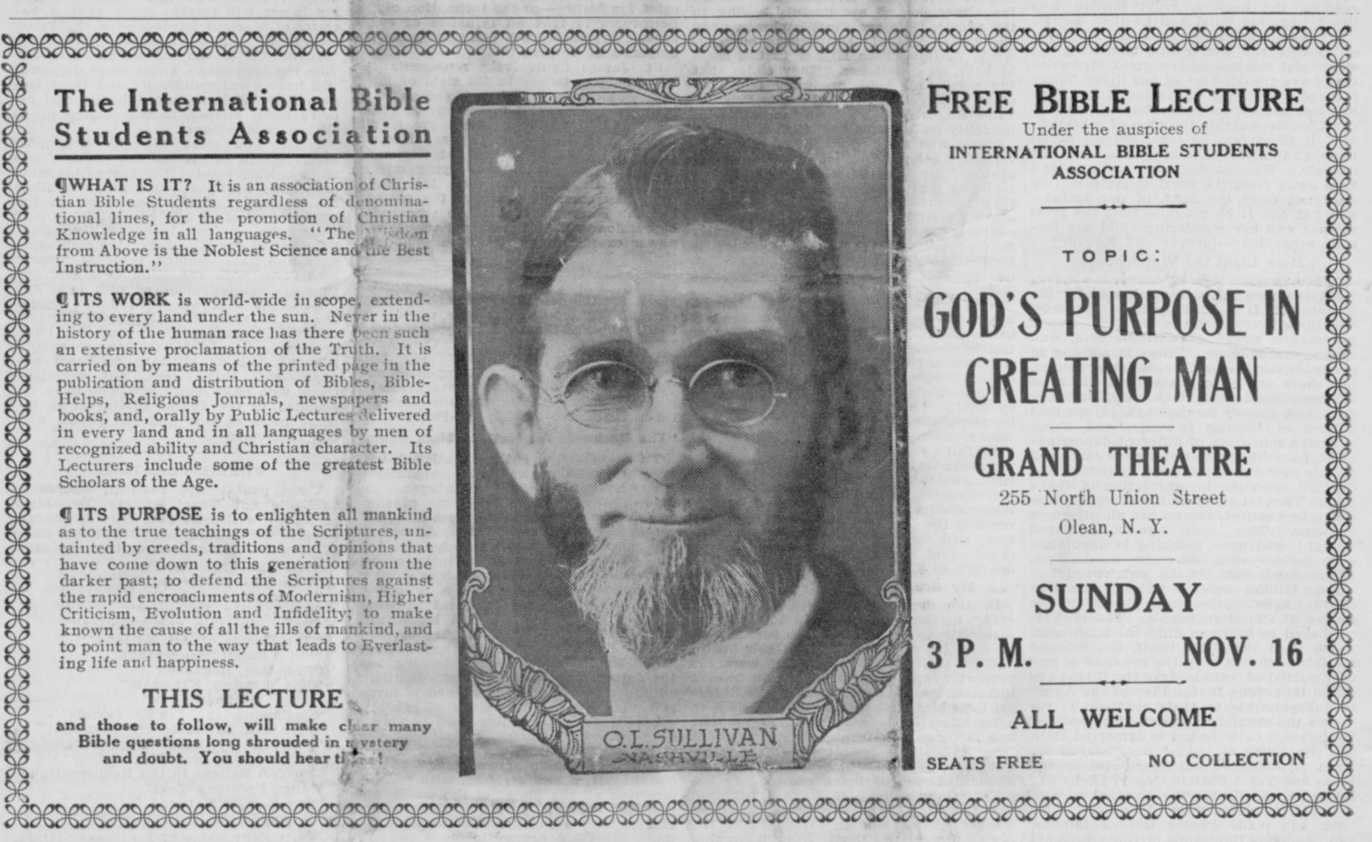
Free Bible Lecture
Under the auspices of
INTERNATIONAL BIBLE STUDENTS
ASSOCIATION
GOD S PURPOSE IN
CREATING MAN
GRAND THEATRE
255 North Union Street
Olean, N. Y
SUNDAY
NOV. 16
THIS LECTURE
ALL WELCOME
NO COLLECTION
SEATS FREE
C ITS PURPOSE is to enlighten all mankind as to the true teachings of the Scriptures, untainted by creeds, traditions and opinions that have come down to this generation from the darker past; to defend the Scriptures against the rapid encroachments of Modernism, Higher Criticism, Evolution and Infidelity; to make known the cause of all the ills of mankind, and to point man to the way that leads to Everlasting life and happiness.
Q ITS WORK is world-wide in scope, extending to every land under the sun. Neter in the history of the human race has there n such an extensive proclamation of the Truth. It is carried on by means of the printed pige in the publication and distribution of Bibles, Bible-Helps, Religious Journals, newspapers and books, and, orally by Public Lectures delivered in every land and in all languages by men of recognized ability and Christian character. Its Lecturers include some of the greatest Bible Scholars of the Age.
CWHAT IS IT? It is an association of Christian Bible Students regardless of denominational lines, for the promotion of Christian Knowledge in all languages. “The ' ’ dom from Alxive is the Noblest Science and uic Best Instruction.'* «
The Gospel of the Kingdom
Many wonder greatly why it was proper for our Lord and the Apostles to declare the Kingdom of Heaven at hand when, as a matter of fact, it has not yet come and, by the Lord’s directions, his followers still pray, “Thy Kingdom come; thy will be done on earth as it is done in heaven.” The understanding of this furnishes the key to the appreciation of much of the Bible that is now misunderstood. We must, therefore, outline the matter in some detail.
For more than sixteen centuries Israel has been waiting for the fulfillment of God's promise that they would become so great that through them the Divine blessing would extend to every nation. Our Lord through the Apostles signified that God’s time had come to fulfil all of his promises made to the Jewish nation if they were ready for them. To be ready they must be a holy nation. And to instruct them and prepare them their Law Covenant had been Introduced to them through Moses centuries before. And now, just preceding Jesus, John the Baptist had preached to them reformation, repentance, getting Into harmony with the Jjaw, that they, might be ready to re-ce.ve the Messiah. While as a people they were the most religious nation in the world at that time, nevertheless t.vt few of them were “Israelites indeed”—at heart fully consecrated to God; fully in accord with the principles of holiness. As a consequence, instead of the whole nation being ready for God’s work, only a small remnant of them were saintly and received the message.
Kingdom Privileges Transferred to Spiritual Israel
God foreknew this, however, and through the prophets declared that a remnant only would be found worthy. To the nation as a whole our Lord declared, "The Kingdom of God shall be taken from you and given to a nation bringing forth the fruits thereof” (Matt. 21:43). Accordingly five days before his crucifixion our Lord said to them, “Your house is left unto you desolate. • Ye shall see me no more until that day when we shall say. Blessed is he that cometh in the name of the Lord.”—Matt. 23:38, 39.
The Kingdom privileges or opportunities which were first offered to natural Israel were transferred to Spiritual Israel, whose existence began at Pentecost. All "Israelites indeed” of the fleshly house were privileged to become members of the spiritual house— to receive the begetting of the holy Spirit and adoption into the Body of Christ, which is the Church. Of this Church St. Peter says, “Ye are a Royal Priesthood, a Holy Nation, a peculiar people.”—1 Pet. 2:9.
After selecting as many Jews as were worthy a place in Spiritual Israel, nominal Israel was cast off from Divine favor until the completion of Spiritual Israel, when God promises that his favor shall return to them (Rom. 11:25, 26). Meantime the invitation has gone through the Lord’s faithful members to every nation, seeking such as have the spirit of loyalty to God, the spirit of “Israelites indeed." All such are accepted with the Jews as members of the same Kingdom. Around these Spiritual Israelites have gathered all sorts, so that there is an outward or nominal body or Church numbering millions, as well as a real body or Church scattered amongst them.
As at the end of the Jewish Age Jesus came to inspect them and to set up his Kingdom if enough worthy ones were to be found, so he will do in the end of this Gospel Age; he will come to Spiritual Israel to find the saintly. The Scriptures assure us that from first to last, from Pentecost until the end of thi>‘ige, a sufficient number of saints will t>e found to constitute the elect Church of Christ, designed of God to I e his Queen and Joint-Heir in the Mediatorial Kingdom, which will then be set up and begin the work of blessing the world. After the spiritual Kingdom of God shall have been exalted, the Bible assures us (Rom. 11:25-32), that God’s favor will return to natural Israel and they will be the first nation to be blessed under the New Order of things that will then prevail and through those of that people in harmony with God the blessing will extend to every nation.
“More Tolerable for Sodom” Than Capernaum
The Sodomites were wickedly immoral; yet, in the Master’s estimation, less wicked than those who, after hearing the Gospel, rejected it. This principle applies to many people and many cities of our day, as well as to Capernaum. The Master assures us that when the age to come, otherwise called the Day of Judgment, shall furnish opportunity for the whole world to be on trial for everlasting life or everlasting death, it will be more tolerable for the Sodomites than for many others. In proportion as anyone has come to a knowledge of Christ he has become responsible. The death of Christ secures for Adam and all of his race one full opportunity for salvation and no more. The majority have died in heathenish darkness without any opportunity: and many in Christian lands have disregarded their opportunity, as did the people of Capernaum. All must be brought to a full knowledge of their privileges in Christ and then all rejectors will be destroyed.—Act 3:23, 1 Tim. 2:4; Matt. 20:28.
“WHAT A FRIEND WE HAVE IN
JESUS."
“ ‘What a friend we have in Jesus,’ Sang a little child one day;
And a weary woman listened To the darling's happy lay.
“All her life seemed dark and gloomy. All her heart was sad with care;
Sweetly rang out baby's treble— ‘All our sins and griefs to bear.’
“She was pointing out the Savior, Who could carry every woe;
And the one who sadly listened Needed that dear Helper so!
“Sin and grief were heavy burdens For a fainting soul to bear;
But the baby singer bade her ‘Take it to the Lord in prayer.’
“With a simple, trusting spirit,
Weak and worn, she turned to God, Asking Christ to take her burden, Owuinir Him as her dear Lord.
“Jesus was her only Refuge,
He could take her sin and care. And He blessed the weary woman When she came to Him in prayer.
“And the happy child, still singing, Little knew she had a part
In God’s wondrous work of bringing Peace unto a troubled heart.”
—Unknown.
