 View PDF
The content displayed below is for educational and archival purposes only.
Unless stated otherwise, content is © 1913 International Bible Students Association

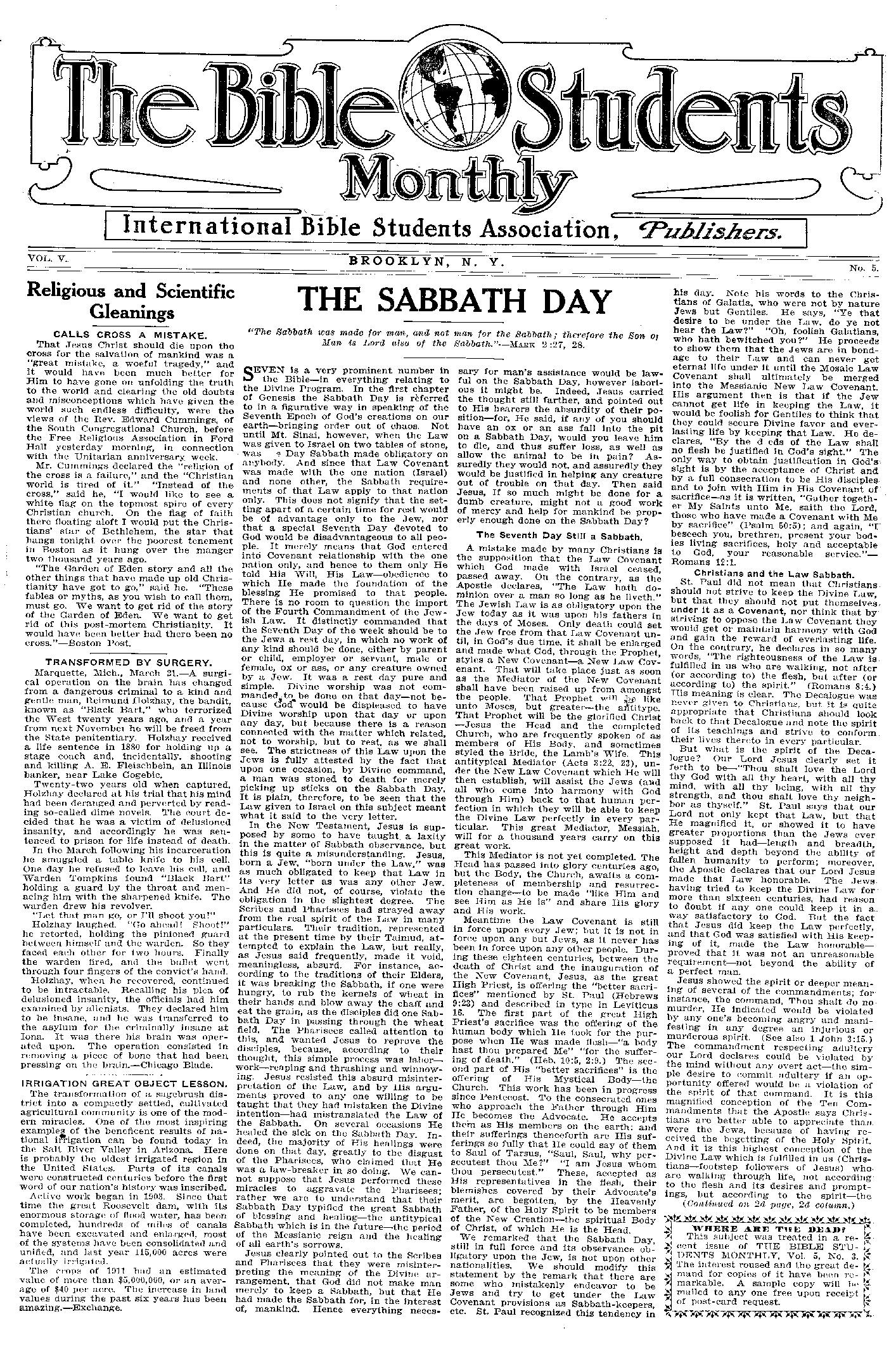
VOL. v. BROOKLYN, N. Y. No. 5.
Religious and Scientific Gleanings
CALLS CROSS A MISTAKE.
That Jesus Christ should die upon the cross for the salvation of mankind was a “great mistake, a woeful tragedy,” and it would have been much better for Him to have gone on unfolding the truth to the world and clearing the old doubts and misconceptions which have given the world such endless difficulty, were the views of the Rev. Edward Cummings, of the South Congregational Church, before the Free Religious Association in Ford Hall yesterday morning, in connection with the Unitarian anniversary week.
Mr. Cummings declared the “religion of the cross is a failure,” and the “Christian world is tired of it.” “Instead of the cross,” said he, “I would like to see a white flag on the topmost spire of every Christian church. On the flag of faith there floating aloft I would put the Christians’ star of Bethlehem, the star that hangs tonight over the poorest tenement in Boston as it hung over the manger two thousand years ago.
“The Garden of Eden story and all the other things that have made up old Christianity have got to go,” said he. “These fables or myths, as you wish to call them, must go. We want to get rid of the story of the Garden of Eden. We want to get rid of this post-mortem Christianity. It would have been better had there been no cross.”—Boston Post.
TRANSFORMED BY SURGERY.
Marquette, Mich., March 21.—A surgical operation on the brain has changed from a dangerous criminal to a kind and gentle man, Reimund Holzhay, the bandit, known as “Black Bart,” who terrorized the West twenty years ago, and a year from next Novembei he will be freed from the State penitentiary. Holzhay received a life sentence in 1880 for holding up a stage coach and, incidentally, shooting and killing A. E. Fleischbein, an Illinois banker, near Lake Gogebic.
Twenty-two years old when captured, Holzhay declared at his trial that his mind had been deranged and perverted by reading so-called dime novels. The court decided that he was a victim of delusioned insanity, and accordingly he was sentenced to prison for life instead of death.
In the March following his incarceration he smuggled a table knife to his cell. One day he refused to leave his cell, and Warden Tompkins found “Black Bart” holding a guard by the throat and menacing him with the sharpened knife. The warden drew his revolver.
“Let that man go, or I’ll shoot you!”
Holzhay laughed. “Go ahead! Shoot!” he retorted, holding the pinioned guard between himself and the warden. So they faced each other for two hours. Finally the warden fired, and the bullet went through four fingers of the convict’s hand.
Holzhay, when he recovered, continued to be intractable. Recalling his plea of delusioned insanity, the officials had him examined by alienists. They declared him to be insane, and he was transferred to the asylum for the criminally insane at Iona. It was there his brain was operated upon. The operation consisted in removing a piece of bone that had been pressing on the brain.—Chicago Blade.
IRRIGATION GREAT OBJECT LESSON.
The transformation of a sagebrush district into a compactly settled, cultivated agricultural community is one of the modern miracles. One of the most inspiring examples of the beneficent results of national irrigation can be found today in the Salt River Valley in Arizona. Here is probably the oldest irrigated region in the United States. Parts of its canals were constructed centuries before the first word of our nation’s history was inscribed.
Active work began in 1903. Since that time the great Roosevelt dam, with its enormous storage of flood water, has been completed, hundreds of miles of canals have been excavated and enlarged, most of the systems have been consolidated and unified, and last year 115,000 acres were actually irrigated.
The crops of 1911 had an estimated value of more than $5,000,000, or an average of $40 per acre. The increase in land values during the past six years has been amazing.—Exchange.
THE SABBATH DAY
“The Sabbath was made 'for man, and not man for the Sabbath; therefore the Son 0) Man is Lord also of the Sabbath.”—Mark 2:27, 28.
SEVEN is a very prominent number in the Bible—in everything relating to the Divine Program. In the first chapter of Genesis the Sabbath Day is referred to in a figurative way in speaking of the Seventh Epoch of God’s creations on our earth—bringing order out of chaos. Not until Mt. Sinai, however, when the Law was given to Israel on two tables of stone, was e Day Sabbath made obligatory on anybody. And since that Law Covenant was made with the one nation (Israel) and none other, the Sabbath requirements of that Law apply to that nation only. This does not signify that the setting apart of a certain time for rest would be of advantage only to the Jew, nor that a special Seventh Day devoted to God would be disadvantageous to all people. It merely means that God entered into Covenant relationship with the one nation only, and hence to them only He told His Will, His Law—obedience to which He made the foundation of the blessing He promised to that people. There is no room to question the import of the Fourth Commandment of the Jewish Law. It distinctly commanded that the Seventh Day of the week should be to the Jews a rest day, in which no work of any kind should be done, either by parent or child, employer or servant, male or female, ox or ass, or any creature owned by a Jew. It was a rest day pure and simple. Divine worship was not commanded* to.* be done on that day—not because God" would be displeased to have Divine worship upon that day or upon any day, but because there Is a reason connected with the matter which related, not to worship, but to rest, as we shall see. The strictness of this Law upon the Jews is fully attested by the fact that upon one occasion, by Divine command, a man was stoned to death for merely picking up sticks on the Sabbath Day. It is plain, therefore, to be seen that the Law given to Israel on this subject meant what it said to the very letter.
In the New Testament, Jesus is supposed by some to have taught a laxity in the matter of Sabbath observance, but this is quite a misunderstanding. Jesus, born a Jew, “born under the Law,” was as much obligated to keep that Law in its very letter as was any other Jew. And He did not, of course, violate the obligation in the slightest degree. The Scribes and Pharisees had strayed away from the real spirit of the Law in many particulars. Their tradition, represented at the present time by their Talmud, attempted to explain the Law, but really, as Jesus said frequently, made it void, meaningless, absurd. For instance, according to the traditions of their Elders, it was breaking the Sabbath, if one were hungry, to rub the kernels of wheat in their hands and blow away the chaff and eat the grain, as the disciples did one Sabbath Day in passing through the wheat field. The Pharisees called attention to this, and wanted Jesus to reprove the disciples, because, according to their thought, this simple process was labor— work—reaping and thrashing and winnowing. Jesus resisted this absurd misinterpretation of the Law, and by His arguments proved to any one willing to be taught that they had mistaken the Divine intention—had mistranslated the Law of the Sabbath. On several occasions He healed the sick on the Sabbath Day. Indeed, the majority of His healings were done on that day, greatly to the disgust of the Pharisees, who claimed that He was a law-breaker in so doing. We cannot suppose that Jesus performed these miracles to aggravate the Pharisees; rather we are to understand that their Sabbath Day typified the great Sabbath of blessing and healing—the antitypical Sabbath which is in the future—the period of the Messianic reign and the healing of all earth’s sorrows.
Jesus clearly pointed out to the Scribes and Pharisees that they were misinterpreting the meaning of the Divine arrangement, that God did not make man merely to keep a Sabbath, but that He had made the Sabbath for, in the interest of, mankind. Hence everything necessary for man’s assistance would be lawful on the Sabbath Day, however laborious it might be. Indeed, Jesus carried the thought still farther, and pointed out to His hearers the absurdity of their position—for, He said, if any of you should have an ox or an ass fall into the pit on a Sabbath Day, would you leave him to die, and thus suffer loss, as well as allow the animal to be in pain? Assuredly they would not, and assuredly they would be justified in helping any creature out of trouble on that day. Then said Jesus, If so much might be done for a dumb creature, might not a good work of mercy and help for mankind be properly enough done on the Sabbath Day?
The Seventh Day Still a Sabbath.
A mistake made by many Christians is the supposition that the Law Covenant which God made with Israel ceased, passed away. On the contrary, as the Apostle declares, “The Law hath dominion over a man so long as he liveth.” The Jewish Law is as obligatory upon the Jew today as it was upon his fathers in the days of Moses. Only death could set the Jew free from that Law Covenant until, in God’s due time, it shall be enlarged and made what God, through the Prophet, styles a New Covenant—a New Law Covenant. That will take place just as soon as the Mediator of the New Covenant shall have been raised up from amongst the people. That Prophet w’H like unto Moses, but greater—the antitype. That Prophet will be the glorified Christ —Jesus the Head and the completed Church, who are frequently spoken of as members of His Body, and sometimes styled the Bride, the Lamb’s Wife. This antitypical Mediator (Acts 3:22, 23), under the New Law Covenant which He will then establish, will assist the Jews (and all who come into harmony with God through Him) back to that human perfection in which they will be able to keep the Divine Law perfectly in every particular. This great Mediator, Messiah, will for a thousand years carry on this great work.
This Mediator is not yet completed. The Head has passed into glory centuries ago, but the Body, the Church, awaits a completeness of membership and resurrection change—to be made “like Him and see Him as He is” and share His glory and His work.
Meantime the Law Covenant is still in force upon every Jew; but it is not in force upon any but Jews, as it never has been in force upon any other people. During these eighteen centuries, between the death of Christ and the inauguration of the New Covenant, Jesus, as the great High Priest, is offering the “better sacrifices” mentioned by St. Paul (Hebrews 9:23) and described in type in Leviticus 16. The first part of the great High Priest’s sacrifice was the offering of the human body which He took for the purpose when He was made flesh—“a body hast thou prepared Me” “for the suffering of death.” (Heb. 10:5, 2:9.) The second part of His “better sacrifices” is the offering of His Mystical Body—the Church. This work has been in progress since Pentecost. To the consecrated ones who approach the Father through Him He becomes the Advocate. He accepts them as His members on the earth; and their sufferings thenceforth are His sufferings so fully that He could say of them to Saul of Tarsus, “Saul, Saul, why persecutes! thou Me?” “I am Jesus whom thou persecutest.” These, accepted as His representatives in the flesh, their blemishes covered by their Advocate’s merit, are begotten, by the Heavenly Father, of the Holy Spirit to be members of the New Creation—the spiritual Body of Christ, of which He is the Head.
We remarked that the Sabbath Day, still in full force and its observance obligatory upon the Jew, is not upon other nationalities. We should modify this statement by the remark that there are some who mistakenly endeavor to be Jews and try to get under the Law Covenant provisions as Sabbath-keepers, etc. St. Paul recognized this tendency in his day. Note his words to the Christians of Galatia, who were not by nature Jews but Gentiles. He says, “Ye that desire to be under the Law, do ye not hear the Law?” "Oh, foolish Galatians, who hath bewitched you?” He proceeds to show them that the Jews are in bondage to their Law and can never get eternal life under it until the Mosaic Law Covenant shall ultimately be merged into the Messianic New Law Covenant. His argument then is that if the Jew cannot get life in keeping the Law, it would be foolish for Gentiles to think that they could secure Divine favor and everlasting life by keeping that Law. He declares, “By the d eds of the Law shall no flesh be justified in God’s sight.” The only way to obtain justification in God’s sight is by the acceptance of Christ and by a full consecration to be His disciples and to join with Him in His Covenant of sacrifice—as it is written, “Gather together My Saints unto Me, saith the Lord, those who have made a Covenant with Me by sacrifice” (Psalm 50:5); and again, “I beseech you, brethren, present your bodies living sacrifices, holy and acceptable to God, your reasonable service.”— Romans 12:1.
Christians and the Law Sabbath.
St. Paul did not mean that Christians should not strive to keep the Divine Law, but that they should not put themselves under it as a Covenant, nor think that by striving to oppose the Law Covenant they would get or maintain harmony with God and gain the reward of everlasting life. On the contrary, he declares in so many words, “The righteousness of the Law is fulfilled in us who are walking, not after (or according to) the flesh, but after (or according to) the spirit.” (Romans 8:4.) His meaning is clear. The Decalogue was never given to Christians, but it is quite appropriate that Christians should look back to that Decalogue and note the spirit of its teachings and strive to conform their lives thereto in every particular.
But what is the spirit of the Decalogue? Our Lord Jesus clearly set it forth to be—“Thou shalt love the Lord thy God with all thy heart, with all thy mind, with all thy being, with all thy strength, and thou shalt love thy neighbor as thyself.” St. Paul says that our Lord not only kept that Law, but that He magnified it, or showed it to have greater proportions than the Jews ever supposed it had—length and breadth, height and depth beyond the ability of fallen humanity to perform; moreover, the Apostle declares that our Lord Jesus made that Law honorable. The Jews having tried to keep the Divine Law for more than sixteen centuries, had reason to doubt if any one could keep it in a way satisfactory to God. But the fact that Jesus did keep the Law perfectly, and that God was satisfied with His keeping of it, made the Law honorable— proved that it was not an unreasonable requirement—not beyond the ability of a perfect man.
Jesus showed the spirit or deeper meaning of several of the commandments; for instance, the command, Thou shalt do no murder, He indicated would be violated by any one’s becoming angry and manifesting in any degree an injurious or murderous spirit. (See also 1 John 3:15.) The commandment respecting adultery our Lord declares could be violated by the mind without any overt act—the simple desire to commit adultery if an opportunity offered would be a violation of the spirit of that command. It is this magnified conception of the Ten Commandments that the Apostle says Christians are better able to appreciate than, were the Jews, because of having received the begetting of the Holy Spirit. And it is this highest conception of the Divine Law which is fulfilled in us (Christians—footstep followers of Jesus) who are walking through life, not according to the flesh and its desires and promptings, but according to the spirit—the
(Continued on 2d page, 2d column.)
>4 WHERE AKI' THE HEAD?
x| This subject was treated in a re-y| cent issue of THE BIBLE STU-DENTS MONTHLY, Vol. 5, No. 3. The interest roused and the great de-mand for copies of it have been re-y< markable. A sample copy will be y mailed to any one free upon receipt * of post-card request.
foible ^Indents IHonthhj
PlIBUKEU .w
13-17 HICKS ST.. BROOKLYN, N. Y.
C. W. Hek, Editor.
Monthly—12 cts. a Year. Single Copy, 1c.
|
An Independent, Unsectarian Re- |
|
ligious Newspaper, Specially Devoted |
|
to the Forwarding of the Laymen's |
|
Home Missionary Movement for the |
|
Glory of God and Good of Humanity. |
PROHIBITION IN KANSAS.
The Hon. C. W. Trickett, who, as special attorney-general, undertook the work of abolishing the unlawful sale of liquor in Kansas City, Kan., and drove the liquor business out of that city, spoke here the other night and made some forceful statements of conditions in Kansas. In part he said:
“There are 3,300,000 people in Missouri and 1,690,000 in Kansas. If the saloon has made more money for Missouri, your cities should show it in improvements, such as paving, etc. There are a number of cities in Missouri of more than five thousand inhabitants without paved streets. I defy any one to find a city of more than 1,500 population in Kansas which does not have paved streets and its electric light plant.
“A short time ago I got the records in Jefferson City, and found the tax rolls showed the total assessed property in Missouri is $1,650,000,000. In Kansas, where we have had prohibition for thirty years, the amount is $2,750,000,000. In thirty years, from the poorest State in the country, it has come to be the richest. A few years ago, during the panic, Kansas banks sent $50,000,000 to the East, but Missouri did not send a dollar. Kansas has organized more banks in the last five years than any other State.
“In Missouri there is one motor car for every one hundred farmers, one for every thirty-five in Iowa and one for every five in Kansas.
“You may say that you are spending your money for labor. Statistics show that a little less than $8 a week is paid for labor here. In Kansas it is $14. Missouri hasn’t put it in her schools, for Kansas has paid proportionately twice as much for education.
In the last twenty years you have spent $1,600,000,000 for liquor, an amount equal to your taxable property. In that time, Kansas has spent but $50,000,000.”—Reform Bulletin (N. Y.).
ACCIDENTS AND FATIGUE.
It was shown by an exhaustive inquiry ■of the subject in France that the number of accidents increases, progressively hour by hour during the first half day; that after the rest at midday the number of accidents is notably less than in the last hour of the forenoon; that in the course of the second half day accidents again become from hour to hour progressively more numerous, and that the maximum number of accidents toward the end of the second half day is notably higher than the corresponding maximum in the morning.
The influence of the workingmen’s fatigue on the production of accidents .stands out clearly from these observations, and it is easy to understand how this comes about when it is remembered that with fatigue the attention readily diminishes and disappears. T.he conclusion, therefore, is that in order to produce a •diminution in the number of accidents it would be sufficient to intercalate in the middle of each half day of work a period ■of repose, naturally not so long as that at midday, but the length of which remains to be determined. In fact, one would only have to apply to the manual labor of adults the measures which for a long time have been put into practice for -children as regards their intellectual labor.—Exchange.
THE MORNING GLORY.
Was it worth while to paint so fair
The every leaf—to vein with faultless art Each petal taking the boon—the light and air
Of summer—so to heart?
To bring thy beauty unto perfect flower, Then, like the passing fragrance of a smile,
Vanish away, beyond recovery’s power— Was it, frail bloom, worth while?
Thy silence answers: “Life was mine!
And I, who pass without regret or grief, Have cared the more to make my moment fine, Because it was so brief.
“In its first radiance I have seen
The sun—why tarry then till comes the night?
I go my way, content that I have been Part of the morning light!”
■—Florence Earle Coates.
WHAT IS THE SOUL?
A postal-card request will secure for you a free copy of this paper in which this interesting subject is treated in a manner that will satisfy the most ■exacting.
(Continued from 1st page, 4th column.) spirit of the Divine Law, the spirit which the Father hath sent forth into our hearts—the desire to be like Him who is the Fountain of Love and Purity.
The Spirit of the Sabbath.
And there is another or deeper meaning to the other commandments than was understood by the Jews; so it is also with the Fourth, which enjoins the keeping of the Seventh Day as a day of rest or Sabbath. The word Sabbath signifies rest, and its deeper or antitypical meaning to the Christian is the rest of faith. The Jew, unable to keep the Mosaic Law and unable, therefore, to get everlasting life under the Law Covenant, was exhorted to flee to Christ; and, by becoming dead to the Law Covenant, by utterly renouncing it, he was provileged to come into membership in Christ—become sharer in the Covenant of sacrifice. So doing, he was promised rest from the Law and its condemnation, because “to them that are in Christ there is no condemnation”—the merit of Christ covers the shortcomings of all those who are striving to walk in His steps, and the Divine Spirit and Word give them the assurances of Divine favor, which ushers them into peace with God through our Lord Jesus Christ—ushers them into rest. Thus the Apostle declares, “We which believe do enter into (Sabbath) rest.”— Hebrews 4:3.
Moreover, the Apostle indicates that although we enter into a rest of faith now, through faith and obedience to Christ, Christians have a still greater rest awaiting them beyond their resurrection, when they shall enter into the rest which is in reservation for those that love the Lord—the rest, the perfection, on the spirit plane, attained, as the Apostle describes, by resurrection—“sown In weakness, raised in power; sown in dishonor, raised in glory; sown an animal body, raised a spirit body.”
Fiftieth Day and Fiftieth Year.
Here we are reminded that Israel had two systems of Sabbaths—one of Sabbath Days and the other of Sabbath Years. The Sabbath Days began to count in the spring. It was a multiple of seven. Seven times seven days (forty-nine days) brought them to the Jubilee day, the fiftieth day, which was styled Pentecost. It is scarcely necessary to call attention to the fulfilment of the antitype of this. Pentecost never had its true meaning until the Lord, as “the First-fruits of them that slept,” arose from the dead. Then immediately the seven times seven, plus one, began to count, and on the fiftieth day the Holy Spirit was shed abroad upon all those “Israelites indeed” who, already consecrated, were vyiting in the upper room for the antitypical High Priest to make satisfaction for their sins and to shed forth upon them the Holy Spirit, as the evidence of their restoration to Divine favor. Immediately they had peace with God. Immediately they entered into rest. Immediately they realized that they were children of God, begotten of the Holy Spirit, that they might in due time become joint-heirs with Jesus Christ their Lord. And is it not true that all down throughout this Gospel Age all who follow in the footsteps of Jesus and the disciples, all who renounce sin, trust in Jesus and fully consecrate their lives to Him, become recipients of the Holy Spirit and similarly enter into His rest? Only those who have entered into this rest and joy of the Holy Spirit can fully appreciate the matter.
Now let us glance at the year Sabbath. Every seventh year the land had its rest. And seven times seven (forty-nine) brought them up to the fiftieth year or the Year of Jubilee, in which year all debts were cancelled and each Israelite returned to his own inheritance. It was a Year of rest, peace, joy. That Jubilee pictures the glorious Restitution Times of Messiah’s Kingdom, which, we believe, are nigh, even at the door. When these times shall be ushered in, all the faithful followers of Jesus will have reached the heavenly condition, to be forever with the Lord. Their rest (Sabbath keeping) will have reached its completion, its perfection, and throughout that antitypical Jubilee the blessings of Divine favor will be gradually extended to the whole world, that every creature desirous of coming into harmony with God may enter into the rest which God has provided for the poor, groaning creation through the great Redeemer.
The Christian’s Sunday Sabbath.
From what we have already seen it is manifest that God has put no Sabbath obligations upon the Christian—neither for the seventh day nor for any other day of the week. He has, however, provided for them a rest in the Lord, which is typified by the Jewish Sabbath Day. Do we ask upon which day we should celebrate this rest? We answer that we should be in this heart attitude of joy, rest, peace in the Lord and in His finished work, every day. So, then, the Christian, instead of having a Sabbath rest day, as the Jew, has rest perpetual —every day. And instead of its being merely a rest for his body, it is better— a rest for his soul, a rest for his entire being. It can be enjoyed wherever he may be, “at home or abroad, on the land or the sea,” for “as his days may demand, shall his rest ever be.” This is the spiritual antitype to the spiritual Israelite, of the Law Sabbath given to the natural Israelites. Whoever quibbles for the day Sabbath of the Jew shows clearly that he has not understood nor appreciated as yet, to the full, at least, the antitypical Sabbath which God has provided for the Spiritual Israelite through Christ.
But is there not a compulsion to the Christian to observe one day in the week sacred to the Lord? Yes, we answer; there is an obligation upon him such as there is upon no one else in the world. He is obligated by his Covenant to the Lord to keep every day sacred to the Lord. Every day he is to love the Lord his God with all his heart, with all his mind, with all his being, with all his strength; every day he is to love his neighbor as himself. And while striving to the best of his ability to conform to this spirit of the Divine Law, and while realizing that the blood of Jesus Christ our Redeemer cleanses us from all the imperfections contrary to our intentions —these may rest in the peace and joy of the Lord continually. “We which believe do enter into rest.”
There is no day of the week commanded to the spiritual Israelite as respects physical or mental rest—the latter they may have always, and the former may be ordered by human regulations for one day or for another. The Christian is commanded to be subject to the laws that be, in all such matters as are non-essential, not matters of conscience.
The Right Use of Liberty.
Let us remember, however, that our liberty in Christ is the liberty from the weight and condemnation of sin and death. Let us not think specially of a liberty from the Jewish restraints of the Seventh Day, nor think especially of the fact that no day above anotner has been commanded upon Christians in the Bible. Let us rather cohsider this liberty as of minor consequence and importance as compared with our liberation from the power of sin and death.
If one day or another be set apart by human lawgivers, let us observe their commands. Let us be subject to every ordinance of men. In Christian lands generally the first day of the week is set apart by law. Shall we ignore this law and claim that God has put no such law upon us and that we should have our liberty to do business, etc.? Nay, verily; rather, on the other hand, let us rejoice that there is a law which sets apart one day in seven for rest from business, etc. Let us use that day as wisely and as well as we are able for our spiritual upbuilding and for assistance to others. What a blessing we have in this provision! How convenient it makes it for us to assemble ourselves together for worship, praise, the study of the Divijie*Word! And if earthly laws provided more than
THE TRUE CHURCH
“But ye are come ... to the General Assembly and Church of the First-born, which are written in Heaven.”—Hebbews 12 :22, 23.
THE oneness of the Church of Christ is everywhere made prominent in the Bible. Sects and parties are nowhere recognized. Nowhere is it intimated that Christ has various Churches—for instance, the Roman Catholic, the Anglican, the Greek, Presbyterian, Congregational, Lutheran, etc. On the contrary, there is but the one “Church, which is the Body of Christ,” and that Body of Christ has but the one Head, Jesus.
We not only find that Christ and the Apostles established but the one Church, but we cannot think of any reason why these should have established more than one. Nothing is plainer than that our sectarian divisions arose from our neglect and loss of “the faith once delivered unto the saints.” (Jude 3.) As the divisions came in, the errors came in with them; and, as the errors go out, so also will sectarianism pass away.
The General Assembly of the Saints.
We should not be under any human or sectarian name, nor divided by sectarian creeds, but united as one people through our consecration to the Lord, through our desire to know His will by the study of His Word. We thus represent the Scriptural or ideal Church of Christ. Regardless of nationality, language, caste and of all sectarian creeds and bondages, we are simply and solely as children of God, to be Bible students in the School of Christ, to learn of Him—to be fitted and prepared for glorious joint-heirship with Him in His coming Kingdom, and meantime to learn at His feet the lessons necessary for so great a coming service.
Enter Into the Joys of the Lord.
-
(1) The joys of the present are merely a foretaste of the perfect glory we will experience when we enter into the joys of the Lord—beyond the veil. Now we know in part the wondrous things of our Heavenly Father’s character and Plan, and of our Redeemer’s love and sympathy, and of each other’s love and sympathy; then we shall know even as we are known, is the guarantee of the inspired Apostle.
Now we see as through an obscure glass the things which the natural eye cannot see nor hear, neither can enter into the heart of the natural man, but which God has revealed unto us by His Spirit. But they are still more or less obscure to us. one Sabbath (rest) day in the week we might well rejoice in that also, for it would afford us that much more opportunity for spiritual refreshment and fellowship.
Nor should our knowledge of the liberty we enjoy in Christ ever be used in such a manner that it might stumble others. Our observance of the Sabbath enjoined by the law of the land should be most complete—to the very letter— that our good be not evil spoken of— that our liberty in Christ and freedom from the Mosaic Law be not misunderstood to be a business or pleasure license, but a privilege and opportunity for the worship and service of the Lord, and the building up of the brethren in the most holy faith, “once delivered to the saints.”
Who Changed the Sabbath Day?
Often the question is asked, Who changed the Sabbath Day to Sunday? The proper answer is that nobody chariged it. The seventh day (Saturday) is still as obligatory upon the Jew as it ever was.
The early Christians observed the seventh day for a long time, because it was the law of the land, which gave them a favorable opportunity for meeting for praise, prayer and the study of God’s Word. In addition, the fact that Jesus arose from the dead on the first day of the week, and that He met with them on that day, led them to meet again and again on the first day, in hope that He would again appear; thus gradually it became a custom for them to meet on that day for Christian fellowship. In this way, so far as we know, both the first day and the seventh day of the week were observed by Christians for quite a time, but neither was understood to be obligatory—a bondage. Both days were privileges. And as many other days of the week as circumstances would permit were used in praising God and building one another up in the most holy faith, just as God’s people are doing, or should be doing, in this, our day.
Are we told that a pope once designated that the first day of the week should be observed by Christians as the Christian Sabbath? We answer that this may be so, but that neither popes nor any beings, not even the Apostles, could have right to add to or to take from the Word of God. St. Paul particularly warned the Church against coming into bondage to the Jewish customs of observing new moons and Sabbaths as though these were obligations upon Christians. The Son of God has made us free—free indeed. But our freedom from the Law Covenant of Israel enables us the more and the better to observe the very spirit of the Divine Law daily, hourly, and to present our bodies living sacrifices, holy and acceptable to God through the merit of our Redeemer.
We cannot weigh nor appreciate the wonderful glories which God has in reservation for us, but then we shall see Him face to face, as St. Paul declares.
-
(2) As New Creatures in Christ, we seek to know each other as God knows us, not after the flesh, but after the spirit. But for all that we experience difficulties. It is often difficult for us to entirely overlook the flesh of our brethren, as they no doubt have difficulty in overlooking our blemishes in the flesh. But oh, what will it be to be there! All the imperfections and weaknesses of the flesh, against which we must now fight—all these will then be gone.
Have we not the promise, “We shall be like Him, for we shall see Him as He is”? Have we not the promise again that, Sown in weakness, we shall be raised in power; sown in dishonor, we shall be raised in glory; sown an animal body we shall be raised a spirit body? Have we not the further promise respecting that glorious resurrection change, which shall lift us completely out of the human and into the divine nature, that “We must all be changed,” “for flesh and blood cannot inherit the Kingdom of God?”— 1 Corinthians 15:50, 51.
Further Trials—Further Battlings.
We remember that we “have not yet resisted unto blood, striving against sin” and fighting “the good fight of faith.” We still have need of the Scriptural exhortation, “Watch,” and “stand fast”; “Quit you like men”; “Put on the whole armor that ye may be able to stand in the evil day, and, having done all, to stand.”
Every spiritual help and assistance we receive are parts of the Father’s good providence for us whereby we shall be the stronger, the more courageous, the better prepared for further trials, besetments, difficulties and conflicts with the world, the flesh and the Adversary.
But when we reach the glorious condition mentioned by the Apostle, all the fightings and trials and testings will be in the past. For us, therefore, there will be no more sighing, no more crying, no more dying, no more fightings, no more crosses, no more sufferings, but instead, life eternal, joy eternal, glory, honor and immortality at our dear Redeemer’s right hand of favor. Well do we know that this hope of sharing in the General Assembly of the Church of the First-borns strengthens and nerves His own to loyalty and faithfulness to the Lord, the Truth and the brethren as the days go by.
Let us console ourselves with the thought that whatever is the will of God concerning us must necessarily be for our highest welfare and best interests. If, therefore, it is not yet time for us to pass beyond the veil, it is because our Heavenly Father and our Redeemer have a work for us to do in the present life—• either a work of further polishing upon our own characters or a work of helping the brethren, for we remember the declaration that the Bride is to make herself ready for that event. We are to build one another up in the most holy faith, encouraging, strengthening, sympathizing with and assisting one another in running the race for the great Prize.
Another happifying thought we should carry with us day by day is the Lord’s promise, “I will never leave thee nor forsake thee.” And again, “My grace is sufficient for thee, for My strength is made perfect in thy weakness.” And again, “We know that all things work together for good to those who love the Lord, to the called according to His purpose.”—Romans 8:28.
So, then, let us not lose heart and flee from the battle, like an army corps in retreat, but rather, as a company of good soldiers who have been refreshed and encouraged and stimulated, we will return to our duties full of good courage, full of joyful anticipation of the coming Great Home-Gathering of the Church of the First-borns; full of renewed determination that by the grace of God, and with the assistance of our great Advocate, we will make our calling and election sure by so running in His footsteps as to obtain the great Prize which He has offered to us.
The Context In Agreement.
Let us detain you a little longer that we may point out afresh that the context confirms our glorious hope respecting this Great Convention of the future, and shows that it is nigh at hand. St. Paul pictures before us the fact that God’s dealings with Israel, in bringing them out of Egyptian bondage and to Mt. Sinai, pictured the work of this Gospel Age, in the calling of Spiritual Israel out of the bondage of the world—the bondage of sin and death. The Apostle thus shows that the giving of the Law Covenant to Israel at Mt. Sinai typically represented the giving to them of the New Law Covenant from Mt. Zion in the end of this Age.
The Law Covenant was given through a mediator, Moses, and the New Law Covenant is to be given through a Mediator, the Antitypical Moses, Jesus the Head and the Church His Body. It has required all this Gospel Age to gather out of the world, and to try, test, polish and fit the members of the Body of Christ, who, under His Headship, will be with Him the Antitypical Moses, the Antitypical Mediator between God and men.— Jeremiah 31:31; Acts 3:22, 23.
As Moses went up into the Mount to commune with God before the Law Covenant was completed, so the entire Church must go up into the Mountain, into the Kingdom, with our glorious Head and Redeemer, by the change of the First Resurrection. As the time for Moses’ going up into the mountain drew near, there were great manifestations of the dignity of the Divine Government. And just so in the closing of this Age, the Apostle informs us, the world will have terrifying experiences on a still greater scale. He says that then the mountain trembled ■and smoked and that the Divine voice was heard. The people were so terrified that they entreated that they might not hear further, but that Moses might act as mediator, and he did so.
So it will be here: There will be such manifestations of Divine Justice and opposition to sin and all iniquity that it will cause the “time of trouble” mentioned by the Prophet and by Jesus, “A time of trouble such as never was since there was a nation; no, nor ever shall be” after.—Daniel 12:1; Matthew 24:21.
The result of this great time of trouble upon the world will be a realization that they need a Mediator—a Mediatorial Kingdom. And this is just what God has provided for them through the arrangement of the New Covenant.
The Shaking Already Commenced.
Contrasting the experiences at the inauguration of the typical Law Covenant with those to be expected at the inauguration of the antitypical, the New Law Covenant, St. Paul says, “God’s voice then shook the earth, but now He hath promised, saying, Yet once more I shake not the earth only, but also heaven.” And the Apostle explains that the expression, “Once more,” signifies that this second shaking will be so thorough that no further shaking will ever be necessary, but everything of injustice and unrighteousness which ought to be shaken loose will be shaken; and this, says the Apostle, implies everything except the Church and
-AX XtZ XtZ XtZ xtz xtz xtz xtz xtx xtz xtz xtz Xt*. d THE BATTLE OF ARMAGEDDON. & « In a recent issue of BIBLE STU- L N DENTS MONTHLY this subject was
fully treated from the standpoint of !z the Scriptures. A sample copy will p be sent free upon request. &
%UW>4X Z»X X(x X>X X|X Zi<x?x the glorious Kingdom which we shall then receive: “Wherefore we, receiving a Kingdom which cannot be moved, let us have grace, whereby we may serve God acceptably with reverence and godly fear.”—Hebrews 12:18-29.
Can we not see the shaking already beginning? Let us remember that this time it will not be the shaking of the literal earth, as in the type, but the shaking of the symbolical earth—the shaking of society to its very center. Do you not already hear the rumblings—the rumblings of discontent, anger, malice, hatred, strife? These forebode the “great earthquake,” an expression symbolic of the great Revolution, wherein the present order of things shall collapse and give place to the New Order of Immanuel’s Kingdom of righteousness, justice, equity.
And, says the Apostle, God intends this time to shake not merely the earth—the social fabric—but also the heaven—the ecclesiastical powers of the present time. Not the true Church will be shaken, but the many systems which more or less misrepresent the true Church and “the faith which was once delivered unto the saints.”—Jude 3.
Do we see premonitions of this shaking? Yea, verily. In all denominations there are forebodings of coming trouble. We may even fear that some of the attempts at Christian union are not made with the proper motive, but through a realization of the shaking which the Lord is about to permit to come upon the ecclesiastical systems of this present time.
“SONGS IN THE NIGHT”
Psalm 85.
“The Lord hath done great things for us; tohereof we are glad.”—Psalm 126 :3.
WE are still in the night of weeping.
Sickness, sorrow, sighing and dying continue, and will continue until the glorious morning of Messiah’s Kingdom. How glad we are that we have learned that then the glorious change will come to earth! The Prophet David expresses this thought, saying, “Weeping may endure for a night, but joy cometh in the morning.” (Psalm 30:5.) St. Paul breathed the same sentiment when he declared, “The whole creation groaneth and travail-eth in pain together until now, waiting for the manifestation of the sons of God.” (Romans 8:19, 22.) The sons of God in glory will, with their Lord, constitute Emmanuel’s Kingdom.
At present these sons of God are comparatively little known or recognized amongst men; frequently they are considered “peculiar people,” because of their zeal for righteousness and Truth and for God . “Beloved, now are we the sons of God; and it doth not yet appear what we shall be, but we know that when He shall appear we shall be like Him, for we shall see Him as He is”; and we shall share His glory, honor and immortality, and with Him scatter Divine blessings to all the families of the earth.—1 John 3:2.
“A Song of Deliverance.”
Our lesson, the 85th Psalm, may properly have several applications. The first of these would be to Israel’s deliverance from the Babylonian captivity, when Cyrus gave permission that all who desired might return to Palestine. About fifty-three thousand availed themselves of this privilege and of his assistance. The people rejoiced in this manifestation of the turning away of Divine disfavor and the return to them of Divine favor and blessing. The pardon of their transgressions as a nation was here evidenced in this privilege of returning to God’s favor.
A secondary application of the Song is just before us. Israel has been in a far greater captivity to Christendom during the past eighteen centuries. She has the promise, nevertheless, of a mighty deliverance. The Cyrus who gave them liberty to return from literal Babylon was a type of the great Messiah who is about to give full liberty for the return of God’s ancient people to Divine favor—to Palestine. St. Paul refers to this coming deliverance of Israel in Romans 11:25-29. The Deliverer will do more than merely regather them. He will do that which the 85th Psalm has predicted; as the Apostle says, “This is My Covenant with them when I shall take away their sins.” See also Jeremiah 31:31-34; Hebrews 8:8-12.
Israel’s sins have not yet been taken away, even as the world’s sins have not yet been taken away. The great Redeemer indeed has died for sin, and He is the sinner’s Friend, but as yet He has only appeared in the presence of God for us—the Church—not for the world. He is the Church’s Advocate only; He advocates for none except those who desire to approach to God, and these are the saintly only—such as love righteousness and hate iniquity.—1 John 2:1.
The world is enslaved by Sin and Death, the twin monarchs which are now reigning and causing mankind to groan. We were born in this enslaved condition; as the Scriptures declare, “Behold, I was shapen in iniquity, in sin did my mother conceive me.” Our race, groaning under the weaknesses and imperfections we have thus inherited—mental, moral and physical—longs for the promised deliverance from the bondage of sin and death. The majority of mankind undoubtedly feel the gall of their slavery, and will be glad to b<» free.—Psalm 51:5.
“Wait Ye Upon the Lord.”
Dear brethren, in these coming days of trouble, which may be very near, the opportunity may come to you and to me to be either strife-breeders or peacemakers. Let us see the will of the Lord in this matter, that we are called to peace, and that the declaration of the Master is, “Blessed are the peacemakers, for they shall be called the children of God.”
Let us seek rather to subdue and calm the passions of men in the coming strife, and to do nothing to augment them or to kindle the fires of passion which we know are about to consume the present social fabric. Let us point out to those with whom we have any influence that the worst form of government in the whole world is better than no government—better than anarchy, a thousand times. Let us remind them of the fact that in God’s providence we have the best of all earthly governments.
Let us remind them, too, that the Lord has told us to wait for Him and not to take matters into our own hands. His words are, “Wait ye upon Me, saith the Lord, until the day that I rise up to the prey; for My determination is to gather the nations, that I may assemble the kingdoms, to pour upon them Mine indignation, even all My fierce anger; for all the earth shall be devoured with the fire of My jealousy. For then will I turn to the people a pure language (Message), that they may all call upon the name of the Lord, to serve Him with one consent.”—Zephaniah 3:8, 9.
The great Deliverer is the antitypical Cyrus. Soon He will be victorious and will establish His Kingdom under the whole heaven. Soon the Church class, the saintly, “the Elect,” will be glorified, and then the time will come for the blessing of the non-elect—for their restitution to human perfection and to a world-wide Paradise, which Messiah’s Kingdom and power will produce. “He must reign until He hath put all enemies under His feet; the last enemy that shall be destroyed is death.” Death will be destroyed; Sheol, Hades, the grave, will be destroyed by the resurrection of the dead therefrom— “Every man in his own order.”
“Songs In the Night He Giveth.”
While the whole creation groans under its load of sin and sorrow, the saintly few may sing, may rejoice, even in the midst of all the sorrows of life, and even though they share the results of sin as fully or even more fully than do others. The secret of their joy is two-fold: (1) They have experienced reconciliation to God. (2) They have submitted their wills to His will. They obtained this new relationship by the way of faith in the Redeemer—faith in His blood of Atonement. They entered by the “strait gate” and “narrow way” of consecration to God —surrendering their own wills and covenanting to do the Divine will to the best of their ability.
This submission of the will to God and the realization that all their life’s affairs are in God’s keeping and under His supervision gives rest to the heart. These have a rest and peace in this surrendered condition which they never knew when they sought to gratify self-will and ignored the right of their Creator to the homage of their hearts and the obedience of their lives.
Similarly, these have joy and peace and songs of thankfulness to God because to them He grants a knowledge of His Divine purposes, and shows them things to come. These see beyond the trials and tribulations of the present time—they see the glories that will follow the present time of suffering. These see that the Church, the saintly few of all denominations and of all nationalities, are prospective heirs of God—heirs of glory, honor and immortality and association with the Redeemer in His glorious Kingdom. This encourages them. They see also the outlines of the Divine Program for the blessing of all the families of the earth. When they thus perceive that God is interested in their dear ones who are not saints, and interested in the whole human family, very few of whom are saints, it causes them rejoicing. When they perceive that God has arranged that through Christ and the glorified Church all the families of the earth shall be blessed, it makes them “joyful in the house of their pilgrimage”—while waiting for their own change from human to divine nature.
“What though my joys and comforts die!
The Lord my Saviour livetli;
What though the darkness gather round! Songs in the night He giveth.
No storm can shake my inmost calm While to that refuge clinging;
Since Christ is Lord of Heav’n and earth How can I keep from singing?
“I lift mine eyes; the cloud grows thin; I see the blue above it;
And day by day this pathway smooths, Since first I learned to love it.
The peace of Christ makes fresh my heart,
A fountain ever springing;
All things are mine since I am His— How can I keep from singing?”
Men Dare to Think Now
The former Associate Editor of a well-known Journal of the South spent many sleepless nights in worry concerning the “Hell-Fire and Brimstone” theory. Later he came into possession of “The Divine Plan of the Ages,” the first of a series of six volumes of “Studies ix the Scriptures/’ by Pastor Russell. After reading the book a great burden was lifted from his mind and he then wrote as follows:
“It is impossible to read this book without loving the writer and pondering his wonderful solution of the great mysteries that have troubled us all our lives. There is hardly a family to be found that has not lost some loved one who died outside the church —outside the plan of salvation, and, if Calvinism be true, outside of all hope and inside of eternal torment and despair. We smother our feelings and turn away from the horrible picture. We dare not deny the faith of our fathers, and yet can it be possible that the good mother and the wandering child are forever separated?—forever and forever?
“I believe it is the rigidity of these teachings that makes atheists and infidels and skeptics—makes Christians unhappy and brings their gray hairs down in sorrow to the grave—a lost child, a lost soul! * * *
More Light the Watchword.
“This wonderful book makes no assertions that are not well sustained by the Scriptures. It is built up stone by stone, and upon every stone is the text, and it becomes a pyramid of God’s Love, and Mercy, and Wisdom.
“There is nothing in the Bible that the author denies or doubts, but there are many texts that he throws a flood of light upon that seems to remove from them the dark and gloomy meaning. I see that editors of leading journals and many orthodox ministers of different denominations have endorsed it and have confessed to this new and comforting light that has dawned upon the interpretation of God’s Book. Then let every man read and ponder and take comfort, for we are all prisoners of hope. This is an Age of advanced thought, and more thinking is done than ever before— men dare to think now. Light—more light is the watchword.”—(“B. Arp”) C. T. Smith.

BIKLE CHAKT OF THE AGES Fully Explained in “ The Divine Flan ”
Four million copies of “The Divine Plan of the Ages” have been placed in the homes of Christian pcon’.e. The book is published in nineteen dl.Tcrent languages. Aside from the Bible itself, the demand for this book has been the greatest of any ever published. Students of the Bible have found that “The Divine Plan of the Ages” is indispensable to their studies. It removes the stumbling stones. The book of 384 pages, neatly bound in imported cloth and containing an interesting Chart of the Ages, is published and distributed by the Bible and Tract Society, No. 15 Hicks St., Brooklyn, N. Y., for the nominal sum of 35 cents per volume, any language. This book has made Pastor Russell famous, and has made thousands of Bible students strong in the faith of God’s Word and a mighty power in the battle for the Truth.
WHAT SAY
THE SCRIPTURES
ABOUT.....
SPIRITISM?
Proofs that It is Demonism! ---Also---
“The Spirits in Prison” and why are they there?
The necessity of this little brochure lies in the fact that SPIRITISM is showing an increased activity of late, and meeting with considerable success in entrapping Christians who are feeling dissatisfied w’th their present attainments and craving spiritual food and a better foundation for faith.
The aim is to show the unscripturalness of Spiritism, and to point those who hunger and thirst for truth in the direction of God’s Word—the Counsel of the Most High. “Thou shalt guide me with Thy counsel, and afterward receive me to glory.”—Psalm 73:24.
119 pages; in paper covers, 10c. postpaid.
Address:
BIBLE AND TRACT SOCIETY, 15 Hicks Street - - - Brooklyn, N. Y.
A SHADOW OF THINGS TO COME
Pastor Barton’s Letter to an Adventist Brother
“Let no man therefore judge you, in meat or in. drink, or in respect of an holy day, or of the new moon, or of the Sabbath days: which are a shadow of
good things to come.”—Colossians 2 :16, 17.
Hear sir and brother:—
Even though differing from you in my views of the Law, I feel constrained to express admiration for the zeal with •which you and your co-workers have endeavored to promulgate what you ■believe to be the truth of God. If we believe anything to be right we must act upon it until the Lord grants us to ■ see otherwise. I had far rather be wrong and consistent than right and inconsistent, though it is best of all to be both right and consistent.
I feel justified in addressing you as a Brother in Christ because of the many points upon which we can hold harmonious fellowship. We look to the same Father in heaven. We trust in the merit of the same great sacrifice for sin. We are seeking light from the same inspired Scripture. We are both striving to live in the way that will be to the glory of God. We see eye to eye upon the nature of the soul, the penalty for sin, earth’s restitution . to Edenic conditions, the Babylonian state of so-called Christendom, and the impending time of trouble along financial, political and social lines. Then last, but not least, we each see the necessity of suffering with Christ if we would be glorified' with him, and have already suffered a little ©f the scorn and derision which the world hurls at the soldier of the cross. The enumeration of all these points ©n which we are agreed will enable you to realize that what I am about to say respecting our differences is not meant in a spirit of wrangling, but solely for the purpose of sharing With you the blessedness and joy which has dawred in our hearts with this comforting light.
We agree with our Adventist friends that God never authorized anyone to Change the Sabbath of the Decalogue from the seventh day of the week to the first, but we do believe that just as truly as the Christian has a greater High Priest, and a greater sacrifice, and a greater tabernacle than Israel had, so, too, the follower of Christ has a much greater Sabbath than the follower of Moses. Everything under the Jewish dispensation was typical ©f “good things to come.” (Heb. 10:1.) The Atonement Day, the passover, the sabbatic years, the jubilees, etc., were all figures of more important things, so why should it seem strange that the seventh or Sabbath day was typical any more than the seventh or sabbatic year? But in order that you may see this to be the Scriptural thought hear Paul in Col. 2:16, 17:' “Let no man therefore judge you, in meat or in drink, or in respect of an holy day, or of the new moon, or of the Sabbath days: Which are a shadow ©f good things to come; but the body fis of Christ.” The seventh-d'ay keep-i <ers will argue that the Sabbath here refers to some of those yearly occasions, which were also called Sabbaths, because part of their observance required rest from ordinary labor; for instance, the Day of Atonement. But this cannot be the meaning of Paul’s language, for he had already included; all these yearly sabbaths under the words, “an holy day.” In harmony With his usual systematic forms of expression Paul first spoke of the yearly holy days, then came the monthly festivals, the new moons, and next the weekly rest days. The Christian has a sabbath, too, but, as we shall see, his sabbath is as much greater than the Jewish sabbath as the substance of a thing is greater than its shadow.
You may ask: Did not the Lord in Ex. 31:16 speak of the seventh day Sabbath as being given for “a perpetual covenant?” I answer to this that the very identical language which the Lord used here of the Sabbath he uses elsewhere of the harvest offering (Lev. 23:14), the Pentecostal sacrifice (Lev. 23:21), the Day of Atonement (Lev. 23:31, 32) and the feast of tabernacles (Lev. 23:41). The same Hebrew word “olam,” which is translated “perpetual” in the seventh-day reference, is the word translated “forever” in th© other passages. See Young’s Analytical Concordance. So if the Advent view is correct we should still be keeping the feast of tabernacles as well as the Sabbath, but as some of your own brethren have Shown, when dealing with the punishment of the wicked, the word “olam,” like the Greek “aion,” really means "age-lasting,” or "lasting to a consummation.” It is sometimes used in the sense of eternal, but not necessarily. Thus in Ex. 29:9 we read of the priestly office being given to Aaron and his descendants “for a perpetual statute,” the same word “olam” being used. But that it does not properly meafi “perpetual” in this passage is evident, for Aaron’s family lost the priesthood 1800 years ago. Note Heb. 7:11-14.
We find, then, that Jehovah used the very same language in speaking of the weekly Sabbath which he used respecting other Jewish institutions which passed away when that of which they were typical came, so similarly may not the Jewish Sabbath have passed away, being supplanted by a greater sabbath? Notice our Lord’s words in Matt. 5:17, 18, “Think not that I am come to destroy the Law or the prophets; I am not come to destroy but to fulfil; for verily I say unto you, till heaven and earth pass one jot or one tittle shall in no wise pass from the Law till all be fulfilled.” Our Saviour did not say the Law should not pass away, but that it should not pass away until it was fulfilled. But he tells us first that he came to fulfil it, so if it was fulfilled in him it has passed away. There is a vast difference between a thing being destroyed and passing away as a result of fulfillment. The law of circumcision was never destroyed, but it passed away and was abolished when that to which it pointed, circumcision of the heart, was set forth, and it is this higher circumcision we must observe. (Rom. 2:28, 29.) Likewise Christ did not destroy the Law, or set it at naught, but his perfect life fulfilled its every requirement, as we imperfect creatures could not, and thus he became the great inheritor of all the promises of the Law, with the right to distribute what he inherited under the Law to all who would become his. Additionally the Law led to Christ and pointed him out as the Holy One of whom Moses had said, “Hear ye him.” (Acts 7:37; Gal. 3:24, 25.) Therefore to consider the Law given through Moses as binding upon the Christian is to doubt whether Christ has accomplished what he came for; “to fulfil” the Law. Of course the Christian must study that Law, and he find's jewels of inspired wisdom in it, but he studies it as a shadow of better things, as typical of the blessings promised under th© greater than Moses—Christ. ''
Then is the follower of Christ under no law? Yes, he is under a new law, a higher law. Just as he has a better High Priest, a better sacrifice, a better everything than the Jew had, so he has a better law, and it contains a better sabbath. Isa. 42:21 foretold that Christ was to “magnify the law and make it honorable,” and we are now under this magnified law. The law said: “Thou shalt not kill,” but Christ magnified that when he taught that whosoever hateth his brother without a cause is guilty of murder. (See Matt. 5:21, 22, 27, 28.) The Law said: “Thou shalt not steal,” but Christ taught us that we should not merely refrain from robbing our neighbor, but be ever ready to share with him what we had, even to the extent of laying down our lives for our brethren. (John 13:24; 1 John 3:16.) The Law said: “Honor thy father and thy mother,” but we are instructed to “honor all to Whom honor is due.”—Rom. 13:7.
Now, dear brother, the Adventists see that Christ magnified the 1st, 2nd, 3rd, 5th, 6th, 7th, 8th, 9th and 10th commandments, but they fail to realize that he magnified the 4th, the Sabbath commandment, too. To the contrary, they believe he made it smaller. One of your brethren put it to me this way: “Before Christ every little act contrary to the Sabbath commandment, even the building of a fire, was to be severely punished, but since Christ’s sacrifice, so long as we try to do our best to keep the Sabbath, the Lord will pardon and overlook where we come short in our obedience to that command.” That would have magnified God’s mercy, but it would not have magnified the commandment. Would it be magnifying the 6th commandment if we should say: “Before Christ murder was to be severely punished, but since then, if you try to keep the Law—“thou shalt not kill”—M will be all right if you do kill a man once in a while”?
Let me now present our understanding of how Christ magnified the Sabbath Law. The Israelite was to consider one-tenth of what he had as holy unto' the Lord; but do we ever hear the Christian advised to give a tithe to the Lord? Not once. How much are we advised to give him? All that we are and have. We are to give all that we can in as direct a way as we can, and the remainder is to be given him in a more indirect way; e. g., we give him the money we spend for food and clothing, because our body belongs to him and is being used to glorify and serve him. The food gives us strength to do more for him, therefore the money we spend for food is being spent for our Lord. (Rom. 12:1; 1 Cor. 6:20; 10:31; 2 Cor. 5:15.) In Luke 14:33 our Master does not tell us to forsake or surrender a tenth, but “all that he hath.”
The Jew sang: “Some of self and some of thee.” The Christian sings: “None of self but all of thee.”
Likewise the Jew gave God one-seventh of his time, but the Christian is to give him seven-sevenths. The I.ord said in Lev. 19:30, “Ye shall keep my sabbaths and reverence my sanctuary.” The sanctuary was the holy structure through which God manifested himself to Israel, so to Lnem the word meant a certain definite holy place; but the Christian finds hij, sanctuary wherever he is; every place is a holy place to him. Similarly every day is a holy day, a sabbath of rest to him. He has a better sanctuary to reverence and a better sabbath to keep. But not only does his sabbath differ from the typical sabbath, the nature of his rest also differs. It does not merely mean a cessation from manual labor, but a rest from laboring for self in order to work and live for God. It means to rest as God rested after he had completed the work of creation, as the Word expresses it: “To enter into his rest.” God’s rest does not mean idleness, “He sends his rain and causes his sun to shine” on the seventh just as much as on any other day. Then how did he rest? He ceased working for himself in order to work for man through his Son. And how do we rest like him? By ceasing to work for self in order to work for him through Christ. Hear Heb. 4:10, “For he that is entered into his rest, he also hath ceased from' his own works, as God did from his.” And then Paul continues in verse 11, “let us labor therefore,” not let us cease from labor, but labor to put down those selfish propensities which would lead us, contrary to God’s will, to live for self, instead of permitting us “to enter into that rest.” This rest of which the seventh day was a type will not end With this life, but it will continue an eternal rest, begun here and consummated in eternity.
Let me digress here to say that God’s rest day was not a period of 24 hours, but, like the six days of ere-: ation, was a long period of time. In our own language this is a very common use of the word “day,” and it is equally frequent in Bible language. (2 Pet. 3:8; Ps: 95:7-10.) While- the day of salvation of 2 Cor. 6:2 is already over 1800 years long, so it was with the great days of creation; they were long periods of time, and likewise the seventh day, in which God rested, is a long period; it is not over yet.
But to return to the subject of this letter. In Isa. 58:13 we have a descrip-: tion by the inspired Prophet of what constitutes Christian sabbath keeping. We must refrain from doing our own ways, and from finding our own pleasures, and from speaking our own words. That is sab-: bath keeping. But the Christian must do that every day, therefore every day must be a sabbath to him. For fear you may not apply the latter part of the verse to the sabbath let me refer you to the Revised Version, which reads: “And shalt honor it, not doing thine own ways,” etc. Every day we are to “speak as the oracles of God.” (1 Pet. 4:11.) Every day God is to work in us “to do of his good pleasure” (Phil. 2:13). Every day “the steps of a good man are ordered of the Lord.” (Ps. 37:23.) So again I say, every day is a sabbath to him who liveth “not unto himself.” Is not this a glorious magnifying of the Law?
We can now see how “Christ is the end of the Law for righteousness to every one that believeth.” (Rom. 10:4.) We can understand why Paul could say in Gal. 3:19, “The Law was added * * TILL THE SEED SHOULD COME,” and then in verses 23 to 25 he boldly compares the Law to a severe pedagogue to whom they were committed for a season, “but after that faith is come we are no longer under a pedagogue.” And we can comprehend why Paul mourns because “ye observe days” (Gal. 4:10, 11), and intimates that the brother is weak who “esteems one day above another" (Rom. 14:5—read verses 1 to 7), failing to realize that they are all to be counted as days in which his glory is to be sought.
I know how the seventh-day Adventists divide the Law into two parts, calling the Decalogue “the law of God,” and the remainder “the law of Moses,” and then claiming that Christ did away with the Law of Moses, but not with the law of God. This is an awful mistake; it was all the Law of God, because it came from him, and it is all the law of Moses in that it came through him. (Lev. 26:46; Deut. 5:5.) Thus our Saviour, in Mark 7:10, quotes one of the ten commandments (Ex. 20:12; Deut. 5:16), and then in the same verse a law which was not in tha Decalogue (Ex. 21:17; Lev. 20:9), and yet attributes them both to Moses. He was not the author of either, but he was the agent through whom God delivered both commands. Furthermore, the fact that the Law, which was until John (Luke 16:16; Matt. 11:13), included the Decalogue as well as the ceremonial features of the Law, is proved by Rom. 7:6, 7; for Paul, after saying, “we are delivered from the law,” leaves no doubt as to what law is meant by quoting from the tenth commandment. And as his words show; we are no longer under the letter (it was the letter which was on the stones), but under the spirit, the antitype, that wh^ch was shadowed forth in the word's on stone, the greater law of love. (James 1:26; 2:8.) When we read, therefore, in the books from Acts to Revelation about the redeemed, keeping “the commandments of God,’* we do not think of the letters in ston® given through Moses, but of the magnified law of the spirit of life in Christ Jesus. (Rom. 8:2.) Notice another passage, viz., 2 Cor. 3:3-11. The expression, “written and engraven in. stones,” and the reference to Moses* face shining at the time is evidence that Paul is speaking of the Decalogue. In verse 7 he tells us how the Law was accompanied with such glory that it even caused Moses’ face to shine. Then in verse 8 he refers to something which would be accompanied with more glory, and following this up shows that when “the glory that excelleth” (v. 10) should come then that which was given with glory—i. e.» the Law written and engraven on stones—was to be “done away.” (v. 11.) Note the remarkable similarity between the Revised Version rendering of verse 11 and Matt. 5:18 Then in verses 12 to 18 Paul shows that while Israel had Moses cover his face so they could not see the glorious results of the giving of that glorious Law, yet we should refrain from covering our hearts with the veil of prejudice, etc., as we wish to see the more glorious results of this more glorious law upon the hearts and lives of our brethren, especially as it was reflected in our great Elder Brother, the Lord Jesus.—2 Cor. 3:1?.
Dear brother, much more might be written, but I must refrain from more than one or two brief statements. Paul’s preaching upon the seventh day, etc., is no endorsement of seventh-day Adventism. That was a day when the cessation from labor brought the Jews together in their synagogues and gave Paul an opportunity he gladly used. Wherever and whenever he found ears to hear he was ready to preach. There were crowds in the synagogues on the seventh day, so Paul went there, and there were numbers at the market every day, so Paul preached there oil other days. (Acts. 17:17.) So just as Paul esteemed those opportunities, so we esteem the opportunities afforded us on the first day, not because there is a divine command to consider that day a sabbath above other days, although we consider it a very appropriate day for meetings of the people of God, being our Lord’s resurrection day. However, refraining from actual labor on the first day is not an endorse-: ment of the wrong ideas many have held about it, any more than a belief in the Bible would mean an endorsement of the many wrong views which, have been entertained of its teaching. It has been a great comfort to me to find that salvation did not hang upon such a slender cord as the keeping ofi a weekly rest day.
There are other features of the Sabbath, for instance its foreshadowing of the Millennium, which I have not touched upon at all. Pastor Chas. T. Russell, of Brooklyn Tabernacle, Brooklyn, N. Y., has treated that phase of the subject most beautifully. Have you ever read his book, “The Divine Plan of the Ages”? It is a book of 386 pages, cloth bound, for 25 cents. The Watch Tower Bible and Tract Society, 13-17 Hicks street, Brooklyn, N. Y., supplies them.
Your Brother in the service of the King of kings, B. H. BARTON.

FREE LITERATURE!
Send postal-card request to the editor for free copies of this paper. Some of the interesting subjects you may have for asking are:
Calamities—Why Permitted?
Creed Idols Smashed!
Spiritism is Demonism!
Cardinal Gibbons’ Sermon.
Prince Lucifer of Old Now Prince of Demons.
The Hope of Immortality.
Do You Believe in the Resurrection of the Dead?
The Most Precious Text.
Our Lord’s Return.
Which Is the True Gospel?
The Battle of Armageddon.
The Handwriting on the Wall.
Divine Ordination.
Some Foreign Mission Facts.
What Is the Soul?

