 View PDF
The content displayed below is for educational and archival purposes only.
Unless stated otherwise, content is © 1917 International Bible Students Association

International Bible Students Association, fPnblisAers.
Vol. IX.
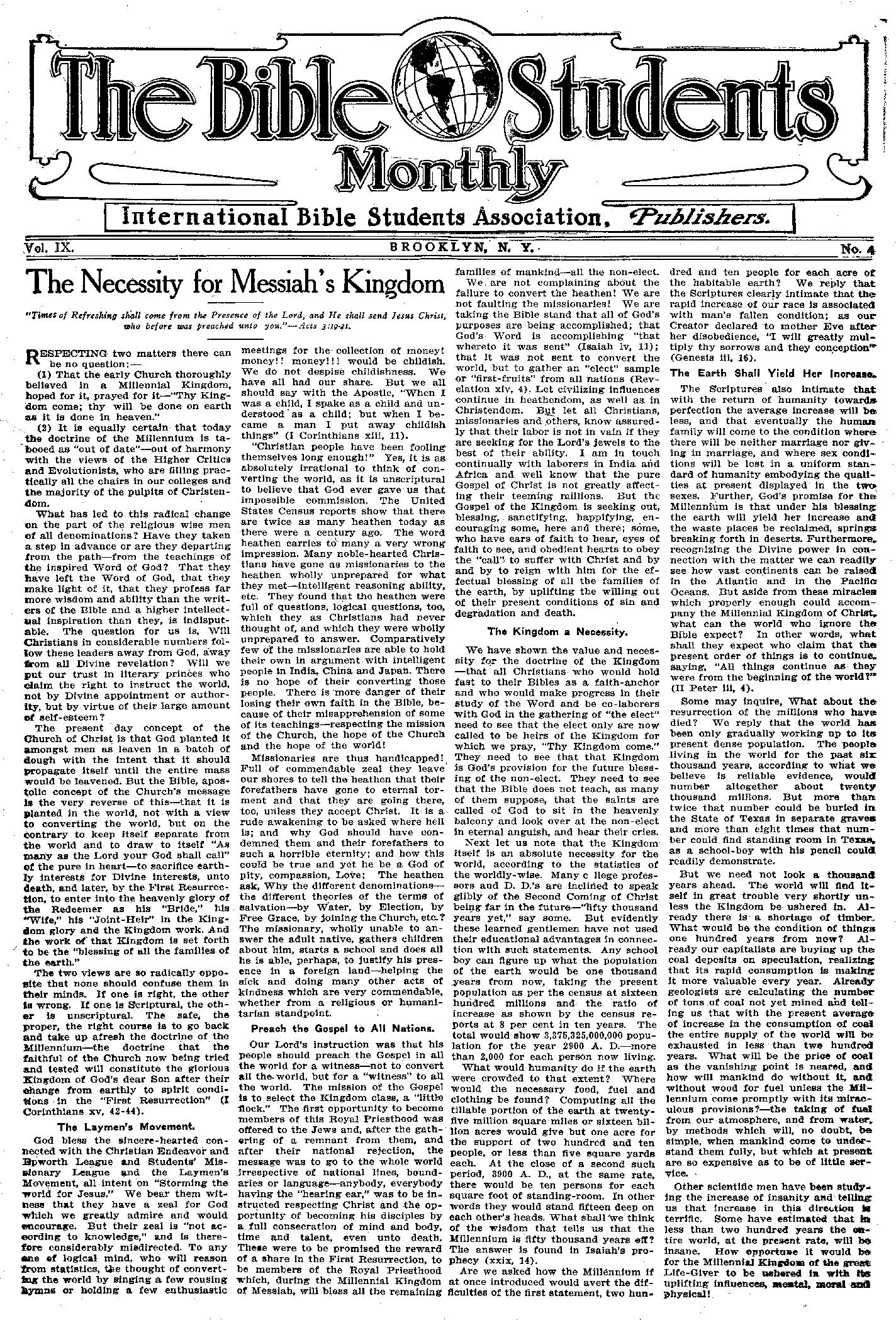
The Necessity for Messiah’s Kingdom
"Times of Refreshing shall come from the Prese who before was preached
DESPECTING two matters there can be no question:—
-
(1) That the early Church thoroughly believed in a Millennial Kingdom, hoped for it, prayed for it—“Thy Kingdom come; thy will be done on earth as it is done in heaven.”
-
(2) It is equally certain that today the doctrine of the Millennium is tabooed as “out of date”—out of harmony with the views of the Higher Critics and Evolutionists, who are filling practically all the chairs in our colleges and the majority of the pulpits of Christendom.
What has led to this radical change on the part of the religious wise men of all denominations? Have they taken a step in advance or are they departing from the path—from the teachings of the inspired Word of God? That they have left the Word of God, that they make light of it, that they profess far more wisdom and ability than the writers of the Bible and a higher intellectual inspiration than they, is indisputable. The question for us is, Will Christians in considerable numbers follow these leaders away from God, away from all Divine revelation? Will we put our trust in literary princes who claim the right to instruct the world, not by Divine appointment or authority, but by virtue of their large amount of self-esteem?
The present day concept of the Church of Christ, is that God planted it amongst men as leaven in a batch of dough with the Intent that it should propagate itself until the entire mass would be leavened. But the Bible, apostolic concept of the Church’s message is the very reverse of this—that it is planted in the world, not with a view to converting the world, but on the contrary to keep itself separate from the world and to draw to itself “As many as the Lord your God shall call” of the pure in heart—to sacrifice earthly interests for Divine interests, unto death, and later, by the First Resurrection, to enter into the heavenly glory of the Redeemer as his “Bride,” his "Wife,” his “Joint-Heir” in the Kingdom glory and the Kingdom work. And the work of' that Kingdom is set forth z to be the “blessing of all the families of the earth.”
The two views are so radically opposite that none should confuse them in their minds. If one is right, the other is wrong. If one is Scriptural, the other is unscriptural. The safe, the proper, the right course is to go back and take up afresh the doctrine of the Millennium—the doctrine that the faithful of the Church now being tried and tested will constitute the glorious Kingdom of God’s dear Son after their change from earthly to spirit conditions in the “First Resurrection” (I Corinthians xv, 42-44).
The Laymen’s Movement.
God bless the sincere-hearted connected with the Christian Endeavor and Bpworth League and Students’ Missionary League and the Laymen’s Movement, all intent on “Storming the world for Jesus.” We bear them witness that they have a zeal for God which we greatly admire and would encourage. But their zeal is “not according to knowledge,” and is therefore considerably misdirected. To any one of logical mind, who will reason from statistics, the thought of convert-faig the world by singing a few rousing hymns or holding a few enthusiastic ice of the Lord, and He shall send Jesus Christ, unto you.”—Acts 3:13-21.
meetings for the collection of money! money!! money!!! would be childish. We do not despise childishness. We have all had our share. But we all should say with the Apostle, “When I was a child, I spake as a child and understood as a child; but when I became a man I put away childish things” (I Corinthians xiii, 11).
“Christian people have been fooling themselves long enough!” Yes, it is as absolutely irrational to think of converting the world, as it is unscriptural to believe that God ever gave us that impossible commission. The United States Census reports show that there are twice as many heathen today as there were a century ago. The word heathen carries to many a very wrong impression. Many noble-hearted Christians have gone as missionaries to the heathen wholly unprepared for what they met—intelligent reasoning ability, etc. They found that the heathen were full of questions, logical questions, too, which they as Christians had never thought of, and which they were wholly unprepared to answer. Comparatively few of the missionaries are able to hold their own in argument with intelligent people in India, China and Japan. There is no hope of their converting those people. There is more danger of their losing their own faith in the Bible, because of their misapprehension of some of its teachings—respecting the mission of the Church, the hope of the Church and the hope of the world!
Missionaries are thus handicapped! Full of commendable zeal they leave our shores to tell the heathen that their forefathers have gone to eternal torment and that they are going there, too, unless they accept Christ. It is a rude awakening to be asked where hell is; and why God should have condemned them and their forefathers to such a horrible eternity; and how this could be true and yet he be a God of pity, compassion, Love; The heathen ask, Why the different denominations— the different theories of the terms of salvation—by Water, by Election, by Free Grace, by joining the Church, etc. ? The missionary, wholly unable to answer the adult native, gathers children about him, starts a school and does all he is able, perhaps, to justify his presence in a foreign land—helping the sick and doing many other acts of kindness which are very commendable, whether from a religious or humanitarian standpoint. i
Preach the Gospel to All Nations.
Our Lord’s instruction was that his people should preach the Gospel in all the world for a witness—not to convert all the. world, but for a “witness” to all the world. The mission of the Gospel is to select the Kingdom class, a “little flock.” The first opportunity to become members of this Royal Priesthood was offered to the Jews and, after the gathering of a remnant from them, and after their national rejection, the message was to go to the whole world irrespective of national lines, boundaries or language—anybody, everybody having the “hearing ear,” was to be instructed respecting Christ and the opportunity of becoming his disciples by a full consecration of mind and body, time and talent, even unto death. These were to be promised the reward of a share in the First Resurrection, to be members of the Royal Priesthood which, during the Millennial Kingdom of Messiah, will bless all the remaining families of mankind—all the non-elect.
We are not complaining about the failure to convert the heathen! We are not faulting the missionaries! We are dred and ten people for each acre of the habitable earth? We reply that the Scriptures clearly intimate that the rapid increase of our race is associated with man’s fallen condition; as our Creator declared to mother Eve after her disobedience, “I will greatly multiply thy sorrows and they conception** (Genesis iii, 16).
taking the Bible stand that all of God’s purposes are being accomplished; that God’s Word is accomplishing “that whereto it was sent” (Isaiah Iv, 11); that it was not sent to convert the world, but to gather an “elect” sample or “first-fruits” from all nations (Revelation xiv, 4). Let civilizing influences continue in heathendom, as well as. in Christendom. But let all Christians, missionaries and others, know assuredly that their labor is not in vain if they are seeking for the Lord’s jewels to the best of their ability. I am in touch continually with laborers in India and Africa and well know that the pure Gospel of Christ is not greatly affecting their teeming millions. But the Gospel of the Kingdom is seeking out, blessing, . sanctifying, happifying, encouraging some, here and there; some, who have ears of faith to hear, eyes of faith to see, and obedient hearts to obey the "call”/ to suffer with Christ and by and by to reign with him for the effectual blessing of all the families of the earth, by uplifting the willing out of their present conditions of sin and degradation and death.
The Kingdom a Necessity.
We have shown the value and necessity for the doctrine of the Kingdom —that all Christians who would hold fast to their Bibles as a faith-anchor and who would make progress in their study of the Word and be co-laborers with God in the gathering of “the elect” need to see that the elect only are now called to be heirs of the Kingdom for which we pray, “Thy Kingdom come.” They need to see that that Kingdom is God’s provision for the future blessing of the non-elect. They need to see that the Bible does not teach, as many of them suppose, that the saints are called of God to sit in the heavenly balcony and look over at the non-elect in eternal anguish, and hear their cries.
Next let us note that the Kingdom itself is an absolute necessity for the world, according to the statistics of the worldly-wise. Many c liege professors and D. D.’s are inclined to speak glibly of the Second Coming of Christ being far in the future—“fifty thousand years yet,” say some. But evidently these learned gentlemen have not used their educational advantages in connection with such statements. Any school boy can figure up what the population of the earth would be one thousand years from now, taking the present population as per the census at sixteen hundred millions and the ratio of increase as shown by the census reports at 8 per cent in ten years. The total would show 3,375,325,000,000 population for the year 2900 A. D.—more than 2,000 for each person now living.
What would humanity do if the earth were crowded to that extent? Where would the necessary food, fuel and clothing be found? Computing all the tillable portion of the earth at twenty-five million square miles or sixteen billion acres would give but one acre for the support of two hundred and ten people, or less than five square yards each. At the close of a second such period, 3900 A. D., at the same rate, there would be ten persons for each square foot of standing-room. In other words they would stand fifteen deep on each other’s heads. What shall'we think of the wisdom that tells us that the Millennium is fifty thousand years eff? The answer is found in Isaiah’s prophecy (xxix, 14).
Are we asked how the Millennium if at once introduced would avert the difficulties of the first statement, two hun-
The Earth Shall Yield Her Increase.
The Scriptures also intimate that with the return of humanity towards perfection the average increase will be less, and that eventually the human family will come to the condition where there will be neither marriage nor giving in marriage, and where sex conditions will be lost in a uniform standard of humanity embodying the qualities at present displayed in the twt» sexes. Further, God’s promise for the Millennium is that under his blessing; the earth will yield her increase and the waste places be reclaimed, springs breaking forth in deserts. Furthermore, recognizing the Divine power in connection with the matter we can readily see how vast continents can be raised in the Atlantic and in the Pacific Oceans. But aside from these miracles which properly enough could accompany the Millennial Kingdom of Christ, what can the world who ignore the Bible expect? In other words, what shall they expect who claim that the present order of things is to continue,, saying, “All things continue as they were from the beginning of the world?” (II Peter iii, 4).
Some may inquire, What about the resurrection of the millions who have died? We reply that the world has been only gradually working up to its present dense population. The people living in the world for the past six thousand years, according to what we believe is reliable evidence, would number altogether about twenty thousand mililons. But more than twice that number could be buried in the State of Texas in separate graves and more than eight times that number could find standing room in Texas, as a school-boy with his pencil could readily demonstrate.
But we need not look a thousand years ahead. The world will find itself in great trouble very shortly unless the Kingdom be ushered in. Already there is a shortage of timber. What would be the condition of things one hundred years from now? Already our capitalists are buying up the coal deposits on speculation, realizing? that its rapid consumption is making? it more valuable every year. Already geologists are calculating the number of tons of coal not yet mined and telling us that with the present average of increase in the consumption of coed the entire supply of the world will be exhausted in less than two hundred years. What will be the price of coal as the vanishing point is neared, and how will mankind do without it, and without wood for fuel unless the Millennium come promptly with its miraculous provisions?—the taking of fuel from our atmosphere, and from water, by methods which will, no doubt, be simple, when mankind come to understand them fully, but which at present are so expensive as to be of little service. ■
Other scientific men have been studying the increase of insanity and telling? us that increase in this direction ta terrific. Some have estimated that in less than two hundred years the entire world, at the present rate, will be insane. How opportune it would be-for the Millennial Kingdom of the great Life-Giver to be ushered in with itB uplifting influences, mental, moral and physical!
PUBLISHED AT 13-1T- HICKS ST.. BROOKLYN, N. Y.
Monthly—12 cts. a year. Single copies, 1c.
"He that sat upon the Throne said, Behold, I make all things new”—Rev. 21:5.
increase, is also being fulfilled. New varieties of wheat, of oats, of cotton, etc., are being discovered, and the yield is being multiplied. At the same time the quality is being advanced. Fruits r and vegetables are reaching a perfection not dreamed of even twenty-five years
An Independent, Unsectarian Religious Newspaper, Specially Devoted to the Forwarding of the Laymen's Home Missionary Movement for the Glory of God and Good of Humanity.
“WITHIN THE LAW.’*
“I have listened to nearly all the great ©teachers of the world, but I never heard ■ from any one of them so powerful a sermon as was preached to me in ‘Within the Law.’ It was an eye-opener, a soul-rpuser, a heart-warmer! It made you feeTgood; it made you feel bad; it threw you down to the bottom of the abyss, it lifted you to the glorious heights; it made you cry, it made you shout for joy.
“Poor humanity, what a hard time you have had of it down through the Jong, sad, weary ages! How your saviors have crucified you, how your governments and laws have robbed and oppressed you; how your institutions, professions, sanctities, have bled you, brutal-r feed you, degraded and damned you! You are still very sad and miserable, after thousands of years of honest struggle for uplift and progress. Squalor, wretchedness, degradation, almost despair, are written very plainly in your jboks and still more plainly in yoqr .deeds.
Hypocrisy and Greed.
“Yes, you have had a hard time of it. It fe because the whole fabric of Society, bhe whole machinery of State, of Busi-bpm, of Politics, of the Law, has been dominated by the spirit of the twin-dfevils of Hypocrisy and Greed.
“The politicians and statesmen have been talking -of reform; the legal gentlemen have been shouting about justice; fibe preachers have been bombarding their omigregations with beautiful platitudes Heaven and the rapture of the saints • and all the while the canker of Greed and Indifference to the great Natural Law of Right, which should ever pre-Vail between man and man, has been eating away at the heart of human joy and human good.
“If Richard Gilder can but make his millions he does not care a continental what becomes of Mary Turner and Helen Morris.
“If Inspector Burke can only ‘convict* Somebody he doesn’t care the toss of & ■Copper wnether the person convicted is guilty or innocent.
The Main Thing.
“If you can only. get wealth and power, it makes no difference hqw you tet them, they will make you a ‘big one/ nd that is the main thing.
“If you are only ‘orthodox’ in religion, Hhen a fig for such idle questions as ‘Is this orthodoxy true, or false? ‘Does it emancipate and uplift the mind or enclave and degrade it? Is it a blessing or A eurse?’
“If the outside of things is alb right no tjaatter about the inside. Keep up the Appearances. Make a good bluff. Be a hypocrite, and act your part so damnably fine that no one [will be able to ‘catch . on’ to the game* _
“It is a wide-reaching, lynx-eyed, all-aearching, remorseless inquisition, that flrags out into the light of day? and. mercilessly flays, the double-dealing, insincerity and cold-blooded selfishness end brutality of institutional society.
“Livery of Heaven.”
‘’It shows us what a terrible thing it is for a man to forget the right of his fellowmen. It makes us feel how supremely necessary it is that we should 1 all feel a loving interest in one another, end be willing—gladly, joyfully willing •—to find our happiness in the happiness of others, if possible, in the happiness of all. It makes us ashamed of the sharktoothed greed which gloats over the gain Chat involves the misery and ruin of ether human beings. It makes us hate with all our heart the suave, oily, decorous hypocrisy that prates of good while it is working evil, and that in its flawless livery of heaven is doing what it •an to turn earth into a bell.
“Is it not about time that those in authority’ had taken off their masks and looked their fellows squarely in the face? isn’t it about time that we had begun ♦o love simple truth, and to love one another more than we love, place, and power, and gold? Isn’t it high time we Bad come to the conclusion that there is nothing holier than human love and happiness, just as there is nothing <n-holier than the brutal selfishness ®r spie-nnd-span hypocrisy which would sacrifice Wiese things to their personal upbuilding?”—Rev. T. B. Gregory in Naw Torb American. __________________
On the Aore of the Sea of Galilee, Where Jesus broiled *om« fieh sae fiae Morning upward* of 1900 years ago, a •arfibM •aMniag iaeteer tepUnaed.
THE promise of a New Day has long * been before God’s people—in the Bible. It was hinted to our first parents, six thousand years ago, that eventually the Seed of the woman should bruise the Serpent’s head. This, interpreted, is understood to mean that the power of Satan will be crushed, and mankind will be delivered from the reign of Sin and Death which has prevailed since the disobedience in Eden.
A second promise, still more explicit, made by God to Abraham of old, says, “In thy Seed shall all the families of the earth be blessed.” For centuries Abraham’s posterity waited for the Messiah of promise, with the anticipation that He would use them in connection with His work of blessing all peoples. The Prophets of Israel foretold the coming King of the line of David—that He ehouldi be a great Priest, a reigning Priest, after the order of Melchizedec. To Him “every knee shall bow and every tongue confess,” and through Him a blessing will extend to all nations as “a feast of fat things full of marrow, and wines on the lees.”—Isaiah 45:23 ; 25:6.
Even the disciples of Jesus, who recognized Him as the “Sent of God,” were disappointed that His glorious Kingdom, of which He spoke, was not immediately revealed, and that in answer to their question he declared, “It is not for you to know the times and the seasons which the Father hath put in His own Power.” ifitill the prophecies respecting Messiah’s Kingdom were repeated and amplified in the parables of Jesus, in the teachings of His Apostles, and finally and graphically, in the last Book of the Bible, in the Revelation which Jesus gave the Church through St. John.
Our text is a quotation from this Revelation, respecting the Kingdom of Messiah. Through it God is to wipe away all tears from off all faces; and the King of kings and Lord of lords, whom Jehovah has established As the great Messiah, assures us that He Himself will “make all things new.”
Even the heathen poets sang of the Golden Age to come—quite probably borrowing their thought from the Hebrew Scriptures and quite probably realizing in some measure that a gracious God would not forever permit a reign of Sin and Death, but would somehow, some time, and through some agent, bring to earth blessings to supplant the curse.
“Arise, Look Around Thee.”
After all these centuries of waiting and hoping and praying, ‘Thy Kingdom come; Thy will be done on earth, as in Heaven,” God’s people to-day are more and more awakening to a realization of the fact that we are living in the very1 2 dawn of the glorious Epoch for which all have waited, prayed and hoped. These blessings have come down like a gentle shower, so quietly that we can scarcely realize that the earth has entered upon the foretold Times of Refreshing and Restitution mentioned by St. Peter.—2 Acts 3:19-21.
Many are still asleep. Some are confused, and know not to what the blessings should be attributed. Having lost faith in the Bible and its promises, many are seeking a solution of the wonderful things of our day along the lines of evolution, claiming that a Nature god operates by blind force under a law of the survival of the fittest. Surely they overlook the fact that there were great characters in the past with whom few of the present day may be compared— such as Shakespeare, Bacon, Socrates, Plato, St. Paul, King Solomon, King David the poet, Job, Moses, etc.
A far better explanation is furnished us in the Bible. It explains; that the wonders of to-day are the foregleams of Messiah’s Kingdom and its blessings, the foregleams of the Golden Age. It explains that we are in the Day of Jehovah’s Preparation for the Kingdom of His Son. We have the numerous Scriptural declarations pointing to the end of this Age and the dawning of a new Age, and assuring us that at this time many would run to and fro, knowledge should be increased, and the wise should under* stand.—Dan. 12:1-10.
“In the Time of the End ”
Thia prophecy of Daniel is worthy of Careful note, not only because Daniel ■wa* a Prophet greatly beloved by the Lord, but because Jesus, the Redeemer, specially quoted a portion of thia prophecy, and thus attested its genuineness. The many running to and fro could seemingly refer to nothing else than,the wonderful traveling which is a feature ®f ear day and np other.
In no other time was running to and fro • possibility to any extent It is lea® than a century since the first crude leeosetive wag built. It is only eoe haadred aad six years since the first •teaaboat by Fulton was tried. It airht be said that there waa *® eppertuaity
for running to and fro until within the past fifty years. Now, the world is gridironed with rails. Now, the ocean voyage of four months is cut down practically to as many days by mammoth vessels carrying three thousand to four thousand at a time.
Who knew, at the time of Daniel’s prophecy, of these wond^ful facilities for running to and fro? Who knew that these facilities would be so generally used in this our day ? Only the Almighty! And He gave this as one of the particular signs of the ending of the present Age—the dawning of the New Dispensation—'the long-promised Messianic Kingdom.
Look also at the second proof furnished us by this Prophet—the increase of knowledge. Who would ever have dreamed, a century ago, of conditions as they are at this moment—when practically every human being in civilized lands, from ten years old and upward, is able to read and write? Who would have dreamed of such persistency to fulfil the prophecy as would lead to laws of compulsory education in all civilized lands? Verily, the increase of knowledge is a positive proof of the inspiration of Daniel’s prophecy, and equally proves that the New Age is dawning, and that we are now in the day of God’s preparation for it.
The next statement of the Prophet Daniel is that the wise of God’s people shall understand. And now, in the appropriate time, all over the world, classes of Bible students are coming together, regardless of denominational lines, to study the Heavenly Father’s Word. And true to the prophecy, the wise, trimming their Bible lamps and being well supplied with the oil of the Holy Spirit, are receiving light — are understanding the things kept secret from past ages and generations.
‘The mystery of God shall be finished” is another of the promises of the Bible respecting the present time; and surely it is having fulfilment! Not all are yet awake. But the joy of those who are awake, and their singing of the song of Moses and the Lamb, tend more and more to awaken all the virgin class.
'One more token of the end of this Age and the.dawning of the New Age: God declared to the Prophet Daniel that “There shall be a time of trouble such as never was since there was a nation.” Let us not especially dwell on this sad feature. Let us regret that unpreparedness for God’s mercies and blessings makes necessary a great day of trouble, to prepare the hearts of men for the blessings God is about to pour upon them.
. The Redeemer mentioned the present time, and the Time of Trouble which we see looming up on every hand and threatening the very foundations of society—political, social and religious. He bade r His followers rejoice even amidst the trouble, because it marks the Day of deliverance from the power of Sin and Death. He said, “When these things begin to come to pass, then look up, and lift up your heads and rejoice, knowing that your deliverance draweth nigh.”—Duke 21:28.
Knowledge of God’s Glory.
The Bible declares that a prominent feature connected with the New Age will be the binding of Satan, the Prince of Darkness, the father of lies, who has been deceiving poor humanity for these six thousand years. Continually he has been misrepresenting God’s character and Plan so as to turn Humanity away from Cod in fear and distrust Thus he has blinded their minds to God’s glorious goodness, which, to His people, is now shining clearly, in the personal character of our Redeemer and in- the promises of the Bible.
'Every preparation is being made for the dissemination of knowledge worldwide. Telegraph wires and cables connect the civilized world, and now additionally the wireless telegraphy; and the later improvements upon this means of communication seem destined to bring it shortly to a plane of world-wide economy and usefulness. The printing-press is one of the most wonderful preparations of God for the general dissemination of knowledge. And already the world is learning that many of the thing® considered absolute certainties by our forefather® are really absurdities. Amongst others are the various creeds which we and other civilised peoples have
loyalty. We are fully content, however, with the Scriptural proposition that ■when the light of that glorious Day shall _______ __________- _____- - bring blessings to every member of our worshiped a* idols—idols which have se- race, the inexorable law will be that riously misrepresented the character of whoever loves sin shall perish in th®
onr Heavenly Father.
In agriculture other wonders are being performed, fulfilling the Scripture*, and seeming, in the light of the past, almost as miracles. Vast areas of wilderness and arid lands are being fertilised. Artesian webs ar® fulfilling th® prophecy •f springs censing forth from the desert. Ths premise of the Lord through th® Prophet, that th® earth ahoald yield her
ago.
The same Divine providence which Mas lifted the veil before the eyes of me-
chanics has also lifted the veil before th® eyes of agriculturists, and Mr. Burbank is giving the world wonderful lessons in agriculture and horticulture. These blessings of our day are Bone the ks® wonderful because they are coming in a seemingly natural way. If once we expected these things to be fulfilled in a miraculous manner, it was because we forgot that
‘‘God moves in a mysterious way
(His wonders to perform.”
Everything in nature is really a. miracle until we come to understand it, and then it is no less a wonder, but merely seems less, so because commonplace and usual.
“Send Out Thy Light.”
While we have been singing, “Send Out Thy Light and Truth, O Lord,” perhaps comparatively few who sang have appreciated the fact that, while we were asking, God • was fulfilling our request, not only along spiritual lines, but also along natural lines. The increase of light, knowledge, understanding, appreciation of 9°d’s Word, has merely been keeping pace with the natural light.
Think of it! even fifty years ago the making of tallow candles was an industry in nearly one-half the homes of humanity ! Only then did petroleum begin to enlighten the world. Then came coal gas; and now this is rapidly giving way to the electric light, in which one form after another is increasing its usefulness and cheapness. Indeed, when we speak of electricity we are speaking of one of the wonders of the World, of which we understand so little. It would appear as though the Lord has in this hidden treasures of wisdom, power and blessing.
Already the hours of labor are greatly decreased. Already time for study, improvement and pleasure is at our disposal. And yet we are only in the infancy of these blessings. We are only nearing the dawn of that glorious Day when sin and sorrow shall pass away forever.
At one time we might have feared that the rapid increase in the consumption of coal would soon leave the world destitute of fuel. Statisticians declare that the supply of the whole earth at the present rate of consumption and increase will be exhausted in less than two centuries. But we need not fear. A better means of comfort, than by the drudgery of our fellow-creatures in the bowels of the earth, will undoubtedly be provided by the great King of kings, who has undertaken by His Kingdom to bring to our race blessings, instead of the curse under which we have labored six thousand years—six great Days.
How He will do it is, of course, a mystery. Nevertheless, we do know that in the water which is so abundant and in the air which we breathe there are elements of combustion far more than sufficient for every need. Man needs the key of knowledge on this subject, and it will doubtless be furnished by the Lord in the very same way that He has already given us the key to our other blessings which are preparing for the perfectness of His Millennial Kingdom,
Forgiveness, Reconciliation, Peace.
But Messiah’s Kingdom will be much more than a beneficent Reign giving mankind temporal blessings and knowledge.* In connection with the knowledge of God, the way of reconciliation will be paved for the sinner. He who redeemed the world with the sacrifice of His own life is to be the great Mediator between God and men. Forgiveness of sins and help out of the weaknesses of the fall are the glorious promises of the Scriptures.
Inherited weaknesses, surrounding temptations and ignorance of God, undoubtedly have more to do with the reifea of Sin in the world than any real preference for sin on the part of the majority. When temptation to sin shall have been removed, when Satan shall be bound, when the True Light shall shine, when God’s true character shall have been manifested, when His loving pity for the race shall have been demonstrated, we have every reason to suppose that then the majority of mankind will be glad to return to the Father’s House,, to serve Him with true contrition of heart and
whoever love* gin shall perish. in th®
Second Death, without hope of recovery.
What God Requires of Us
•Wiai defh thy Ged require of thee, but te de justly, to levs mercy, ttnd te walk humbly with th* Ged?"—Micah d;8.
A RS the words of thia text true? Is it possible that the trus religion of th® BR>1» demands nothifig more of us than is expressed in this text? What about Mte Jewish Law? What about its sin-eflfering, its burnt-offering, its thank-offerings? What about the ten. commandments? What about the digest of those commandments approved by our Lord Jesus, “Thou shalt love the Lord thy God with all thy heart, with all thy ■sind, with all thy being, with all thy Strength; and thou shalt love thy neighbor as thyself”? What about Gfcurch attendance? What about our responsibilities to our families? To the Ghurch? To the poor? What about Study of the Bible to know God’s will? What about our responsibility for the heathen? What about baptism and the Lord’s supper?
Indirectly, dear brethren, all the matters included in our questions and many mere are included incidentally in the provisions of our text. Sometimes a whole sermon is preached in a few wwds. No one will dispute the reasonableness of the Divine requirement as stated in our text. Our Creator could Mot justly or with self-respect ask less titan this ef his creatures who would enjoy his favor. The interests of all demand that these principles should be required of every creature permitted the enjoyment of Divine favor to the eKtent of eternal life. Whoever fails to come up to these conditions would thus evidence his unworthiness of life eternal; his prolonged existence would merely be a prospering of sin and a menace to the happiness and righteousness of others.
But now let us see the scope of this Divine requirement, whose justice we have already acknowledged. We note tfce natural division of our teat into three parts:
(1) Doing justly;
(fl) Loving mercy;
-
(8) Walking humbly.
The requirement of justice ia our dealings with our fellows, commends itself to every rational mind. It includes the whole Law of God. A brief statement of that Law which had our Lord’s approval reads, Thou shalt love the Lord thy God with all thy heart and all thy mind, all thy being and all Bly strength; and thou shalt love thy neighbor as thyself. On these two propositions hang all the Law and the Prophets. It is but just that we should recognize our Creator as first; that we should glorify the One who gave us our being and all the blessings that come therewith; that we should be obedient to his righteous requirements that make for our own happiness and that of others. R is also but right that we should recognize the rights of others, as we would have them recognize our rights. The Golden Rule is the barest of justice. Not a hair’s breadth less would come within the requirements of our text, Do Justly. “Come, then, let us reason together”: How many of us do justly in all of life’s affairs—in our relationship to our God and to our neighbor?
Begin at home. Let each one criti-«tae his words and his deeds toward his parents; toward his children; toward his brothers; toward his sisters; toward husband; toward wife. Do we In all of our relationships of life treat these who are so near and so dear to us according to the standards of justice, according to the Golden Rule? De we do toward them as we would have them do toward us ? If not, after nuiking a beginning with the Lord, striving to render to him our homage and obedience, let us closely scrutinize ♦very word, every act of the home life and see to what extent these can bo Improved upon and made more nearly fust. The majority of people, we feel sure, will be surprised to know how Unjust they have been toward those Who are of the very nearest and doar-CBt of fleshly relationships.
Fellow th® matter up and consider Mi® justice er injustice ®f your words and deeds in daily life with yeur neighbors and dally associates. De yen ^variably te them in the same weeds and w* th® sum® toe® and gesture that you would approve if they were in your place and you in theirs? In matters of business do you drive a closer bargain with them than you would think just for them to make with you? Or, on the other hand, do you ask of them higher prices for the services or materials you furnish them than you would consider just and right if you were the purchaser and they the venders? Do you watch your chickens that they do not commit depredations upon your neighbor’s garden as carefully as you would wish your neighbor to watch his chickens as respects your garden, if you had one? Do you blow no more tobacco smoke in the face of your neighbor than you would like to have him blow in your face? Are you as careful about wiping your feet when entering his house as you would lik® him to be when entering your house? Do you treat all men, women, children and animals as kindly, as gently, as properly every way as you think would be just and right if you were in their place and they in yours? Do you speak as kindly of your neighbors as you would have them speak of you? Or do you hold up their imperfections to ridicule, as you would not like to have them hold up yours? Do you guard your tongu® so that you speak only things you would think proper for your neighbor to speak respecting you, if you changed places?
Simple Justice—Nothing More.
Do you not begin to see, dear friends, that what God requires of us is much beyond what th® majority have been rendering? Do you stand appalled and tell me that It would be impossible to live fully up to that standard?" I agree with you. And St. Paul agrees, saying, “We cannot do the things which we would.” The Scriptures again agree and declare “There is none righteous, no, not one. All have sinned and come short of the glory of God.”
What shall we do ? Shall w® say that because we are unable to live up to our own conceptions and standards of justice we will make no attempt to do so, but abandon those standards entirely? God forbid. We are weak enough and imperfect enough as it is. To ignore our best ideals of justice would be to take off all the brakes and permit the downward tendencies of our depraved natures to go rapidly from bad to worse—to carry us further and further from God and the standards of character which he approves.
What Would Be the Use?
Suppose we do our very best daily to measure up to our highest conceptions of our God-given ideals and standards, would God accept of this and count us worthy of his favor and of eternal life? Surely not. The Law of the Lord is perfect. Justice is Justice. Not the hearer of a law, not the well-wishing, receives the reward, but the doer, the obedient! Here, then, we find ourselves in difficulty. With our hearts, our minds, we approve God’s Law and desire to be obedient to him, but find, as St. Paul says, that many things we wish to do we fail to accomplish; and many of the things we do not wish to do we cannot avoid. “We cannot do the things that we would.” We approve the excellent demands of God’S Law. We disapprove the imperfections of our own flesh. Like St. Paul, we cry out, “O wretched man that I am! who •hall deliver me from this dead body?” <—this body that is imperfect through inherited sin and weaknesses? With our minds we serve God’s Law and approve it; but with our bodies we come short. What is our hope? How shall
Tke Hope of Immortality
This sabjeet whiofa has b®<M s® ■tisnaderetoed, is eeaviaeiagSr aad *®ri»t«raUr irea^ed
-
•ead oaed flea® wmm®1®. we be delivered? Can w® prevail upon God to change the reasonable requirement of our text so that it shall read, What doth God require of me but to will justly and do imperfectly? We cannot hope for such a change la the Divine Law. Are we then hopeless as respects Divine approval and eternal life? (Romans vii, 17-24.)
The Gift of God Is Eternal Life.
In our moment of perplexity we hear God’s message “speaking peace through Jesus Christ our Lord.” The message of peace is that what we could not do for ourselves in the way of lifting ourselves up to Divine approval God has provided shall be done for us through our Lord Jesus Christ. Our failure to keep the Law marks us as unworthy of eternal life, and worthy of the wages of sin—not eternal torment, but death. God in mercy concluded to offer us eternal life as a gift—because of our not actually meriting it under his legal requirements. Thus we read, “The wages of sin is death; but the gift of God is eternal life through Jesus Christ our Lord” (Romans vl, 23). What we could not obtain legally under the Divine requirements God proffers to us as a gift. But the gift is a conditional one as expressed, in the words, “through Jesus Christ our Lord.” Only those who accept Jesus Christ as “the Way, the Truth, and th® Life” may have God’s gift of eternal life. Henc® it will be seen that it is wholly a mistake to •uppos® that the heathen at home or abroad can get eternal life, the gift of God, in ignoranc® of Christ. All the Scriptures confirm this and declare not only that w® cannot save ourselves by obedience to th® terms of God’s Law, but that “ther® is none other name under heaven given among men, whereby we must be saved”—through faith in his name—through faith in his blood (Acts iv, 12).
But how is this done justly? and, why does God so limit his gift of eternal life ?
God’s Law represents himself and cannot change. He cannot require less than perfection. To do so would be to fill the Universe to all eternity with depraved and imperfect beings. God has a higher plan than this and declares, “As th® heavens are higher than the earth, so are my .ways higher than your ways” (Isaiah 55:9). He explains that his ultimate purpose is that there shall be no imperfect creature in all his Universe. All whose hearts ar® loyal to him and the principles of his government shall be perfected, and all others shall be destroyed in the Second Death. Thus, eventually, every kne® shall bow and every tongue confess t® the glory of God. Then every creature which is in heaven, and on the earth, and such as have been under the earth, shall be heard, saying, Blessing, and honor and glory and power be unto him that sitteth upon the throne, and unto the Lamb forever (Revelation v, 13).
You Ard Bought With a Price.
Possibly God could have arranged some other way of dealing with sin and sinners which would not have required th® death of Jesus as the Ransom price, the purchase price, the redemption price for sinners. But the fact that this method was adopted by our great Creator assures us that no other method would have been so wise, so just, so beneficial. No other method would hav® so fully demonstrated God’s Wisdom, Justice, Love and Power.
In brief, then, God’s arrangement Is that all of his human creatures shall have opportunity of full return to harmony with himself, provided they wish to do so, provided their hearts, their wills, ar® fully responsive to the letter and spirit of his Law—the requirements set forth in our text. God has provided in Jesus for the satisfaction of Divine Justice as respects all of the condemned race who desire to return to his favor.
We agree with all th® orthodox ereeds of Christendom that only repentance from sin and an endeavor t® put it away from our thoughts and words and deeds, combined with faith in the R®de®mer’s sacrifice and a full consecration of h®art and Hf® to d® th® Father’s will—nothing short of this attainment will gain th® salvation which God is now holding out t® man hind. T® •noh th® A*®«tl® captains that th® ii«ht®®wm«es, th® Mi demands <tf th® Law of God, his full requirement, "1® fulfilled in us who ar® walking not after the flesh, but after the Spirit” (Romans viii, 4). From the moment of our consecration and begetting of ths holy Spirit God deals with this elasn as with sons. He trains them in th® School of Christ, disciplining, chastening, proving them, testing the sincerity of their consecration vows and the loyalty of their hearts. To those who prove faithful the great r®ward is promised—glory, honor, immortality, joint-heirship with the Lord Jesus Christ in his Millennial Kingdom and its work of blessing all the families of the earth (Galatians iii, 29; Revelation iii, 21).
Our disagreement with all “orthodox creeds” is in respect to what shad be done with the unsaintly—with thos® who do not present themselves to God and who are not begotten again of th® holy Spirit. Our creeds of the dark ages misrepresented the teachings of the Bible in respect to these and told us that they are all to be consigned for hundreds or thousands of years to Purgatory or for all eternity in heM torment. Not such is the teaching of God’s Word, but the very reverse, a» we have previously shown. The Scriptures do not declare, In thee and ia thy Seed shall all the families of th® earth be damned; but the reverse of this—that they shall all be blessed. AR the sin-blind eyes shall be opened. AM the deaf ears of ignorance shall be unstopped. For the blessed thousand year® of Christ’s reign the world’s uplifting or resurrection will proceed, while th® knowledge of the glory of God shall AM the whole earth. The angels on th® plains of Bethlehem did not declare to the shepherds, Fear greatly! for behold, w® bring you bad tidings of great misery which shall be unto all people. Their message was the reverse of this: “Fear not; behold, we bring you good tidings of great joy which shall be unto all people” (Luke it, 10). God who had a “due time” for calling natural Israel and who had also a “due time” for calling spiritual Israel, has a “due time** for making known the riches of hiB grace to the non-elect world of mankind. And the “elect” of spiritual Israel and of natural Israel are to be the channels of this Divine grace and mercy, which, during the Messianic Kingdom, will flow as a river of salva-: tion to which all mankind will be iw vited to come and drink freely.
EVERY THINKING
CHRISTIAN
SHOULD READ
PASTOR
RUSSELL’S
BOOKS
“Studies
in the
Scriptures”
Nespoctiag' ike first volume of thio work TSBI ATLANTA CONSTITUTION says editosiailyi
“It is impossible to read thio book withoid loving the writer and pondering his worudei fjl solution of the great mysteries that hav® troubled us all our live*. There is hardly a family to be found that has not lost some loved one who died outside the church—outside the plan of salvation, and if Calvinism b® true, outside of all hope and inside eternal torment and despair.
“This wonderful book makes no assertion® that are not well sustained by the Scriptures It is built up stone by stone, and upon eves* st®ne is the tent, and it becomes • pyvandw of God’s love and merejr and wisdom. Ther® is nothing in the Mible that the author denies or doubts, but there aoe mev texts that b® throws a flood of kght ®po« that seiMi to «a» cover its meaning."
* • a
Th® ®®t ®f aix volumes, el®th, MOO pages, I® suppli®d by th® BIBLE AND TRACT SOCIETY, N®. 17 HICKS ST, BROOKLYN, N. Y, far IN® u®o®i prta® •f one cu®b vthfflJt, vk, ffl.M prapaM.
Significance of Ordination
Of Christian Ministers
PASTOR RUSSELL’S
BELIEVING the following letter from Pastor Russell to a friend in British West Indies would be of interest to our readers, who may have come in contact with some of the slanders offered by opponents,- we have asked permission to reproduce it in these columns. This letter was published in the newspapers of Trinidad, as follows: “Mr. E. J. Cowabd,
“Port-of-Spain, Trinidad, B. W. I.
“Dear Brother in Christ: Yours of October 3d is before me. Thanks for its clippings from the Gazette and the Evangelical Christian.
“I am quite familiar with the slanderous screed issued by Rev. J. J. Ross. In Canada they have just two laws governing libel. Under the one the falsifier may be punished by the assessment of damages and money, Under the other, criminal libel, he is subject to imprisonment. I entered suit against Rev. Ross under the criminal act, at the advice of my attorneys, because, as he has no property, ft sujt for danjages would pot intimidate him nor stop him. The lower Court found him guilty of libel. But when the case went to the second Judge lie called up an English precedent, in which it was held that criminal ■ libel would operate in a case only where the jury felt sure that there was danger of rioting or violence. As there was no danger that either I or my friends would resort to rioting, the case was thrown out. I could still bring my action for financial damages, but it would be costly to me and impotent as respects Rev. Ross. He, however, is having troubles of his own. The Bible authorizes a defense of the Truth only. We are not to smite the brethren. Whoever undertakes an attack upon any Christian minister’s reputation violates the Master’s commands, and puts himself on the side of the Adversary. A lying spirit is sure to be a boomerang.
“As respects my education in Greek and ’Hebrew: Not only do I not claim very special knowledge of either language, but I claim that not one minister in a thousand is either a (Hebrew or a Greek scholar. To be able to spell out a few Greek words is of no earthly value. Nor is it necessary longer to study these languages, in order to have knowledge of the Bible. Our Presbyterian friends have gotten out at great cost Young’s Analytical Hebrew, Chaldaic, Greek and English Lexicon Concordance, which anyone may procure. And our Methodist friends have issued a similar work— Strong’s Analytical Concordance and (Lexicon. And there is a still older one entitled En trii ah ma rfo-JTebrew Chaldaic, Greek and English (Lexicon and Concordance. Additionally, Liddell and Scott’s ’Greek Lexicon is a standard authority. The prices of these are not beyond the reach of the average man. By these works scholarly information respecting the original text of the Bible is obtainable. I have all four of these works and have used them faithfully. Very few college professors, even, would risk to give a critical translation of any text of Scripture without consulting these very works of reference, which are standard. To merely learn to read the Greek and Hebrew without a six years’ course in their grammars is more likely to hinder than to help in Bible study; far better take the acknowledged scholarship to which I have referred.
“Additionally I remind you of the many translations of the Bible now extant—all of them very good. I have all of these and find them useful in comparison in the study of any text—one sometimes giving a thought which another may not. The other day, for curiosity’s sake, I counted Bibles in different translations, etc., in my study and found that I have thirty-two.
“As respects my business dealings, I need not remind you that American Courts are very strict, and that if anybody feels that I have wronged him out of a dollar, he would have no difficulty in haling me into Court. You have my assurance, dear Brother, that I do not owe any man on earth a penny, and that I have never taken a penny from anyone unjustly. On the contrary, as you know, I have spent several small fortunes in seeking to do good to my fellowmen—• in helping them to a better understanding of God and the Bible. Having once been an infidel myself, and having subsequently found that I bad confused the teachings of the Bible with the teachings of the creeds, and that the Bfble’s teaching is a glorious, grand doctrine, it has since been my business and pleasure to do all in my power to help fellow-mortals out ef darkness into the true light.”
I need not tell you how absurdly untrue 'Rev. Ross’ statements are in respect to my ordination; but really it seems strange how little people use their thinking faculties in- such matters—how few who would read the Rev. Ross’ state-
REPLY TO CRITICS
ments would see their absurdity.
For
instance, he is a Baptist and was authorized or ordained by the Baptists—not by 'Methodists, Presbyterians, Lutherans, Catholics or Episcopalians. Would an Episcopalian recognize Rev. Ross’ ordination? Surely not! Would a Roman Catholic recognize his ordination? Of course not. Ordination merely means authorization. The Catholics will authorize, or ordain, those only who belong to their faith. The Baptists will ordain, or authorize, those only who are Baptists. How foolish, then, to talk about ordination from their standpoint!
But ordination from my standpoint, the Bible standpoint, the standpoint of
an increasing number of Bible students
all the world over, is different.
Divine
ordination. But our Baptist who, not knowing how to meet my theological teachings, do not attempt to do so at all, but merely charge me with ignorance. As I read his vile slanders 1 thought of what the New Testament says about St. Peter and St. John. They were so woefully ignorant that all the people perceived that they were ‘ignorant and
friends and our Methodist friends would say that they, also, recognize Bible ordination, that they are not merely dependent upon each other. But we challenge them to prove that they ever had a Divine ordination or that they ever tl.ink of it. They merely think of a sectarian ordination, or authorization, each from his own sect or party.
True, Catholics and Episcopalians are different and do recognize a Divine ordination. They claim that Jesus ordained His Twelve Apostles and that these have successors in the Bishops, who are sty'.ed ‘apostolic bishops,’ and under the theory of ‘apostolic succession’ have the same power as the original Twelve Apostles to ordain and to teach. Bible students believe that they err in this claim and that the doctrine of ‘apostolic succession’ is unscriptural. The Bible recognizes only Twelve Apostles. More than that, the Bible denounces all apostolic bishops as being in error. Referring to them, Jesus said that they claimed to be apostles, and are not, but do lie. (Revelation 2:2.) In other words, contrary to the superstitions of Catholics and Episcopalians, their bishops have no authority whatever to ordain anybody.
What, then, is the proper ordination of a minister of Christ, and how can it be obtained, according to the Bible?
We answer that God’s ordination, or authorization, of any man to preach is by the impartation of the Holy Spirit to him. Whoever has received the Holy Spirit has received the power and authority to teach and to. preach in the name of God. Whoever has not received the Holy Spirit has no Divine authority or sanction to his preaching. In other words, he is unordained in the highest, truest sense of that word.
What is the secret of the opposition and. slander that is being raised up against me and against all who, like me, are Bible students? It is malice, hatred, envy, strife, on the part of those who are still hugging the nonsense of the Dark Ages and neglecting true Bible study. They see that their influence is waning. But they have not yet awakened to the true situation. They think that I am responsible for their smaller congregations and small collections. But not so. The real difficulty with them is that the people are becoming more intelligent and can no longer be driven with the crack of a merely man-devised whip of fear. The colleges of the world have been teaching that the Bible is a .foolish old book, until few preachers and few of the educated of the world believe it to be of Divine inspiration. Losing faith in the Bible, in the preachers and in the creeds, the people are drifting toward atheism. That is the real difficulty.
While my work does not. indeed, help to build up any of the sects of Christendom, it is helping to establish Christian people in a true faith in God and in the Bible. It is giving them a firm foundation and an intelligent understanding such as they had prayed for and hoped for before, but never found. This is not because of great ability on my part, nor on the part of my associates, but because God’s time has come for blessing Bible study in the light of present-day opportunities. It is as Jesus promised—the Wise Virgin class of Christian people, who ‘trim their lamps’—study the Bible —find it to shine out brightly and to point them to the new Age of blessing under Messiah’s Kingdom.
“If you choose, you may make such extracts of this as are likely to reach intelligent people through any of the newspapers. But really I care little for what men may say or think about me. Of coursb, such things are painful; but they are only what the Bible tells us will be
more or less the experience of all who. without loving the writer and pondering would be loyal to God and His Word.
So persecuted they the' saints and prophets of the past—even the Master
Himself. And as for how I got my education—it seems to me of little consequence. I have enough to serve my own purposes, and, apparently, too much to please Rev. Ross and others of his type.
PRAYERS FOR KINGS AND GOVERNMENTS
'I exhort, therefore, that, first of all, supplications, prayers, intercessions, and giving of thanks, be made for all men; for kings and for all that are in authority ; that we may lead a quiet and peaceable life in all Godliness and honesty."—1 Tim. 2:1,2.
THE Scriptures tell us clearly that the prepared to appreciate the better govern-kingdoms of this world are not the ment when it shall come in.
kingdoms of our Lord. (Luke 19:11, 12.)
— —j Satan (Matthew 4:8, 9; John 14:30); It is a that the Lord will not set up His King-
They inform us in an indirect way that the world cannot realize that the affairs of the present order of things are all under the supervision and care of dom of righteousness until His appointed time. When that time shall come, all kings and priests and peoples shall serve and obey Him. (Daniel 7:27.) His reign will be the one that will be the “desire of all nations."
But in the meantime, the Bible gives us to understand, these present kingdoms are given the opportunity of seeing wnat they can do under these conditions. (Daniel 2:37-44.) When the typical kingdom of Israel was destroyed and the kingdom was given to Nebuchadnezzar, it was for the opportunity of seeing what his kingdom could do. It might be righteous or unrighteous.
And so it has been from the kingdom of Nebuchadnezzar down. They are. all Gentile kingdoms, and not representatives of God. All these various kingdoms are demonstrating various principles of government. Mankind under these kingdoms are learning lessons of experience which will be valuable to them in the future. Under these kingdoms we have seen men battling for rights. 'Sometimes they have been defeated, and sometimes victorious —as the case may have been. In the various, battlings we have seen righteousness and unrighteousness striving together ; but with all, policy rules.
Under all the kingdoms mankind has demonstrated that no government by imperfect man can rectify the difficulties which confront humanity. We cannot abolish sin and sorrow, crying and dying. Had only one king or one nation been permitted to experiment with the race, we would not have known whether or not other nations might not have been successful, had they had the opportunity. Each nation in turn seeks to be the universal power, and each claims to be the better government; as, for instance, the American Government wants to give better government to the Filipinos, and Great Britain wants to give better government to the people of India and South Africa. What do civilized nations and tongues do in less civilized lands? What can they do for the betterment of conditions? In all these countries they show that selfishness dominates.
Power Used for Selfish Purposes.
We see the fact demonstrated that if one nation had really the power to bless others, it would not bless them without taking advantage of them. Our civilized nations in heathen lands use their power in a selfish way—taking money away from their fellow-creatures. Instead of leading them to higher and better conditions, things have generally been conducted on a commercial basis. And these very peoples who have more or less taken advantage of others in their extremity and need, and those peoples who have been taken advantage of by fear, will all learn a good lesson from this experience.
MEN DARE TO THINK NOW!
The former associate editor of a weH- ings and turn away from the horrible known journal of the South spent many picture. We dare net deny the faith sleepless nights in worry concerning the our fathers, and yet can it be possible
“Hell-Fire and Brimstone” theory. Later., that the good mother and her wandering he came into possession of a volume set-
God is permitting the nations to learn these various lessons, before setting up His Kingdom in great power and glory. When His Kingdom shall be established, the contrast between its government and all these other governments will be so marked that all will have a great deal to learn. No doubt many who suffered through injustice will be all the better ting forth plainly an entirely different program of the Almighty God. After reading the book a great burden was lifted from his mind and he then said:
“It is impossible to read this book his wonderful solution of the great mysteries that have troubled us all out lives. There is hardly a family to be found that has not lost some loved one who died outside the Church—outside the plan of salvation, and, if Calvinism be true, outside of all hope and inside of eternal torment and despair. We smother our feel-unlearned men.’ If they were living today, I suppose -that the Rev. Ross and Co. would be after them to show them up as not having been ordained by the Baptists and not knowing anything anyway.
“Very truly your servant ip the Lord, “C. T. Russell"
In the meantime, God’s people who are
■being called out to be members in the
Body of The (Messiah, are not told to say, “These kingdoms are not doing well, and our Kingdom will show this. On the contrary, we should speak encouraging words: “Your nation is seeming to d® about the best it knows how to do. Ab it gets more intelligent, it strives for a better government.” *' ]
Sympathy for Those In Authority.
We who belong to the new Kingdom are as citizens in a foreign country. We see that we are more or less influenced by the condition of the things of this world. We have sympathy with mankind. We are glad that a New Dispensation is coming in. We see that these who are striving to make things better
have a Herculean task, give it up to us it would time; and under present we could do no better
If they were to take all of our evil conditions than they are sympathy for ■ do well to ae-
doing. We have great kings and princes. They — -----
complish so much, with sin in every direction.
Our sympathy would lead us to consider them kindly in our minds. And we may pray for them such wisdom as God sees best. It would not be for us to request of God that one of them should, ’be healed, if he were sick. If we had some means of helping, we should use that means; but as for the results, we should remember that these lie in the hands of God. We should help in any way we can. We are not to specify, but to pray blessings upon these kingdoms.
We are interested in these kingdoms because We are interested in mankind in general. We wish to live a peaceful and godly life, that we may have that much more opportunity for reading and studying. (1 Timothy 2:1, 2.) We would Efe glad if there were peace in the earth now; and we do not intend to quarrel. We intend to pray for these rulers; for we d® not believe that they are at heart vicious or evil-intentioned. Perhaps they ar® trying to do to the best of their knowledge what would be the best for all. We believe that most of the monarchs of Europe did not really wish to pull the people into war.
Present Day Blessings.
As to the people who are keeping such a wonderful government in our own land, we see how they are having persons i® watch every building that is bein^ erected; how they .give special attention to the fire department and the water department, that there may be a proper supply and purity of water; and how they care for the general health of ths city, providing for quarantine, etc., etc. Those who have charge of the scheeil systems for the young, and of the bospitM systems, are doing a great work.
We should reflect that ours is a happy day in comparison with what it wouHl be if we were living as people did in the time of the barbarians. When we see the wonderful things which are being done to-day—'the great buildings, bridges and other wonderful improvements—we say, “What is man ! Surely a wonderful piece of Divine mechanism I What things he can do, even in his imperfect condition! And what will he not be able accomplish when Messiah’s Kingdom is here, which will put stripes on the dip-obedient, and utterly destroy those wk* will not come into harmony with its rufe •f righteousness!”
child are forever separated?
More Light the Watchword!
“This wonderful book makes no assertions that are not well sustained by the Scriptures. It is built up stone by stone, and upon every stone is the text, and it becomes a pyramid of God’s love, and mercy and wisdom. There is nothing in the Bible that the author denies or doubts, but there are many texts upon which he throws a flood of light that dispels many dark and gloomy forebodings.”
For other information, see foot of page 3.
Thi» article was publiahad ia Vat
No. 3. The great deMand ter cepiea ef it has been remarkable. A semple cepy will be mailed ta aay •ne free. Addreaa, Bible Samaty, IS Hicka Street, Breeklyn, JJ. ¥.
