 View PDF
The content displayed below is for educational and archival purposes only.
Unless stated otherwise, content is © Watch Tower Bible and Tract Society of Pennsylvania
You may be able to find the original on wol.jw.org
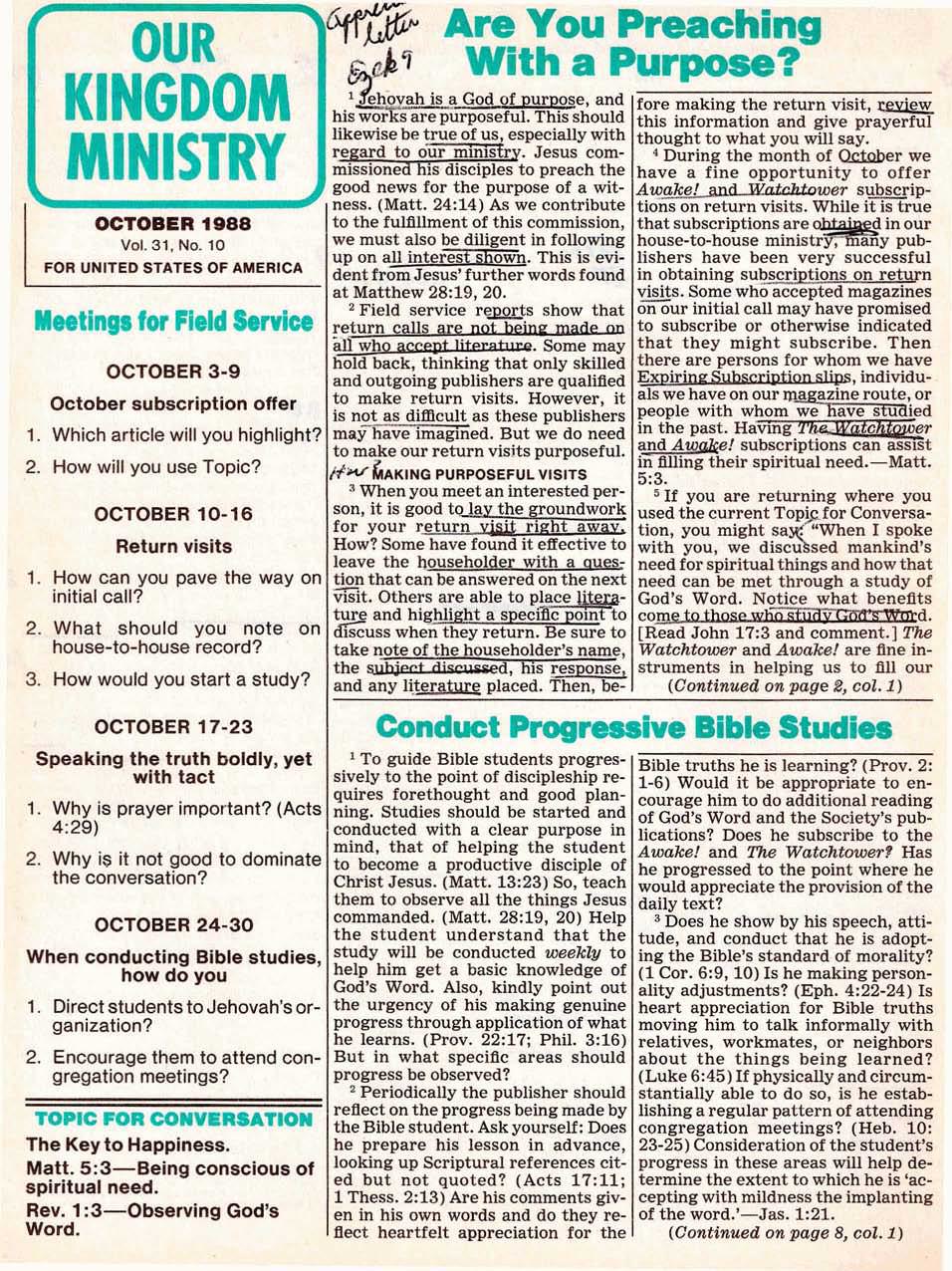
’ OUR ' KINGDOM MINISTRY
OCTOBER 1988
Vol. 31, No. 10 FOR UNITED STATES OF AMERICA
Meetings for Field Service
OCTOBER 3-9
October subscription offer
-
1. Which article will you highlight?
-
2. How will you use Topic?
OCTOBER 10-16
Return visits
-
1. How can you pave the way on initial call?
-
2. What should you note on house-to-house record?
-
3. How would you start a study?
OCTOBER 17-23
Speaking the truth boldly, yet with tact
-
1. Why is prayer important? (Acts 4:29)
-
2. Why i$ it not good to dominate the conversation?
OCTOBER 24-30
When conducting Bible studies, how do you
-
1. Direct students to Jehovah's organization?
-
2. Encourage them to attend congregation meetings?
TOPIC FOR CONVERSATION
The Key to Happiness.
Matt. 5:3—Being conscious of spiritual need.
Rev. 1:3—Observing God’s
Word.
Are You Preaching c With a Purpose?
1Jehovah is a God of purpose, and his works are purposeful. This should likewise be true of us, especially with regard to dur ministry. Jesus commissioned his disciples to preach the good news for the purpose of a witness. (Matt. 24:14) As we contribute to the fulfillment of this commission, we must also be diligent in following up on all interest shown. This is evident from Jesus’ further words found at Matthew 28:19, 20.
2 Field service reports show that return calls are not being made on all who accept litpratiirp Some may hold back, thinking that only skilled and outgoing publishers are qualified
to make return visits. However, it is not as difficult as these publishers may have imagined. But we do need to make our return visits purposeful.
Making purposeful visits
3 When you meet an interested person, it is good to lay the groundwork for your return visit right awav. How? Some have found it effective to leave the householder with a question that can be answered on the next visit. Others are able to place literature and highlight a specific point to discuss when they return. Be sure to take note of the householder’s name, the subject dis^u^yed, his response, and any literature placed. Then, be-
Conduct Progressive Bible Studies
-
1 To guide Bible students progressively to the point of discipleship requires forethought and good planning. Studies should be started and conducted with a clear purpose in mind, that of helping the student to become a productive disciple of Christ Jesus. (Matt. 13:23) So, teach them to observe all the things Jesus commanded. (Matt. 28:19, 20) Help the student understand that the study will be conducted weekly to help him get a basic knowledge of God’s Word. Also, kindly point out the urgency of his making genuine progress through application of what he learns. (Prov. 22:17; Phil. 3:16) But in what specific areas should progress be observed?
-
2 Periodically the publisher should reflect on the progress being made by the Bible student. Ask yourself: Does he prepare his lesson in advance, looking up Scriptural references cited but not quoted? (Acts 17:11; 1 Thess. 2:13) Are his comments given in his own words and do they reflect heartfelt appreciation for the fore making the return visit, review this information and give prayerful thought to what you will say.
-
4 During the month of October we have a fine opportunity to offer Awake! and Watchtower subscriptions on return visits. While it is true that subscriptions are obLyg^d in our house-to-house ministry, many publishers have been very successful in obtaining subscriptions on return visits. Some who accepted magazines on our initial call may have promised to subscribe or otherwise indicated that they might subscribe. Then there are persons for whom we have Expiring Subscription slips, individuals we have on our magazine route, or people with whom wehave studied in the past. Having The. Watchtower and Awake! subscriptions can assist
in filling their spiritual need.—Matt.
5:3.
come to those who si
;d.
-
5 If you are returning where you used the current Topip for Conversation, you might say: “When I spoke with you, we discussed mankind’s need for spiritual things and how that need can be met through a study of God’s Word. Notice what benefits [Read John 17:3 and comment.] The Watchtower and Awake! are fine in-
struments in helping us to fill our (Continued on page 2, col. 1)
Bible truths he is learning? (Prov. 2: 1-6) Would it be appropriate to encourage him to do additional reading of God’s Word and the Society’s publications? Does he subscribe to the Awake! and The Watchtower! Has he progressed to the point where he would appreciate the provision of the daily text?
-
3 Does he show by his speech, attitude, and conduct that he is adopting the Bible’s standard of morality? (1 Cor. 6:9,10) Is he making personality adjustments? (Eph. 4:22-24) Is heart appreciation for Bible truths moving him to talk informally with relatives, workmates, or neighbors about the things being learned? (Luke 6:45) If physically and circumstantially able to do so, is he establishing a regular pattern of attending congregation meetings? (Heb. 10: 23-25) Consideration of the student’s progress in these areas will help determine the extent to which he is ‘accepting with mildness the implanting of the word.’—Jas. 1:21.
(Continued on page 8, col. 1)
:e
tsciples
WEEK STARTING OCTOBER zfo) Song 193
10 min: Local announcements. Appropriate Announcements from Our Kingdom Ministry. Encourage magazine activity for second Saturday of month. Suggest appropriate talking points as time allows.
18 min: “Are You Preaching With a Purpose?” Question-and-answer consideration of article. Emphasize the importance of making return visits with the purpose of starting Bible studies. When discussing paragraph 5, demonstrate how subscription offer can be made on a return visit.
17 min: Youths—Do Not Be Deceived. Talk and interview. Young ones are special target of Satan. He picks on less experienced, seducing them as he did Eve. (Gen. 3:1) Deceives youths by enticements, allurements, temptations. Promotes idea that youths in truth are missing out on something. (Gen. 3:4, 5) Cultivates selfish desire to do own thing, decide for self what is good and bad. Satan makes ways of world, such as sexual immorality, smoking, drug abuse, association with nonbelievers, and worldly entertainment, look attractive. Makes such appear harmless, as fruit on tree appeared to Eve. (Gen. 3:6) What attitude should Christian youths have toward these things, and why? (1 John 2:15-17) Since world is passing away, what goals should youths pursue? (Matt. 6:33; 24:14; 28: 19, 20) Jehovah makes provision to protect youths from being deceived: Youth book, School brochure, Awake! feature “Young People Ask,” meetings, assemblies, parents, and elders. Why is a lifetime in Jehovah’s service
Preaching (Cont’d)
spiritual need.” Then you mightpainL out a specific item in the magazine you are featuring and proreed tn px-plain_the subscription offer. Keep in mind, too, that our purpose in calling is to start Bible studies, so the study arrangement can be explained to them also.
SCHEDULE VISITS
6 Some do not make return visits because they do not schedule a~<TeT-inite time fnr them Return visits can be made in the evenings, on week-endsb-just after completing house-to-house calls, or at other convenient times. Why not set a personal goal of the best way of life? (Prov. 27:11; Eccl. 12:1) As time permits, interview one or two exemplary youths who have cultivated wholesome desires. Find out what has helped them to resist pressures to conform in school. Highlight need for others to assist youths to remain loyal and not be deceived by the world.
Song 164 and concluding prayer.
l15vEEK STARTING OCTOBER 10 U ^?gi29 .
10 min: LocalAnnouncements, Theocratic Ne.ws, and accounts report.
20 min?J ‘‘Conduct Progressive Bible Studies.” Questions and answers. When considering paragraph 4, have experienced pioneer or publisher demonstrate how a Bible study can be terminated. Give number of Bible studies being conducted by congregation. What progress have they made? Warmly encourage all those who are conducting studies to examine the results of each one in the light of this material. Any who need help can speak to service overseer or book study conductor. . ,
15 min: Strengthening Single-Parent Families. Qjialjfl^d elder conducts interview with three or four single parents. Consider matters realistically. What unique problems do they face? How have they learned to cope with their situation? In what ways has the congregation been supportive? What personal or family goals have been set and how has this aided the family? Be positive and warmly commend them for their contribution to the congregation’s spirituality. Remind all of need to remember such ones in our prayers.
Song 161 and concluding prayer.
making at least one return visit each w££k? Seek the aid of those who arc more experienced in this aspect of the field service. Feel free to ask your book study conductor for suggestions along these lines. Also, you may want to gain experience by going along with a .pioneer or a publisher who does well in this work.
7 The apostle Paul mentioned both planting and watering in connection with the Christian ministry. (1 Cor. 3:6, 7) So we have a responsibility to call back on individuals with the purpose of starting a Bible study. Our io.v_will certainly increase if we are preaching with a purpose.
^jweek s/Xr^i^g October 17//# Song 92
5 min: Local ahnouncements. Encourage all to share in magazine work on fourth Saturday of month.
20 min: “Presenting the Good News —Boldly, Yet With Tact.” Question^ and-answer coverage. Demonstrate one of the examples cited in para-fraph 3, using Reasoning book.
8 min: “Subscriptions.” Qualified brother should read all paragraphs and intersperse appropriate comments.
12 min: Local needs. Review suggestions for improvement as noted on circuit overseer's last report.
Song 2 and concluding prayer.
fclWEEK STARTING OCTOBER 24
Song 106 /f/vv
10 min: Local announcements. Discuss introductions in Reasoning book that could be used with Topic for Conversation and would fit local territory. Show why these introductions will be effective.
20 min: “Helping Others Serve Je- J hovah Whole-Souled.” Discussion by presiding overseer. Have an experi-encea regular pioneer demonstrate how to have a heart-to-heart talk with . a Bible student who regularly attends^* meetings but holds back from being / baptized. Use the February 15,1982, Watchtower article “What Prevents Me From Getting Baptized?” Interview one or two in full-time service, asking who encouraged and helped them to make adjustments to take up full-time service. Ask what further goals they are working toward.
15 mln: “Special Convention Fea- .
tures Unite.” Talk. Expand coverage with comments from audience on the four special convention features covered in article.
Song 78 and concluding prayer.
Schedule for congregation studies in the book Life—How Did It Get Here? By Evolution or by Creation?:
October 3: Pages 57* to 64*
October 10: Pages 64* to 70
October 17: Pages 71 to 80*
October 24: Pages 80* to 87'
October 31: Pages 87* to 95*
• To or from subheading.
e 1988 Watch Tower Bible and Tract Society of Pennsylvania. All rights reserved. Our Kingdom Ministry (USPS 295-360) is published monthly by Watchtower Bible and Tract Society of New York, Inc., and International Bible Students Association, 25 Columbia Heights, Brooklyn, N.Y. 11201. Second-class postage paid at Brooklyn, N.Y., and at additional mailing offices. POSTMASTER: Send address changes to Watchtower, 25 Columbia Heights, Brooklyn, N.Y. 11201. Printed in U.S.A.

THEOCRATIC MINISTRY SCHOOL SCHEDULE FOR 1989
INSTRUCTIONS
During 1989 the following will be the arrangements when conducting the Theocratic Ministry School.
TEXTBOOKS: The New World Translation of the Holy Scriptures [bif2], “All Scripture Is Inspired of God and Beneficial” [si], Reasoning From the Scriptures [rs], and You Can Live Forever in Paradise on Earth [pe] will be the basis for assignments.
The school will begin with song, prayer, and remarks of welcome, and then proceed as follows:
ASSIGNMENT NO. 1: 15 minutes. This should be handled by an elder or by a qualified ministerial servant. It will be based on “All Scripture Is Inspired of God and Beneficial.” This assignment should be delivered as a 10-to 12-minute instruction talk with a 3- to 5-minute oral review following, using the printed questions in the section. The objective should be not just to cover the material but to focus attention on the practical value of the information being discussed, highlighting what will be most helpful to the congregation. Where needed, a theme should be selected. All are encouraged to make careful advance preparation so as to benefit fully from this material.
The brothers assigned this talk should be careful to keep within the time limit. Private counsel may be given if necessary.
HIGHLIGHTS FROM BIBLE READING: 6 minutes. This should be handled by the school overseer or another qualified elder or by a ministerial servant assigned by the school overseer. This should not be just a summary of the assigned reading. After giving a brief overall view of the assigned chapters, help the audience to appreciate why and how the information is of value to us. Check Watchtower issues for further highlight material. The students will then be dismissed to their various classrooms by the school overseer.
TALK NO. 2: 5 minutes. This is a Bible reading of the assigned material to be given by a brother. This will apply in the main school as well as in the auxiliary groups. The reading assignments are usually short enough to permit the student to present brief explanatory information in the opening and concluding remarks and even at intermediate points. Historical background, prophetic or doctrinal significance, and application of principles may be included. All the assigned verses should actually be read.
TALK NO. 3: 5 minutes. This talk will be assigned to sisters. The subjects for this talk will alternate between the Reasoning and Live Forever books, the latter to be mainly assigned to young or new students. The student assigned should be able to read. When delivering the talk, the student may be either seated or standing. One assistant will be scheduled by the school overseer, but additional assistants may be used. It is preferred that settings involve field service or informal witnessing. The one giving the talk may either initiate the conversation to establish the setting or have her assistant(s) do so. Not the setting but the material should be given prime consideration. The student should use the theme shown.
TALK NO. 4: 5 minutes. Assigned to a brother or a sister. When assigned to a brother, this should be a talk to the entire audience. It will usually be best for the brother to prepare his talk with the Kingdom Hall audience in mind so that it will be truly informative and beneficial to those who actually hear it. However, if the material lends itself better to another practical and suitable audience-type setting, the brother may choose to develop his talk accordingly. The student should use the theme shown.
S-38 10/88
When assigned to a sister, the material should be presented as outlined for Talk No. 3.
COUNSEL AND REMARKS: After each student talk, the school overseer will give specific counsel, not necessarily following the program of progressive counsel outlined on the Speech Counsel slip. Rather, he should concentrate on those areas where the student needs to improve. If the student speaker merits solely a “G" and there is no other speech quality marked “I” or “W," then the counselor should circle the box, where the “G,” “I,” or “W” would normally appear, of the speech quality that the student should work on next. He will advise the student of this that evening as well as show this speech quality on the student’s next Theocratic Ministry School Assignment slip (S-89). Those giving talks should sit toward the front of the hall. This will save time and enable the school overseer to give his counsel directly to each student. As time allows after the giving of necessary oral counsel, comments may be given by the counselor on informative and practical points not covered by the students. The school overseer should be careful to use no more than a total of two minutes for counsel and remarks after each student talk. If the Bible highlights presentation left something to be desired, private counsel may be given.
PREPARING TALKS: Brothers giving Assignment No. 1 should select a theme where needed. Students assigned the second talk should choose a theme that will allow for the best coverage of the material. Students assigned the third and fourth talks should use the theme shown. Prior to giving the talk, students will want to read over the School Guidebook material dealing with the speech quality being worked on.
TIMING: No talk should go overtime. Neither should the counsel and remarks of the counselor. Talks No. 2 through 4 should tactfully be stopped when the time is up. The one assigned to give the “stop signal” should do so promptly. When brothers handling Assignment No. 1 go overtime, they should be given private counsel. All should watch their timing carefully. Total program: 45 minutes, excluding song and prayer.
WRITTEN REVIEW: Periodically a written review will be given. In preparation, review the assigned material and complete the scheduled Bible reading. Only the Bible may be used during this 25-minute review. The balance of the time will be devoted to a discussion of the questions and answers. Each student will check his own paper. The school overseer will read off all answers and concentrate on the more difficult questions, helping all to understand the answers clearly. If, for some reason, local circumstances make it necessary, the written review may be used a week later than what is shown on the schedule.
LARGE AND SMALL CONGREGATIONS: Congregations with a school enrollment of 50 or more students may wish to arrange for additional groups of students to deliver the scheduled talks before other counselors. Of course, unbaptized persons whose lives conform to Christian principles may also enroll in the school and receive assignments.
ABSENTEES: All in the congregation can show appreciation for this school by endeavoring to be present at every weekly session, by preparing their assignments well, and by participating in question sessions. It is hoped that all students will view their assignments conscientiously. If a student is not present when scheduled, a volunteer may take the assignment, making whatever application he feels qualified to make on such short notice. Or the school overseer may cover the material with appropriate audience participation.
3 OUR KINGDOM MINISTRY, OCTOBER 1988
SCHEDULE
Jan. 2 Bible reading: Ezekiel 38 and 39
Song No. 94
No. 1: Introduction to Lamentations (si pp. 130-1, pars. 1-7)
No. 2: Ezekiel 39:1-13
No. 3: True Prophets Did Not Always Understand How and When Things Foretold Would Happen (rs p. 134 )
No. 4: A True Prophet’s Pronouncements Promote True Worship (rs p. 135, first subheading)
Jan. 9 Bible reading: Ezekiel 40 to 44
Song No. 140
No. 1: Lamentations 1:1 to 5:22 (si pp. 131-2, pars. 8-12)
No. 2: Ezekiel 44:1-16
No. 3: Why Jesus Could Not Return as a Human (pe chap. 17, pars. 1-5)
No. 4: True Prophets Identified by Fruits Produced (rs p. 135, second subheading, to p. 137, par. 1)
Jan. 16 Bible reading: Ezekiel 45 to 48
Song No. Ill
No. 1: Introduction to Ezekiel (si pp. 132-3, pars. 1-6)
No. 2: Ezekiel 47:1-12
No. 3: Why Errors Made by Jehovah’s Witnesses Do Not Disqualify Them as True Prophets (rs p. 137, pars. 2-4)
No. 4: God Does Not Predestinate When Each Person Will Die (rs p. 138)
Jan. 23 Bible reading: Daniel 1 and 2
Song No. 195
No. 1: Ezekiel 1:1 to 7:27 (si pp. 133-4, pars. 7-11)
No. 2: Daniel 2:36-46
No. 3: Jesus’ Fleshly Body Not Taken to Heaven (pe chap. 17, pars. 6-12)
No. 4: Not Everything That Happens Is God’s Will (rs p. 139 to p. 140, first subheading)
Jan. 30 Bible reading: Daniel 3 and 4
Song No. 143
No. 1: Ezekiel 8:1 to 11:25 (si p. 134, pars. 12-14)
No. 2: Daniel 3:19-30
No. 3: God Does Not Foreknow and Foreordain Everything (rs p. 140, second subheading)
No. 4: God’s Ability to Foreknow and Foreordain Events (rs p. 141)
Feb. 6 Bible reading: Daniel 5 and 6
Song No. 61
No. 1: Ezekiel 12:1 to 23:49 (si pp. 134-5, pars. 15-19)
No. 2: Daniel 5:17-31
No. 3: How Christ Returns and How His Return Is Recognized (pe chap. 17, pars. 13-17)
No. 4: Why God Did Not Exercise His Foreknowledge Regarding Adam (rs p. 142, first subheading)
Feb. 13 Bible reading: Daniel 7 and 8
Song No. 180
No. 1: Ezekiel 24:1 to 32:32 (si pp. 135-6, pars. 20-23)
No. 2: Daniel 8:15-27
No. 3: God Did Not Predestinate Jacob, Esau, or Judas (rs p. 142, second subheading, to p. 143, first subheading)
No. 4: In What Way Was the Christian Congregation Predestinated? (rs p. 143, second subheading)
Feb. 20 Bible reading: Daniel 9 and 10
Song No. 187
No. 1: Ezekiel 33:1 to 39:29 (si p. 136, pars. 24-26)
No. 2: Daniel 9:20-27
No. 3: To What Do Christ’s “Coming” and “the End of the World" Refer? (pe chap. 18, pars. 1-6)
No. 4: What Is the Scriptural View of Astrology? (rs pp. 144-5)
Feb. 27 Bible reading: Daniel 11 and 12
Song No. 168
No 1: Ezekiel 40:1 to 48:35 (si pp. 136-7, pars. 27,28)
No. 2: Daniel 12:1-13
No. 3: What Are Some Sound Reasons for Believing in God? (rs p. 145, last subheading)
No. 4: Wickedness and Suffering Do Not Disprove God’s Existence (rs p. 146 to p. 147, first subheading)
Mar. 6 Bible reading: Hosea 1 to 5
Song No. 98
No. 1: Daniel, Introduction and Authenticity (si pp. 138-9, pars. 1-7)
No. 2: Hosea 5:1-15
No. 3: Wars and Famines Visible Proof of Christ’s Invisible
Presence (pe p. 150)
No. 4: God Is a Real Person Capable of Emotion (rs p. 147, second subheading, to p. 148, first subheading)
Mar. 13 Bible reading: Hosea 6 to 10
Song No. 144
No. 1: Daniel 1:1 to 4:37 (si pp. 139-40, pars. 8-11)
No. 2: Hosea 8:1-14
No. 3: God Had No Beginning (rs p. 148, second subheading)
No. 4: Use of God’s Name Essential for Salvation (rs p. 149, first subheading)
Mar. 20 Bible reading: Hosea 11 to 14
Song No. 105
No. 1: Daniel 5:1 to 8:27 (si pp. 140-1, pars. 12-15)
No. 2: Hosea 11:1-12
No. 3: Pestilence, Earthquakes, Fear, and Lawlessness Proof of Christ’s Presence (pe pp. 151-2)
No. 4: Are All Religions Good? (rs p. 149, second subheading)
Mar. 27 Bible reading: Joel 1 to 3
Song No. 21
No. 1: Daniel 9:1 to 12:13 (si p. 141, pars. 16-19)
No. 2: Joel 2:21-32
No. 3: What Kind of “God” Is Jesus? (rs p. 150, first subheading)
No. 4: Overcoming Objections to Belief in God (rs p. 150, par. 3, to p. 151, par. 3)
Apr. 3 Bible reading: Amos 1 to 5
Song No. 162
No. 1: Introduction to Hosea (si pp. 143-4, pars. 1-8)
No. 2: Amos 3:1-15
No. 3: Fulfillment of 2 Timothy 3:1-5 a Sign of Last Days (pe pp. 152-4)
No. 4: Why Men Have Been Unable to Establish a Just Government (rs p. 152 to p. 153, par. 1)
Apr. 10 Bible reading: Amos 6 to 9
Song No. 222
No. 1: Hosea 1:1 to 14:9 (si pp. 144-5, pars. 9-13)
No. 2: Amos 8:1-14
No. 3: Why Human Efforts to Bring Relief Cannot Succeed (rs p. 153, first subheading, to p. 154, first subheading)
No. 4: God’s Kingdom Only Answer to Mankind’s Real Needs (rs p. 154, second subheading)
Apr. 17 Bible reading: Obadiah 1 to Jonah 4
Song No. 151
No. 1: Introduction to Joel (si p. 146, pars. 1-5)
No. 2: Jonah 1:14-2:10
No. 3: Why “Armageddon” Not a Frightening Word (pe chap. 19, pars. 1-3)
No. 4: Bible Prophecies Have Proved Completely Reliable (rs p. 155, first subheading)
Apr. 24 Written Review. Complete Ezekiel 38 to Jonah 4
Song No. 155
No. 1: Joel 1:1 to 3:21 (si pp. 146-7, pars. 6-11)
No. 2: Micah 4:1-12
No. 3: Miraculous Healings Today Not Done by God's Spirit (rs p. 156 to p. 157, par. 3)
No. 4: Difference Between Cures of Jesus and His Apostles and Those of Today (rs p. 157, subheading, to p. 158, first subheading)
May 8 Bible reading: Micah 5 to 7
Song No. 55
No. 1: Introduction to Amos (si pp. 148-9, pars. 1-6)
No. 2: Micah 6:3-16
No. 3: Blessings Coming to Mankind After Armageddon (pe pp. 156-8)
No. 4: How True Christians Are Identified Today (rs p. 158, second and third subheadings)
May 15 Bible reading: Nahum 1 to 3
Song No. 14
No. 1: Amos 1:1 to 9:15 (si pp. 149-50, pars. 7-12)
No. 2: Nahum 1:2-14
No. 3: Why Gifts of Healing Were Given in the First Century (rs p. 159)
No. 4: What Hope Is There for Real Healing for All Mankind? (rs p. 160, second subheading)
May 22 Bible reading: Habakkuk 1 to 3
Song No. 220
No. 1: Introduction to Obadiah (si pp. 151-2, pars. 1-5)
No. 2: Habakkuk 2:1-14
No. 3: What Blessings and What Work Will Be the Lot of Armageddon Survivors? (pe chap. 19, pars. 4-7)
No. 4: Who Alone Had a Prehuman Existence? (rs p. 161, last subheading)
May 29 Bible reading: Zephaniah 1 to 3
Song No. 146
No. 1: Obadiah 1 to 21 (si p. 152, pars. 6-9)
No. 2: Zephaniah 2:1-11
No. 3: Not All Good People Go to Heaven (rs p. 162, first subheading)
No. 4: Adam Was Not Promised Heavenly Life (rs p. 162, second subheading)
June 5 Bible reading: Haggai 1 and 2
Song No. 127
No. 1: Introduction to Jonah (si pp. 153-4, pars. 1-5)
No. 2: Haggai 2:1-9, 20-23
No. 3: Identifying the "New Heavens" and the “New Earth” (pe chap. 19, pars. 8-10)
No. 4: Not Necessary to Go to Heaven to Have a Happy Future (rs p. 163, first subheading)
June 12 Bible reading: Zechariah 1 to 5
Song No. 212
No. 1: Jonah 1:1 to 4:11 (si p. 154, pars. 6-9)
No. 2: Zechariah 4:1-14
No. 3: Jesus Did Not Open Way to Heaven for Those Who Died Before He Did (rs p. 163, second subheading)
No. 4: Heavenly Life Not Hope of All Christians (rs p. 164)
June 19 Bible reading: Zechariah 6 to 9
Song No. 6
No. 1: Introduction to Micah (si pp. 155-6, pars. 1-8)
No. 2: Zechariah 8:9-23
No. 3: Kingdom Blessings Coming to Mankind (pe pp. 161-2)
No. 4: Christian Scriptures Contain Hope of Earthly Blessings (rs p. 165, subheading)
June 26 Bible reading: Zechariah 10 to 14
Song No. 205
No. 1: Micah 1:1 to 7:20 (si pp. 156-7, pars. 9-15)
No. 2: Zechariah 13:1-9
No. 3: How Many Will Get Heavenly Reward and Why the Number Is Not Symbolic (rs p. 166, first subheading, and p. 167, first subheading)
No. 4: The 144,000 Not Only Natural Jews (rs p. 166, second subheading)
Song No. 118
No. 1: Introduction to Nahum (si pp. 158-9, pars. 1-7)
No. 2: Malachi 3:1-10,16-18
No. 3: Blessings in Store for Armageddon Survivors (pe chap. 19, pars. 11-21)
No. 4: Great Crowd Before God's Throne, but Not in Heaven (rs p. 167, second subheading)
July 10 Bible reading: Matthew 1 to 3
Song No. 13
No. 1: Nahum 1:1 to 3:19 (si pp. 159-60, pars. 8-10)
No. 2: Matthew 3:1-17
No. 3: Heavenly Duties of 144,000 (rs p. 168, first subheading)
No. 4: Bible Shows Dead Do Not Suffer Pain (rs p. 169, first and second subheadings)
July 17 Bible reading: Matthew 4 and 5
Song No. 36
No. 1: Introduction to Habakkuk (si p. 161, pars. 1-5)
No. 2: Matthew 5:1-17
No. 3: The Resurrection Hope in the Hebrew Scriptures (pe chap. 20, pars. 1-4)
No. 4: Bible Shows Both Good and Bad Go to Hell at Death (rs p. 170, first to third subheadings)
July 24 Bible reading: Matthew 6 and 7
Song No. 172
No. 1: Habakkuk 1:1 to 3:19 (si pp. 161-2, pars. 6-11)
No. 2: Matthew 6:1-14,31-33
No. 3: Bible Translators Cause Confusion About Hell (rs p. 170, last subheading)
No. 4: Wicked Eternally Punished but Not Eternally Tormented (rs p. 171, subheading)
July 31 Bible reading: Matthew 8 and 9
Song No. 211
No. 1: Introduction to Zephaniah (si pp. 163-4, pars. 1-6)
No. 2: Matthew 9:18-38
No. 3: Resurrections Recorded in the Christian Greek Scriptures (pe chap. 20, pars. 5-9)
No. 4: Meaning of Eternal Torment Mentioned in Revelation (rs p. 172, subheading)
Aug. 7 Bible reading: Matthew 10 and 11
Song No. 27
No. 1: Zephaniah 1:1 to 3:20 (si pp. 164-5, pars. 7-9)
No. 2: Matthew 10:5-15, 24-31
No. 3: What Is the Fiery Gehenna Mentioned by Jesus? (rs p. 173, subheading)
No. 4: God’s Punishment of the Wicked Compatible With His Personality (rs p. 174, third subheading, and p. 175, subheading)
Aug. 14 Bible reading: Matthew 12 and 13
Song No. 133
No. 1: Introduction to Haggai (si pp. 166-7, pars. 1-7)
No. 2: Matthew 13:34-52
No. 3: Who Will Be Resurrected? (pe chap. 20, pars. 10-18)
No. 4: Parable of Rich Man and Lazarus Teaches What? (rs p. 174, last subheading)
Aug. 21 Bible reading: Matthew 14 and 15
Song No. 156
No. 1: Haggai 1:1 to 2:23 (si p. 167, pars. 8-12)
No. 2: Matthew 15:1-20
No. 3: What Disproves Jesus Was Born December 25? (rs p. 176)
No. 4: Who Were the Magi That Visited Jesus? (rs p. 177, first subheading)
Aug. 28 Written Review. Complete Micah 1 to Matthew 15
Song No. 123
No. 1: Introduction to Zechariah (si pp. 168-9, pars. 1-7)
No. 2: Matthew 16:13-28
No. 3: The Tw’o Resurrections (pe chap. 20, pars. 19-24)
No. 4: What Is the Origin of Christmas Giving? (rs p. 177, second subheading)
Sept. 11 Bible reading: Matthew 18 and 19
Song No. 38
No. 1: Zechariah 1:1 to 7:14 (si pp. 169-70, pars. 8-17)
No. 2: Matthew 18:7-22
No. 3: Why Should Christians Have Nothing to Do With Christmas Celebrations? (rs p. 178, subheading)
No. 4: Why Should Christians Not Celebrate Easter or New Year’s? (rs p. 179, subheading, to 180, first subheading)
Sept. 18 Bible reading: Matthew 20 and 21
Song No. 195
No. 1: Zechariah 8:1 to 14:21 (si pp. 170-1, pars. 18-22)
No. 2: Matthew 20:17-34
No. 3: The Resurrection Truly a Miracle (pe chap. 20, pars. 25-27)
No. 4: What Is the Origin of All Souls’ Day Celebrations? (rs p. 180, second subheading)
Sept. 25 Bible reading: Matthew 22 and 23
Song No. 204
No. 1: Introduction to Malachi (si pp. 172-3, pars. 1-6)
No. 2: Matthew 22:15-33
No. 3: Why Do Christians Not Participate in Worldly Holidays? (rs p. 181, subheading, to p. 182, third subheading)
No. 4: What Does the Bible Say About Image Worship? (rs p. 183, first subheading)
Oct. 2 Bible reading: Matthew 24 and 25
Song No. 193
No. 1: Malachi 1:1 to 4:6 (si pp. 173-4, pars. 7-12)
No. 2: Matthew 24:3-22
No. 3: How Long Will the Judgment Day Be, and Who Will Do the Judging? (pe chap. 21, pars. 1-4)
No. 4: True Worship Does Not Need Images as Aids (rs p. 183, last subheading)
Oct. 9 Bible reading: Matthew 26
Song No. 112
No. 1: Introduction to Romans (si pp. 204-5, pars. 1-7)
No. 2: Matthew 26:1-5,17-30
No. 3: “Saints” Cannot Serve as Intercessors (rs p. 184)
No. 4: How Does God View Images That Arc Objects of Worship? (rs p. 185, second subheading)
Oct. 16 Bible reading: Matthew 27 and 28
Song No. 129
No. 1: Romans 1:1 to 8:39 (si pp. 205-6, pars. 8-12)
No. 2: Matthew 28:7-20
No. 3: Why Is the Judgment Day Not to Be Dreaded? (pe chap. 21, pars. 5-7)
No. 4: How Should We Eeel About Images We Once Venerated? (rs p. 186, subheading)
Oct. 23 Bible reading: Mark 1 and 2
Song No. 92
No. 1: Romans 9:1 to 12:21 (si pp. 206-7, pars. 13-15)
No. 2: Mark 1:1-15
No. 3: What Effect Could Use of Images Have on Our Future? (rsp. 187)
No. 4: Casting Aside Bible’s Moral Standards Does Not Bring Freedom (rs p. 187, last subheading, to p. 188, par. 2)
Song No. 2
No. 1: Romans 13:1 to 16:27 (si p. 207, pars. 16-19)
No. 2: Mark 4:21-34
No. 3: What Are the Resurrections to Life and to Judgment? (pe chap. 21, pars. 12-14)
No. 4: Materialistic Pursuits Are Self-Defeating (rs p. 188, par. 3)
Nov. 6 Bible reading: Mark 5 and 6
Song No. 35
No. 1: Introduction to 1 Corinthians (si pp. 208-9, pars. 1-7)
No. 2: Mark 6:30-44, 56
No. 3: Christians Must Avoid Bad Associations (rs p. 189, par. 2)
No. 4: Satan, Chief Instigator Against God’s Commands (rs p. 189, last subheading, to p. 190, first subheading)
Nov. 13 Bible reading: Mark 7 and 8
Song No. 48
No. 1: 1 Corinthians 1:1 to 7:40 (si pp. 209-10, pars. 8-13)
No. 2: Mark 7:5-23
No. 3: By What Will People Be Judged on Judgment Day? (pe chap. 21, pars. 15-18)
No. 4: What Independent Attitudes Must Christians Avoid? (rs p. 190, second subheading, to p. 191, first subheading)
Nov. 20 Bible reading: Mark 9 and 10
Song No. 207
No. 1: 1 Corinthians 8:1 to 11:34 (si pp. 210-11, pars. 14-17)
No. 2: Mark 9:1-13
No. 3: Where Is God’s Name to Be Found in Some Commonly Used Bibles? (rs p. 191, last subheading, to p. 193, par. 7)
No. 4: Why Do Many Translations Slight God’s Name? (rs p. 193, subheading)
Nov. 27 Bible reading: Mark 11 and 12
Song No. 86
No. 1: 1 Corinthians 12:1 to 16:24 (si p. 211, pars. 18-22)
No. 2: Mark 12:28-44
No. 3: How Jehovah Determines Who Will Be Written in the Book of Life (pe chap. 21, pars. 19-21)
No. 4: How Do We Know Christian Greek Scripture Writers Used Jehovah’s Name? (rs p. 194)
Dec. 4 Bible reading: Mark 13 and 14
Song No. 206
No. 1: Introduction to 2 Corinthians (si p. 213, pars. 1-4)
No. 2: Mark 13:21-37
No. 3: Why Do We Prefer "Jehovah” to “Yahweh”? (rs p. 195, subheading)
No. 4: Why Is It Important to Know and Use Jehovah’s Name? (rs p. 196, subheading)
Dec. 11 Bible reading: Mark 15 and 16
Song No. 58
No. 1: 2 Corinthians 1:1 to 7:16 (si pp. 213-14, pars. 5-12)
No. 2: Mark 15:1-15
No. 3: Who Will Survive the Present Judgment Day? (pe chap. 21, pars. 22, 23)
No. 4: Jehovah of the “Old Testament” Is Not Jesus of the “New Testament” (rs p. 197, subheading)
Dec. 18 Bible reading: Luke 1
Song No. 12
No. 1: 2 Corinthians 8:1 to 13:14 (si pp. 214-15, pars. 13-17)
No. 2: Luke 1:57-80
No. 3: Why We Can Both Love and Fear Jehovah (rs p. 198, subheading)
No. 4: Three Beliefs That Set Us Apart From Other Religions (support with scriptures) (rs pp. 199-200)
Dec. 25 Written Review. Complete Matthew 16 to Luke 1
Announcemen ts • Literature offer for October: Subscriptions for either Awake! or The Watchtower or for both magazines. One-year subscriptions are on a contribution of $5.00 each. Six-month subscriptions are $2.50 each. November: New World Translation with the "Kingdom Come” book for a contribution of $5.00. December: My Book of Bible Stories or You Can Live Forever in Paradise on Earth for a contribution of $3.00. Small-size Live Forever book is $1.50. January and February: Any 192-page book published prior to 1980 and not printed on better-grade paper for contribution of 50c.
• New Publications Available:
Holy Scriptures, (Deluxe edition), maroon —Finnish
New World Translation of the Holy Scriptures, (Deluxe pocket edition: DLbi25), available in black or maroon —German, Portuguese
New World Translation of the Holy Scriptures—Large print (Set of four volumes) —German
New World Translation of the Holy
Scriptures—With References (RbiS)
—French
Life—How Did It Get Here! By Evolution or by Creation! (Small size)
—Greek
Sing Praises to Jehovah (Large size)
—Greek
True Peace and Security—How Can You Find It! —Dutch
You Can Live Forever in Paradise on Earth (Small size)
—Korean, Sinhalese
Your Youth—Getting the Best out of It
—Romanian
Watch Tower Publications Index 1986 —French, German • New Cassette Recordings Available:
Jehovah Delivers Those Calling Upon His Name—Drama (single cassette; congregation and public: $2.00; pioneers: $1.75) —Indonesian
Jeremiah, Lamentations (set of five cassettes; congregation and public: $7.50; pioneers: $6.25) —Spanish • Congregations should begin ordering Examining the Scriptures Daily—1989 with their October literature order. (See the 1988 Cost List, paragraphs 7-10.) Booklets will be available in Arabic, Chinese, Danish, Dutch, English, Finnish, French, German, Greek, Iloko, Italian, Japanese, Korean, Norwegian, Portuguese, Samoan, Spanish, Swedish, Tagalog, Turkish, and Vietnamese. Until these booklets are available and shipments are made, they will appear as “Back Ordered" on congregation invoices. Examining the Scriptures booklets are controlled stock items and will be charged to the literature account at 30e each, which is the publisher rate. Regular and special pioneers on the list before July 1, 1988, may receive one free copy and obtain additional copies at 20e each. A separate entry should be made on the monthly remittance form (S-20), showing free copies to pioneers.—See the 1988 Cost List, paragraphs 23-25.
Helping Others Serve Jehovah Whole-Souled
1 Jehovah rightly requires that each one of us serve him whole-souled. (Mark 12:30; Col. 3:23) Although having different capabilities, we individually want to do our very best in serving him.—Matt. 13:23.
7 2 Can we be of further assistance to our children in this regard? Are there ways’we can provide more encour--agement to those with whom we conduct Bible studies? Are there some in the congregation who might be able < o improve the quality or quantity of their service if we give them some practical assistance?
HOW TO HELP
3 There are a number of persons who have been regularly attending all congregation meetings. Some have even qualified to start sharing in field service. This is commendable. However, not all have decided to make a dedication and set baptized. Can we help them in this regard? Have we had a heartfelt discussion with them personally? It may be that a frank, kindly review of the article V1 What Prevents Me From Getting Baptized?’7on pages 27-31 of the February 15, 1982, Watchtower will help.
-
1 There are also those who have been baptized but then hold back from making themselves available for privileges within their abilities , and circumstances. Some may be ^regular publishers who auxiliary pioneer from time to time. Could they perhaps make needed adjustments so
Special Convention Features Unite
-
1 “Look! How good and how pleasant it is for brothers to dwell together in unity!” (Psalm 133:1) After enjoying our “Divine Justice” District Convention program with its various special features, these words have taken on added meaning for the worldwide brotherhood of Jehovah’s people.
-
2 Anticipation was aroused when it was announced that selected talks on the convention program would be tied in to all convention cities each week by means of telephone transmission. Then when the stimulating information was given by each speaker, we rejoiced that we could be present and participate. And what a joy it was to be tied in with so many brothers in shouting “Aye!” to the powerful Resolution!
-
3 Special, also, was the release of the two-volume publication entitled Insight on the Scriptures. What a beautifully illustrated publication! How it will unite us in researching Bible subjects so that we may speak in agreement on the real mean-as to be regular auxiliary pioneers? Is . it possible for some who are regular x auxiliary pioneers to become regular ' pioneers? At times, woi^s of exhortation along with a few practical suggestions from a parent, an elderor from onealread.yserving.as a regular pioneer will motivate such ones to serve to the full extent that their abilities and circumstances allow. —2 Tim. 4:2.
GIVE ENCOURAGEMENT
-
5 Others may become qualified for appointment as ministerial servants or elders after responding to the < needed encouragement and “reaching out” for such privileges. (1 Tiffl. ’ 3:1) By taking advantage of practical assistanceoffered through the Theocratic Ministry School- certain ones . can become effective pnhlin speak- I ers. Some single elders and ministerial servants have been helped to make the needed adjustments to x qualify for the Ministerial Training School,, Can you think of other privi- -j leges for which some in your family ' or congregation could possibly quali- -fy if they receive some assistance? In ■, what way might you help them?
-
6 We should offer. Jehovah the best service we can give him. (Rev. 4:11) ■ We want to do his will whole-souled V, and heln others to do likewise. (Eph. ’*> 6:6) Those who are responsive to help and encouragement toward serving Jehovah whole-souled can be sure that Jehovah will giveQ'the due reward.” J-Col. 3:24.
ing of the Scriptures!—1 Cor. 1:10.
-
4 What a pleasant surprise we received on Saturday afternoon when the announcement came that a new publication entitled Revelation—Its Grand Climax at Hand! was being released. This 320-page book will certainly help us unite our thoughts on the meaning of the many symbolic expressions found in the last book of the Bible.
-
5 Not to be forgotten was the special feature of having missionaries relate their personal experiences at many of the conventions. How we appreciate their years of faithful service! Despite many obstacles, such as failing health, language problems, and opposition, they have expanded the preaching of the good news in distant lands.
-
6 Certainly Jehovah has blessed us with more than we ever anticipated. Now it is our determination to bear witness concerning divine justice so that still other righteoushearted ones may respond.
PRESENTING THE GOOD NEWS
Boldly, Yet With Tact
-
1 When Peter and John were ordered to stop preaching, they replied/‘But as for us, we cannot stop speaking about the things we have seen'and heard.”\Acts 4:20) What enabled them to' speak with such boldness? They “made supplication” and became “filled with the hqiy spirit and were speaking the word of GoiTwith boldness.” (Acts 4:31) Certainly we likewise can be emboldened to preach(jf>we follow their example.
-
2 But how can we speak with bold-ness-SriU at the same’time be tact-fuJTDne dictionary definition of tact iXja keen sense of what to do or say in order to avoid offense.’/Estahlish-ing a common ground will help us to be tactful. Learning how to reason with people will also enable us to be tactful. What better instrument could we use than(Reasoning From the Scripturesjto help us be both bold and tactful.
BEING BALANCED
-
3 Maintaining a b.-<l.mcc between boldness<.andj)tactfulness is important in getting the preaching work accomplished successfully. For example, how could we address those who raise the question. ‘Is it not true that there is good in all religions?’ A
Bible Studies (Cont’d)
TERMINATING UNFRUITFUL STUDIES
-
4 If a student is not making meaningful progress after you have patiently aided him over a reasonable period of time, it may be best to use the time to better advantage searching for deserving ones. (Matt. 10: 11-13) Depending on the circumstances, it may be wise to discontinue the study. Genuinely commend the householder for the progress made. Point out, however, that as Bible truths are learned they should be applied. Using Jesus’ parable of the sower, you might discuss each of the four kinds of soil referred to and then show how this illustration emphasizes the need to respond positively to the Kingdom message. This may help the student to realize what has held him back from making steady progress. You may have opportunity to comment on what you have observed. Be kind, but straightforward and clear. (1 Cor. 14:8, 9) Let him know that the study might be resumed when the needed adjustments have been made. In the meantime, you will be calling periodically to encourage him.—See Kingdom Ministry, February 1970, page 4.
direct but tactful reply is found on page 323 of the Reasoning book. Also, if someone raises ^question as to why we reneatedly call on persons who are not Jehovah’s Witnesses and who have their own faith, we can give a bold but tactful reply as outlined on page 206 of the Reasoning book. Some peopUsifek why Jehovah’s Witnesses do not get involved in things tn help make the. commnnity a better place to live. Several fine points are presented on pages 207 and 208 that will enable us to speak boldly but with tact.
EXAMPLES
-
1 Peter said we should be ‘always ready to make a defense before those demanding a reason for our hope.’ He then ajdfid that we should ‘do so together with a mild temper and deep respect.’ (1 Pet. 3:15) Yes, Peter recognized the need to be bold but also to use tact. The success of publishers following this method is reported in the Society’s publications.—w86 4/1 pp. 6-7; w86 8/1 pp. 21, 24; j/b87 pp. 53-4.
-
5 Relying on Jehovah in p^aj^er. as many examples highlight, will enable us to receive the help of the holy spirit, thus strengthening us to speak with boldness and tact.—Acts 5:29.
-
5 When locating people in the territory who have studied before, it is wise to find out how long they studied and with whom. Why did they stop? If the one who previously conducted the study is known, it would be good to discuss the matter with him and the service overseer before resuming the study. Likely there are factors about which you are not aware. Some persons have studied with many different publishers over the years without ever making any real progress. We need to spend time with those who show a genuine interest in the truth.
G Whether terminating a Bible study or resuming one previously stopped, you may wish to discuss with the householder the fine material appearing in the article “There Is Still Time to ‘Turn to Jehovah’” on pages 220-2 of the April 1,1976, issue of The Watchtower. As we sharpen our abilities in conducting progressive Bible studies, countless others may yet be aided to learn, accept, and practice the truth. This can result in their obtaining an approved relationship with Jehovah God and, ultimately, everlasting life.—Phil. 4:9; John 17:3.
THEOCRATIC NEWS
♦ The island of Kiribati reported a new peak of 24 publishers for May, a 60-percent increase over last year’s average. Congregation publishers averaged 19.5 hours in the field.
♦ New Caledonia had a peak of 954 publishers in May. Their circuit assemblies were attended by 2,159, and 30 were baptized.
♦ Nigeria had an all-time peak In May of 134,543 publishers. Thus far this service year 5,456 have been baptized, which is 16.1 percent above the number baptized for the same period last year._____________________________
Subscriptions
-
1 Subscriptions to The Watchtower and Awake! have helped many to become acquainted with God’s Word. What can we do to ensure that subscribers continue getting the best service possible?
-
2 Accuracy in filling out the sub-scrijttion blank cannot be overstressed. Eine improvement has been achieved in this area. However, a growing problem is occurring when a subscriber moves. Often the Society is noMmmediately informed ancTThe subscription service is interrupted.
-
3 The postal service returns all un-deliyjerajole magazines to the Society at a charge of 30<t each. In 1987 the Society had to spend more than $50,000 to cover postage on these’ returned undeliverable magazines. Most of these were returned because the subscriber had moved. Notices of address changes supplied to~the postal service generally dn nnt apply to ouwuagazines. Therefore, in order to have the address changed for Watchtower and Awake! subscriptions, the Society’s Subscription Change of Address form (M-205) must be sent in to give the new address. Your assistance in this will help the Society keep its handling costs at a minimum.
-
4 All Expiring Subscription slips should he given immediate attention. Publishers are encouraged to follow through immediately in obtaining renewals and turning these in tn the brother caring for subscriptions. Both new and renewal subscriptions obtained from unbaptized people may be reported by the publisher. (See Our Ministry, page 102.) However, it is helpful to the Society to have the renewals sent in as early as possible. All subscriptions should besent to the Society weekly,
JULY SERVICE REPORT
Pubs. Hrs. Mags. R.V. Bi.St.
Aux. Pios. 30,944 59.3 26.5 14.4
TOTAL 775,138
Newly Dedicated Ones Baptized: 11,865
