 The content displayed below is for educational and archival purposes only.
Unless stated otherwise, content is © Watch Tower Bible and Tract Society of Pennsylvania
You may be able to find the original on wol.jw.org
Video above © Watch Tower Bible and Tract Society of Pennsylvania
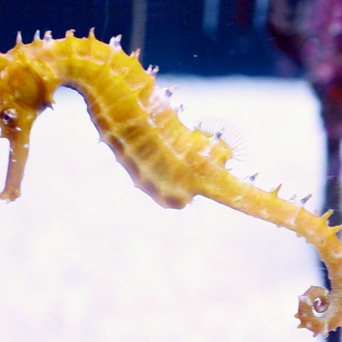
00:00:08 The seahorse has a very unusual feature for a fish: 00:00:12 a prehensile, or grasping, tail. 00:00:15 This tail can anchor the seahorse to one spot, 00:00:18 resisting the ocean currents that surround it. 00:00:23 How does it work? 00:00:25 The cross-section of the seahorse’s tail is square, 00:00:30 not round like that of most other animals with gripping tails. 00:00:33 In contrast with a round shape, 00:00:35 this square shape allows the tail to contact a greater area 00:00:38 of the surface being gripped, 00:00:40 making it more difficult to dislodge. 00:00:43 It can also 00:00:45 twist and untwist with minimal energy. 00:00:50 In addition, the tail of the seahorse is encased 00:00:52 in overlapping bony plates with many joints. 00:00:56 When subjected to a potentially harmful force, 00:00:59 the plates slide over one another, 00:01:01 absorbing the energy. 00:01:04 This can prevent damage to the seahorse’s spinal column. 00:01:08 The design of the seahorse’s tail could be applied to search-and-rescue robots, 00:01:12 which need to be strong and capable of bending and twisting 00:01:16 in tight spaces. 00:01:17 The same properties could be useful 00:01:20 in some surgical equipment. 00:01:22 According to Professor Ross Hatton: 00:01:25 “Human engineers tend to build things 00:01:27 “that are stiff so they can be controlled easily. 00:01:30 “But nature makes things just strong enough not to break, 00:01:33 “and then flexible enough to do a wide range of tasks. 00:01:37 “That’s why we can learn a lot from animals 00:01:39 that will inspire the next generations of robotics.” 00:01:42 What do you think? 00:01:45 Did the seahorse’s tail evolve? 00:01:47 Or was it designed?
00:00:08 The seahorse has a very unusual feature for a fish: 00:00:12 a prehensile, or grasping, tail. 00:00:15 This tail can anchor the seahorse to one spot, 00:00:18 resisting the ocean currents that surround it. 00:00:23 How does it work? 00:00:25 The cross-section of the seahorse’s tail is square, 00:00:30 not round like that of most other animals with gripping tails. 00:00:33 In contrast with a round shape, 00:00:35 this square shape allows the tail to contact a greater area 00:00:38 of the surface being gripped, 00:00:40 making it more difficult to dislodge. 00:00:43 It can also 00:00:45 twist and untwist with minimal energy. 00:00:50 In addition, the tail of the seahorse is encased 00:00:52 in overlapping bony plates with many joints. 00:00:56 When subjected to a potentially harmful force, 00:00:59 the plates slide over one another, 00:01:01 absorbing the energy. 00:01:04 This can prevent damage to the seahorse’s spinal column. 00:01:08 The design of the seahorse’s tail could be applied to search-and-rescue robots, 00:01:12 which need to be strong and capable of bending and twisting 00:01:16 in tight spaces. 00:01:17 The same properties could be useful 00:01:20 in some surgical equipment. 00:01:22 According to Professor Ross Hatton: 00:01:25 “Human engineers tend to build things 00:01:27 “that are stiff so they can be controlled easily. 00:01:30 “But nature makes things just strong enough not to break, 00:01:33 “and then flexible enough to do a wide range of tasks. 00:01:37 “That’s why we can learn a lot from animals 00:01:39 that will inspire the next generations of robotics.” 00:01:42 What do you think? 00:01:45 Did the seahorse’s tail evolve? 00:01:47 Or was it designed?
