 View PDF
The content displayed below is for educational and archival purposes only.
Unless stated otherwise, content is © 1915 International Bible Students Association

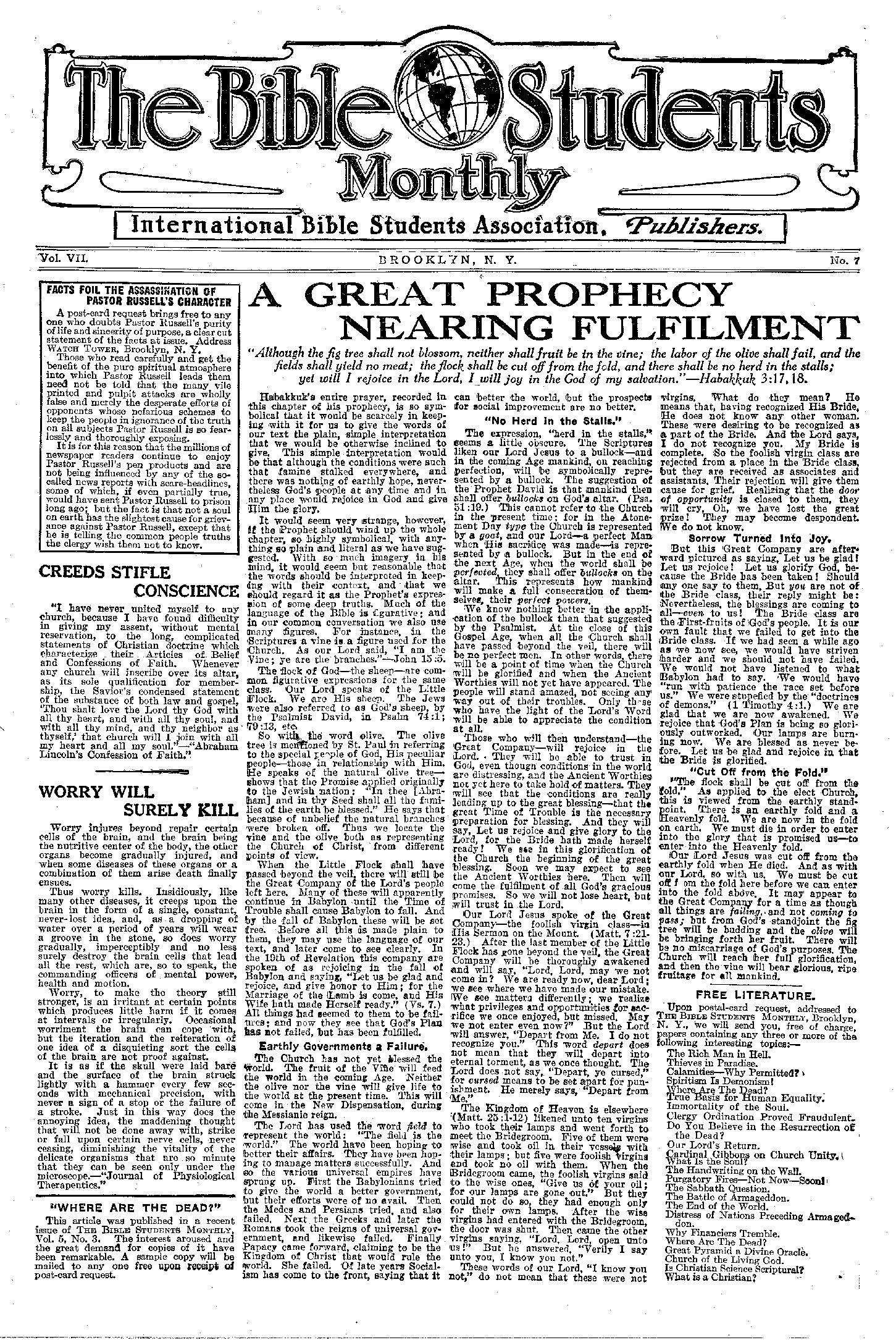
Vol. VII.
BROOKLYN, N. Y.
No. 7
FACTS FOIL THE ASSASSINATION OF PASTOR RUSSELL’S CHARACTER
A post-card request brings free to any one who doubts Pastor Russell’s purity of life and sincerity of purpose, a clear cut statement of the facts at issue. Address Watch Tower, Brooklyn, N. Y.
Those who read carefully and get the benefit of the pure spiritual atmosphere into which Pastor Russell leads them need not be told that the many vile printed and pulpit attacks are wholly false and merely the desperate efforts of opponents whose nefarious schemes to keep the people in ignorance of the truth on all subjects Pastor Russell is so fearlessly and thoroughly exposing. #
It is for this reason that the millions of newspaper readers continue to enjoy Pastor _ Russell’s pen products and are not being influenced by any of the so-called news reports with scare-headlines, some of which, if even partially true, would have sent Pastor.Russell to prison long ago; but the fact is that not a soul on earth has the slightest cause for grievance against Pastor Russell, except that he is telling, the common people truths the clergy wish them not to know.
CREEDS STIFLE
CONSCIENCE
“I have never united myself to any church, because I have found difficulty in giving my assent, without mental reservation, to the long, complicated statements of Christian doctrine which characterize their Articles of-Belief and Confessions of Faith. Whenever any church will inscribe over its altar, as its sole qualification for membership, the Savior’s condensed statement of the substance of both law and gospel, ‘Thou shalt love the Lord thy God with all thy heart, and with all thy soul, and with all thy mind, and thy neighbor as thyself,’ that church will I join with all my heart and all my soul.”—“Abraham Lincoln’s Confession of Faith.’*
WORRY WILL
SURELY KILL
Worry injures beyond repair certain cells of the brain, and the brain being the nutritive center of the body, the other organs become gradually injured, and when some diseases of these organs or a combination of them arise death finally ensues.
Thus worry kills. , Insidiously, like many other diseases, it creeps upon the brain in the form of a single, constant, never- lost idea, and, as a dropping of water over a period of years will wear a groove in the stone, so does worry gradually, imperceptibly and no less surely destroy the brain cells that lead all the rest, which are, so to speak, the commanding officers of mental power, health and motion.
Worry, to make the theory still stronger, is an irritant at certain points which produces little harm if it comes at intervals or irregularly. Occasional worriment the brain can cope with, but the iteration and the reiteration of one idea of a disquieting sort the cells of the brain are not proof against.
It is as if the skull were laid bard and the surface of the brain struck lightly with a hammer every few seconds with mechanical precision, with never a sign of a stop or the failure of a stroke. Just in this way does the annoying idea, the maddening thought that will not be done away with, strike or fall upon certain nerve cells, never ceasing, diminishing the vitality of the delicate organisms that are , so minute that they can be seen only under the microscope.—“Journal of Physiological Therapeutics.”
“WHERE ARE THE DEAD?”
This article was published in a recent issue of The Bible Students Monthly, Vol. 5, No. 3. The interest aroused and the great demand for copies of it . have been remarkable. A sample copy will be mailed to any one free upon receipt of post-card request.
A GREAT PROPHECY
NEARING FULFILMENT
"Although the fig tree shall not blossom, neither shall fruit be in the vine; the labor of the olive shall fail, and the fields shall yield no meat; the flock. shall be cut off from the fold, and there shall be no herd in the stalls;
yet will I rejoice in the Lord, I will joy in the God of my salvation.”—Habakfiuk 3:17,18.
Halbakkuk’s entire prayer, recorded in 'this chapter of his prophecy, is so symbolical that it would be scarcely in keeping with it for us to give the words, of our text the plain, simple interpretation that we would be otherwise inclined to give. This simple interpretation would be that although the conditions were such that famine stalked everywhere, and there was nothing of earthly hope, nevertheless God’s people at any time and in any place would rejoice in God and give Him the glory.
It would seem very strange, however, if the Prophet should wind up the whole chapter, so highly symbolical, with anything iso plain and literal as we have suggested. With so much imagery in his mind, it would seem but reasonable that the words should be interpreted in keeping with their context, and' that we should regard it as the Prophet’s expression of some deep truths. Much of the language of the Bible is figurative; and in our common conversation we also use many figures. For instance, in the 'Scriptures a vine is a figure used for the Church. As our Lord said, “I am _the Vine ; ye are the branches.”—John 15:5.
The flock of God—the sheep—are common figurative expressions for the same class. 'Our Lord speaks of the Little Flock. We are His sheep. The Jews were also referred to as God’s sheep, by the Psalmist David, in Psalm 74:1; 79:13, etc-.
So witi|, the word olive. The olive tree is mentioned by St. Paul in referring to the special people of God, His peculiar people—those in relationship with Him. He speaks of the natural olive, tree-shows that the Promise applied originally ito the Jewish nation: “In thee [ Abraham] and in thy Seed shall all the families of the earth be blessed.” He says that because of unbelief the natural branches were broken off. Thus we locate the vine and the olive both as representing the Church of Christ, from different points of view.
.When the Little Flock shall have passed beyond the veil, there will still be the Great Company of the Lord’s people left here. Many of ’these will apparently continue in Babylon until the Time of Trouble shall cause Babylon to fall. And by the fall of Babylon, these will be set free. Before all this is made plain to them, they may use the language of our text, and later come to see clearly. In the 19th of Revelation this company are spoken of as rejoicing in the fall of Babylon and saying, “Let us be glad and rejoice, and give honor to Him; for the Marriage of the Lamb is come, and His Wife hath made Herself ready.” (Vs. 7.) All things had seemed to them to be failures; and now they see that God’s Plan has not failed, but has been fulfilled.
Earthly Governments a Failure.
The Church has not yet blessed the Mrorld. The fruit of the Vine will feed the world in the coming Age. Neither the olive nor the vine will give life to the world at the present time. This will come in the New Dispensation, during the Messianic reign.
The Lord has used the word field to represent the world: “The field is the world.” The world .have been hoping to better their affairs. They have been hoping to manage matters successfully. And so the various universal empires have sprung up. First the Babylonians tried to give the world a better government, but their efforts were of no avail. Then the Medes and Persians tried, and also failed. Next the Greeks and later the Romans took the reigns of universal government, and likewise failed. Finally Papacy came forward, claiming to be the Kingdom of Christ that would rule the world. She failed. 'Of late years Socialism has come to the front, saying that it can better the world, but the prospects for social improvement are no better.
“No Herd in the Stalls.”
The expression, “herd in the stalls,” seems .a little obscure. The Scriptures liken our Lord Jesus to a bullock—and in the coming Age mankind, on reaching perfection, will be symbolically represented by a bullock. The suggestion of the Prophet David is that mankind then shall offer "bullocks on God’s altar. (Psa. 51:19.) This cannot refer to the Church in the present time; for in the Atonement Day type the Church is represented by a goat, and our Lord—a perfect Man when His sacrifice was made—is represented by a bullock. But in the end of ■the next Age, when the world shall be perfected, they shall offer bullocks on the altar. This represents how mankind will make a full consecration of themselves, their perfect powers.
We know nothing better in 'the application of the bullock than that suggested by the Psalmist. At the close of this Gospel Age, when all the Church shall have passed beyond the veil, there will be no perfect men. In other words, there will be a point of time when the Church will be glorified and when the Ancient Worthies will not yet have appeared. The people will stand amazed, not seeing any way out of their troubles. Only th'se who have the light of the Lord’s Word will be able to appreciate the condition at all.
Those who will then understand—the 'Great Company—will rejoice in the Lord. • They will be able to trust in God, even though conditions in the world are distressing, and the Ancient Worthies not yet here to take hold of matters. They will see that the conditions are really leading up to the great blessing—that the great Time of Trouble is the necessary preparation for blessing. And they will say, Let us rejoice and give glory to the Lord, for the Bride hath made herself ready! We s«e in this glorification of the Church the beginning of the great blessing. Soon we may expect to see the Ancient Worthies here. Then will come the fulfilment of all God’s gracious promises. So we will not lose heart, but will trust in the Lord.
Cur Lord Jesus spoke of the Great Company—the foolish virgin class—in His Sermon on the Mount. (Matt. 7:21-23.) After the last member of the Little Flock has gone beyond the veil, the Great Company will be thoroughly awakened and will say, “Lord, Lord, may we not come in? We are ready now, dear Lord • we see where we have made our mistake. We see matters differently; we realize what privileges and opportunities for sacrifice we once enjoyed, but missed. May we not enter even now?” But the Lord will answer, “Depart from Me. I do not recognize you.” This word depart does not mean that they will depart into eternal torment, as we once thought. The Lord does not say, “Depart, ye cursed,” for cursed means to be set apart for punishment. He merely says, “Depart from 'Me.”
The Kingdom of Heaven is elsewhere '(Matt. 25:1-12) likened unto ten virgins who took their lamps and went forth to meet the Bridegroom. Five of them were wise and took oil in their vessels with their lamps; but five were foolish virgins and took no oil with them. When the [Bridegroom came, the foolish virgins said to the wise ones, “Give us of your oil; for our lamps are gone out.” But they could not do so, they had enough only for their own lamps. After the wise virgins had entered with the Bridegroom, the door was shut. Then came the other virgins saying, “Lord, Lord, open unto us!” But he answered, “Verily I say unto you, I know you not.”
These words of our Lord, “I know you not,” do not mean that these were not virgins. What do they mean? He means that, having recognized His Bride, He does not know any other woman. These were desiring to be recognized as a part of the Bride. And the Lord says, I do not recognize you. My Bride is complete. So the foolish virgin class are rejected from a place in the Bride class, but they are received as associates and assistants. Their rejection will give them cause for grief. Realizing that the door of opportunity is closed to them, they will cry, Oh, we have lost the great prize! They may become despondent. IWe do not know.
Sorrow Turned Into Joy.
But this Great Company are after* ward pictured as saying, Let us be glad! Let us rejoice! Let us glorify God, because the Bride has been taken! Should any one say to them, But you are not of the Bride class, their reply might be: Nevertheless, the blessings are coming to all—even to us! The Bride class are the First-fruits of 'God’s people. It is our own fault that we failed to get into the (Bride class. If we had seen a while ago as we now see, we would have striven (harder and we should not have failed. We would not have listened to what [Babylon had to say. 'We would have “run with patience the race set before us.” We were stupefied by the “doctrines of demons.” (1 Timothy 4:1.) We are glad that we are now awakened. We rejoice that God’s Plan is being so gloriously outworked. Cur lamps are burning now. We are blessed as never before. Let us be glad and rejoice in that the Bride is glorified.
“Cut Off from the Fold.”
“The flock shall be cut off from the fold.” As applied to the elect Church, this is viewed from the earthly standpoint. There is an earthly fold and a Heavenly fold. We are now in the fold on earth. We must die in order to enter into the glory that is promised u&—to enter into the Heavenly fold.
Cur Lord Jesus was cut off from the earthly fold when He died. And as with our Lord, so with us. We must be cut off f om the fold here before we can enter into the fold above. It may appear to the Great Company for a time as though all things are failing, and not coming to pass; but from God’s standjoint the fig tree will be budding and the olive will be bringing forth her fruit. There will be no miscarriage of God’s purposes. The Church will reach her full glorification, and then the vine will bear glorious, ripe fruitage for all mankind.
FREE LITERATURE.
Upon postal-card request, addressed to The Bible Students Monthly, Brooklyn, N. Y., we will send you, free of charge, papers containing any three or more of the iollowing interesting topics:—
The Rich Man in Hell.
Thieves in Paradise.
Calamities—Why Permitted?'
Spiritism Is Demonism!
Where_Are The Dead? „ „ .
True Basis for Human Equality.
Immortality of the Soul.
Clergy Ordination Proved Fraudulent^
Do You Believe in the Resurrection of the Dead?
Our Lord’s Return.
on Oh"r,:h Unity‘l
The Handwriting on the Wall.
Purgatory Fires—Not Now—Seoul1
The Sabbath Question.
The Battle of Armageddon.
The End of the World.
Distress of Nations Preceding Armaged— don.
Why Financiers Tremble.
Where Are The Dead?
Great Pyramid a Divine Oracle.
Church of the Living God.
Is Christian Science Scriptural?
What is a Christian? - *
THE BBI£ STUDENTS MONTHLY
W. F. HUDGINGS, Editor.
15, 17 HICKS ST., BROOKLYN, N. Y.
Monthly—-12 cts. a year. Single copies. Io.
An Independent, Unseetarinn Religious Newspaper, Specially Devoted to the Forwarding of the Daymen’s Home Missionary Movement for the Glory of God and Good of Humanity.
Ministers of the I. B. S. A. render their services at funerals free of charge. They also invite correspond-•nee from those desiring Christian counsel.
DO YOU KNOW?
DO YOU KNOW that the Lord more than two thousand years ago gave through the Prophet Daniel, a clear description of the times in which we are now living?
DO YOU KNOW that the Bible, In referring to this present time as “the time of. the end,” does not signify the destruction of the earth, but the end of the present dispensation, after which a new age will be introduced—the Millennium? “The earth abideth forever.” —Eccl. 1:4.
DO YOU KNOW that the Millennial age was specially preached about by the Apostles as “The Day of Christ,” “The Kingdom of God,” etc.?—and that it was the earnest faith of the early Church?—Phil. 1:6; Mark 1:14,
DO YOU KNOW of the Apostle Peter’s reference to it, in Acts 3:19-21, where he calls it “the times of restitution of all things which God hath spoken by the mouth of all the holy prophets”?
DO YOU KNOW that St. Peter there declares that these times of blessing will not precede, but will follow, the Second Coming of our Lord Jesus?
DO YOU KNOW that the prophecies and signs which now herald the second advent of Christ are much more distinct than were those signs and prophecies which marked His first advent?
DO YOU KNOW that the object of the Second Coming of Christ, as well as its manner, is generally misunderstood? that His coming, according to the Scriptures, means the blessing of all the families of the earth?
DO YOU KNOW that the Church which God is electing or selecting during this Gospel age is promised a spiritual or heavenly reward ?—to be “made partakers of the divine nature” (2 Pet. 1:4), and to share with Christ the work of blessing the world during the Millennium, but that the Lord’s provision for those who accept His grace during the Millennial age is a restitution or restoration of the perfections of human nature (lost by sin) in Paradise restored —the new earth?—Acts 3:19-21; KeV. 21:1-4.
DO YOU KNOW that the large majority of humanity have never had any trial, because they died in total ignorance of the only name given whereby they can be saved?
DO YOU KNOW that some living in civilized lands have never had a full knowledge of the gospel with a full opportunity to show whether they would choose righteousness or sin; because they have had comparatively little knowledge of righteousness, by either experience or observation, and great experience only With sin, within and without?
DO YOU KNOW that the Millennial age is for the very purpose of causing the knowledge of the Lord to fill the whole earth as the waters cover the sea, and to open the eyes of men’s understanding and to unstop their ears that they may hear God’s message of .mercy, and see “the true light which lighteth every- man that cometh into the world”? —Isa. 11:9; 35:5; John 1:9.
DO YOU KNOW that many of . the inost prominent ministers of the various denominations are preaching on every other subject than the gospel, while some of them are denying the fall, the redemption and a coming restitution, so clearly taught in the Bible, and teaching, instead, Evolution—yea, and even denying the inspiration of the Bible?
’ DO YOU KNOW that we can supply you helpful literature on all these subjects which will in every case cite you, not to the creeds and opinions of fallible men, however good, but to the words of our Lord, the apostles and prophets?— “That your faith should not stand in the wisdom of men, but in the power of God.”—1 Cor. 2:5, 9-14,
DO YOU KNOW that Pastor Russell’s “Studies in the Scriptures” treat every phase of Christian doctrine and practise, and that they are supplied by our Association at cost price, or loaned to those too poor to buy? These books have reclaimed more skeptics and established more Christians than any other works in the world. They are indeed “Bible Keys” and “Helping Hands for Bible Students.’*
IT' to those who search for Truth “as men
1 HE r IKS 1 KESU KKEC1 ION
-.......... It is very easy for all to grasp the;
"Bui the rest of the Dead lived not again until the thousand years were finished.”—Bsf. 20:5, thought that Messiah’s Kingdom is to THE resurrection of the dead seems signifies eMef, foremost, superior. It S.n'be'afive’at SatS’timed an^whi1 shall 1 , to be the most difficult thing in the win indeed be first in order of time, too; rn durhJttS pSd,wAK pate in the wonderful blessings and privileges which it- will bring to the human family. They are ready, too, to admit the reasonableness of giving an equal opportunity to those of our race who have gone down into death with
by faith. This must be because the human mind instinctively realizes the majesty of the Power and Wisdom necessary to the reproduction of the same individuality which lived and thought centuries ago, before passing into the silence of the tomb. The Bible makes no denial of the stupendousness of the resurrection miracle—so far beyond the wildest flights of human imagination; it confesses this and calls upon us to exercise faith in the great Creator, the Omnipotent One, whose greatness we can but feebly sense and surely, cannot comprehend.
Hence," the doctrine of the resurrection of the dead, from its first announcement in the Scriptures, has called for the strongest faith on the part of believers and has excited the general resentment of unbelievers, who seem to find it easier to believe anything else respecting the dead. Undoubtedly this is the reason why so many who give evidence of general intelligence accept the absurd theory that when a dog dies he is dead, but when a man dies he is more alive than ever.
These properly claim to hope for everlasting life, but not having faith enough to believe in the Divine power to perform the resurrection of the dead, they are driven to the theory of Plato. Indeed, who has not heard Plato quoted by ministers and other learned men when discussing the future life? They do not quote Jesus and the Apostles, because the explanations of Jesus and the Apostles are all to the contrary, proving that the dead are dead, and that the only hope of a future existence is by a resurrection.
Jesus’ Answer to the Sadducees.
Note the answer of Jesus to the Sadducees of His day, who, we are told, specially denied the resurrection of the dead. Jesus answered, “That the dead are [to be] raised was shown to Moses at the burning bush,” when God’s message was, “I am the God of thy fathers, the God of Abraham and the God of Isaac and the God of Jacob.”' ;(Mark 12:26; Acts 7:32.)' Jesus commented that God would not declare Himself to be their God if they were (dead in the absolute sense that brutes die. Jesus’ argument was that the fact that God
Bible for the worldly-minded to grasp still recognized them as persons while dead implied that their souls merely slept and will be granted a resurrection of the dead, in God’s due time and in better bodies—under more favorable condition® than those under which they died.
We remember that St. Paul’s letters and sermons abound in references to th® dead. We call to mind his great resur* lection chapter (1 Corinthians 15)* ini which he declares that “As all die ini Adam, so all shall be made alive ini Christ—every man in his own order.” (Verses 22, 23.) He does not say that every man is alive, but that they shall be made alive in the resurrection. The intermediate state he declares is a sleep, from which, by Divine arrangement through Jesus, they will all be awakened in the resurrection morning, at and after the Second Coming of Christ.
We remind you afresh of his positive statement that if there be no resurreo tion of the dead, then all whom we have supposed have fallen asleep have per-* ished. (Verses 16-18.) But that God is able to raise all the dead he declares is demonstrated by the fact that He raised up Jesus from the dead on the third day; and likewise on the Third Day of a larger scale—the third thousand-year day from the time Jesus was raised—God will raise up all those whq have died because of Adam’s sin.
That Third Great Day, the Millennium, will be the Great Seventh Day, or Sabbath, So to speak, our Lord gave Himself a Ransom-price in the Fifth Day, from which the Seventh would be the Third Day, the day of the world’s resurrection—“the last Day”—the end of the present Week of 1,000-year days in which sin and death have reigned, ushering in the glorious Epoch when God’s will shall be done on earth as it is done in Heaven.
The Chief Resurrection.
The tenor of all the Scriptures is that the Church alone will participate in the First or Chief Resurrection—the world in general will have no share in it. Hearken to Jesus’ words on this subject, and note their explicitness of statement to the effect that all who. participate in this First 'Resurrection will be the elect overcomers of this Age, and they will be the Royal Priests, or Priestly Kings, of the next Age, in which the world will be dealt with and, so far as willing, uplifted from sin and death. He says, “Blessed and holy are all they that have part in the First Resurrection; on such the Second Death hath no power; they shall be priests unto God, and unto Christ, and shall reign with Him a thousand yeprs.”—'Revelation 20:6.
The word in this text rendered first
will indeed be first in order of time, too; but the particular thought is that it is superior. Its superiority rests in the fact that all who share in its blessings
Will not only attain life, full, perfect and everlasting, but additionally they will receive life on the highest plane, being made partakers of the Divine nature, by the “change” which this resurrection, will bring to them.—2, Peter 1:4.
The sharers of this resurrection will
either no knowledge of Christ, as was the case for four thousand years, or with the too limited knowledge to benefit .. iifn K.-it- them, as has been the case during the
Past two thousand years, and today only
StnnV this text respecting the “rest of the
proof—immortal in the Bible sense, in. j <.f-aT1fio & their wav
Web It to declared that Cod alone hath %df it is no 'rSsary for us to-immortality. God has also given im- this s ’intnr_ asidft.
even thoueh all
mortality to our Redeemer in His resurrection, and has promised the same to the elect Church, the Bride, the Lamb’s Wife, in this First Resurrection. Aside from these, so far as the Bible teaches, immortality goes to no other creatures in the Universe.
Even angels, both the holy and the fallen, possess only the ordinary immortality known as everlasting life'—an immortality or deathlessness dependent upon the Divine pleasure and supported by necessary elements of Divine pro-
Vision. The Church, on the contrary, sharing in this Chief Resurrection, will possess inherency of life, the same kind of immortality possessed by Jehovah Himself.
From the context it will be seen that none will participate in this Chief Resurrection except such as shall successfully pass their trial and be accounted worthy of joint-heirship with Messiah in His glorious Kingdom, for it is distinctly stated that they are to “reign with Him a thousand years.”
Sharing “His Resurrection.”
From what we have seen it must be evident to all of us that to gain a share in this Chief Resurrection is to gain the great Prize held out before us in the Gospel Age—the Prize which our Lord referred to as the ‘‘Pearl of great price,” for which a man would be well justified in selling- all that he has that he might purchase it.
St. Paul declares that because of His obedience in carrying out the Divine Program as our Redeemer—even unto death—“Therefore, God hath highly exalted Him, and hath given Him a name l£honor, station] above every name [except His own—He is excepted], that at the name of Jesus every knpe should bow, those in Heaven and those on the earth.” (Philippians 2:9, 10.) To this end we must all be changed from earthly ito heavenly nature, because “Flesh and blood cannot inherit the Kingdom.”
It seems a long time indeed between (bur Lord’s resurrection and the resurrection of His Mystical Body, the
Church class (Col. 1:18, 24), but the period is long only from our limited human standpoint—not long from the Divine standpoint, in which a thousand years are as one day. (2 Peter 3 :8.) who brought again from the dead Lord Jesus, that Great sheep, will bring us dead] by Him,” and members of His Body.
He our the the as
Shepherd of also [from with Him,
_____ „ _____ ________Paul refers saying, I count all [earthly] things but loss, * * ♦ that I may win Christ [win. a membership in His glorified Body —in the Kingdom class], * * * that I might know Him and the power of His resurrection [that I might experience that great power of God which in the Redeemer’s case lifted Him not only out of death, but to the very highest plane of existence, the Divine nature, with its glory, honor and immortality], * * * being made conformable unto His death, that I might share also in His resurrec-
It is to this that St.
tion.”—Philippians 3:7-ll.
Oh, the Apostle gives us the key to his hopes; he did not hope that the Heavenly Father, who had required of Jesus a manifestation of His loyalty unto death before He would crown Him with immortality at His own right hand—he did not expect that this same God would give him a share in that great glory and honor, except as. he should have the mind of Christ and should demonstrate similarly his loyalty to the extent of his ability in being conformed to Christ’s death.
There is a lesson here for us. It is in vain that we shall hope to share the Master’s glory if we 'fail to share His loyalty,. His ignominy—to be dead with Him to the world, its praises, its ambitions, its rewards. “If we suffer with Him, we shall also reign with Him.” And the only way to enter into that reign of glory will be through the power of “His Resurrection”—the Chief Resurrection.
*‘But the Rest of the Dead.”
The statement of our text that the rest of the dead will not live until the thousand years of Christ’s reign are finished has proven a stumbling 'block to many who have studied superficially. Let us not forget that the Spirit does not reveal the .deep things of God, except
set this Scripture aside, even though all
Bible scholars know, or should know, that this portion of Revelation 20:4, 5, which relates to “the rest of the dead, which live not again until the thousand years are finished,” is spurious—that it is not found in any of the old Greek manuscripts. It is supposed that it got into the text, not through any desire to-corrupt the same and falsify the record, but that in the days when the manuscripts were copied by pen, some copyist, made this memorandum on the margin of: his manuscript as a helpful thought, and that other copyists, using his manuscript, supposed it to be a part of the original, and incorporated it in the text.
However, the additional words are in no sense in conflict with the facts, which are these: Adam, created in his Maker’s, likeness, perfect, was alive in the sense, that he enjoyed perfection of life and. that he had a risht to a life everlasting, except as he should forfeit the same by disobedience. The moment he disobeyed God’s command he came under the sentence for sin, namely, death. From that: moment onward he was judicially dead, even though the dying process lasted for ( more than nine hundred years.
Fallen Humanity Legally Dead.'?
same thought in His teaching, saying, “Let the dead bury their dead.” Only those who have accepted Him as their Life-giver are even reckonedly considered alive, from the Divine standpoint.
And so, throughout the thousand year® of Messiah’s reign. “All in their graves shall come forth,” “every man in his own order”; but they will still be, from the Divine standpoint, judicially dead—without the right to everlasting life. The work of the Lord Jesus, as the Great Prophet, Priest, King and Judge, and the Church with Him, will be the instruction and assistance of these for their gradual uplifting out of sin and. . weakness and imperfection—toward perfection—toward acceptance with God—>■ toward everlasting life. Such as reject the assistance offered will die the Second Death. Such as avail themselves of the blessed privileges of that time will attain human perfection. But still they will not have everlasting life accorded to
Similarly, all of his posterity, from, the Divine standpoint, are dead, “children of wrath.” Jesus carried out Cni® them. They will merely be in a good, suitable and ready condition for God to grant them everlasting life, if they shall stand His tests.
■ The tests for eternal life will come at the close of the Messianic reign—when the great Mediator between God and men, having accomplished His work of restitution of the race, shall deliver over everything into the hands of the Father —the hands of Justice. Everlasting life will not be given as a matter of mercy, but as a matter of justice—to those who will demonstrate their loyalty and worthiness of everlasting life. The mercy of God will be exercised in the bringing of them to this condition, where perfection in word, deed and thought will be possible.
The great temptation which will then come to all the world, through the loosing of Satan—the temporary permission of evil in the world—will demonstrate which of these resurrected from the dead God can approve and consistently grant the great gift of eternal life. All those who fail in their trial will be destroyed with Satan in the Second Death, whity all who prove their loyalty’ will be acknowledged worthy of everlasting life.
Thus the rest of the dead, aside from those now on trial, the Church class, will not live in the full sense of Divine recognition as worthy of everlasting life until the thousand years of Messiah’s reign shall have ended.
What say the Scriptures about
SHEOL—HADES—HELL?
A very interesting pamphlet, explaining every verse in the Bible in which the original words are found that are translated into the English as “Hell,” will be sent on postal-card request, free of charge, to any one. Address I. B. S. A., 15 Hicks Street, Brooklyn, N. Y.
CONSUMPTION AND THE GOOD TIDINGS
"J will even appoint over you terror, consumption, and the burning plague, that Which consumeth [before] the eyes, and causeth sorrow of heart.”
—Leviticus 26:16.
'T'HIS topic is chosen in harmony with * the general movement against consumption, the white plague, which is annually sweeping more millions to the grave than have all the wars of all the world—the present great war possibly excepted.
True, our Divine commission is to preach the Gospel. Nevertheless, since the Gospel is the Good Message of the Divinely arranged recovery from sin and death, we consider it eminently proper to call attention to the ravages of the white plague as a part of the penalty of sin. We would not in this be understood as meaning that all consumptives are especially sinners. 'Some of the most saintly of God’s people have died of consumption and other ailments. The Redeemer is credited with having died of a ruptured heart, a disease not unknown to medical practitioners.
It is quite apparent that much confusion prevails amongst Christian people respecting sickness and health. It seems only logical for us to reason that God wishes His creatures to be healthy and happy always, especially such as seek to live in harmony with Him. True, we have received the Bible instruction that sickness is a part of death; that death is the Divine curse, or sentence, or penalty, for sin ; that sin entered the world through the disobedience of our first parents; and that all mankind therefore are under the curse, or sentence of death, of which sickness is merely a forerunner —'the dying process.
Still it seems natural for us to think that after we turn from sin and consecrate, our lives to God, He would relieve us of the penalties of sin and restore us fully to His original favor—to human perfection and to everlasting life and to happy conditions. When we find that some of the best of God’s people, including the Savior, the Apostles and the Prophets, have suffered, even unto death, and that none are immune from this penalty, a perplexity takes possession of our minds which only the Bible sets straight.
The Old Covenant and the New.
God first announced to Abraham His ultimate purpose of blessing the world— releasing them from the curse of sin and death. He did not explain how this would be done, except that it would be accomplished by Abraham’s posterity, or Seed. Four hundred and thirty years later God proposed to the Israelites that if they wished to inherit the Promise made to Abraham, the door was open for them. God entered into a Covenant with them at Mount Sinai, through Moses, the mediator. In that Covenant God agreed to certain things, and Israel to other certain things. Israel agreed to keep the Divine Law perfectly; and God agreed that if they would do so, He would bless them with everlasting life, and open the way by which they might be the saviors of the world, to help all out from under the curse and back to the favor of God.
But Israel failed to keep the Divine requirements perfectly, as God foreknew they would. Hence they never gained everlasting life for themselves, but died like other men. Hence, also, they were not able to be the world’s uplifters from sin and death. Later, God explained to them that a greater than Moses would come; namely, Messiah, who would SO' help, strengthen and uplift from sin and death a select Seed of Abraham that such, with Him, would be qualified to constitute the Kingdom of God—the ruling power which God would use in putting down sin and Satan, ignorance and wrong, and in lifting up mankind under the Law Covenant renewed.
'Our text is a part of God?s message to Israel, in which He assured them that if they would keep the Law they should have all the blessings of His favor in their earthly lives; but if they were disobedient, various sicknesses would come upon them as chastisements. As for the other nations of the world, they were not in covenant relationship with God, and were subject to the mutations of their dying condition.
Only with the Israelites was consumption specially stated to be the penalty for sin, and only the Israelites were promised immunity from these sicknesses on condition that they would live in obedience to the Divine Law. God never had any such arrangement with any other people. They are all sinners, all under sentence of death,.all dying, justly, regardless of whether .it be a more gradual wearing out, or instantaneous death—whether it be by hunger, accident, white plague, black plague, or other ailment.
But should not the followers of Christ expect exemption?, some inquire. We answer, No! Quite to the contrary, these enter into a special Covenant of Sacrifice—surrendering qp all
ishing foods, are necessary for our physical bodies—-the more so if they are af-■fiicted with the white plague—consumption. In a Word, cleanliness, pure air and pure, nourishing food, are the most prominent factors for the relief of sufferers from this plague. These may be supplemented by a tablespoonful of pure glycerine, three times a day, and by a biochemical salt, calcaria phos.
All should know that this dreadful disease, which literally burns up the vitality of the patient, is highly contagious through the excrement. All discharges contain the elements of disease liable to spread the contagion. Discharges from the head should preferably be on paper, which should be burned in the fire before 'becoming dry. When dry, the duct carries the infection to whoever may breathe it.
This also reminds us that sin is like disease. It is contagious. Every sinner, therefore, who realizes his condition, will strive against contaminating others. Indeed, who does not know that the impression made by words may do far more harm in the hearts and minds of others than all the fleshly diseases we could imagine? Oh, how careful we should be that evil coming into our minds should be put away, that we do not spread the contagion of moral sin, even as we should be careful to avoid spreading the contagious physical ailments; and thus will our influence for evil be minimized!
Leprosy Also Typed Sin.
Under the Mosaic Law, leprosy seems to be indicated as a special type of sin. When Pastor Russell was in India he was invited to the Leper Hospital to address the poor inmates. He tried to tell them of the love of God and the glorious provision made for all mankind through the death of Jesus, not only for the healing of leprosy and all diseases, but for the healing and overthrow of sin; and that all this is near at hand, to be brought to mankind by Messiah’s Kingdom. But alas, poor creatures I He could see that although they understood the words of the interpreter they had no hearing ears or seeing eyes of the heart.
The Apostle’s words came to mind: “The god of this world hath blinded the minds of them that believe not.” Oh, yes, he said, it is only he that hath an ear that can hear; only he that hath an eye that can see! Where Satan’s work has been so fully accomplished, and men are blinded by ignorance and superstition, the Gospel Message can do nothing. We must wait for the Kingdom power. We wait in full assurance of faith, knowing that He who hath given His Son gave Him not in vain, noting also that the Son, “who gave His life a Ransom for all, to be testified in due time,” will yet “see of the travail of His soul and be satisfied.”—1 Timothy 2 :6 ; Isaiah 53 :11.
Oh, what a blessing is knowledge in association with faith in God! How differently we can look upon all the dreadful evils which afflict the world, mentally, morally, physically, than before our eyes were opened! What manner of persons
their claim to an earthly life, earthly hopes, earthly joys, in exchange for the Heavenly ones which God has promised to all the followers of Jesus. Only those who suffer with Him will reign with Him. Only those who die with Him to the earthly nature, etc., will live with Him on the Heavenly plane, and be kings and priests and joint-heirs with Christ in the Heavenly Kingdom which is to bless the world and restore it to human perfection.
Few seem to have noticed that Jesus healed neither Himself nor any of the Apostles. The miracles of healing were performed on outsiders, with a view to evidencing the Redeemer’s teachings; and even these attesting miracles, as St. Paul pointed out, ceased after they had accomplished their work—after the Church had been established. But, we are asked, did not Jesus say in Mark 16:17, 18 that the healing power would be an evidence of discipleship throughout this Age? No, we answer. All scholars now agree that no part of the 16th chapter of Mark after the 8th verse was written by St. Mark. That the portion from the 9th verse to the end of the chapter was added long centuries after St. Mark was dead is clearly evidenced by the fact that those verses do not occur in any manuscript of earlier date than the fifth century.
The rewards of this Age, offered to the Church, are Heavenly, spiritual, to be attained fully in the resurrection change of the Church. Nevertheless, the faithful followers of Jesus enjoy’ certain special blessings of mind and body in their present life—such as “the peace of God, which passeth all understanding,” a rest from the worrying cares common to the remainder of the world. These, indeed, bring often a measure of health to persons previously annoyed by every trying difficulty of life, but now enabled, through faith in Christ and acceptance of the Divine promises through the. Holy Spirit, to take no anxious care in respect to the future, knowing that their Father careth for them and has promised that all things shall work together for their good, whether it be sickness or poverty, or what not.
The Gospel Respecting the Plague.
The Gospel has a special Message to every one smitten with the white plague or the black plague, or any other of the hundreds of forms of death. That Message is that the present life is but transitory, a vestibule to a more glorious life, an anteroom of instruction, preparatory to entering the life which God has provided for all of our race who are willing to accept it on His terms through the merit of Christ’s sacrifice.
The broad Message of the Gospel, while it has only one offer in the present time, assures us of a future opportunity for all. Those who now accept the grace of God have the great privilege of becoming members of the Church in Glory. Others have the assurance that there will be a resurrection, not only of the just, but also of the unjust; and that this signifies an opportunity of rising up out of sin and death conditions to human perfection. But even to attain that blessing would mean to attain an earthly instead of a Heavenly inheritance.
Moreover, that blessed opportunity of attaining eternal life and earthly perfection will not mean an escape from the penalty of wilful sins of the present life. It is a part of the Divine Law that whoever sins shall suffer; and that “whatsoever a man soweth, that shall he also reap.” But those who have known the Master’s will, and failed to do it, will receive more and severer “stripes,” heavier punishment, than others who have not known His will, and have done equally evil things—the ‘heathen, for instance.— Luke 12:47, 48.
The Morning Is Dawning.
The light of the Millennial Morning, gradually breaking through the darkness, ignorance and superstition of the past, is showing us more particularly what disease is and how it should be combated. And although’ we cannot hope to accomplish great results, it is our duty to do our best in opposing the reign of Sin and Death—to do’ all in our power to stamp them out. All the diseases of our bodies are aggravated by sin and more or less relieved by proper living, proper thinking, and a mind and heart resting in faith upon the Redeemer, and His glorious provision for our future.
We are learning, too, that as the sunlight of Truth is good for our minds and morals, so the natural sunlight is good for our bodies. It is an important factor in the healing of all diseases. As the Word of God is the pure Food which builds us up spiritually and makes us strong in the Lord, so pure foods, nourought we to be in “showing forth th® praises of Him who hath called us out of darkness into His marvelous light!” How generous and sympathetic we should be to all who are in any trouble, physical or moral or mental! We should be like unto our Father in Heaven, who is kind to the unthankful, and sends His sunshine and rain upon the evil and the good. How’ we should prepare ourselves at any and every cost that we may be accounted worthy of a share with our Redeemer in His excellent glory!—'Romans 8:17, 18.
Cancer Also Represents Sin.
Another dreadful disease, often considered incurable and therefore like sin, is cancer. Consumption (tuberculosis) is a disease of the blood, which afflicts more or less every part of the body. Cancer, on the contrary, appears to be a fungus growth which feeds upon the human tissue, and propagates itself at the expense of those parts of the body which it attacks. This more particularly corresponds to the vices which attach themselves to humanity, and are destructive to our usefulness in respect to those parts of our character which are especially afflicted. ’
‘Only a most radical treatment seems to affect the cancer. Ordinarily, it is claimed, only the surgeon’s knife, pursuing every root and branch of the cancer, will arrest its growth. Anfi often this is ineffectual. So in the treatment of vice: If we find that it has attached itself to us personally, or to our city or village, drastic measures are the only ones which will give relief.
In the interest of many who are suffering from cancer, let us here mention that quite recently we came into possession of a cancer cure. It can be Used only for cancers upon the surface of the body, and not for those which fasten themselves upon the internal organs. It is highly .recommended by many who have used it. We are informed that the recipe was sold on one occasion to a physician for a thousand dollars, after he had seen the good results. We are informed that he has erected a sanatorium. for the treatment of cancer and is meeting with success.
The death of the doctor who discovered the remedy brought it into the hands of a relative. 'That relative gave it freely to us, and. we are offering it free to all who desire it. . We would publish the recipe, but experience teaches us that more will likely be benefited by it if obliged to write for it. Any reader of this is welcome to the recipe, and he can purchase the ingredients of his own druggist for a dime. Address The Bible Students Monthly, 13-17 Hicks street, Brooklyn, N. Y.
While urging all to help themselves and each other in the fight against the ailments of the flesh, the dying conditions of the present time, we still more par-ticularly urge that we all fight sin and assist one another in finding the remedy which God has provided in Christ. “The b’ood of Jesus Christ His Son cleansetB aa from sin.”
THIS IS NOT AN ADVERTISEMENT, BUT AN EDITORIAL
“STUDIES IN THE SCRIPTURES"
Is the general title of a series of Six intensely interesting volumes from the well-known pen of Pastor Russell. They now enjoy a circulation of wer eight million copies, in 19 principal languages of the world. For a candid, lucid presentation of the Bible’s teaching, we believe these volumes cannot be surpassed. The contrast between the true God held forth in STUDIES IN THE SCRIPTURES and the God of the creeds is so marked that the public is taking notice, and thousands upon thousands from all schools arid denominations are testifying to the.blessings.received by these writings. “The Existence of a Supreme Intelligent Creator” is the subject of an entire chapter, “The.Bible a Divine Revelation’* is another, while “The Permission of Evil” is discussed invincibly, and in a manner sure to satisfy all who believe the Bible to be God’s Word of Truth. Note a.few extracts:
“God’s purpose in permitting evil was to make manifest the perfection, majesty and righteousness of His moral law. . . Again, God designed to permit evil, because, having the remedy already provided for man’s release, He saw the result would be to lead him through experience to a full appreciation of the exceeding sinfulness of sin and to the matchless brilliancy of virtue in contrast with it—thus teaching him to love his Creator, the source and fountain of all goodness, and to shun forever that which brought so much woe and misery to the human family.”
“Right and wrong, as principles, have always existed and must exist; though the right principle only will forever continue to be active. When the activity of the evil principle has accomplished its purpose it shall forever cease, and all who continue to submit to its control shall forever cease to exist. Right- oing and right-doers owZy shall continue forever.”—1 Cor. 15: 25,26; Heb. 2:14.
“The most momentous ev-nt of earth’s history is the establishment of God’s Kingdom amongst men. ... All discoveries, inventions and advantages which make our day the superior of every other are but so many elements working together for the incoming Millennial Kingdom, when true and healthful reform, and actual and rapid progress in every direction will be the order, to all and for all.”_
THE BIBLE STUDENTS MONTHLY, seeking to uphold God’s Word at any cost, seeks to shed abroad “The Light of the Knowledge of the Glory of
God, as it shines in the face of Jesus Christ our Lord.” We hereby commend to our thousands of readers a careful study of tha six volumes of STUDIES IN THE SCRIPTURES, which unlock the secrets of God’s great Plan.
STUDIES IN THE SCRIPTimES’^^DRRiKS
NOW QK POSTK
ONLY PAID f J
for the entire set of six books, A
v Over 8,000,000 Copies in Circulation—19 Languages— ft* Handsome Embossed Cloth.
JU Vol. I. “The Divine Plan of the Ages”......384 pn
V “ II. “The Time Is at Hand”.............384
k\f “ III. “Thy Kingdom Come”..............384
“ iv. “The Battle of Armageddon”.........688
-
V. “Atonement Between God and Man”. .640 “
ill
together with one year’s sub- OJ scription to pastor Russell’s A semi-monthly journal, The fjj Watch Tower. Order to-day. A INTERNATIONAL BIBLE STUDENTS W ASSOCIATION
Brooklyn, N. Y., or London, England.
FATAL AMBITION
NOBLE AMBITION
"Who, being in the form of God, did not meditate a usurpation to be on an equality with God, but [contrariwise] made Himself of no reputation, and took upon Him the form of a servant.”—Philippians
2:6, 7. (Preferred translation.)
VT7HOEVER has no ambition has not ™ __ properly begun to live. Ambition implies appreciation of the value of life— a weighing of prospects and possibilities —a decision, and a fixed determination of will. Parents and teachers should aim to lift before the mental -vision of the young, noble ideals, and to assist them in determining what they would copy and which goal they will bend life’s energies to reach. To such parents and teachers many of those successful in life refer in terms of endearment, declaring how much they owe. to the encouragement of ideals and ambitions to which these assisted them.
Many Woe-Begone Faces.
As we learn to read character and to observe people, we perceive that many are wholly without ambition; or that their ambitions are so low and trivial as not to be of real benefit. In a crowd of a thousand people, less than a hundred will show by their faces and their energy that they have an ideal, an ambition, and are pursuing it. In other words, nine-tenths of our poor, fallen race lack the very mainspring of life.
This lack of proper ambition not only makes life a drudgery instead of a pleasure, but it is a menace to our social fabric. According to the Bible, it is this nine-tenths of the human family, without lawful ambitions, that will be anarchists, striving to pull down the structure of civilization in a kind of blind fury—the awakening of an ambition which knowing not how to vent itself, will bring trouble upon all.
It is the ambitious tenth of humanity that causes the wheels of progress to turn. Their ambitions are keeping their own minds actively occupied and are giving employment to the remainder of men. The ambitious mechanic hopes to become an inventor and to rise in the social scale. The ambitious clerk strives for success, hoping to become a successful merchant. The successful merchants, princes and captains of industry take pride in building up vast enterprises in the erection of monumental edifices, in the construction of great bridges, tunnels, etc. Others have ambitions along professional lines.
There is a general tendency among the ambitionless to view these successful people harshly, to think of their ambitions as purely selfish, giving no credit to the pleasure of an exercise of ambition which the majority cannot appreciate because they have none themselves.
Contrary Thoughts, Should Prevail.
Men with ambition leading on to genius should be admired, appreciated; and it should be remembered that they have helped mankind in general to larger conceptions of life and to wider possibilities. We grant, indeed, the necessity for legislation in restraining the rich, and especially trusts and combinations of brain and money which might endanger the liberties and prosperity of the masses. But let us never forget how much we owe to the ambitious men whom we seek to restrain from power to crush 'those of less ambition and less capacity, who are more or less dependent upon them.
As proving that some of our successful men were moved by ambition rather than love of money, we note the fact that, having accumulated vast fortunes, some are directing their energies in expending the money in the endowment of colleges, the building of libraries, the financing of political and medical investigations for public weal. Whether their judgment and ours agree as respects the wisdom of their benefactions is another matter. They have a right to exercise their own judgment in the use of money which came to them through the exercise of their own brains and ambitions.
We can surely agree that a beautiful library building becomes an incentive for the erection of other beautiful buildings, even though comparatively few of the public make use of the books therein and prefer the trashy kind. Perhaps some good may also result from the endowment of great colleges, even though they are doing more than anything else to undermine faith in the personal God of the Bible, and thus hastening the great day of anarchy by destroying faith and hope in Messiah’s promised Kingdom, which are an offset to the trials and difficulties of the present life.
And if to us should come the thought of how much more wisely we could use the money, let us check the thought, remembering that God has not entrusted it to us, and that all our time and thought may be more wisely used in connection with our own stewardship of what talent, influence and money we do possess.
The Lesson of Our Text.
We should remember that our text, and indeed the entire Bible, is addressed to the Church of Christ—to those who have
left the world, who have given their all to the Lord, acceptable through Christ, and who are intent upon knowing and doing God’s will. The world is left by the Lord to try out its own ambitions, to realize eventually that these result in disappointment. It is when we experience the disappointment of our own plans and ambitions that we are truly prepared to look to the Lord.
In our text the Apostle does not specify Satan in contrast with Jesus; yet we may read between the lines that He had in mind the opposite course pursued by Lucifer, who became Satan, and the Logos, who became Christ. The Scriptural record is that Lucifer was one of the highest and most glorious spirit beings —a cherub. But a sinful ambition took possession of him. Instead of the righteous ambition to serve and honor his Creator, he thought that if he had an empire of his own he could improve upon the Divine order of things.—Isa. 14:12-15.
This ambition ultimately led Lucifer to carry out the program in connection with mankind. Thenceforth he was known as Satan, God’s Adversary, “the Prince of this world, which now worketh in the hearts of the children of disobedience.” According to the Bible, Satan has been permitted to have a certain amount of liberty, to show what the evil course would be and what its evil results. But according to the Bible he is soon to be restrained for a thousand years, while Messiah’s Kingdom will break the shackles of sin and death, and give all the fullest opportunity to return to harmony with God and to attain everlasting life. Ultimately, Satan is to be destroyed, together with all who have his spirit of antagonism to God—insubordination—evil ambition.
The Logos Humbled Himself.
Mark the sharp contrast between Satan’s course and that of the Logos, the Only Begotten Son of God. The latter meditated no such usurpation of,Divine authority as Lucifer aimed to obtain. On the contrary, He was the very personification of loving obedience and self-abnegation. Instead of meditating a usurpation to make Himself equal to the Father, He declared, “My Father is greater than I”; “My Father is greater than all”; “I delight to do Thy will, O My God.”—John 14:28; 10:29; Psalm 40:8.
As in due time Satan found opportunity for manifesting Shis ambition, so in due time the Logos found opportunity for manifesting his humility and loving obedience. Man’s fall brought the opportunity—the need of a Redeemer. As it was man who was condemned to death, so the redemption of Adam and his race must be accomplished by the death of a man. The death of bulls and goats could be only typical. Neither would an angel be a corresponding price. Hence the Divine proposal to the Logos—that if He would become a man, taking the sinner’s nature, but not participating in the sinner’s weakness or sin, He might thus be the Redeemer of men and accomplish the Divine will.
Attached to this proposal was the promise that so great a manifestation of love, loyalty and obedience to the Father would receive a great reward—an exaltation to the Divine nature, glory, honor and immortality. Thus Jesus declared that for His faithfulness He had been rewarded by His Father with a place in His Throne.—Revelation 3 :21.
The Lesson of Humility.
St. Paul was seeking to impress the lesson of humility, as the context shows. Jesus exemplified in His own course of humility the ambition to be and to do just what would be pleasing to the Heavenly Father, not meditating for an instant to grasp Divine glory and honor, and association with the JTather in His Throne. He did God’s will at the cost of His life—even the death of the cross.
And behold God’s wonderful grace! He who sought not to usurp the Throne, but who humbled Himself, has been exalted to the right hand of God! What an exemplification of the teachings of God’s Word! Did not (God declare “Pride goeth before destruction, and a haughty spirit before a fall”? He permitted Satan to be an illustration of just such a result; and this illustration is forceful in its application to all. “God resisteth the proud, but giveth grace to the humble.”
The Apostle points out that the Heavenly Father, who so highly rewarded our Savior’s loving obedience, has made a similar proposition to those whom He is calling during this Age to become associates with His 'Son. _ If we become dead to the world and lay down our lives in obedience to the Father’s will, as Jesus did, we shall share His Throne, as He has promised. Justified by faith in our Redeemer’s sacrifice, presenting our
bodies living sacrifices, and faithfully persevering in the Narrow Way, we shall “make our calling and election sure.”
“Every Knee Shall Bow.”
The Apostle (V. 10) declares that our Master’s exaltation, as a result of His humility, is so great that all eventually must recognize Him as Lord of all. Unto Him every knee shall bow of the Heavenly and the earthly families. Already the angels acknowledge Him. As we read, the Father saith, “Let all the angels of God worship [acknowledge] Him.” The bowing of earth will come later.
The work of the entire thousand years of Messiah’s Reign will be for the uplifting of mankind from sin and death. Whom the Son shall make free will be free indeed. But all those made free will know that their release is due to the great sacrifice which Jesus accomplished in the carrying out of the Divine Plan. And all will know that the Redeemer has been honored of the Father and exalted to the .chief ]lace. Arid those reaching perfection will be glad to bow the knee and to confess Him with their tongues.
The Father Is Excepted.
We are not to gather from these statements that Jesus, in any sense of the word, will take the place, the glory, the honor, of the Father. Jehovah God declares, “I give not My glory to another.” (Isaiah 42:8.) St. Paul explains that although Jesus will be hailed as Lord of all, nevertheless it is manifest that He is excepted who puts all things thus in subjection to the Son. St. Paul emphasizes this by telling us (1 Corinthians 15:27, 28) that it will be the Father’s Power that will bring everything in subjection to the Son ; and that when the Son, in carrying out the Father’s gracious plans, shall have put all things in obedience to Himself, then shall He deliver up the Kingdom to the Father, that the Father may be all in all.
Truly the Divine Program, as stated in the Bible, is beautiful and wonderful! It illustrates to us elements of the Divine Character that we never could have appreciated except as man’s fall into sin and death gave opportunity for the exercise of Divine Wisdom, Justice, Love and Power. Had there Deen no sin, no death, there would have been no opportunity for God to manifest His Justice in dealing with the sinner, no opportunity to manifest His love for the world in providing that they should be rescued from the power of sin and death. Neither would there have been an opportunity for demonstrating Satan’s disloyalty and whereunto it would lead. Nor would there have been an opportunity for testing the Only Begotten of the Father, and demonstrating the depth of His love and loyalty even unto the death of the cross, unless sin had been permitted.
Neither would there have been an opportunity for God to show His generosity in dealing with the Logos, in His high exaltation to the Divine nature and glory. There would have been no opportunity to show the length, . breadth, height and depth of the Love of God in lifting the Church from the horrible pit and miry clay of sin and death, justifying them freely through the merit of Christ’s sacrifice, inviting them to share in His glory, honor and immortality, and finally bringing the Elect to participation in the Divine nature, and in the great work of Messiah.—Rev. 2:10, 2G, 27.
Room for Boundless Ambition.
In view of what we have seen of the Divine arrangement there surely is room for the exercise of the most boundless ambition imaginable amongst those blest with the hearing ear and the Gospel Message. It would, be a great ambition to strive to become kings or queens of the kingdoms of the world. It would be a great ambition to hope to become judges, senators, or the President of the United •States. But such great ambitions would be as nothing when compared with that set before believers of God’s Word—the ambition to be received by the great Creator as sons, partakers of the Divine nature (2 Peter 1:4), heirs of God, and joint-heirs with Jesus Christ our Lord, to a Heavenly inheritance and Kingdom everlasting.
If anyone wants a grand ambition, herd is one worth dying for! Indeed, it can be attained only by dying. First must come the death of the will as respects earthly aims, projects, ambitions, etc. Then gradually must come the transformed mind, which rejoices to die daily and to suffer with Christ, if so be that we may be also glorified with Him. (Romans 8:17.) This is the ambition necessary to make true, loyal soldiers of the Cress, willing to endure hardness in the Cause of the Captain of their Salvation, and to lay down life in the service of the King of kings.
One might suppose that such a Message would find millions^ anxious and willing to lay hold upon its terms. But no! only a few have faith—and without faith they cannot be pleasing to God. Some have a little faith and render a little obedience, take some steps, refrain from certain sins and seek to walk hand in hand with the Lord—and with mammon. But these make a mistake. There is no promise of joint-heirship with the Savior except by a full cutting loose from the
world and by a vital union with God through Christ.
“He that hath an ear to hear, let him hear.” He that hath a humble heart of obedience, let him lay hold of the promise and attain the greatest of all ambitions.
OUTWARD vs.
INWARD MAN
"Though Our Outward Man Perish,
Yet the Inward Man Is Renewed
Day by Day,”—2 Corinthians 4:16.
THIS TEXT and similiar expressions • throughout the Scriptures are not understood by the masses. Few, even among Bible students, discern that the Church is wholly distinct and separate from the remainder of mankind; that the Scriptures speak literally when they declare. the Church to be a “new creation” and its members “new creatures.” As to the natural man there is a human begetting and a human birth, so to these “new creatures” there is a Spirit-begetting, which vill culminate in the First Resurrect’ m, in their spirit-birth—“changed in a moment, in the twinkling of an eye”— spirit being. glorious, immortal, jointheirs with their Redeemer in His glorious Millennial Kingdom and sharers in His great work of blessing humanity.
“Our Outward Man Perisheth.”
Changing times and circumstances vary conditions, but tne principles enunciated in the Scriptures continue to have force and meaning. It is no longer the custom to crucify, nor to stone to death, nor to beat with rods, nor to burn at the stake, nor to imprison for religious convictions. The Gospel of Christ has made a deep impression upon the world and its general sentiments, even though it has influenced only a “little flock” to accept full discipleship and willingness to “follow the Lamb withersoever He goeth.” It is still true, however, that whosoever will live godly in this present Age shall suffer persecution—more refined, more civilized, but in some respects no less bitter and malicious than that of times past—sometimes causing excruciating pain and sorrow and heartache. It is still true also that as the persecution of our Lord’s time came from the nominally religious and orthodox of His day and Nation, and as all the persecutions of the dark ages similarly were instituted by the professedly religious and professedly orthodox, so today more of the pain and sorrow, “more of the mortification of our flesh” comes from the professedly religious, professedly orthodox, professedly brethren.
Mortify, Therefore, Your Members.
But we have been considering merely the attacks upon our mortal bodies which come from without and have seen how, as our context declares, “Our light affliction, which is but for a moment, worketh for us a far more exceeding and eternal weight of glory.” From this standpoint we have realized that all the persecutions, trials, sorrows, pain, which come to our flesh, are really blessings in disguise, because our human nature must be utterly destroyed before we as “new creatures” can be perfected in the First Resurrection. It may surprise some to note the Apostle’s exhortation that we not only endure and appreciate the Lord’s providences in respect to the persecutions from without, but that our zeal as “new creatures” lead us to make an attack upon our own flesh from within. He assures us that there is a conflict to be waged between the new -nature and the old, and that the progress and development and victory of one means the overthrow and destruction of the other, so antagonistic are these interests.
This battle of -the “new creature” against the old man is referred to by the Apostle when he exhorts the “new creature” saying, “Mortify therefore your members” which are of the earth—deaden them—'first of all surrender your human will to death that you may have no will of your own, but may adopt in the fullest measure the mind of Christ, the Will of the Father, that it, the will of the “new creature,” may henceforth dominate your life and more and more control your every ■thought and word and deed. But thia deadening is not to end with the will though it must begin there. The mortifying or killing is to proceed to grapple with every organ of our mortal bodies and to render them dead to Sin and to quicken and encourage them with the holy spirit of the “new creature.”
Henceforth our hands and all their doings, our feet and all their goings, our eyes and all their visions, our tongues and all their words, are to be dead to Sin, dead to selfishness, dead to everything except the new mind, the Holy Spirit, which, controlling these, is to use them daily, hourly, incessantly, in the service of God, the service of Christ, the service of the brethren, the service of the Truth, and, so far as opportunity may afford, in the service of humanity—not forgetting, however, that the real service of humanity comes in the Millennial Age and will be granted in the present time only to -those “new creatures” who fight a good fight against the Old Man and its natural inclinations and in favor of the “new creature,” the prefect Will of God.
